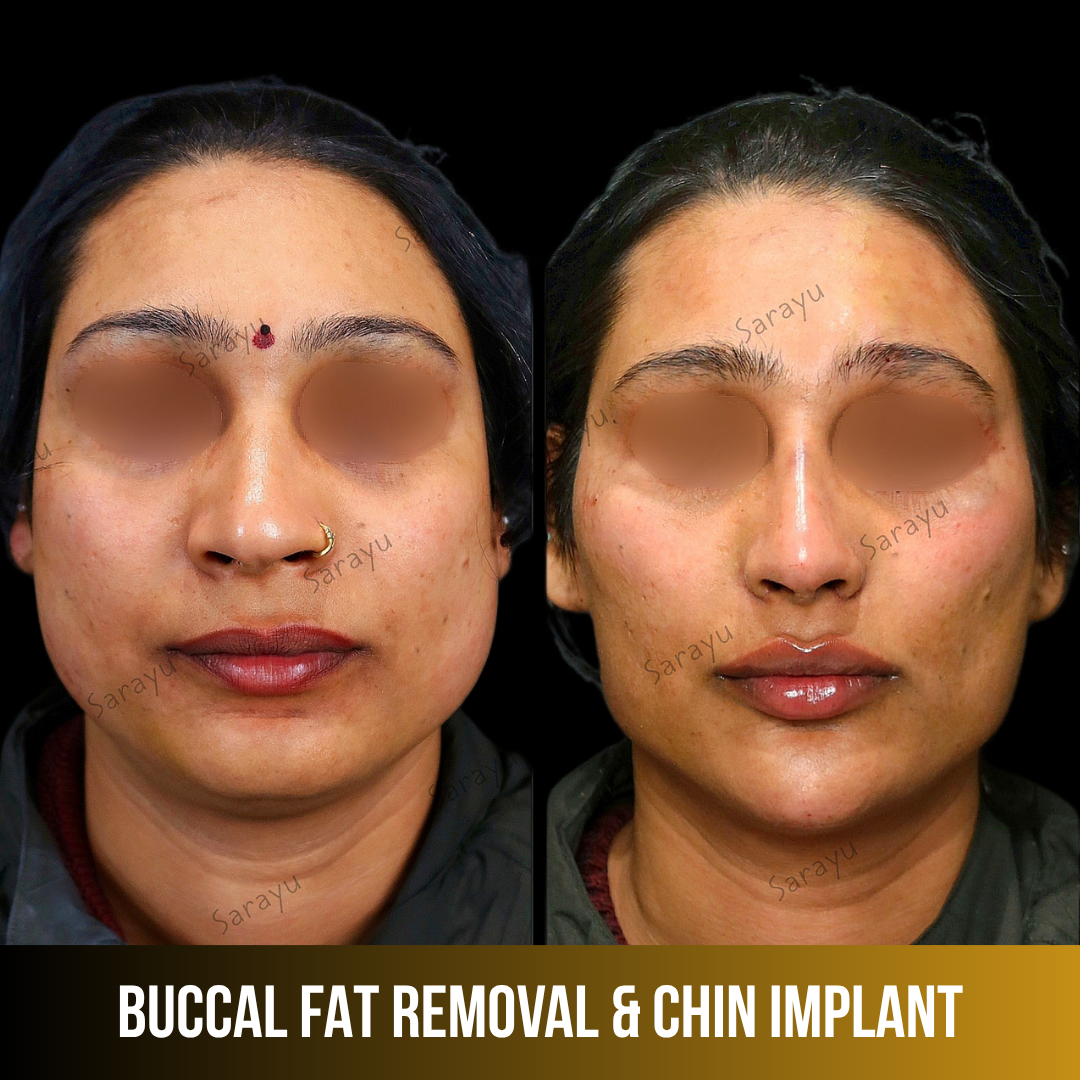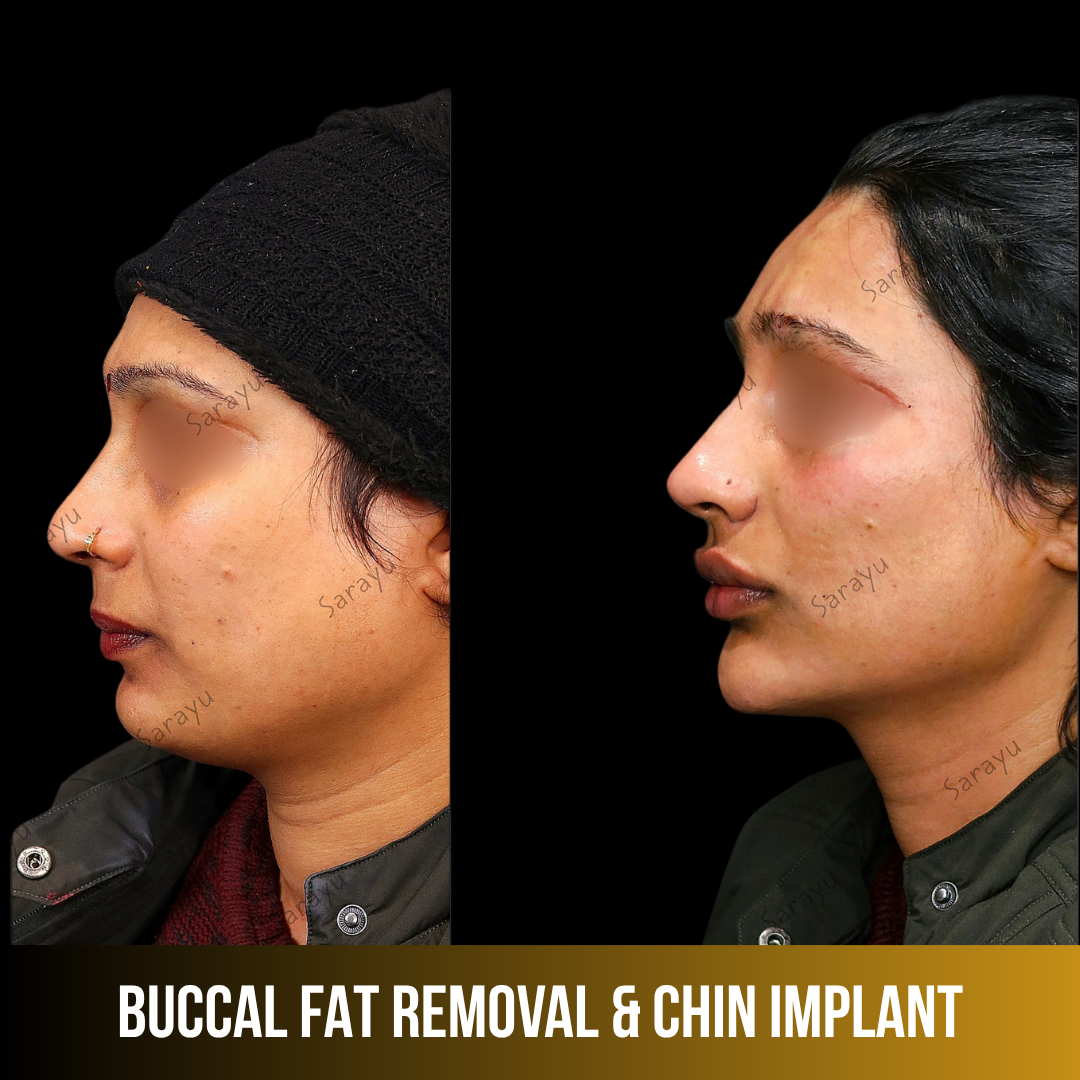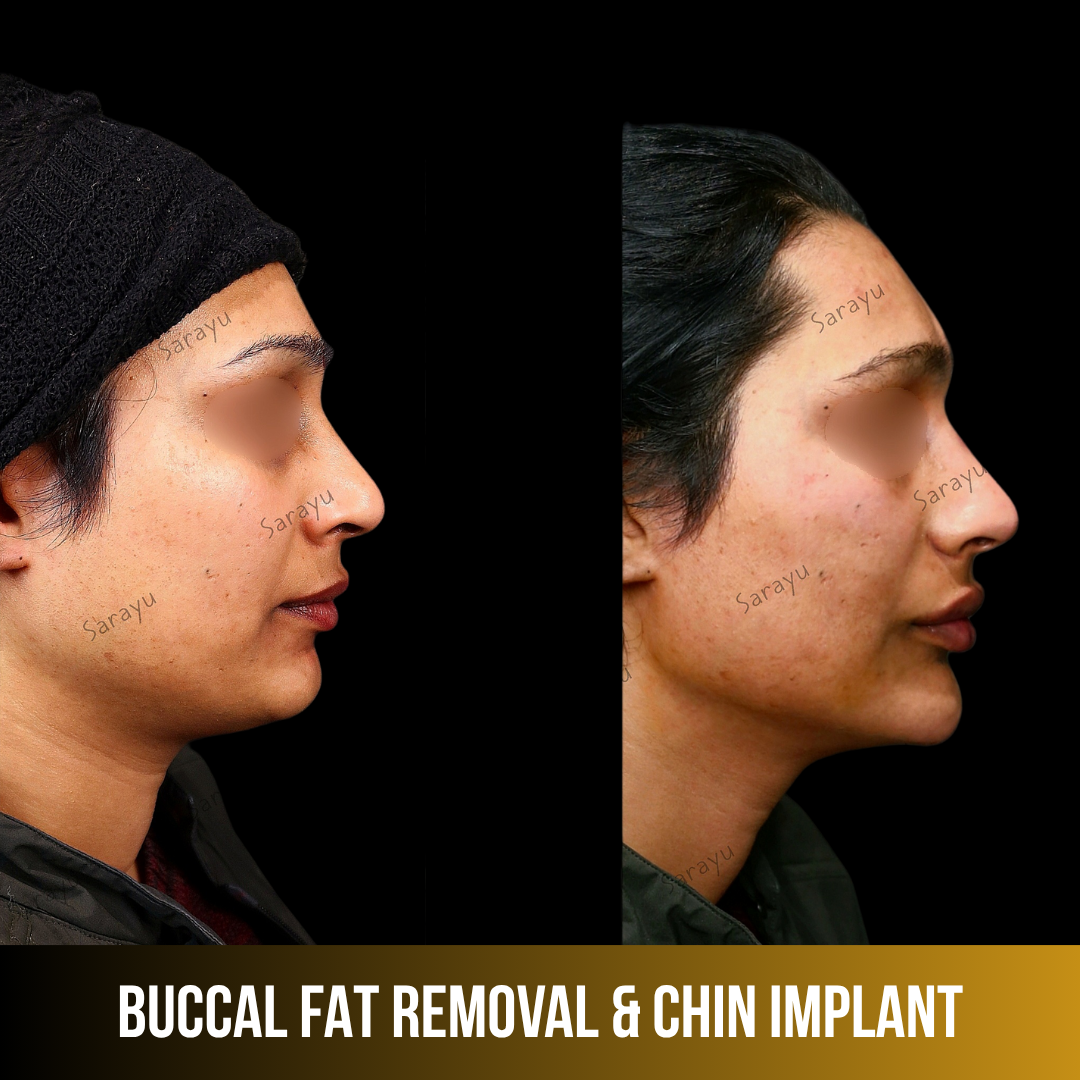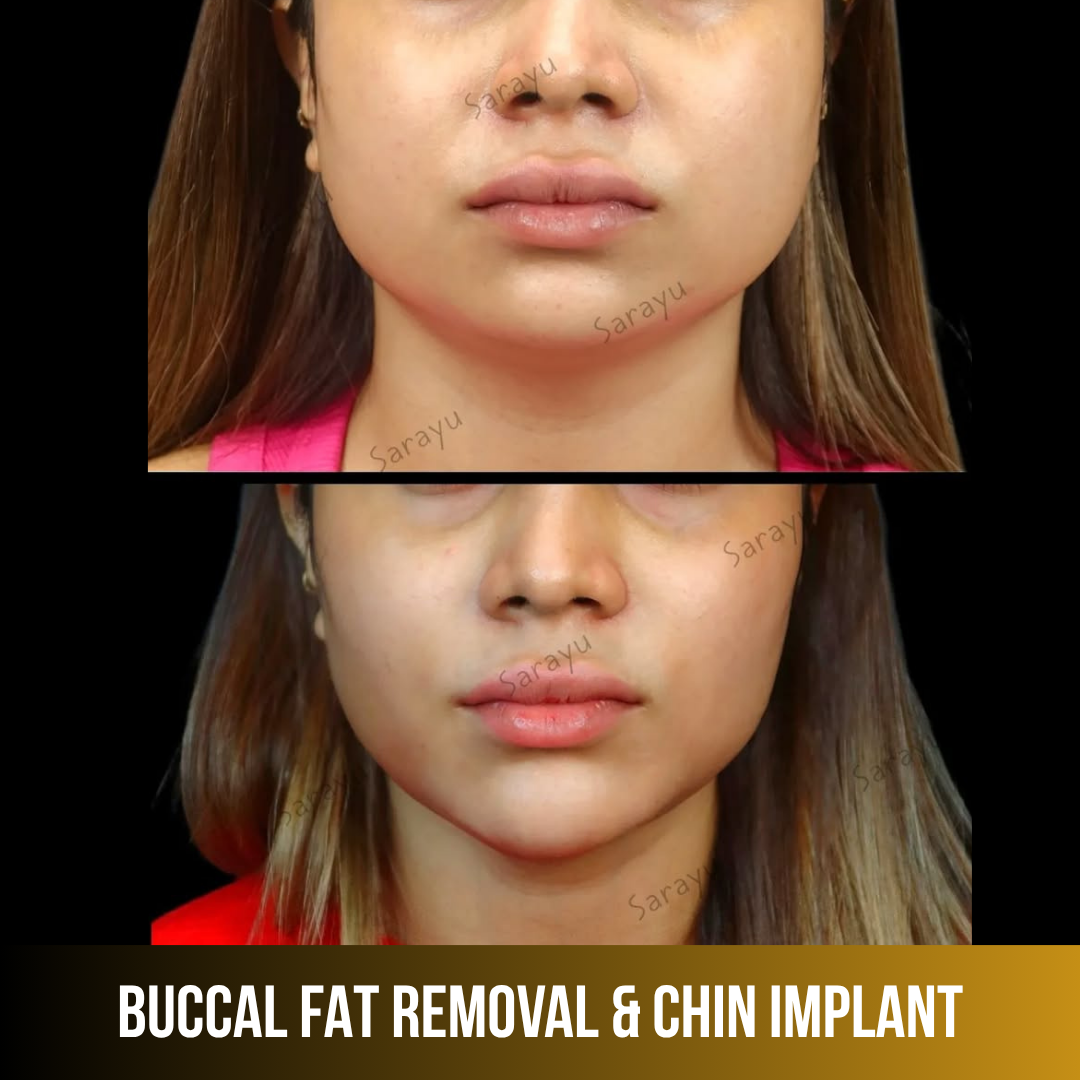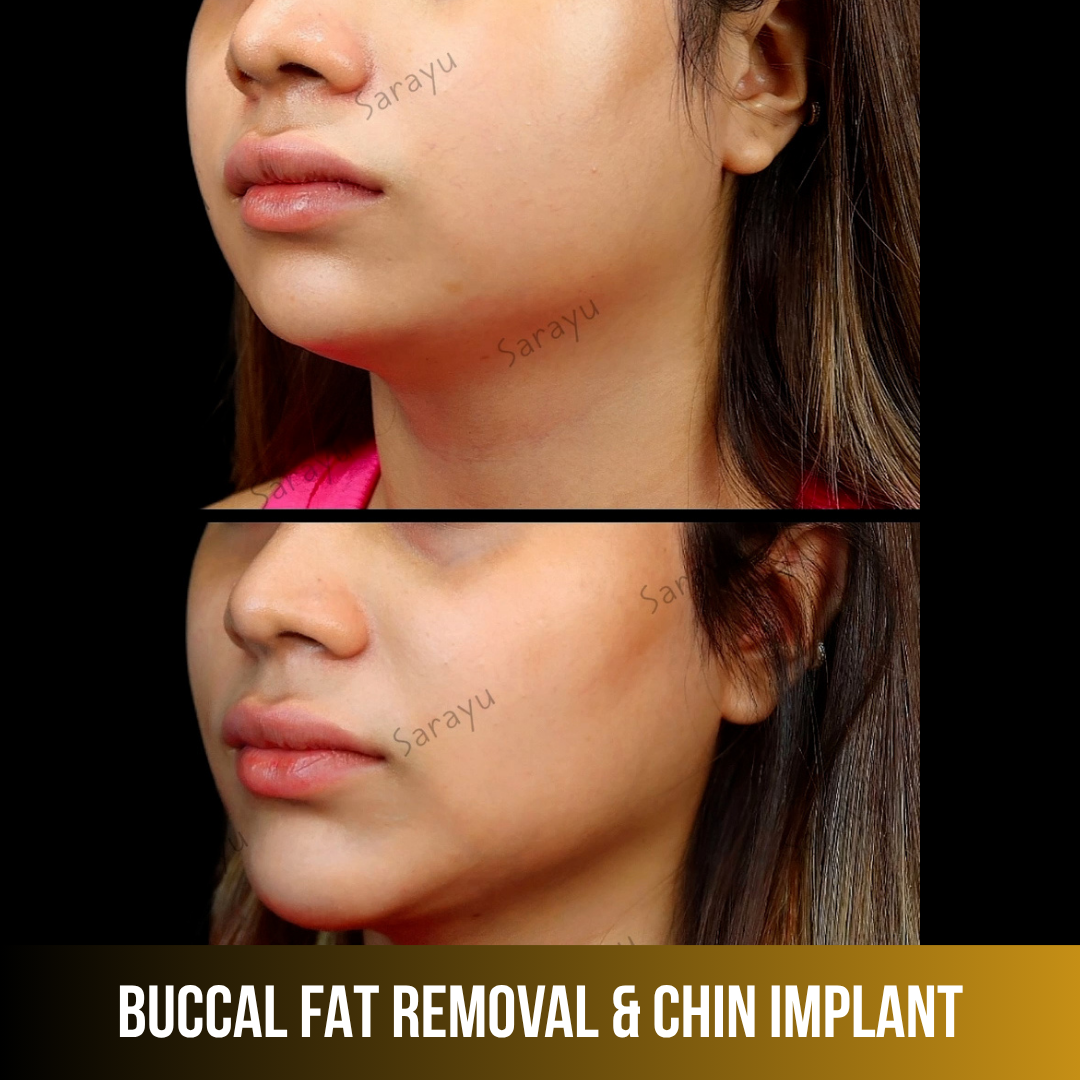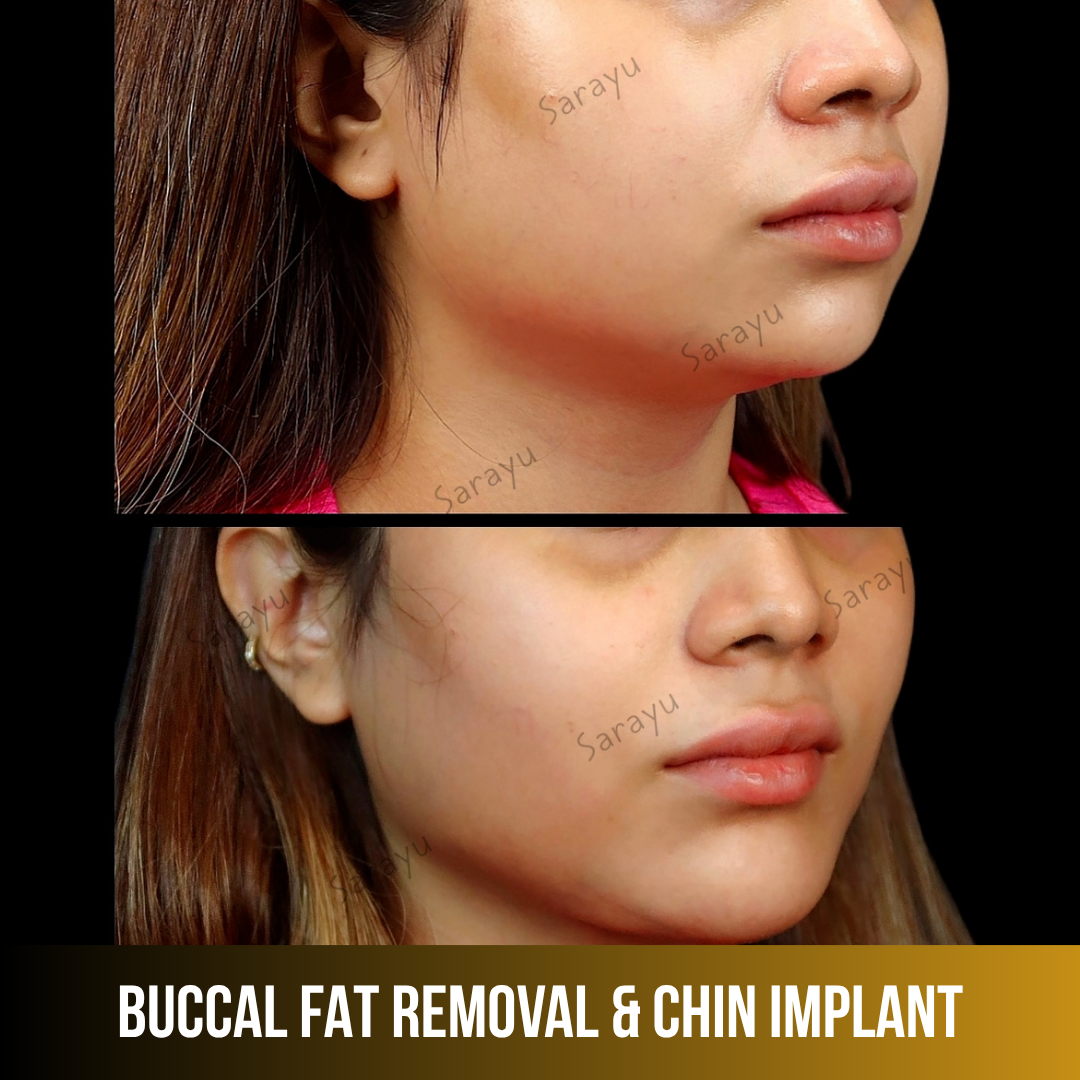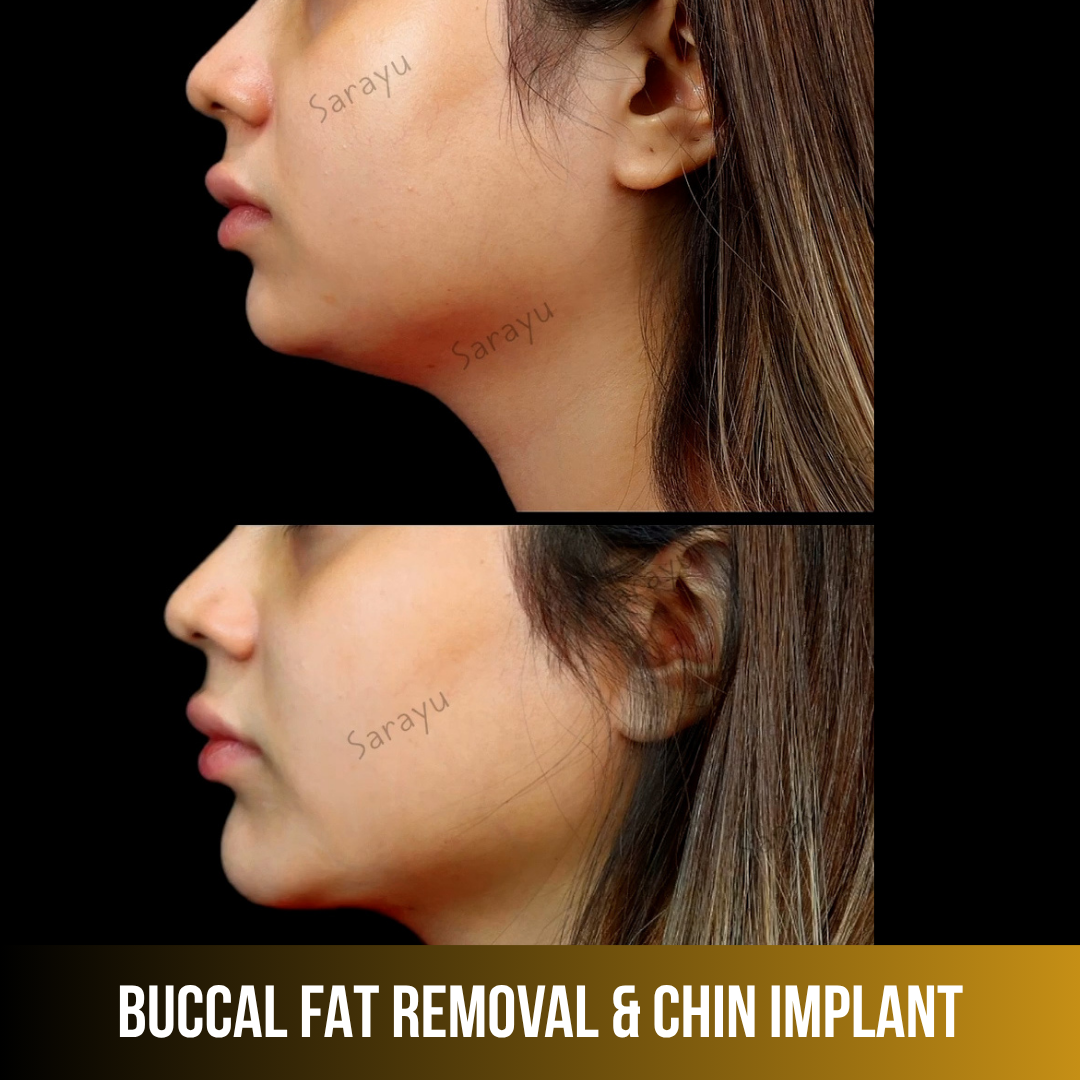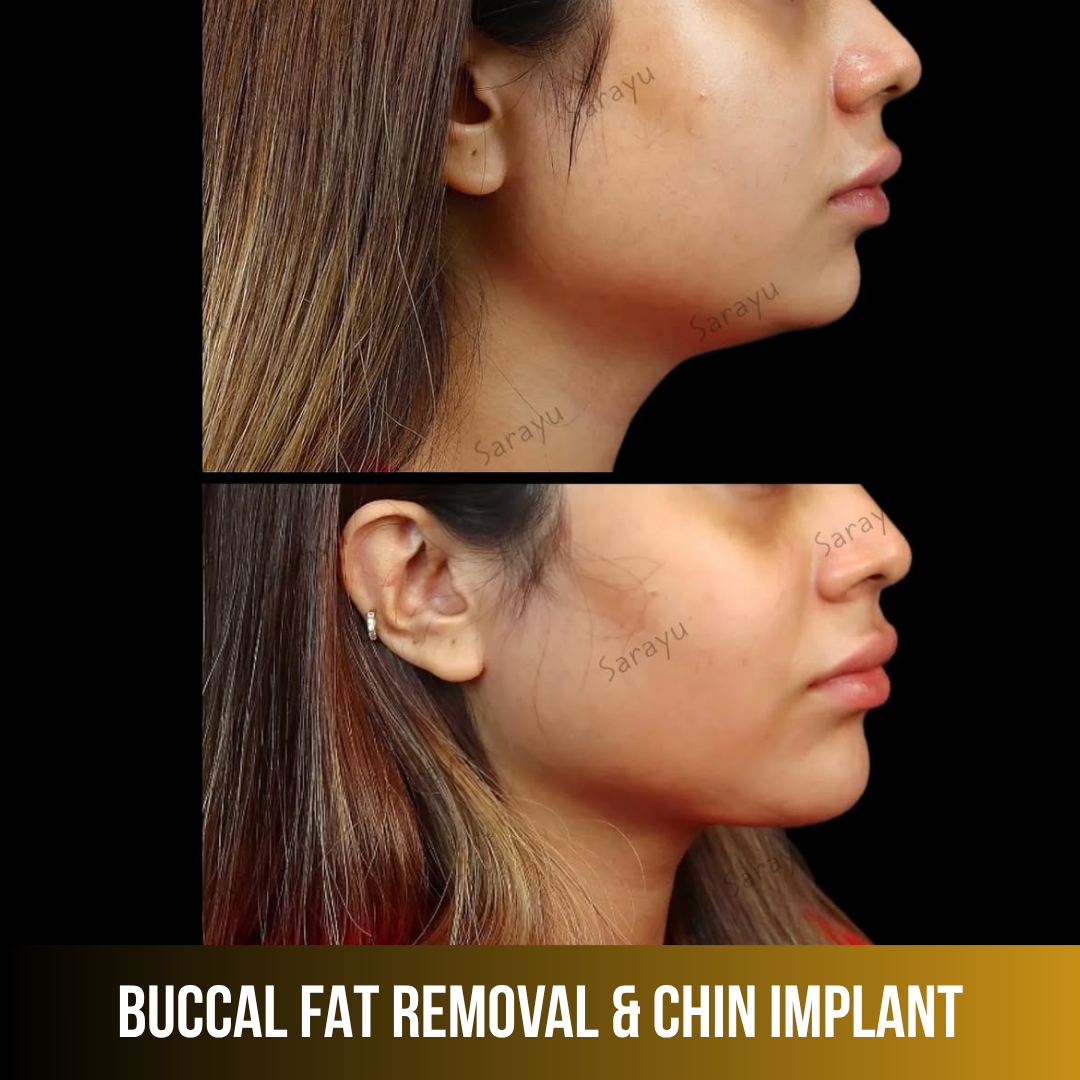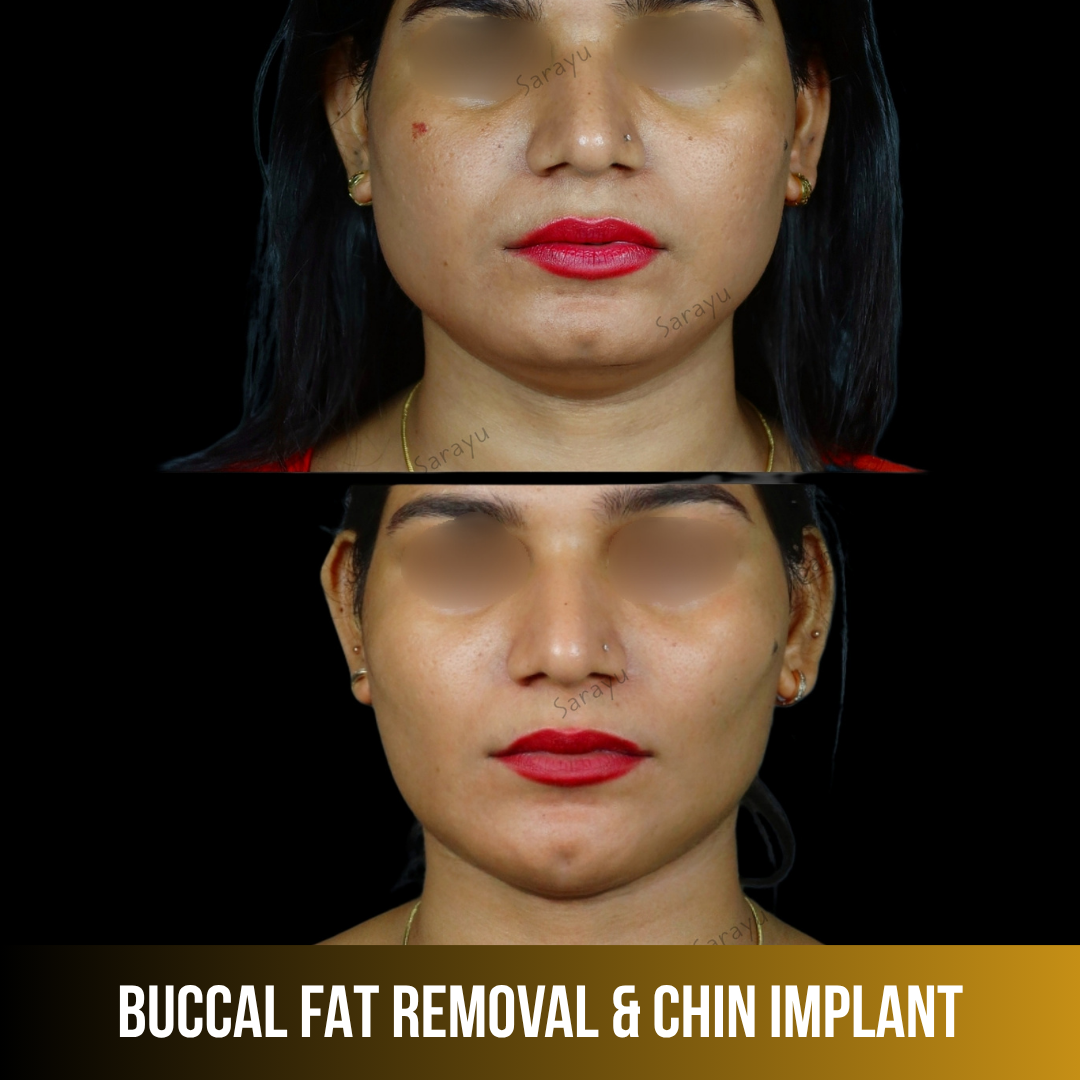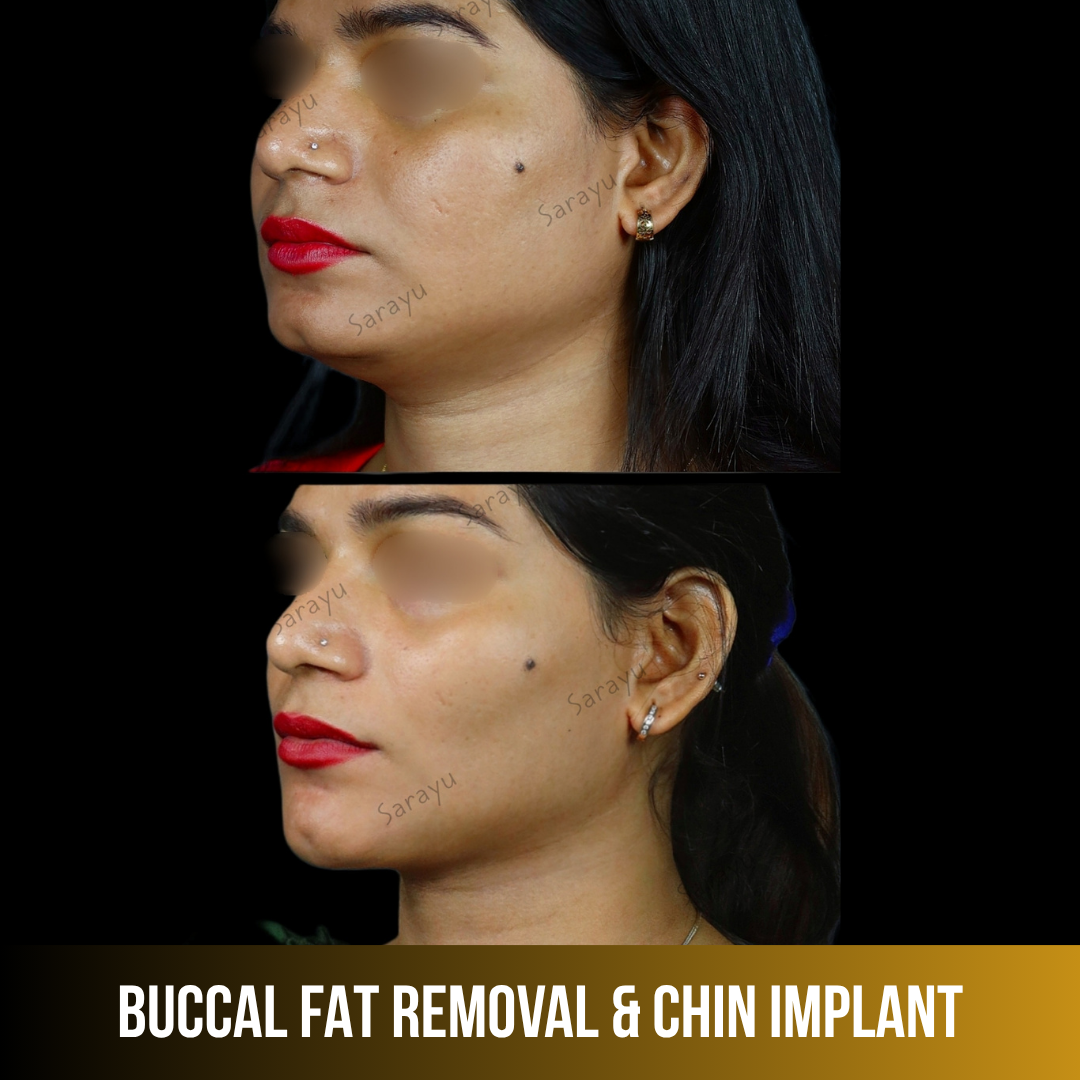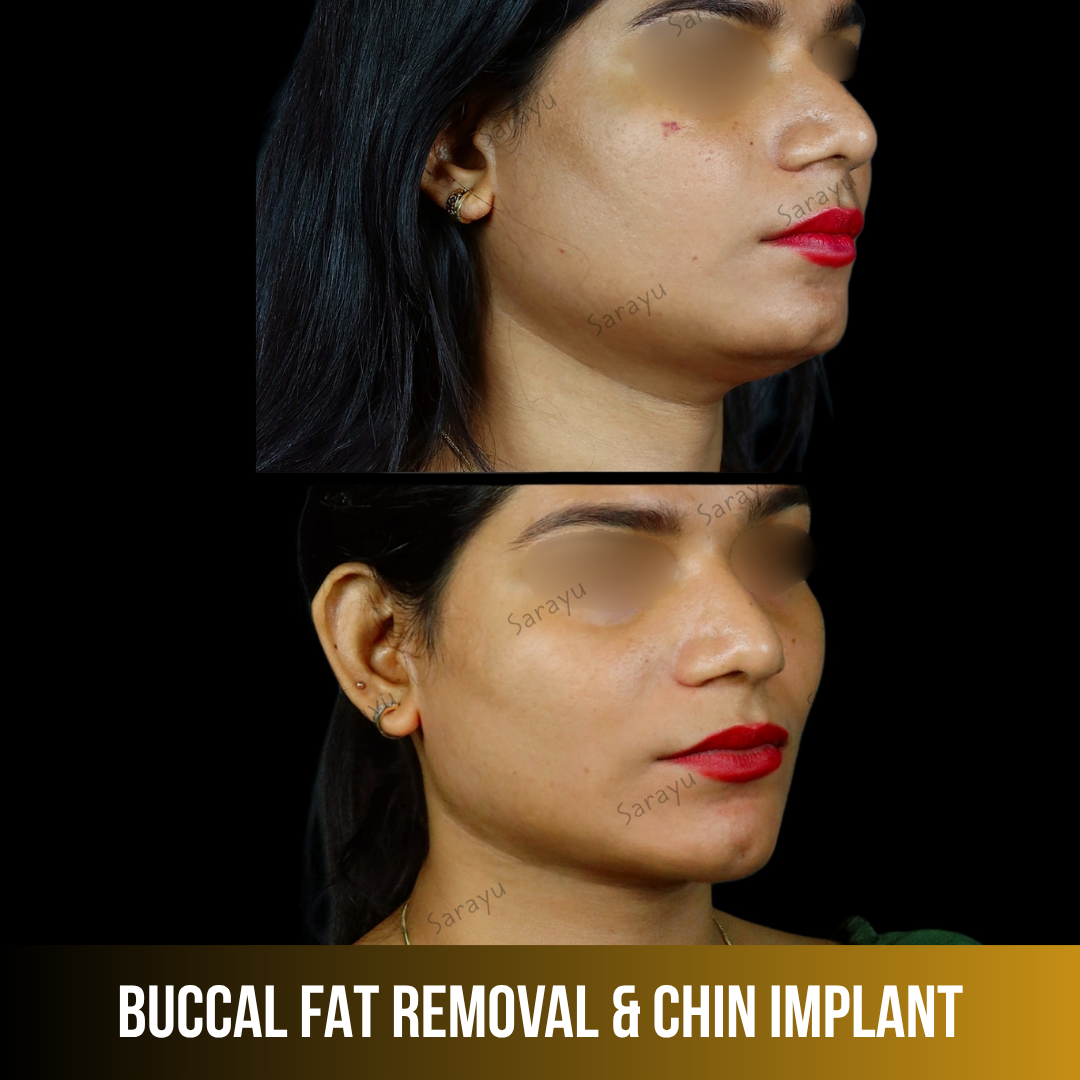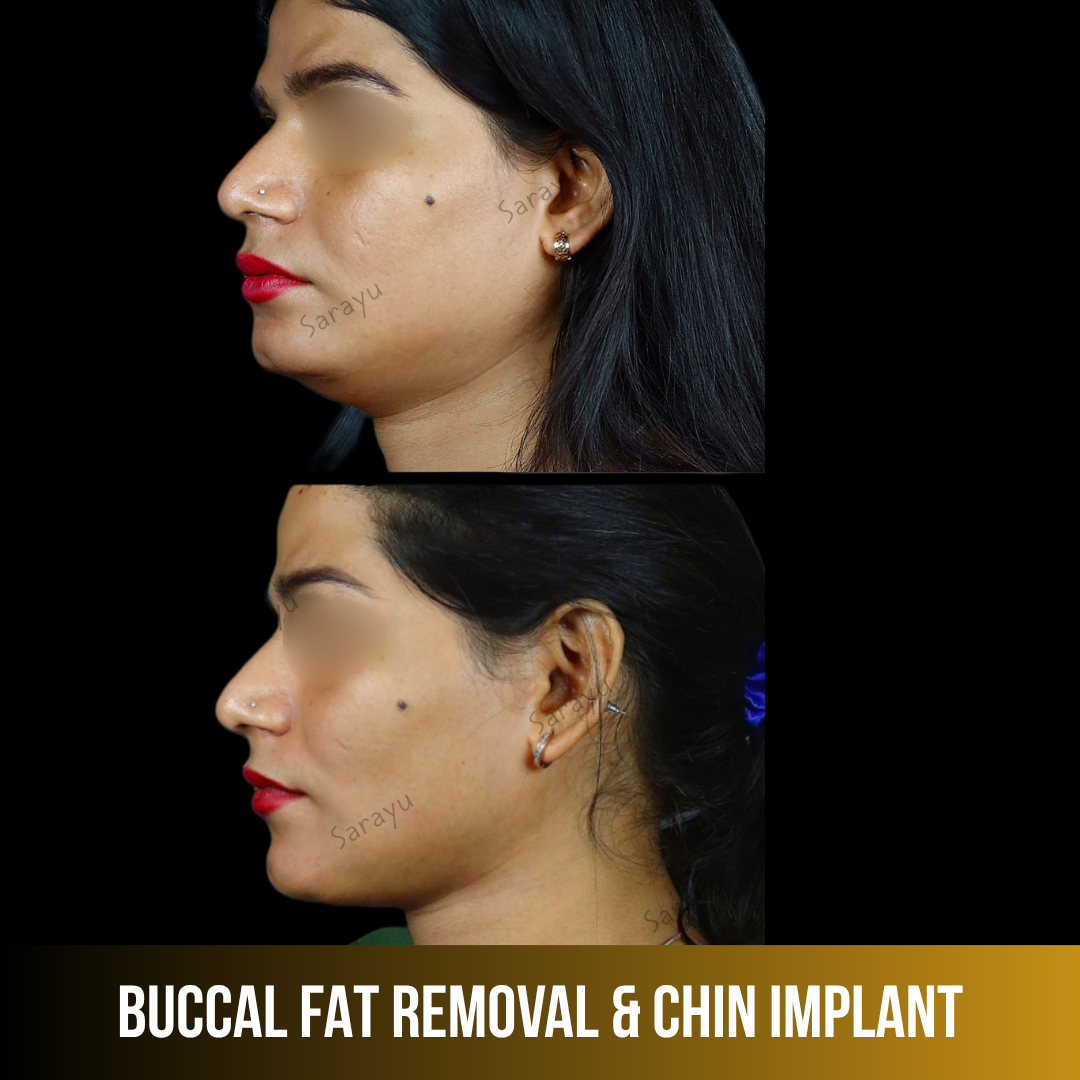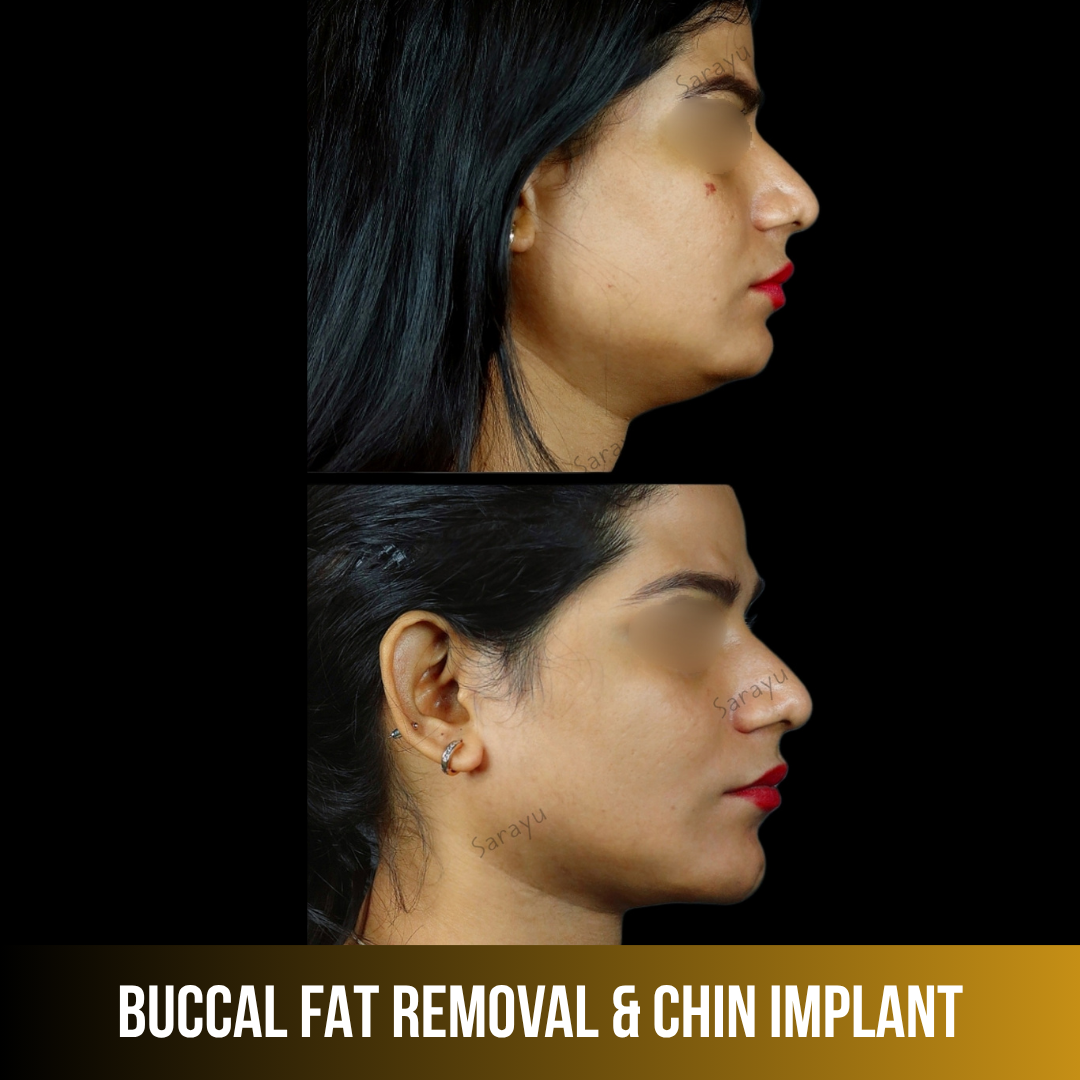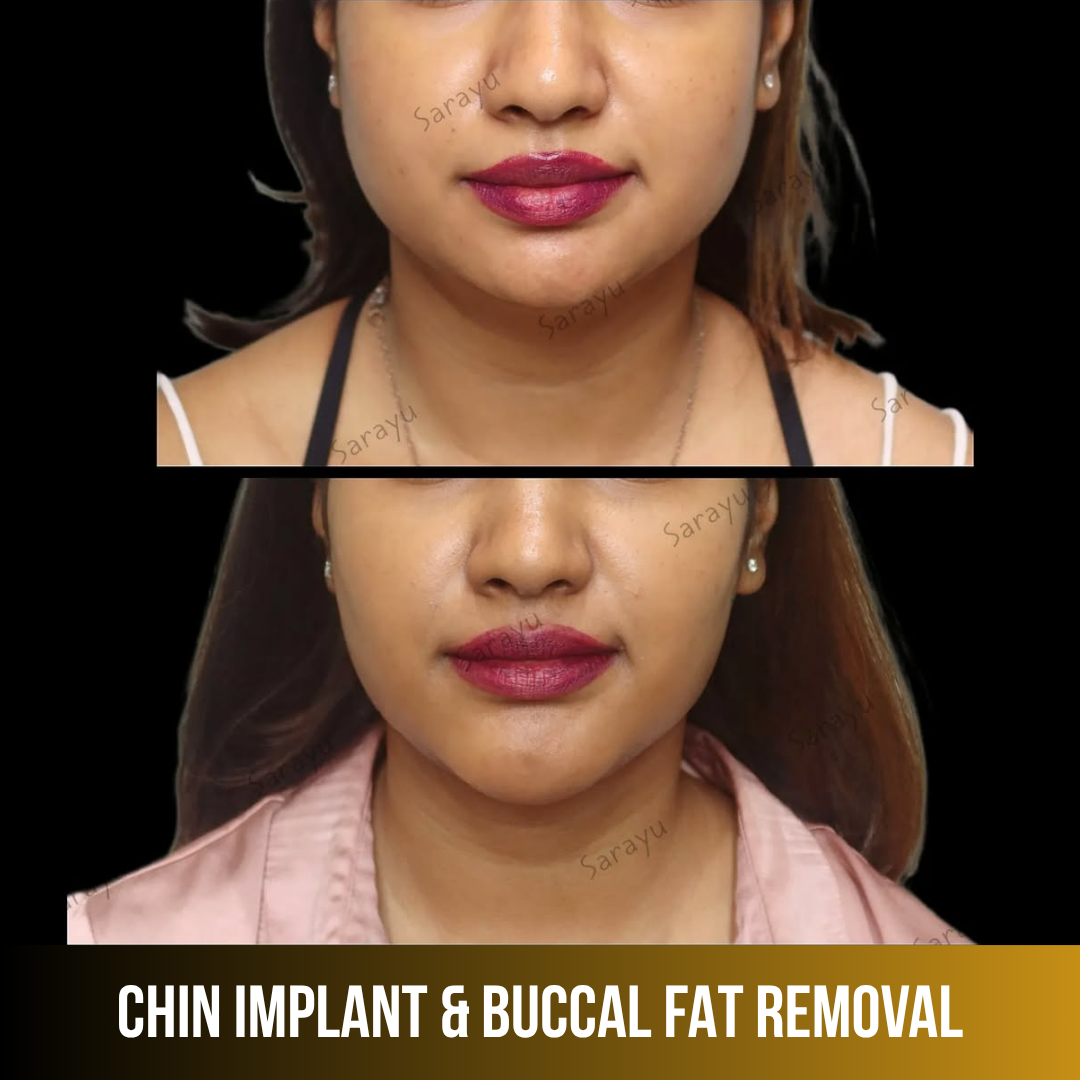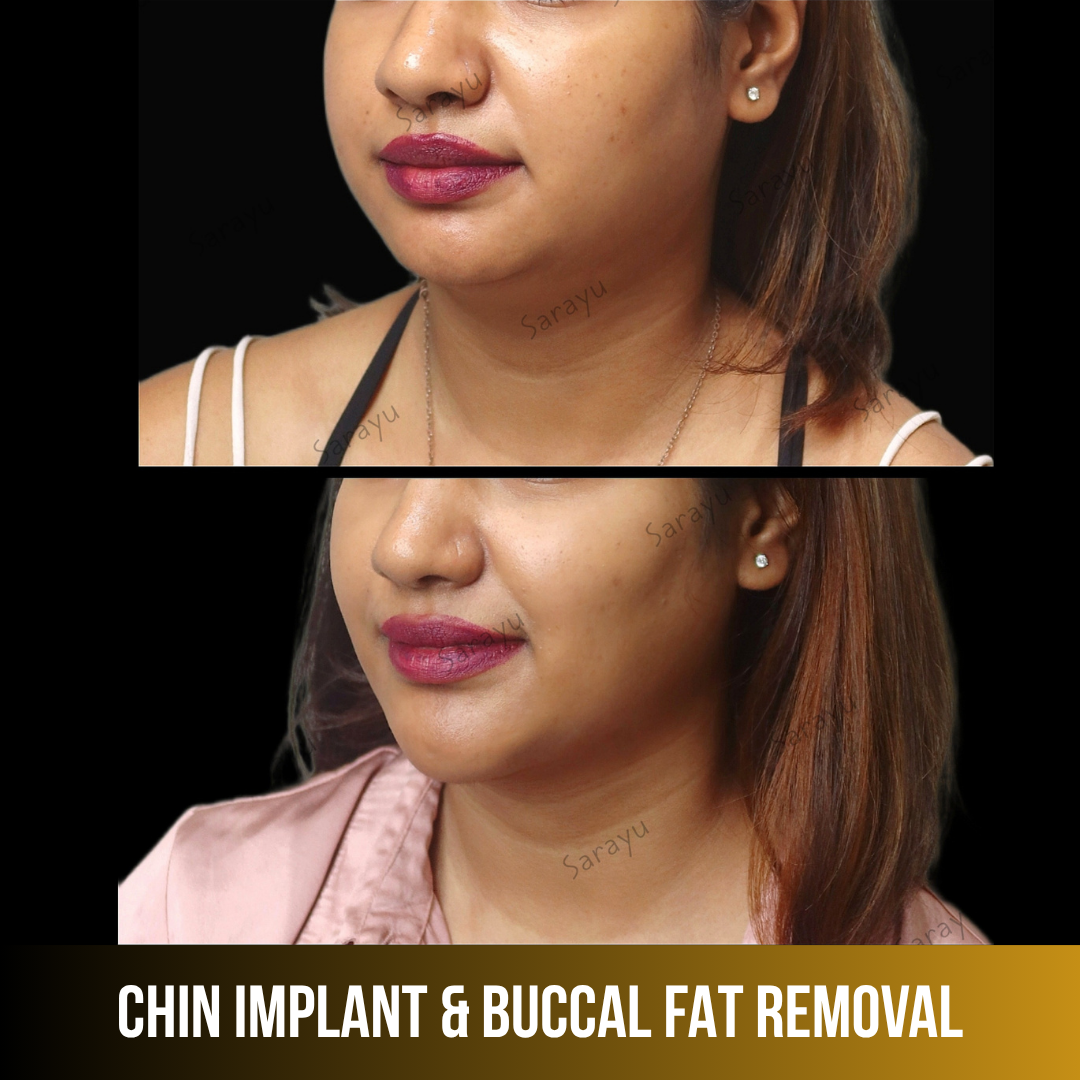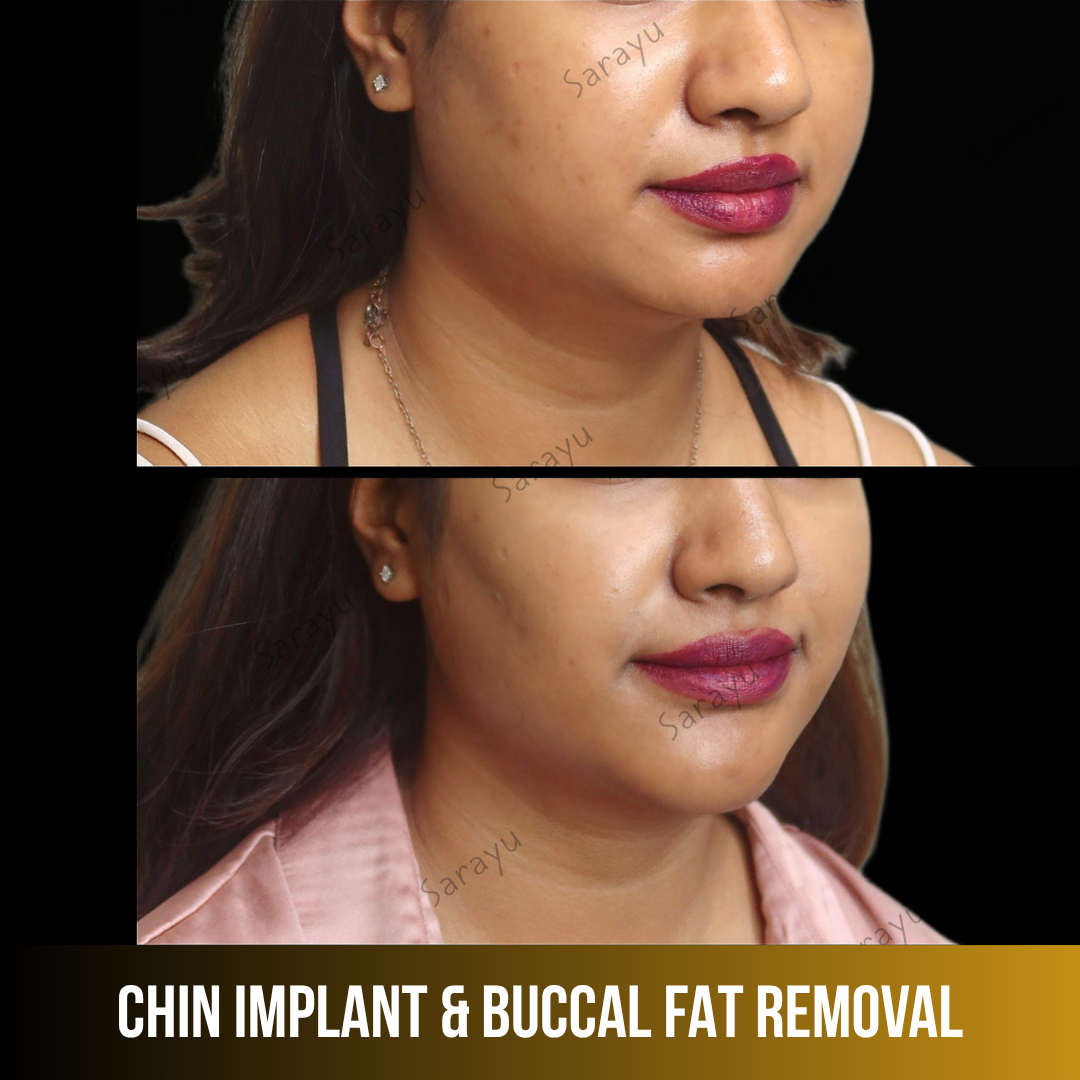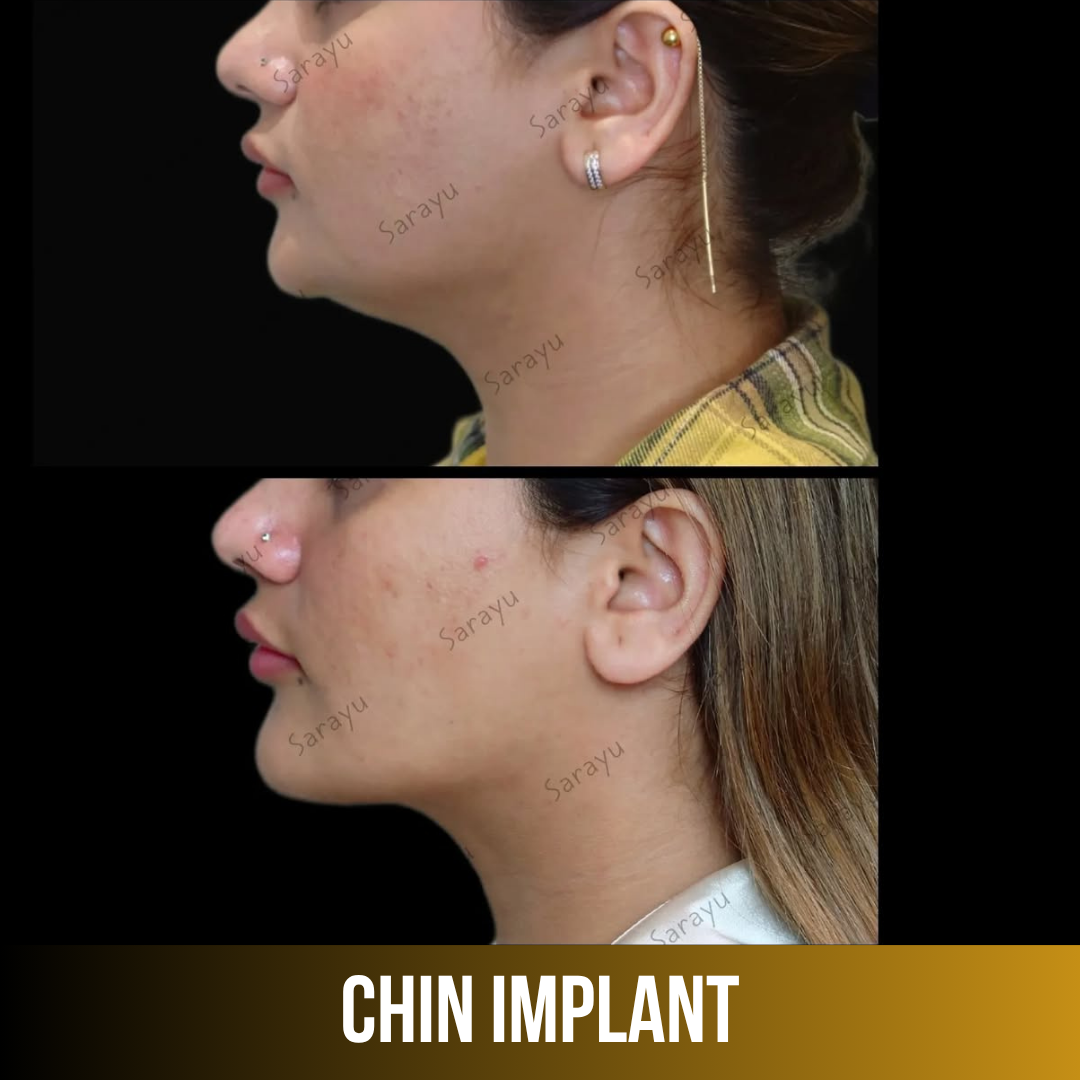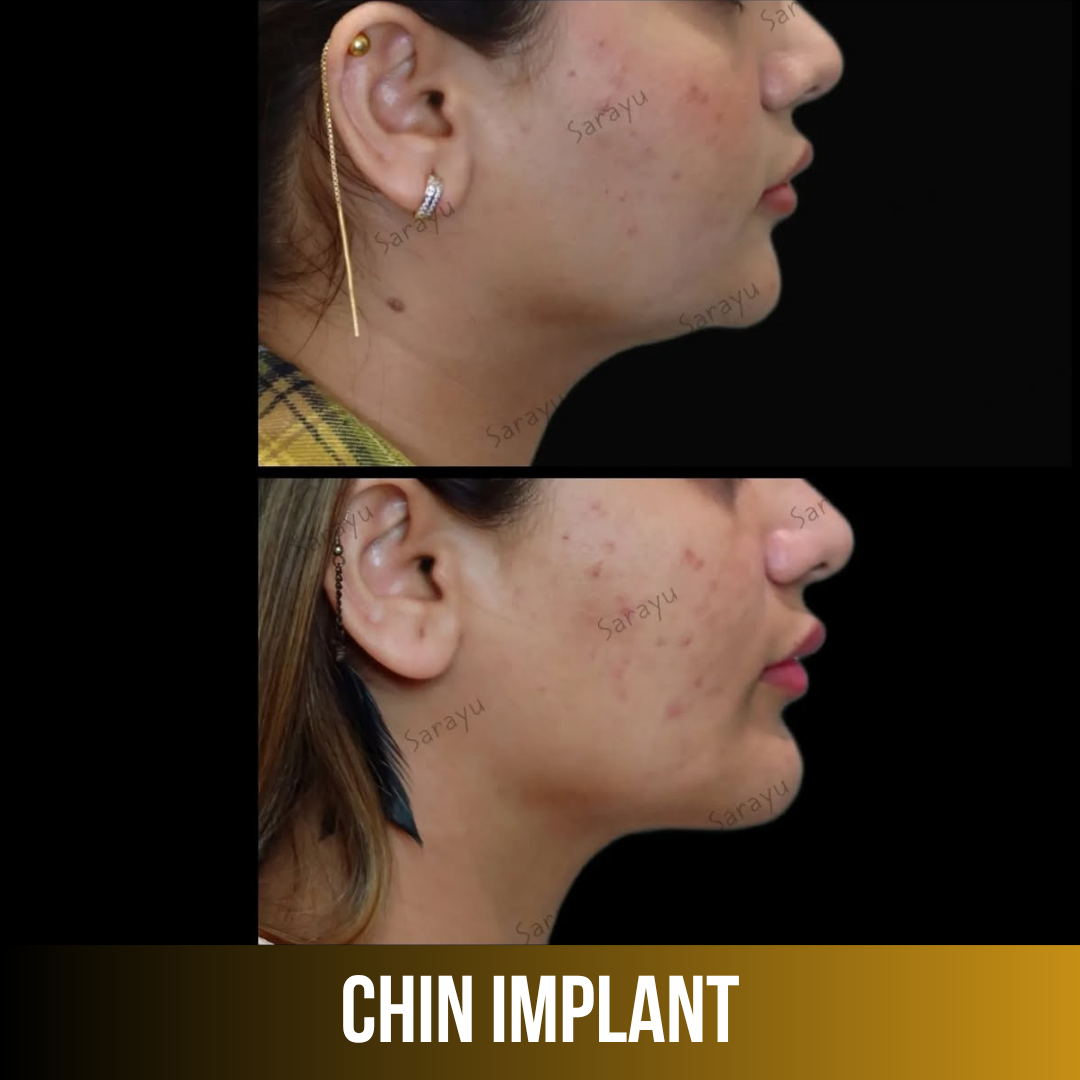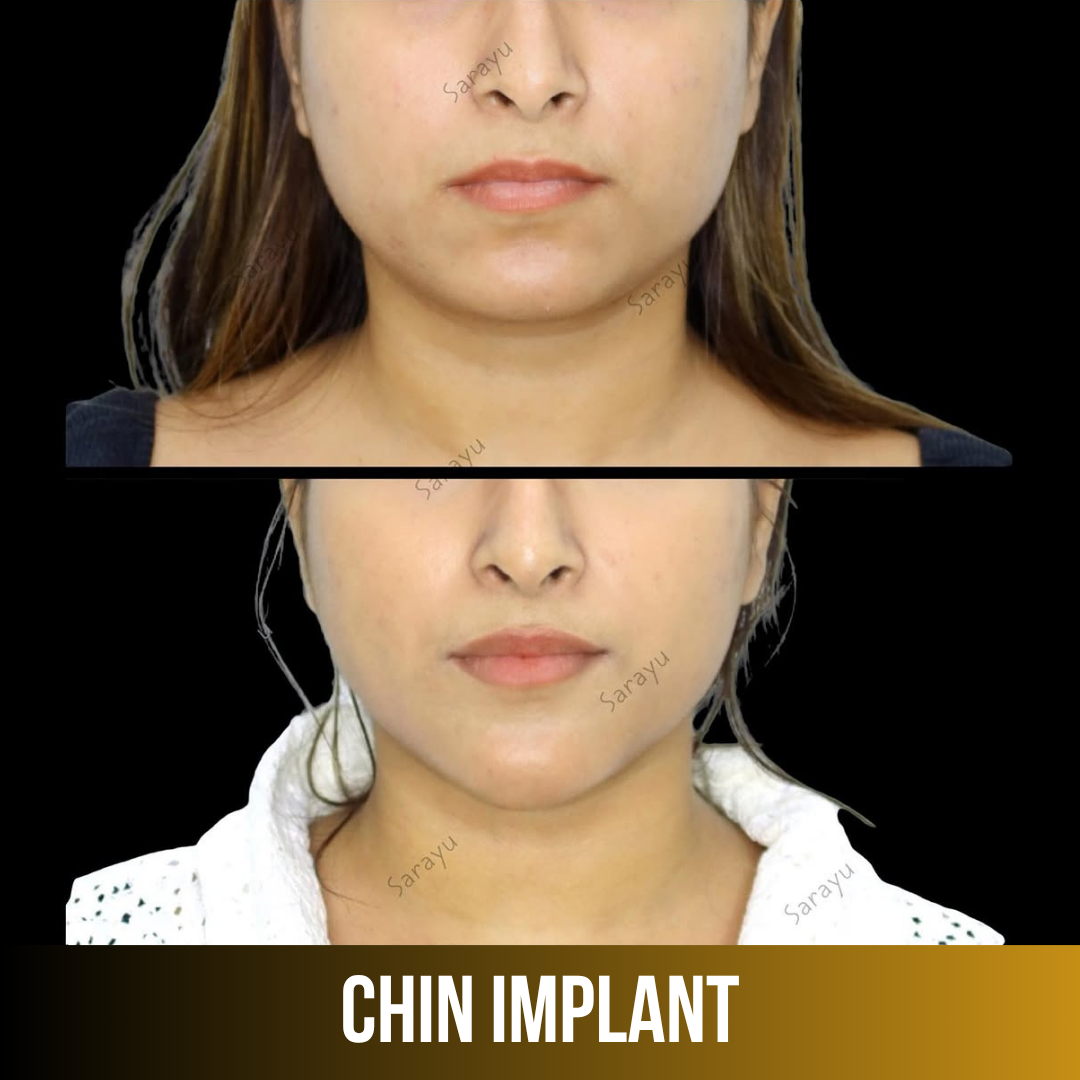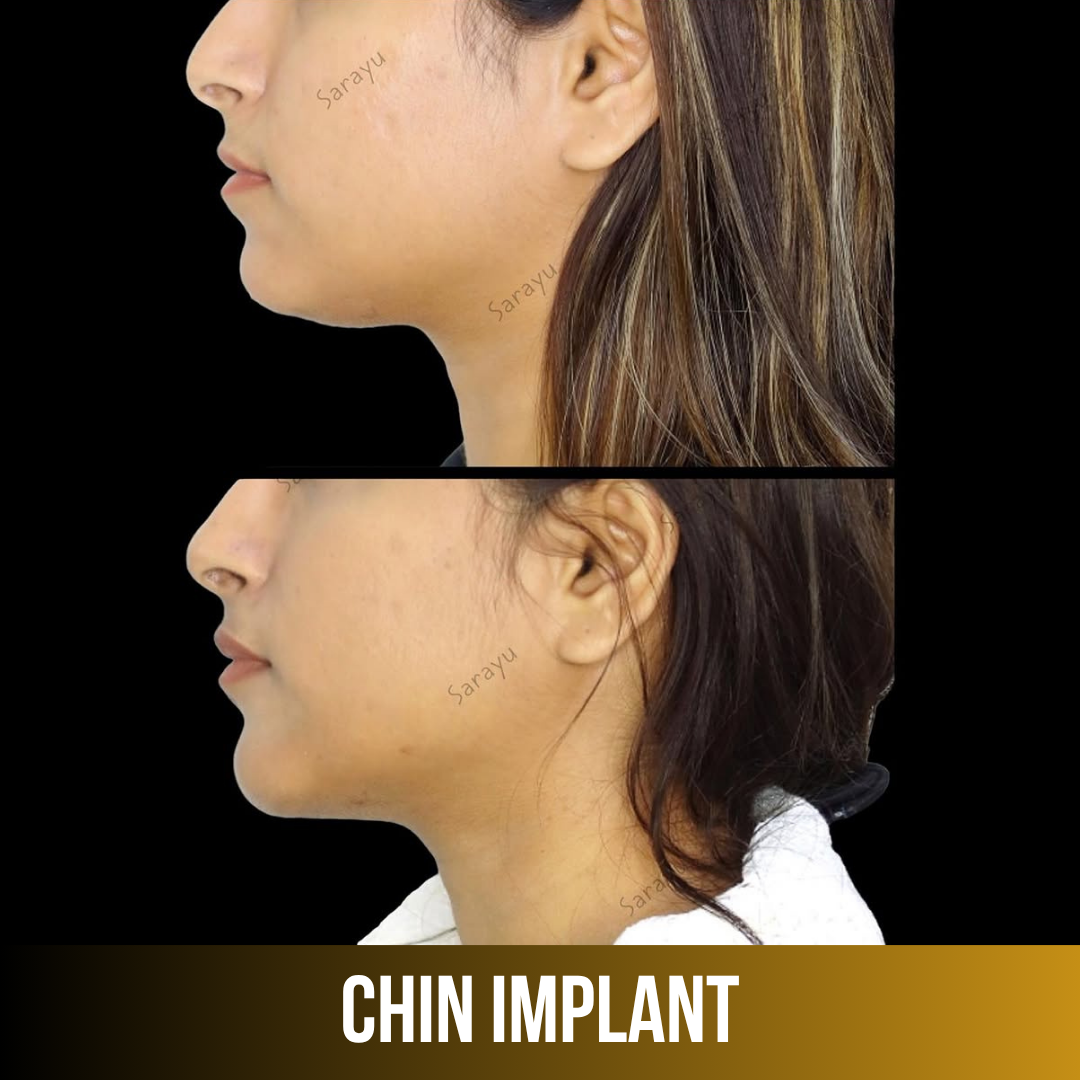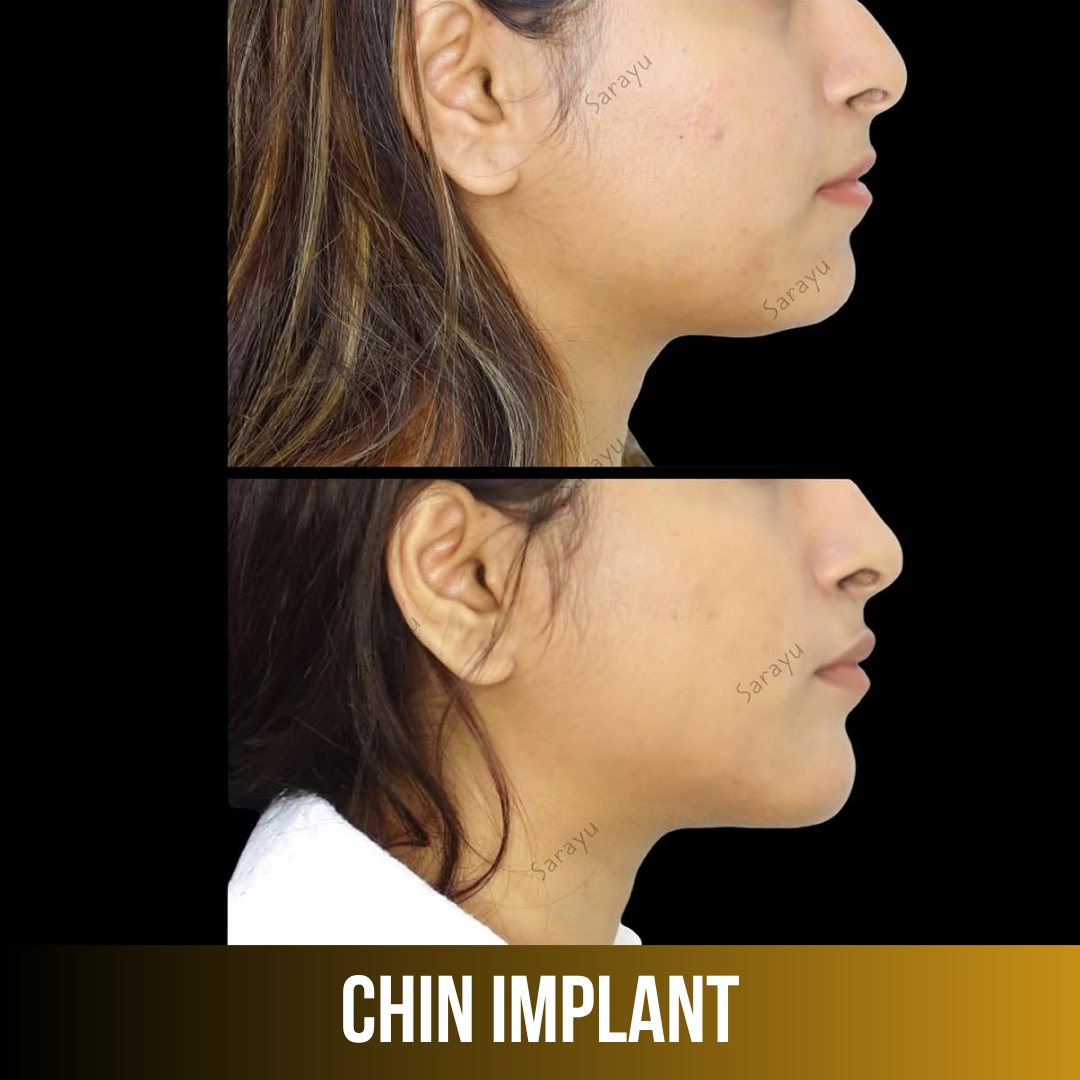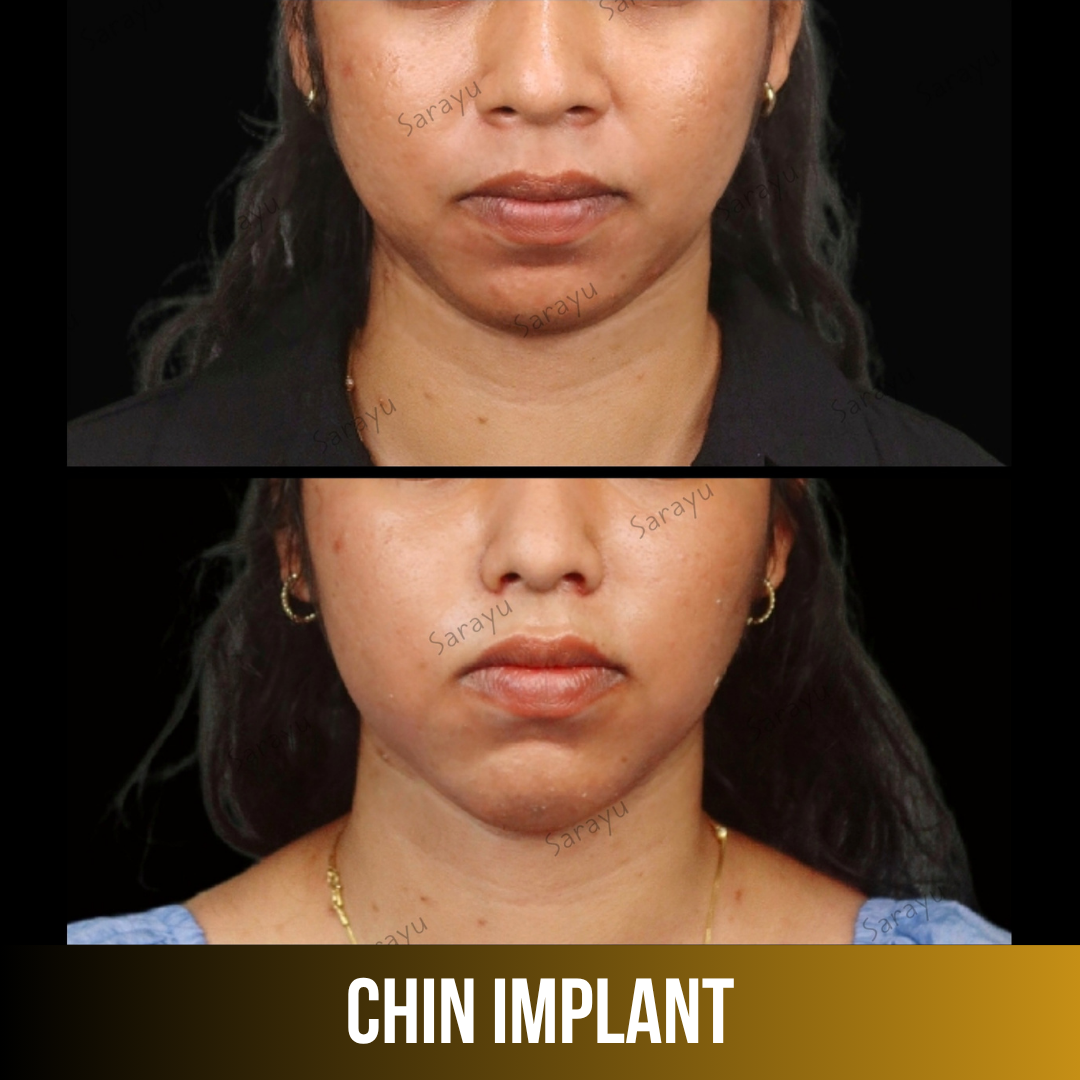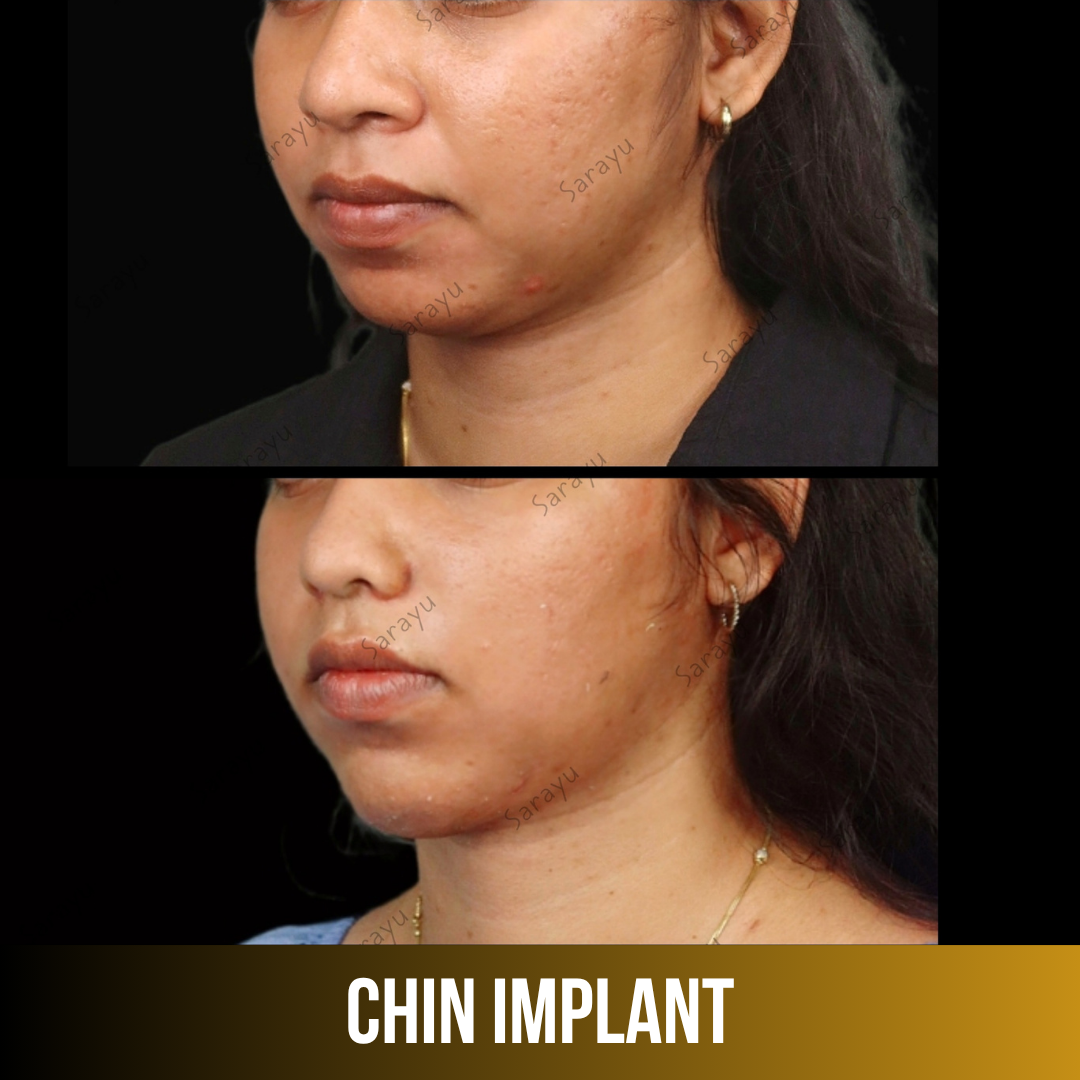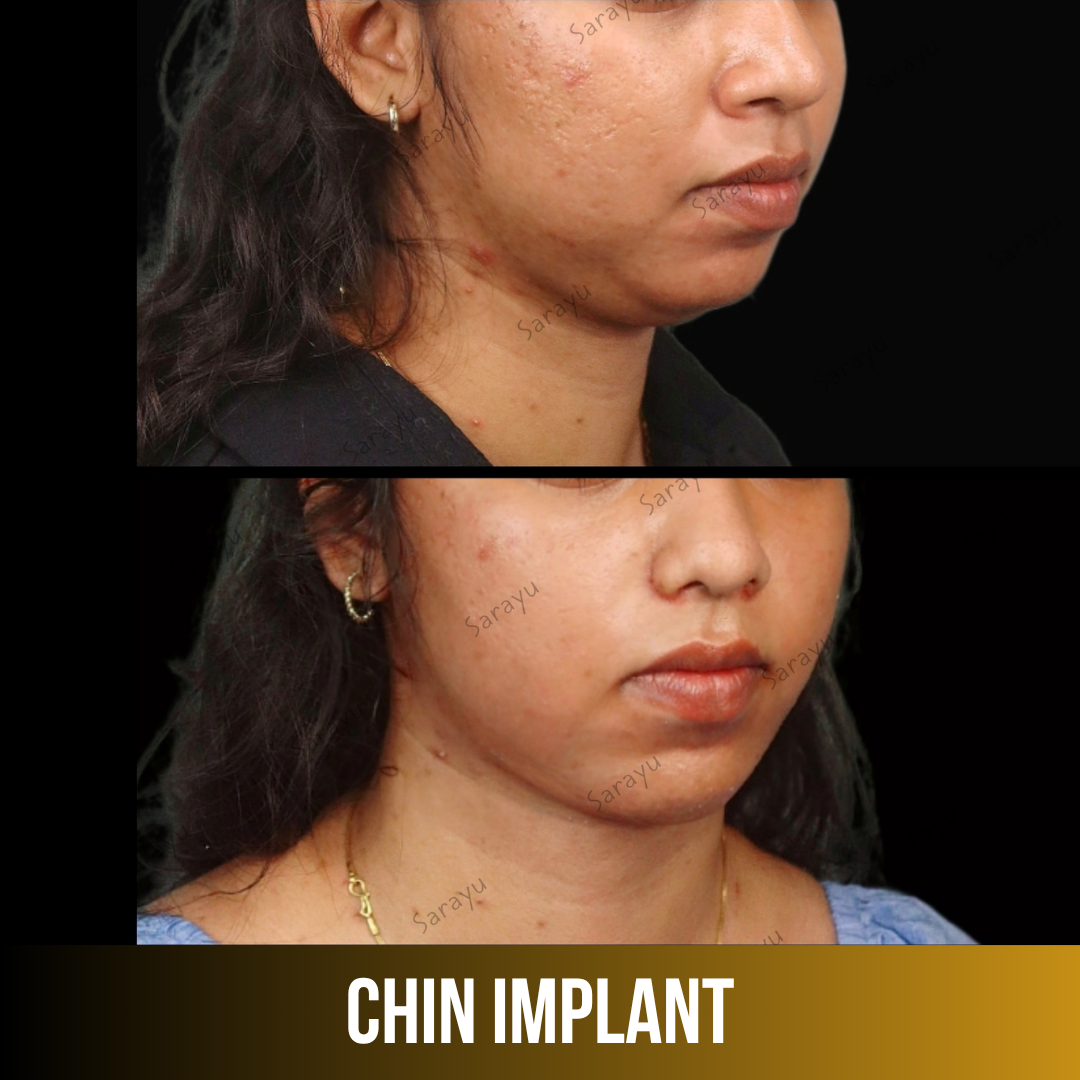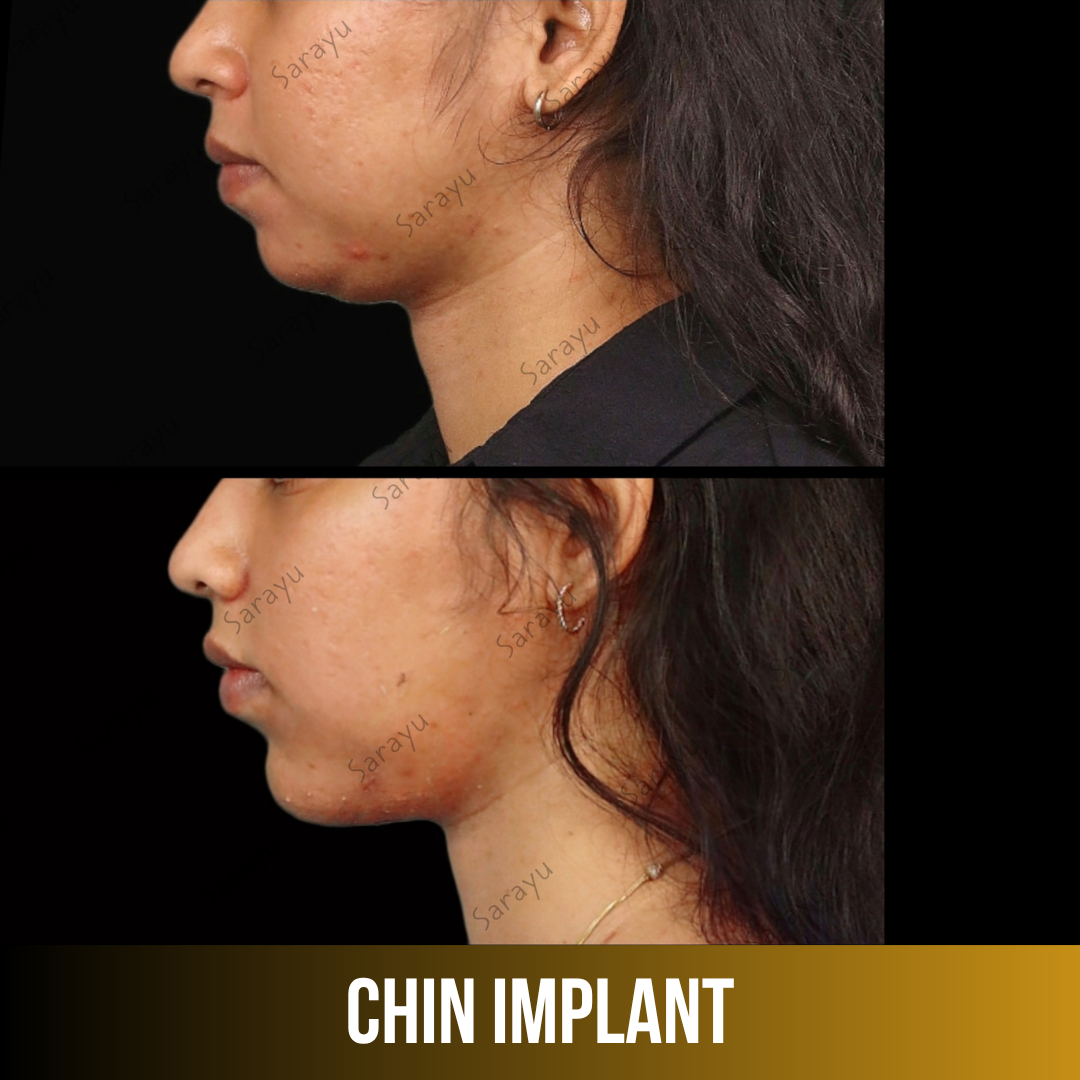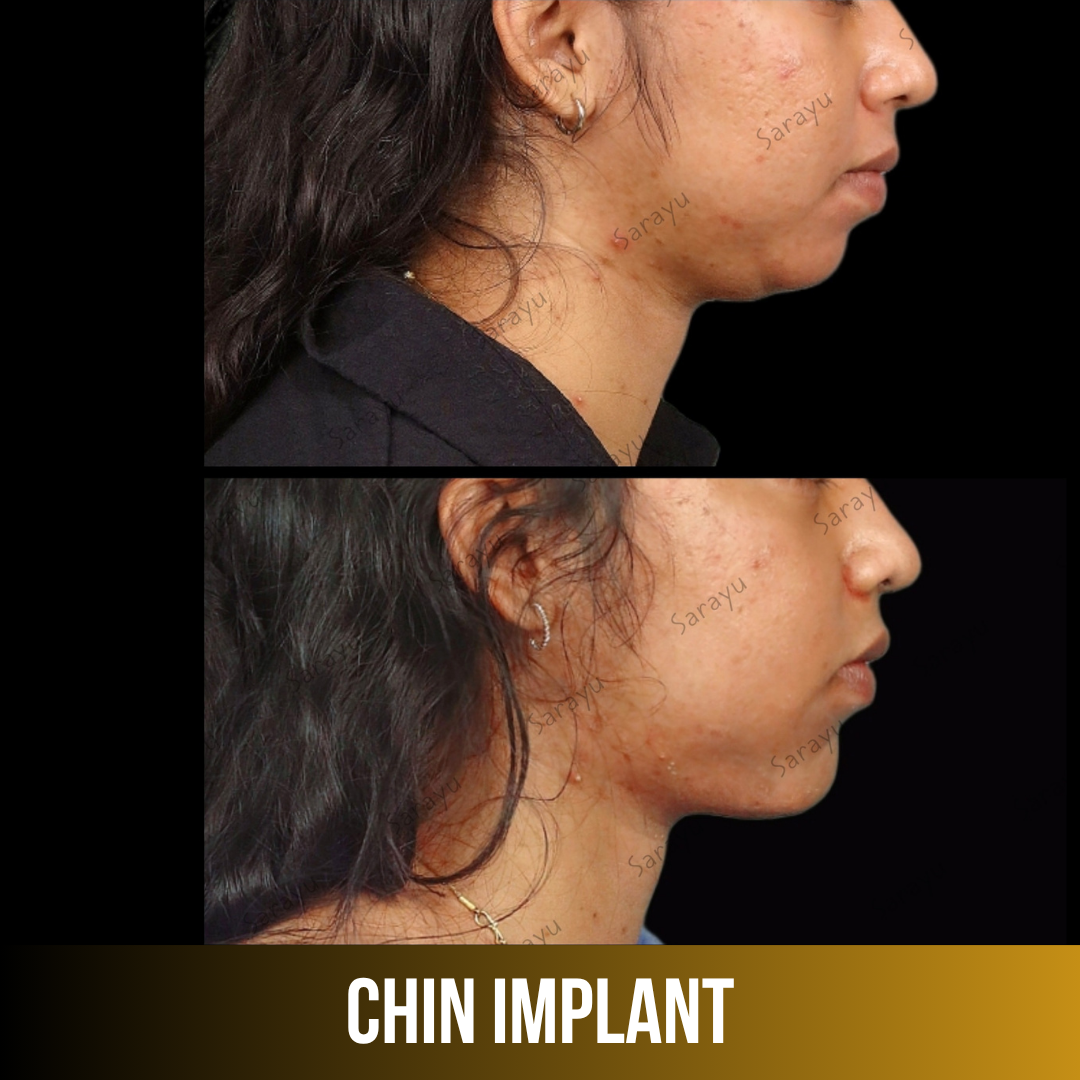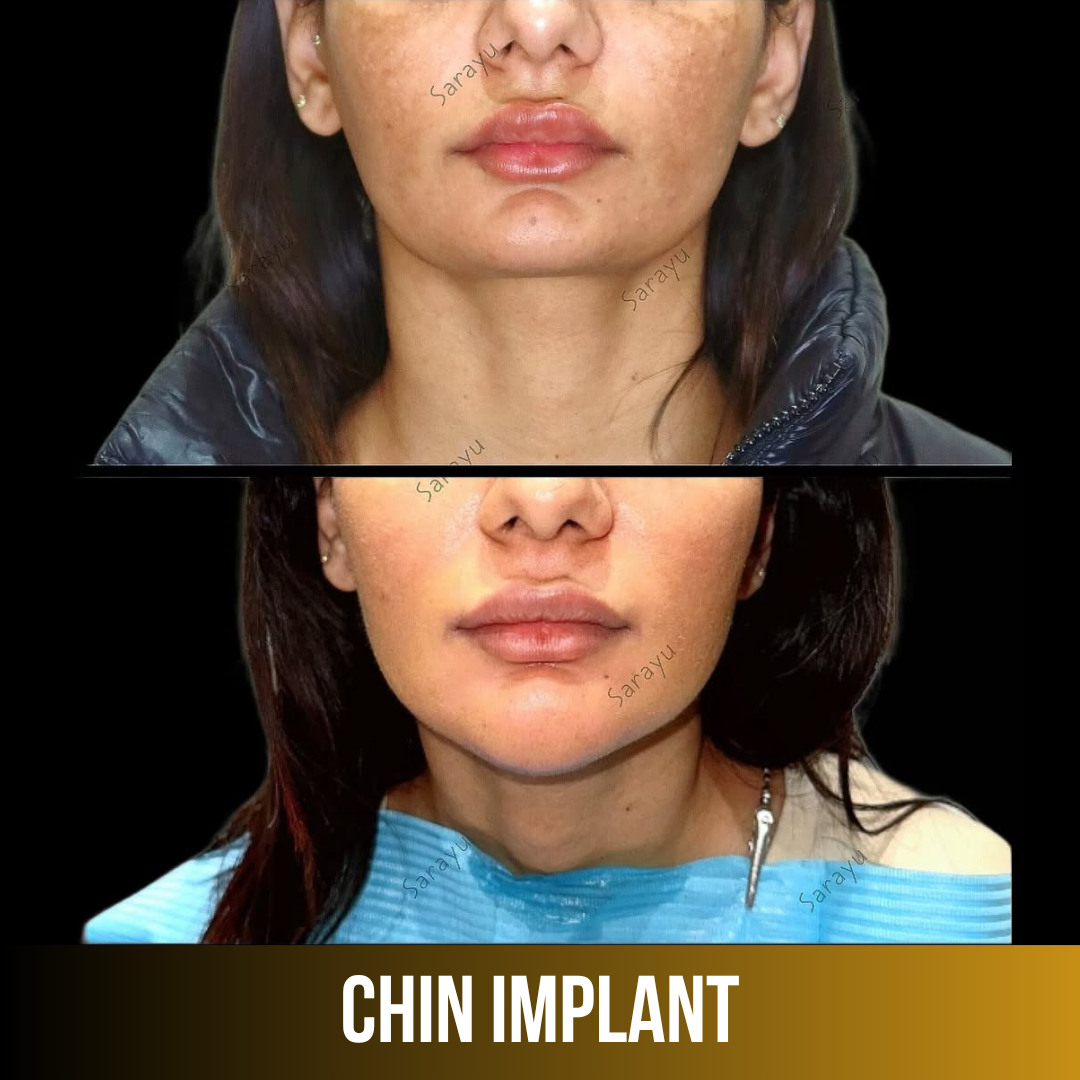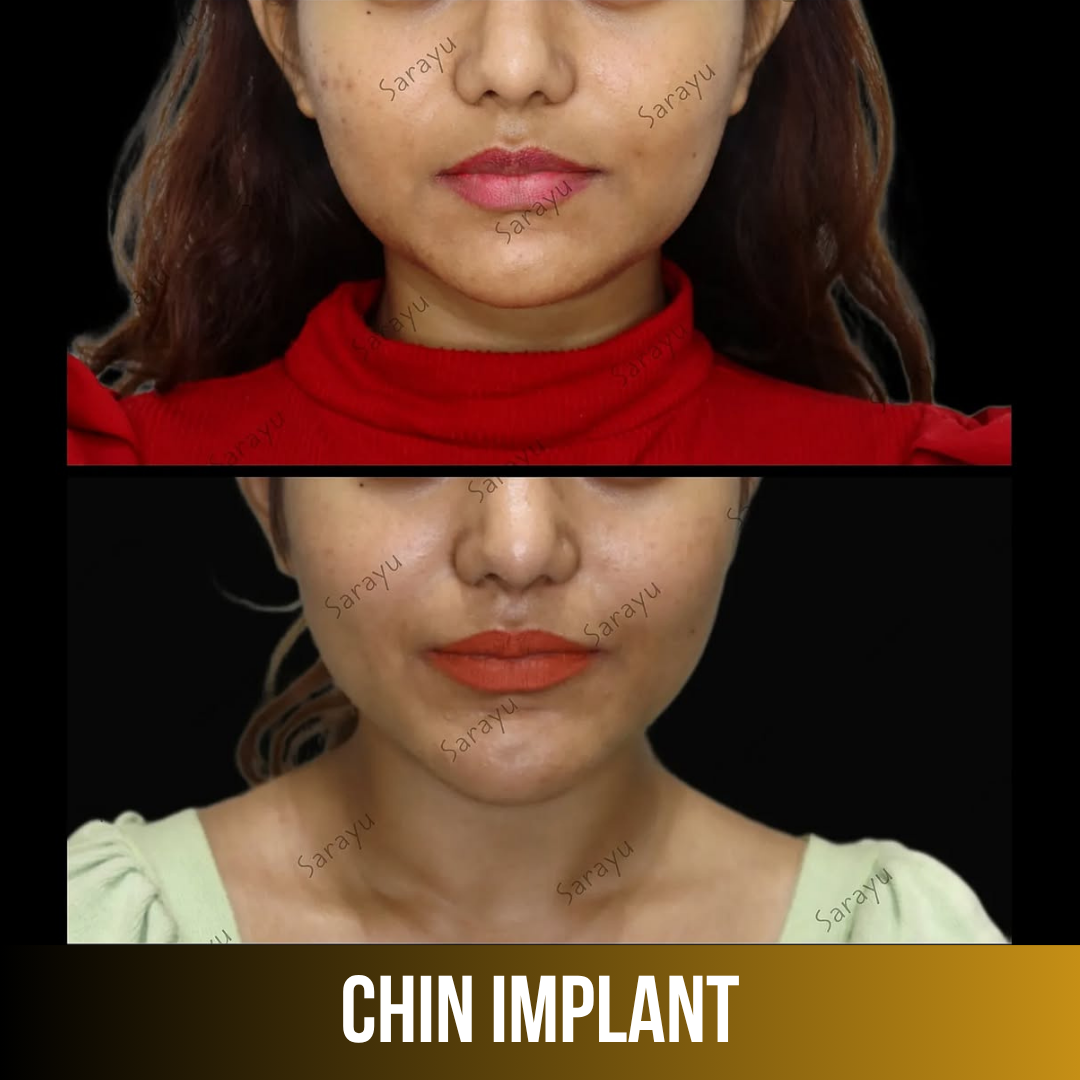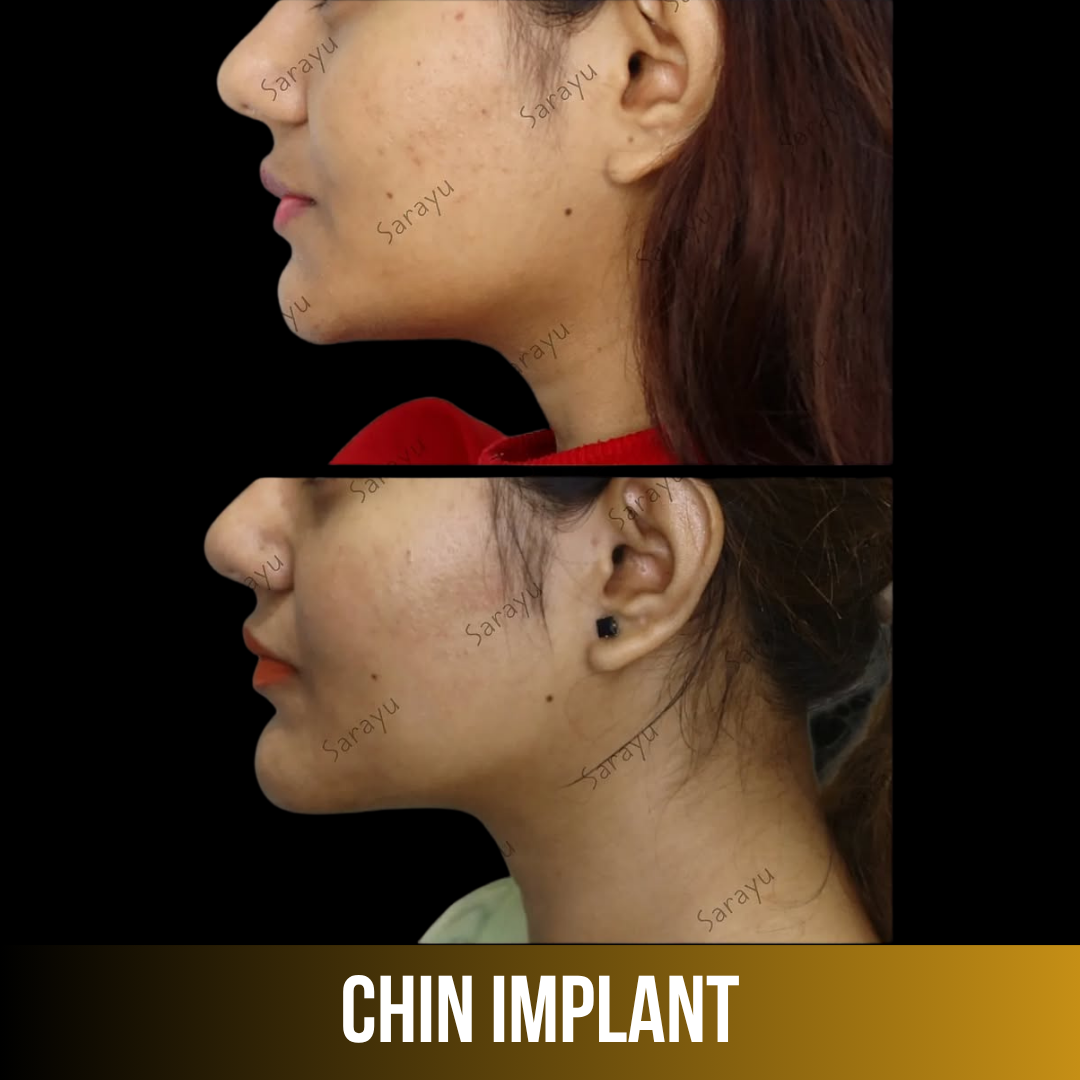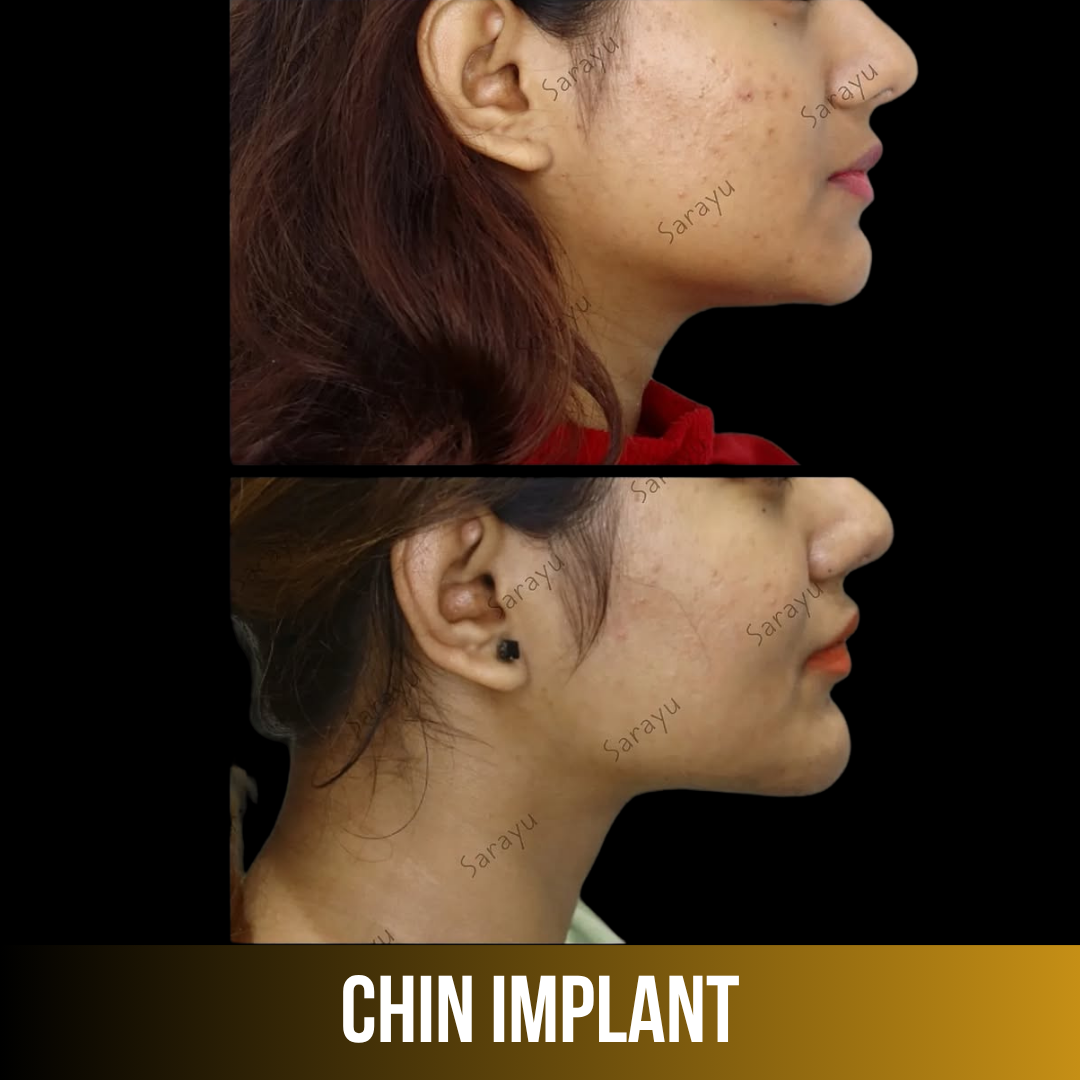
Chin Implant Surgery in Delhi
Quick answer : Chin implant surgery (chin augmentation) places a shaped, medical-grade implant over the chin bone to strengthen a weak or receding chin and balance the profile. At Sarayu Clinics, Greater Kailash-1, it takes 30–60 minutes under local anaesthesia with sedation, costs roughly Rs 60,000–Rs 1,50,000 in the Delhi market, and has most people back at desk work in 3–5 days. Results are permanent — and if your anatomy suits bone repositioning (genioplasty) or a non-surgical option better, this page maps those too.
The chin is the quietest feature on the face and the one doing the most structural work. When it sits even a few millimetres back, everything around it pays: the nose looks bigger than it is, the jawline blurs into the neck, side-profile photos never quite look like you feel. Patients rarely walk in saying “my chin is small” — they say “I hate my side profile”, “my face looks heavy on camera”, or “should I get a nose job?” Half the time, the honest answer to that last question is: your nose is fine; your chin is under-projecting, and fixing the chin will do more for your profile than touching the nose ever could.
I am Dr. Adarsh Tripathi , facial plastic and maxillofacial surgeon at Sarayu Clinics, Greater Kailash-1. The chin and jaw are the maxillofacial surgeon’s home ground — I operate on this exact anatomy every week, from implants to bone repositioning. That matters for one specific reason you will see throughout this page: I have no professional stake in steering you toward an implant, a genioplasty, a filler or nothing at all. The recommendation follows your face.

Chin Enhancement in Delhi: All Your Options, Honestly Mapped
“Chin enhancement treatment” covers four very different things. Most clinics offer one or two of them and, unsurprisingly, recommend what they offer. Here is the full map:
Your situation | The right-sized option | Why |
Mild recession, or you want to preview the change before committing | Chin filler – /dermal-fillers-in-delhi/ | 10-minute injectable projection lasting 12–18 months. The best “test drive” for surgery — and enough, permanently repeated, for some faces. |
Moderate recession; you want it fixed once and permanently | Chin implant — this page | A shaped implant over the bone: predictable projection and width, 30–60 minutes, decades of stability. |
Recession plus vertical imbalance, asymmetry, or a chin that travels with a bite/jaw issue | Sliding genioplasty (bone repositioning) | Your own chin bone is moved into position — no foreign material, and the only option that corrects height and asymmetry, not just projection. Maxillofacial home ground. |
Soft-tissue thinness rather than bone deficiency | Fat grafting – /fat-grafting-in-delhi/ | Your own fat, transferred for natural softness — alone or refining an implant result. |
Chin fine; the blur is under it or along the jaw | Double chin removal – /double-chin-removal-in-delhi/ and HIFU – /hifu-treatment-in-delhi/ | Submental fat and skin laxity mimic a weak chin. Fixing the right layer beats augmenting the wrong one. |
One more honest line for this table: some “small chin” cases are actually jaw-position cases — the whole lower jaw sits back, sometimes with a deep bite. Most cosmetic pages quietly send those patients elsewhere. Here, that assessment — and where needed, that surgery — is native to the practice. It is the difference between a clinic that sells chin implants and a surgeon who treats chins.
What Is Chin Implant Surgery?
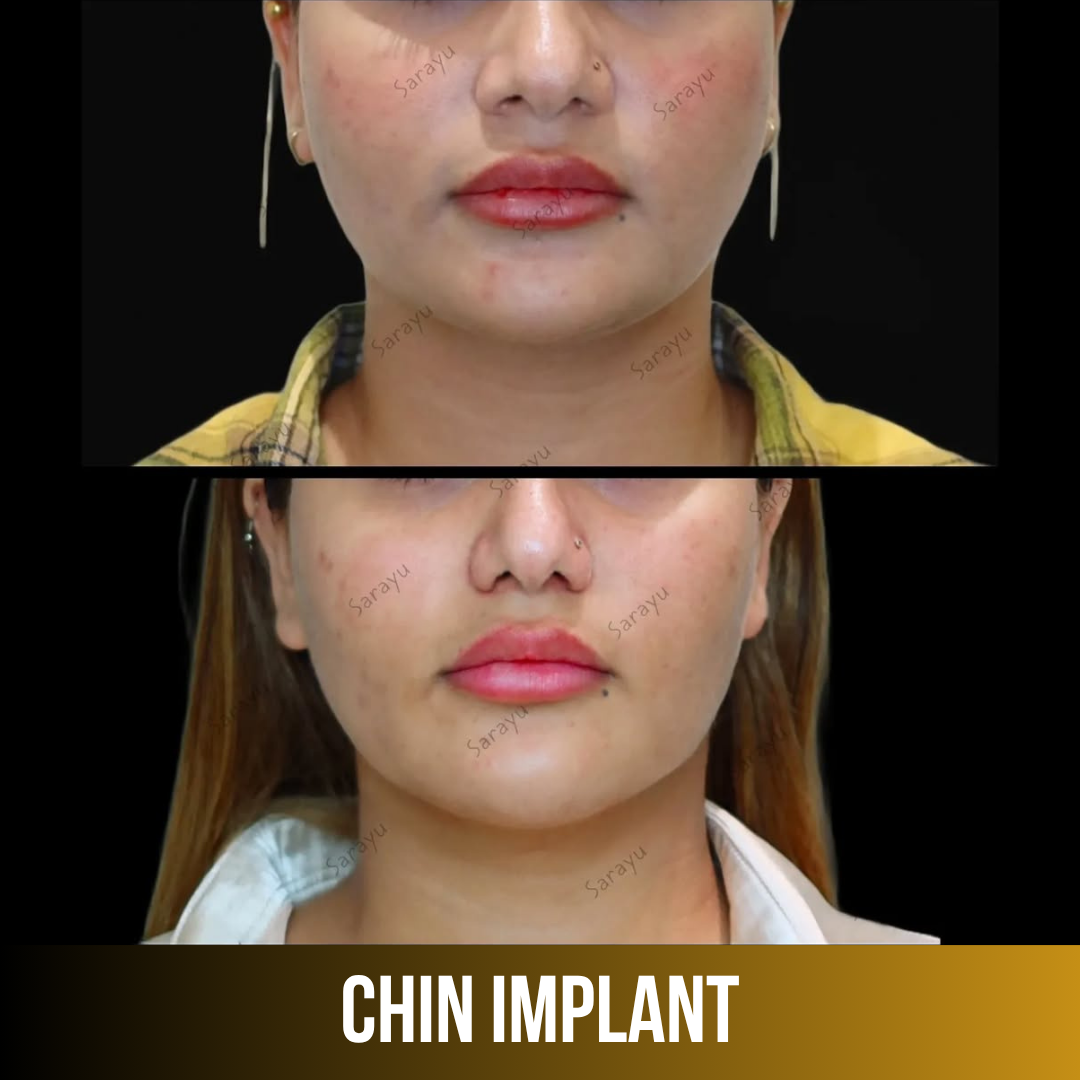
A chin implant is a soft, anatomically shaped piece of medical-grade silicone [confirm materials offered] placed in a snug pocket directly over the chin bone, where your own tissue holds — and over time integrates around — it. Modern implants come in graded sizes and extended “anatomical” shapes whose tapered wings blend into the jawline instead of creating an obvious button chin. Choosing the size and shape is measurement work, not guesswork: we analyse your profile against established proportions (the chin’s ideal projection sits just behind a vertical line dropped from the lower lip), photograph, and show you the planned change before anything is scheduled.
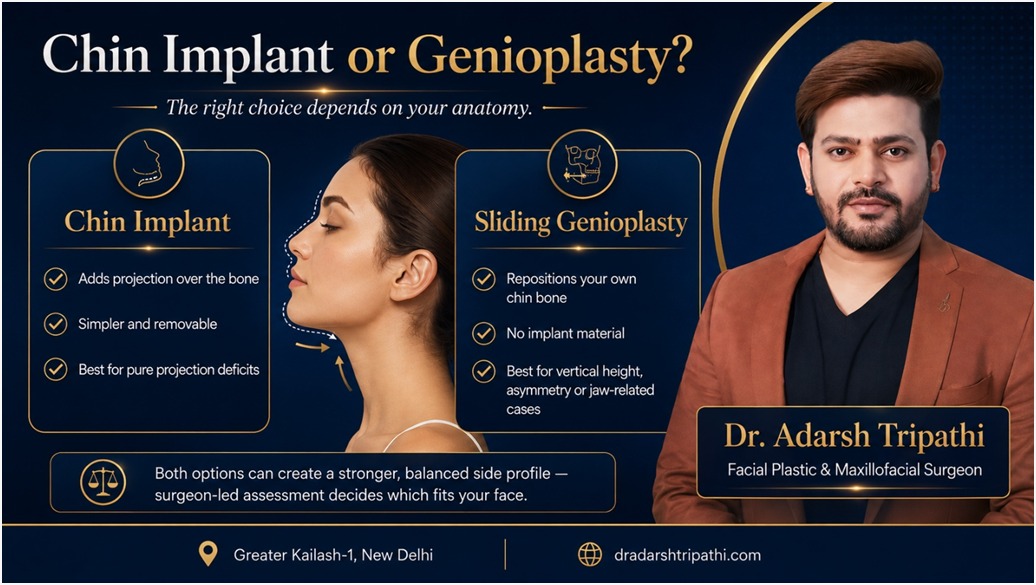
Chin implant or Genioplasty? The Question Most Clinics Cannot Ask You
There are two definitive surgical answers to a weak chin, and honest guidance between them is rare because most providers only perform one. An implant adds projection over the bone — simpler, faster, and removable if you ever change your mind. A sliding genioplasty cuts and repositions the chin bone itself — no foreign material, and the only operation that can also correct a chin that is too long, too short, or asymmetric. A 2025 systematic review of 1,126 patients found high satisfaction with both, with a trend toward higher satisfaction after genioplasty; implants carried a higher infection risk (strongly technique-dependent), while genioplasty’s trade-off is temporary numbness of the lip and chin that occasionally lingers. The review also observes that implants dominate partly because they are technically simpler for surgeons without formal craniofacial training. As a maxillofacial surgeon I perform both, so the recommendation you get here follows your anatomy — pure projection deficits usually favour the implant; vertical problems, asymmetry, and jaw-related cases favour the bone. You will know which you are, and why, before you decide.
Benefits of Chin Implant Surgery
- The whole profile improves at once: a balanced chin sharpens the jawline, defines the neck angle and — the part nobody expects — makes the nose look proportionate without touching it.
- Permanent, stable, reversible: the implant does not wear out or need replacing on a schedule; unlike bone surgery, it can also be removed or exchanged — a fair safety valve.
- Small surgery, big leverage: 30–60 minutes, local anaesthesia with sedation, home the same day — among the highest impact-per-downtime procedures in facial surgery.
- Hidden access: through a small incision inside the lower lip or in the natural crease under the chin — nothing visible either way.
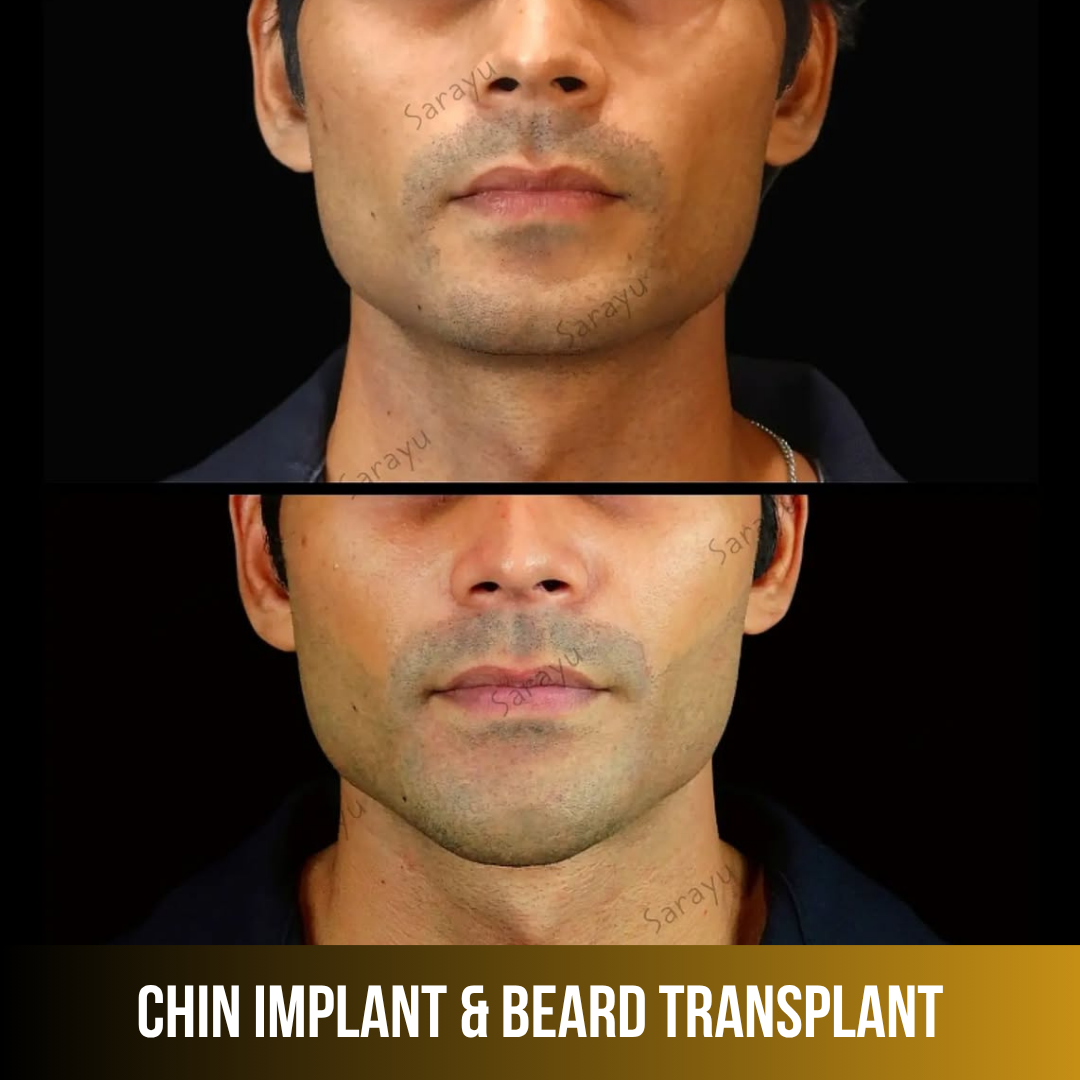
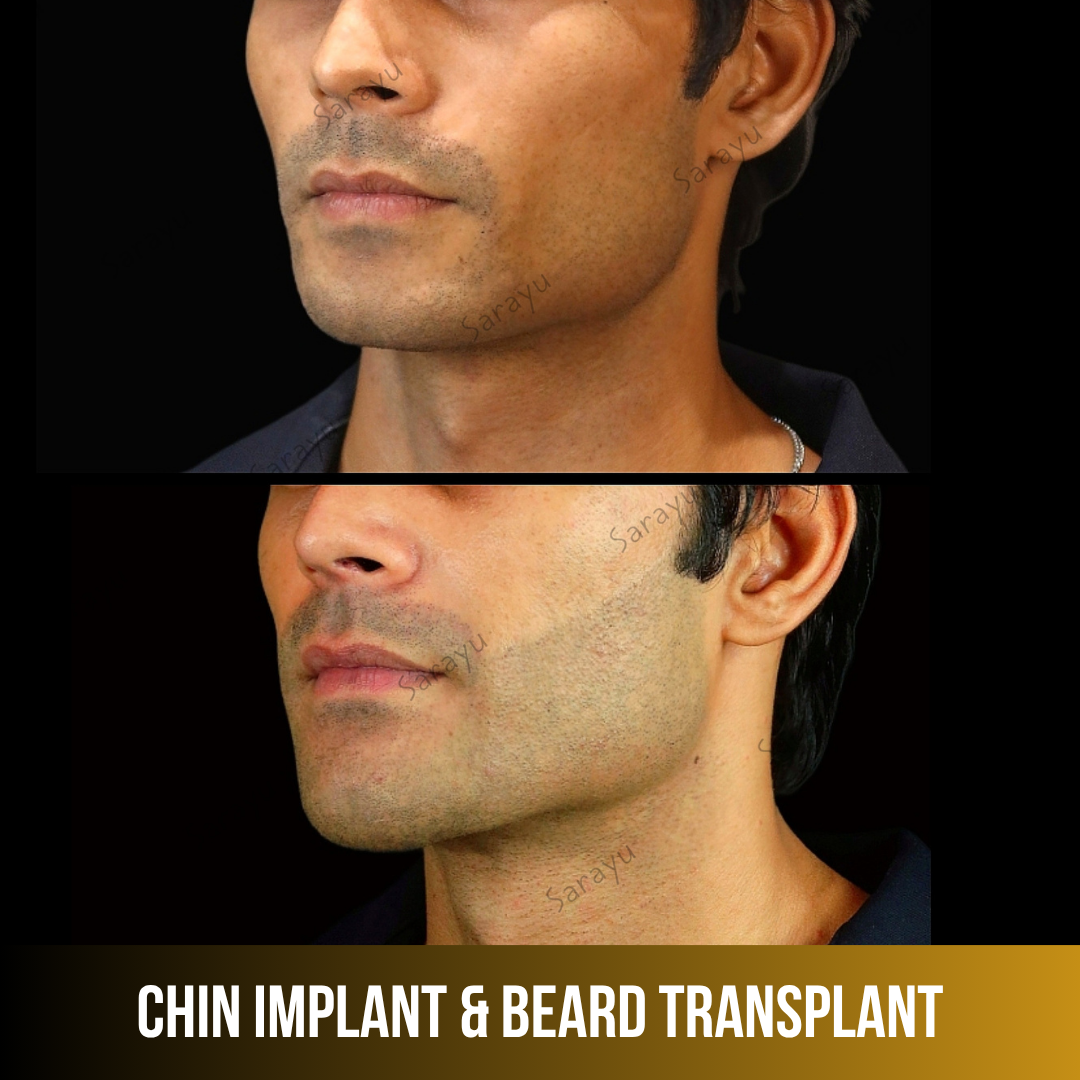
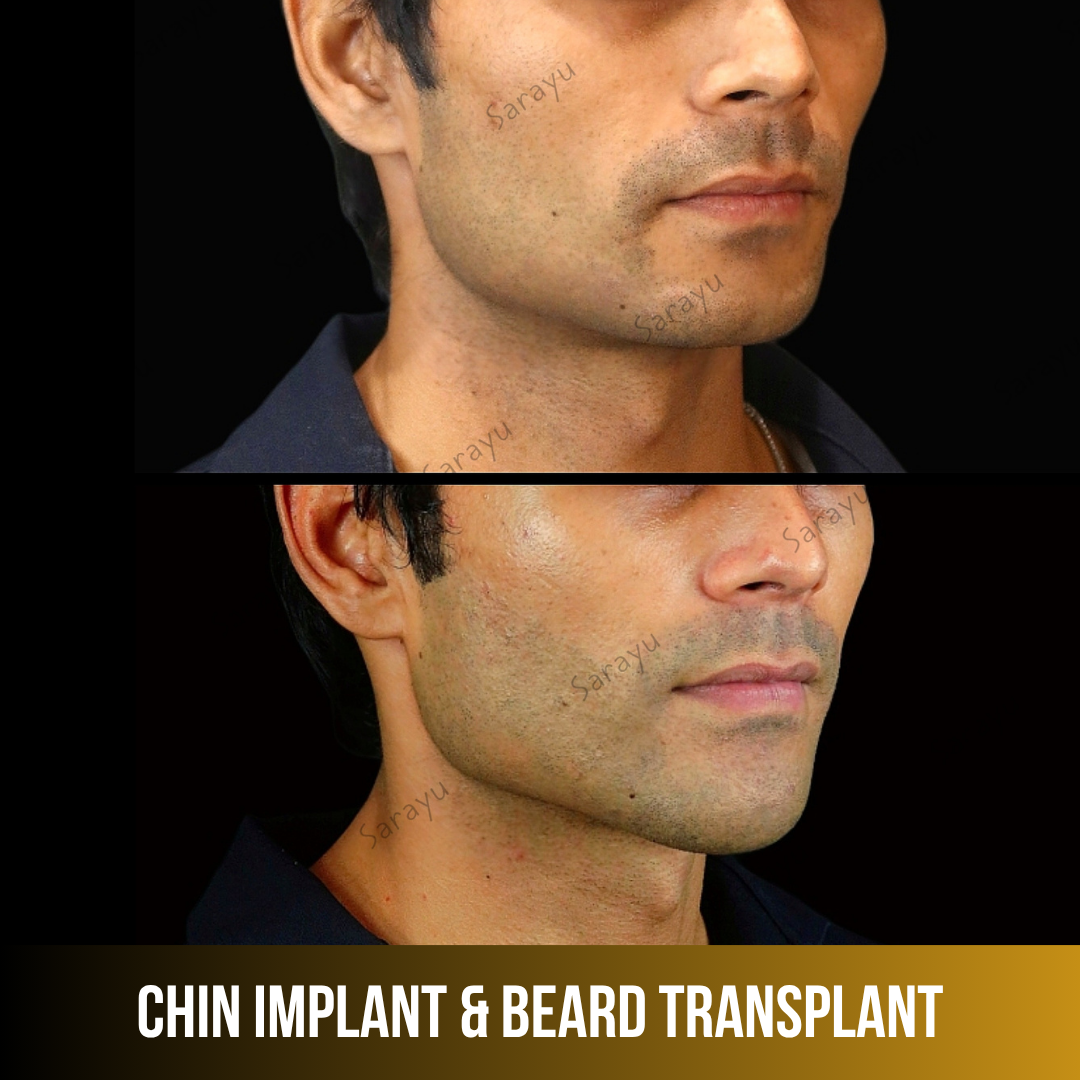
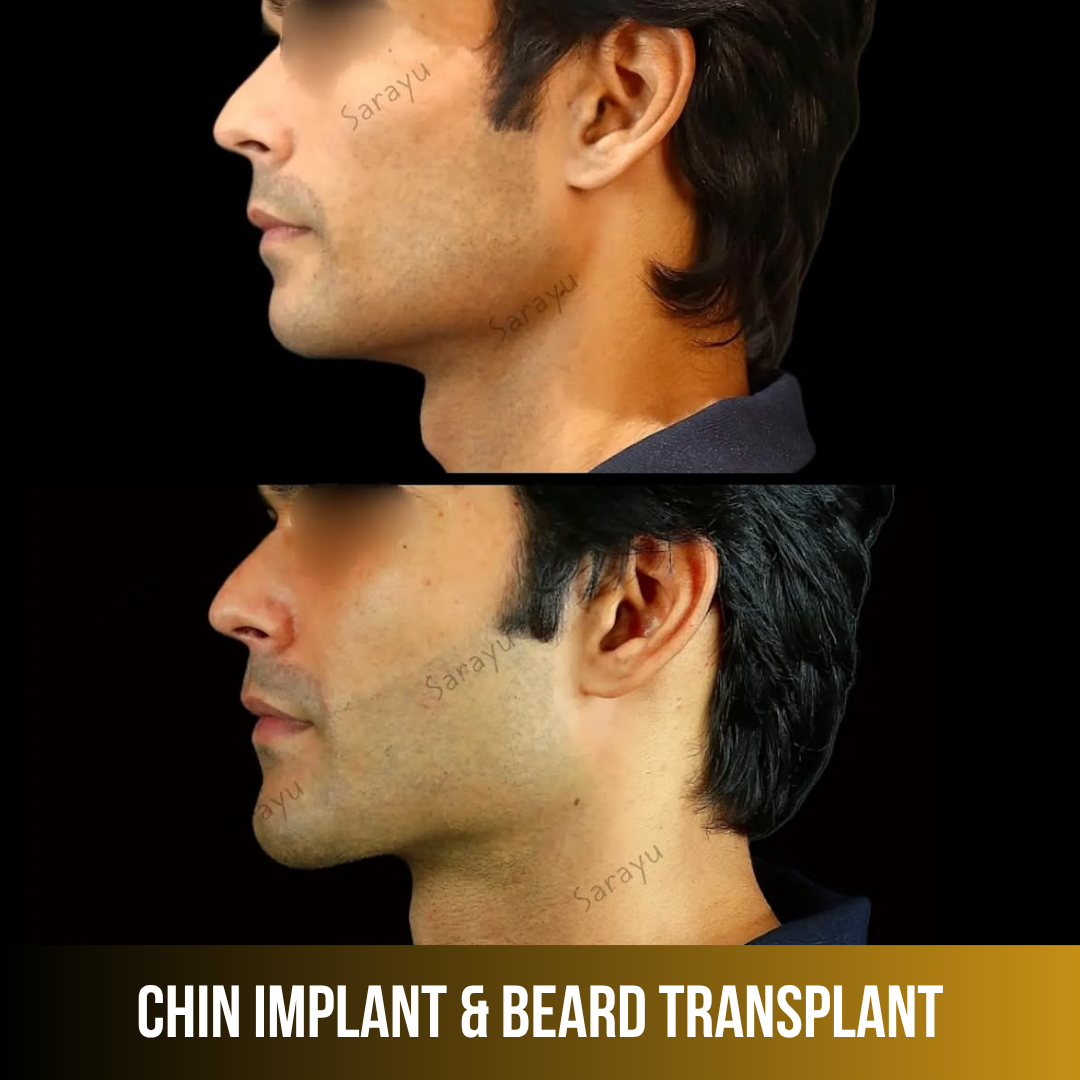
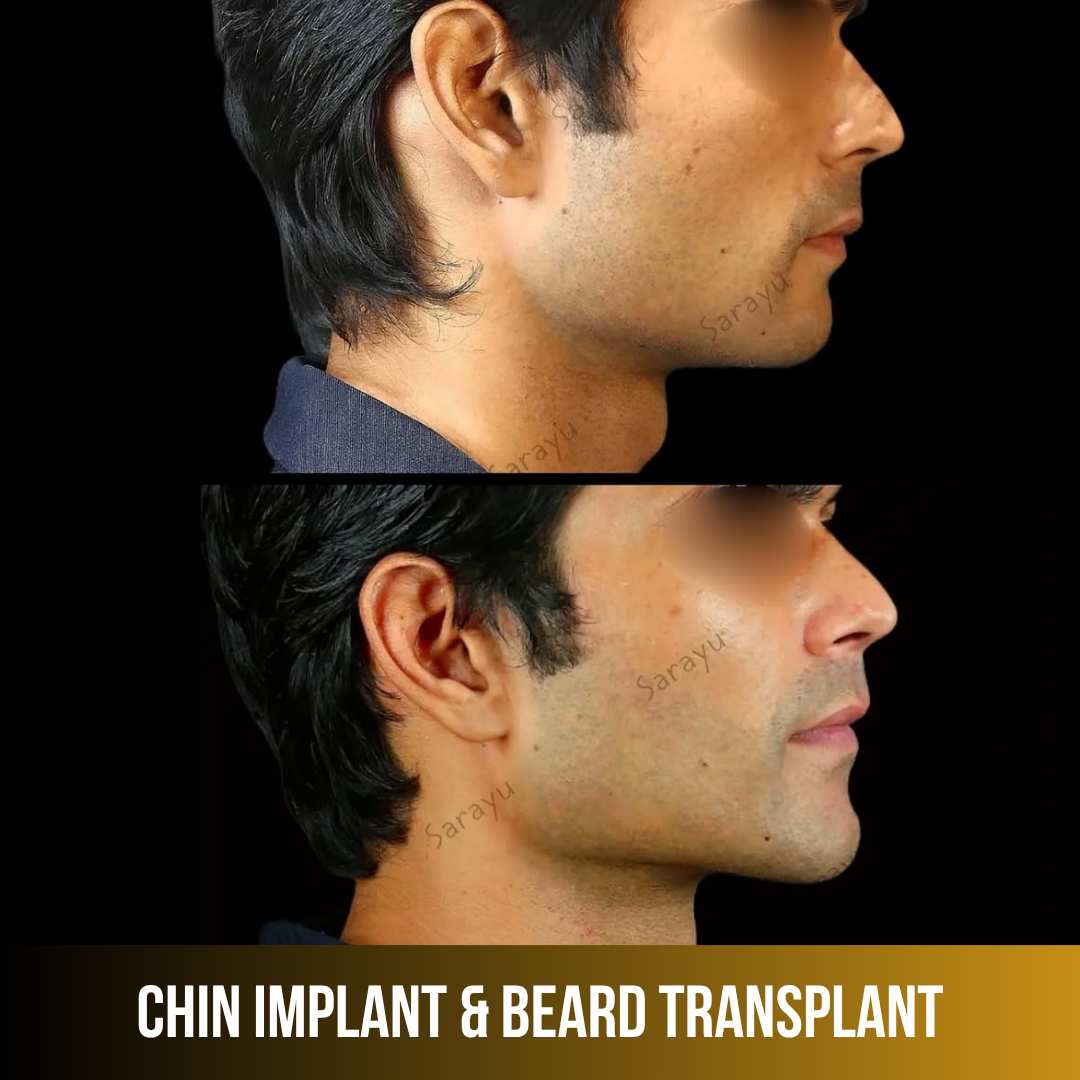
- Works for men and women: sizing and shape differ — broader, squarer projection for masculine jawlines; refined, tapering projection for feminine ones. Our gallery below includes men’s cases combining a chin implant with a beard transplant for a fully built lower face.
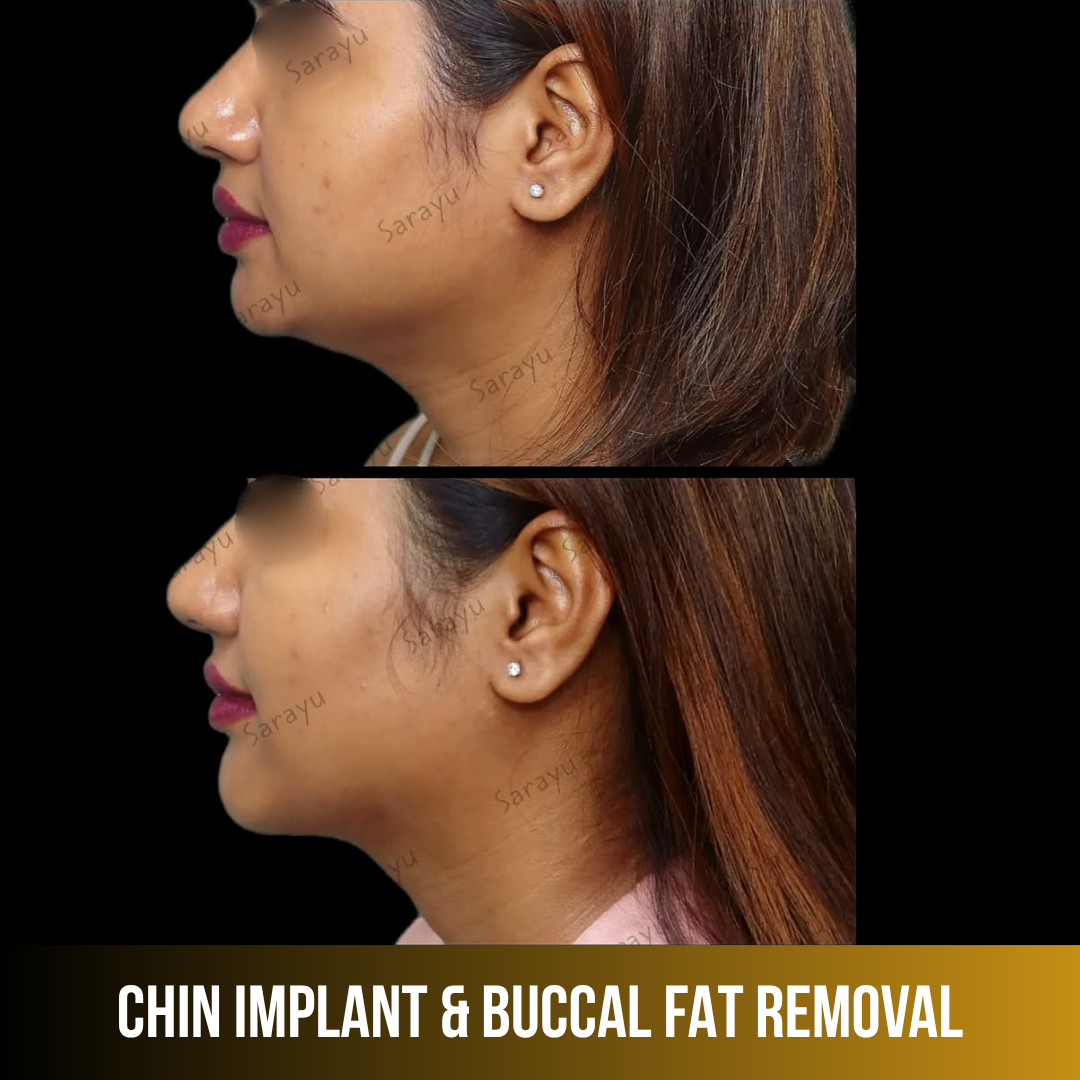
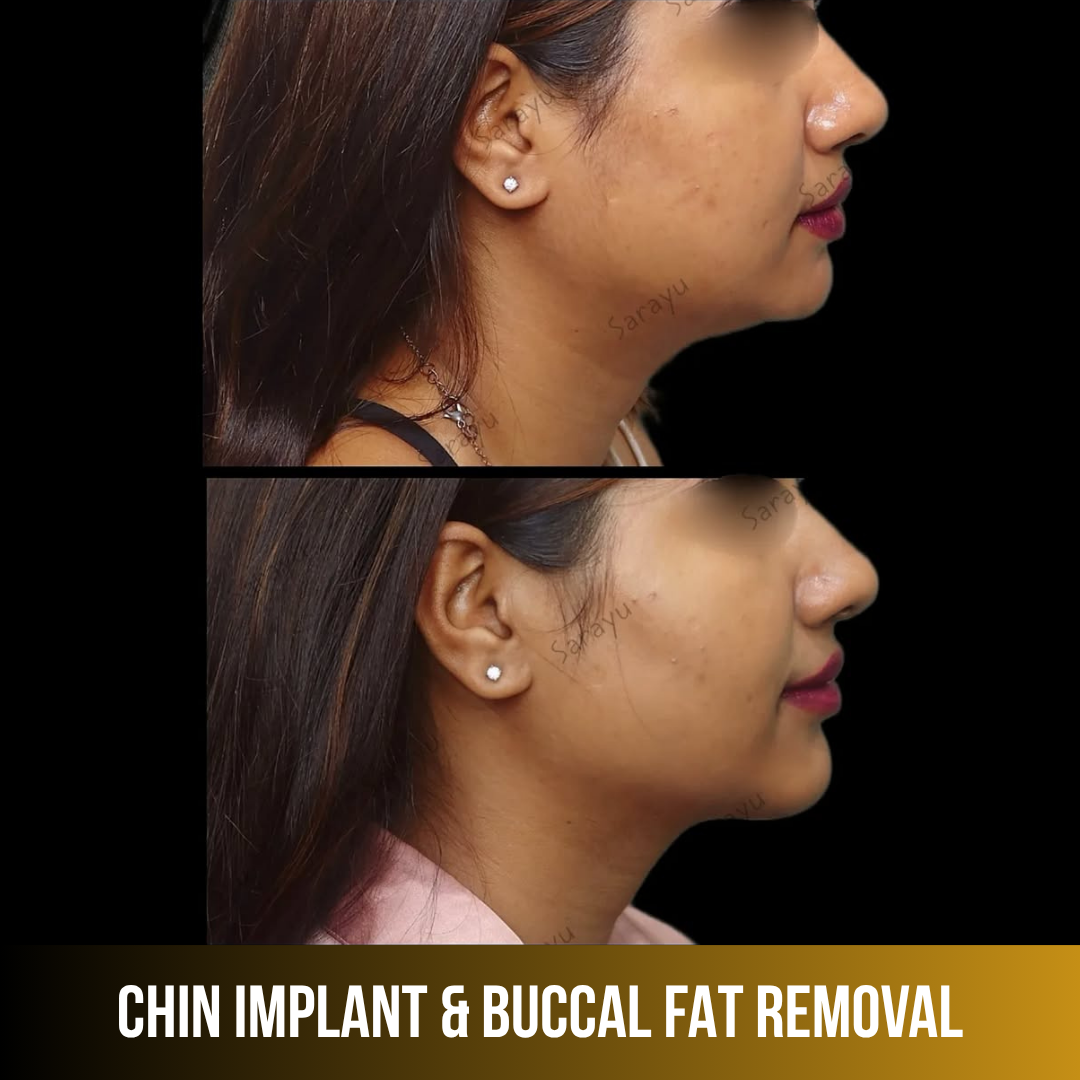
- Combines naturally: with rhinoplasty (profile plan), buccal fat removal (18 combined cases in the gallery), or double-chin liposuction for the complete lower-face result.
Who Is a Good Candidate — and Who Should Wait ?
Good candidates:
- A weak, receding or short-looking chin that bothers you in profile photos, with facial growth complete (18+).
- Good general and dental health — the intraoral route passes near the gum line, so active dental or gum infection is treated first.
- Realistic expectations: a balanced version of your face, not a borrowed jawline from a photograph.
We advise waiting or a different plan if:
- Your bite is significantly off or the whole lower jaw sits back — that is a jaw-position assessment first (done here), because an implant on a mispositioned jaw solves the photo and ignores the cause.
- There is active infection anywhere near the surgical field, including dental issues.
- You smoke and cannot pause around surgery, or you have unmanaged conditions affecting healing.
- The concern feels out of proportion to what others see — we talk honestly before operating; permanent surgery deserves a settled mind.
The Procedure: Step by Step
Step 1 — Consultation, measurement and planning
Profile analysis against your nose, lips and neck; chin height, width and projection measured; photographs and digital imaging so you can see the planned change; and the implant-vs-genioplasty question settled openly. You leave with the technique, the implant size range, and the written cost.
Step 2 — Anaesthesia and incision choice
Local anaesthesia with light sedation for most cases. The incision is either inside the lower lip (nothing on the skin, sutures dissolve) or in the crease under the chin (a ~1.5 cm line that hides in the fold and fades to nearly invisible). Each has a real trade-off — the intraoral route shows slightly higher infection rates in the literature because it crosses the mouth; the submental route leaves the tiny external mark. We choose per case and tell you why.
Step 3 — Creating the pocket and seating the implant (30–60 minutes)
A precise pocket is made directly on the bone — snug matters, because a well-fitted pocket is what keeps an implant exactly where it was placed for decades. The implant is positioned symmetrically over the chin point, checked from every angle, and secured [confirm fixation technique].
Step 4 — Closure and home the same day
Fine sutures, a supportive chin dressing or strap if advised, antibiotics, and written aftercare. You are home within the hour and on soft foods tonight if the incision is intraoral.
Recovery Timeline After Chin Implant Surgery
Stage | What to expect |
Day 0–1 | Tightness and swelling over the chin; the strap (if given) stays on as advised. Sleep with your head elevated; soft foods for intraoral incisions. |
Days 2–4 | Swelling peaks then turns; some bruising may drift down the neck. Desk work from home is comfortable from day 2–3. |
Days 5–7 | Presentable for office and social life; intraoral sutures begin dissolving; external sutures (if any) come out at the clinic. |
Week 2 | Light exercise resumes; temporary tingling or numbness of the lower lip and chin — common, from swelling near the mental nerve — is settling. |
Weeks 3–4 | Swelling largely gone; the chin stops feeling “present” and starts feeling like yours. |
Months 2–3 | Final contour as deep swelling resolves; the implant is fully settled and undetectable to touch in almost all cases. |
Risks, Honestly — With the Numbers
The common and temporary: swelling, bruising, tightness, and tingling or numbness of the lower lip and chin that resolves as swelling around the mental nerve settles. The uncommon but real: infection — the main implant-specific risk, low in absolute terms but strongly dependent on sterile technique, antibiotic cover and incision choice, which is exactly why those decisions are made deliberately here; implant shifting, largely prevented by a snug pocket and fixation; and long-term, a small amount of bone remodelling under the implant, documented in the literature and clinically insignificant with properly sized implants. A comparative study of both chin procedures at 12 months found high satisfaction with either route when patients were selected correctly — selection, sizing and sterility are the three levers, and all three are surgeon-dependent. Worst case, an implant can be removed or exchanged — a genuine advantage over irreversible procedures, and one more reason conservative sizing beats ambitious sizing.
Chin Implant Surgery Cost in Delhi (2026)
Across reputable Delhi practices, chin implant surgery runs Rs 60,000–Rs 1,50,000, with hospital chains and premium implants at the upper end. The full enhancement menu for comparison:
Option | Approx. Delhi market cost | Notes |
Chin implant surgery (silicone) | Rs 60,000 – Rs 1,50,000 | Local anaesthesia + sedation; day-care; [insert Sarayu Clinics pricing] |
Sliding genioplasty | Rs 1,00,000 – Rs 2,50,000 | Bone repositioning; quoted after assessment |
Chin filler | Rs 15,000 – Rs 35,000 per session | Lasts 12–18 months; the reversible preview |
Fat grafting to chin | Rs 40,000 – Rs 80,000 | Alone or refining an implant result |
Implant + double-chin liposuction | Rs 1,00,000 – Rs 2,00,000 | The most-requested combination for jawline definition |
Your written quote covers the surgeon’s fee, anaesthesia, the accredited day-care facility, the implant itself, follow-ups and suture removal — no hidden add-ons. What moves the number: implant brand and shape, incision route, anaesthesia depth, and combinations. For context, the same surgery abroad typically runs four to five times these figures, which is why Delhi draws international patients for exactly this procedure.
Prices shown are for guidance only. Your final treatment cost will be confirmed during the initial consultation, based on your individual needs, concerns, and personalised treatment plan.
Implant vs Genioplasty vs Filler vs Fat Grafting — Side by Side
| Chin Implant | Sliding Genioplasty | Chin Filler | Fat Grafting |
What it is | Shaped implant over the bone | Your chin bone repositioned | Injectable gel projection | Your own fat transferred |
Fixes | Projection and width | Projection, height, asymmetry | Mild projection, contour | Soft-tissue thinness |
Lasts | Decades; removable | Permanent; not reversible | 12–18 months | Years (partial absorption) |
Downtime | 3–5 days | 7–10 days | None to 1 day | 2–4 days |
Delhi cost | Rs 60,000–1,50,000 | Rs 1,00,000–2,50,000 | Rs 15,000–35,000/session | Rs 40,000–80,000 |
Profile Planning: Chin, Nose and Jawline Read Together
The profile is a system. A projecting chin makes a strong nose look balanced; a recessed one makes a normal nose look big — which is why a proper profile assessment sometimes redirects a rhinoplasty consult toward the chin, or plans both together in one anaesthesia. The other natural partners: buccal fat removal for cheek definition (the 18 combined cases in our gallery show why this pairing became a signature), double chin removal when submental fullness is blurring the new jawline, and full face sculpting when the goal is the whole lower face planned as one. For men, the gallery’s chin implant + beard transplant cases show how structure and framing work together.
Choosing Your Chin Implant Surgeon in Delhi — Why Patients Choose Dr. Tripathi
- This is the home organ: Adarsh Tripathi is a facial plastic and maxillofacial surgeon with 18+ years of experience — chin and jaw anatomy is his daily operating field, not an add-on service.
- Both operations, one honest recommendation: implants and genioplasty are both performed here [confirm genioplasty offered at the clinic], so the advice follows your anatomy rather than the only technique available.
- The jaw pathway others lack: bite and jaw-position assessment is native — cases most cosmetic clinics must refer away are evaluated and treated under one roof.
- Trusted by photographed faces: including celebrity work — see Yo Yo Honey Singh’s transformation — where a natural result is the whole job description.
Related Procedures at Our Delhi Clinic
Nose & profile | Face shape | Lift & skin |
Lip Augmentation – /best-lip-augmentation-treatment-in-delhi/ | ||
Frequently Asked Questions About Chin Implant Surgery in Delhi
How much does chin implant surgery cost in Delhi?
Chin implant surgery in Delhi costs Rs 60,000-1,50,000 depending on the implant brand and shape, the incision route, anaesthesia depth and the facility. Sliding genioplasty runs Rs 1,00,000-2,50,000, and chin fillers cost Rs 15,000-35,000 per session. Your written quote at Sarayu Clinics covers the surgeon, anaesthesia, implant, facility and follow-ups.
What is the difference between a chin implant and chin fillers?
Fillers add temporary projection with an injectable gel lasting 12-18 months – the ideal way to preview the change. An implant is a one-time surgical solution that lasts decades and gives more definite projection and width. Many patients try filler first, love the balance, and then choose the implant as the permanent version.
Chin implant or genioplasty – which is better?
Neither is universally better; they solve different problems. An implant adds projection over the bone and is simpler and removable. Sliding genioplasty repositions your own chin bone – the only option that also corrects vertical height and asymmetry, with no foreign material. A 1,126-patient review found high satisfaction with both. We perform both, so the recommendation follows your anatomy.
Is chin implant surgery painful? What anaesthesia is used?
The procedure is done under local anaesthesia with light sedation, so you feel nothing during surgery. Afterwards, expect tightness and mild soreness for a few days rather than real pain, managed with simple tablets. Most patients describe the recovery as easier than they expected.
Will there be a visible scar after chin implant surgery?
No visible scarring either way. The incision is placed inside the lower lip (nothing on the skin, dissolvable sutures) or in the natural crease under the chin, where a ~1.5 cm line hides in the fold and fades to nearly invisible within months. We choose the route case by case and explain the trade-offs.
How long does a chin implant last? Can it be removed?
Modern silicone chin implants last decades – effectively a lifetime – without scheduled replacement. Unlike bone surgery, an implant is also removable or exchangeable if you ever want a change, which is a genuine safety valve. The result you have at three months is essentially the result you keep.
Is chin implant surgery safe? Will my lips go numb?
In experienced hands it is one of the safest facial surgeries. Temporary tingling or numbness of the lower lip and chin is common for a few weeks as swelling near the mental nerve settles, and resolves. Infection is the main implant-specific risk – low, and driven by sterile technique, antibiotic cover and incision choice, which is why those decisions are made deliberately.
How long is recovery after chin implant surgery?
Desk work from day 2-3, presentable for office and social life by day 5-7, light exercise at two weeks. Swelling is largely gone by weeks 3-4, and the final settled contour appears by two to three months. A soft diet applies for the first days if the incision is inside the mouth.
Will my chin look natural? How do you choose the implant size?
Size and shape are measured, not guessed: your profile is analysed against established proportions, and modern anatomical implants have tapered wings that blend into the jawline instead of creating a button chin. The goal is the balanced version of your own face – conservative sizing beats ambitious sizing every time.
Can men get chin implants?
Yes – a large share of our chin patients are men seeking a stronger jawline and profile. Male implants are sized broader and squarer to preserve masculine proportions. Our gallery includes men’s cases combining a chin implant with a beard transplant for a fully built lower face.
What is the right age for chin implant surgery?
Facial growth should be complete, so 18 and above. There is no meaningful upper limit for healthy adults – suitability depends on anatomy, dental health and expectations. If a bite or jaw-position issue underlies the small chin, that assessment comes first, at any age.
Can a chin implant be combined with rhinoplasty or other procedures?
Yes, very commonly. Chin and nose read together, so implant + rhinoplasty is the classic profile plan in one anaesthesia. Other frequent pairings: buccal fat removal for cheek definition (18 combined cases in our gallery), and double-chin liposuction to sharpen the new jawline. Combinations are assessed and priced as one plan.
How to Reach Us:
Phone:+91 9289111083 ,+91 9289111084
Email: sarayuinquiries@gmail.com
Dr Adarsh’s website: https://dradarshtripathi.com/
Facebook: https://www.facebook.com/DrAdarshTripathi3011
Instagram: https://www.instagram.com/dr_adarsh_tripathi/
Youtube: https://www.youtube.com/@dr_adarsh_tripathi
Linkedin: https://www.linkedin.com/in/dr-adarsh-tripathi-a43005b8/
Online Booking: https://dradarshtripathi.com/contact-us/ to schedule appointments conveniently.
Our Patients