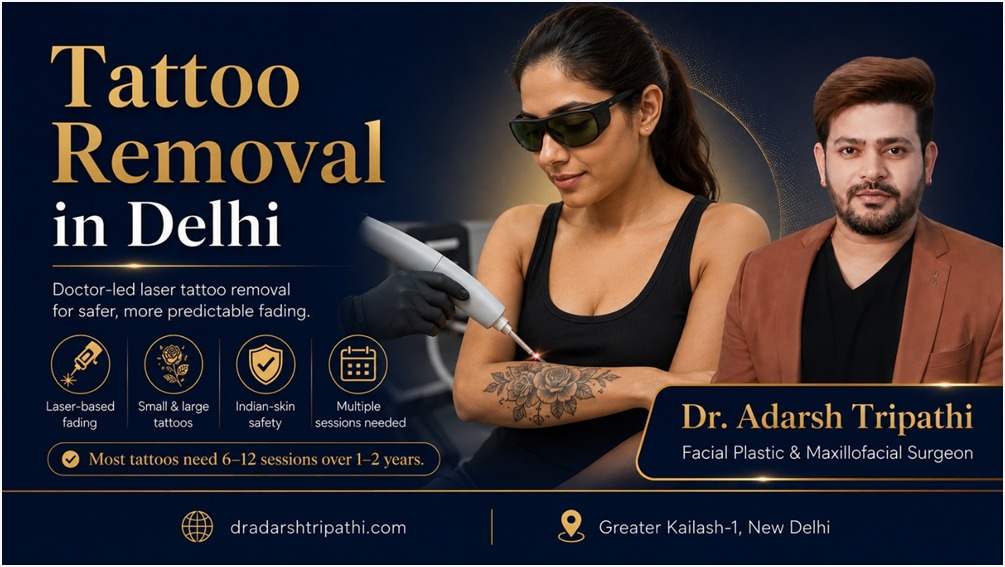
Tattoo Removal in Delhi — The Right Laser for Your Ink, Done Safely
People come for tattoo removal for all sorts of reasons. Sometimes it’s a name. Sometimes it’s a design choice from years ago that no longer fits who they’ve become. Sometimes it’s a poorly-done piece they want gone before getting it covered. Sometimes it’s a workplace expectation, or a wedding photograph being planned, or simply a quiet decision to start over. Whatever brings you here, the goal is the same: gradual, controlled fading or complete removal with the smallest possible mark left behind. This page explains exactly how that’s done well — and the things that can go wrong when it isn’t.
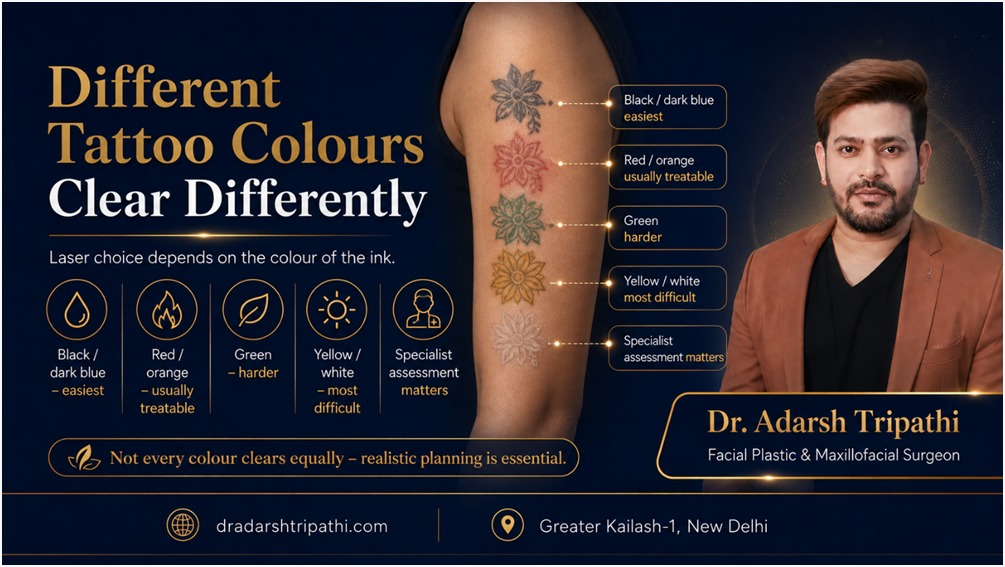
Here’s the most important technical fact about tattoo removal, and it’s where most clinic pages get vague: different ink colours absorb different wavelengths of laser light. There is no single laser that removes every tattoo. Black and dark blue inks respond best to one specific wavelength; reds, oranges and yellows respond to another; greens and light blues need yet another. A clinic offering only one type of laser can clear some of your tattoo but leave the rest stubbornly visible. Matching the right laser wavelength to each colour in your tattoo is the difference between a complete result and a partial one. Modern picosecond lasers also do a job that older Q-switched lasers couldn’t — they break ink into smaller particles faster, often clearing stubborn colours like green, light blue, and yellow in fewer sessions.
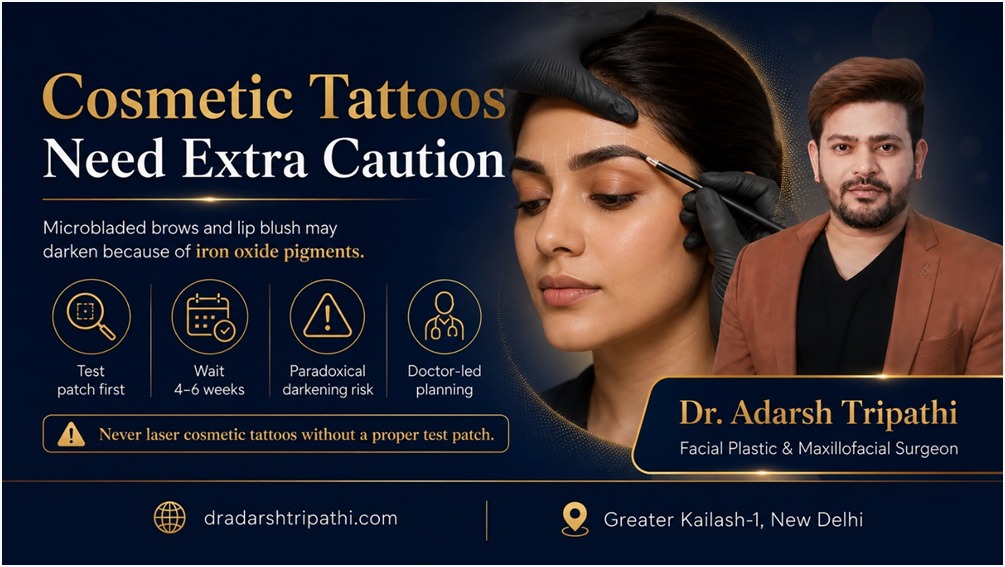
There’s also a serious safety point that almost no Delhi clinic page warns about, and it deserves space upfront. Cosmetic tattoos — eyebrow microblading, lip blush, eyeliner tattoos, permanent makeup — often contain iron oxide pigments. When lasered, these can paradoxically turn permanently BLACK rather than fading. This complication is sometimes very difficult to correct. Anyone considering removing cosmetic tattoos needs a doctor who knows this risk and tests carefully first. It’s a safety point we cover properly later on this page.
Dr. Adarsh Tripathi is a Maxillofacial and Facial Plastic Surgeon with over 18 years of experience at Sarayu Clinics, Greater Kailash-1, New Delhi. As a facial surgeon, he brings the deep skin and anatomy knowledge that translates into safer laser settings (particularly important for Indian skin’s higher pigmentation risk), the judgement to know when NOT to treat (cosmetic tattoos, certain locations), and access to the right laser modalities matched to your tattoo. This page covers everything: how it works, what ink colours need what wavelengths, the realistic 1–2 year timeline, recovery, cost, risks honestly explained, and how to choose the right tattoo removal doctor in Delhi.
Quick Answer — How does tattoo removal work and what does it cost in Delhi?
Tattoo removal in Delhi uses focused laser light to break tattoo ink into microscopic particles, which your body’s immune system then clears over weeks. Different lasers and wavelengths target different ink colours: 1064nm Q-switched Nd:YAG for black/dark blue; 532nm for red/orange/yellow; alexandrite/ruby or picosecond lasers for green/light blue. Most professional tattoos need 6–12 sessions spaced 6–8 weeks apart, with results unfolding over 12–18 months. Costs range Rs. 2,000–15,000 per session depending on size, ink density, and laser type. Dr. Adarsh Tripathi at Sarayu Clinics, Greater Kailash, performs doctor-led, wavelength-matched, Indian-skin-conscious laser tattoo removal.
Benefits of Doctor-Led Laser Tattoo Removal
When the right laser, right settings, and right protocol are used, modern tattoo removal genuinely delivers — but the benefits depend entirely on doing it medically rather than at a street-corner shop. Here’s an honest picture:
- Progressive, controlled fading — the tattoo lightens session by session in a predictable way
- Most tattoos significantly reduced or fully cleared with enough sessions (some inks more reliably than others)
- Minimal scarring when correct laser settings are used — far less risky than dermabrasion, salabrasion, or excision for most tattoos
- Skin texture preserved — modern Pico and Q-switched lasers target ink selectively, leaving surrounding skin largely undamaged
- Multi-colour tattoos can be cleared with the right multi-wavelength approach
- Outpatient procedure — each session takes 15–45 minutes and you go home the same day
- Suitable for most skin types when settings are matched to your skin tone
- Allows for cover-up fading — many people don’t want full removal, just enough fading for a new tattoo to cover
- Safer than surgical excision for tattoos in visible locations
- Doctor-led treatment includes medical assessment for safer, better outcomes
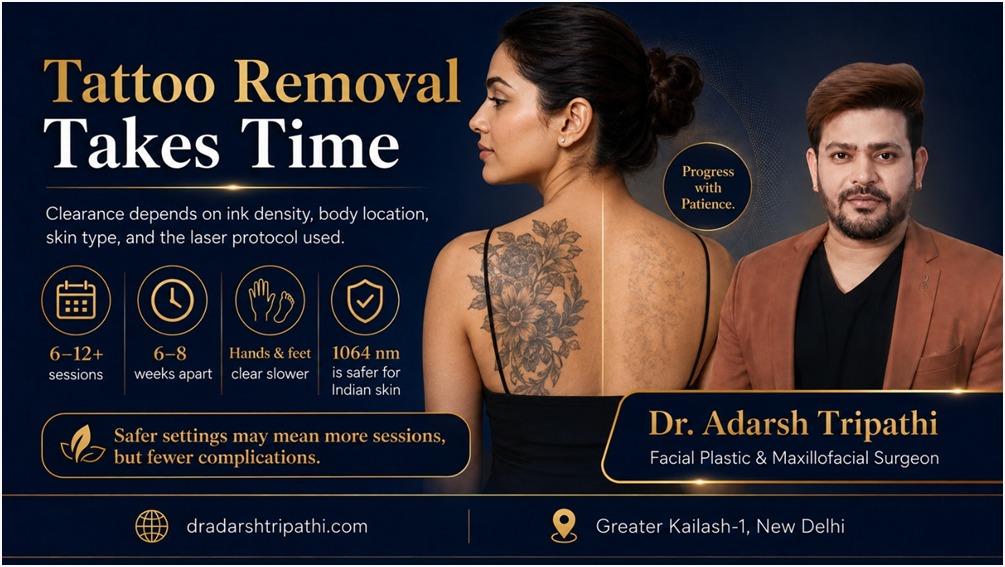
An honest framing: tattoo removal is rarely a quick fix. Realistic expectations matter more than for almost any other aesthetic treatment. Most tattoos take 6–12 sessions over 1–2 years for substantial fading or full removal. Some colours (yellow, white, light blue) may never completely clear. A small percentage of patients will see some long-term skin tone change in the treated area (lightening or darkening). A good doctor will tell you all of this honestly before you start — not after you’ve paid for several sessions.
Areas of the Body Where Tattoos Are Removed
Tattoos can be on any part of the body, and the location matters more than most people realise — both for how the laser is delivered and for how quickly your body clears the broken ink.
How Location Affects Clearance Speed ?
Here’s an under-discussed clinical fact: tattoos closer to the heart clear faster than tattoos farther from it. Why? Because clearance depends on lymphatic and blood circulation removing the laser-fragmented ink particles, and areas with better blood supply naturally clear better. A chest or upper-back tattoo of the same size and colour as one on the ankle will typically need fewer sessions to clear. This is one of those professional details that helps you set realistic expectations from the start.
Chest, Upper Back, and Shoulders
Excellent blood and lymphatic supply; tattoos here usually clear more efficiently. Among the most commonly removed areas, especially upper-back name tattoos and shoulder pieces from earlier years.
Arms — Upper Arm and Forearm
Common tattoo locations with reasonable clearance. The inner upper arm tends to clear well; lower forearm slightly slower.
Neck
Highly visible tattoos commonly removed for professional or social reasons. Skin here is thin and sensitive — conservative settings and careful technique are important.
Face (Cosmetic Tattoos and Facial Ink)
Includes cosmetic tattoos (eyebrow microblading, lip blush, eyeliner) and decorative facial tattoos. Facial tattoo removal demands the most refined technique — particularly cosmetic tattoos where the iron oxide paradoxical darkening risk applies (see safety section).
Hands and Fingers
These clear slowly because of reduced blood flow at the extremities. Hand tattoos commonly need more sessions and may have residual shadow even after extensive treatment. Honesty about this is important.
Lower Back
Reasonably good clearance area; commonly treated location.
Legs — Thigh and Calf
Thigh clears reasonably; calf and below slow down. Set realistic expectations for lower-limb tattoos.
Ankles, Feet, and Toes
The slowest-clearing locations because of the poorest circulation. Tattoos here often need more sessions than expected — and some residual shadow may persist. A good clinic will tell you this rather than promise quick results.
Lips and Mucosal Surfaces
Cosmetic lip-blush tattoos specifically. Highly specialised area requiring careful test patches because of the iron oxide darkening risk.
Tattoo Types and Conditions Treated
Not all tattoos are the same — and the type strongly influences how readily and how fully it clears.
Amateur Tattoos
Self-applied or non-professional tattoos using single-colour ink (often black) placed at shallower, irregular depths. These typically clear in the FEWEST sessions — often 3–6 — because the ink is shallower and less dense than professional ink.
Professional Tattoos
Modern professional tattoos use dense, deep, high-quality ink — designed to last. These need MORE sessions (typically 6–12 for single colour; 10–15+ for multi-colour) because the ink is deeper in the dermis and at higher concentration. Honest expectation-setting matters.
Multi-Colour Tattoos
The most technically demanding category. Different colours need different laser wavelengths, so each session may involve multiple laser settings to address all colours. May need more total sessions because some colours respond slowly even with the right laser.
Older / Faded Tattoos
Tattoos older than 10–15 years are often partly faded already, with ink particles that have started migrating. These typically need fewer sessions than fresh tattoos to complete fade.
Cover-Up Fading (Not Full Removal)
A specific request — fading an existing tattoo just enough to let a tattoo artist work over it with a new design. Usually 3–6 sessions, not the full course. A different and more limited objective worth discussing with the doctor.
Cosmetic Tattoos / Permanent Makeup
Eyebrow microblading, lip blush, eyeliner tattoos. Different from decorative tattoos because these often use iron oxide pigments and carry the paradoxical darkening risk (covered in detail below). Special handling and careful test patches needed. NOT a quick zap — requires expert assessment first.
Traumatic Tattoos
Tattoos from accidents — usually embedded debris (asphalt, graphite, gunpowder) that’s healed under the skin. Often respond to laser, though sometimes need different approaches than ink-based tattoos.
Regret Tattoos (Names, Symbols, Old Designs)
Names of former partners, outdated symbols, designs from a different stage of life — the largest category in real-world practice. The goal here is usually full removal, and good news: black/dark blue ink (which most of these tattoos use) is the easiest category to clear.
The single most important technical insight: ink colour determines the laser
Black and dark blue ink absorb best at 1064nm (Q-switched Nd:YAG). Red, orange, and yellow ink absorb at 532nm (frequency-doubled Nd:YAG). Green, light blue, and dark green absorb best with alexandrite (755nm), ruby (694nm), or modern Pico lasers. A clinic using only one wavelength can clear some colours but leave others. The right tattoo removal plan uses the right wavelength for each colour in your tattoo. This is exactly how Dr. Adarsh Tripathi approaches every tattoo — assessing colour composition first, then matching the laser approach.
Ink Colour and Laser Wavelength — The Complete Map
Here’s the table competitor pages skip — the specific colour-to-wavelength mapping that determines whether your tattoo will fully clear.
Ink Colour | Best Laser / Wavelength | Difficulty | Notes |
Black, Dark Blue | Q-switched Nd:YAG 1064nm | Easy | Most predictable; safest for Indian skin |
Red, Orange | Q-switched 532nm | Medium | Responds well; rare allergic reaction possible |
Yellow | 532nm or Pico | Difficult | Often persistent; Pico best |
Dark Green | Alexandrite/Ruby or Pico | Difficult | Pico significantly better than older lasers |
Light Blue / Sky Blue | Alexandrite/Ruby or Pico | Difficult | Often the trickiest decorative colour |
Brown | 1064nm or Pico | Medium | Watch for paradoxical darkening |
Purple, Violet | Alexandrite or Pico | Medium-Difficult | Variable response |
Pink | 532nm or Pico | Medium | Generally responsive |
White, Flesh Tones | CAUTION | High Risk | Paradoxical darkening risk — careful test patch essential |
Cosmetic Tattoo Inks | CAUTION | High Risk | Iron oxide may darken permanently |
What this means practically: when planning your removal, the doctor identifies every colour in your tattoo and selects which laser(s) to use across the course. A black-only tattoo can be cleared with just 1064nm. A red-and-black tattoo needs 1064nm and 532nm. A full-colour piece may need three or four different wavelengths to address all colours. The Pico laser is increasingly used because it addresses stubborn colours (green, light blue, yellow) more effectively than older Q-switched alone — though Q-switched Nd:YAG remains the safest and most affordable workhorse for black/dark inks, especially on Indian skin.
Critical Safety — Cosmetic Tattoo (Permanent Makeup) Removal
This section deserves its own space because most Delhi clinic pages quietly skip it. Permanent makeup — microbladed eyebrows, lip blush, eyeliner tattoos, areola tattoos — is increasingly common, and increasingly often regretted. Removing cosmetic tattoos is NOT the same as removing decorative tattoos, and the difference can be permanent.
The Iron Oxide Problem
Many cosmetic tattoo pigments contain iron oxide — a compound that, when struck by certain laser wavelengths, undergoes a chemical change called ‘reduction’. The result: the pigment can paradoxically turn permanently BLACK rather than fading. A red lip blush hit with the wrong laser settings can become a black mark. Brown microbladed eyebrows can darken to charcoal-black streaks. This complication is real, well-documented in medical literature, and sometimes very difficult to correct.
How Risk Is Managed ?
- Always test patch first — a small area treated and observed for 4–6 weeks before treating the whole tattoo
- Knowing which pigment likely contains iron oxide based on colour and source
- Sometimes using laser parameters or wavelengths chosen specifically to minimise iron-oxide darkening
- Sometimes recommending NOT to laser — surgical excision or other approaches may be safer for certain cosmetic tattoos
- Honest counselling about the risk before any treatment
When Surgical Removal May Be Safer ?
For certain cosmetic tattoos (especially lip blush and eyeliner that contain known iron oxide), surgical excision or other approaches may be safer than laser. This depends on the size, location, and pigment composition. The right answer isn’t ‘always laser’ — it’s ‘whichever method has the best risk-benefit ratio for THIS tattoo’. A facial surgeon who can offer both laser and surgical options is positioned to make that judgement honestly.
If a clinic doesn’t test-patch your cosmetic tattoo first, walk out
Lasering cosmetic tattoos without a careful test patch is genuinely risky. The paradoxical darkening complication can be very difficult to correct, and prevention through proper testing is the standard of care. Any clinic willing to laser your microbladed eyebrows or lip blush at the first appointment, without 4–6 weeks of observed test response first, is taking a chance with your face that no responsible doctor would take. Ask before booking: ‘Do you test patch cosmetic tattoos? What’s your protocol for iron oxide pigments?’ The answer tells you everything.
Are You a Good Candidate for Tattoo Removal?
Most adults with an unwanted tattoo are candidates for at least gradual fading — the question is what’s realistic for your specific situation.
You are likely a good candidate if:
- You have an unwanted tattoo (decorative, amateur, professional, or cover-up fading goal)
- You’re in good general health with no active infection in the area
- You’re not pregnant or breastfeeding (treatments deferred)
- You understand the realistic timeline (6–12+ sessions over 1–2 years for most)
- You’re prepared for the cost over a course rather than expecting one cheap session
- You’re committed to strict sun protection between sessions
- You have realistic expectations — substantial fading or full removal for most tattoos; some colours may never fully clear
Special considerations for Indian skin
Indian and darker skin (Fitzpatrick IV–VI) carries additional considerations: higher risk of post-inflammatory hyperpigmentation (dark marks where the tattoo was), higher risk of hypopigmentation (lighter patches), and need for more conservative laser settings (which can mean more sessions). The safest laser for darker Indian skin is the 1064nm Q-switched Nd:YAG. Aggressive settings to ‘speed up’ removal create more risk on Indian skin than they do on lighter skin types — meaning the right approach is methodical, conservative, and honest about a longer course.
The Kirby-Desai Scale — Predicting Difficulty
A clinical tool that estimates how many sessions your tattoo will need based on six factors: skin type (Fitzpatrick), location, ink colour, ink amount, scarring, and ink layering. Not every clinic uses it — but having a doctor who can give you an evidence-based estimate of difficulty (rather than ‘around 5–6 sessions for everyone’) is a sign of professional rigour. Estimates from this scale typically range from 5 sessions for the simplest amateur tattoos to 15+ for dense multi-coloured professional pieces.
Discuss carefully if you:
- Have a tendency to keloid scarring (personal or family) — cautious approach needed
- Have very dark skin (Fitzpatrick V–VI) — conservative settings and 1064nm wavelength priority
- Want a cosmetic tattoo (permanent makeup) removed — test patch is essential first
- Are on isotretinoin (acne medication) — treatment usually deferred 6 months after stopping
- Have a tan or recent sun exposure — wait until skin returns to baseline
- Have unrealistic ‘one-session removal’ expectations — honest counselling about timeline matters
- Have allergic reactions to your tattoo — laser releases ink fragments that may trigger more reaction; careful management needed
Laser Methods at Sarayu Clinics, Delhi
Different lasers and techniques are used for different situations. Here’s what each does best.
1. Q-Switched Nd:YAG (1064nm) — The Workhorse for Indian Skin
Nanosecond-pulse laser at 1064nm wavelength — the safest and most widely used laser for tattoo removal on Indian and darker skin. Targets black and dark blue ink predictably and effectively. Well-tolerated, proven over decades, and importantly, safest for Fitzpatrick IV–VI skin because melanin absorbs less at this wavelength (reducing PIH and hypopigmentation risk).
- Best for: black/dark blue ink; Indian and darker skin; foundational laser for most tattoos
2. Q-Switched 532nm (Frequency-Doubled Nd:YAG) — for Warm Colours
The same Q-switched platform delivering at 532nm — the wavelength absorbed by red, orange, and yellow inks. Combined with 1064nm in multi-colour tattoo plans to address warm colours alongside black.
- Best for: red, orange, yellow ink in multi-colour tattoos
3. Q-Switched Alexandrite (755nm) and Ruby (694nm) — for Greens and Light Blues
Wavelengths that target the difficult cool colours — dark green, light blue, blue-green. Used when these colours are present. Either Pico or these Q-switched options work for cool colours; Pico is generally more effective per session.
- Best for: green and light blue ink
4. Picosecond Laser (Pico) — the Modern Stubborn-Ink Solution
Picosecond pulses are thousands of times shorter than nanosecond Q-switched pulses, delivering a different type of energy (photo-acoustic shockwave rather than primarily photo-thermal). This shatters ink into smaller particles that the body clears faster. The result: often fewer sessions for stubborn colours (green, light blue, yellow, multi-colour tattoos) and slightly less skin damage per session. Pico is the leading-edge option for difficult cases.
- Best for: stubborn colours (green, light blue, yellow), multi-colour tattoos, fewer-session protocols
5. R20 Method (Multi-Pass per Session)
Rather than one laser pass per session, R20 involves 4 passes with 20-minute intervals between, treating the tattoo more aggressively in a single visit. Can speed up total course but is more taxing on skin and isn’t suitable for every patient. Used selectively.
- Best for: patients wanting accelerated removal; suitable cases only
6. PFD Patch (Perfluorodecalin) Method
A clear gel patch applied during treatment that rapidly clears the ‘frosting’ effect on skin (which usually blocks further laser passes), allowing multiple passes in quick succession. An advanced technique used in select cases for faster clearance.
- Best for: accelerated treatment protocols, especially for newer tattoos
7. Combination Protocols
In practice, the best results often come from combining multiple wavelengths across sessions — 1064nm for black, 532nm for warm colours, and Pico or alexandrite for cool colours. Across a course of treatments, different wavelengths are used at different sessions or even within the same session to address the full colour palette of your tattoo.
Why Doctor-Led Tattoo Removal Specifically ?
Tattoo removal can be done at salons, spas, and stand-alone laser clinics — but a medically qualified doctor brings: (a) accurate assessment of difficulty and realistic plan; (b) knowledge of when NOT to treat (cosmetic tattoos, certain locations); (c) safer settings on Indian skin; (d) ability to manage complications if they arise; (e) access to multiple laser modalities rather than just one device. For something that takes 1–2 years and you carry the result of for life, doctor-led treatment is genuinely worth the investment.
The Tattoo Removal Procedure — Step by Step
Step 1: Consultation & Tattoo Assessment
Dr. Tripathi examines your tattoo — composition (colours present), depth and density of ink, professional vs amateur, age, location, your skin type, and any scarring from the original tattoo or earlier removal attempts. Realistic session estimates are given (using Kirby-Desai principles), the right laser(s) are selected, and risks specific to your skin and tattoo are discussed honestly. Photos are taken for baseline tracking. For cosmetic tattoos, a test patch is scheduled before any full treatment.
Step 2: Preparation
- Avoid sun exposure and tanning for 2 weeks before each session (strictly — for Indian skin especially)
- Stop blood-thinning medications/supplements for a few days before (only with doctor’s clearance)
- Arrive with the area clean, no creams or lotions applied
- Eat normally beforehand; arrange transport if you’ll feel anxious
- For cosmetic tattoos: complete the 4–6 week test-patch observation first
Step 3: Numbing
Topical numbing cream is applied 30–45 minutes before treatment. For more sensitive areas (lips, ankles, ribs), a local anaesthetic injection or cooling device may be added. The treatment itself feels like rapid rubber-band snaps — uncomfortable but manageable for most patients.
Step 4: The Laser Session
- Skin is cleansed thoroughly
- Protective eyewear is provided to both patient and operator
- Skin is cooled (often with a chiller device) for comfort and to protect surface
- The correct laser wavelength is applied across the tattoo with overlapping passes
- For multi-colour tattoos, multiple wavelengths may be used in the same session
- Treated skin develops ‘frosting’ (a temporary whitening that fades within 20 minutes)
- Cooling, soothing cream, and a sterile dressing are applied
A typical session takes 15–45 minutes depending on tattoo size.
Step 5: Aftercare
- Keep the area clean and dry for 24–48 hours
- Apply prescribed antibiotic ointment 2–3 times daily for 5–7 days
- Cover with a sterile dressing as advised until any blistering or scabbing fully heals
- Do NOT pick at scabs or blisters — they protect underlying healing skin
- Strict sun protection (SPF 50+) on the treated area — essential to prevent PIH
- No swimming, saunas, or heavy sweating for 1–2 weeks
- Mild over-the-counter pain relief if needed (avoid aspirin/ibuprofen for 24 hours)
- Report any unusual swelling, increasing pain, or discharge to the clinic promptly
Step 6: Spacing Between Sessions
Sessions are spaced 6–8 weeks apart — this isn’t an arbitrary scheduling choice. It takes that long for the body to clear the laser-fragmented ink particles via the lymphatic system. Treating too soon doesn’t help (the previous fragments aren’t yet cleared) and increases skin risk. A patient and methodical course gives the best, safest results.
Downtime — What to Expect After Each Session
Days 1–3
Mild swelling, redness, possibly small blisters or scabs in treated areas. The tattoo looks blanched (‘frosted’) initially, then returns to a darker version of itself before fading. Treated area feels tender, similar to a sunburn. Take ordinary precautions — keep clean, dressing as advised.
Days 4–10
Any scabs/blisters heal and fall off naturally. Mild itching is normal. Don’t pick. Sun protection remains essential. The treated area is healing through this phase.
Weeks 2–6
Visible fading begins gradually as the body clears the fragmented ink. The tattoo appears progressively lighter each week. By 6 weeks, the result of this session is essentially complete.
Weeks 6–8
Ready for the next session if continuing the course.
Possible Side Effects (Honestly Explained)
- Mild swelling, redness, blistering, scabbing (expected; resolves in days)
- Temporary darkening before fading (normal)
- Post-inflammatory hyperpigmentation (PIH) — darker marks especially in Indian/darker skin if sun protection fails
- Hypopigmentation — lighter patches (can be temporary or, rarely, permanent — the ‘ghost tattoo’ effect)
- Scarring (rare with proper settings; more likely if scabs are picked or aggressive settings used)
- Paradoxical darkening (mainly for cosmetic tattoos and certain pigments)
- Allergic reaction to released ink fragments (uncommon)
- Infection (rare; minimised by sterile technique and aftercare)
- Incomplete removal for some colours (especially yellow, light blue, white)
Most of these are minimised by doctor-led treatment with appropriate settings and proper aftercare. Indian-skin patients should specifically discuss PIH and hypopigmentation risks with their doctor.
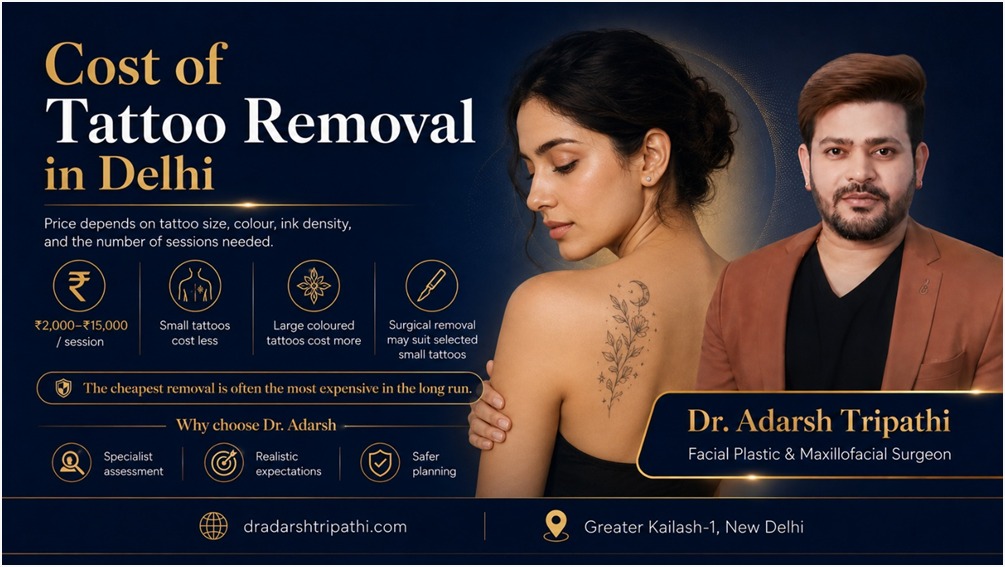
Tattoo Removal Cost in Delhi — Transparent Pricing
Cost depends on tattoo size, ink density, number of colours, laser type, and total sessions needed. Because most tattoos need a course of 6–12+ sessions, total course cost matters more than per-session price.
Approximate Cost at Sarayu Clinics, Delhi
Tattoo Size | Approx. Cost Per Session | Typical Sessions | Total Course Estimate |
Very small (<2 inches) | Rs. 2,000–5,000 | 4–8 | Rs. 10,000–30,000 |
Small (2–4 inches) | Rs. 3,000–7,500 | 6–10 | Rs. 20,000–60,000 |
Medium (4–8 inches) | Rs. 5,000–10,000 | 8–12 | Rs. 45,000–1,00,000 |
Large (8+ inches) | Rs. 7,500–15,000 | 10–15+ | Rs. 80,000–2,00,000+ |
Multi-Colour Add-On | +25–40% | Same range | Higher total |
Pico Laser Premium | +20–30% per session | Often fewer needed | Comparable total |
Cosmetic Tattoo Removal | Rs. 4,000–10,000 | Test patch + 3–8 | Rs. 20,000–80,000 |
Cover-Up Fading (limited) | Same per session | 3–6 (not full course) | Rs. 15,000–60,000 |
Prices shown are for guidance only. Your final treatment cost will be confirmed during the initial consultation, based on your individual needs, concerns, and personalised treatment plan.
Why the cheapest tattoo removal is often the most expensive ?
A Rs. 1,500 session at a salon using a single budget laser, taking 20 visits to fade a tattoo poorly with risk of scarring or hypopigmentation, is genuinely more expensive than a Rs. 6,000 doctor-led session that finishes the job properly in 8 visits with no lasting skin damage. Tattoo removal is a course, not a session — and the wrong protocol can leave you with a ‘ghost tattoo’ or scarring that’s harder and more expensive to correct than the original tattoo would have been to remove properly. Look at total course cost AND quality of result, not the headline session price.
Results Timeline — Realistic Expectations Across 1–2 Years
This is where honest expectation-setting genuinely matters. Tattoo removal is a slow, gradual process. Here’s what really happens:
After Each Session
- Immediate: frosting (temporary whitening) fades within 20 minutes
- Days 1–10: healing of any blisters/scabs; skin returns to baseline
- Weeks 2–6: progressive fading as the body clears the broken ink
- By 6–8 weeks: that session’s full result is visible; ready for the next
Over the Course (6–12+ Sessions, 12–18 Months)
- Sessions 1–3 (first 4–6 months): tattoo becomes noticeably lighter; black areas show clearest improvement first
- Sessions 4–6 (months 6–10): substantial fading visible; tattoo about 50–70% cleared for most
- Sessions 7–10 (months 10–18): difficult colours and dense areas continue lightening; close to final result for most amateur and single-colour tattoos
- Sessions 10–15+ (months 18–24): completing the course for professional and multi-colour tattoos; final clearance
How Much Will My Tattoo Fade?
For most professional tattoos in single dark colours: 90–100% clearance is realistic with a complete course. For multi-colour professional tattoos: 70–95% depending on colours present (yellow and light blue may leave faint shadow). For amateur tattoos: usually 95–100% clearance, often in fewer sessions than expected. For cosmetic tattoos: variable, depending on pigment composition and approach.
How Long Until the Result Is ‘Final’?
Continue counting fading from the LAST session — fading typically continues for 3–6 months after your final treatment because your body keeps clearing fragmented ink. So you may finish active sessions at month 18 and see continued slight fading until month 24. Don’t add additional sessions before giving your body time to clear what’s already been broken down.
Comparison — Tattoo Removal Methods (and Why Laser Wins)
Laser is the modern standard, but it’s worth understanding why — particularly because older or alternative methods are still occasionally pushed by less reputable providers.
Method | How It Works | Effectiveness | Risks | Verdict |
Modern Laser (Q-Sw + Pico) | Light shatters ink; body clears | Excellent | Low when doctor-led | Gold standard |
Q-Switched Only (older) | Single laser, multiple sessions | Good for many | Low–moderate | Still proven; better with Pico |
Surgical Excision | Cut out skin + suture | Permanent if complete | Scar inevitable | Selected small tattoos |
Dermabrasion | Mechanical sanding | Variable | High scar/PIH risk | Largely obsolete |
Salabrasion | Salt scrubbing | Poor; painful | Scarring + PIH | Avoid |
Cream Removal | Topical ‘fade’ creams | Minimal/none | Variable | Mostly marketing |
Cover-Up Tattoo | New tattoo over old | Cosmetic | No medical risk | Valid alternative |
Surgical Excision — When It Makes Sense
For very small tattoos in suitable locations (where a fine surgical scar would be less visible than the tattoo itself or laser shadow), surgical excision in one visit can give complete permanent removal. As a facial plastic surgeon, Dr. Tripathi can offer this option for selected small tattoos where it’s the cleaner solution. For most tattoos, however, laser is the better choice.
Cover-Up Tattoo — A Valid Alternative
If you don’t want full removal, having a tattoo artist cover the old design with a new one is a perfectly valid option — often combined with 3–6 laser sessions first to fade the original enough for cover-up to work well. The ‘fade for cover-up’ approach is a specific and lower-cost goal than full removal.
Avoid — Salabrasion, Aggressive Dermabrasion, ‘Magic’ Creams
Tattoo removal creams and ‘fade’ products marketed online are largely ineffective at best and irritating at worst. Salabrasion (rubbing salt into the tattoo) and aggressive mechanical dermabrasion are outdated methods that cause scarring and pigment change without reliably removing the tattoo. A clinic still pushing these approaches in 2026 is one to avoid.
Why a Facial Plastic Surgeon for Tattoo Removal?
Tattoo removal is primarily a laser procedure, but the medical expertise around it makes a real difference: accurate difficulty assessment (Kirby-Desai), safe settings for Indian skin, knowledge of when to laser vs surgically excise, recognition of the iron-oxide cosmetic-tattoo risk, and ability to manage complications. A facial plastic surgeon brings depth on all of these. For tattoo removal on the face or in visible areas, this expertise is particularly important — the consequences of a poor outcome are visible permanently.
Why Dr. Adarsh Tripathi Is a Trusted Tattoo Removal Doctor in Delhi ?
Tattoo removal looks simple — ‘just laser it off’ — but the difference between a good result and a poor one (scarring, PIH, ghost tattoo, paradoxical darkening) is decided by clinical judgement long before the laser fires. Here’s how to choose, and why patients choose Dr. Tripathi:
What to Look For in a Tattoo Removal Doctor ?
- Medical qualification (not just laser technician training) — assesses your skin and tattoo properly
- Access to multiple laser wavelengths or partnerships with clinics that have them
- Honest assessment of difficulty (use of Kirby-Desai or equivalent approach)
- Indian-skin-conscious protocols (conservative 1064nm priority, longer course, PIH-aware aftercare)
- Test-patch protocol for cosmetic tattoos (non-negotiable safety standard)
- Willingness to recommend AGAINST treatment when it’s the right call
- Refined surgical option available for selected small tattoos
- Personal consultation by the doctor; clinical (not salon) facilities
- Realistic expectations setting before you start the course
Dr. Tripathi’s Credentials
- Maxillofacial and Facial Plastic Surgeon with 18+ years of experience
- Deep skin and facial anatomy knowledge — translating into safer laser settings
- Indian-skin-conscious protocols designed for Fitzpatrick IV–VI from the start
- Access to multiple laser modalities — wavelength matched to your specific ink
- Recognises iron-oxide / paradoxical darkening risk for cosmetic tattoos; test-patches first
- Surgical excision available where it’s the better option for small/selected tattoos
- Honest about timeline, difficulty, and realistic outcomes — no ‘one session and gone’ promises
- Consultations personally conducted by Dr. Tripathi; known for natural, careful results
A Safety-First, Honest-Timeline Philosophy
Dr. Tripathi’s approach to tattoo removal is conservative, doctor-led, and built around realistic expectations. That means matching the laser to your ink, choosing safer settings for Indian skin even when it means more sessions, testing carefully before treating cosmetic tattoos, and being honest about what your specific tattoo will and won’t fully clear. The goal is the best long-term outcome for your skin — not the fastest route to a smaller tattoo with lingering complications.
Frequently Asked Questions — Tattoo Removal in Delhi
Q: Who is the best tattoo removal doctor in Delhi?
A: The best tattoo removal doctor in Delhi for you is a medically qualified specialist with access to multiple laser wavelengths, Indian-skin-conscious protocols, honest assessment of difficulty (using the Kirby-Desai scale or equivalent), and a test-patch protocol for cosmetic tattoos. Dr. Adarsh Tripathi is a Maxillofacial and Facial Plastic Surgeon with 18+ years of experience performing doctor-led, wavelength-matched, safety-first tattoo removal at Sarayu Clinics, Greater Kailash.
Q: How does laser tattoo removal work?
A: Laser tattoo removal works by delivering focused light energy at wavelengths absorbed by tattoo ink. The light shatters ink particles into microscopic fragments that your immune system then gradually clears via the lymphatic system over weeks. Different ink colours absorb different wavelengths — black/dark blue at 1064nm, red/orange/yellow at 532nm, green/light blue with alexandrite or picosecond lasers. The right wavelength for each colour in your tattoo is what makes full clearance possible.
Q: How much does tattoo removal cost in Delhi?
A: Tattoo removal in Delhi costs approximately Rs. 2,000–15,000 per session depending on tattoo size, ink density, and laser type. Because most tattoos need 6–12+ sessions, total course cost typically ranges from Rs. 20,000 for a small amateur tattoo to Rs. 2,00,000+ for a large multi-colour professional piece. Picosecond laser sessions cost more individually but may need fewer total sessions, making total cost comparable for difficult tattoos. A personalised quote is given after consultation at Sarayu Clinics.
Q: How many sessions are needed for tattoo removal?
A: Most tattoos need 6–12 sessions spaced 6–8 weeks apart for substantial fading or full removal, with results unfolding over 12–18 months. Amateur single-colour tattoos may need only 3–6 sessions; dense professional multi-colour tattoos may need 10–15+. The exact number depends on size, ink colours, ink depth, your skin type, and tattoo location — the Kirby-Desai clinical scale gives an evidence-based estimate at consultation.
Q: Can tattoos be completely removed?
A: Most tattoos can be substantially faded or fully removed with a complete course of treatment — but honest expectations matter. Black and dark blue ink usually clears completely (90–100%). Multi-colour professional tattoos typically reach 70–95% clearance, with stubborn colours like yellow, light blue, and white sometimes leaving faint residual shadow. Amateur tattoos often clear completely. Any clinic promising 100% removal of every tattoo in a few sessions is overpromising.
Q: Is laser tattoo removal painful?
A: Laser tattoo removal causes mild-to-moderate discomfort, often described as rapid rubber-band snaps against the skin. A topical numbing cream is applied 30–45 minutes beforehand, and skin is cooled during treatment, which significantly reduces sensation. For sensitive areas (ribs, ankles, lips, lower legs), local anaesthetic injection may be added. Most patients describe it as uncomfortable but manageable, similar to or slightly more than getting the original tattoo.
Q: Is tattoo removal safe for Indian skin?
A: Tattoo removal is safe for Indian and darker skin (Fitzpatrick IV–VI) when performed with the right laser (1064nm Q-switched Nd:YAG is safest), conservative settings, strict sun protection, and a doctor-led protocol. Indian skin carries higher risk of post-inflammatory hyperpigmentation (PIH) and hypopigmentation, so settings are deliberately gentler than for lighter skin — meaning more sessions but lower complication risk. Aggressive settings to ‘speed up’ removal create more risk on darker skin.
Q: Can microbladed eyebrows or lip blush tattoos be removed with laser?
A: Cosmetic tattoos (microbladed eyebrows, lip blush, eyeliner tattoos) CAN be removed with laser — but they require special caution because pigments containing iron oxide can paradoxically turn permanently BLACK when treated. A test patch is essential before any full treatment, with 4–6 weeks of observed response. Some cosmetic tattoos may be safer to remove surgically rather than with laser. Never have cosmetic tattoos lasered at a clinic that won’t test-patch first — that’s the safety standard.
Q: Will I have a scar after tattoo removal?
A: Modern laser tattoo removal rarely causes scarring when performed by an experienced doctor with appropriate settings. Possible cosmetic changes include temporary post-inflammatory hyperpigmentation (PIH), occasional hypopigmentation leaving lighter patches (‘ghost tattoo’ effect), and very rarely, true scarring. Risks are minimised by Indian-skin-appropriate settings, sterile technique, strict sun protection, and proper aftercare (especially not picking at scabs).
Q: Can I get a new tattoo over an old removed one?
A: Yes — many patients want fading rather than full removal so they can have a tattoo artist do a cover-up. The ‘fade for cover-up’ approach is a specific goal: typically 3–6 laser sessions fade the original enough for a new tattoo to be designed over it cleanly. This is a faster and lower-cost goal than full removal, and a popular path for those who simply want a better tattoo over an older one.
Q: Why does my tattoo location affect how fast it clears?
A: Tattoos closer to the heart clear faster because clearance depends on lymphatic and blood circulation removing the laser-fragmented ink particles. Chest, upper back, and shoulder tattoos clear more efficiently than tattoos on the lower legs, ankles, hands, and feet, where circulation is reduced. The same size and colour tattoo on the chest may need fewer sessions than on the ankle. Set realistic expectations for distal tattoos.
Q: How do I choose a tattoo removal doctor in Delhi?
A: Choose a medically qualified doctor with access to multiple laser wavelengths (not just one device), Indian-skin-conscious protocols, honest difficulty assessment, a test-patch standard for cosmetic tattoos, and willingness to recommend against treatment when appropriate. Look for clinical (not salon) facilities, consultation with the doctor personally, realistic timeline-setting, and refined surgical options for selected small tattoos. Beware extremely cheap quotes and clinics promising removal in one or two sessions.
How to Reach Us:
Phone:+91 9289111083 ,+91 9289111084
Dr Adarsh’s website: https://dradarshtripathi.com/
Facebook: https://www.facebook.com/DrAdarshTripathi3011
Instagram: https://www.instagram.com/dr_adarsh_tripathi/
Youtube: https://www.youtube.com/@dr_adarsh_tripathi
Linkedin: https://www.linkedin.com/in/dr-adarsh-tripathi-a43005b8/
Online Booking: https://dradarshtripathi.com/contact-us/ to schedule appointments conveniently.