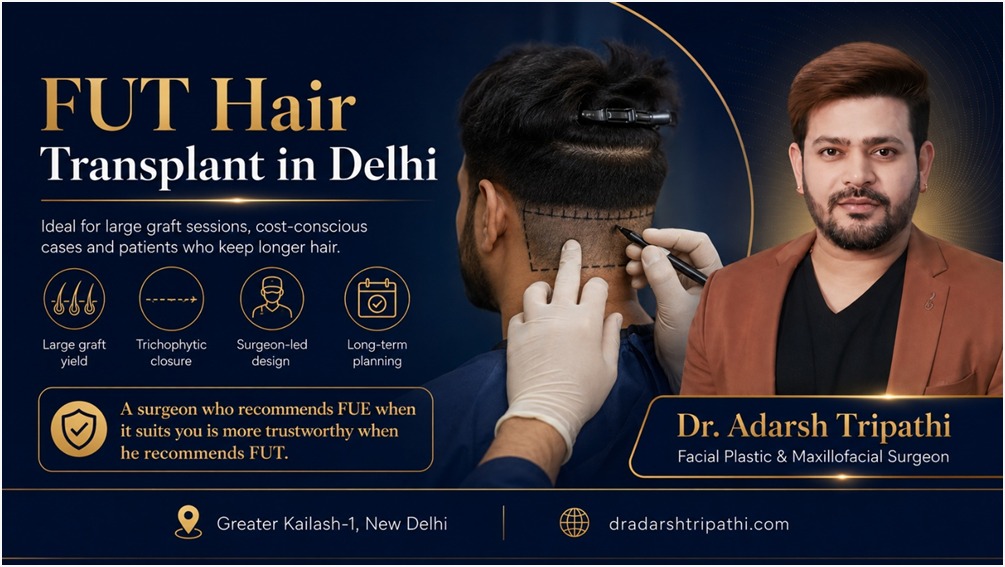
FUT Hair Transplant in Delhi — Strip-Method Hair Restoration for Maximum Graft Yield
FUT — Follicular Unit Transplantation, also called the strip method — is the older, proven technique that built modern hair transplant surgery. In FUT, a thin strip of donor scalp is surgically removed from the back of the head, the wound is closed with fine sutures (often using a refined technique called trichophytic closure that allows hair to grow through the resulting scar), and the strip is then dissected under microscope into thousands of individual follicular units for implantation. FUT was the dominant technique through the 2000s and remains the technique of choice for specific situations even as FUE has overtaken it for most candidates today.
Here’s the honest reality this page is built around: most hair transplant candidates in 2026 will be better served by FUE — the scarless technique covered separately on our dedicated FUE page. But FUT is genuinely the better choice for a specific group of patients, and this page is for them. Three situations where FUT genuinely wins: very LARGE cases where 4,000–6,000+ grafts are needed in a single session (FUT can yield more grafts in one visit than even motorised FUE); COST-CONSCIOUS large cases (FUT is typically Rs. 10–30 per graft cheaper than FUE, meaningful when graft counts run into thousands); and patients planning to ALWAYS keep longer hairstyles (4mm length or longer hides the linear FUT scar essentially completely). Outside these situations, FUE is usually the better choice — and any clinic pushing FUT for every patient is selling rather than advising.
Most clinic pages oversell whichever procedure they offer. We’d rather be honest about which technique suits which patient — because the wrong technique for the wrong patient is a result you live with forever. As a Maxillofacial and Facial Plastic Surgeon, Dr. Adarsh Tripathi performs both FUT and FUE, and recommends each only when it’s genuinely the right choice for that patient. The honest matching of technique to candidate is part of the value of a doctor-led consultation.
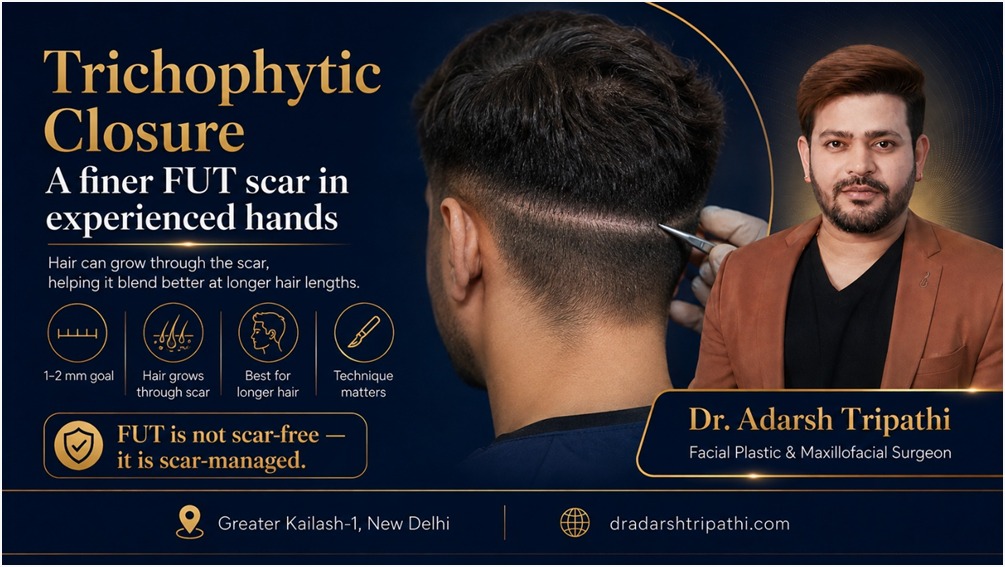
There’s a related insight rarely discussed: TRICHOPHYTIC CLOSURE — a refined closure technique developed specifically for FUT — allows hair to grow THROUGH the resulting linear scar, dramatically reducing its visibility. This is the modern refinement that addresses FUT’s main historical weakness. Without trichophytic closure, the linear scar can be a visible line. With proper trichophytic closure, it typically requires careful examination to find. Whether a clinic uses trichophytic closure (and how well they execute it) is a question worth asking. Dr. Tripathi uses trichophytic closure as standard practice.
Dr. Adarsh Tripathi is a Maxillofacial and Facial Plastic Surgeon with over 18 years of experience at Sarayu Clinics, Greater Kailash-1, New Delhi. This page covers FUT hair transplant in depth — what it is, when it’s the right choice (and when FUE is better), the procedure, trichophytic closure, the realistic 12–18 month timeline, cost, the FUT-vs-FUE comparison, what FUT can’t do, and how to choose the right FUT hair transplant doctor in Delhi.
Quick Answer — What is FUT hair transplant and what does it cost in Delhi?
FUT (Follicular Unit Transplantation), also called the strip method, is a hair transplant technique in which a thin strip of donor scalp (typically 1–1.5cm wide and 15–25cm long) is surgically removed from the back of the head and microscopically dissected into individual follicular units for implantation into areas of hair loss. The donor wound is closed with trichophytic closure — a refined technique that allows hair to grow through the resulting linear scar. In Delhi, FUT hair transplant costs Rs. 30–60 per graft, typically Rs. 60,000–2,50,000 total depending on graft count. FUT is the right choice for large cases (4,000–6,000+ grafts in a single session), cost-conscious large cases, and patients planning to keep longer hairstyles. Final results appear 12–18 months after surgery.
Benefits of FUT Hair Transplant — Where FUT Genuinely Wins
FUT has clear advantages over FUE for specific situations — even in 2026 when FUE dominates most cases. Here’s an honest list of where FUT delivers value:
- Highest single-session graft yield — 4,000–6,000+ grafts in a single procedure (mega session)
- Cost-effective for large cases — typically Rs. 10–30 per graft cheaper than FUE; meaningful at 3,000+ graft counts
- Maximum donor preservation — the strip is taken from the densest part of the donor area; FUE harvests from a wider area
- Microscopic dissection allows examination of every graft — each follicular unit is verified individually under microscope
- Less time-intensive per graft — once the strip is removed, dissection is efficient; FUE requires individual extraction of each follicle
- Predictable graft quality — strip excision under direct vision is less prone to follicle damage than blind FUE punch extraction
- Trichophytic closure makes the scar largely invisible at hair length 4mm+ (essentially any non-buzzed style)
- Repeatable for second sessions — additional strips can be taken in subsequent surgeries (with cumulative scar consideration)
- Established, well-studied technique with decades of outcome data
- Permanent results — transplanted follicles grow for life
An honest framing of FUT’s trade-offs: a linear scar remains across the donor area (typically 12–25cm long, 1–2mm wide with good closure technique) — invisible at hair length 4mm or longer, but limiting very short or buzzed haircuts permanently. Recovery is slower than FUE (10–14 days vs 5–7), with more post-operative discomfort due to the surgical wound under tension. The surgeon’s closure technique matters enormously — a poorly closed FUT can leave a wider, more visible scar. These trade-offs are why FUE has become more popular — but they’re acceptable trade-offs for the specific situations where FUT genuinely wins.
Areas Treated with FUT Hair Transplant
FUT is fundamentally a SCALP-to-SCALP procedure. Unlike FUE (which can harvest from chest, beard, or other body areas), FUT only takes its donor strip from the scalp. This limits FUT to scalp restoration as its primary application.
Scalp — Receding Hairline and Front
FUT can treat the receding hairline effectively, though FUE’s finer extraction is often preferred for the very front edge where 1-hair grafts are placed for the most refined look. With careful microscopic dissection, FUT can produce comparable hairline results — the quality depends on the dissection team’s precision in separating 1-hair, 2-hair, and 3-hair grafts.
Scalp — Crown and Vertex
FUT works well for crown restoration — the high graft yield allows substantial coverage of the whirl area in a single session. The crown typically uses 2-hair and 3-hair grafts that FUT dissection produces efficiently.
Scalp — Mid-Scalp and Vertex Combined
This is where FUT’s high-yield advantage matters most — covering the entire top of the scalp from frontal hairline through vertex requires substantial graft counts (4,000–6,000+), and FUT can deliver this in a single session more efficiently than FUE.
Female Hair Loss — Diffuse Thinning
FUT can be appropriate for selected female cases with adequate donor density. However, female pattern hair loss often involves a thinner donor area too, which can make the visible donor wound less ideal in females. FUE is more commonly chosen for females. Individual assessment is essential.
Repair of Old Transplants
FUT can be used to add density to areas of incomplete previous transplants. However, FUE is generally preferred for repair work because it allows more precise individual graft placement and can also extract from previous old plug grafts to recycle into the new design.
What FUT Cannot Treat ?
FUT cannot harvest from chest, beard, or body — these capabilities are exclusive to FUE. Patients needing body hair transplant supplementation should consider FUE or combined approaches. Eyebrow and beard transplants are also better done with FUE due to the smaller, finer graft requirements.
When FUT Is the Right Choice — Honest Candidate Selection ?
Choosing FUT over FUE is a deliberate decision based on specific clinical and personal factors. Here’s an honest framework:
FUT is genuinely the better choice if:
- You have ADVANCED hair loss (Norwood 5, 6, or 7) requiring 4,000+ grafts in a single session
- You want a MEGA SESSION (5,000–6,000+ grafts in one procedure) — FUT yields more per session than FUE
- You have GOOD scalp laxity — the back of your scalp is flexible enough to allow strip removal and closure without tension
- You ALWAYS plan to keep longer hairstyles (4mm length or longer) where the linear scar is hidden
- You’re COST-CONSCIOUS for a large case — FUT’s lower per-graft cost adds up at large graft counts
- You’re comfortable with 10–14 days of recovery and sutures
- You prefer the single-session efficiency vs FUE’s potentially staged approach
- Your donor area has high density (60+ follicular units per cm²) — denser donor means more grafts per cm of strip
FUE is probably better if you:
- Have mild to moderate hair loss (Norwood 2–4) — FUE handles these excellently
- Want to keep your hair short (buzz cuts, fade cuts) — the FUT scar will be visible
- Want faster recovery — FUE is 5–7 days vs FUT’s 10–14
- Are concerned about any donor scarring
- Want body hair transplant supplementation — only FUE can do this
- Have tight scalp (poor laxity) — would create a more visible FUT scar
- Prioritise minimal post-operative discomfort
Universal Hair Transplant Candidacy (FUE or FUT)
- Stable hair loss pattern over recent years
- Adequate donor area density
- Good general health, non-smoker or willing to stop for 4+ weeks
- No bleeding disorders or uncontrolled medical conditions
- Not on isotretinoin (wait 6 months after stopping)
- Realistic expectations and patience for the 12–18 month timeline
- Understanding that transplant doesn’t stop ongoing native hair loss
- Willingness to consider combined medical therapy (finasteride/minoxidil)
Important — even with FUT, the same realities apply
FUT moves bald-resistant follicles to bald areas. Like FUE, FUT does NOT stop ongoing native hair loss. The transplanted hair stays for life, but your non-transplanted native hair can continue to thin without medical therapy. The most successful FUT outcomes combine surgery (for the visible bald areas) with finasteride and/or minoxidil to preserve native hair. The 2–4 week shedding phase happens with FUT too — transplanted hair shafts shed at 2–4 weeks (normal) before regrowth begins around month 3–4. The ‘ugly duckling’ phase at months 2–3 is the same. None of this is FUT-specific or FUE-specific — it’s the biology of hair transplant.
The FUT Hair Transplant Procedure — Step by Step
Step 1: Consultation & Planning
Dr. Tripathi assesses your hair loss pattern (Norwood/Ludwig stage), donor area density and scalp laxity, family history, age, and goals. Photos are taken. Whether FUT or FUE suits you better is discussed honestly. If FUT is the right choice, the proposed strip dimensions are calculated based on graft count needed and donor density. Hairline design is created. Realistic timeline, recovery expectations, and budget are established.
Step 2: Pre-Operative Preparation
- Stop smoking at least 4 weeks before — critical for graft survival AND for the surgical wound healing
- Stop blood-thinning medications/supplements 1 week before (with doctor’s clearance)
- Pre-operative blood tests if not done recently
- Start minoxidil 4–6 weeks before if recommended
- Avoid alcohol for 48 hours before
- Wash hair the morning of the procedure with prescribed shampoo
- Eat a normal breakfast — procedure is under local anaesthesia, not general
- Wear comfortable button-front clothing
- Arrange transport home (taxi/Uber; no driving same day)
Step 3: Hairline Design Marking
On the procedure day, before any cutting, the hairline is designed in detail and marked on your scalp. Adjustments are made until you’re comfortable with the planned shape, height, and temple positions. This is your final opportunity to refine before extraction begins.
Step 4: Local Anaesthesia
Local anaesthesia is administered to the donor area (back of scalp where the strip will be removed) and recipient area. Initial injections feel like brief pinpricks; once numb, the rest of the procedure is essentially painless. Sedation can be added for anxious patients.
Step 5: Donor Strip Excision
A thin strip of donor scalp — typically 1–1.5cm wide and 15–25cm long depending on graft needs — is precisely excised from the densest part of the donor area at the back of the head. The strip dimensions are calculated to provide the planned graft count while preserving scalp closure tension within safe limits. Skilled excision removes follicles cleanly without damaging adjacent areas. Time required: 30–60 minutes.
Step 6: Trichophytic Closure — The Key Modern Refinement
This is where modern FUT differs from older techniques. The donor wound is closed with trichophytic closure — a refined closure technique in which the edges of the wound are slightly bevelled so that hair from the surrounding follicles can grow THROUGH the eventual scar line, dramatically reducing its visibility. The wound is closed in layers using fine absorbable sutures internally and fine non-absorbable sutures externally. Done well, trichophytic closure produces a scar that’s typically 1–2mm wide and largely camouflaged by hair growing through it. Time required: 30–60 minutes.
Step 7: Microscopic Strip Dissection
While Dr. Tripathi prepares the recipient area, the surgical team — under microscopes — carefully dissects the excised strip into individual follicular units. Each follicular unit (containing 1–4 hairs) is separated using fine instruments under microscope magnification. Grafts are categorised by hair count (1-hair for hairline, 2-hair for transition, 3-hair and 4-hair for density). Damaged grafts are discarded. This careful microscopic dissection is one of FUT’s quiet advantages — every graft is examined and verified individually. The team typically processes 800–1,500 grafts per hour. Time required: 2–4 hours.
Step 8: Recipient Site Creation
Dr. Tripathi personally creates the recipient incisions in the planned hairline and treatment areas. Angle determines how hair will grow; density determines coverage; irregularity determines naturalness. The same aesthetic principles apply as in FUE — the technique for making recipient sites is independent of whether grafts came from FUE extraction or FUT strip dissection.
Step 9: Graft Placement
Each follicular unit is placed individually into the prepared sites by the surgical team with Dr. Tripathi placing critical front-line grafts and overseeing throughout. Single-hair grafts are placed at the very front, 2-hair grafts behind for transition, 3-hair and 4-hair grafts in the bulk for density. Direction and angle match surrounding hair. This phase takes 2–4 hours.
Step 10: Post-Procedure Care
After all grafts are placed, both the donor area (with sutures) and recipient areas are gently cleaned. Mild antibiotic ointment is applied. A donor area bandage may be worn for the first 24 hours (unlike FUE which doesn’t need one). Detailed aftercare instructions are given. You leave the clinic the same day. Total procedure time: 8–12 hours for moderate cases with breaks; mega sessions (5,000+ grafts) may run the full day.
Trichophytic Closure — The Refinement That Modernised FUT
This section deserves its own space because it’s the single biggest reason FUT scars in 2026 are much less visible than FUT scars from 15 years ago — and most clinic pages skip past it without explanation.
What Is Trichophytic Closure?
‘Trichophytic’ means ‘hair-growing’. Trichophytic closure is a wound closure technique developed specifically for FUT in which the surgeon slightly bevels the edges of the donor wound so that hair follicles at the wound edges can grow THROUGH the resulting scar line rather than parallel to it. The hair growing through the scar effectively camouflages the scar — making the linear donor mark much less visible.
How Trichophytic Closure Differs from Older Closure
In older FUT closure technique, the wound edges were brought together cleanly — producing a clean linear scar but with no hair growing through it. The scar was clearly visible whenever hair was short enough to expose it. In trichophytic closure, the upper edge of the wound is shaved slightly (1–2mm) before suturing, so that follicles at the lower edge grow up and through the scar tissue. The result: a scar with hair growing through it, much less visible.
Variants of Trichophytic Closure
- Upper-edge trichophytic closure (most common) — upper edge bevelled, lower edge follicles grow up through scar
- Lower-edge trichophytic closure — opposite direction, less commonly used
- Double trichophytic closure — both edges bevelled, even more growth through scar
What Trichophytic Closure Achieves
With trichophytic closure done well, the resulting FUT scar:
- Is typically 1–2mm wide (versus 3–5mm without trichophytic closure)
- Has hair growing through it, camouflaging the scar line
- Is largely invisible at hair length of 4mm or longer (essentially any non-buzzed style)
- Requires careful examination to identify
- Allows patients to maintain most hairstyles including most short crops (just not full buzz cuts)
What Trichophytic Closure Doesn’t Achieve
- Doesn’t eliminate the scar — only camouflages it
- Doesn’t allow full buzz cuts (length under 2–3mm will show the scar)
- Quality depends on surgeon’s skill — poorly executed trichophytic closure works no better than regular closure
- Requires good wound healing — smokers and patients with healing issues get less benefit
This is one of the technical questions worth asking any FUT surgeon: ‘Do you use trichophytic closure?’ and ‘How visible are your typical donor scars at 5mm hair length?’ The answers tell you a great deal about the quality of FUT you’ll receive.
Downtime & Recovery After FUT Hair Transplant
FUT recovery is notably longer than FUE recovery because of the surgical wound that must heal — typically 10–14 days vs 5–7 for FUE. Here’s the honest timeline:
Days 1–3
Mild swelling around the forehead is common — peaks at day 3, then resolves. Donor area is tender across the suture line — typically more uncomfortable than FUE’s donor area. Recipient sites have tiny scabs (do not pick). Take prescribed antibiotics, anti-inflammatory medications, and pain relief. Sleep with head elevated and AVOID sleeping on the back (the donor wound). No vigorous activity. The bandage on the donor area is typically removed at day 1 follow-up.
Days 4–7
Recipient scabs gradually shed as you gently wash according to instructions. Donor area gradually less tender but still avoid pressure. Most patients return to desk work around day 5–7, often wearing a hat for confidence.
Days 10–14 — Suture Removal
This is FUT-specific. The external sutures are removed at the clinic at day 10–14 (timing depends on closure tension and individual healing). Removal is quick and almost painless. Internal absorbable sutures dissolve on their own over weeks. After suture removal, donor area appearance significantly improves.
Weeks 2–4 — The Shedding Phase (NORMAL)
Same as FUE — transplanted hair shafts shed 2–4 weeks after surgery. The follicle remains alive in the scalp. Don’t panic — this is normal and expected.
Months 2–3 — Ugly Duckling Phase
Same as FUE — no visible new growth yet; may look thinner than before surgery. Temporary.
Months 3–6 — Regrowth Begins
New hair emerges, initially fine and wispy. By month 6, around 50% of final result visible.
Months 6–12 — Steady Improvement
Hair thickens and gains length. By 12 months, approximately 90% of final result is visible.
Months 12–18 — Final Mature Result
Density and texture fully mature. The transplanted hair behaves like normal hair for life.
Donor Scar Evolution Over Time
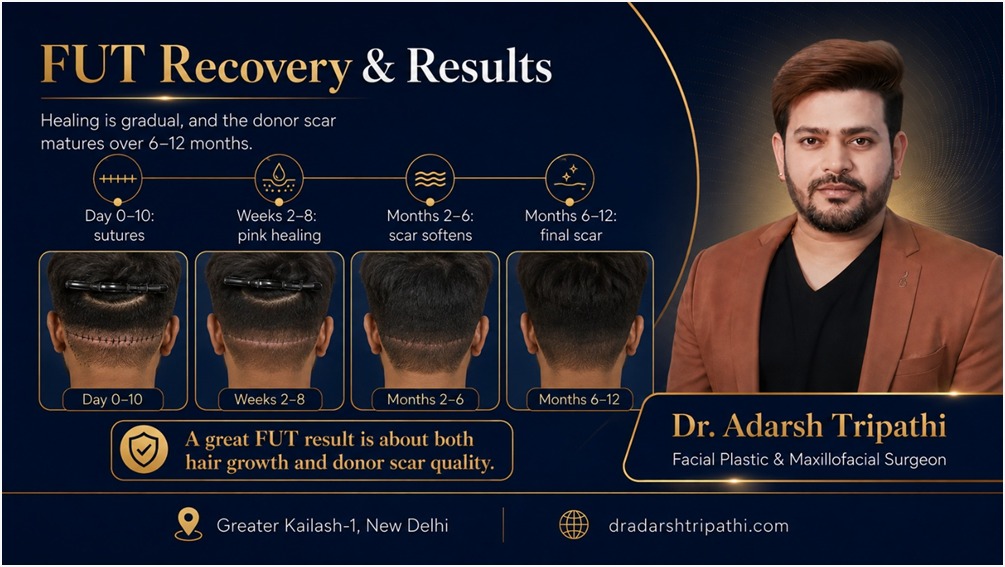
FUT-specific timeline for the donor scar:
- Day 0–10: Sutures visible (then removed)
- Weeks 2–8: Scar pink/red, slightly raised
- Months 2–6: Scar gradually flattens and fades to pale
- Months 6–12: Scar reaches final mature appearance — typically 1–2mm wide pale line with hair growing through (trichophytic closure)
- After 12 months: Stable; very minor further fading possible
FUT-Specific Recovery Considerations
- Sleep face-up (not on the back of your head) for at least 10 days
- Avoid bending, lifting, straining — increases tension on the donor wound
- No heavy exercise for 2–3 weeks
- Suture removal appointment at day 10–14
- Donor area tenderness can last 2–4 weeks (longer than FUE)
- Avoid pressure on the donor area for several weeks
- Some numbness in the area above the donor wound is normal for several months
Standard Recovery Essentials (FUT or FUE)
- First gentle washing typically day 3–4 with prescribed shampoo
- No picking at scabs
- No swimming, saunas, gym for 2–3 weeks
- No direct sun exposure to scalp for 2 weeks; SPF afterward
- No alcohol for 5 days; no smoking for 4+ weeks
- Take all prescribed medications
- Don’t expect visible new growth before 4 months
- Trust the process
FUT Hair Transplant Cost in Delhi — Transparent Pricing
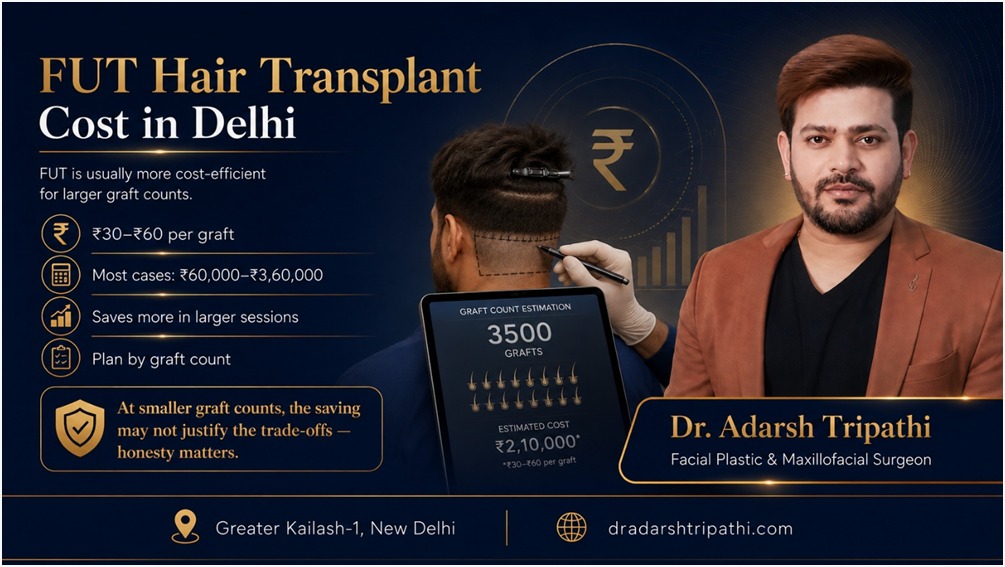
FUT pricing is typically per-graft, with FUT generally Rs. 10–30 per graft cheaper than FUE because the extraction is more efficient per graft once the strip is removed. For large cases, this per-graft saving adds up significantly.
Approximate Cost at Sarayu Clinics, Delhi
Procedure | Per-Graft Cost | Typical Grafts | Total Cost Range |
Standard FUT | Rs. 30–60 | 2000–4500 | Rs. 60,000–2,70,000 |
FUT Mega Session (large yield) | Rs. 30–55 | 4500–6500 | Rs. 1,35,000–3,60,000 |
FUT for Advanced Loss (Norwood 5-7) | Rs. 30–55 | 4000–6500 | Rs. 1,20,000–3,60,000 |
FUT Crown Restoration | Rs. 30–60 | 1500–3000 | Rs. 45,000–1,80,000 |
FUT + Trichophytic Closure (standard) | Included | — | No additional cost |
FUT + Later FUE Scar Camouflage | Rs. 30–80 | Combined | Customised plan |
FUT Repair of Old Transplant | Customised | Variable | Customised |
PRP Therapy (adjunct) | Per session | — | Rs. 6,000–15,000 |
Prices shown are for guidance only. Your final treatment cost will be confirmed during the initial consultation, based on your individual needs, concerns, and personalised treatment plan.
FUT vs FUE — Cost Comparison at Different Graft Counts
Graft Count | FUT Estimate | FUE Estimate | FUT Savings |
1500 grafts | Rs. 45,000–90,000 | Rs. 60,000–1,20,000 | Rs. 15,000–30,000 |
2500 grafts | Rs. 75,000–1,50,000 | Rs. 1,00,000–2,00,000 | Rs. 25,000–50,000 |
3500 grafts | Rs. 1,05,000–2,10,000 | Rs. 1,40,000–2,80,000 | Rs. 35,000–70,000 |
5000 grafts | Rs. 1,50,000–3,00,000 | Rs. 2,00,000–4,00,000 | Rs. 50,000–1,00,000 |
6500 grafts | Rs. 1,95,000–3,60,000 | Rs. 2,60,000–5,20,000 | Rs. 65,000–1,60,000 |
The cost difference matters most at higher graft counts — at 5,000 grafts, FUT can save Rs. 50,000–1,00,000 over FUE. This is the genuine financial case for FUT at large case sizes. At smaller graft counts (1,500–2,500), the saving is modest and may not be worth FUT’s recovery and scar trade-offs for most patients.
Why a doctor-led FUT is worth more than a budget FUT
FUT’s quality depends critically on three things the surgeon does personally: the strip excision (must be precise and minimise unnecessary tissue removal), the trichophytic closure (skilled execution makes the scar largely invisible; poor closure leaves a visible line), and the recipient site creation (the aesthetic dimension). Clinics that delegate these to non-surgeon staff can produce wider, more visible donor scars and less refined hairlines. Ask before booking: ‘Who personally performs the strip excision and closure?’ and ‘Who creates the recipient incisions?’ The answers tell you whether you’re getting refined FUT or cost-cutting FUT.
Results Timeline — Realistic Expectations Across 12-18 Months
FUT results follow the same biological timeline as FUE — because the follicles themselves behave identically once placed. The difference is the donor area recovery, which takes longer for FUT.
Same Day
Hairline design placed; donor wound sutured. NOT what your final result looks like.
Week 1
Scabs at recipient sites shed gradually. Donor area healing; sutures still in place.
Days 10–14
Suture removal. Donor area appearance improves significantly.
Weeks 2–4 — Shedding Phase (NORMAL)
Transplanted hair sheds. Follicle remains alive. Completely normal.
Months 2–3 — Ugly Duckling Phase
No visible new growth; may look thinner than before surgery.
Months 4–6 — Regrowth
New hairs emerge. Around 50% of final result by month 6.
Month 9–12 — Near Final
Around 90% of final result by month 12.
Month 12–18 — Final Mature Result
Density and texture fully mature. Transplanted hair is permanent.
Donor Scar Maturation Timeline
Specific to FUT: the donor scar evolves over the first 6–12 months from a pink, slightly raised line to its final pale, flat appearance — typically 1–2mm wide with hair growing through (trichophytic closure). By month 12 the scar reaches its final stable appearance and is largely invisible at hair length 4mm+.
How Long Do FUT Results Last?
The transplanted hair is permanent — these follicles are genetically resistant to balding and grow for life. Your NATIVE non-transplanted hair can continue thinning over years, which is why most surgeons recommend combining FUT with medical therapy (finasteride for men, minoxidil for both sexes) to preserve native hair.
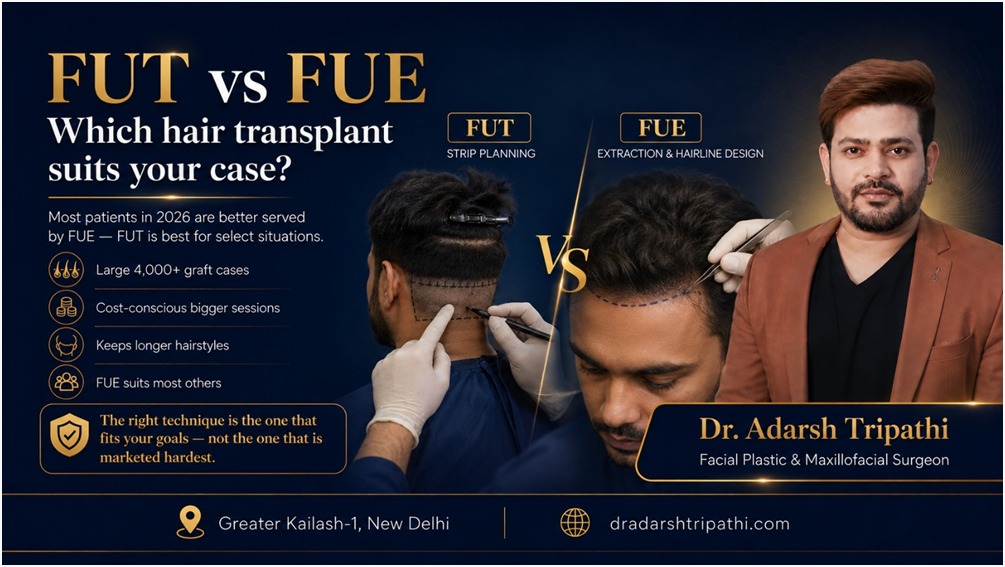
FUT vs FUE — The Direct Honest Comparison
This is the question every hair transplant patient asks. Here’s the honest answer — including when each genuinely wins.
Factor | FUT | FUE |
Extraction method | Single strip excision | Individual punches |
Donor scar | Linear scar 1-2mm wide | Tiny invisible dots |
Suitable for short hair | No (scar visible under buzz) | Yes (including buzz cuts) |
Recovery time | 10–14 days | 5–7 days |
Sutures | Yes (removed day 10-14) | No |
Post-op discomfort | Moderate (wound under tension) | Mild |
Maximum graft yield/session | 6,000+ | 4,000–4,500 |
Cost per graft | Rs. 30–60 | Rs. 40–80 |
Donor area appearance | Strip removed once | Wider extraction area |
Body hair transplant | Cannot harvest body hair | Can harvest body hair |
Best for | Large cases, cost, longer hair | Most other cases |
Microscopic graft dissection | Yes (advantage) | Not applicable |
Trichophytic closure refines result | Yes — modern standard | Not applicable |
Choose FUT When:
- Norwood 5-7 advanced loss requiring 4,000+ grafts in single session
- Mega session (5,000–6,000+ grafts) needed
- Cost-conscious large case
- Planning to always keep hair length 4mm+
- Good scalp laxity
- Want microscopic dissection quality verification of every graft
Choose FUE When:
- Mild to moderate loss (Norwood 2-4)
- Plan to keep short hair or might in the future
- Want fastest recovery
- Want minimal post-operative discomfort
- Want body hair transplant option
- Want repair work or refined hairline only
- Tight scalp (poor laxity for FUT)
The Combined Approach — FUT Now, FUE Later
Here’s a strategy worth knowing: some patients benefit from FUT for the bulk graft yield in the first session, followed by FUE in a subsequent session to (a) add detail/refinement, (b) provide further density, or (c) place FUE grafts INTO the FUT donor scar to camouflage it further. This combined approach gives the best of both — maximum yield from FUT, scarless additions from FUE, and the FUT scar concealed by later FUE grafts. A flexible strategy for advanced cases.
Why a Facial Plastic Surgeon for FUT ?
FUT execution requires specific surgical skills — strip excision technique, layered wound closure including trichophytic closure, and the same hairline-design aesthetic judgement that matters for FUE. A facial plastic surgeon brings the surgical sophistication for the strip and closure (more technically demanding than FUE extraction) plus the facial-aesthetic eye for hairline design. The combination of surgical and aesthetic skills is what produces good FUT outcomes — minimised donor scarring AND natural-looking hairlines.
Why Dr. Adarsh Tripathi Is a Trusted FUT Hair Transplant Doctor in Delhi ?
FUT outcomes depend on three things: honest candidate assessment (recommending FUT only when it’s genuinely the right choice), the surgeon’s personal execution of critical steps (strip excision, trichophytic closure, recipient site creation), and aesthetic judgement on hairline design. Here’s how to choose, and why patients choose Dr. Tripathi:
What to Look For in an FUT Hair Transplant Surgeon ?
- Medical qualification — facial plastic, plastic, or dermatological surgeon (NOT ‘hair technician’)
- HONEST recommendation — FUT only when it genuinely suits the case, FUE when that’s better
- Trichophytic closure as standard practice
- Surgeon’s PERSONAL execution of strip excision and closure (not delegated)
- Personal involvement in hairline design and recipient incision creation
- Discussion of medical therapy (finasteride/minoxidil) alongside surgery
- Realistic graft count and conservative donor area management
- Natural hairline design — facial-aesthetic positioning
- Clinical (not salon) facilities; transparent pricing; no high-pressure sales
Dr. Tripathi’s Credentials
- Maxillofacial and Facial Plastic Surgeon with 18+ years of experience
- Facial aesthetic expertise — daily work on facial proportion and hairline-to-face relationships
- Performs both FUT and FUE — recommends each only when genuinely the right choice
- Trichophytic closure as standard practice for FUT
- Personal execution of strip excision, closure, and recipient site creation
- Honest about realistic outcomes, timeline, future loss, and combined approach
- Conservative donor area management
- Consultations personally conducted by Dr. Tripathi
The Hairline Design Philosophy
Dr. Tripathi’s approach to hair transplant — FUT or FUE — is built on facial aesthetics first. The hairline shape, height, irregularity, and density gradient are designed to suit YOUR face. The technical execution (FUT or FUE) follows the design. The result is hairlines that look natural on the face — not transplanted lines stitched on top.
Frequently Asked Questions — FUT Hair Transplant in Delhi
Q: Who is the best FUT hair transplant surgeon in Delhi?
A: The best FUT hair transplant surgeon in Delhi for you is a medically qualified specialist — ideally a facial plastic, plastic, or dermatological surgeon — who honestly recommends FUT only when genuinely appropriate (not for every case), uses trichophytic closure as standard, personally performs the strip excision and closure, and creates recipient incisions himself rather than delegating. Dr. Adarsh Tripathi is a Maxillofacial and Facial Plastic Surgeon with 18+ years of experience who performs FUT with trichophytic closure when it’s the right choice for the patient — and recommends FUE when that suits better.
Q: What is FUT hair transplant?
A: FUT (Follicular Unit Transplantation), also called the strip method, is a hair transplant technique in which a thin strip of donor scalp (typically 1–1.5cm wide and 15–25cm long) is surgically removed from the back of the head, microscopically dissected into individual follicular units, and implanted into areas of hair loss. The donor wound is closed with trichophytic closure — a refined technique allowing hair to grow through the resulting scar. FUT is best for large cases requiring 4,000–6,000+ grafts in a single session.
Q: How much does FUT hair transplant cost in Delhi?
A: FUT hair transplant in Delhi costs approximately Rs. 30–60 per graft, typically Rs. 60,000–3,60,000 total depending on graft count. Mega sessions (5,000–6,500 grafts for advanced Norwood 5-7 loss) range Rs. 1,50,000–3,60,000. FUT is typically Rs. 10–30 per graft cheaper than FUE, which becomes meaningful at large graft counts — savings of Rs. 50,000–1,00,000 are common at 5,000 grafts. A personalised quote follows consultation at Sarayu Clinics.
Q: Is FUT better than FUE hair transplant?
A: FUT is better than FUE for SPECIFIC situations: large cases needing 4,000+ grafts in a single session, mega sessions of 5,000–6,000+ grafts, cost-conscious large cases, and patients planning to always keep longer hair (4mm length or longer). For most other situations — mild to moderate loss, patients wanting short hair, faster recovery, body hair transplant option — FUE is the better choice. Neither is universally superior; the right choice depends on YOUR case, goals, and preferences.
Q: What is trichophytic closure in FUT?
A: Trichophytic closure is a refined wound closure technique developed specifically for FUT in which the surgeon slightly bevels the edges of the donor wound so that hair follicles can grow THROUGH the resulting linear scar, dramatically reducing its visibility. The hair growing through the scar effectively camouflages it. Modern FUT performed with trichophytic closure produces a scar typically 1–2mm wide and largely invisible at hair length of 4mm or longer (essentially any non-buzzed hairstyle).
Q: How visible is the FUT donor scar?
A: The FUT donor scar’s visibility depends on the closure technique used. With modern trichophytic closure performed well, the resulting scar is typically 1–2mm wide with hair growing through it — largely invisible at hair length of 4mm or longer (essentially any non-buzzed style). Without trichophytic closure or with poor technique, the scar can be wider (3–5mm) and visible even with longer hair. Asking specifically about a surgeon’s trichophytic closure standard is one of the most important questions before choosing FUT.
Q: How long is recovery after FUT hair transplant?
A: FUT recovery is typically 10–14 days for the visible healing — sutures are removed at day 10–14, donor area tenderness gradually settles, and most patients return to work around day 7–10 depending on their job. Compared to FUE’s 5–7 day recovery, FUT takes longer because of the surgical wound that must heal. The actual hair growth timeline (shedding at 2–4 weeks, regrowth at 3–6 months, final result at 12–18 months) is the same as FUE.
Q: Is FUT hair transplant painful?
A: FUT hair transplant is essentially painless during the procedure itself because local anaesthesia is used. After the procedure, mild-to-moderate donor area discomfort lasts 3–7 days (more than FUE because of the surgical wound under tension) and is managed with prescribed pain medication. Most patients describe FUT post-operative discomfort as manageable but more noticeable than FUE. The recipient area discomfort is similar for both techniques — typically mild.
Q: Can FUT yield more grafts than FUE in one session?
A: Yes — FUT can yield more grafts in a single session than FUE. FUT mega sessions can produce 5,000–6,000+ grafts in one visit; motorised FUE typically maxes out around 4,000–4,500 grafts per session. For advanced loss (Norwood 5-7) requiring maximum coverage, FUT’s high-yield advantage matters. For smaller cases, the FUT yield advantage is less relevant.
Q: Can I get FUT and then FUE later?
A: Yes — a combined approach using FUT first (for bulk graft yield) followed by FUE in a later session (for refinement, additional density, or camouflaging the FUT scar) is a valid strategy for some advanced cases. FUE grafts placed into the FUT donor scar can further reduce scar visibility. The combined approach gives the best of both techniques: FUT’s maximum yield + FUE’s scarless additions and scar camouflage capability.
Q: Will FUT stop my native hair from thinning further?
A: No — FUT does not stop ongoing native hair loss. Like all hair transplant techniques, FUT moves bald-resistant follicles to bald areas. The transplanted hair stays for life, but your non-transplanted native hair can continue thinning without medical therapy. The most successful FUT outcomes combine surgery with finasteride (for men) and/or minoxidil (for both sexes) to preserve native hair. Without this combined approach, your FUT result may be surrounded by progressively thinning native hair over the years.
Q: How do I choose the best FUT hair transplant doctor in Delhi?
A: Choose a FUT doctor who is medically qualified (facial plastic, plastic, or dermatology surgeon), who HONESTLY tells you whether FUT or FUE suits your case better (rather than recommending FUT regardless), who uses trichophytic closure as standard, who personally performs the strip excision and closure (not delegated), who creates recipient incisions himself, who discusses combined medical therapy alongside surgery, and who operates in clinical (not salon) facilities. Asking ‘is FUE actually better for my case?’ tests whether the surgeon will give an honest answer.
How to Reach Us:
Phone:+91 9289111083 ,+91 9289111084
Dr Adarsh’s website: https://dradarshtripathi.com/
Facebook: https://www.facebook.com/DrAdarshTripathi3011
Instagram: https://www.instagram.com/dr_adarsh_tripathi/
Youtube: https://www.youtube.com/@dr_adarsh_tripathi
Linkedin: https://www.linkedin.com/in/dr-adarsh-tripathi-a43005b8/
Online Booking: https://dradarshtripathi.com/contact-us/ to schedule appointments conveniently.