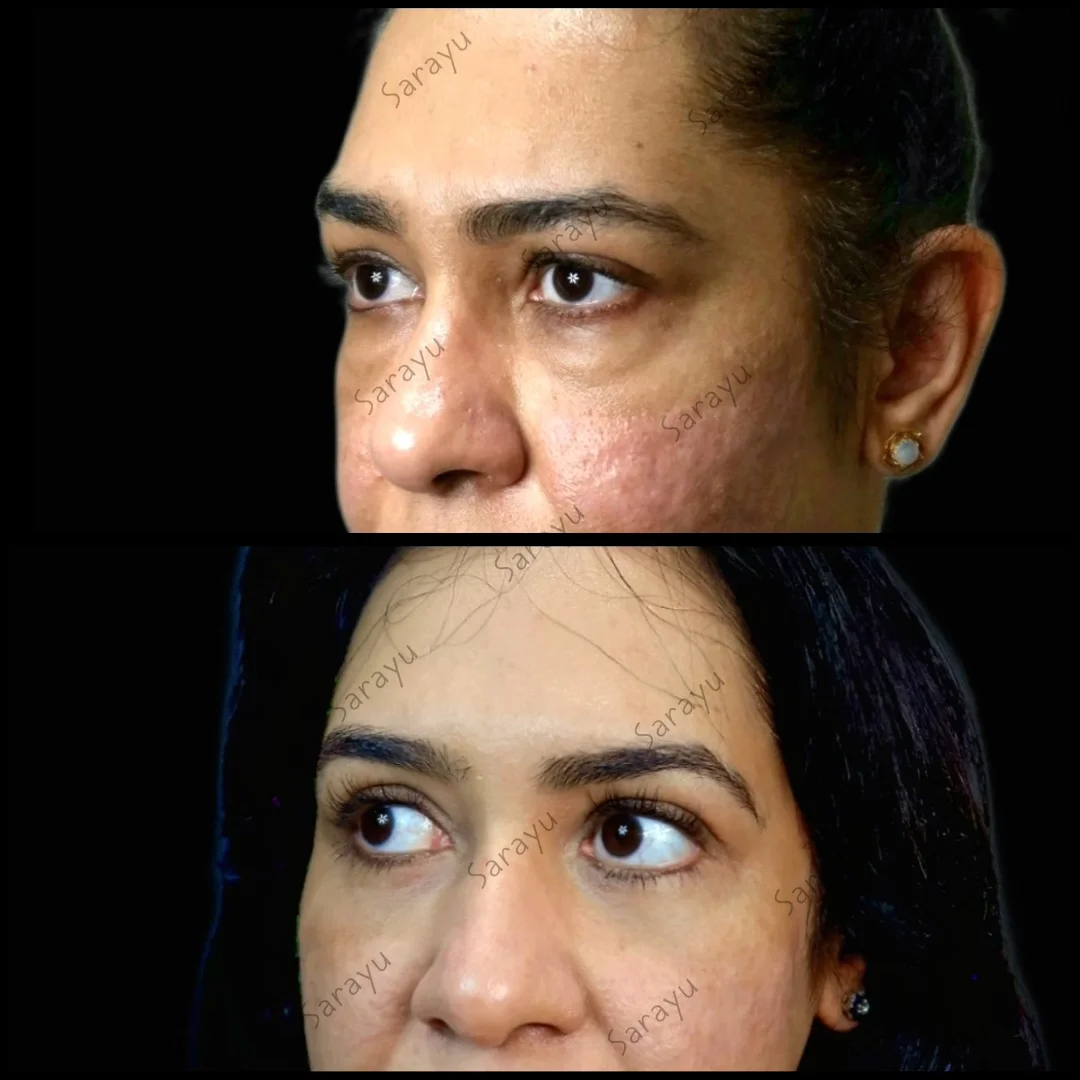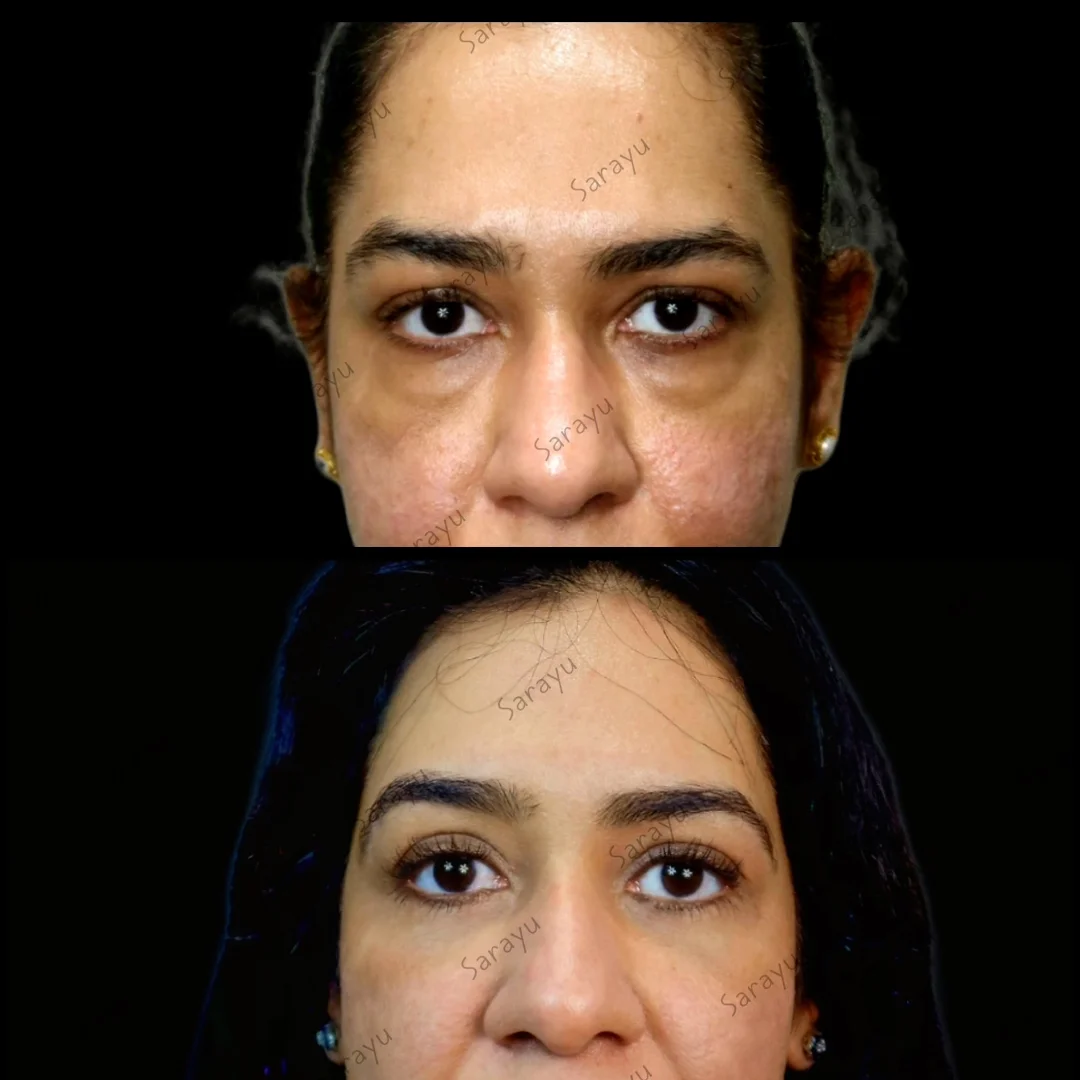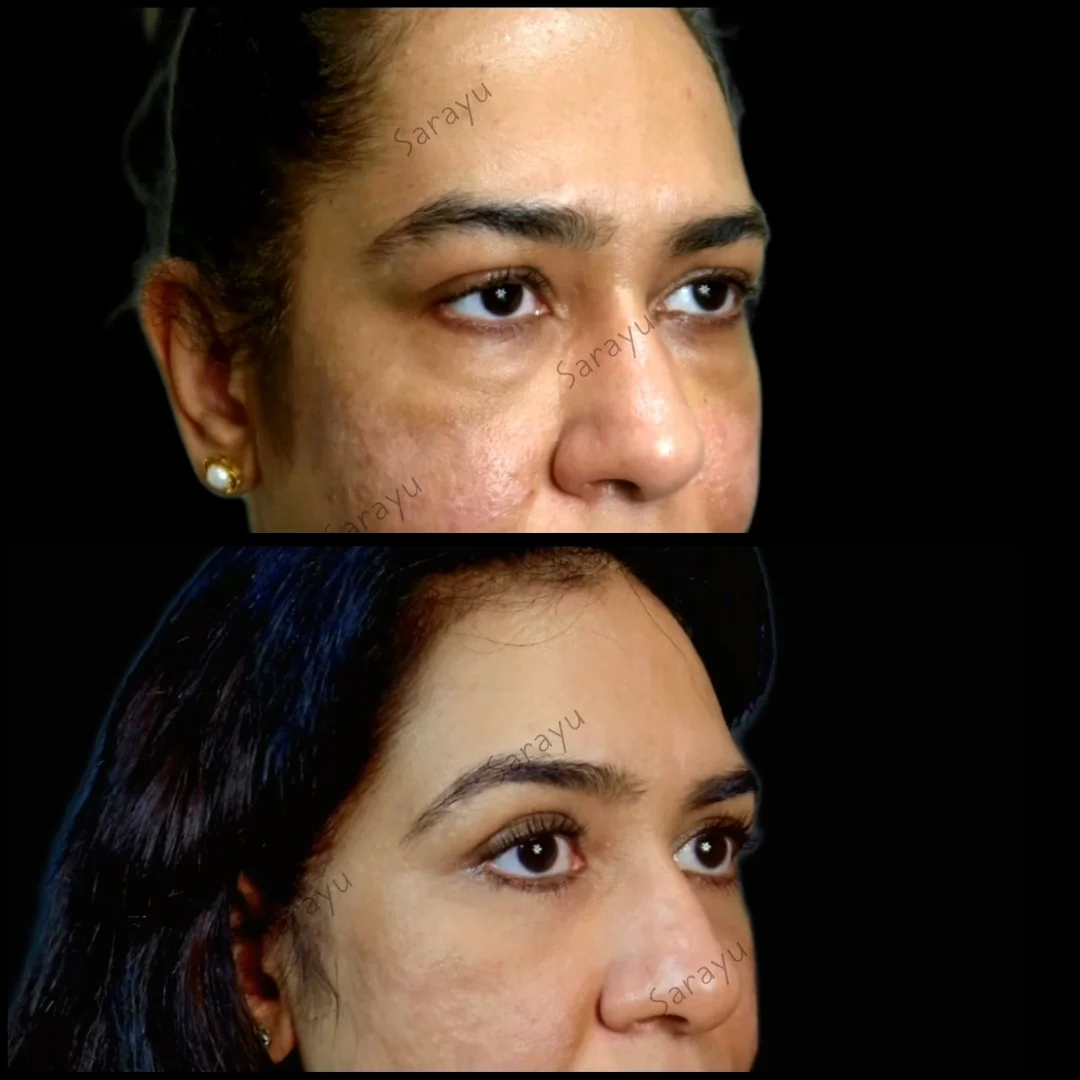
Blepharoplasty (Eyelid Surgery) in Delhi
Quick answer : Blepharoplasty — eyelid lift surgery — removes or repositions the excess skin, fat and muscle that make eyes look hooded, puffy or tired. At Sarayu Clinics, Greater Kailash-1, it is a 1–2 hour procedure under local anaesthesia with sedation, costs Rs 50,000–Rs 1,50,000 depending on whether upper, lower or both eyelids are treated, and has most people back at work in 7–10 days. Results typically last 8–10 years or more.
“You look tired.” If you hear that on days you slept perfectly well, your eyelids are usually the reason. The skin around the eyes is the thinnest on the body, and years of Delhi screens, sun, late hours and simple genetics show up here first — as hooding that swallows your eyelid crease, puffiness under the eyes, or lids heavy enough to rest on your lashes by evening. Creams cannot remove skin that is already stretched. Surgery can, and done well, it is one of the most quietly transformative procedures in facial plastic surgery: nobody says “you had work done”; they say you look like you finally took a holiday.
I am Dr. Adarsh Tripathi , facial plastic and maxillofacial surgeon at Sarayu Clinics, Greater Kailash-1. This page covers everything I discuss in an eyelid consultation: what blepharoplasty can and cannot fix, the crucial difference between excess skin and a truly droopy eyelid (they need different operations), the types of eyelid surgery we perform, real recovery, honest risks, cost, and the non-surgical alternatives — because some eyes need those instead.
One Procedure, Several Names — and One Important Exception
Blepharoplasty, eyelid surgery, eyelid lift and eyelid rejuvenation all describe the same operation: removing or repositioning excess tissue of the upper or lower eyelids. The exception is the phrase “droopy eyelid”. Sometimes it means loose skin folding over the lash line — classic blepharoplasty territory. But sometimes the eyelid margin itself sits too low over the eye because the lifting muscle has weakened — that is ptosis, and it needs a muscle-tightening repair, not just skin removal. The distinction changes the operation, the result and the cost, so it gets its own section below — and its own assessment in every consultation here.
What Eyelid Surgery Can — and Cannot — Do ?
Can:
- Remove hooded, sagging upper-lid skin and restore a visible, natural crease.
- Remove or reposition the fat pockets that cause under-eye bags, smoothing the lid-cheek junction.
- Open up the visual field when drooping skin genuinely blocks side vision (functional blepharoplasty).
- Make eyes look rested, more open and younger — while still unmistakably yours.
Cannot:
- Erase dark-circle pigmentation — surgery removes the shadow cast by bags, not brown pigment in the skin; that responds to laser toning and skin boosters .
- Remove crow’s feet or forehead lines — that is Botox territory, often combined with surgery.
- Lift a heavy, descended brow — a brow that has dropped needs brow-level treatment; operating only on the lid under it disappoints.
- Stop future ageing — it resets the clock roughly a decade; it does not freeze it.
The Droopy Eyelid Question: Blepharoplasty or Ptosis Repair?
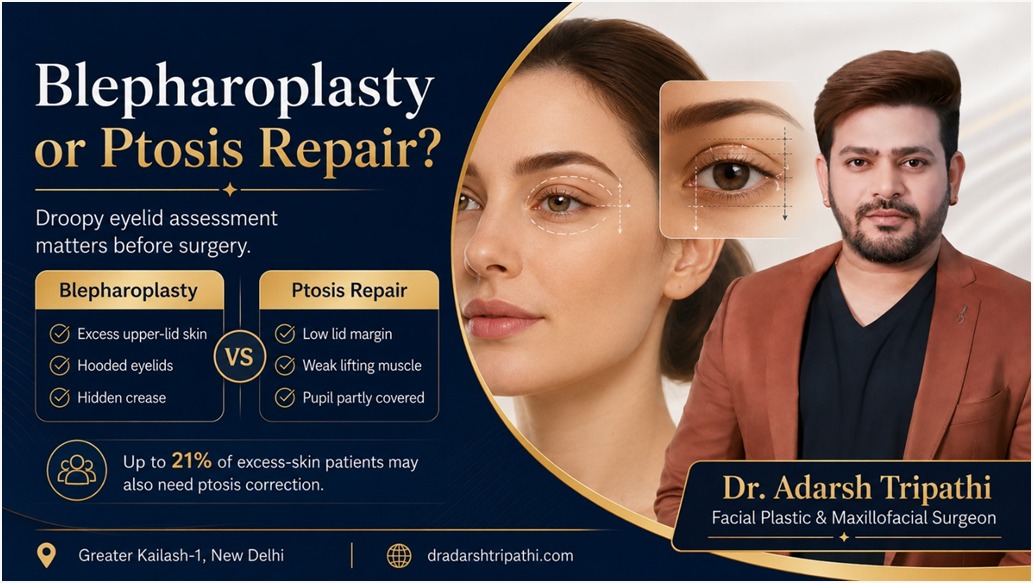
This is the section most Delhi clinics skip, and it matters more than any other on this page. Two different problems produce a “droopy eyelid”. Dermatochalasis is excess, stretched skin folding down over the lashes — the lid margin itself is at the right height, and blepharoplasty fixes it. Ptosis is the lid margin sitting too low over the coloured part of the eye because the levator muscle that lifts the lid has stretched or slipped — and removing skin does nothing for it. Published work is blunt on this: a 2024 review of 278 patients presenting for routine “excess skin” surgery found up to 21% also needed ptosis correction, and the classical literature warns that doing blepharoplasty alone on a ptotic lid can make the droop look worse afterwards.
So at your consultation we measure, not guess: lid height over the pupil, crease position, muscle function, and photographs with your brows relaxed (raised brows hide ptosis). If it is skin, we plan blepharoplasty. If there is a muscle component, the plan includes ptosis correction — assessed and quoted honestly. Getting this diagnosis right before surgery is what “droopy eyelid surgeon” should actually mean.

Types of Blepharoplasty We Perform
Upper Eyelid Surgery
The workhorse: a sliver of excess skin (and, when needed, a little fat) is removed through an incision hidden precisely in the natural crease. Restores the crease, un-hoods the eye, and takes about an hour for both sides.
Lower Eyelid Surgery
Targets under-eye bags and loose skin. Depending on your anatomy, fat is removed or — better in many cases — repositioned to fill the hollow beneath the bag, smoothing the whole lid-cheek transition rather than leaving a scooped look.
Scarless (Transconjunctival) Lower Blepharoplasty
For younger patients whose problem is purely the fat pocket, the entire correction is done through the inside of the eyelid — no external incision, no visible scar at all. Sometimes paired with a conservative skin-pinch when a few millimetres of loose skin remain.
Combined (Four-Lid) Blepharoplasty
Upper and lower lids in one sitting — one anaesthesia, one recovery, one balanced result. The most common choice for patients in their 50s and 60s.
Tear-Trough Fat Grafting
Where hollowness, not just bags, ages the eyes, we transfer a small amount of your own fat to the tear trough — alone or with lower-lid surgery — for a smooth, rested junction. More on fat grafting.
Functional Blepharoplasty
When hooding is heavy enough to block side vision — patients describe lifting their brows all day or tilting their head back to see — surgery is not cosmetic, it is functional. The American Academy of Ophthalmology’s evidence review concluded that repairing drooping lids and excess skin significantly improves vision, peripheral vision and quality of life. We document the visual-field impact for these cases.
Concerns Eyelid Surgery Can Address
- Hooded, heavy upper lids: skin folding onto the lashes; a crease that disappeared years ago; eyeliner that vanishes when you open your eyes.
- The permanent tired look: being asked if you are sleepy, unwell or upset when you feel fine.
- Under-eye bags and puffiness: fat pockets that no amount of sleep, water or eye cream changes.
- Blocked side vision: the functional cases above — more common after 60 than most people realise.
- Asymmetry: one lid heavier or lower than the other, in photos and in the mirror.
- A truly droopy lid margin: possible ptosis — diagnosed and addressed as described above, not hidden inside a skin-only operation.
Blepharoplasty Surgery in Delhi: Step by Step
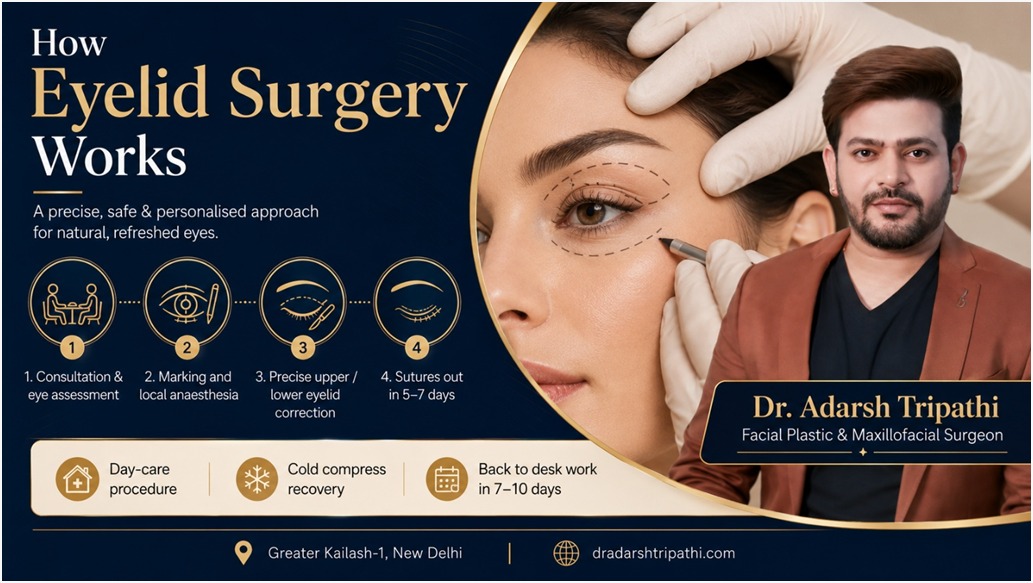
Step 1 — Consultation and eye assessment
We examine skin quality, fat pockets, lid height, muscle function and tear film, screen for dry eye and relevant medical history, and photograph everything. You see exactly what is skin, what is fat, what is muscle — and which operation (if any) fits. You leave with a written plan and cost.
Step 2 — Anaesthesia
Local anaesthesia with light sedation for most cases — you are comfortable, drowsy and feel nothing at the lids; general anaesthesia is reserved for combined longer procedures. Either way, it is day-care: home the same evening.
Step 3 — Precise incisions and correction (1–2 hours)
Incisions are hidden in the upper crease, just under the lower lash line, or inside the lid (scarless technique). Excess skin is removed conservatively; fat is removed or repositioned; the muscle layer is tightened where needed; ptosis repair is performed when planned.
Step 4 — Fine closure and going home
Ultra-fine sutures, cold compresses, lubricant drops, and written aftercare. Someone should drive you home; you rest with your head elevated tonight.
Who Is a Good Candidate — and Who Should Wait ?
Good candidates:
- Hooded lids, bags or asymmetry that bother you in daily life or photographs.
- Good general health, stable blood pressure and blood sugar, and realistic expectations — rested, not re-designed.
- Non-smokers, or willing to pause completely around surgery.
We advise waiting or an alternative if:
- You have significant dry eye — surgery can worsen it temporarily, so we treat and stabilise it first.
- You have active thyroid eye disease — eyelid surgery waits until the disease is quiet and stable.
- You have had recent eye surgery, uncontrolled glaucoma, or take blood thinners that cannot be safely paused — we coordinate with your physician.
- The real problem is a descended brow or pigmented dark circles — you would spend surgical money on the wrong fix, and we will say so.
Recovery Timeline After Eyelid Lift Surgery
Stage | What to expect |
Day 0–1 | Tightness, watering and swelling; cold compresses 10 minutes every hour while awake; lubricant drops; sleep with head elevated on two pillows. |
Days 2–4 | Bruising peaks then starts fading — it drifts down the cheek before it clears; screens in short stretches; no rubbing, no makeup. |
Days 5–7 | Sutures out at the clinic (external ones); most people return to desk work now. Sunglasses outdoors — they hide bruising and protect the scars. |
Week 2 | Eye makeup and contact lenses usually cleared; social events comfortable with light concealer. |
Weeks 3–4 | Exercise resumes; swelling mostly gone — photographs already look dramatically fresher. |
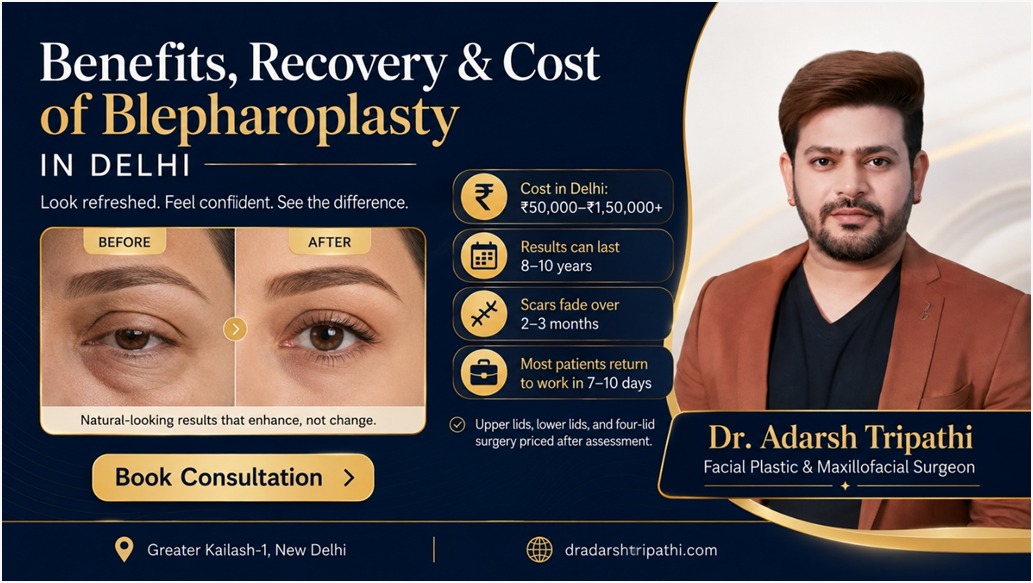
Months 2–3 | Final result: scars fade into the crease and lash line; the last few percent of swelling leaves the lid contour crisp. |
Risks, Honestly — With the Numbers
Every surgical page owes you this list. Common and temporary: bruising, swelling, tightness, watery or gritty eyes for the first weeks. Uncommon: visible scarring (incisions hide in natural lines and fade), small asymmetries during healing, temporary blurring. The 278-patient series above reported new dry-eye symptoms lasting beyond three months in just 0.8% of cases — all of which resolved. Rare but real, and the reason experience matters: removing too much skin (lids that will not close fully — lagophthalmos) or pulling the lower lid down (ectropion). Both are prevented by the same habit that protects alarplasty patients: conservative, measured excision — the eyelid forgives taking too little far more than taking too much. If you are comparing surgeons, ask each one how much skin they leave, not how much they remove.
Blepharoplasty Cost in Delhi (2026)
Across reputable Delhi practices, eyelid surgery runs Rs 50,000–Rs 1,50,000 depending on which lids are treated and the technique. Typical ranges:
Procedure | Approx. Delhi market cost | Notes |
Upper blepharoplasty (both eyes) | Rs 50,000 – Rs 90,000 | Local anaesthesia + sedation; day-care |
Lower blepharoplasty | Rs 60,000 – Rs 1,20,000 | Transcutaneous or scarless transconjunctival |
Combined upper + lower (four lids) | Rs 1,00,000 – Rs 1,80,000 | One sitting, one recovery |
Tear-trough fat grafting (add-on) | Rs 30,000 – Rs 60,000 | Alone or with lower-lid surgery |
Ptosis correction | Quoted after assessment | Depends on muscle findings; sometimes combined with upper blepharoplasty |
Your written quote at Sarayu Clinics covers the surgeon’s fee, anaesthesia, the accredited day-care facility, suture removal and scheduled follow-ups — no hidden add-ons. On insurance: cosmetic blepharoplasty is not covered in India; genuinely functional cases with documented visual-field obstruction are sometimes considered by insurers case-by-case — we provide the clinical documentation, and your insurer decides.
Prices shown are for guidance only. Your final treatment cost will be confirmed during the initial consultation, based on your individual needs, concerns, and personalised treatment plan.
Surgery or Something Smaller? An Honest Comparison
| Blepharoplasty | Botox | Under-eye Fillers | HIFU / Morpheus 8 | Thread Lift |
Best for | Excess skin, fat bags, hooding | Crow’s feet, brow position tweaks | Mild hollows and tear troughs | Early skin laxity, crepey texture | Mild brow/upper-face lift |
Invasiveness | Day-care surgery | Injections | Injections | Non-invasive energy | Minimally invasive |
Downtime | 7–10 days | None | 1–2 days | None to 2 days | 2–5 days |
Lasts | 8–10+ years | 3–4 months | 9–18 months | 9–18 months | 12–18 months |
Delhi cost | Rs 50,000–1,50,000 | Rs 8,000–25,000 | Rs 20,000–45,000 | Rs 15,000–40,000/area | Rs 30,000–80,000 |
The honest rule: injectables and energy devices flatter skin that is still where it belongs; once skin has genuinely stretched and folded, only surgery removes it — and doing repeated non-surgical sessions on surgical-grade lids wastes money. Explore the alternatives properly: Botox , dermal fillers , HIFU , Morpheus 8 and thread lifts — all available here, which is exactly why the recommendation you get is the right-sized one.
Choosing Your Blepharoplasty Surgeon in Delhi — Why Patients Choose Dr. Tripathi
- Periorbital anatomy is home ground: as a facial plastic and maxillofacial surgeon (BDS, MDS) with 16+ years of experience [confirm exact figure], Dr. Adarsh Tripathi operates around the eyes, brow and midface week in, week out — including the ptosis assessment most cosmetic clinics skip.
- Conservative on principle: millimetre-measured skin excision and fat repositioning over removal — the habits that keep results natural and complications rare.
- The full toolkit, one roof: surgery, Botox, fillers, energy devices and threads — so the plan fits your eyes, not the clinic’s only machine.
- South Delhi, properly equipped: accredited day-care surgical setup at Greater Kailash-1 — minutes from South Delhi, Noida and Faridabad patients who currently travel across the city for eyelid surgery.
Related Procedures at Our Delhi Clinic
Around the eyes | Face & lift | Nose & structure |
Eye Beautification (non-surgical) – /eye-beautification-treatment-in-delhi/ | ||
Frequently Asked Questions About Eyelid Surgery in Delhi
How much does blepharoplasty cost in Delhi?
Eyelid surgery in Delhi costs Rs 50,000-90,000 for upper lids, Rs 60,000-1,20,000 for lower lids, and Rs 1,00,000-1,80,000 for all four lids together. Tear-trough fat grafting adds Rs 30,000-60,000, and ptosis correction is quoted after muscle assessment. Your written quote covers surgeon, anaesthesia, facility and follow-ups.
Is eyelid surgery painful? What anaesthesia is used?
Blepharoplasty is done under local anaesthesia with light sedation – you are relaxed and feel nothing at the eyelids, and general anaesthesia is reserved for longer combined procedures. Afterwards, expect tightness and mild soreness for a few days rather than real pain, managed with simple tablets, cold compresses and lubricant drops.
Will there be visible scars after blepharoplasty?
Incisions are hidden in the natural upper-lid crease or just under the lower lash line, and the scarless transconjunctival technique places them inside the eyelid with no external mark at all. External scars fade from pink to nearly invisible over 2-3 months and sit exactly where the eye naturally folds.
How long do eyelid lift results last?
Typically 8-10 years or longer. The removed skin and fat do not return; what continues is normal ageing from your new starting point. Sun protection, sleep and stable weight stretch the result further, and many patients never need a second eyelid procedure in their lifetime.
What is the difference between upper and lower blepharoplasty?
Upper blepharoplasty removes the hooded skin that hides your eyelid crease and weighs on the lashes. Lower blepharoplasty treats under-eye bags by removing or repositioning fat, with or without a strip of loose skin. They solve different problems and are often combined in one sitting for a balanced, four-lid result.
My eyelid droops – do I need blepharoplasty or ptosis repair?
It depends on what is drooping. If loose skin folds over your lashes but the lid edge sits at the right height, blepharoplasty fixes it. If the lid margin itself hangs low over the coloured part of the eye, that is ptosis – a weakened lifting muscle – and it needs muscle repair; research shows up to 21% of “excess skin” patients also have ptosis. We measure both at consultation before recommending anything.
Can blepharoplasty remove my dark circles?
It removes the shadow cast by under-eye bags, which is one major cause of dark circles – but it does not remove brown pigmentation in the skin itself. Pigment-based circles respond to laser toning and skin boosters instead, and hollows respond to tear-trough filler or fat grafting. We identify which type yours are before suggesting a fix.
How long is recovery after eyelid surgery?
Sutures come out at day 5-7 and most desk workers return to office within 7-10 days, using sunglasses to cover fading bruises. Makeup and contact lenses are usually cleared by week two, exercise by week three or four, and the final crisp result appears by two to three months.
Will eyelid surgery change the shape of my eyes?
Not if it is done conservatively – the goal is your eyes, rested, not new eyes. We remove only measured excess and preserve your natural crease position and eye shape. Dramatic shape change is a sign of over-resection, which is precisely what millimetre planning exists to prevent.
What is the right age for blepharoplasty?
There is no fixed number – it is condition-led. Genetic hooding or prominent fat bags can justify surgery in the 20s and 30s, while age-related changes typically bring patients in their 40s to 60s. Health, skin quality, tear function and expectations decide suitability far more than the birth year does.
Can men have eyelid surgery?
Yes – a substantial share of our blepharoplasty patients are men, usually for heavy upper lids or under-eye bags that read as tiredness in meetings and on video calls. Technique is adjusted to preserve a naturally fuller, lower male brow-lid appearance so the result never looks feminised or “done”.
Are there non-surgical alternatives to eyelid surgery?
For early changes, yes: Botox for crow’s feet and small brow adjustments, tear-trough filler for hollows, and HIFU or Morpheus 8 for mild skin laxity. Once skin has truly stretched and folded over the lashes, only surgery removes it – and we will tell you honestly which side of that line your eyelids are on.
How to Reach Us:
Phone:+91 9289111083 ,+91 9289111084
Dr Adarsh’s website: https://dradarshtripathi.com/
Facebook: https://www.facebook.com/DrAdarshTripathi3011
Instagram: https://www.instagram.com/dr_adarsh_tripathi/
Youtube: https://www.youtube.com/@dr_adarsh_tripathi
Linkedin: https://www.linkedin.com/in/dr-adarsh-tripathi-a43005b8/
Online Booking: https://dradarshtripathi.com/contact-us/ to schedule appointments conveniently.
Our Patients