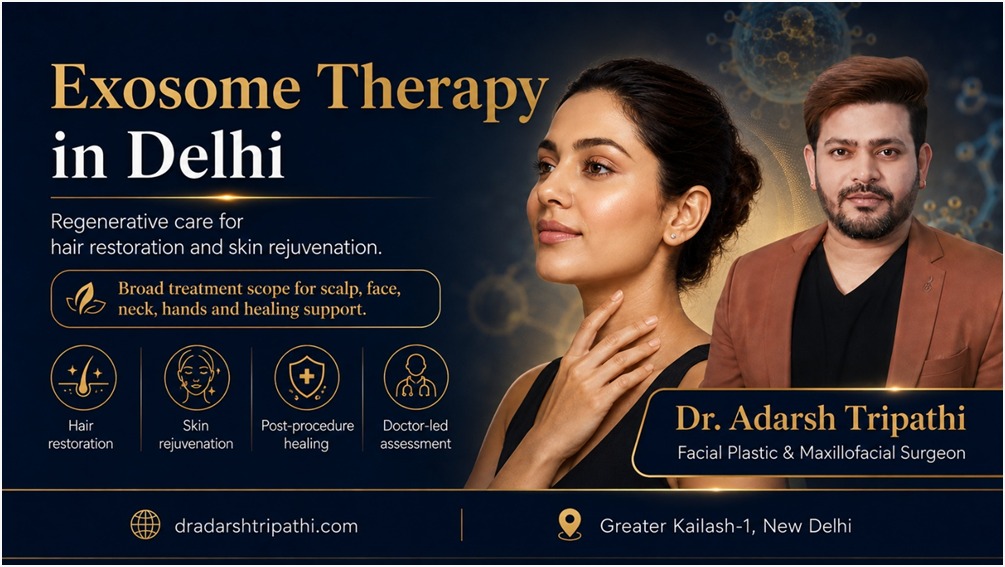
Exosome Therapy in Delhi — Regenerative Treatment for Hair Restoration & Skin Rejuvenation
Exosome therapy is one of the most genuinely interesting developments in regenerative aesthetic medicine — and also one of the most overhyped. The biology behind it is elegant: exosomes are microscopic vesicles (30–150 nanometres across) that cells use to communicate with each other, carrying growth factors, signalling proteins, and genetic material that instruct nearby cells how to behave. When concentrated exosomes are applied to the scalp or skin (typically after micro-needling or with carefully placed injections), they deliver a rich signal cocktail that can support follicle regeneration, collagen production, and tissue repair. For selected indications — early hair thinning, post-procedure skin recovery, certain skin rejuvenation goals — exosome therapy offers a genuinely sophisticated regenerative option.
Here’s the part most clinic pages skip past, and it matters: exosome therapy is also still genuinely NEW. The US FDA has not approved exosome products for most therapeutic uses and has issued public warnings about unapproved products. The evidence base is developing but more limited than for established treatments like hair transplant, PRP, finasteride, or minoxidil. Different exosome products on the market vary enormously in purity, source, and manufacturing quality — some ‘exosome’ products may not contain true exosomes at all. And the long-term outcome data we’d ideally want simply doesn’t yet exist for many indications. None of this means exosome therapy doesn’t work — preliminary results for several uses are encouraging. It means honest framing matters. A clinic that pitches exosomes as a definitively proven wonder treatment is overselling; a clinic that presents them as a promising regenerative therapy for selected cases is being honest with you.
The right way to think about exosome therapy in 2026: a promising, evolving regenerative treatment that may genuinely help in selected indications — particularly early hair loss, post-procedure healing, skin rejuvenation, and as an adjunct to established treatments — but not a replacement for established proven approaches like hair transplant for advanced loss, finasteride/minoxidil for ongoing hair preservation, or surgery for structural problems. For the right patient with the right indication, exosomes may add real value. For others, more established treatments will give better, more predictable results.
Dr. Adarsh Tripathi is a Maxillofacial and Facial Plastic Surgeon with over 18 years of experience at Sarayu Clinics, Greater Kailash-1, New Delhi. His approach to exosome therapy is built on honest indication-matching — recommending it where evidence and clinical judgement suggest it may help, recommending established treatments (PRP, hair transplant, medical therapy) when those are the better answer. This page covers exosome therapy in depth — what it is, honest status, indications, types of exosomes, the procedure, recovery, cost, results timeline, comparisons with PRP/GFC/stem cell therapy, and how to choose the right exosome therapy doctor in Delhi.
Quick Answer — What is exosome therapy and what does it cost in Delhi?
Exosome therapy uses microscopic vesicles (30-150nm) — extracellular signalling particles derived from stem cells or platelets — to deliver growth factors and signalling molecules to the scalp (for hair restoration) or skin (for rejuvenation). Exosomes are typically applied topically after microneedling or as carefully placed injections. In Delhi, exosome therapy costs Rs. 20,000–50,000+ per session — significantly higher than PRP (Rs. 6,000–15,000). Most protocols use 3–6 sessions spaced 4–6 weeks apart. Exosome therapy is a genuinely promising regenerative treatment for selected indications (early hair loss, post-procedure healing, skin rejuvenation) but remains a newer therapy with evolving evidence base. Dr. Adarsh Tripathi at Sarayu Clinics performs exosome therapy with honest assessment of when it suits and when established alternatives are better.
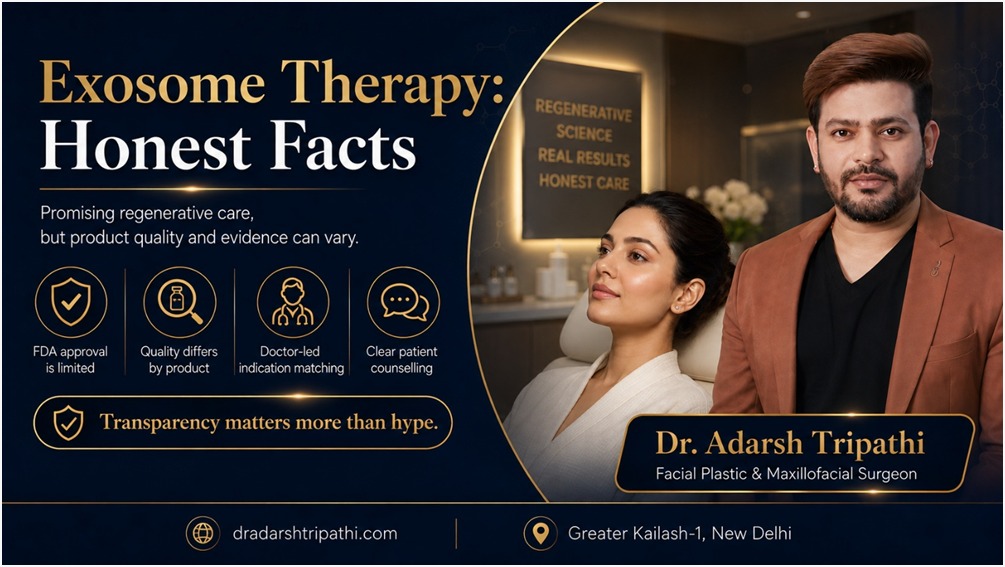
The Honest Status Update — Where Exosome Therapy Stands in 2026
This section exists because no other Delhi clinic page is willing to write it. Patients deserve honest context before making a decision about a relatively new therapy that costs significantly more than established alternatives.
What’s Genuinely True About Exosome Therapy ?
- The biology is real — exosomes are well-characterised extracellular vesicles that genuinely carry growth factors and signalling molecules
- Preliminary clinical results are encouraging for certain indications, particularly early androgenetic alopecia and post-procedure skin healing
- Exosomes can potentially deliver a richer signal cocktail than PRP because they’re concentrated cellular communication packages
- No allergic reaction risk because exosomes are biologically active without contributing immunogenic cells
- Less variability than PRP for some indications (PRP quality depends on patient’s blood; exosomes are standardised products)
- Useful as an adjunct to other treatments — particularly combined with MNRF, microneedling, hair transplant, or post-laser healing
What’s Honest to Acknowledge ?
- The US FDA has not approved exosome products for most therapeutic uses and has issued multiple warnings
- India’s regulatory framework is less strict but still evolving for exosome products
- Long-term outcome data is limited compared to established treatments (PRP has 15+ years of literature; hair transplant has 30+ years)
- Product quality varies dramatically between brands — sources, purity, particle counts, and growth factor content differ
- Some ‘exosome’ products on the market may contain few actual exosomes — characterization varies
- Results are variable and not all patients respond
- Cost is significantly higher than established alternatives like PRP
- For advanced hair loss, exosomes alone will not produce hair transplant-level results
What Honest Framing Looks Like ?
A clinic offering exosome therapy honestly will: (a) explain what exosomes can and can’t do for your specific case; (b) tell you which product source and brand they use, and why; (c) recommend AGAINST exosomes for cases where established treatments would work better (e.g. advanced hair loss needing transplant); (d) offer realistic expectations including the possibility of limited or no response; (e) not pressure you with ‘limited-time’ offers on a treatment of evolving evidence; (f) discuss combined approaches rather than positioning exosomes as a stand-alone solution. This is the framework Dr. Tripathi uses at consultation.
Important — exosome therapy is for SELECTED indications, not a universal solution
Exosome therapy is most reasonable to consider for: early-stage androgenetic hair loss (Norwood 2-3), supporting healing after MNRF/laser/microneedling procedures, certain skin rejuvenation goals, and as an adjunct to hair transplant or other established treatments. It is NOT a good substitute for: hair transplant in advanced loss (Norwood 5+), structural facial concerns needing surgery, or established preventive therapy (finasteride/minoxidil for hair preservation). A clinic recommending exosomes for advanced hair loss as a transplant replacement is overselling — the biology cannot deliver that result. Honest indication-matching is essential.
Benefits of Exosome Therapy — Realistic and Evidence-Based
When exosome therapy is the right choice for the right indication, the potential benefits are genuinely interesting. Here’s a realistic, evidence-based picture:
- Stimulation of hair follicle activity — preliminary evidence supports benefit in early androgenetic alopecia
- Potentially improved hair density and thickness over 3-6 month protocols
- Enhanced scalp health and follicle environment
- Skin quality improvement — texture, tone, fine line softening
- Accelerated healing after MNRF, fractional laser, microneedling, or other resurfacing procedures
- Support for hair transplant graft survival when used as adjunct
- Anti-inflammatory effect that may help certain inflammatory skin conditions
- Non-surgical, minimally invasive procedure with minimal downtime
- No blood extraction required (unlike PRP)
- Lower allergic-reaction risk than some other regenerative approaches
An honest framing of benefits: response varies significantly between patients, and not every patient responds to exosome therapy. Realistic expectations are: a meaningful but not dramatic improvement in hair density and quality over a 3-6 session course for appropriate candidates with early hair loss; useful adjunctive effect for skin rejuvenation and post-procedure healing; valuable as a combination therapy rather than standalone for many indications. Patients hoping for hair transplant-level results without surgery should consider hair transplant; patients hoping to reverse advanced loss with exosomes alone will likely be disappointed.
Areas Treated with Exosome Therapy
Scalp — Hair Restoration
The most common application. Exosomes are applied to the scalp (typically after microneedling or via direct injection) for early-to-moderate hair thinning, supporting follicle activity and growth phase. Most appropriate for Norwood 2-3 in men and early Ludwig 1-2 in women — not a substitute for hair transplant in more advanced loss.
Face — Skin Rejuvenation
Full-face exosome treatment for overall skin quality, texture refinement, and tone evenness. Often applied after MNRF or fractional laser to accelerate recovery and enhance results. May help fine lines and early skin aging signs.
Periorbital — Around the Eyes
Fine lines, mild crepiness, and texture concerns around the eyes can benefit from carefully placed exosome therapy. The delicate periorbital skin requires conservative application.
Neck and Décolletage
Sun-damaged, crepey skin on the neck and chest may improve with exosome therapy as part of broader rejuvenation protocols, often combined with MNRF or fractional treatments.
Hands
Aging hands with thinning skin and texture loss can be treated with exosome therapy for skin quality improvement.
Post-Procedure Healing (Various Areas)
Exosomes are increasingly used to support healing after MNRF, fractional CO2 laser, microneedling, chemical peels, and other resurfacing procedures — accelerating recovery and potentially enhancing the procedure’s results.
As Adjunct to Hair Transplant
Some clinics offer exosome therapy alongside hair transplant to support graft survival and accelerate the growth phase. Evidence for this adjunctive use is encouraging but still developing.
What Exosomes Cannot Treat ?
- Advanced hair loss (Norwood 5+) — established follicle loss requires transplant
- Structural facial problems needing surgery (sagging, ptosis, deep wrinkles)
- Established scars — scar revision techniques are more appropriate
- Significant skin laxity — HIFU, RF tightening, or surgery are stronger options
- Pigmentation disorders — peels, lasers, and brightening agents work better
- Acne — needs proper medical management, not regenerative therapy
Conditions Exosome Therapy Addresses
Early Androgenetic Hair Loss (Male and Female)
The strongest indication for hair-focused exosome therapy. Early-stage pattern hair loss (Norwood 2-3 in men, Ludwig 1-2 in women) may respond to exosome treatment with improved density and thickness over a course of 3-6 sessions. Best results when combined with medical therapy (finasteride/minoxidil) to address the underlying loss process.
Hair Thinning Without Active Pattern Loss
Diffuse thinning from stress, post-pregnancy telogen effluvium, nutritional issues, or general aging may improve with exosome therapy — though addressing the underlying cause (stress, deficiencies, hormones) is more important than any treatment.
Skin Aging and Photodamage
Early signs of skin aging — fine lines, mild texture changes, early tone unevenness, photodamage — may improve with exosome therapy as part of comprehensive rejuvenation. Strongest when combined with MNRF, microneedling, or other procedures.
Post-Procedure Recovery
Accelerating healing and enhancing results after resurfacing procedures — MNRF, fractional laser, microneedling, chemical peels. This is one of the most established adjunctive uses of exosome therapy.
Sensitive or Compromised Skin
Skin in healing phase, mild rosacea, post-inflammatory states — exosome therapy’s anti-inflammatory effects may help.
Combination with Hair Transplant
Pre-procedure (preparing recipient sites), during procedure (graft preservation), or post-procedure (supporting graft survival and growth) — exosomes as a hair transplant adjunct.
What Exosome Therapy Cannot Address ?
- Advanced hair loss requiring surgical restoration
- Significant skin laxity needing HIFU or surgery
- Deep static wrinkles needing fillers or surgery
- Pigmentary disorders (melasma, PIH) needing specific treatments
- Active acne or inflammatory dermatoses needing medical treatment
- Structural facial concerns
Types of Exosomes — Source Matters Enormously
Not all exosomes are created equal. Different sources, manufacturing methods, and characterization standards produce dramatically different products. This is a question worth asking any clinic offering exosome therapy.
MSC-Derived Exosomes (Mesenchymal Stem Cell)
Exosomes harvested from mesenchymal stem cells — the most studied and clinically used type. Sources include umbilical cord, adipose tissue, dental pulp, and bone marrow.
- Umbilical-cord MSC exosomes — most common source; well-studied; standardised production
- Adipose-derived MSC exosomes — abundant source; growing literature
- Bone marrow MSC exosomes — older source; less commonly used now
- Dental pulp MSC exosomes — emerging source
Platelet-Derived Exosomes
Exosomes derived from platelets — overlapping with PRP/PRF technology. Some clinics offer ‘platelet-rich plasma exosomes’ as a hybrid approach. Different mechanism from MSC-exosomes.
Plant-Derived Exosomes
Exosomes from plants (e.g. ginseng, rose). Marketed extensively but evidence base for clinical effect is more limited than MSC-derived. Consider whether the marketing claims match the published evidence.
Synthetic / Engineered Exosomes
Laboratory-engineered exosome-mimicking particles. Emerging area; evidence still developing.
Why the Source Matters ?
Different exosome sources contain different growth factor profiles, signalling molecules, and biological effects. Umbilical-cord MSC exosomes contain a different signal cocktail than plant-derived exosomes. The ‘best’ exosome depends on the indication — and clinic transparency about which source they use is a quality signal.
Quality Variables Beyond Source
- Manufacturing standards (GMP-certified vs uncertified)
- Particle count per dose (varies enormously)
- Characterization standards (verified as exosomes vs assumed)
- Storage and handling chain (exosomes are temperature-sensitive)
- Source country and regulatory oversight (different countries have different standards)
- Documented growth factor content vs marketing claims
These quality variables aren’t obvious to patients but matter enormously for results. A clinic transparent about which brand and source they use — and why — is signalling quality. A clinic that only says ‘we use exosomes’ without specifying source or brand is leaving important questions unanswered.
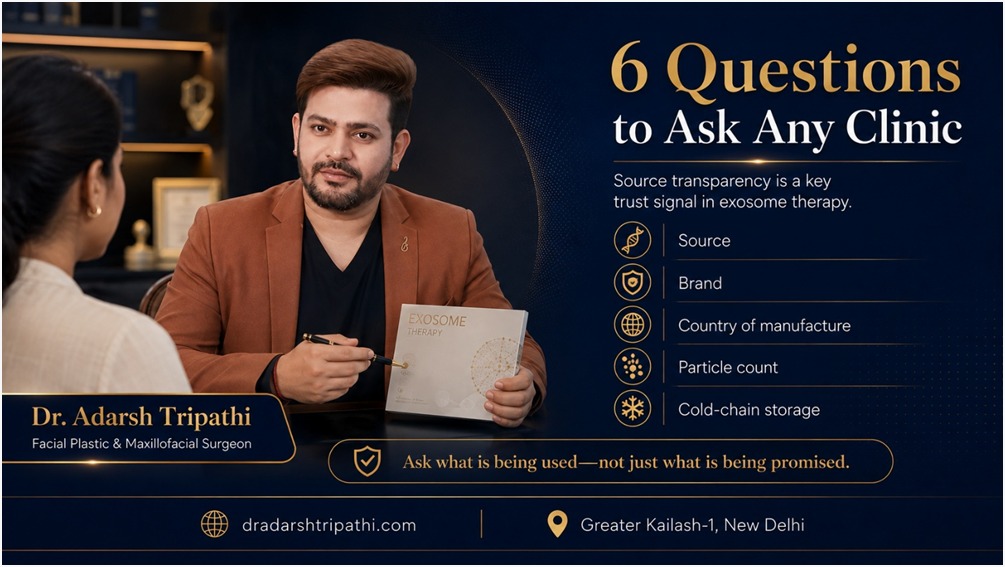
Questions worth asking any clinic offering exosome therapy
1. What’s the SOURCE of the exosomes you use (umbilical-cord MSC, adipose, platelet, plant)? 2. What BRAND or product line? 3. What COUNTRY of manufacture, and what regulatory standards apply? 4. What’s the PARTICLE COUNT per session? 5. How is the product CHARACTERIZED (verified as containing exosomes)? 6. What’s your COLD-CHAIN handling protocol? A clinic that can answer these clearly is operating with the transparency the therapy deserves. A clinic that deflects these questions is one to think carefully about.
Are You a Good Candidate for Exosome Therapy?
Honest candidate selection matters more for exosome therapy than for many established treatments — because it’s a newer, more expensive option, and not every patient is well-suited.
You may be a good candidate if:
- You have early-stage androgenetic hair loss (Norwood 2-3 in men, Ludwig 1-2 in women)
- You have diffuse hair thinning without major patterned loss
- You’re seeking skin rejuvenation and quality improvement
- You’re recovering from MNRF, laser, or other resurfacing procedure
- You’re undergoing hair transplant and want adjunctive support
- You’re not ready for or candidate for surgical hair restoration
- You’re in good general health
- You can commit to a 3-6 session course
- You have realistic expectations of gradual improvement, not dramatic transformation
- You can afford the cost relative to alternatives
You may NOT be a good candidate if:
- You have advanced hair loss (Norwood 5+) — hair transplant is more appropriate
- You expect dramatic transformation in 1-2 sessions
- You’re unwilling to combine with established treatments (finasteride/minoxidil for hair)
- You have active scalp/skin infection or dermatitis in treatment area
- You have unrealistic ‘reverse all hair loss without surgery’ expectations
- You’re pregnant or breastfeeding (defer non-urgent treatment)
- You have bleeding disorders or are on anticoagulation (case-by-case)
- You have active autoimmune flare-ups (case-by-case assessment)
- You have specific allergies to components (verify with the product brand)
Where Exosomes Suit Best — A Realistic Framework ?
Best Indications: Early hair loss (Norwood 2-3, Ludwig 1-2), post-procedure healing support (after MNRF, laser, microneedling), hair transplant adjunct, mild-to-moderate skin rejuvenation goals, and as part of combination protocols.
Marginal Indications: Moderate hair loss (Norwood 4) where transplant might be preferred but patient prefers non-surgical first, mature skin rejuvenation goals where established treatments alone might be sufficient.
Poor Indications: Advanced hair loss (Norwood 5+), significant skin laxity, structural facial concerns, conditions needing established medical management.
The Exosome Therapy Procedure — Step by Step
Step 1: Consultation & Assessment
Dr. Tripathi assesses your specific concern (hair, skin, or post-procedure healing), reviews medical history, examines the treatment area, and discusses honestly whether exosome therapy is appropriate or whether established alternatives (PRP, hair transplant, MNRF, medical therapy) would suit better. If exosome therapy is recommended, the specific product source/brand used at Sarayu Clinics is explained, including transparency about manufacturing standards. Realistic expectations and protocol details are discussed. Photos are taken for baseline.
Step 2: Pre-Treatment Preparation
- Strict sun avoidance and SPF for 2 weeks before for skin treatments
- Avoid blood-thinning medications/supplements for 5-7 days (with doctor’s clearance)
- Avoid active skincare (retinoids, acids) for 3 days before
- Arrive with treatment area clean — no makeup, sunscreen, or styling products
- Eat normally before the session
- Inform the doctor of any allergies, recent infections, or medication changes
Step 3: Numbing (For Procedures Requiring Microneedling or Injection)
Topical anaesthetic cream is applied 30-45 minutes before treatment when microneedling or significant injection is planned. For superficial topical application without microneedling, numbing may not be required.
Step 4: Treatment Area Preparation
The scalp or skin is thoroughly cleansed and prepared. For maximum exosome absorption, the typical protocol uses MNRF or microneedling first to create micro-channels that allow exosomes to penetrate into deeper layers — followed immediately by exosome application.
Step 5: Exosome Application
Exosomes are applied to the treatment area using one or a combination of these methods:
- Topical application immediately after MNRF or microneedling — the micro-channels allow penetration
- Direct microinjection (mesotherapy-style) using fine needles to deliver exosomes to specific depths
- Combined approach — topical plus selective injection in areas of concern
The session itself takes 30-60 minutes depending on area and protocol.
Step 6: Immediate Aftercare
- Soothing serum applied to treated area
- SPF applied for skin treatments
- Detailed aftercare instructions provided
- No makeup for 24 hours after facial treatments
- Gentle washing only for 48-72 hours
- Avoid heavy sweating, gym, saunas, swimming for 48-72 hours
- Sun protection essential
Step 7: Session Spacing
Most protocols use 3-6 sessions spaced 4-6 weeks apart. The gap allows initial healing and biological response before the next session adds to it. Treating too frequently doesn’t help and may increase irritation. A patient course gives best results.
Downtime — What to Expect After Exosome Therapy
Day 0 (Immediately After)
Mild redness and slight swelling in treated area is normal — typically resolves within hours to a day. If MNRF or microneedling was used first, expect more visible redness for 24-48 hours (similar to any MNRF session). Treatment area may feel warm, mildly tender, slightly tight.
Days 1-3
Any redness from microneedling/MNRF settles. Treated area may have mild dryness or fine flaking. Most patients return to normal activities within 24 hours. Use only gentle skincare and strict sun protection.
Days 4-14
Skin or scalp appears normal. Subtle improvements may begin to be noticeable. For hair treatments, no visible change yet — exosomes work over weeks-to-months. For skin treatments, gradual texture and quality improvement begins.
Weeks 2-6
Continued biological response. Hair treatments: subtle increase in hair density and quality may be noted. Skin treatments: progressive improvement in texture, tone, and quality. Next session typically scheduled at 4-6 weeks.
Possible Side Effects (Honestly Listed)
- Mild redness and swelling for 24-48 hours (expected)
- Tenderness at treatment sites
- Mild dryness or fine flaking
- Rare allergic-type reaction to product components
- Rare infection (minimised by sterile technique)
- Possible disappointment if results don’t meet expectations — important to discuss this honestly
- No clinical response in some patients — exosome therapy doesn’t help every case
Aftercare Essentials
- Strict SPF 50+ for 2 weeks after for skin treatments
- No retinoids, acids, or actives for 5-7 days
- No hot showers, saunas, hot yoga for 48-72 hours
- No heavy exercise or excessive sweating for 48 hours
- Gentle cleansing only; gentle moisturiser
- Don’t pick or rub treated area
- No makeup for 24 hours after facial exosome therapy
- Hydration and good sleep support biological response
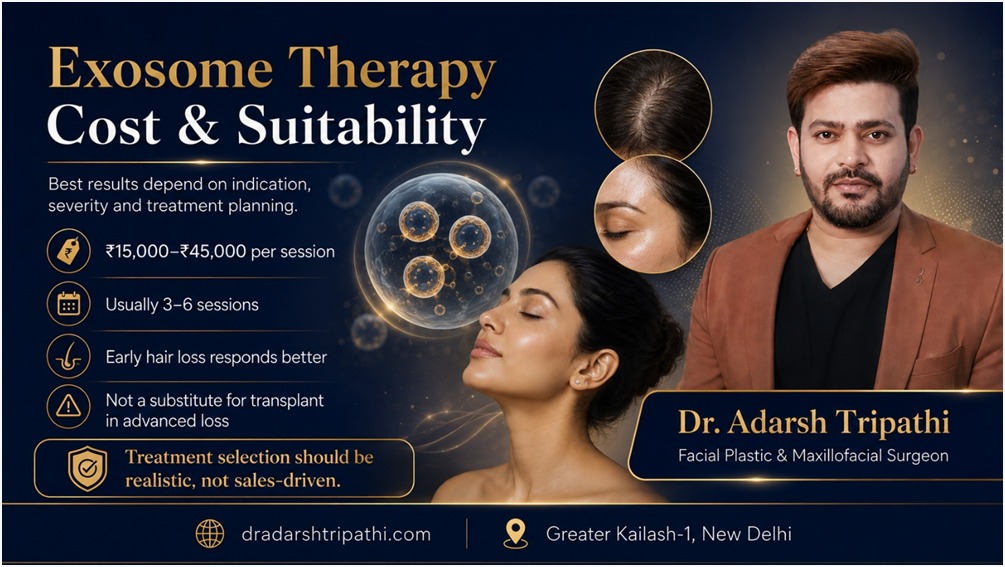
Exosome Therapy Cost in Delhi — Transparent Pricing
Exosome therapy is significantly more expensive than PRP and other established alternatives — reflecting the cost of the exosome product itself, which is the main cost driver. Most clinics price per session with packages for course pricing.
Approximate Cost at Sarayu Clinics, Delhi
Treatment | Cost Per Session | Typical Sessions | Total Course |
Exosome Therapy — Scalp (Hair) | Rs. 20,000–35,000 | 3–6 | Rs. 75,000–1,80,000 |
Exosome Therapy — Full Face | Rs. 22,000–40,000 | 3–4 | Rs. 70,000–1,50,000 |
Exosome Therapy — Targeted Area | Rs. 18,000–30,000 | 3–4 | Rs. 60,000–1,15,000 |
Exosome + MNRF Combination | Rs. 25,000–45,000 | 3–4 | Rs. 80,000–1,70,000 |
Exosome + Microneedling | Rs. 22,000–38,000 | 3–4 | Rs. 70,000–1,45,000 |
Exosome Post-Procedure Healing (single session add-on) | Rs. 15,000–28,000 | 1–2 | Rs. 15,000–55,000 |
Exosome as Hair Transplant Adjunct | Rs. 18,000–30,000 | Per protocol | Customised |
Prices shown are for guidance only. Your final treatment cost will be confirmed during the initial consultation, based on your individual needs, concerns, and personalised treatment plan.
Why Exosome Therapy Costs More Than PRP ?
PRP is made from your own blood at the clinic — the main cost is the kit, processing, and clinic time (Rs. 6,000–15,000 per session typically). Exosome therapy requires purchasing manufactured exosome products from specialised suppliers, which is itself expensive — the product cost is the main driver of the higher per-session price. Higher-quality, well-characterised exosome products from reputable manufacturers cost more than less rigorously characterized alternatives — and this difference shows up in clinic pricing.
The cost-vs-evidence consideration
Exosome therapy costs 2-4x more than PRP for similar indications. For some patients and some indications, the additional cost may be justified by potentially stronger or more consistent results. For others, established alternatives like PRP, finasteride/minoxidil for hair, or MNRF for skin may give better value. The right answer depends on YOUR specific indication, response to other treatments, and budget. An honest consultation includes this cost-benefit discussion — not just a sales pitch for the more expensive option.
Results Timeline — Realistic Expectations
Exosome therapy works through biological signalling — which means results unfold over weeks to months, not days. Patience and realistic expectations matter.
After Single Session
- Day 0-2: redness/swelling from procedure; no visible benefit yet
- Days 3-14: subtle improvements may emerge (skin texture, scalp condition)
- Weeks 2-6: gradual response continuing; subtle changes accumulate
Across the Course (3-6 Sessions over 3-6 Months)
- Session 1-2 (months 1-2): early biological response; modest visible changes
- Session 3-4 (months 2-4): more noticeable improvements in target indication
- Session 5-6 (months 4-6): main course completion; results consolidating
After the Course (Months 6-12)
- Continued response for several months after final session
- Gradual stabilisation of results
- Maintenance sessions every 6-12 months may be considered
Realistic Improvement Per Indication
- Early hair loss: modest improvement in hair density and quality; not transplant-level results
- Skin rejuvenation: visible texture and quality improvement; not facelift-level rejuvenation
- Post-procedure healing: faster recovery, potentially enhanced outcomes from the underlying procedure
- Hair transplant adjunct: potentially improved graft survival and growth phase
Important — Response Variability
Honest acknowledgment: not all patients respond strongly to exosome therapy. Some respond well; others see modest changes; some see little benefit. Pre-treatment expectations should account for this variability. A ‘no response’ scenario isn’t a failure of the clinic — it reflects the still-developing nature of regenerative therapies and individual biological variation. Combination protocols (exosomes + MNRF, exosomes + medical therapy for hair) typically produce more reliable results than exosomes alone.
How Long Do Results Last?
Exosome therapy results are not permanent — the biological signalling effect persists for a period, then gradually wanes as the underlying cause of the original concern (hair loss process, skin aging) continues. Maintenance sessions every 6-12 months may help sustain results, but the underlying condition still needs separate management (e.g. finasteride/minoxidil for ongoing hair loss; comprehensive skincare and lifestyle for skin aging).
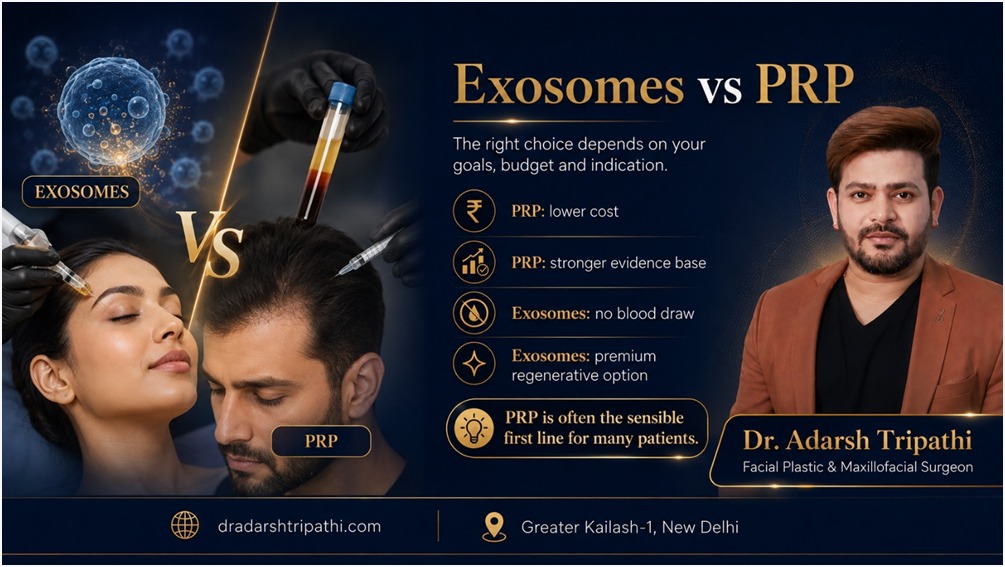
Exosome Therapy vs Other Regenerative Treatments — Honest Comparison
Patients considering exosome therapy often weigh it against other regenerative options. Here’s an honest comparison:
Treatment | Source | Mechanism | Cost (Delhi) | Evidence Base |
Exosome Therapy | MSC-derived vesicles | Concentrated growth factor signalling | Rs. 20,000–50,000/session | Developing — promising but new |
PRP | Patient’s own blood platelets | Platelet-derived growth factors | Rs. 6,000–15,000/session | Well-established 15+ years |
GFC | Patient’s blood (processed differently) | Concentrated growth factors | Rs. 8,000–20,000/session | Established alternative to PRP |
Stem Cell Therapy | Patient’s own stem cells | Cellular regeneration | Variable; usually higher | Genuinely controversial; limited |
MNRF | Device-based RF | Collagen induction | Rs. 8,000–18,000/session | Well-established |
Hair Transplant | Patient’s own follicles | Surgical relocation | Rs. 40-90/graft | Established 30+ years |
Topical Minoxidil | Pharmaceutical | Vasodilator + growth phase | Rs. 500-2,000/month | Very well-established |
Oral Finasteride | Pharmaceutical | DHT blocker | Rs. 300-1,500/month | Very well-established |
Exosome vs PRP — The Direct Comparison
PRP wins on: cost (significantly cheaper), established evidence base (15+ years of literature), uses your own blood (no foreign material), broader insurance/regulatory acceptance, well-understood mechanism. Exosome therapy wins on: potentially higher growth factor concentration per session, standardised product (less variability than patient-specific PRP), no blood draw required, possibly stronger response in some cases. The honest answer for most indications: PRP is the more established, cost-effective first-line; exosome therapy may be considered when PRP has been tried with insufficient response, when stronger signal is wanted, or when patient cannot/prefers not to have blood drawn.
Exosome vs GFC (Growth Factor Concentrate)
GFC is a processed concentration of growth factors from the patient’s own blood — overlapping with PRP/PRF technology but with different processing. Cost is intermediate between PRP and exosomes. Evidence base is reasonably established. Useful alternative to PRP for some patients. Comparable to lower-end exosome offerings.
Exosome vs Hair Transplant
Hair transplant and exosome therapy treat fundamentally different problems. Hair transplant moves existing bald-resistant follicles to bald areas — surgical, established, predictable, suited to established hair loss. Exosome therapy supports existing follicle activity — non-surgical, regenerative, suited to EARLY hair loss where follicles are still alive but weak. Exosomes do NOT replace hair transplant for established loss — they’re complementary, not competing, treatments.
Exosome vs MNRF
Different mechanisms entirely. MNRF stimulates collagen via controlled thermal injury and RF energy. Exosome therapy delivers concentrated growth factors. They’re often COMBINED — MNRF creates micro-channels and stimulates collagen induction; exosomes added immediately afterward enhance the biological response. The combination is one of the better-established uses of exosome therapy.
Why a Facial Plastic Surgeon for Exosome Therapy?
Exosome therapy is offered at many types of clinics — dermatology, hair specialty, medical spas, aesthetic clinics. So why specifically a facial plastic surgeon? Because the value isn’t in the technique (which is the same wherever it’s done) — it’s in the JUDGEMENT about when it’s appropriate and when established alternatives are better. A facial plastic surgeon brings the medical depth to recognise when a patient would benefit MORE from hair transplant than from exosome courses, when skin laxity needs HIFU rather than regenerative therapy, when surgery is the right answer rather than non-surgical alternatives. This honest indication-matching protects you from over-treatment in the wrong direction.
Why Dr. Adarsh Tripathi Is a Trusted Exosome Therapy Doctor in Delhi ?
Exosome therapy is a treatment where the right clinical judgement matters more than the technique itself. Here’s how to choose, and why patients choose Dr. Tripathi:
What to Look For in an Exosome Therapy Clinic ?
- Medical qualification — doctor performing or directly overseeing treatment
- Transparency about exosome SOURCE, BRAND, and manufacturing standards
- HONEST recommendation — exosomes only when genuinely appropriate, not for every case
- Willingness to recommend established alternatives (hair transplant, PRP, MNRF, medical therapy) when they suit better
- Discussion of combination protocols vs solo exosome therapy
- Realistic expectation-setting including possibility of limited response
- Clinical (not salon) facilities; proper cold-chain storage
- Sterile technique for injection-based protocols
- No pressure tactics or ‘limited-time’ urgency on a treatment of evolving evidence
Dr. Tripathi’s Approach
- Maxillofacial and Facial Plastic Surgeon with 18+ years of experience
- Honest indication-matching — recommends exosomes when appropriate, established alternatives when those suit better
- Transparent about the exosome product source and brand used
- Combination protocols (exosome + MNRF, exosome + medical therapy for hair) as standard
- Realistic expectations discussion before any treatment commitment
- Conservative approach — preserving budget for proven combinations rather than experimental sole-treatment courses
- Personal consultation and treatment delivery
The Honesty-First Philosophy
Exosome therapy is a treatment where misaligned expectations and inappropriate indications cause more disappointment than the treatment itself does. Dr. Tripathi’s approach is built on honest framing: exosomes are a genuinely promising regenerative therapy for selected indications, NOT a wonder treatment. The right patient for exosomes gets clear value; the wrong patient is better served by established alternatives. The honest indication-matching at consultation is the most important part of the value — not the procedure itself.
Frequently Asked Questions — Exosome Therapy in Delhi
Q: Who is the best exosome therapy doctor in Delhi?
A: The best exosome therapy doctor in Delhi for you is a medically qualified specialist who is transparent about the exosome source/brand used, who honestly tells you when exosomes are appropriate AND when established alternatives (hair transplant, PRP, MNRF, medical therapy) would suit better, who offers combination protocols rather than positioning exosomes as a stand-alone solution, and who sets realistic expectations including possible limited response. Dr. Adarsh Tripathi is a Maxillofacial and Facial Plastic Surgeon with 18+ years of experience offering exosome therapy with honest indication-matching at Sarayu Clinics, Greater Kailash.
Q: What is exosome therapy?
A: Exosome therapy uses microscopic vesicles (30-150 nanometres in size) — extracellular signalling particles derived from stem cells or platelets — that carry growth factors and signalling molecules. When applied to the scalp or skin (typically after microneedling or via injection), exosomes deliver concentrated cellular communication signals that may support follicle regeneration, collagen production, and tissue repair. Exosome therapy is genuinely promising for selected indications (early hair loss, post-procedure healing, skin rejuvenation) but remains a newer treatment with evolving evidence base.
Q: How much does exosome therapy cost in Delhi?
A: Exosome therapy in Delhi costs approximately Rs. 20,000–50,000 per session — significantly higher than PRP (Rs. 6,000–15,000). Most protocols use 3-6 sessions, giving total course costs of Rs. 60,000–2,50,000 depending on area treated, product brand, and combination protocols. The high per-session cost reflects the price of manufactured exosome products themselves. Package pricing for full courses typically offers 10-15% savings over per-session totals. A personalised quote follows consultation at Sarayu Clinics.
Q: Is exosome therapy FDA approved?
A: No — the US FDA has not approved exosome products for most therapeutic uses and has issued multiple public warnings about unapproved exosome products marketed for treatments. India’s regulatory framework is less strict but still evolving for exosome products. This doesn’t mean exosome therapy doesn’t work — preliminary clinical evidence is encouraging for several indications — but it means honest framing is essential and clinics offering it should be transparent about regulatory status.
Q: Is exosome therapy better than PRP?
A: Exosome therapy and PRP each have specific advantages — neither is universally better. PRP wins on: cost (significantly cheaper), well-established 15+ year evidence base, uses patient’s own blood (no foreign material), more standardised quality framework. Exosome therapy wins on: potentially higher concentrated growth factor signalling, no blood draw, manufactured standardised product. For most indications, PRP is the established cost-effective first-line; exosome therapy may be considered when PRP gives insufficient response or when stronger signalling is wanted. Many protocols combine both.
Q: How many exosome therapy sessions are needed?
A: Most exosome therapy protocols use 3-6 sessions spaced 4-6 weeks apart for visible results. Hair restoration typically needs 4-6 sessions; skin rejuvenation 3-4 sessions; post-procedure healing 1-3 sessions. Results continue developing for several months after the final session. Maintenance sessions every 6-12 months may help sustain results — but the underlying condition (hair loss process, skin aging) still needs separate management.
Q: Does exosome therapy work for hair loss?
A: Exosome therapy may help EARLY hair loss (Norwood 2-3 in men, Ludwig 1-2 in women) by supporting follicle activity and the hair growth phase. Preliminary clinical evidence is encouraging but the response varies between individuals. For ADVANCED hair loss (Norwood 5+), exosome therapy alone will NOT produce hair-transplant-level results — surgical hair restoration is more appropriate. Combined approaches (exosome therapy + finasteride + minoxidil) typically produce more reliable results than exosomes alone for early-stage loss.
Q: Is exosome therapy painful?
A: Exosome therapy involves minimal discomfort. When combined with MNRF or microneedling (the typical delivery method), topical numbing cream is applied 30-45 minutes before treatment to make the microneedling step comfortable — most patients describe the overall sensation as mild warmth or pricking. Direct exosome microinjection may involve brief sting at injection points. No general anaesthesia is needed; you can drive home after.
Q: What is the downtime after exosome therapy?
A: Exosome therapy downtime is typically 1-2 days when combined with MNRF/microneedling — mild redness and slight swelling for 24-48 hours, similar to any MNRF session. For topical-only exosome application without microneedling, downtime is minimal. Most patients return to work the next day, often with light makeup if needed. Avoid heavy sweating, hot showers, saunas, and active skincare for 48-72 hours.
Q: Are there any risks or side effects of exosome therapy?
A: Exosome therapy is generally well-tolerated. Common, temporary effects include mild redness and swelling for 24-48 hours, tenderness at injection sites, mild dryness or flaking. Rare risks include allergic-type reactions to product components, infection (minimised by sterile technique), and the possibility of limited or no response (exosome therapy doesn’t help every case). Choose a clinic with proper cold-chain storage, transparent product sourcing, and sterile technique to minimise risks. Disclose any allergies before treatment.
Q: Can exosome therapy be combined with other treatments?
A: Yes — exosome therapy is often more effective when combined with other treatments. Common combinations: exosomes + MNRF (delivery via micro-channels enhances absorption); exosomes + microneedling; exosomes + medical therapy for hair (finasteride, minoxidil); exosomes as adjunct to hair transplant (supporting graft survival); exosomes after fractional laser (enhanced healing). Most experienced clinics use combination protocols rather than positioning exosomes as a stand-alone treatment.
Q: How do I choose an exosome therapy clinic in Delhi?
A: Choose a clinic where a doctor (not just technician) personally evaluates and treats you, where the exosome product source, brand, and manufacturing standards are transparent, where honest recommendations include established alternatives (hair transplant, PRP, MNRF) when those suit better, where realistic expectations are set including possible limited response, where combination protocols are offered, and where the facility uses proper cold-chain product storage and sterile technique. Avoid clinics that pitch exosomes uncritically as a wonder treatment, refuse to specify the product source, or use high-pressure ‘limited-time offer’ tactics.
How to Reach Us:
Phone:+91 9289111083 ,+91 9289111084
Dr Adarsh’s website: https://dradarshtripathi.com/
Facebook: https://www.facebook.com/DrAdarshTripathi3011
Instagram: https://www.instagram.com/dr_adarsh_tripathi/
Youtube: https://www.youtube.com/@dr_adarsh_tripathi
Linkedin: https://www.linkedin.com/in/dr-adarsh-tripathi-a43005b8/
Online Booking: https://dradarshtripathi.com/contact-us/ to schedule appointments conveniently.