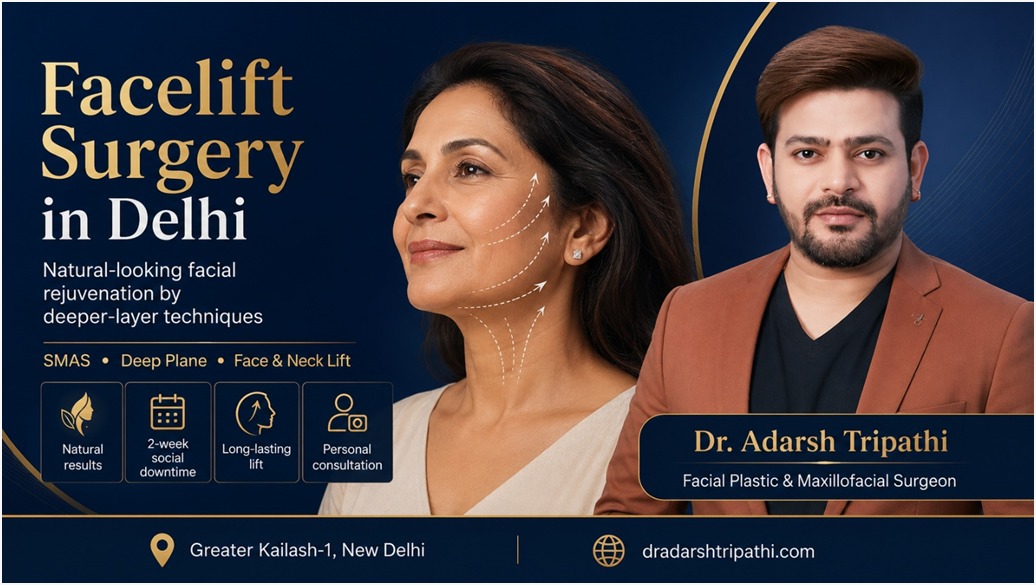
Facelift Surgery in Delhi — Looking Like a Rested Version of Yourself
Quick answer : A facelift (rhytidectomy) repositions the deeper layers of the face — not just the skin — to lift jowls, redefine the jawline and neck, and soften deep folds, so you look 10–15 years fresher rather than “done”. At Sarayu Clinics, Greater Kailash-1, modern SMAS and deep plane techniques are used; surgery takes 2–4 hours, costs Rs 1,50,000–Rs 6,00,000 depending on technique and whether a neck lift is combined, and needs about two weeks of downtime. Results last roughly 10–15 years.
There’s a particular fear that stops many people from considering a facelift, and it’s worth naming honestly: the worry of ending up looking ‘done’ — that tight, wind-swept, pulled appearance that’s instantly recognisable as surgery. It’s a legitimate concern, because that look was the result of older facelift techniques that simply pulled the skin tight. But modern facelift surgery doesn’t work that way at all. Done properly today, a facelift repositions the deeper layers of the face — not just the skin — so the result looks like you, ten or fifteen years fresher. People notice you look rested and well, not that you’ve ‘had work done’.
Here’s what most clinic pages bury in jargon: the difference between a natural result and an obvious one comes down to which layer of the face the surgeon works on. A skin-only facelift pulls the surface and looks tight and fades fast. A SMAS facelift repositions the deeper muscle-and-tissue layer for a stronger, longer-lasting, natural lift. A deep plane facelift — the most advanced technique — releases and repositions the deep tissues and their ligaments as a unit, giving the most natural, longest-lasting rejuvenation with no tension on the skin. Understanding this is the single most useful thing to know before choosing a facelift, and it’s exactly why the surgeon’s technique and experience matter more than anything else.
Dr. Adarsh Tripathi is a Maxillofacial and Facial Plastic Surgeon with over 18 years of experience at Sarayu Clinics, Greater Kailash-1, New Delhi. Because his entire practice is the face — its anatomy, ageing, and proportion — facelift surgery is core, considered work. This page explains the techniques in plain language, what a facelift can and genuinely cannot do, who it suits, recovery, cost, and how to choose the right facelift surgeon in Delhi.
Benefits of Facelift Surgery — What It Actually Delivers
A modern facelift, done well, offers a level of rejuvenation that no non-surgical treatment can match. Here’s an honest picture:
- A naturally younger appearance — typically looking 10–15 years fresher, not different
- Lifted, redefined jawline with the jowls smoothed away
- A tighter, smoother neck with banding and looseness corrected (when combined with a neck lift)
- Softened deep folds — the nasolabial folds and marionette lines around the mouth
- Repositioned cheek and midface volume that had drooped with age
- Long-lasting results — 8–15 years depending on technique, skin, and lifestyle
- A refreshed rather than ‘operated’ look, because deeper-layer techniques avoid skin tension
- Restored facial harmony and a genuine boost in confidence
An honest and important point: a facelift lifts and repositions sagging tissue — it is the gold standard for that. But it does not improve skin quality (sun damage, fine lines, pigmentation), nor does it replace lost facial volume on its own. The best results often pair a facelift with fat grafting (to restore volume) and skin treatments (for surface quality). A good surgeon explains this so your expectations match what surgery alone achieves — and recommends the complementary treatments that complete the result.
Areas a Facelift Treats
A common misunderstanding is that a facelift rejuvenates the whole face. In fact, it primarily addresses the lower two-thirds and neck. Understanding what each technique targets explains why a facelift is often combined with other procedures for complete rejuvenation.
Lower Face and Jawline
The core target of a facelift. As we age, the cheek and jaw tissues descend, creating jowls and blurring the once-crisp jawline. A facelift repositions these tissues upward and backward, restoring a defined jaw and smooth lower face — the single most ageing-reversing change.
Midface and Cheeks
The cheeks flatten and descend with age, deepening the folds from nose to mouth. A facelift (particularly the deep plane technique) repositions the midface and cheek fat pads upward, restoring youthful cheek projection and softening these folds.
Nasolabial Folds and Marionette Lines
The deep creases running from the nose to the mouth corners (nasolabial folds) and from the mouth corners downward (marionette lines) soften considerably when the deeper facial tissues are repositioned, rather than just filled.
Neck and Jaw-Neck Angle
Sagging neck skin, fat, and the vertical ‘platysmal bands’ that appear with age blur the neckline. A neck lift — almost always combined with a facelift for full lower-face rejuvenation — tightens the neck and restores a crisp jaw-neck angle. A facelift without addressing the neck often looks incomplete.
What a Facelift Does NOT Treat ?
- The forehead and brow — addressed by a brow lift
- The eyes and eyelids — addressed by blepharoplasty (eyelid surgery)
- Skin quality — sun damage, fine lines, and pigmentation need resurfacing treatments
- Lost volume — often needs fat grafting or fillers alongside the lift
Signs of Ageing a Facelift Addresses
Jowls and a Blurred Jawline
The hallmark sign of lower-face ageing — tissue descends along the jaw, creating jowls and erasing the clean jawline of youth. A facelift is the definitive correction.
Sagging Cheeks and Midface Descent
Flattened, drooping cheeks and the deepened folds they create. Repositioning this tissue is central to a natural facelift result.
Deep Nasolabial Folds and Marionette Lines
Static creases that no longer disappear at rest. A facelift softens them at their structural cause rather than just filling the surface.
Loose, Sagging Neck Skin and Bands
A ‘turkey neck’, loose skin, and visible vertical bands. Corrected with a neck lift combined with the facelift.
Loss of Facial Definition
An overall tired, heavy, deflated look as the facial framework descends. A facelift restores the underlying structure and definition.
Premature Ageing from Sun and Lifestyle
Significant sun exposure, smoking history, and weight changes can age the face earlier. A facelift addresses the resulting laxity, ideally alongside skin treatments for surface damage.
Are You a Good Candidate for a Facelift?
A facelift suits people with genuine tissue sagging and laxity — not those whose main concern is skin texture or volume alone, which other treatments address better.
You are likely a good candidate if:
- You have visible sagging of the lower face, jowls, or neck
- You’re bothered by deep folds and loss of jaw and neck definition
- You’re in good general health, suitable for surgery and anaesthesia
- You’re a non-smoker, or willing to stop for several weeks around surgery (smoking seriously impairs facelift healing)
- You have realistic expectations — a natural, younger you, not a transformation into someone else
- Your skin still has some elasticity to re-drape well (though deeper techniques help even when it doesn’t)
Typical age range
Most facelift patients are between 45 and 70, though the right time depends on your individual ageing, not a number. Some choose an earlier ‘preventative’ lift in their 40s; others have excellent results in their 70s if healthy. There’s no single right age — it’s about the degree of sagging and your health.
You may be better suited to other treatments if:
- Your main concern is skin quality or fine lines → resurfacing, not a facelift
- Your main concern is lost volume with little sagging → fat grafting or fillers
- You have only mild, early laxity → non-surgical tightening (HIFU) may suffice for now
- You smoke and won’t stop → significantly raises complication risk; should be addressed first
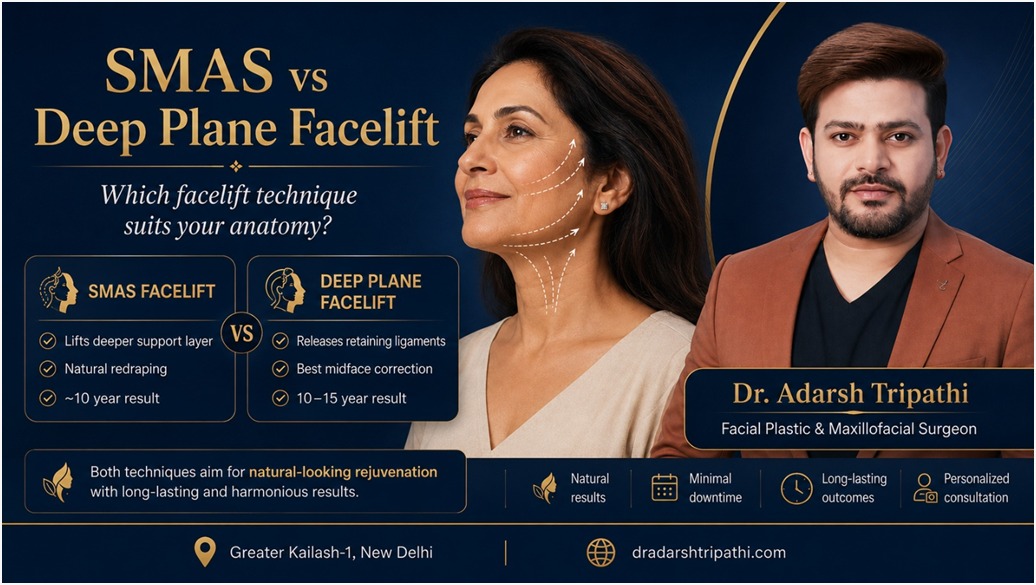
Types of Facelift Offered at Sarayu Clinics, Delhi
1. SMAS Facelift
The well-established modern standard. The SMAS (superficial musculoaponeurotic system) is the deep layer of muscle and connective tissue that controls facial expression and that sags with age. A SMAS facelift lifts and repositions this layer — not just the skin — then re-drapes the skin without tension. This gives a strong, natural, long-lasting result and is an excellent choice for most patients with moderate lower-face and neck ageing, typically those 45 and over.
- Natural, long-lasting (around 10 years); addresses lower face and neck
2. Deep Plane Facelift
The most advanced technique. Rather than lifting the SMAS as a separate step, the deep plane facelift works beneath it, releasing the retaining ligaments that tether the ageing face and repositioning the skin, fat, and muscle together as one unit. Because nothing is pulled and the natural fat pads are repositioned, it gives the most natural, longest-lasting result (often 10–15 years) and the best correction of midface sagging and deep folds. Ideal for significant sagging, midface descent, and those wanting the most durable, natural outcome — and for facelift revisions.
- The most natural and durable result; best for significant or midface ageing
3. Mini Facelift (Short-Scar Facelift)
A less extensive version targeting early jowling and mild lower-face laxity through shorter incisions, often under local anaesthesia with sedation. Less downtime, suited to younger patients (often 40s) with limited sagging who want a subtle lift before more advanced ageing sets in. Not a substitute for a full facelift when sagging is significant.
- Subtle lift, less downtime; best for early, mild jowling
4. Mid-Facelift
Specifically targets the cheek and midface region, lifting flattened cheeks and softening the nasolabial folds. Useful when the midface is the main concern rather than the jawline and neck. Sometimes combined with other procedures.
5. Neck Lift
Tightens loose neck skin, removes or repositions neck fat, and corrects the platysmal bands that blur the neckline. Almost always combined with a facelift for complete lower-face rejuvenation, because lifting the face without addressing an ageing neck leaves the result unbalanced.
6. Combination & Complementary Procedures
For complete facial rejuvenation, a facelift is often combined with eyelid surgery (blepharoplasty) for the eyes, a brow lift for the forehead, fat grafting to restore lost volume, and skin resurfacing for surface quality. Because a facelift addresses sagging but not skin texture or volume, these combinations produce the most complete, natural rejuvenation. Dr. Tripathi plans the right combination for your face.
The Facelift Procedure — Step by Step
Step 1: Consultation & Planning
Dr. Tripathi assesses your facial ageing — the degree and pattern of sagging, skin quality, volume loss, and your neck — reviews your medical history, and discusses your goals honestly. The most suitable technique (SMAS, deep plane, mini, or combination) is recommended based on your anatomy, and any complementary procedures are planned. Photographs and sometimes simulation help align expectations.
Step 2: Pre-Operative Preparation
- Stop smoking for at least 4–6 weeks before and after (critical for facelift healing)
- Stop blood-thinning medications and supplements for 2 weeks as advised
- Pre-operative blood tests and medical/anaesthetic clearance
- Arrange time off (about 2 weeks) and someone to help at home initially
Step 3: Anaesthesia
A facelift is performed under general anaesthesia, or under local anaesthesia with sedation for less extensive lifts. The choice depends on the technique and extent, discussed at consultation.
Step 4: The Surgery
- Discreet incisions are made along the hairline, around and behind the ears, hidden in natural creases and the hairline
- The skin is gently lifted to access the deeper SMAS layer
- The SMAS (or, in a deep plane lift, the deeper plane and retaining ligaments) is released and repositioned upward and backward
- Excess fat is repositioned or refined; the neck is addressed if a neck lift is included
- The skin is re-draped without tension, excess trimmed, and incisions closed meticulously to keep scars fine and hidden
A facelift typically takes 2–4 hours, longer if combined with other procedures.
Step 5: Immediate Recovery
A supportive dressing is applied. Most patients stay overnight or are discharged the same day depending on the extent. You’ll have detailed aftercare instructions, pain relief, and follow-up appointments scheduled.
Recovery and Downtime — What to Expect
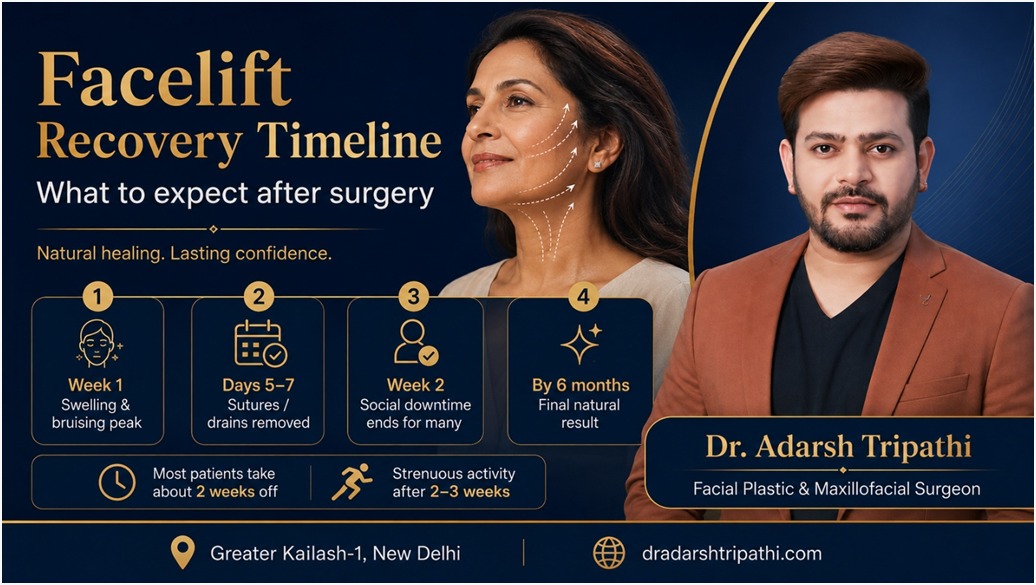
Week 1
Swelling and bruising are at their peak; the face feels tight and somewhat numb (normal). A supportive dressing or garment is worn. Discomfort is moderate and managed with prescribed medication. Rest with the head elevated. Sutures and any drains are typically removed around days 5–7.
Week 2
Swelling and bruising reduce noticeably. Most patients feel comfortable being seen by close family and can manage light activities. Many return to non-physical work toward the end of this week or in week 3, often with the help of light makeup over fading bruising.
Weeks 3–4
Residual swelling continues to settle; the face looks increasingly natural. Most social and work activities resume. Numbness around the ears and cheeks gradually improves over weeks to months (normal and temporary).
Months 2–6
Remaining deep swelling resolves and the tissues settle into their final, natural position. Scars (already well-hidden) continue to fade. The natural, rejuvenated result becomes fully apparent.
Recovery Essentials
- Rest and avoid strenuous activity and heavy lifting for about 2–3 weeks
- Sleep with the head elevated for the first 1–2 weeks to reduce swelling
- No smoking throughout — it severely impairs healing and risks skin complications
- Protect incisions and skin from the sun; use SPF once healed
- Attend all follow-ups so healing is monitored
- Be patient with numbness and tightness — both ease over weeks to months
Facelift Cost in Delhi — Transparent Pricing
Facelift cost depends mainly on the technique, the extent of the lift, whether a neck lift or other procedures are combined, the anaesthesia, and the surgeon’s expertise. Here’s a clear breakdown:
What Affects the Cost ?
- Technique — mini vs SMAS vs deep plane (deep plane involves more complex dissection)
- Whether a neck lift or other procedures are combined
- Anaesthesia (general vs sedation) and facility charges
- Primary vs revision facelift (revision is more complex)
The surgeon’s experience and specialisation
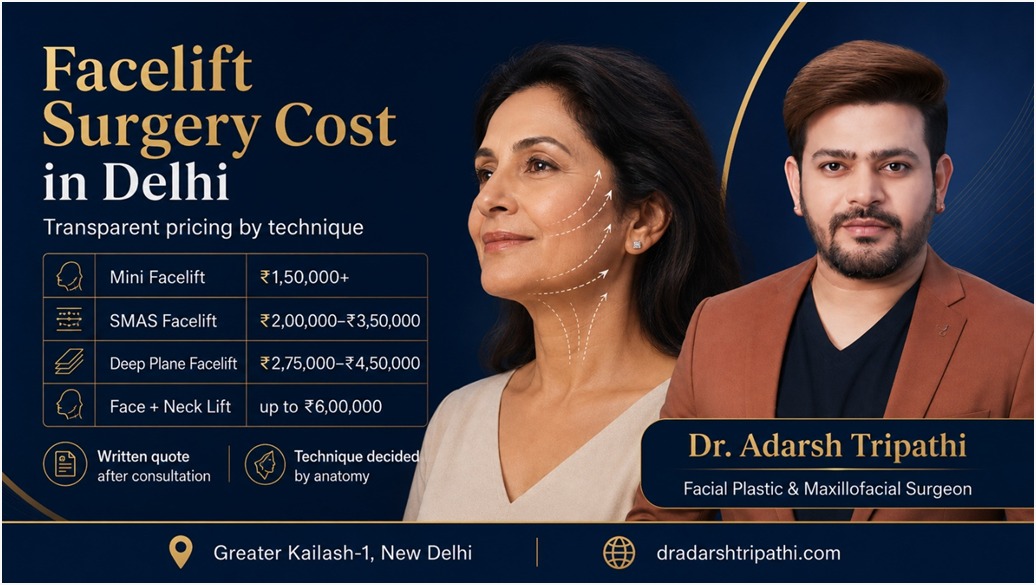
Approximate Cost at Sarayu Clinics, Delhi
Procedure | Approx. Cost | Duration | Anaesthesia | Longevity |
Mini Facelift | Rs. 1,50,000–2,50,000 | 1.5–2.5 hrs | Local + sedation | 5–8 years |
SMAS Facelift | Rs. 2,00,000–3,50,000 | 2.5–3.5 hrs | GA | ~10 years |
Deep Plane Facelift | Rs. 2,75,000–4,50,000 | 3–4 hrs | GA | 10–15 years |
Neck Lift (with facelift) | Rs. 1,25,000–3,00,000 | +1–1.5 hrs | GA | Long-lasting |
Facelift + Neck Lift (combined) | Rs. 3,50,000–6,00,000 | 3.5–5 hrs | GA | 10–15 years |
Revision Facelift | Customised | Varies | GA | Varies |
Prices shown are for guidance only. Your final treatment cost will be confirmed during the initial consultation, based on your individual needs, concerns, and personalised treatment plan.
Results Timeline — When Will I See My Final Result?
A facelift’s result emerges gradually as swelling settles and tissues relax into position — patience in the first weeks is rewarded with a natural outcome.
- Week 1: swollen and bruised — not representative of the result (expected)
- Weeks 2–3: bruising fades, major swelling reduces, early result visible
- Month 1: looking notably refreshed; about 70–80% of the result visible
- Month 3: most swelling resolved; result largely settled, scars fading
- Month 6: final, natural result fully established; scars well-hidden
How Long Do Facelift Results Last?
A SMAS facelift typically lasts around 10 years; a deep plane facelift often 10–15 years; a mini facelift around 5–8 years. The face continues to age naturally after surgery, but you’ll always look younger than you would have without the lift — the clock is effectively set back, then resumes from that younger point. Sun protection, not smoking, stable weight, good skincare, and complementary treatments (volume and skin quality) all help prolong the result.
Comparison — Facelift vs Other Rejuvenation Options
A facelift is the gold standard for sagging, but it’s worth understanding where it sits among the alternatives — and where they complement rather than replace it.
Option | Best For | Permanence | Downtime | Notes |
Deep Plane Facelift | Significant sagging, midface | 10–15 years | 2–3 weeks | Most natural & durable |
SMAS Facelift | Moderate lower-face/neck ageing | ~10 years | 2 weeks | Established gold standard |
Mini Facelift | Early, mild jowling | 5–8 years | 1 week | Subtle, less downtime |
HIFU / RF Tightening | Mild early laxity | 6–18 months | None | Non-surgical, modest |
Mild laxity, temporary | 1–2 years | Few days | Limited, short-lived | |
Fillers / Fat Grafting | Volume loss (not sagging) | Months–years | Minimal–1 wk | Complements, not replaces |
Surgical Facelift vs Non-Surgical ‘Lifts’ — An Honest Comparison
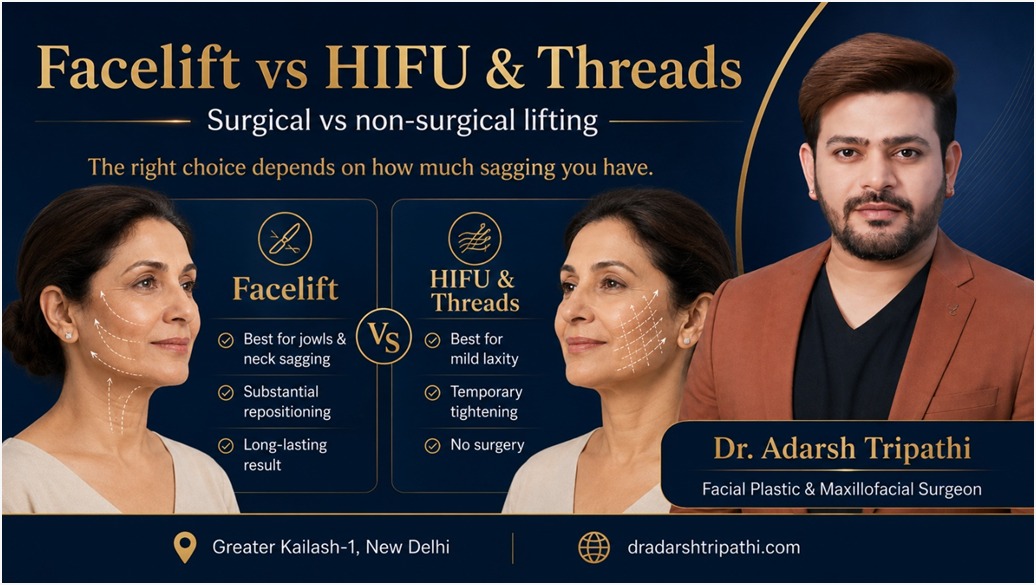
Non-surgical options (HIFU, RF, thread lifts) are marketed as facelift alternatives, and they have a genuine place — for mild, early laxity, or for those not ready for surgery. But it’s honest to say they cannot match a surgical facelift for moderate-to-significant sagging: they tighten modestly and temporarily, whereas a facelift repositions tissue substantially and durably. The right choice depends on how much sagging you have. For early laxity, start non-surgical; for established jowls and neck sagging, only a facelift delivers. A good surgeon will tell you honestly which category you’re in rather than overselling a non-surgical fix that won’t satisfy.
Why a Facial Plastic Surgeon for a Facelift?
A facelift is among the most technically demanding facial procedures — it involves working safely around the facial nerve and repositioning deep structures for a natural result. A surgeon who specialises exclusively in the face, like Dr. Adarsh Tripathi, brings the detailed anatomical knowledge and refined judgement that distinguish a natural, lasting facelift from a tight or short-lived one. When you search for a facelift surgeon in Delhi, this depth of facial specialisation and experience with deeper-layer techniques is exactly what to look for.
Why Dr. Adarsh Tripathi Is a Trusted Facelift Surgeon in Delhi
Of all facial procedures, a facelift most rewards surgeon skill and judgement — the difference between natural and ‘done’ is entirely in the hands. Here’s how to choose, and why patients choose Dr. Tripathi:
What to Look For in a Facelift Surgeon ?
- Specialisation in the face, with experience in SMAS and deep plane (not skin-only) techniques
- A portfolio of natural-looking before-and-after results, not tight or wind-swept ones
- Honesty about what a facelift can and cannot do, and which complementary procedures you need
- Detailed knowledge of facial nerve anatomy for safe, natural results
- A consultation conducted personally by the surgeon
- Genuine reviews and accredited, safe surgical facilities
Dr. Tripathi’s Credentials
- Maxillofacial and Facial Plastic Surgeon with 18+ years of experience
- Practice focused exclusively on the face and neck — facelift surgery is core work
- Uses modern deeper-layer techniques (SMAS, deep plane) for natural, lasting results — not outdated skin-only pulls
- Deep anatomical knowledge of the facial nerve and facial structures for safe surgery
- Plans complete rejuvenation — combining facelift with neck lift, eyelid surgery, volume, and skin treatments as needed
- Consultations personally conducted by Dr. Tripathi; known for natural results, including work with public figures who are regularly photographed
A Natural-Results Philosophy
The ‘pulled’ facelift look comes from tension on the skin — an outdated approach. Dr. Tripathi’s philosophy is to reposition the deeper structures so the skin re-drapes naturally, with no tension and no tell-tale tightness. The aim is for you to look like a rested, younger version of yourself, where people sense you look well rather than guessing you’ve had surgery.
Frequently Asked Questions — Facelift Surgery in Delhi
What is the cost of facelift surgery in Delhi?
The cost of facelift surgery in Delhi ranges from Rs 1,50,000 for a mini facelift to Rs 6,00,000 for a combined face and neck lift. A SMAS facelift is typically Rs 2,00,000-3,50,000 and a deep plane facelift Rs 2,75,000-4,50,000. The final figure depends on the technique, whether a neck lift is combined, anaesthesia and whether it is a primary or revision facelift. A written quote is given after consultation.
What is the difference between a SMAS and a deep plane facelift?
Both reposition the deep layer of the face rather than just pulling skin. A SMAS facelift lifts and tightens the muscle-and-tissue layer and re-drapes the skin without tension, lasting around 10 years. A deep plane facelift works beneath that layer, releasing the retaining ligaments and repositioning skin, fat and muscle as one unit – giving the most natural, longest-lasting result (often 10-15 years) and the best midface correction. A 2025 meta-analysis found deep plane satisfaction at 94.4% versus 87.8% for SMAS. Which suits you depends on your anatomy and degree of ageing.
Will a facelift look natural or “done”?
Done properly with modern deeper-layer techniques, a facelift looks natural – people notice you look rested and well, not operated on. The tight, wind-swept look comes from outdated skin-only techniques that put tension on the skin. Because SMAS and deep plane methods reposition the deeper structures and let the skin re-drape without tension, the result is a fresher version of your own face, not a different one.
How long do facelift results last?
A SMAS facelift lasts around 10 years, a deep plane facelift often 10-15 years, and a mini facelift around 5-8 years. Your face keeps ageing naturally after surgery, but you will always look younger than you would have without it – the clock is set back, then resumes from that younger point. Sun protection, not smoking, stable weight and good skincare all help prolong the result.
What is the right age for a facelift?
Most facelift patients are between 45 and 70, but the right time depends on your degree of sagging and your health, not a number. Some choose an earlier preventative lift in their 40s; others have excellent results in their 70s if healthy. Recent evidence even suggests addressing facial ageing somewhat earlier can give more durable outcomes. The consultation assesses whether surgery is right for you now or whether a non-surgical option suits this stage.
How much downtime does a facelift need?
Most people take about two weeks off. Swelling and bruising peak in week one, when sutures and any drains are removed around days 5-7. By week two, bruising fades and many return to non-physical work, often with light makeup. Residual swelling settles over weeks to months, with the final natural result appearing by around six months. Strenuous activity waits 2-3 weeks.
Is a facelift painful? What anaesthesia is used?
A facelift is performed under general anaesthesia, or local anaesthesia with sedation for less extensive lifts, so the procedure itself is painless. Afterwards, most patients describe tightness and moderate discomfort rather than severe pain, well controlled with prescribed medication. Numbness around the ears and cheeks is normal and eases gradually over weeks to months.
Does a facelift include a neck lift?
Not automatically – but a neck lift is almost always combined with a facelift for complete lower-face rejuvenation, because lifting the face without addressing an ageing neck leaves the result unbalanced. A neck lift tightens loose neck skin, removes or repositions fat, and corrects the vertical platysmal bands. Whether you need one is assessed at consultation based on your neck.
What does a facelift NOT fix?
A facelift lifts sagging tissue but does not improve skin quality (sun damage, fine lines, pigmentation), does not replace lost facial volume, and does not treat the forehead or eyelids. Those need resurfacing, fat grafting or fillers, a brow lift, and eyelid surgery respectively. The most complete, natural results often combine a facelift with these – which is exactly what a facial specialist plans for you rather than overselling surgery alone.
Facelift or non-surgical treatments like HIFU and threads – which do I need?
It depends on how much sagging you have. Non-surgical options such as HIFU, radiofrequency and thread lifts genuinely help mild, early laxity and suit those not ready for surgery, but they tighten modestly and temporarily. For established jowls and neck sagging, only a facelift repositions tissue substantially and durably. An honest surgeon tells you which category you are in rather than selling a non-surgical fix that will not satisfy.
Is a facelift safe? What are the risks?
In experienced, specialist hands a facelift is safe, and permanent facial nerve injury – the complication patients fear most – is very rare, under 1% in high-volume practice. Most issues are minor and temporary: swelling, bruising, tightness and numbness that resolve over weeks. Because a facelift involves working safely around the facial nerve, choosing a surgeon who specialises in facial anatomy is the single most important safety decision you make.
Who is the best facelift surgeon in Delhi?
The best facelift surgeon for you is one who specialises in the face, is experienced in modern SMAS and deep plane techniques (not skin-only pulls), shows a portfolio of natural results, and is honest about what surgery can and cannot do. Dr. Adarsh Tripathi is a Maxillofacial and Facial Plastic Surgeon whose practice is focused exclusively on the face and neck, using deeper-layer techniques for natural, lasting results, with consultations conducted personally.
How to Reach Us:
Phone:+91 9289111083 ,+91 9289111084
Dr Adarsh’s website: https://dradarshtripathi.com/
Facebook: https://www.facebook.com/DrAdarshTripathi3011
Instagram: https://www.instagram.com/dr_adarsh_tripathi/
Youtube: https://www.youtube.com/@dr_adarsh_tripathi
Linkedin: https://www.linkedin.com/in/dr-adarsh-tripathi-a43005b8/
Online Booking: https://dradarshtripathi.com/contact-us/ to schedule appointments conveniently.