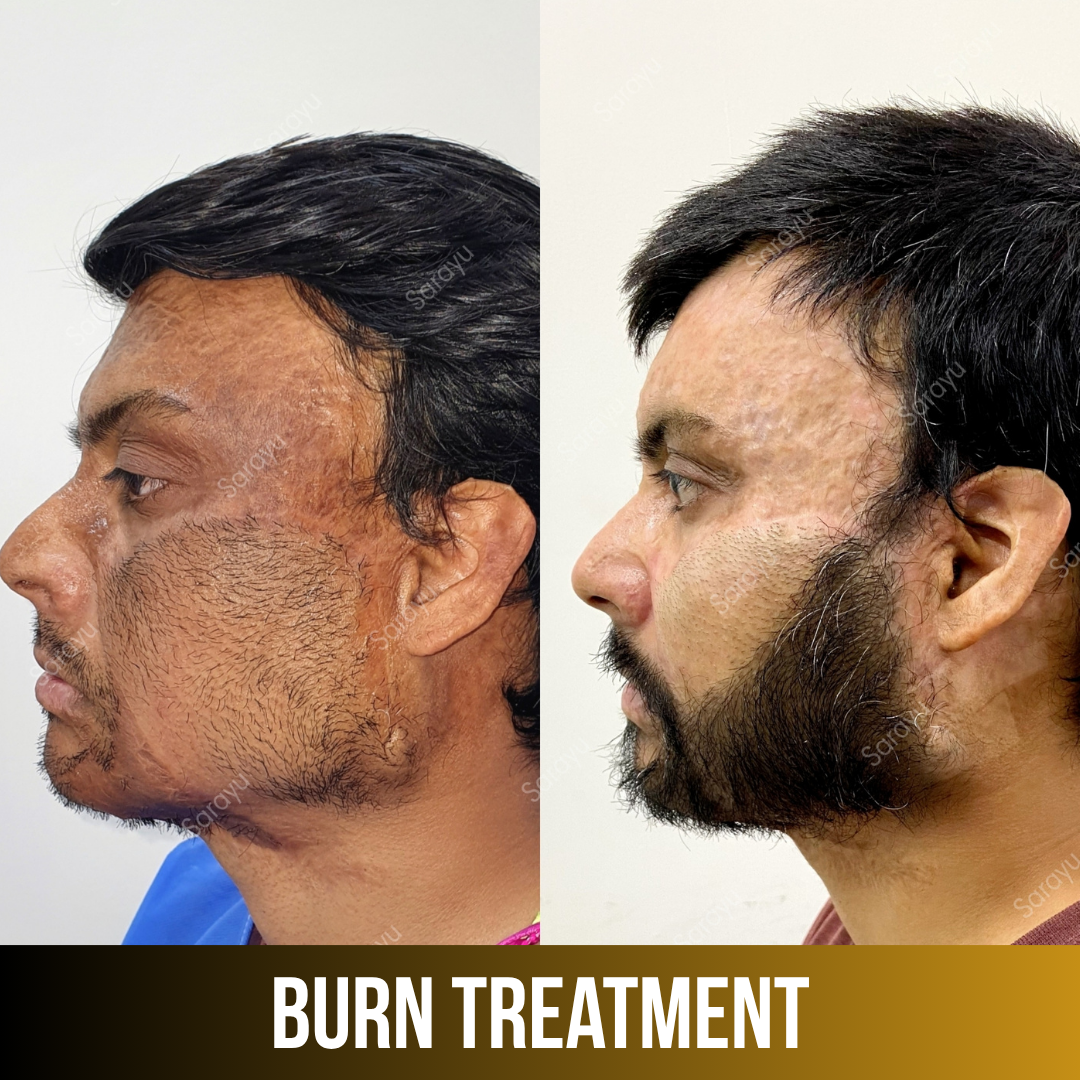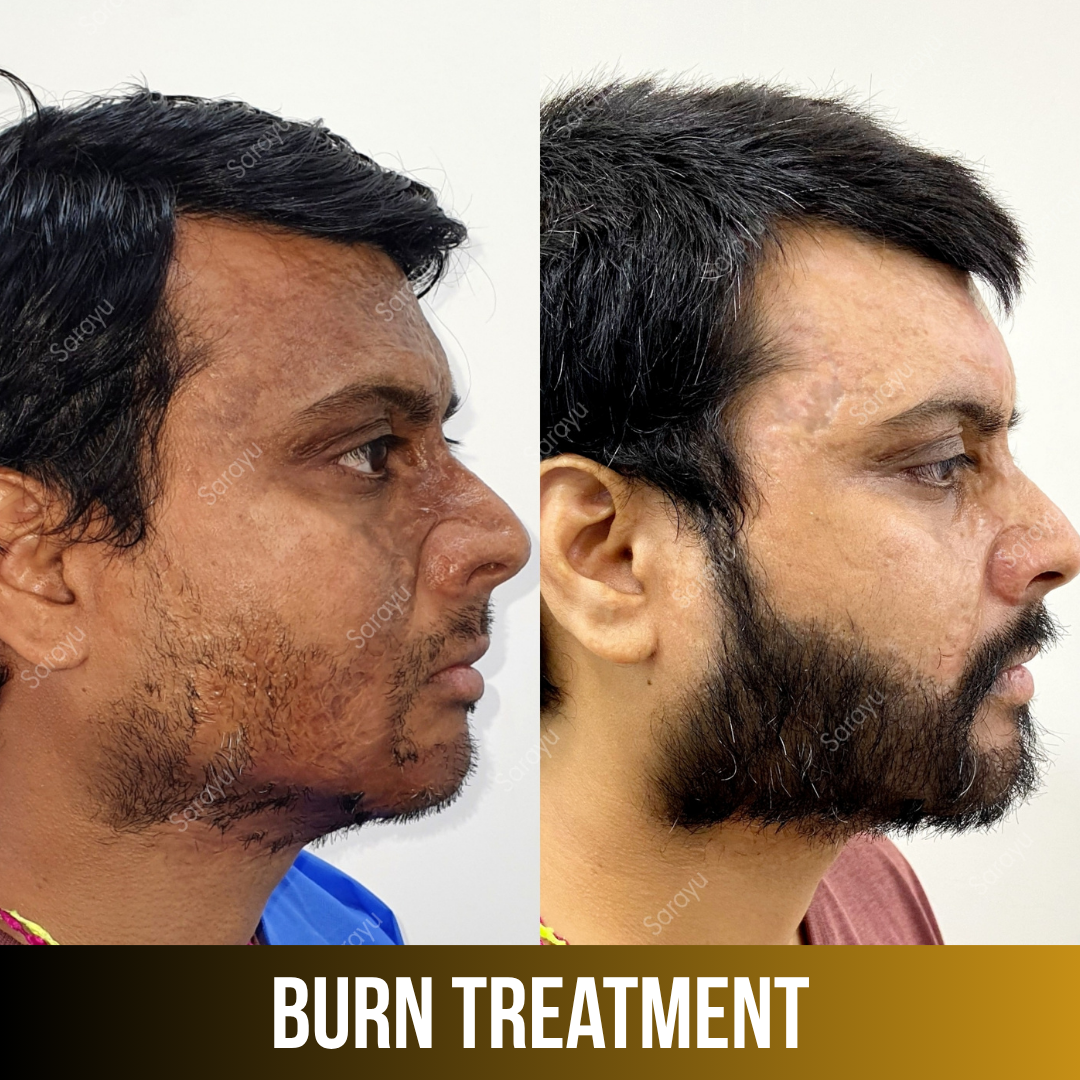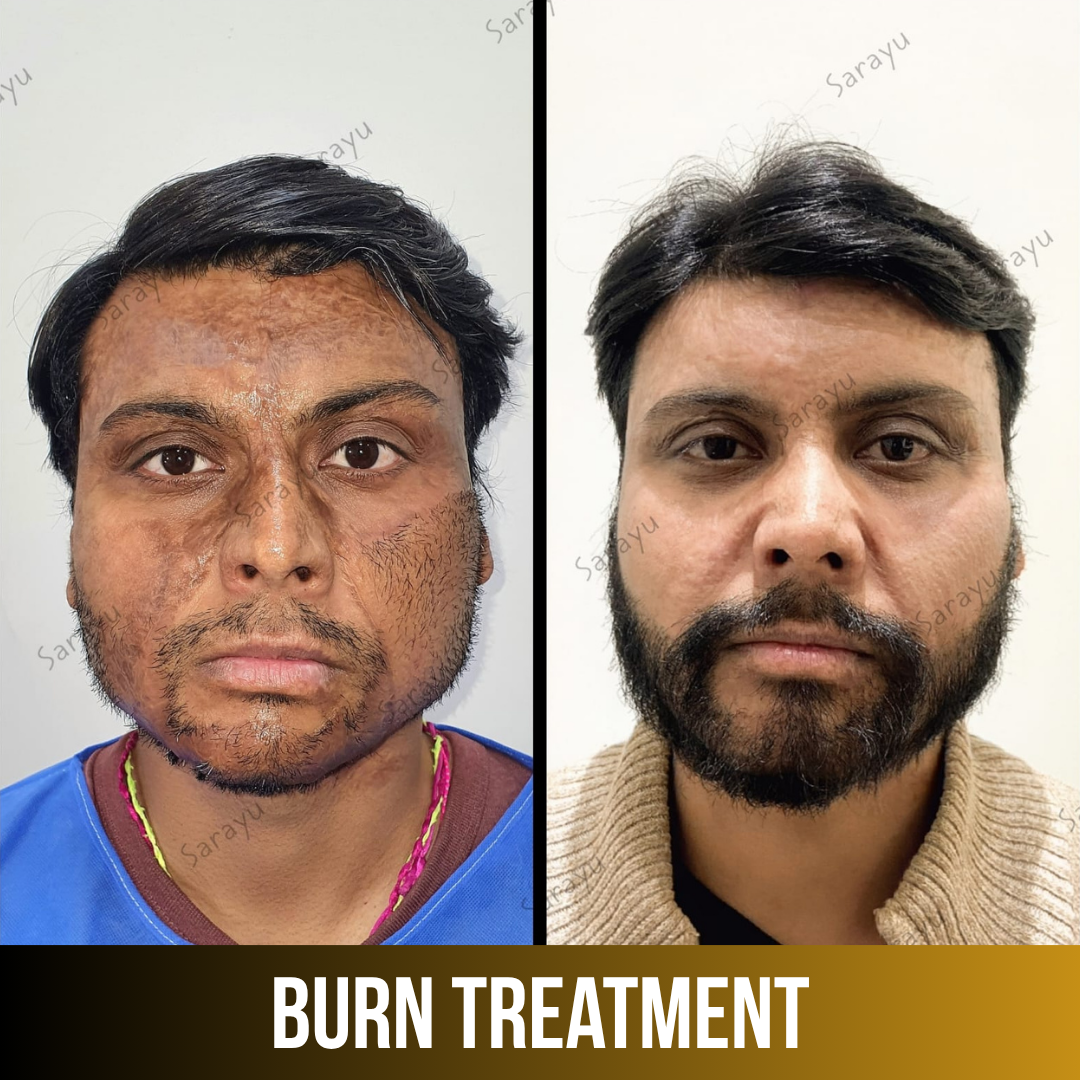
Burn Mark Removal in Delhi — Improving How Burn Scars Look and Move
Quick answer : Burn mark removal in Delhi ranges from non-surgical resurfacing — fractional CO2 laser and microneedling radiofrequency (MNRF) to soften texture and colour — to reconstructive surgery for deeper burn scars, including contracture release, skin grafting, and tissue expansion. At Sarayu Clinics, Greater Kailash-1, treatment is matched to the scar: laser sessions cost roughly Rs 6,000–Rs 20,000 each, while surgical reconstruction is quoted after assessment. Because burn scars often restrict movement as well as affecting appearance, they are treated by a facial plastic and reconstructive surgeon who addresses both. Most improvement comes from a planned combination over several months.
A burn scar is one of the hardest marks to live with, because it rarely lets you forget how it happened. It can be tight where it should be soft, raised where it should be flat, pale or dark where the skin lost its natural colour — and when it crosses a joint, the neck, or the corner of the mouth, it can physically pull, limiting how freely you move. That combination of the visible and the functional is what makes burn scars different from most other marks, and it is why they deserve more than a single laser applied to everyone.
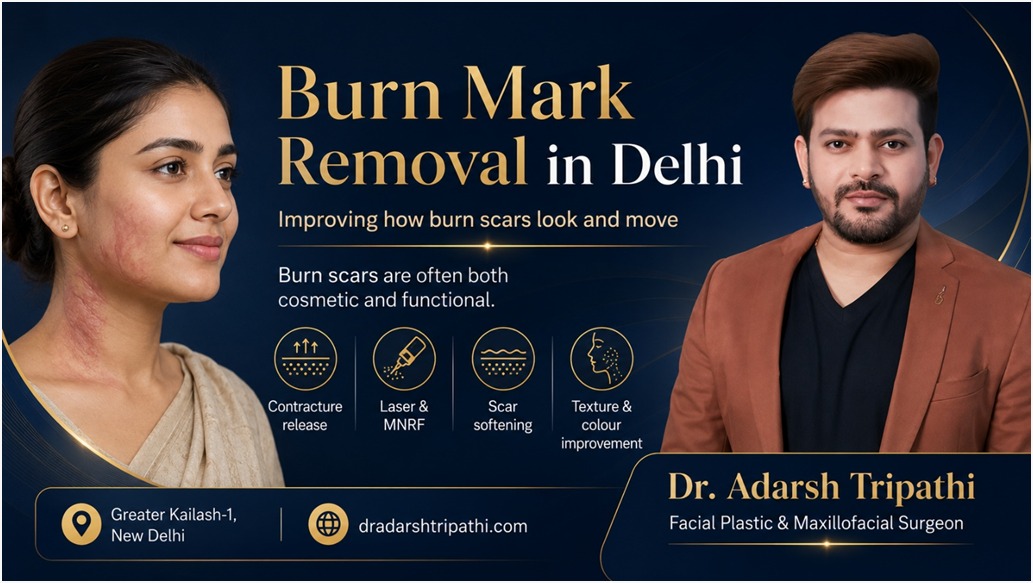
I am Dr. Adarsh Tripathi , facial plastic and maxillofacial surgeon at Sarayu Clinics, Greater Kailash-1. Burn scar treatment sits exactly where my training lives — it is part reconstructive surgery (releasing tight scars, grafting, rebuilding), part modern resurfacing (fractional laser and radiofrequency for texture and colour), and part honesty about what is realistically achievable. This page explains the types of burn scars, every treatment we use for them, what each realistically achieves, recovery, and cost — so you can see how a proper plan is built around your scar rather than around one machine.
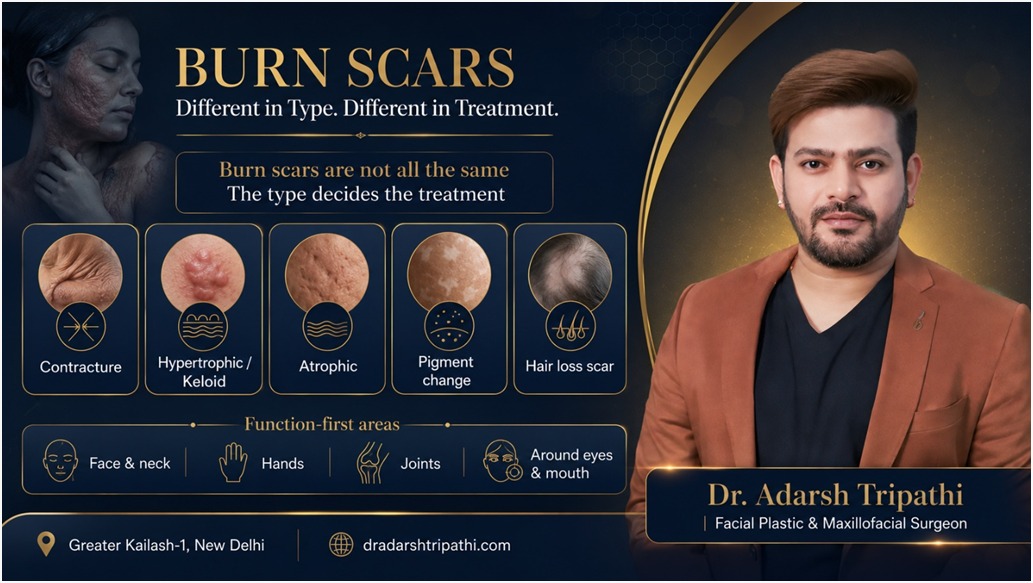
Burn Scars Are Not All the Same — and the Type Decides the Treatment
The single most important step is identifying what kind of burn scar you have, because the right treatment differs completely between them. Most significant burns leave a mix, which is why combination plans are usual.
Type of burn scar | What it looks like / does | Main treatments |
Contracture scar | Tight, hard scar tissue that pulls the skin — across a joint, the neck, mouth or eyelid — and can restrict movement or function | Surgical contracture release, skin grafts or flaps, tissue expansion; laser/MNRF to soften afterwards |
Hypertrophic scar | Raised, thick, red scar that stays within the original burn area; often itchy or tight | Steroid injections, silicone, fractional laser, MNRF, pressure therapy |
Keloid scar | Raised scar that grows beyond the original burn edge; firmer, can be symptomatic | Specialised keloid management — steroid/other injections, careful surgery with adjuncts, laser |
Atrophic / textural scar | Depressed, uneven, or thinned skin texture from a more superficial burn | Fractional CO2 laser, MNRF, subcision, microneedling with PRP |
Pigmentary change | Darker (hyperpigmented) or lighter (hypopigmented) skin where the burn healed | Resurfacing lasers, pigment-targeted treatment, medical camouflage; careful protocols for Indian skin |
Hair loss over the burn | Permanent bald patches where a burn destroyed hair follicles (scalp, brow, beard) | Hair transplant / restoration into the burn-scarred area once stable |
The practical point: a tight contracture across the neck needs surgery to release it before any laser is worth doing, while a flat, discoloured, superficial burn mark may need only resurfacing — and getting that judgement right is what separates a real plan from a sales package.
Areas We Treat — Function First
Burn scars can occur anywhere, but some areas matter for movement and expression as much as appearance, and are planned with particular care:
- Face and neck: where appearance and expression matter most, and where neck contractures can limit head movement — the area a facial specialist is specifically trained for.
- Hands and fingers: where contractures can seriously affect grip and daily function; releasing them restores both use and appearance.
- Joints (elbow, knee, armpit, shoulder): where tight scar bands restrict the joint’s range — contracture release is functional surgery, not only cosmetic.
- Around the eyes and mouth: where even small contractures can pull the eyelid or lip — delicate, high-value reconstructive work.
- Scalp, brow and beard: where burns leave permanent bald areas that hair restoration can refill once the scar is stable.
- Torso and limbs: larger surface scars where resurfacing, grafting and pigment treatment improve texture and colour.
Benefits of Professional Burn Scar Treatment
- Restored movement: releasing a contracture can return range of motion to a joint, hand, or the neck — a functional gain, not just a cosmetic one.
- Flatter, softer scars: raised and hard scars can be reduced and softened, easing tightness and itch.
- More even texture and colour: resurfacing and pigment treatment blend the scar closer to surrounding skin.
- Relief of symptoms: many burn scars itch, sting, or feel tight — treatment can genuinely reduce these, as the evidence below shows.
- Hair where it was lost: restoration can refill burn-related bald patches on the scalp, brow, or beard.
- Confidence and comfort: reducing a visible burn scar, especially on the face, is often deeply felt — while we stay honest that improvement, not erasure, is the realistic goal.
What Burn Scar Treatment Can Realistically Achieve ?
Honesty matters here more than on almost any other page, because burn scars are often over-promised to vulnerable people. The realistic picture: most burn scars can be significantly improved — flatter, softer, more even in colour, and less restrictive — but a mature burn scar cannot be erased to normal, unmarked skin. The goal is meaningful improvement in both appearance and function, achieved through a planned combination of treatments over months. The encouraging part is that the improvement is often functional as well as visual: in a published study of fractional CO2 laser for burn scars — 131 patients across 387 treatment sessions — 96.7% of patients were satisfied, with measurable reductions in scar tightness, thickness, neuropathic pain, and itch. A broader systematic review likewise found fractional CO2 laser significantly improves the overall quality of hypertrophic burn scars. Real results come from the right combination over time — any clinic promising to erase a burn scar in one or two sessions is not being straight with you.
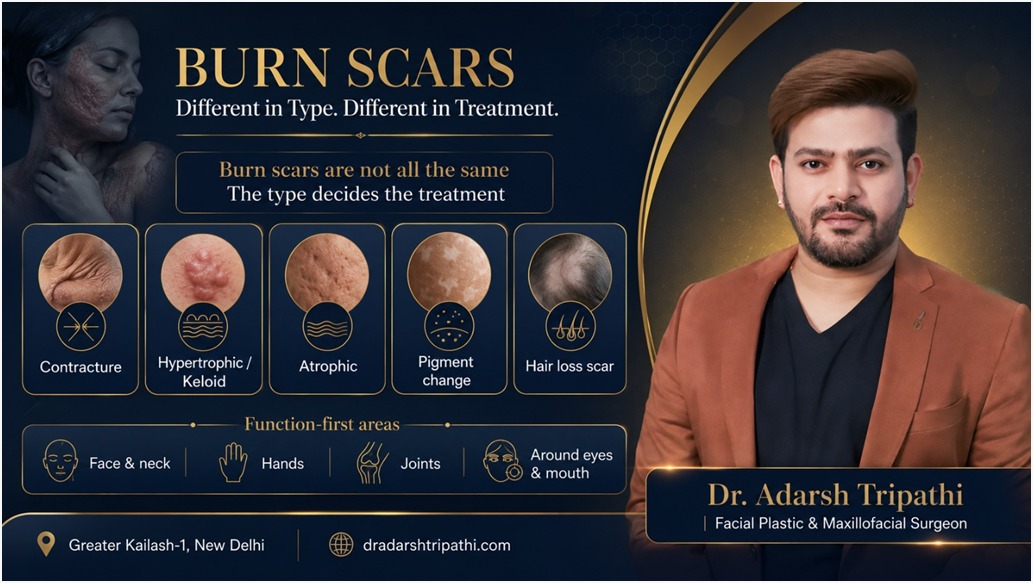
Burn Scar Treatments at Sarayu Clinics, Delhi
The right plan usually combines several of these, matched to your scar type and whether function is involved.
Non-Surgical & Resurfacing
- Fractional CO2 laser: the workhorse for burn-scar texture, tightness and colour — controlled microscopic columns trigger remodelling; the evidence above shows it also reduces pain and itch. Settings are adjusted carefully for Indian skin.
- Microneedling radiofrequency (MNRF): remodels scar collagen with a lower pigmentation risk than ablative laser — often preferred for darker skin; see MNRF and Morpheus 8 .
- Subcision& microneedling with PRP: release tethered depressed scars and boost healing with your own growth factors.
- Steroid / scar injections: flatten and soften raised hypertrophic and keloid scars, often alongside laser.
- Pigment & camouflage treatment: targeted work for the dark or pale patches burns leave behind, with pigmentation treatment protocols suited to Indian skin
Surgical & Reconstructive
- Contracture release: cutting and releasing tight scar bands across a joint, neck, or face to restore movement — the core reconstructive procedure, often combined with a graft or flap.
- Skin grafting: replacing lost or released scar tissue with healthy skin from another area, to resurface and free the area.
- Flap surgery: moving skin with its own blood supply into a burn-damaged area for a durable, better-matched reconstruction.
- Tissue expansion: gradually growing extra healthy skin nearby, then using it to replace the scar — excellent colour and texture match.
- Scar revision: surgically re-orienting or refining a scar to make it less visible and less tight; see scar revision.
- Hair restoration into burn scars: transplanting hair into stable burn-scarred scalp, brow, or beard once the scar is mature; see hair transplant.
Who Is a Good Candidate — and When to Treat ?
You are likely a good candidate if:
- Your burn has fully healed and the scar is mature or maturing (often best assessed from several months to a year after the burn, though contractures affecting function may be addressed sooner).
- You have a contracture limiting movement, a raised/hard scar, an uneven texture, pigment change, or burn-related hair loss that bothers you.
- You are in good general health with no active infection in the area.
- You have realistic expectations — significant improvement in appearance and function over a planned course, not overnight erasure.
Timing and special notes:
- Function comes first: a contracture that restricts a joint or pulls an eyelid or lip is assessed promptly — that is reconstructive priority, not elective cosmetic.
- Let scars mature for resurfacing: for texture and colour work, allowing the scar to settle usually gives better, safer results.
- Indian and darker skin: burns commonly leave pigment change, and aggressive treatment can worsen it — so MNRF and conservative laser settings with strict sun protection are used to protect against post-inflammatory pigmentation.
- Children and large burns: extensive or paediatric burn reconstruction may be staged over time and, where appropriate, coordinated with the right multidisciplinary care.
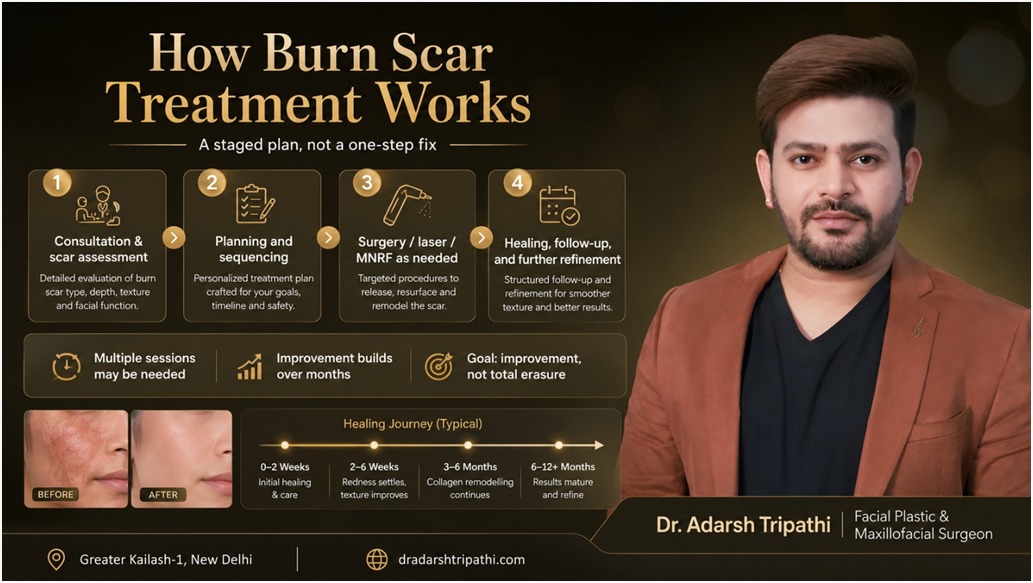
The Treatment Process — Step by Step
Step 1 — Assessment and scar mapping
We examine the burn scar — its type, maturity, whether it restricts movement, the pigment and texture, and the surrounding skin — and map a plan. This is where the reconstructive-versus-resurfacing decision is made: what needs surgery, what needs laser or MNRF, what needs both, and in what order.
Step 2 — Planning and sequencing
Burn scar improvement is usually a sequence, not a single event: for example, release a contracture surgically first, let it heal, then resurface the area with laser or MNRF and address pigment. You receive the plan, the number of stages, and the written cost before anything begins.
Step 3 — Treatment
Non-surgical sessions (laser, MNRF, injections) are done under numbing cream in the clinic; reconstructive surgery is performed under local or general anaesthesia depending on size and site. Each step is planned to build on the last.
Step 4 — Aftercare and scar support
Healing is supported with the measures that genuinely help burn scars: strict sun protection, silicone gel or sheeting, pressure garments where indicated, moisturisation, and scheduled reviews — with results building over the following months as collagen remodels.
Downtime — What to Expect by Treatment
Treatment | Visible after-effects | Downtime |
Fractional CO2 laser | Redness, peeling, temporary darkening | 5–7 days social downtime; sun care essential |
MNRF / Morpheus 8 | Redness, pinpoint marks | 1–3 days |
Steroid / scar injections | Minor swelling at the site | Minimal — same day |
Subcision / microneedling + PRP | Bruising, redness | 2–5 days |
Contracture release + graft | Dressings; graft/donor healing | 2–4 weeks initial; fuller recovery over weeks–months |
Tissue expansion | Gradual over weeks as expander fills | Staged over weeks–months |
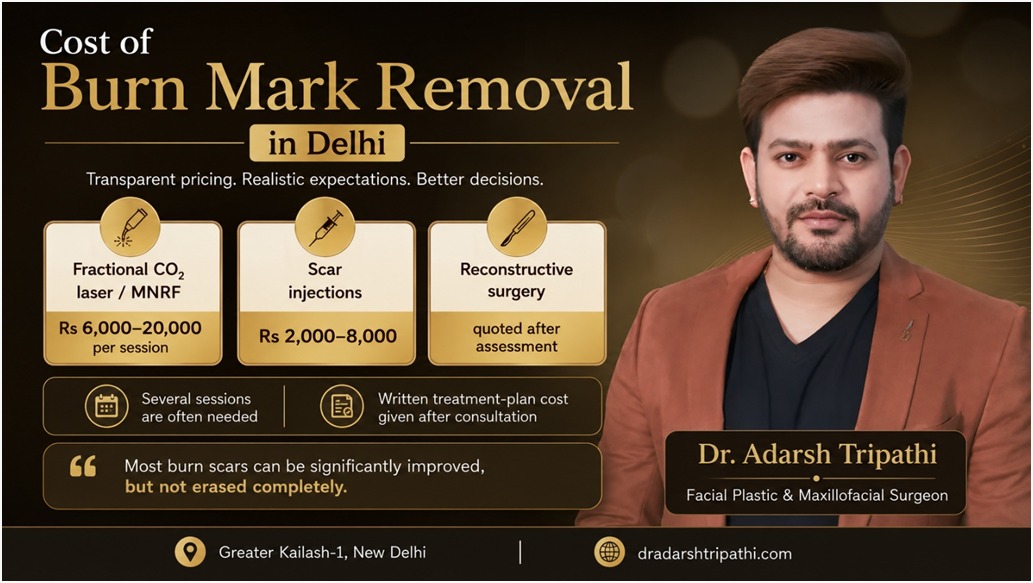
Cost of Burn Mark Removal in Delhi (2026)
The cost of burn mark removal in Delhi depends on the scar type, size, and — above all — whether it needs resurfacing only or reconstructive surgery. Because burn scars almost always need a combination over several stages, it is best to think in terms of a treatment plan rather than a single price. Realistic ranges:
Prices shown are for guidance only. Your final treatment cost will be confirmed during the initial consultation, based on your individual needs, concerns, and personalised treatment plan.
Treatment | Approx. Delhi cost | Notes |
Fractional CO2 laser (per session) | Rs 6,000 – Rs 20,000 | Multiple sessions usual; [insert clinic pricing] |
MNRF / Morpheus 8 (per session) | Rs 6,000 – Rs 18,000 | Lower pigmentation risk for darker skin |
Steroid / scar injections (per session) | Rs 2,000 – Rs 8,000 | For raised hypertrophic/keloid scars |
Subcision / microneedling + PRP | Rs 4,000 – Rs 12,000 | For tethered/textural scars |
Contracture release / grafting / flap surgery | Quoted after assessment | Depends on size, site, complexity, anaesthesia |
Tissue expansion (staged) | Quoted after assessment | Multi-stage reconstruction |
Hair restoration into burn scar | Quoted after assessment | Once the scar is stable |
Your written plan and quote at Sarayu Clinics are given after assessment. On insurance: where burn scar surgery is reconstructive and functional — releasing a contracture that restricts movement, for example — it may qualify for partial coverage with proper documentation, unlike purely cosmetic work. We provide the clinical documentation; your insurer decides.
Results Timeline — When Will I See Improvement?
- First weeks: after a laser/MNRF session, healing and settling; after surgery, wound and graft healing — limited visible change at first.
- 1–3 months: texture and colour begin improving as collagen remodels; released contractures show restored movement once healed.
- 3–6 months: the main improvements become clear across a combination plan — flatter, softer, more even scars.
- 6–12 months and beyond: burn scars remodel slowly — improvement continues for up to a year or more, with maintenance sessions as planned.
Patience genuinely matters with burn scars: they respond, but they respond gradually, and the best results come from completing the planned sequence rather than judging too early.
Why a Facial Plastic & Reconstructive Surgeon for Burn Scars?
This is the heart of it. Burn scar treatment is not a single-device job — it needs both reconstructive surgical skills (contracture release, grafting, flaps, tissue expansion) to address function and structure, AND modern resurfacing (fractional CO2 laser, MNRF) to refine texture and colour, plus the judgement to treat Indian skin safely and to know which scar needs which. A laser-only skin clinic can resurface but cannot release a contracture or graft; a general setup may not offer the aesthetic resurfacing that refines the final look. A facial plastic and maxillofacial surgeon brings both halves — which is exactly what a burn scar, sitting at the border of function and appearance, requires.
- Function and appearance together: contractures are assessed for movement, not just looks — the reconstructive priority a cosmetic-only clinic may miss.
- Safe for Indian skin: PIH-conscious protocols, MNRF-first where appropriate, and strict sun protection to protect pigment.
- Honest, staged planning: a realistic sequence with written costs — improvement, not false promises of erasure.
Related Treatments at Our Delhi Clinic
Resurfacing & scar | Reconstructive & hair | Skin & pigment |
Pigmentation Treatment – /permanent-pigment-treatment-in-delhi/ | ||
Frequently Asked Questions About Burn Mark Removal in Delhi
What is the cost of burn mark removal in Delhi?
The cost of burn mark removal in Delhi depends on the scar and the treatment: fractional CO2 laser and MNRF are roughly Rs 6,000-20,000 per session (several sessions are usual), scar injections Rs 2,000-8,000, and reconstructive surgery such as contracture release, grafting, or tissue expansion is quoted after assessment based on size, site, and complexity. Because burn scars usually need a staged combination, a written treatment-plan cost is given at consultation.
Can burn scars be completely removed?
Burn scars can be significantly improved – flatter, softer, more even in colour, and less restrictive – but a mature burn scar cannot be erased back to normal, unmarked skin. The realistic goal is meaningful improvement in both appearance and function through a planned combination of treatments over several months. Any clinic promising complete erasure in one or two sessions is overpromising.
What is the best treatment for burn scars?
It depends on the scar type. Contractures that restrict movement need surgical release, often with a graft or flap; raised hypertrophic and keloid scars respond to steroid injections, laser, and pressure; textural and pigment scars respond to fractional CO2 laser and MNRF. Most burn scars need a combination, sequenced correctly – which is why assessment by a reconstructive facial surgeon matters more than any single device.
What is a contracture, and why does it need surgery?
A burn contracture is tight, hardened scar tissue that pulls the skin and can restrict movement when it crosses a joint, the neck, an eyelid, or the mouth. Because the tissue is genuinely short and tight, laser alone cannot fix it – it needs surgical release (cutting and freeing the band), usually combined with a skin graft or flap to resurface the released area. This is functional reconstructive surgery, not only cosmetic.
Is laser or surgery better for burn scars?
They do different jobs and are often combined. Surgery (contracture release, grafting, flaps, tissue expansion) restores function and replaces or frees badly scarred tissue; laser and MNRF refine texture, colour, and tightness of the scar surface. A flat, discoloured burn mark may need only resurfacing, while a tight contracture needs surgery first and resurfacing afterwards. The right answer is decided at assessment.
Is burn scar treatment safe for Indian and darker skin?
Yes, with the right protocols. Indian and darker skin is more prone to post-inflammatory pigmentation, so aggressive settings can worsen discolouration. That is why microneedling radiofrequency (MNRF) is often preferred over ablative laser for darker skin, laser settings are kept conservative, and strict sun protection is essential. Matching treatment intensity to skin tone is a key safety step.
How many sessions will I need for burn scar treatment?
Most people need several sessions over months, because burn scars remodel slowly and combination treatment works best. Resurfacing (laser/MNRF) is typically done in a course of multiple sessions spaced weeks apart, and surgical reconstruction may be staged. The exact number depends on the scar type, size, and whether surgery is involved, and is planned at your consultation.
Does insurance cover burn scar removal in Delhi?
Purely cosmetic burn scar treatment is generally not covered, but reconstructive surgery for a functional problem – such as releasing a contracture that restricts movement – may qualify for partial coverage with proper medical documentation. It depends on your policy and the clinical indication. We provide the documentation your insurer requires; the insurer makes the final decision.
Is burn scar treatment painful?
Laser and MNRF are done under numbing cream and feel like heat or prickling rather than real pain; injections cause a brief sting. Reconstructive surgery is performed under local or general anaesthesia, so it is painless during the procedure, with manageable discomfort afterwards controlled by prescribed medication. Aftercare is designed to keep you comfortable as the area heals.
When should burn scar treatment be started after the burn?
Timing depends on the goal. A contracture that restricts movement or pulls an eyelid or lip is assessed promptly, because function is a priority. For improving texture and colour, it is usually best to let the scar mature – often several months to a year – as this gives safer, better resurfacing results. An assessment determines the right timing for your scar.
Can hair be restored to a burn scar?
Yes. Where a burn destroyed hair follicles and left a permanent bald patch on the scalp, brow, or beard, hair can be transplanted into the burn-scarred area once the scar is stable and the blood supply is adequate. It is a specialised application of hair restoration and is planned individually after assessing the scarred skin.
Who is the best burn scar removal doctor in Delhi?
The best burn scar removal doctor in Delhi is one who offers both reconstructive surgery (for contractures and deep scars) and modern resurfacing (for texture and colour), and treats Indian skin safely. Dr. Adarsh Tripathi is a Maxillofacial and Facial Plastic Surgeon with 16+ years of experience who combines reconstructive and aesthetic treatment in a single plan at Sarayu Clinics, Greater Kailash, addressing both how a burn scar looks and how it moves.
How to Reach Us:
Phone:+91 9289111083 ,+91 9289111084
Dr Adarsh’s website: https://dradarshtripathi.com/
Facebook: https://www.facebook.com/DrAdarshTripathi3011
Instagram: https://www.instagram.com/dr_adarsh_tripathi/
Youtube: https://www.youtube.com/@dr_adarsh_tripathi
Linkedin: https://www.linkedin.com/in/dr-adarsh-tripathi-a43005b8/
Online Booking: https://dradarshtripathi.com/contact-us/ to schedule appointments conveniently.