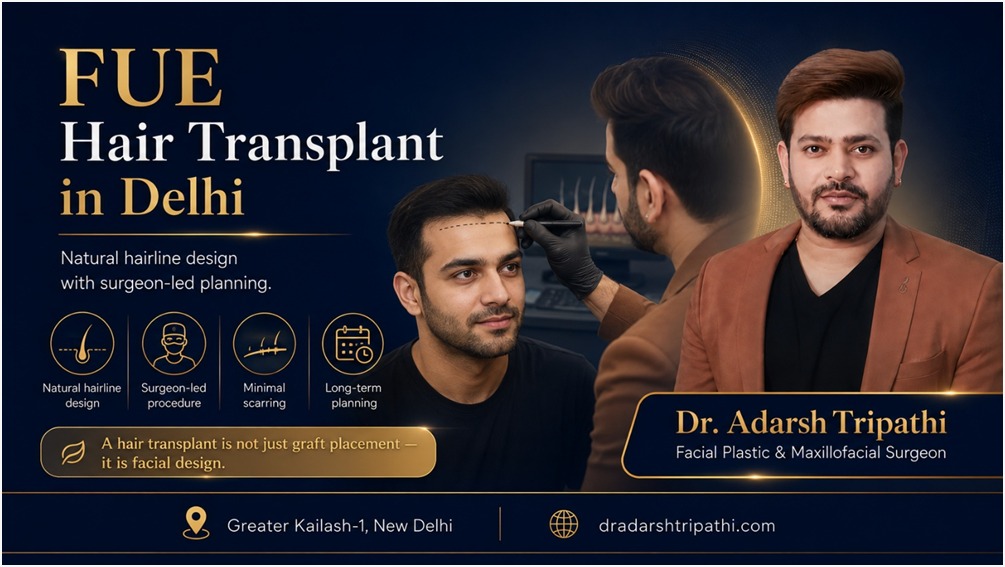
FUE Hair Transplant in Delhi — Scarless Hair Restoration with Facial-Aesthetic Hairline Design
FUE — Follicular Unit Extraction — has become the most popular hair transplant technique worldwide for a reason: it leaves no linear scar, has a faster recovery than the older FUT strip method, lets patients wear short hairstyles without giveaway scars, and produces results that, in the right hands, are indistinguishable from natural hair. If you’re searching for an FUE hair transplant surgeon in Delhi, you’re already looking in the right direction. The question that matters is not whether FUE works — it does — but what separates an average FUE result from a genuinely natural one. The answer comes down to four things: the SURGEON’s personal involvement in critical steps (not delegation to technicians), hairline DESIGN as a facial aesthetic decision, the PUNCH technique and tool selection (Sapphire vs steel, 0.6mm vs 0.8mm vs 1.0mm), and a low GRAFT TRANSECTION RATE — the quiet, technical measure that distinguishes skilled FUE from mass-throughput work.
Here’s the most important strategic insight on this page, and it’s where this clinic differs from most FUE-only clinics in Delhi: FUE technique is widely taught and broadly available, but HAIRLINE DESIGN — where the hairline sits, what shape it has, how much irregularity it carries, how it tapers from front to back — is fundamentally a facial aesthetic decision. The hairline frames the face. Its position relative to the eyebrows and forehead, its symmetry with overall facial proportion, and its irregularity (a perfectly straight hairline is the classic ‘doll’s hair’ giveaway) all decide whether your FUE result reads as natural hair on your head or as a transplanted line stitched on top. As a Maxillofacial and Facial Plastic Surgeon, Dr. Adarsh Tripathi’s daily work is exactly this — facial proportion, balance, aesthetic harmony. For FUE, this expertise is the difference between a good technical result and a genuinely natural one.
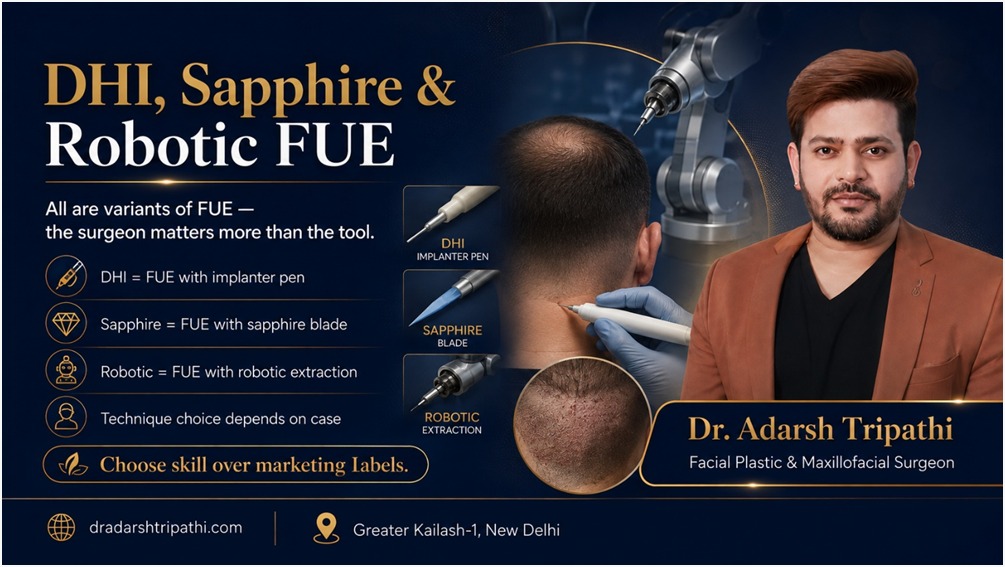
There’s a related insight rarely discussed by FUE clinic websites: DHI (Direct Hair Implantation) is NOT a separate technique — it’s a variant of FUE using a different implantation tool (the Choi pen) for placing grafts. Similarly, Sapphire FUE is FUE using a sapphire blade for recipient incisions. Robotic FUE is FUE with a robot doing the extraction. These are all FUE. Marketing language often presents them as competing alternatives, but they’re variations of the same fundamental technique. The surgeon’s skill matters far more than which tool brand is used. This page covers all of them honestly — what each is, when each is useful, and when none of them matters much.
Dr. Adarsh Tripathi is a Maxillofacial and Facial Plastic Surgeon with over 18 years of experience at Sarayu Clinics, Greater Kailash-1, New Delhi. This page covers FUE hair transplant in depth — what it is, who it suits, the variants (manual, motorised, Sapphire, DHI, robotic, body hair), step-by-step procedure, the realistic 12–18 month timeline, cost in Delhi, the FUE-vs-FUT-vs-DHI comparison, what FUE can’t do, and how to choose the right FUE hair transplant doctor in Delhi.
Quick Answer — What is FUE hair transplant and what does it cost in Delhi?
FUE (Follicular Unit Extraction) is a hair transplant technique in which individual hair follicles are extracted one by one from the donor area (back and sides of the scalp) using a fine circular punch (typically 0.6–1.0mm), then implanted into areas of hair loss. Unlike the older FUT ‘strip’ method, FUE leaves no linear scar — only tiny dot scars that become essentially invisible. In Delhi, FUE hair transplant costs Rs. 40–90 per graft, with most patients requiring 1,500–4,000 grafts for total costs of Rs. 60,000 to Rs. 3,00,000+. Final results appear 12–18 months after surgery. Dr. Adarsh Tripathi at Sarayu Clinics, Greater Kailash, performs FUE hair transplant personally — designing each hairline with the facial-aesthetic precision of a facial plastic surgeon.
Benefits of FUE Hair Transplant — Why It's the Modern Standard
FUE has overtaken FUT (the older strip method) as the dominant hair transplant technique because of several genuine clinical advantages. Here’s the honest picture:
- No linear scar — only tiny circular dot scars at extraction sites that become essentially invisible within months
- Suitable for short hairstyles — including buzz cuts, crew cuts, and fade haircuts; the donor scars don’t show even at very short lengths
- Faster recovery — no sutures to remove, less donor area tenderness, return to most activities in 5–7 days
- Less post-operative pain — no surgical wound under tension across the back of the scalp
- Can harvest from multiple donor areas — scalp, beard, chest, and (rarely) other body areas to extend usable graft supply
- Repeatable across multiple sessions over time — without the cumulative scarring concern of multiple FUT strips
- Suitable for repair work — fixing old transplants, transplanting into scarred scalp, or filling small areas
- Permanent results — the transplanted hair follicles grow for life because they’re genetically resistant to balding
- Outpatient procedure under local anaesthesia — no general anaesthesia, walk in and walk out the same day
- Aesthetic flexibility — fine 0.6–0.7mm punches allow extraction of 1-hair grafts for refined hairline work
An honest framing: FUE is excellent but isn’t perfect for every case. For very large cases (4,000+ grafts in a single session), FUT can sometimes yield more grafts per session and is more cost-effective per graft. FUE extraction is slower per graft than FUT dissection, which means longer total procedure time. The shaved donor area for traditional FUE is visible for 1–2 weeks. None of these are deal-breakers — they’re trade-offs to discuss. For most candidates with mild-to-moderate loss who want a scarless, modern approach with short-hairstyle flexibility, FUE is the right answer.
Areas Treated with FUE Hair Transplant
FUE’s flexibility — small precise extraction, no linear scar, ability to use donor from multiple regions — makes it suitable for almost all hair restoration applications. Here’s where FUE excels:
Scalp — Receding Hairline and Temples
The most commonly treated area, especially in men. FUE’s fine punches (typically 0.7–0.8mm) allow extraction of 1-hair and 2-hair grafts for the most refined hairline work. This is where the facial-aesthetic hairline design matters most — height above the brows, shape of the temples, irregularity at the very front edge, density gradient from front to back. The combination of refined extraction + careful design is what produces hairlines that look like they belong on your face rather than imposed on top.
Scalp — Crown and Vertex
The whirl area at the top-back of the head. Often the second area to thin in male pattern baldness. FUE allows precise placement following the natural whirl pattern — important because incorrectly angled crown placement creates obvious cowlicks. The crown typically uses 2-hair and 3-hair grafts for density.
Scalp — Mid-Scalp Thinning
Diffuse thinning across the middle of the scalp. FUE allows precise placement among existing native hair without disrupting it (a key concern when transplanting into thinning rather than bald areas).
Female Hair Loss — Crown and Diffuse Thinning
Female pattern hair loss (typically Ludwig type 1–3) tends to be diffuse with preserved hairline. FUE allows the very precise, careful placement needed for adding density to thinning native hair without disturbing it — particularly important in female cases where hairline restoration is rarely the goal. The fine FUE punches don’t disturb surrounding native hair the way a larger strip excision can.
Beard and Moustache
FUE beard transplant addresses patchy beards, absent moustache areas, scarred beard regions, or genetically sparse facial hair. Scalp donor follicles are extracted via FUE and implanted into the beard area — they adapt to the new environment and grow indefinitely. FUE’s precise angle control is particularly important here because beard hair angles vary significantly across the face. Sometimes scalp-to-beard FUE is used; sometimes beard-to-scalp FUE in body-hair-transplant cases.
Eyebrows
FUE eyebrow restoration uses fine scalp follicles to recreate thinning, over-plucked, scarred, or absent eyebrows. The most aesthetically demanding application — every single hair must be angled, directed, and placed individually. FUE’s precision is essential. The transplanted hairs need ongoing trimming because they grow at scalp rate, not eyebrow rate.
Body Hair Transplant (BHT) — FUE-Exclusive
Body Hair Transplant is FUE-only — FUT cannot harvest body hair. For patients with advanced scalp loss and depleted scalp donor area, body hair (chest, beard, and occasionally other areas) can supplement the scalp donor. The harvested follicles are placed strategically — beard hair is often used for the front hairline (where its slight thickness gives density) or behind the visible hairline; chest hair provides additional bulk. Specialised technique for selected complex cases. Available at Sarayu Clinics.
Scar Hair Transplant
FUE follicles can be transplanted into scars from previous hair transplant strips (the linear FUT scar), surgical scars on the scalp, traumatic scars, or scars on the face/body to camouflage them with hair. Effective complement to surgical scar revision.
Repair of Previous Hair Transplants
Old hair transplants with unnatural hairlines (the classic ‘plug’ look from older techniques), bad direction or angle of grafts, depleted donor areas, or visible donor scarring can sometimes be improved with FUE — extracting and re-implanting misplaced grafts, adding density behind problematic areas, and camouflaging visible scarring with new grafts. Specialised, technically demanding work.
Who Suits FUE Hair Transplant Specifically?
FUE is the right technique for the majority of hair transplant candidates today — but there are situations where FUT or another approach is genuinely better. Honest matching of technique to candidate is the mark of an experienced surgeon.
FUE is particularly the right choice if you:
- Want a scarless option — particularly important if you keep short hair or might in the future
- Want faster recovery — no suture line means return to most activities in 5–7 days
- Have mild to moderate hair loss (Norwood 2–4 typically) — ideal FUE candidates
- Want a refined hairline — FUE allows the finest punches for the most natural front edge
- Want body hair transplant — FUE is the only technique that allows this
- Want to repair a previous transplant — FUE’s precision suits this
- Want eyebrow or beard restoration — FUE is the standard for these
- Are concerned about donor area appearance even after healing
Consider FUT or staged FUE if you:
- Need very large graft counts (4,000+ in single session) — FUT can yield more per session
- Have advanced loss (Norwood 5–7) requiring extensive coverage — FUT or staged FUE plans
- Are budget-conscious for large cases — FUT is typically Rs. 10–30 per graft cheaper
Plan to always keep longer hair (4+ length) where the FUT scar will hide easily
Universal Hair Transplant Considerations (FUE or FUT)
- Stable hair loss pattern over recent years
- Adequate donor area — sufficient density at the back and sides
- Good general health, non-smoker or willing to stop for 4+ weeks
- No bleeding disorders or uncontrolled medical conditions
- Not on isotretinoin (wait 6 months after stopping)
- Realistic expectations and patience for the 12–18 month timeline
- Willingness to consider combined medical therapy (finasteride/minoxidil) to preserve native hair
Important — FUE alone doesn’t stop ongoing hair loss
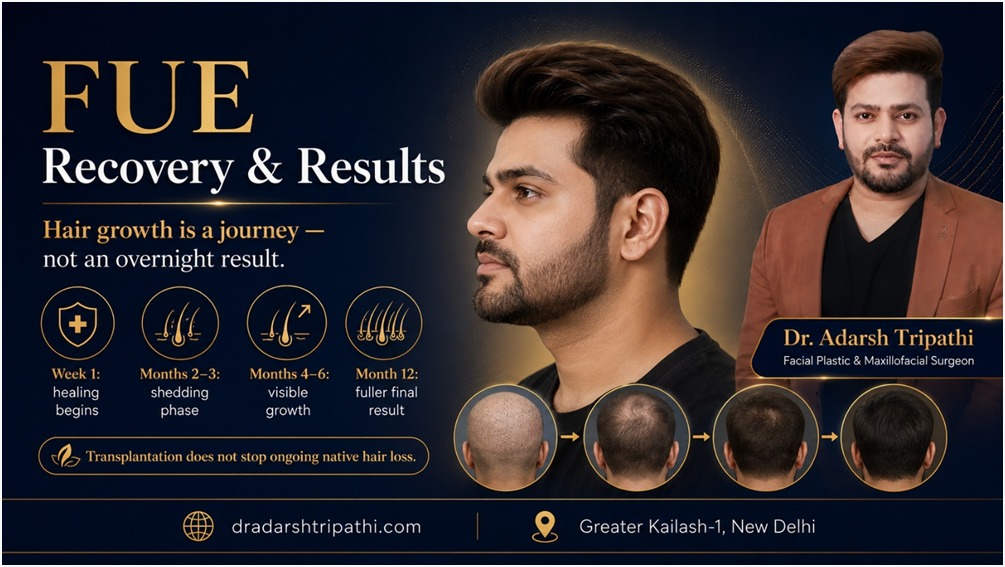
Like all hair transplant techniques, FUE moves bald-resistant follicles to bald areas — the transplanted hair stays for life, but your NATIVE non-transplanted hair can continue to thin. The most successful FUE outcomes combine surgery (for the visible bald areas) with medical therapy (finasteride for men, minoxidil for both sexes) to preserve native hair. Without addressing the underlying loss medically, your FUE result may be surrounded by progressively thinning native hair over the years — leading to either a second procedure or a permanently thin look around the transplanted area. Dr. Tripathi discusses combined medical therapy at every FUE consultation. The combination is what produces lasting natural-looking results.
Types of FUE — Manual, Motorised, Sapphire, Robotic, and DHI
Within FUE, there are several technique variations. Understanding what each is — and isn’t — helps you cut through marketing language.
1. Manual FUE — The Foundation
Standard FUE in which the surgeon (or technician) uses a hand-held manual punch to extract each follicular unit. Slower per graft than motorised options but allows maximum tactile feedback — the surgeon feels the resistance of the tissue and can adjust each extraction. Many experienced FUE surgeons prefer manual technique for high-quality work, particularly for the front hairline.
- Best for: refined hairline work; smaller cases; experienced surgeon working personally
2. Motorised FUE
FUE using a motorised hand-piece that rotates or oscillates the punch automatically. Faster than manual extraction (especially for large cases), with the punch movement standardised by the machine. Speed is the advantage; some surgeons feel manual gives slightly better tactile feedback for delicate work.
- Best for: larger cases; balancing speed and quality
3. Sapphire FUE
FUE in which the recipient incisions (the tiny channels where grafts are placed) are made using a sapphire blade rather than steel. The sapphire blade is harder and creates slightly finer, cleaner incisions, which some surgeons find improves graft survival and reduces post-operative redness. The EXTRACTION is the same as regular FUE; only the recipient site creation changes.
- Best for: refined hairline work; reducing post-operative redness
- Note: Sapphire FUE is a refinement of FUE, not a fundamentally different technique. The surgeon’s skill matters more than the blade material
4. DHI (Direct Hair Implantation)
DHI is FUE that uses the Choi implanter pen (or similar tool) for the implantation step. The Choi pen makes the recipient incision and places the graft in one step — eliminating the separate incision-making step of standard FUE. This allows very precise placement angle and depth. DHI is widely marketed as a ‘separate’ technique but is genuinely just FUE with a different implantation tool.
- Best for: precise angle/depth control; selected cases
- Note: DHI is a VARIANT of FUE, not a different technique. The surgeon’s overall skill matters more than choice of implantation tool
5. Robotic FUE (ARTAS)
FUE performed with robotic assistance — the ARTAS robot identifies follicular units and harvests them automatically. Consistency is the marketed advantage; speed is similar to a skilled manual surgeon. Robotic FUE is available at selected clinics worldwide. Most Delhi clinics use manual or motorised FUE rather than robotic. Robot or human, the recipient site creation, hairline design, and graft placement still require the surgeon.
- Best for: clinics with the equipment and trained operators
6. Body Hair Transplant (BHT) FUE — FUE-Exclusive
Using FUE to extract follicles from the chest, beard, abdomen, or other body areas for transplantation. Only FUE can do this — FUT cannot harvest body hair. Useful for patients with depleted scalp donor area and advanced loss. Body hair characteristics differ (texture, growth rate, maximum length) so it’s strategically placed.
- Best for: advanced loss with limited scalp donor
Hybrid Techniques
Many surgeons combine techniques — manual for the hairline (refined), motorised for the donor harvesting (speed), Choi pen for selected DHI-style placement (angle precision), and Sapphire blade for recipient incisions. A skilled surgeon uses the best tool for each step rather than committing to one technique exclusively.
FUE Punch Sizes & Tools — A Technical Deep-Dive
Most patient-facing pages skip this, but it matters: the punch size used for FUE extraction directly affects the quality of harvested grafts and the donor area’s eventual appearance.
Punch Size Spectrum
Punch Size | Best For | Trade-Off |
0.6–0.7mm | Refined hairline; 1-hair grafts | Slower extraction; higher transection risk if unskilled |
0.8mm | Most general FUE; 1-2 hair grafts | Best balance — most-used size |
0.9–1.0mm | Larger grafts (3-4 hair); body hair | Slightly more donor scarring; faster extraction |
Sapphire blade (recipient sites) | Fine recipient incisions | Refinement; not for extraction |
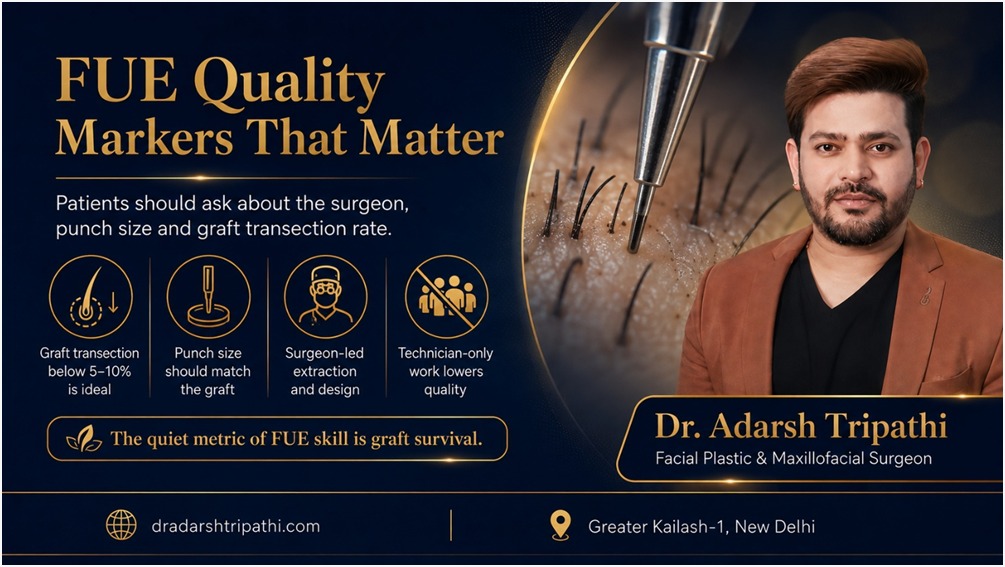
A skilled FUE surgeon selects punch size based on graft type needed. The hairline needs fine 1-hair grafts (extracted with smaller punches), behind the hairline needs 2-3 hair grafts (medium punches), the body of the scalp needs 3-4 hair grafts (medium punches). One-size-fits-all FUE is a sign of less refined practice.
Graft Transection Rate — The Quiet Quality Measure
Transection means damaging a follicle during extraction (cutting or separating part of the follicle from the rest). High transection rate means damaged grafts that don’t survive well. The transection rate is the quiet measure of FUE skill that experienced surgeons monitor closely. A skilled FUE practitioner aims for transection rates below 5–10%; rushed or unskilled extraction can produce rates above 20%, dramatically affecting outcomes. Patients rarely ask about this — but asking can identify the more skilled clinics.
Surgeon-Performed vs Technician-Delegated
Many clinics delegate most of the FUE extraction and even placement to technicians while the surgeon does only the initial design. This volume-throughput model can produce acceptable results but typically with higher transection rates and less refined hairline work. At Sarayu Clinics, Dr. Tripathi personally designs the hairline, makes the recipient incisions, oversees extraction, and places critical grafts. The surgeon’s personal involvement at every critical step is the difference between technical FUE and refined FUE.
The FUE Hair Transplant Procedure — Step by Step
Step 1: Consultation & Hairline Design
Dr. Tripathi assesses your hair loss pattern (Norwood/Ludwig stage), donor area density, scalp characteristics (skin tightness, follicle density per cm², hair characteristics), and goals. Photos are taken. The proposed hairline is designed in detail — height above brows, shape, irregularity, density gradient — and shown to you. Graft count needed is estimated. Single vs staged procedure is planned. Medical therapy options are discussed. Realistic timeline and budget are established.
Step 2: Pre-Operative Preparation
- Stop smoking at least 4 weeks before — critical for graft survival
- Stop blood-thinning medications/supplements 1 week before (with doctor’s clearance)
- Pre-operative blood tests if not done recently
- Start minoxidil 4–6 weeks before if recommended (improves recipient site readiness)
- Avoid alcohol for 48 hours before
- Wash hair the morning of the procedure with prescribed shampoo
- Eat a normal breakfast — procedure is under local anaesthesia, not general
- Wear comfortable button-front clothing
- Arrange transport home (taxi/Uber fine; no driving same day)
Step 3: Donor Area Preparation
The donor area at the back and sides is trimmed to allow precise extraction (typically to 1–2mm length). Some practices offer ‘unshaven FUE’ where only individual hair tufts are trimmed — useful for patients who don’t want a fully shaved donor area visible during recovery. The trimmed appearance returns to normal within 2–3 weeks as the donor hair grows back.
Step 4: Hairline Design Marking (On the Procedure Day)
Before any cutting, the planned hairline is marked precisely on your scalp and shown to you for final approval. Adjustments are made until you’re comfortable with the shape, height, and temple positions. This is your last opportunity to refine before extraction begins.
Step 5: Local Anaesthesia
Local anaesthesia is administered to the donor area (back/sides of scalp) and recipient area (top/front). Initial injections feel like brief pinpricks; once numb, the rest of the procedure is essentially painless. Sedation can be added for anxious patients. You stay awake throughout — can read, listen to music, watch shows, or rest.
Step 6: FUE Extraction
Using the selected punch (typically 0.7–0.9mm), follicular units are extracted one at a time from the donor area. Each extraction is a deliberate movement — score, dissect, extract, place into preservation solution. The extraction phase is the longest part of the procedure — 2–5 hours depending on graft count. Manual, motorised, or combination technique is used. The team aims for minimum transection rate.
Step 7: Graft Sorting and Preservation
Extracted grafts are sorted by hair count (1-hair, 2-hair, 3-hair, 4-hair groupings) under microscope, then kept in chilled preservation solution to maintain viability between extraction and implantation.
Step 8: Recipient Site Creation
Dr. Tripathi personally creates the recipient incisions in the planned hairline and treatment areas. This is one of the most aesthetically critical steps — angle determines how hair will grow, density determines coverage, irregularity determines naturalness. Fine 0.6–0.7mm sapphire or steel blades create the incisions at the precise depth needed. Sites are designed to match natural hair direction across the entire scalp.
Step 9: Graft Placement
Each follicular unit is placed individually into the prepared sites. Single-hair grafts are placed at the very front for the natural soft hairline. 2-hair grafts are placed just behind for density transition. 3-4 hair grafts are placed in the bulk of the recipient area for density. Direction and angle of placement match surrounding hair. Done by the surgical team with the surgeon overseeing or personally placing critical front grafts. This phase takes 2–4 hours.
Step 10: Post-Procedure Care
After all grafts are placed, the donor area is gently cleaned. Mild antibiotic ointment is applied. No bandage is typically needed for FUE donor (unlike FUT). Detailed aftercare instructions are given. You leave the clinic the same day, typically by taxi (no driving). Total procedure time: 6–10 hours for moderate cases with breaks; large cases may extend to a full day or be staged across two days.
Downtime & Recovery After FUE Hair Transplant
Days 1–3
Mild swelling around the forehead is common — peaks at day 3, then resolves. Small scabs form around each graft site (looks like tiny dots — DO NOT pick). Donor area feels slightly tender; FUE tenderness is less than FUT and typically settles within 3–4 days. Take prescribed antibiotics, anti-inflammatory if prescribed, and pain medication. Sleep with head elevated (2 pillows or recliner). No vigorous activity.
Days 4–10
Scabs gradually shed as you gently wash according to instructions (typically starting day 3–4 with prescribed shampoo). Swelling resolves. Most patients return to desk work around day 5–7, often wearing a hat or cap for the first few days. Donor area shaved appearance is still visible but improving.
Weeks 2–4 — The Shedding Phase (NORMAL)
This surprises patients who weren’t prepared: around 2–4 weeks after FUE, the TRANSPLANTED HAIRS SHED. The hair shaft falls out — but the FOLLICLE remains alive in the scalp. The follicle then enters a resting phase before producing new hair. This shedding is normal, expected, and happens to almost everyone. It’s a sign the transplant is healing as expected, not a failure. Don’t panic. Don’t judge the result.
Months 2–3 — The ‘Ugly Duckling’ Phase
The hardest emotional phase. The transplanted hair has shed; the native hair is unchanged; no visible new growth yet. You may look thinner than before surgery. Normal and temporary. Resist judging the result during this phase.
Months 3–6 — Regrowth Begins
New hair starts emerging from the transplanted follicles. Initially fine and wispy, gradually thickening. By month 6, around 50% of the eventual final result is visible. Real momentum.
Months 6–12 — Steady Improvement
Hair continues thickening, gaining length, matching surrounding hair character. By 12 months, approximately 90% of final result is visible.
Months 12–18 — Final Mature Result
Density and texture mature fully. From now on, the transplanted hair behaves exactly like normal hair — washes, cuts, styles, grows normally.
FUE-Specific Recovery Advantages over FUT
- No sutures to remove — FUE doesn’t need stitches
- No linear donor scar — only invisible tiny dot scars
- Less donor area discomfort — no surgical wound under tension
- Faster donor area healing — typically 5–7 days vs 10–14 for FUT
- Return to short hairstyles possible — FUT scar limits hair length forever
- Can sleep on the donor area earlier — FUT requires longer protection of suture line
Recovery Essentials
- Sleep with head elevated for 7 days
- First gentle washing typically day 3–4 with prescribed shampoo as instructed
- No picking at scabs — let them shed naturally
- No swimming, saunas, gym for 2–3 weeks
- No direct sun exposure to scalp for 2 weeks; SPF on scalp afterward
- No alcohol for 5 days; no smoking for 4+ weeks (preferably permanently)
- Take prescribed medications including antibiotics
- Sleep face up (not on transplanted area) for first 7–10 days
- Don’t expect visible new growth before 4 months
- Trust the process — the shedding phase at 2–4 weeks is normal
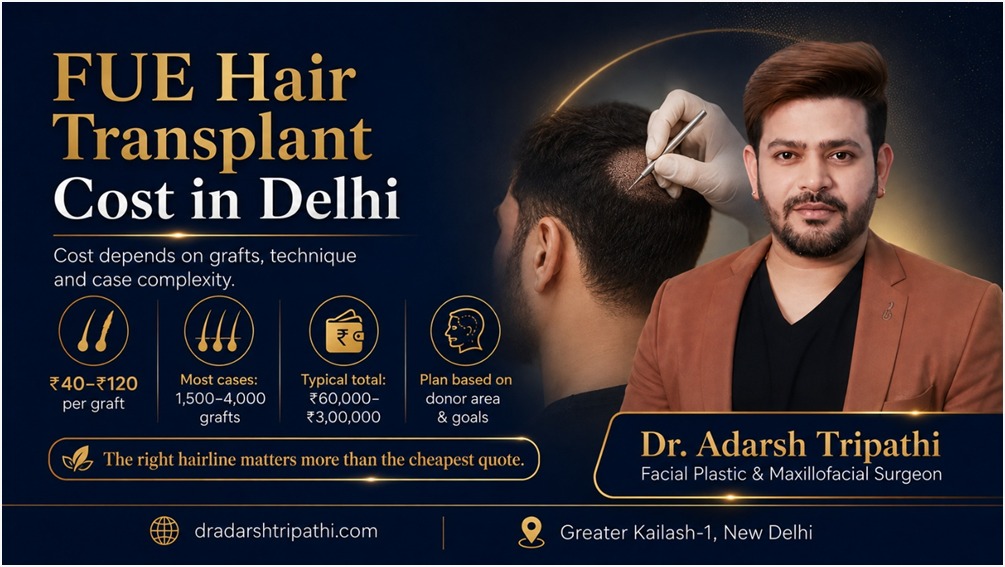
FUE Hair Transplant Cost in Delhi — Transparent Pricing
FUE cost in Delhi depends primarily on graft count, technique variation (standard FUE, Sapphire FUE, DHI, robotic), and the surgeon’s experience and personal involvement. Most clinics quote either per-graft pricing or total package pricing.
Approximate Cost at Sarayu Clinics, Delhi
Procedure | Per-Graft Cost | Typical Grafts | Total Cost Range |
Standard FUE | Rs. 40–80 | 1500–4000 | Rs. 60,000–2,80,000 |
Sapphire FUE | Rs. 50–100 | 1500–4000 | Rs. 75,000–3,50,000 |
DHI (Choi pen FUE) | Rs. 60–100 | 1500–3500 | Rs. 90,000–3,00,000 |
Robotic FUE (where available) | Rs. 70–120 | 1500–4000 | Rs. 1,05,000–4,00,000 |
FUE Beard Transplant | Per session | 800–2500 | Rs. 50,000–2,00,000 |
FUE Eyebrow Transplant | Per session | 200–600 | Rs. 40,000–1,20,000 |
Body Hair Transplant (FUE) | Per graft (premium) | Selected cases | Customised — typically higher |
FUE Repair of Old Transplant | Customised | Variable | Customised |
PRP Therapy (adjunct) | Per session | — | Rs. 6,000–15,000 |
GFC Therapy (adjunct) | Per session | — | Rs. 8,000–20,000 |
Prices shown are for guidance only. Your final treatment cost will be confirmed during the initial consultation, based on your individual needs, concerns, and personalised treatment plan.
Cost vs Value in FUE — what to ask before booking
Two clinics may quote the same number of grafts at similar prices — but one has the surgeon designing the hairline, creating recipient incisions, and placing the front grafts personally, while the other delegates everything except the design briefing to technicians. The graft count is identical; the result quality is dramatically different. Specific questions worth asking any clinic: Who personally creates the recipient incisions? Who places the front-line grafts? What is the surgeon’s graft transection rate? Do you use 0.7mm punches for front-line work? The answers tell you whether you’re getting refined FUE or mass-throughput FUE. Don’t choose FUE on lowest price alone — the result is permanent.
Results Timeline — Realistic Expectations Across 12-18 Months
FUE results unfold slowly — there’s no shortcut around the biology of hair follicle integration and growth cycles. Patience is rewarded.
Same Day
You have your hairline design placed but it’s covered in tiny scabs with shaved donor area visible. This is NOT what your result will look like.
Week 1
Scabs shed gradually with gentle washing. Donor area heals. Most patients return to desk work, often with a hat or cap for confidence.
Weeks 2–4 — Transplanted Hair Sheds (NORMAL)
Transplanted hairs shed — the shaft falls out, follicle remains alive beneath. Completely normal and expected.
Months 2–3 — Ugly Duckling Phase
No visible growth yet; may look thinner than before surgery. Temporary. Don’t judge.
Months 4–6 — Regrowth Begins
New hairs emerge, initially fine and wispy. By month 6, around 50% of final result visible.
Month 9 — Real Progress
Around 70-80% of final result. Clear improvement visible to you and others.
Month 12 — Near Final
Around 90% of final result. Most patients very happy at this stage.
Month 18 — Final Mature Result
Density and texture fully mature. The transplanted hair is now part of your scalp for life.
How Long Do FUE Results Last?
The transplanted hair is permanent — these follicles are genetically resistant to balding and grow for life. However, your NATIVE hair (not transplanted) can continue thinning, which is why most surgeons recommend combining FUE with medical therapy (finasteride for men, minoxidil for both sexes) for lasting natural-looking results that age well.
FUE vs FUT vs DHI — The Direct Comparison
Within hair transplant techniques, three names dominate patient conversations. Here’s the honest direct comparison.
Factor | FUE | FUT | DHI (FUE variant) |
Extraction method | Individual punches | Strip dissection | Same as FUE |
Donor scar | Tiny dots only | Linear strip scar | Tiny dots only |
Implantation tool | Forceps + needle/blade | Forceps + needle/blade | Choi implanter pen |
Best for short hair | Yes | Avoid (scar visible) | Yes |
Best for very large cases | Moderate | Excellent | Moderate |
Speed | Slower per graft | Faster per graft | Similar to FUE |
Recovery | Faster (5-7 days) | Slower (10-14 days) | Same as FUE |
Cost per graft | Higher | Lower | Highest |
Body hair option | YES — FUE only | No | YES (variant of FUE) |
Suitable for repair work | Excellent | Limited | Excellent |
Best donor preservation | Wider extraction area | Single strip only | Wider extraction area |
FUE vs FUT — When Each Wins
FUE wins for: most modern hair transplant cases, particularly mild-to-moderate loss, patients keeping short hair, those wanting fastest recovery, those wanting body hair option, repair cases, and small refined cases (eyebrows, beard). FUT wins for: very large single-session cases (4,000+ grafts), patients planning to always keep longer hair (4+ length), budget-conscious large cases. For most patients in 2026, FUE is the right choice.
FUE vs DHI — The Honest Truth
DHI is a VARIANT of FUE — it uses the Choi implanter pen for the implantation step rather than the conventional forceps-and-blade approach. The extraction is the same as FUE. DHI advocates highlight the ability to make the recipient incision and place the graft in one step (potentially reducing graft handling time and allowing precise angle control). Standard FUE advocates point out that an experienced surgeon’s manual placement is equally precise, often faster, and doesn’t depend on availability of the specific Choi pen. The reality: DHI is FUE done with a different tool. The surgeon’s overall skill matters more than choice between conventional FUE and DHI. Both can produce excellent results.
FUE vs Sapphire FUE — Refinement, Not Revolution
Sapphire FUE is regular FUE but using sapphire blades (rather than steel) for making the recipient incisions. The sapphire blade creates slightly finer, cleaner incisions, which some surgeons find reduces post-operative redness and may marginally improve graft survival. The EXTRACTION technique is identical to standard FUE. Sapphire is a refinement, not a fundamentally different technique. Worth considering for refined hairline work; not a deal-breaker if not available.
FUE vs Robotic FUE (ARTAS)
Robotic FUE uses an automated robotic system (ARTAS being the best-known) to identify and harvest follicular units. Marketed for consistency; in practice, a skilled manual or motorised FUE surgeon often matches or exceeds robotic speed and quality. Robotic FUE has selected applications but isn’t categorically superior to skilled manual technique. Available at limited Delhi clinics.
Why a Facial Plastic Surgeon for FUE Specifically
FUE technique is broadly taught and widely available across Delhi clinics. What differentiates an excellent FUE result from a merely adequate one is HAIRLINE DESIGN — and hairline design is fundamentally a facial aesthetic decision. The hairline frames the face. Its height, shape, irregularity, and density gradient affect how your whole face appears. A facial plastic surgeon’s daily work is facial proportion and aesthetic harmony — the same expertise that goes into rhinoplasty, blepharoplasty, and facial sculpting goes into designing your hairline. Combined with personal involvement in extraction oversight and recipient site creation, this aesthetic dimension is the genuine value of choosing a facial plastic surgeon for your FUE.
Why Dr. Adarsh Tripathi Is a Trusted FUE Hair Transplant Surgeon and Specialist in Delhi ?
FUE outcomes depend on three things: honest candidate assessment and planning (Norwood stage, donor capacity, future loss), the surgeon’s personal involvement in hairline design and recipient site creation (not delegation), and aesthetic judgement that treats the hairline as part of the face. Here’s how to choose, and why patients choose Dr. Tripathi:
What to Look For in an FUE Hair Transplant Surgeon ?
- Medical qualification — facial plastic, plastic, or dermatology surgeon (NOT ‘hair technician’)
- Surgeon’s PERSONAL involvement in hairline design and recipient incision creation (not delegated)
- Knowledge of multiple FUE variations (manual, motorised, Sapphire, DHI) and the right choice for each case
- Honest assessment of Norwood stage and future progression
- Discussion of medical therapy (finasteride/minoxidil) alongside surgery
- Awareness of graft transection rate and conservative donor management
- Natural hairline design — not too low, not too dense, with appropriate irregularity
- Honest about who is NOT a candidate
- Pre-operative photos and design shown to you before extraction starts
- Clinical (not salon) facilities; transparent pricing; no high-pressure sales
Dr. Tripathi’s Credentials
- Maxillofacial and Facial Plastic Surgeon with 18+ years of experience
- Facial aesthetic expertise — daily work on facial proportion, balance, and hairline-to-face relationships
- Personal involvement in hairline design and recipient site creation for every patient
- Multiple FUE variations offered (Standard, Sapphire, DHI variant, Body Hair Transplant)
- Honest about realistic outcomes, timeline, future loss, and combined approach
- Conservative donor area management — preserving future surgical options
- Consultations personally conducted by Dr. Tripathi
The Hairline Design Philosophy
Dr. Tripathi’s approach to FUE hair transplant is built on facial aesthetics first. The hairline shape, height, irregularity, and density gradient are designed to suit YOUR face — your forehead height, brow position, facial proportions, and how you’ll want your face to look at age 50 as much as 30. The technical FUE execution (extracting and implanting follicles) follows the design. The result is hairlines that look like they belong on the face — not a transplanted line stitched on top.
Frequently Asked Questions — FUE Hair Transplant in Delhi
What makes someone an FUE hair transplant specialist rather than a clinic that offers FUE?
An FUE hair transplant specialist in Delhi is distinguished by what the surgeon personally does rather than by the equipment on the premises. The markers are: the surgeon designs the hairline and creates the recipient incisions himself rather than briefing a technician; the punch size is chosen per graft type rather than one size used throughout; graft transection rate is monitored and can be discussed; more than one FUE variant is available so the technique is matched to the case; and donor area management is conservative to preserve future surgical options. A clinic where the surgeon appears only for the design consultation and technicians perform everything else is offering FUE as a service. A specialist is performing surgery.
Is DHI better than FUE?
No, because DHI is FUE. DHI (Direct Hair Implantation) uses a Choi implanter pen for the placement step, which makes the recipient incision and places the graft in one movement. The extraction is identical to standard FUE. It is marketed as a separate, premium technique, but it is a variant using a different tool. The same applies to Sapphire FUE, which uses a sapphire blade for recipient incisions, and robotic FUE, which uses a robot for extraction. All are FUE. An experienced surgeon’s manual placement is equally precise and often faster. Choose the surgeon, not the tool name.
What is graft transection rate and why does it matter?
Transection means damaging a follicle during extraction, so it does not survive transplantation. It is the quiet technical measure of FUE skill. A skilled practitioner aims for a transection rate below 5-10%; rushed or unskilled extraction can exceed 20%, meaning one graft in five is wasted while you still pay for it. Very few patients ask about this, which is precisely why asking identifies the more careful clinics. If a clinic cannot answer the question, that itself is informative.
Will FUE stop my hair loss?
No. FUE moves balding-resistant follicles from the donor area to the bald area – the transplanted hair is permanent, but your native untransplanted hair can keep thinning. Without medical therapy alongside surgery, a good FUE result can end up surrounded by progressively thinning native hair, leading either to a second procedure or a permanently patchy appearance. This is why finasteride for men and minoxidil for both sexes are discussed at every consultation. Surgery addresses what is already lost; medical therapy protects what remains.
How many grafts will I need?
Most patients need between 1,500 and 4,000 grafts. A receding hairline alone typically needs 1,500-2,500; hairline plus mid-scalp 2,500-3,500; extensive coverage including the crown 3,500-4,000 or more, sometimes staged across two sessions. The figure depends on your Norwood stage, donor density, hair calibre and the coverage you want – it cannot be estimated accurately without examining your scalp, and any clinic quoting a graft count over the phone is guessing.
Can I have FUE without shaving my head?
Partially. Unshaven or partially-shaven FUE trims only small sections or individual hair tufts in the donor area rather than shaving the whole back and sides, which keeps the procedure discreet during recovery. It is slower, limits the number of grafts that can be harvested in a session, and costs more per graft – so it suits smaller cases where discretion matters more than volume. For larger sessions, a trimmed donor area is the practical choice, and it regrows to normal within two to three weeks.
How to Reach Us:
Phone:+91 9289111083 ,+91 9289111084
Dr Adarsh’s website: https://dradarshtripathi.com/
Facebook: https://www.facebook.com/DrAdarshTripathi3011
Instagram: https://www.instagram.com/dr_adarsh_tripathi/
Youtube: https://www.youtube.com/@dr_adarsh_tripathi
Linkedin: https://www.linkedin.com/in/dr-adarsh-tripathi-a43005b8/
Online Booking: https://dradarshtripathi.com/contact-us/ to schedule appointments conveniently.