
Nose Augmentation in Delhi — Building a Higher, More Defined Nose
Not every nose concern is about making the nose smaller. For a great many people — particularly those of Indian, South Asian, and East Asian heritage — the wish is the opposite: a nose that’s a little too flat across the bridge, a tip that lacks projection and definition, or an overall profile that feels under-structured and gets lost in the face. This is where nose augmentation comes in. Rather than reducing, augmentation builds up and adds definition — raising a low bridge, projecting the tip, and creating the elegant, defined profile that brings the whole face into balance.
There’s an important distinction worth making clear up front, because most clinic pages blur it. ‘Rhinoplasty‘ is the broad term for reshaping the nose, which can mean reducing a hump or refining a large nose. ‘Nose augmentation’ specifically means adding structure — and that’s a different conversation, with different techniques and a different set of choices. The biggest of those choices is what to build the nose up with: a synthetic implant (like silicone), or your own cartilage taken from your septum, ear, or rib. That single decision shapes the safety, naturalness, and longevity of your result, and understanding it is the most useful thing you can take from this page.
Dr. Adarsh Tripathi is a Maxillofacial and Facial Plastic Surgeon with over 18 years of experience at Sarayu Clinics, Greater Kailash-1, New Delhi. As a facial surgeon experienced with the specific anatomy of Indian and Asian noses, he offers both surgical augmentation (using implants or your own cartilage) and non-surgical augmentation (using dermal fillers) — and, crucially, the honest guidance on which suits you. This page explains every option, who each suits, recovery, cost, and how to choose the right nose augmentation surgeon in Delhi.
Benefits of Nose Augmentation
Nose augmentation, done well, brings the nose into harmony with the rest of the face — and the change to overall facial balance is often more striking than people expect. Here’s an honest picture:
- A higher, more defined bridge — correcting a flat or low dorsum that lacked structure
- A more projected, refined nasal tip — adding definition to a flat or droopy tip
- A more elegant side profile — the single change that most improves facial harmony
- Better overall facial balance — a defined nose lifts and frames the whole face
- Correction of a saddle nose or post-injury collapse — restoring lost structure
- Options to suit your comfort level — reversible fillers, or permanent surgical augmentation
- Natural-looking results when your own cartilage is used — feels and looks like your own nose
- Improved confidence in profile, photos, and overall appearance
An honest framing for Indian and Asian patients in particular: the goal of ethnic nose augmentation is enhancement that respects your features and heritage — a refined, defined version of your own nose, not a different, ‘Westernised’ one. The best results look like they belong on your face. A good surgeon plans augmentation to suit your individual proportions, not to impose a single template.
Areas of the Nose That Augmentation Enhances
Nose augmentation targets specific structures. Understanding which part you want built up explains the technique and material that suit you best.
The Nasal Bridge (Dorsum)
The most commonly augmented area. A flat, low, or under-projected bridge — common in Indian and Asian noses — is built up to create height and a defined dorsal line. This is achieved with a dorsal implant or, preferably, the patient’s own cartilage. Raising the bridge has a powerful effect on the side profile and on how defined the whole nose appears.
The Nasal Tip
A flat, rounded, droopy, or under-projected tip is reshaped and projected forward for definition. Tip augmentation uses cartilage grafts (from the septum or ear) to add structure and refinement — this is technically demanding, and where a surgeon’s skill most shows, because the tip is the most expressive part of the nose.
The Radix (Upper Bridge / Root)
The radix is the topmost part of the bridge, between the eyes. A low radix makes the nose look short and the bridge look flatter than it is. Subtle augmentation here lengthens the apparent nose and improves the start of the dorsal line — often done elegantly with filler in non-surgical cases.
The Columella and Nostril Base
The columella (the strip between the nostrils) and the base can be augmented or reshaped to improve tip projection and the nose’s relationship to the upper lip — refining the overall structure rather than just the bridge.
Correcting a Saddle Nose or Collapsed Bridge
A ‘saddle nose’ — a collapsed or sunken bridge from injury, infection, or a previous over-aggressive surgery — is a reconstructive augmentation, rebuilding the lost structural support, usually with the patient’s own cartilage (rib cartilage for significant collapse). This is specialised work requiring genuine surgical expertise.
Concerns Nose Augmentation Addresses
Flat or Low Nasal Bridge
The most common reason for augmentation — a bridge that lacks height and definition, very common in Indian and Asian noses. Building it up transforms the profile.
Under-Projected or Flat Tip
A tip that lacks definition and forward projection, making the nose look flat or rounded. Cartilage grafting adds the structure and refinement it lacks.
Lack of Overall Nasal Definition
A nose that feels soft, structureless, or ‘gets lost’ in the face. Augmentation provides the framework that brings definition and presence.
Profile Imbalance
A nose that’s out of proportion with the forehead, lips, and chin on the side view. Augmentation (often alongside chin assessment) restores profile harmony.
Saddle Nose / Post-Traumatic Collapse
A sunken bridge from injury, infection, prior surgery, or congenital causes — rebuilt with cartilage to restore both appearance and, often, breathing.
Ethnic Nose Enhancement
Indian, South Asian, East Asian, and Middle Eastern noses often have specific augmentation needs — typically more bridge and tip projection — that require a surgeon experienced in enhancing these features naturally while preserving ethnic identity.
Are You a Good Candidate for Nose Augmentation?
Most healthy adults who want more height, projection, or definition in the nose are candidates for at least one form of augmentation. The right method depends on how much change you need and your preference for permanence.
You are likely a good candidate if:
- You have a flat or low bridge, or an under-projected tip, you’d like built up
- You want better profile definition and facial balance
- You’re in good general health, suitable for the chosen procedure
- You have realistic expectations — natural enhancement that suits your face and heritage
- You’re a non-smoker, or willing to stop around any surgery (smoking impairs nasal healing)
Method selection depends on your goal:
- Want a subtle, reversible, no-downtime change → non-surgical filler augmentation
- Want a permanent, structural, natural result → surgical augmentation with your own cartilage
- Want significant bridge height or tip projection → surgical augmentation
- Have a saddle nose or collapsed bridge → reconstructive surgical augmentation (often rib cartilage)
- Want to ‘try’ a higher bridge before committing to surgery → fillers first, as a preview
Discuss carefully if you:
- Have very thin nasal skin → implants are riskier (more visible); cartilage preferred
- Have had previous nasal surgery or implants → assessment and possibly revision planning needed
- Want filler augmentation but have had prior nasal surgery → vascular risk is higher; expert injector essential
- Have unrealistic or ‘someone else’s nose’ expectations → honest counselling on natural results
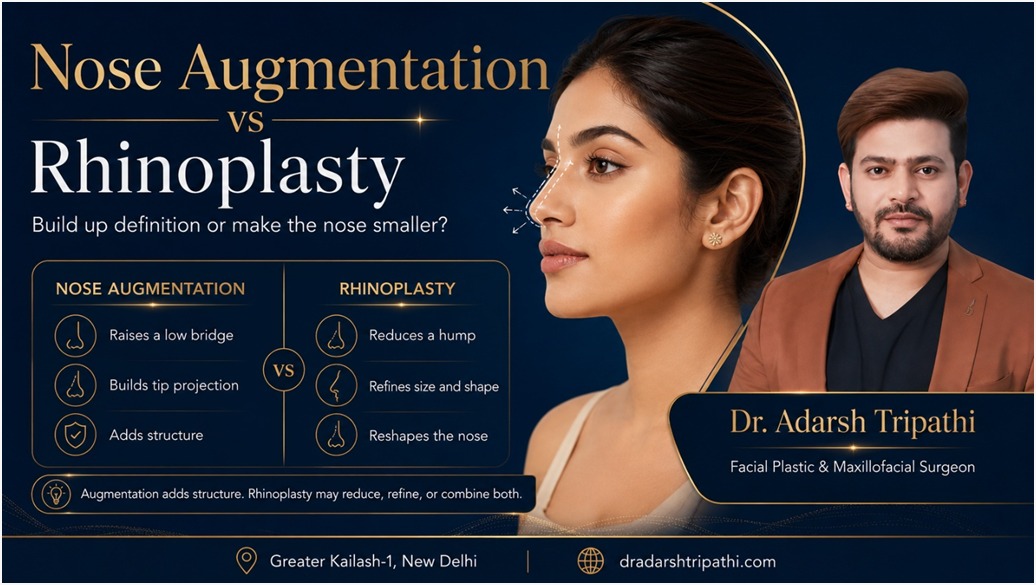
Nose Augmentation Methods at Sarayu Clinics, Delhi
1. Non-Surgical Nose Augmentation (Liquid Rhinoplasty / Fillers)
Hyaluronic acid dermal fillers are precisely injected to build up the bridge, lift and project the tip, smooth a minor hump by filling around it, improve symmetry, and refine the profile — all without surgery. It’s quick (15–30 minutes), uses only topical numbing, has essentially no downtime, and results are immediate. Results last 12–18 months and are reversible with hyaluronidase if needed.
- Best for: subtle augmentation, bridge/tip refinement, trying a change before surgery
- Reversible, no downtime, immediate result; temporary (12–18 months)
- Cannot reduce nose size or fix breathing; a vascular-aware expert injector is essential for safety
2. Surgical Augmentation with Your Own Cartilage (Autologous Graft)
The gold standard for permanent, natural nose augmentation. Cartilage is taken from your own body and used to build up the bridge and tip:
- Septal cartilage (from inside the nose): ideal first choice; same surgical site, strong, reliable
- Ear (conchal) cartilage: a small, inconspicuous harvest from behind the ear; good for tip work
- Rib (costal) cartilage: for significant augmentation or reconstruction (saddle nose), providing ample structural support
Because it’s your own tissue, it integrates naturally, feels like your own nose, and has the lowest risk of infection or rejection. This is the approach Dr. Tripathi favours for surgical augmentation.
- Best for: permanent, natural, structural augmentation; saddle-nose reconstruction
3. Surgical Augmentation with Implants (Silicone / Synthetic)
Pre-formed implants (commonly silicone, sometimes Gore-Tex/ePTFE) can be placed to raise the bridge. The advantage is no second surgical site and a quicker procedure. The trade-off is that, as foreign material, implants carry a higher long-term risk of infection, shifting, becoming visible through thin skin, or extrusion — and may eventually need removal or replacement. Suitable for selected patients after careful discussion of the risks versus cartilage.
- Best for: selected bridge augmentation cases where the patient understands the trade-offs
4. Combined / Augmentation Rhinoplasty
Full surgical augmentation often combines bridge and tip work, sometimes with septal correction for breathing, in a single rhinoplasty. This is planned individually around your anatomy and goals, and may be open or closed approach depending on the complexity.
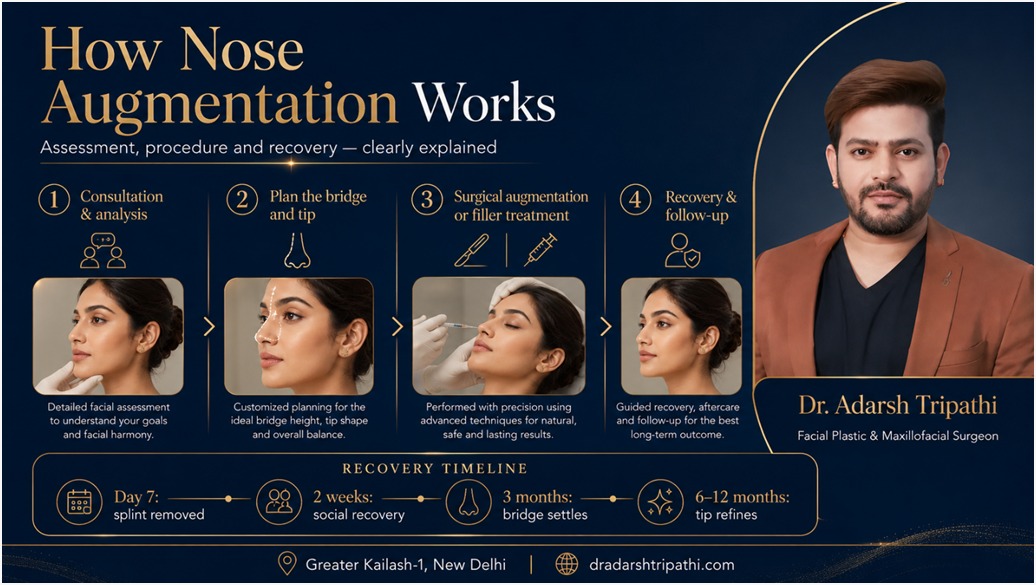
The Nose Augmentation Procedure — Step by Step
Non-Surgical (Filler) Augmentation
- Consultation: your nose, goals, and proportions assessed; sometimes 3D imaging to preview
- Topical numbing cream applied for about 20 minutes
- Filler precisely injected at planned points along the bridge, radix, or tip using a fine needle or blunt cannula (cannula preferred for vascular safety)
- The nose is gently moulded to shape; result reviewed immediately
- Aftercare given; you leave the same day
Takes 15–30 minutes.
Surgical Augmentation
- Consultation and planning, including the choice of cartilage source or implant, and 3D imaging where helpful
- Anaesthesia — general, or local with sedation depending on extent
- Cartilage harvested (septum, ear, or rib) if using your own tissue
- Through an open or closed approach, the graft or implant is precisely shaped and placed to build up the bridge and/or tip
- Structure is secured, symmetry checked, and incisions closed; a splint is applied to the nose
Surgical augmentation typically takes 2–3 hours depending on complexity and cartilage harvest.
Pre-Operative Preparation (Surgical)
- Stop smoking for 4 weeks before and after — critical for nasal healing
- Stop blood-thinning medications/supplements for 2 weeks as advised
- Pre-operative blood tests and medical clearance
- Arrange time off (about 1–2 weeks) and transport home
Recovery and Downtime — What to Expect
Non-Surgical (Filler) Augmentation
Essentially no downtime. Minor swelling, redness, or small bruises at injection points settle within 24–48 hours. You can return to normal activity immediately, with light makeup the next day. Avoid pressing the nose, glasses resting on it, and strenuous exercise for a day or two.
Surgical Augmentation
Week 1
Swelling and bruising around the nose and eyes peak in the first few days. A splint protects the nose and is removed around day 7. The nose feels congested (internal swelling). Rest with the head elevated. If rib cartilage was used, the chest harvest site is tender for a week or so. Discomfort is managed with prescribed medication.
Weeks 2–4
Bruising fades; the splint is off and the new shape is visible (though still swollen). Most patients return to work and social life within 2 weeks, often using light makeup over residual bruising. Avoid strenuous activity and glasses on the nose.
Months 2–12
Swelling — especially at the tip — continues to settle gradually. The refined final shape emerges over months. As with all nose surgery, the tip takes longest (up to a year) to fully define, particularly with thicker skin.
Recovery Essentials (Surgical)
- Wear the splint as instructed; keep the nose protected
- Sleep head-elevated for the first week to reduce swelling
- No glasses resting on the bridge for several weeks (tape or use contacts)
- No strenuous activity, swimming, or contact sport for several weeks
- No smoking throughout — it seriously impairs healing
- Strict sun protection of the nose during healing
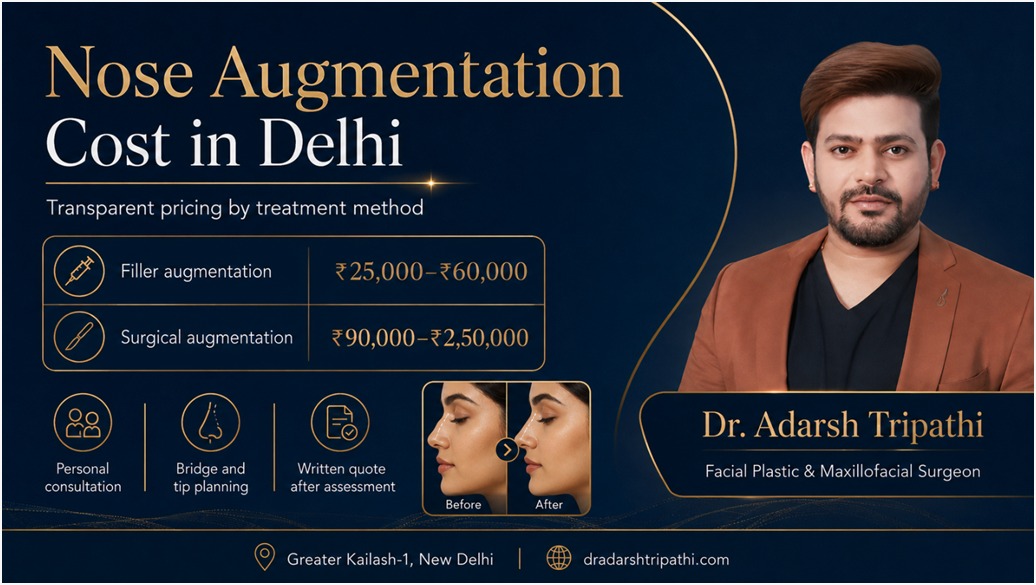
Nose Augmentation Cost in Delhi — Transparent Pricing
Cost depends mainly on whether it’s non-surgical or surgical, the material used (filler, your cartilage, or implant), the extent of augmentation, anaesthesia, and the surgeon’s expertise. Here’s a clear breakdown:
Approximate Cost at Sarayu Clinics, Delhi
Method | Approx. Cost | Longevity | Downtime | Material |
Non-Surgical (Filler) | Rs. 25,000–60,000 | 12–18 months | None | Hyaluronic acid |
Surgical — Septal/Ear Cartilage | Rs. 90,000–1,80,000 | Permanent | 1–2 weeks | Your own cartilage |
Surgical — Rib Cartilage | Rs. 1,50,000–2,50,000 | Permanent | 2 weeks | Your own rib cartilage |
Surgical — Implant (Silicone) | Rs. 90,000–1,75,000 | Long-term* | 1–2 weeks | Synthetic implant |
Saddle-Nose Reconstruction | Customised | Permanent | 2 weeks | Usually rib cartilage |
Prices shown are for guidance only. Your final treatment cost will be confirmed during the initial consultation, based on your individual needs, concerns, and personalised treatment plan.
Results Timeline — When Will I See My New Nose?
Augmentation results follow different timelines depending on method — fillers are instant, while surgical results emerge over months as swelling settles.
Non-Surgical (Filler)
- Immediate: the augmented shape is visible at once
- Day 1–2: minor swelling settles; this is your result
- Lasts 12–18 months; maintained with top-ups
Surgical Augmentation
- Week 1: splint removed — new shape visible but swollen
- Weeks 2–4: major swelling settles, shape clearer; presentable socially
- Month 3: around 80% of the final result; bridge well-defined
- Months 6–12: tip refines fully; final, stable result established
How Long Do Results Last?
Surgical augmentation is permanent — your own cartilage integrates and lasts a lifetime; implants are long-lasting but carry a higher chance of eventually needing attention. Filler augmentation is temporary (12–18 months) and reversible, making it ideal for those wanting flexibility or a preview before committing to surgery. The right longevity depends on whether you value permanence (cartilage surgery) or flexibility (fillers).
Comparison — Which Nose Augmentation Method Is Right for You?
If You Want… | Best Method | Why | Permanence |
Subtle change, no downtime | Filler augmentation | Quick, reversible, immediate | 12–18 months |
To ‘try before you buy’ | Filler first | Preview a higher bridge | Temporary |
Permanent, natural result | Cartilage augmentation | Own tissue, integrates naturally | Permanent |
Major bridge/tip projection | Cartilage surgery | Structural support needed | Permanent |
Saddle-nose reconstruction | Rib cartilage surgery | Rebuilds lost structure | Permanent |
Quick bridge lift (accepting risks) | Silicone implant | No harvest site | Long-term* |
Surgical vs Non-Surgical Augmentation — The Honest Trade-Off
Non-surgical filler augmentation is wonderful for subtle changes, has no downtime, and is reversible — but it’s temporary, can’t achieve major structural change, and (importantly) carries a rare but serious vascular risk in the nose that demands an expert, medically qualified injector. Surgical augmentation achieves permanent, significant, structural change with natural materials — but involves surgery and recovery. A common, sensible path is to try fillers first to preview a higher bridge, then choose surgery for a permanent result if you love it. A good surgeon helps you decide honestly rather than pushing the more expensive option.
Why a Facial Plastic Surgeon for Nose Augmentation?
The nose is a vascular, structurally complex, three-dimensional feature, and augmentation — especially with cartilage — demands detailed knowledge of nasal anatomy and grafting. A facial plastic surgeon like Dr. Adarsh Tripathi, experienced with Indian and Asian nasal anatomy and skilled in both cartilage augmentation and safe filler technique, offers the full range and the judgement to recommend what genuinely suits you. When you search for a nose augmentation surgeon in Delhi, this combination of ethnic-anatomy experience and cartilage expertise is exactly what to look for.
Why Dr. Adarsh Tripathi Is a Trusted Nose Augmentation Surgeon in Delhi ?
Augmentation is where the surgeon’s material choice and technical skill most determine your result and safety. Here’s how to choose, and why patients choose Dr. Tripathi:
What to Look For in a Nose Augmentation Surgeon ?
- Specialisation in the face, with specific experience in nasal augmentation and grafting
- A preference for your own cartilage over synthetic implants for natural, safer results
- Experience with Indian and Asian nasal anatomy
- Honest guidance on surgical vs non-surgical, and willingness to suggest fillers first
- Vascular-aware, medically qualified technique for non-surgical augmentation
- A consultation conducted personally by the surgeon; genuine reviews and safe facilities
Dr. Tripathi’s Credentials
- Maxillofacial and Facial Plastic Surgeon with 18+ years of experience
- Practice focused exclusively on the face — nasal surgery is core work
- Skilled in cartilage-based (autologous) augmentation for natural, lasting results
- Experienced with ethnic nose augmentation that respects and enhances your features
- Offers both surgical and safe non-surgical augmentation — for unbiased advice
- Consultations personally conducted by Dr. Tripathi; known for natural results, including work with public figures
A Natural-Results, Safety-First Philosophy
Dr. Tripathi’s approach to augmentation favours your own cartilage for its safety and naturalness, plans the augmentation to suit your individual face and heritage rather than a generic template, and is honest about when fillers are the smarter starting point. The aim is a nose that looks like a refined, more defined version of your own — never an obvious implant or an over-done bridge.
Frequently Asked Questions — Nose Augmentation in Delhi
Q: Who is the best nose augmentation surgeon in Delhi?
A: The best nose augmentation surgeon in Delhi for you is a facial specialist experienced with cartilage-based augmentation and Indian/Asian nasal anatomy, who favours natural materials over synthetic implants. Dr. Adarsh Tripathi is a Maxillofacial and Facial Plastic Surgeon with 18+ years of experience who performs both surgical (own-cartilage) and non-surgical nose augmentation at Sarayu Clinics, Greater Kailash.
Q: What is nose augmentation?
A: Nose augmentation is a surgical or non-surgical procedure that builds up and adds definition to the nose — raising a low or flat bridge, projecting an under-projected tip, and refining the profile. Surgical augmentation uses your own cartilage or a synthetic implant; non-surgical augmentation uses dermal fillers for a temporary, no-downtime result. It differs from a reduction rhinoplasty, which makes the nose smaller.
Q: How much does nose augmentation cost in Delhi?
A: Nose augmentation in Delhi costs approximately Rs. 25,000–60,000 for non-surgical (filler) augmentation and Rs. 90,000–2,50,000 for surgical augmentation, depending on the material (your own cartilage or an implant) and the extent. Rib-cartilage and reconstruction cases are at the higher end. A personalised quote is given after consultation at Sarayu Clinics.
Q: What is the difference between nose augmentation and rhinoplasty?
A: Nose augmentation specifically means building up and adding definition to the nose — raising the bridge or projecting the tip. Rhinoplasty is the broader term for reshaping the nose, which also includes reducing a hump or making a large nose smaller. Augmentation is one type of rhinoplasty focused on adding structure rather than removing it, and is especially relevant for flatter or under-projected noses.
Q: Is it better to use an implant or my own cartilage for nose augmentation?
A: For most patients, your own cartilage is the better choice for nose augmentation. It integrates naturally, feels like your own nose, and has a much lower long-term risk of infection, shifting, or extrusion than a synthetic implant. Implants are quicker and avoid a harvest site, but as foreign material they carry higher long-term risks and may eventually need removal. Cartilage gives the safest, most natural, lasting result.
Q: Is non-surgical nose augmentation safe?
A: Non-surgical nose augmentation with hyaluronic acid fillers is safe when performed by a medically qualified, vascular-aware injector. The nose is a vascular area, so correct technique — ideally using a blunt cannula — is essential to avoid rare but serious complications. This is why it should only be done by an experienced medical professional, not a non-medical provider, and is even more important if you’ve had previous nasal surgery.
Q: How long does non-surgical nose augmentation last?
A: Non-surgical nose augmentation with dermal fillers typically lasts 12–18 months before the filler gradually and naturally dissolves. It can be maintained with top-up sessions, or reversed early with hyaluronidase if desired. For a permanent result, surgical augmentation with your own cartilage is the alternative.
Q: Is nose augmentation surgery painful?
A: Nose augmentation surgery is performed under anaesthesia, so the procedure is painless. Afterwards most patients describe congestion, pressure, and mild discomfort rather than significant pain, managed with prescribed medication for the first few days. Non-surgical filler augmentation involves only minor discomfort, with a numbing cream applied first.
Q: Can nose augmentation help an Indian or flat nose?
A: Yes — nose augmentation is particularly suited to Indian, South Asian, and Asian noses, which often have a flatter bridge and a less projected tip. Building up the bridge and projecting the tip (ideally with your own cartilage) enhances definition and profile while respecting and preserving your ethnic features. The goal is a refined version of your own nose, not a different one.
Q: How long is recovery after nose augmentation surgery?
A: Most patients return to work and social activities about 2 weeks after surgical nose augmentation, once the splint is off and major bruising has settled. The bridge shape is clear by around 3 months, while the tip continues refining for up to 6–12 months. Non-surgical filler augmentation has essentially no downtime.
Q: Will nose augmentation look natural?
A: Nose augmentation looks natural when it’s planned to suit your individual face and heritage and, for surgery, uses your own cartilage. The natural result comes from adding the right amount of definition in the right places — not an over-raised bridge or an obvious implant. Choosing a surgeon experienced in natural, ethnicity-respecting augmentation is what ensures a result that looks like your own, better-defined nose.
Q: How do I choose a nose augmentation surgeon in Delhi?
A: Choose a facial plastic or maxillofacial surgeon experienced in cartilage-based nasal augmentation and with Indian/Asian nasal anatomy, who favours natural materials over implants and is honest about surgical versus non-surgical options. Look for natural-looking before-and-after results, a consultation conducted by the surgeon personally, vascular-aware filler technique, and genuine reviews. Prioritise the surgeon’s skill and safety approach over the lowest price.
How to Reach Us:
Phone:+91 9289111083 ,+91 9289111084
Dr Adarsh’s website: https://dradarshtripathi.com/
Facebook: https://www.facebook.com/DrAdarshTripathi3011
Instagram: https://www.instagram.com/dr_adarsh_tripathi/
Youtube: https://www.youtube.com/@dr_adarsh_tripathi
Linkedin: https://www.linkedin.com/in/dr-adarsh-tripathi-a43005b8/
Online Booking: https://dradarshtripathi.com/contact-us/ to schedule appointments conveniently.