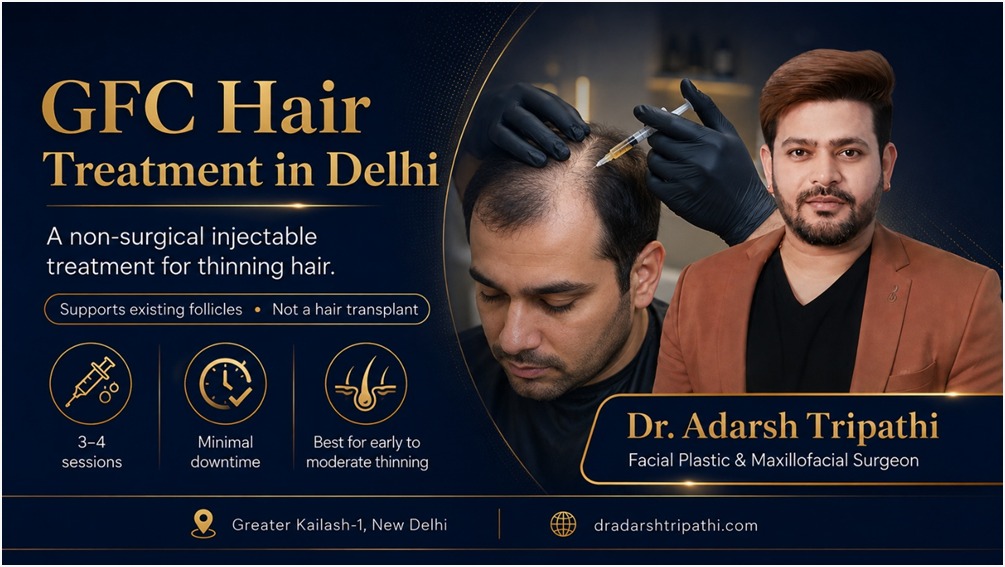
GFC Hair Treatment in Delhi
Quick answer: GFC (Growth Factor Concentrate) is a non-surgical injectable treatment for hair thinning, made from your own blood but processed differently from PRP to produce a concentrated, cell-free growth factor solution. It is injected into the scalp across a course of three to four sessions spaced four to six weeks apart, and works by supporting existing but weakening follicles. In Delhi, GFC costs roughly Rs 8,000-18,000 per session. It does not regrow hair on a completely bald scalp and it is not permanent. At Sarayu Clinics in Greater Kailash-1, treatment is planned by Dr. Adarsh Tripathi, a maxillofacial and facial plastic surgeon with 18+ years of experience – which also means being told honestly when GFC is not enough and a hair transplant is the better answer.
One clarification before anything else, because a lot of pages get this wrong. GFC is not a hair transplant. You will find it described that way online – including by at least one large healthcare aggregator – but there are no grafts, no donor area, no surgery and no incisions involved. It is an injection. The confusion matters because patients arrive expecting transplant-level results from a treatment that does something quite different, and are then disappointed by a perfectly good outcome. GFC supports hair you still have. A transplant replaces hair you have lost. Both are useful; they are not interchangeable.
Hair loss treatment in Delhi has become crowded with acronyms – PRP, GFC, QR678, exosomes, mesotherapy – marketed as though each is a generational leap over the last. The reality is more modest and more useful: these are different preparations working on a similar principle, at different price points, with different amounts of evidence behind them. GFC sits in a sensible middle position, and this page explains honestly where it fits, what it can do for you, and where its limits are.
What GFC Actually Is ?
GFC stands for Growth Factor Concentrate. A small sample of your blood is drawn, then processed in a closed, standardised system to extract and concentrate the growth factors held inside your platelets – proteins with names like PDGF, VEGF, EGF and IGF-1 that signal tissue repair and support follicle activity.
The key technical difference from PRP: PRP is a platelet-rich plasma – the platelets themselves are injected, and they release their growth factors gradually once in the scalp. GFC releases those growth factors from the platelets first, then delivers the concentrated growth factors in a cell-free solution. In practice that means a higher and more predictable concentration of the active signalling proteins, and less variability between one patient’s preparation and another’s. That standardisation is the honest case for GFC over PRP – not that it is a different category of treatment, but that it is a more controlled version of the same idea.
Because it comes from your own blood, there is no risk of allergic reaction or rejection, and no foreign material is introduced.
What GFC Hair Treatment Delivers ?
- Reduced hair fall, usually the first change patients notice, often within four to six weeks
- Improved hair calibre – existing thin, wispy hairs growing back thicker over the course
- Better scalp condition and follicle environment
- Support for miniaturising follicles that are weakening but still active
- Denser-looking hair, largely from improving what is already there rather than creating new growth
- A standardised, more predictable preparation than PRP
- No surgery, no downtime, and a return to normal activity the same day
- No allergy or rejection risk, since the material is your own
- A useful adjunct before, or after, a hair transplant
What GFC honestly cannot do ?
- It cannot regrow hair where follicles are gone. On a genuinely bald scalp there is nothing left to stimulate – that needs a hair transplant
- It is not permanent. Results fade over months without maintenance sessions, because GFC does not change the underlying cause of the hair loss
- It does not stop androgenetic hair loss. The hormonal process continues – which is why GFC works best alongside medical therapy rather than instead of it, discussed below
- It does not work equally for everyone. Response varies, and some patients see modest benefit despite a well-performed course. An honest clinic says so before you commit
- It is not a substitute for diagnosis. Hair loss from thyroid disease, iron deficiency, or a scarring alopecia will not respond well, and treating it with GFC without investigating is poor practice
Areas Treated
GFC is used almost entirely on the scalp, in the areas where thinning is active but follicles remain.
Crown and vertex
The most commonly treated area in men, where early androgenetic thinning usually shows first. GFC works well here when the hair is thinning rather than absent.
Mid-scalp and diffuse thinning
The classic pattern in female hair loss – a widening parting and general loss of density rather than a receding line. GFC is often a good fit here because the follicles are miniaturising rather than lost.
Frontal hairline and temples
GFC can support a thinning hairline, but with an important caveat: a receded hairline where the follicles have gone will not respond. If the hairline has genuinely receded rather than thinned, that is a FUE hair transplant conversation.
Post-transplant support
GFC is frequently used after a hair transplant to support graft survival and encourage the native hair around the grafts. Many surgeons consider this one of its more reliable applications.
Eyebrows
Occasionally used for thinning eyebrows in selected cases, though this is a smaller and less established application.
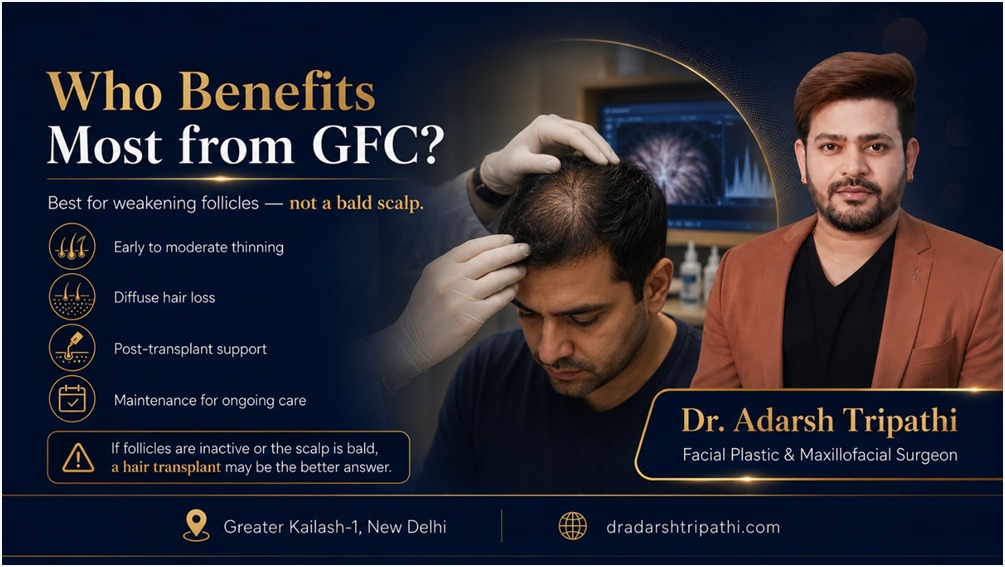
Who GFC Hair Treatment Suits ?
Good candidates
- Early to moderate hair thinning – Norwood 2-3 in men, Ludwig 1-2 in women
- Visible miniaturisation, where hair is getting finer rather than disappearing
- Increased hair fall over recent months with density still largely intact
- Patients not ready for, or not yet needing, a hair transplant
- Post-transplant patients wanting to support grafts and surrounding native hair
- Anyone wanting a more standardised alternative to PRP
- Patients willing to commit to a course and to maintenance
GFC is not the right treatment if
- You have completely bald areas with no follicular activity – nothing to stimulate
- You have advanced hair loss (Norwood 5-7) – a transplant is the appropriate answer
- You have scarring alopecia, where follicles have been replaced by scar tissue
- Your hair loss has an untreated medical cause – thyroid, iron deficiency, PCOS – that needs addressing first
- You expect permanent results from a course of injections
- You have a bleeding disorder, are on anticoagulants without clearance, or have an active scalp infection
- You are pregnant or breastfeeding – treatment is deferred
The diagnosis point deserves emphasis. A meaningful proportion of hair loss seen in Delhi clinics is not purely androgenetic – iron deficiency and thyroid dysfunction are common and both cause hair fall that will not respond well to GFC. Blood tests before starting a course are not an upsell; they are the difference between treating the problem and treating around it.
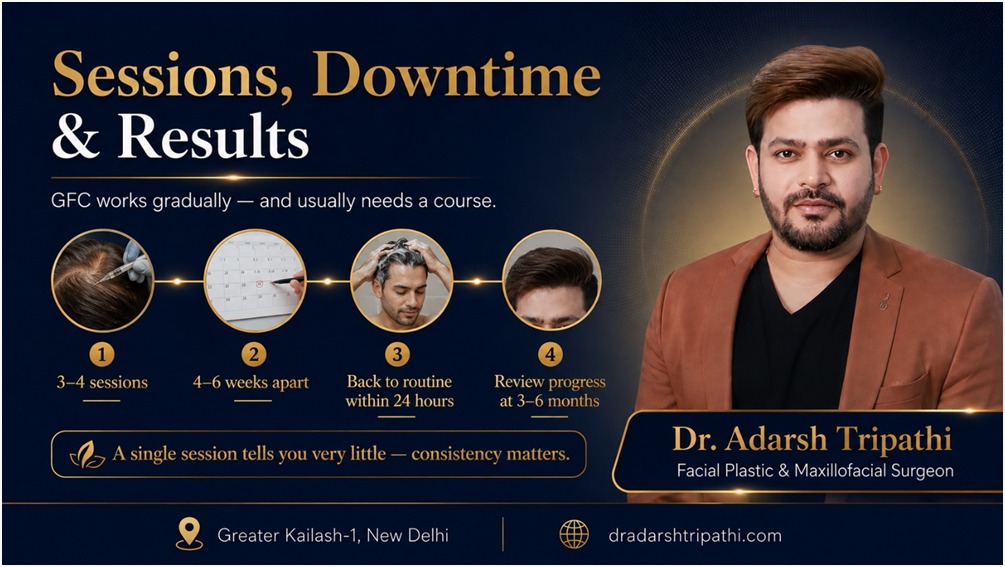
The GFC Hair Procedure, Step by Step
Consultation and diagnosis
Dr. Tripathi examines the scalp, assesses the pattern and stage of loss, checks donor density, and reviews your medical history. Blood tests are arranged where indicated. Crucially, this is where you are told honestly whether GFC suits your stage of hair loss, or whether medical therapy, a transplant, or a combination would serve you better. Baseline photographs are taken – without them, judging progress at four months is guesswork.
Blood draw
Around 10-16ml of blood is drawn from your arm, exactly as for a routine blood test. Nothing more invasive than that.
Processing
The sample is processed in a closed, single-use system that separates the platelets and then releases and concentrates their growth factors, producing a cell-free concentrate. This takes roughly 20-30 minutes and happens while you wait. The closed system is what gives GFC its consistency advantage over manually prepared PRP.
Scalp preparation
The scalp is cleansed and topical anaesthetic applied for 20-30 minutes. Most patients find the injections easily tolerable with numbing; some prefer none.
Injection
The concentrate is injected into the scalp at the level of the follicles using fine needles, in a systematic grid across the thinning areas. The session takes 20-30 minutes. Some clinics combine this with microneedling to improve distribution.
The course
A standard course is three to four sessions spaced four to six weeks apart, followed by maintenance every four to six months. GFC works cumulatively – a single session tells you very little, and patients who try one and conclude it does not work have usually not completed a course.
Downtime and Aftercare
Timeframe | What to expect |
Immediately after | Mild redness and slight tenderness across the scalp. Small injection points, no dressing needed |
Day 1 | Redness settles. Some patients notice mild scalp tightness or a dull ache – normal |
Days 2-3 | Back to entirely normal. Hair washing resumes after 24 hours |
Weeks 4-6 | Reduced hair fall – usually the first noticeable change |
Months 3-4 | Improved hair calibre and density becoming visible in photographs |
Aftercare is simple: no hair wash for 24 hours; no swimming, sauna or heavy sweating for 48 hours; avoid hair colouring or chemical treatments for a week; no direct sun on the scalp for a couple of days; and no scratching or massaging the treated area. There is no meaningful downtime – most patients treat it as a lunchtime appointment.

Cost of GFC Hair Treatment in Delhi
Direct answer: GFC hair treatment in Delhi costs approximately Rs 8,000-18,000 per session, with most patients needing a course of three to four sessions – so a full initial course typically runs Rs 25,000-65,000. Maintenance sessions every four to six months are charged at the single-session rate. GFC sits above PRP and below exosome therapy on price.
Treatment | Per session | Typical course | Course total |
GFC – single area (crown or hairline) | Rs 8,000-14,000 | 3-4 | Rs 25,000-50,000 |
GFC – full scalp | Rs 12,000-18,000 | 3-4 | Rs 40,000-65,000 |
GFC + microneedling combined | Rs 12,000-20,000 | 3-4 | Rs 40,000-72,000 |
GFC post-transplant support | Rs 8,000-15,000 | 2-3 | Rs 20,000-45,000 |
Maintenance session | Rs 8,000-18,000 | Every 4-6 months | – |
For comparison – PRP | Rs 6,000-15,000 | 4-6 | Rs 25,000-75,000 |
For comparison – Exosome therapy | Rs 20,000-50,000 | 3-6 | Rs 60,000-2,50,000 |
What drives the price ?
- Area treated – full scalp costs more than a single zone
- The GFC kit used, which is a genuine consumable cost and varies by manufacturer
- Whether microneedling or other adjuncts are combined in the session
- Number of sessions your stage of loss genuinely needs
- Whether a doctor assesses and injects, or a technician runs a standard protocol
An honest note on value. GFC costs more per session than PRP and less than exosomes, and the evidence base follows roughly the same order in reverse – PRP has the longest track record, exosomes the shortest. For most patients with early thinning, PRP or GFC is the sensible starting point, and which of the two depends more on how much you value the standardisation than on a dramatic difference in outcome. Anyone presenting GFC as a generational leap over PRP is overselling it. It is a refinement, and a worthwhile one.
Results - What to Expect and When
- Weeks 4-6: reduced hair fall. Usually the first and most reassuring change
- Months 2-3: existing hair feels thicker; scalp condition improves
- Months 3-4: visible improvement in density and calibre – this is when photographs start showing it
- Months 4-6: the full effect of the initial course
- Beyond 6 months: gradual fading without maintenance. Sessions every four to six months sustain the result
Two things worth knowing. First, baseline photographs matter more than they sound – hair changes slowly and daily observation is unreliable, so without a before image at month four you are comparing against memory. Second, GFC improves what you have; it does not create new follicles. If the improvement seems modest, that is usually because expectations were set against transplant outcomes rather than against what a supportive treatment realistically achieves.
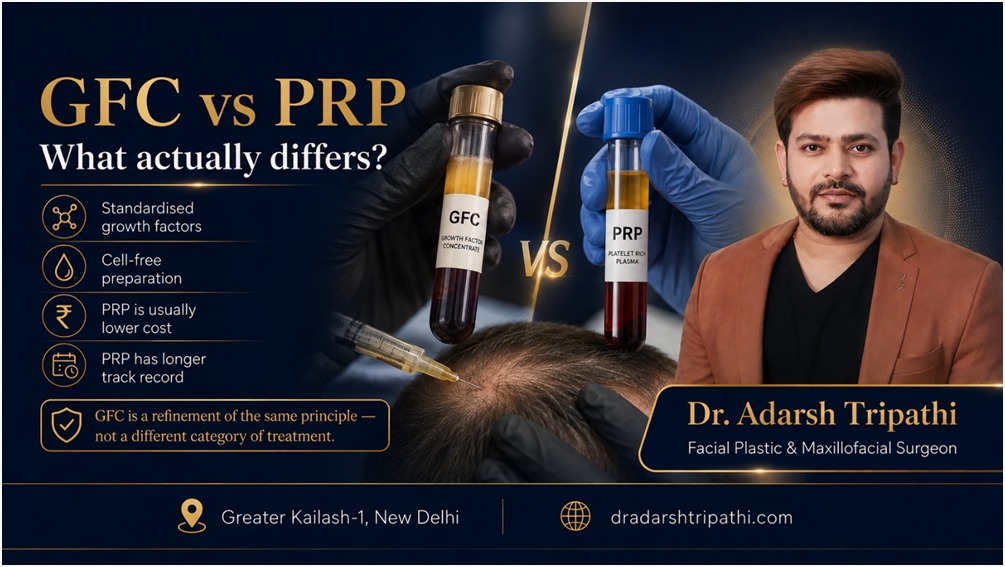
GFC vs PRP vs Exosomes vs Transplant
Treatment | What it does | Best stage | Per session | Evidence base |
GFC | Concentrated cell-free growth factors | Early-moderate thinning | Rs 8,000-18,000 | Growing; less than PRP |
Platelet-rich plasma, gradual release | Early-moderate thinning | Rs 6,000-15,000 | Longest, best established | |
Regenerative signalling vesicles | Early thinning | Rs 20,000-50,000 | Newest; regulatory questions | |
Vitamin and drug cocktail injections | Early thinning, adjunct | Lower | Variable | |
Medical therapy (finasteride, minoxidil) | Blocks or slows the underlying process | All stages | Low, ongoing | Strongest of all |
Relocates permanent follicles | Established loss, Norwood 3+ | Rs 40-120/graft | Definitive for lost hair |
GFC or PRP – the honest comparison
GFC gives a higher and more consistent growth factor concentration through a standardised closed system; PRP is cheaper, has the longer clinical track record, and in skilled hands with a good preparation protocol produces comparable results for many patients. GFC’s genuine advantage is predictability – less variation between preparations and between clinics. If budget is the constraint, PRP remains a perfectly respectable choice. If consistency matters more to you, GFC is the refinement worth paying for. What is not true is that GFC is a different order of treatment.
Why medical therapy still matters more than any of them ?
This is the part most clinic pages skip because it is not billable. In androgenetic hair loss, finasteride and minoxidil have substantially more evidence behind them than any injectable, and they address the underlying process rather than supporting the follicles around it. GFC, PRP and exosomes all work better alongside medical therapy than instead of it. A clinic recommending a Rs 50,000 injectable course without discussing medical therapy first is not giving you the full picture.
Choosing a GFC Hair Treatment Doctor or Specialist in Delhi
Direct answer: a GFC hair treatment doctor in Delhi should diagnose before treating – including blood tests where indicated – should explain honestly how GFC compares with PRP rather than simply calling it more advanced, should discuss medical therapy alongside it, should take baseline photographs, and should tell you plainly when your stage of hair loss has moved past what injectables can achieve. Because GFC is technically straightforward to administer, the value of the doctor lies almost entirely in the diagnosis and the honesty of the recommendation.
On the word ‘surgeon’
GFC is a non-surgical injectable, so strictly there is no surgery and no surgeon involved in the procedure itself. But patients searching for a GFC hair treatment surgeon in Delhi are usually asking a sensible question: is there someone who can offer me the injectable option AND perform the transplant if it comes to that, rather than a clinic that only sells one of the two? That is a genuine advantage. A practice that offers only injectables has a structural reason to keep recommending injectables. A surgeon who performs FUE and FUT as well as GFC can tell you honestly which stage you are at – including that you are not yet a surgical candidate and should stay on non-surgical treatment for now.
Questions worth asking before you book
- What stage is my hair loss, and is GFC actually appropriate for it?
- Should I have blood tests first to rule out other causes?
- How does GFC compare with PRP for my case, and why are you recommending one over the other?
- What about medical therapy – should I be on finasteride or minoxidil alongside this?
- How many sessions, what maintenance, and what is the full cost over two years?
- At what point would you tell me to consider a transplant instead?
Why patients choose Dr. Adarsh Tripathi
- Adarsh Tripathi is a Maxillofacial and Facial Plastic Surgeon with 18+ years of experience
- Offers the full hair spectrum – GFC, PRP, exosome therapy, medical therapy and hair transplant surgery – so the recommendation is based on your stage, not on what the clinic sells
- Diagnosis before treatment, including blood tests where indicated rather than treating every case as androgenetic
- Standardised closed-system GFC preparation Baseline photography so progress is measured rather than remembered
- Honest about response variability and about the point at which injectables stop being the answer
- See before-and-after results and celebrity work
- Greater Kailash-1, New Delhi – convenient from GK-2, CR Park, Kailash Colony, Defence Colony, Hauz Khas, Nehru Place and South Extension.
Frequently Asked Questions
What is GFC hair treatment?
GFC (Growth Factor Concentrate) is a non-surgical injectable treatment for hair thinning. A small blood sample is processed in a closed system to release and concentrate the growth factors held in your platelets, producing a cell-free concentrate that is injected into the scalp. It supports existing weakening follicles rather than creating new ones. It is not a hair transplant – there are no grafts, no donor area and no surgery involved. See our hair transplant page for the surgical option.
How much does GFC hair treatment cost in Delhi?
GFC hair treatment in Delhi costs approximately Rs 8,000-18,000 per session depending on the area treated and the kit used. Most patients need three to four sessions, putting a full initial course at Rs 25,000-65,000. Maintenance sessions every four to six months are charged at the single-session rate. GFC sits above PRP and well below exosome therapy on price.
Is GFC better than PRP?
GFC offers a higher and more consistent growth factor concentration than PRP because it uses a standardised closed system, which reduces variation between preparations. But PRP is cheaper and has the longer clinical track record, and in skilled hands produces comparable results for many patients. GFC is a refinement of the same principle rather than a different category of treatment – anyone describing it as a generational leap is overselling it.
How many GFC sessions will I need?
A standard course is three to four sessions spaced four to six weeks apart, followed by maintenance every four to six months. GFC works cumulatively, so a single session tells you very little – patients who try one and conclude it does not work have usually not completed a course. The exact number depends on your stage of hair loss and how you respond.
When will I see results from GFC?
Reduced hair fall is usually the first change, at around four to six weeks. Improved hair calibre and density become visible in photographs at three to four months, with the full effect of the initial course at four to six months. Baseline photographs matter here – hair changes slowly and daily observation is unreliable, so without a before image you are comparing against memory.
Does GFC regrow hair on bald areas?
No. GFC supports follicles that are still present but weakening – on a genuinely bald scalp there is nothing left to stimulate. If you have established bald areas, a hair transplant is the appropriate treatment. This is one of the most common misunderstandings about GFC and it is worth being clear about before booking a course.
Is GFC hair treatment permanent?
No. GFC does not change the underlying cause of hair loss, so results fade over months without maintenance. Sessions every four to six months sustain the improvement. In androgenetic hair loss the hormonal process continues regardless, which is why GFC works considerably better alongside medical therapy such as finasteride or minoxidil than it does on its own.
Who is the best GFC hair treatment doctor in Delhi?
The right GFC doctor diagnoses before treating – including blood tests where indicated – explains honestly how GFC compares with PRP, discusses medical therapy alongside it, takes baseline photographs, and says plainly when your hair loss has moved past what injectables can achieve. Dr. Adarsh Tripathi is a Maxillofacial and Facial Plastic Surgeon with 18+ years of experience who offers GFC, PRP, exosomes and hair transplant surgery, so the recommendation is not limited by what is on offer.
Is there a GFC hair treatment surgeon in Delhi?
GFC itself is non-surgical, so no surgery is involved in the procedure. But patients searching this way are usually asking a sensible question – whether one practitioner can offer both the injectable option and the transplant if it becomes necessary. That matters, because a clinic offering only injectables has a structural reason to keep recommending them. Dr. Adarsh Tripathi performs FUE and FUT hair transplant as well as GFC, and will tell you honestly which stage you are at.
Does GFC hurt?
Discomfort is mild. Topical numbing cream is applied for 20-30 minutes beforehand, after which most patients describe the injections as brief pressure or pinpricks rather than pain. The session itself takes 20-30 minutes. Some patients prefer to skip the numbing entirely and find it perfectly tolerable.
Is there downtime after GFC?
Effectively none. Expect mild redness and slight scalp tenderness for a few hours, settling by the next day. Avoid washing your hair for 24 hours, and skip swimming, sauna and heavy sweating for 48 hours. Most patients treat it as a lunchtime appointment and return to normal activity immediately.
Can GFC be combined with a hair transplant?
Yes, and it is one of GFC’s more reliable applications. Used after a hair transplant it supports graft survival and encourages the native hair around the grafted area, which matters because transplanted hair is permanent but surrounding native hair can keep thinning. GFC is also sometimes used before surgery to optimise scalp condition. Discuss timing with your surgeon, as protocols vary.
How to Reach Us:
Phone:+91 9289111083 ,+91 9289111084
Dr Adarsh’s website: https://dradarshtripathi.com/
Facebook: https://www.facebook.com/DrAdarshTripathi3011
Instagram: https://www.instagram.com/dr_adarsh_tripathi/
Youtube: https://www.youtube.com/@dr_adarsh_tripathi
Linkedin: https://www.linkedin.com/in/dr-adarsh-tripathi-a43005b8/
Online Booking: https://dradarshtripathi.com/contact-us/ to schedule appointments conveniently.