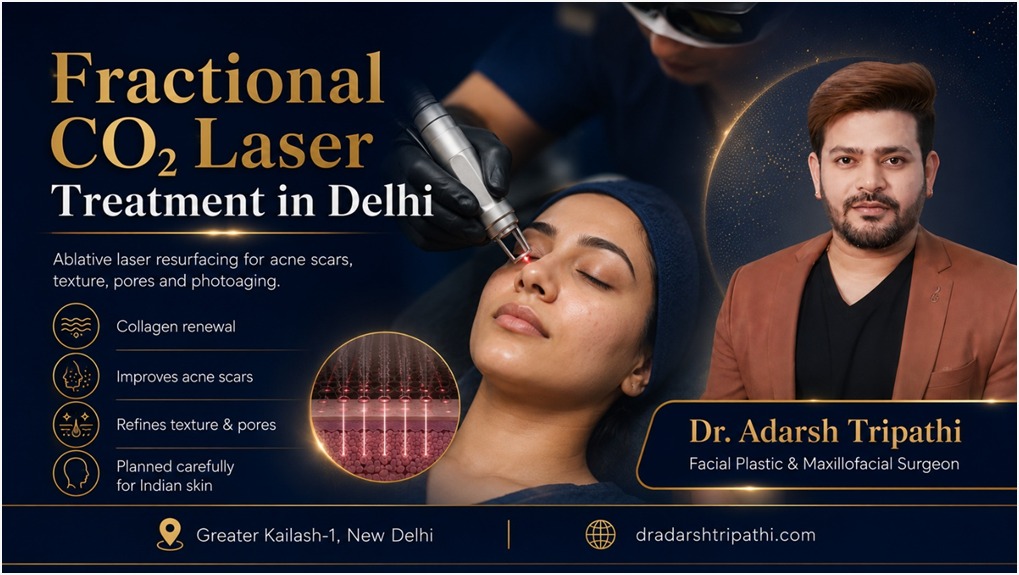
Fractional CO2 Laser Treatment in Delhi
Quick answer: Fractional CO2 laser is an ablative resurfacing treatment. It uses a carbon dioxide laser split into thousands of microscopic beams, which create tiny columns of controlled injury in the skin while leaving the skin between them untouched. That untreated skin speeds healing, and the repair process builds new collagen. It is used mainly for acne scars, certain other scars, uneven texture, enlarged pores and photoaging. It involves genuine downtime – typically several days of redness and peeling – and on Indian skin it needs careful settings to manage pigmentation risk. At Sarayu Clinics in Greater Kailash-1, treatment is planned by Dr. Adarsh Tripathi, a maxillofacial and facial plastic surgeon.
Quick Facts
Treatment type | Ablative fractional laser resurfacing |
Anaesthesia | Topical numbing cream; occasionally additional measures for deeper settings |
Session time | Varies with area treated – typically well under an hour for a full face |
Downtime | Usually several days of redness, swelling and peeling; longer with more intensive settings |
Sessions | Varies by indication and intensity – commonly a small number, spaced weeks apart |
Results | Begin during healing; collagen remodelling continues for months |
Suitable for Indian skin | Yes, with appropriate settings, priming and aftercare – see the pigmentation section |
Price | Prices will be discussed during the consultation. |
Most people who come in asking about fractional CO2 laser have already tried something gentler. They have had facials, peels or microneedling, seen a small improvement, and want to know whether there is something stronger. There is – and this is usually it. Fractional CO2 is the most powerful resurfacing option available in most clinics.
That power is the point, and it is also the reason this treatment needs more thought than a facial does. It works by injuring the skin in a controlled way and letting it heal. That means real downtime, real aftercare, and a genuine risk of pigmentation problems if the settings or the patient are wrong. Used well, on the right skin, for the right problem, it does things nothing gentler can. Used carelessly it can leave a patient worse off than before.
This page explains what the treatment actually does, who it suits, what it costs, and – equally important – when something else would serve you better.
What Is Fractional CO2 Laser Treatment?
A CO2 laser produces light at a wavelength that water absorbs very strongly. Because skin is largely water, that energy is absorbed almost entirely at the surface, where it vaporises a thin layer of tissue. This is what ‘ablative’ means – the laser removes tissue rather than heating it from underneath.
Older CO2 resurfacing treated the entire surface at once. It was effective but the recovery was substantial, often weeks, because the whole area had to heal at the same time.
Fractional delivery changed that. Instead of one continuous beam, the laser is split into thousands of tiny beams. Each creates a narrow column of treated tissue – a microthermal treatment zone – surrounded by skin that has not been touched. Typically only a fraction of the surface is treated in any one session. The untreated skin in between acts as a reservoir of healthy cells that repairs the treated columns quickly, which is why fractional treatment heals in days rather than weeks.
You get much of the benefit of full ablative resurfacing, spread across several sessions, with recovery most people can plan around.
How Does Fractional CO2 Laser Work?
Two things happen at once.
- The columns of tissue that are vaporised are replaced as the skin heals. That directly resurfaces the top layer, which is what improves texture and surface irregularities.
- Heat spreads a short distance around each column into the deeper dermis. This does not remove tissue but stimulates the wound-healing response, which lays down new collagen over the following weeks and months. This is the part that keeps improving long after the surface has healed.
It is why results are not immediate. The surface settles within a couple of weeks; the collagen response continues well beyond that. Patients who judge the outcome at three weeks are judging half the treatment.
Conditions Fractional CO2 Laser May Treat
The evidence is strongest for textural problems – things you could feel with a fingertip – rather than for colour problems.
Where it is a strong option ?
- Atrophic acne scars – depressed scarring, particularly rolling and shallow boxcar types. Covered in detail below
- Selected surgical and traumatic scars, including some burn scars – though scar age, thickness and site all affect suitability
- Uneven skin texture and roughness
- Enlarged pores
- Fine lines, particularly around the mouth and eyes
- Photoaging – the cumulative surface change from years of sun exposure
Where it may help, with qualification ?
- Some pigmentation associated with sun damage may improve as the surface is resurfaced. But ablative laser is not a first-line treatment for most pigmentation problems in Indian skin, and it is generally avoided in melasma, where heat can worsen the condition. For pigmentation, laser toning and chemical peels are usually the more appropriate starting point
- Certain stretch marks, in selected cases. Response is variable and generally more modest than for facial scarring
Where something else is usually better ?
- Ice-pick acne scars – narrow and deep. These respond poorly to resurfacing alone; TCA CROSS or scar revision is often more effective
- Tethered rolling scars – subcision to release the tether usually needs to come first
- Skin laxity and sagging – resurfacing is not a lifting treatment. See HIFU or Morpheus8
- Active acne – inflammation should be controlled before resurfacing
- Volume loss – hollowing is not a texture problem. See dermal fillers or fat grafting
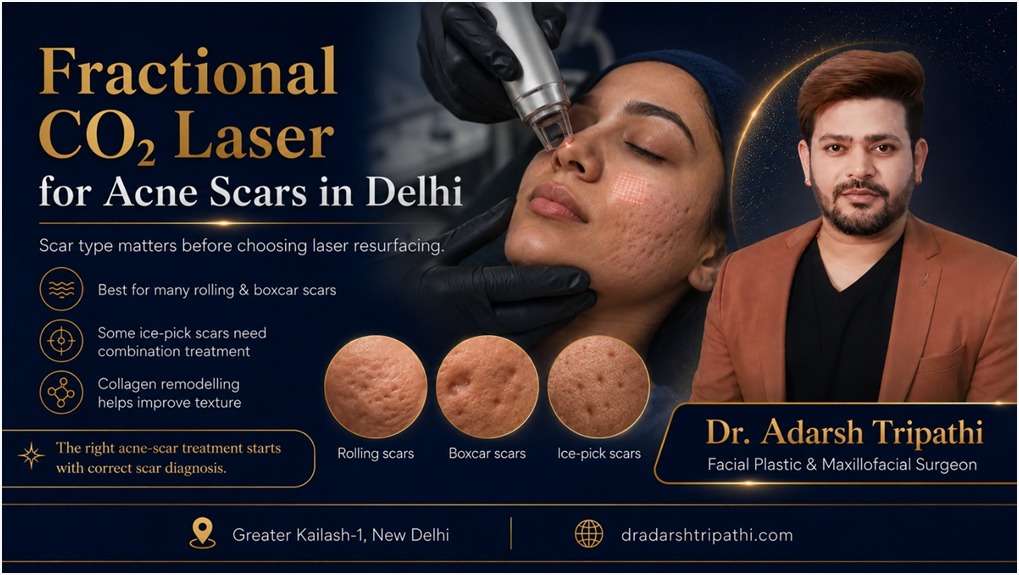
Fractional CO2 Laser for Acne Scars in Delhi
This is the most common reason patients ask about the treatment, and it is where the detail matters most – because acne scarring is not one condition. The scar type largely determines whether fractional CO2 is the right tool, a partial answer, or the wrong choice.
Rolling scars
Broad, shallow depressions with sloping edges, giving skin an undulating look. They are often tethered to deeper tissue by fibrous bands. Resurfacing alone improves the surface but does not release the tether – which is why subcision, a technique that cuts those bands, is frequently done first or alongside. The combination usually outperforms either on its own.
Boxcar scars
Wider depressions with sharp, defined edges – like small craters. Shallow boxcar scars respond reasonably well to fractional CO2, because resurfacing softens the sharp edges and allows the skin to blend. Deeper boxcar scars respond less completely and may need punch techniques or surgical revision.
Ice-pick scars
Narrow, deep and steep-sided, extending well into the dermis. These are the least responsive to resurfacing, because a fractional laser cannot reach the base of a narrow deep track without treating everything around it. TCA CROSS – applying a high-strength acid precisely into the scar base – or punch excision generally works better.
Hypertrophic and keloid scars
Raised rather than depressed, and a different problem entirely. These need a different approach – intralesional steroids and a combination protocol – and simply resurfacing them is not appropriate. Our scar revision page covers this in detail, including why keloids should rarely be excised on their own.
Why combination treatment is usually the honest answer
Most people with meaningful acne scarring have more than one type on the same face. That is why a single treatment rarely produces the result patients hope for, and why a plan often combines approaches. Depending on scar type, a doctor may consider subcision, microneedling radiofrequency, TCA CROSS, chemical peels, dermal fillers for selected depressed scars, or surgical scar revision alongside or instead of fractional CO2. Which of these is appropriate depends entirely on assessment – this is not a decision that can be made from a photograph or a phone call.
Areas That Can Be Treated
The face is the most commonly treated area and the one with the best evidence, because facial skin has a dense supply of the structures the skin heals from.
- Full face – the standard approach for widespread acne scarring or photoaging
- Cheeks – the most common site for acne scarring
- Forehead
- Around the mouth – one of the better responses for fine lines
- Around the eyes – treated with particular care given the thin skin
- Specific scar areas anywhere on the body, treated as a defined patch
Neck and chest need caution. The skin here is thinner and heals more slowly than facial skin, and complication rates are higher. It can be treated, but conservatively and only after discussion. Any clinic offering the same settings on your neck as your face has not thought about it.
What Fractional CO2 Laser Realistically Achieves ?
- Meaningful improvement in the appearance of atrophic acne scars, particularly rolling and shallow boxcar types
- Smoother overall skin texture
- Reduced appearance of enlarged pores
- Softening of fine lines
- Improvement in the look of selected scars
- Continued gradual improvement for months after the surface has healed, as collagen remodels
- Treatment of several concerns in one procedure, since resurfacing is not selective
What it will not do. It will not remove scars completely – improvement is the honest word, not erasure. It will not lift sagging skin. It will not restore lost volume. It will not stop new acne. And it will not produce its result in one session for most people. Any clinic promising flawless skin from a laser is describing something that does not exist.
Who Is a Good Candidate?
Likely a good candidate
- Atrophic acne scarring, uneven texture, enlarged pores or photoaging as the main concern
- Acne currently under control, not actively inflamed
- Realistic expectations – improvement over sessions, not erasure
- Able to take several days of visible downtime
- Willing to commit to strict sun protection afterwards, which is not optional
- Good general healing and no history of poor wound healing
Who may not be suitable ?
These are general clinical considerations, not personal medical advice. Suitability is decided at assessment.
- Active skin infection, cold sores or inflamed acne in the treatment area
- Recent isotretinoin use – resurfacing is usually deferred for a period after stopping
- A tendency to keloid or hypertrophic scarring
- Active or recently active melasma, where heat may worsen pigmentation
- Recent significant sun exposure or an active tan
- Certain autoimmune or connective tissue conditions, and conditions affecting wound healing
- Pregnancy or breastfeeding – elective treatment is generally deferred
- Photosensitising medication, depending on the medication
- Unwillingness or inability to follow aftercare – this genuinely affects both outcome and risk
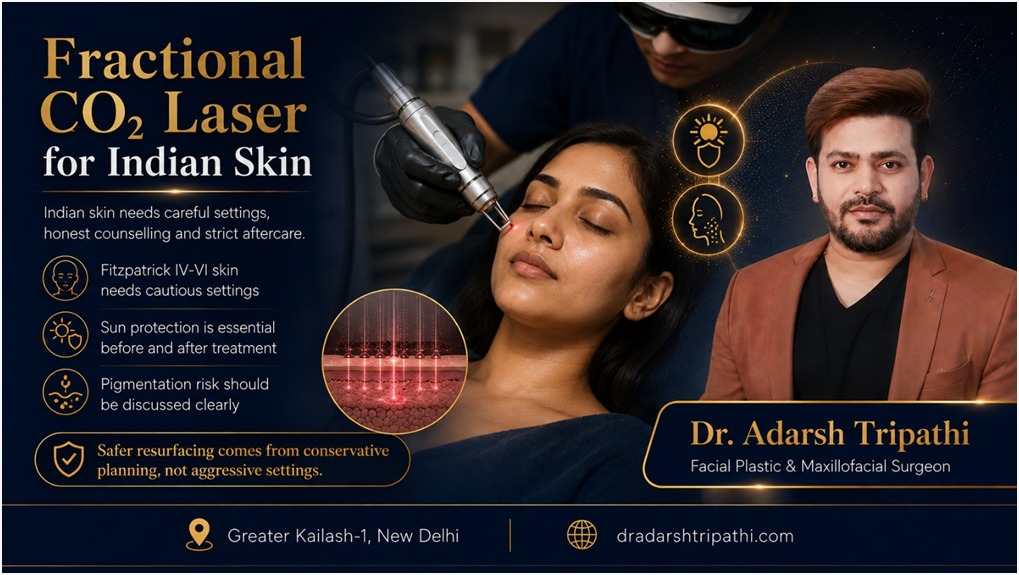
Fractional CO2 Laser and Indian Skin
This deserves its own section because it is the single most important safety consideration for most patients reading this page, and because a great deal of the information available online is written for lighter skin types.
Skin with more melanin – Fitzpatrick types IV to VI, which covers the majority of patients in Delhi – carries a higher risk of post-inflammatory hyperpigmentation after any procedure that causes controlled injury. With an ablative laser, that risk is real and needs managing rather than ignoring.
It does not mean fractional CO2 is unsuitable for Indian skin. It means the approach has to be different from the one used on lighter skin:
- More conservative energy settings and lower density, accepting that more sessions may be needed to reach the same endpoint
- Priming the skin beforehand where indicated, to reduce the pigment response
- Strict avoidance of treatment on tanned or recently sun-exposed skin
- Rigorous sun protection afterwards – this is the single biggest factor within the patient’s control
- A test patch in higher-risk cases
- Prompt management if pigmentation does develop, rather than waiting to see
The honest framing: post-inflammatory hyperpigmentation after resurfacing is usually temporary and treatable, but it can take months to settle, and during that time the skin can look worse than before treatment. Being told this beforehand is part of informed consent. A clinic that does not raise it is either not thinking about it or not telling you.
Consultation and Skin Assessment
Fractional CO2 is not a treatment that should be booked from a price list. The settings used – energy, density, depth, number of passes – are chosen for your skin and your problem, and getting them wrong in either direction means either no result or a complication.
An assessment should establish your Fitzpatrick skin type, the specific type or types of scarring or texture change present, whether pigmentation is a coexisting concern, your history of healing and scarring, current and recent medications, and whether anything else would treat your problem better. Baseline photographs matter here more than patients expect, because change is gradual and memory is unreliable at three months.
This is also where realistic expectations are set – what degree of improvement is achievable, roughly how many sessions that is likely to take, and how much downtime you should plan for.
Preparation Before Treatment
Individual instructions vary and your clinic’s advice takes precedence over anything on this page. In general:
- Avoid sun exposure and tanning for a period before treatment; treatment is postponed on tanned skin
- Daily sun protection in the run-up
- Stop retinoids and strong exfoliating actives a few days before, on advice
- Disclose any history of cold sores – preventive antiviral treatment is commonly prescribed before facial resurfacing
- Disclose all medications and supplements, including anything photosensitising
- Priming skincare may be prescribed for some weeks beforehand, particularly on darker skin types
- Arrange your calendar around the downtime rather than hoping it will be shorter than you were told
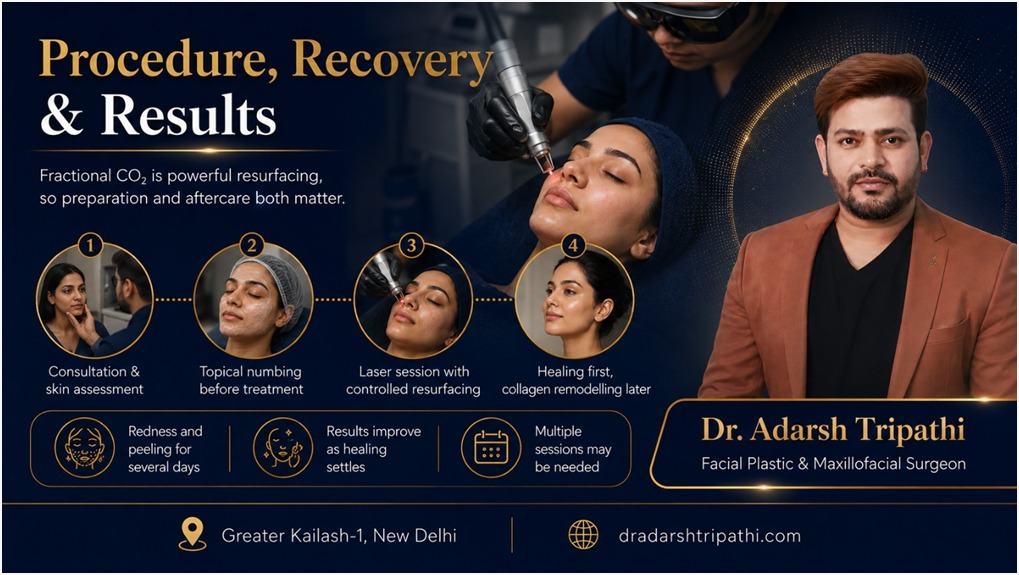
The Fractional CO2 Laser Procedure in Delhi
Step 1 — Consultation and planning
Skin type, concern and suitability are assessed, and treatment parameters planned. Where relevant this includes deciding whether fractional CO2 alone is appropriate or whether it should be combined with another technique.
Step 2 — Photography and documentation
Standardised baseline photographs, so progress can be judged against an image rather than a memory.
Step 3 — Cleansing
The area is cleansed thoroughly to remove makeup, oils and product.
Step 4 — Anaesthesia
Topical numbing cream is applied and left for a period to take effect. For deeper settings or more sensitive areas, additional comfort measures may be used at the doctor’s discretion.
Step 5 — Eye protection
Protective eyewear for the patient, and for everyone in the room. This is not optional with a CO2 laser.
Step 6 — Laser treatment
The handpiece is passed systematically over the treatment area, delivering the fractionated beam at the planned settings. Duration depends on the area – a defined scar takes minutes, a full face longer. Most patients describe a hot prickling sensation.
Step 7 — Immediate aftercare
Cooling is applied, followed by a protective ointment or dressing as advised. The skin will look red and feel hot, similar to a strong sunburn.
Step 8 — Instructions and follow-up
Written aftercare instructions, any prescribed medication, and a follow-up appointment. You should leave knowing exactly what the next week looks like.
Does Fractional CO2 Laser Hurt?
Direct answer: with topical numbing cream applied beforehand, most patients find the treatment uncomfortable rather than painful – usually described as heat, prickling or a snapping sensation. Sensitivity varies by area, with skin around the eyes and mouth generally more sensitive. Afterwards, the skin feels like a moderate sunburn for a day or two: hot, tight and tender rather than sharply painful. Deeper settings are more uncomfortable than lighter ones, and your doctor can adjust comfort measures accordingly.
Recovery and Downtime
Recovery depends heavily on treatment intensity. Light settings mean a few days; more aggressive settings mean longer. The pattern is consistent:
Stage | What to expect |
First 24 hours | Marked redness, warmth and swelling. Skin feels tight, like a strong sunburn. Ointment applied as directed; sleeping with the head elevated helps swelling |
Days 2-3 | Swelling usually peaks then begins to settle. Skin feels rough and may look bronzed or darker as treated columns come to the surface |
Days 4-7 | Peeling and flaking. This is the treated tissue shedding. Do not pick or scrub – this stage largely determines whether you get pigmentation problems |
Week 2 | New skin visible, usually pink. Most people are comfortable in public around now, often with mineral makeup once permitted |
Weeks 3-6 | Pinkness fades gradually. Sun protection remains essential throughout |
Months 2-6 | Collagen remodelling continues. Improvement keeps developing well beyond the point the skin looks healed |
Aftercare
Aftercare is not an afterthought with this treatment. It affects both the result and the risk of complications, particularly pigmentation.
- Cleanse gently with a mild, non-foaming cleanser and lukewarm water. No scrubbing, no washcloths, no brushes
- Keep the skin moisturised as directed. Healing skin that dries out is more uncomfortable and more likely to mark
- Do not pick, peel or exfoliate the flaking skin. Let it come away on its own
- Sun protection, daily and rigorously, from the point your clinic permits sunscreen. Physical avoidance in the first days
- Avoid active skincare – retinoids, acids, vitamin C – until cleared to restart
- Avoid heat: saunas, steam, hot yoga, heavy sweating, until advised
- Avoid swimming pools while the skin barrier is healing
- Take any prescribed medication exactly as instructed, including antivirals if given
- Contact the clinic promptly if you develop increasing pain, spreading redness, pus, fever or anything that does not match what you were told to expect
Side Effects and Risks
Fractional CO2 is a well-established procedure, but it is not risk-free and no responsible page should suggest otherwise.
Expected effects
- Redness, which can persist for weeks after more intensive treatment
- Swelling in the first days
- Peeling, flaking and crusting during healing
- Sensitivity, tightness and dryness
- Temporary darkening of treated areas as tissue sheds
Less common
- Post-inflammatory hyperpigmentation – the main concern in darker skin types. Usually temporary but can take months to resolve
- Hypopigmentation – lightening, which can be more persistent
- Infection, including bacterial infection or reactivation of cold sores
- Prolonged redness beyond the expected window
- Acne flare or milia during healing
- Scarring – uncommon, but a genuine risk with an ablative treatment, particularly with excessive settings or poor aftercare
Why practitioner selection matters more here than with gentler treatments: the same device can produce an excellent result or a complication depending on the settings chosen and the patient selected. There is no safe default. Assessment, conservative parameters on higher-risk skin, and proper follow-up are what separate the two outcomes.
Results Timeline
- Weeks 1-2: healing. The skin looks worse before it looks better. Judge nothing yet
- Weeks 2-4: fresh skin visible; early improvement in texture becomes apparent as pinkness settles
- Months 2-3: collagen remodelling is well underway; scar depth and texture continue improving
- Months 3-6: the fuller effect of a session. This is the point to assess honestly and decide whether further sessions are worthwhile
- Long term: results are durable, but skin continues to age and sun exposure will undo improvement faster than anything else
Results vary between individuals and cannot be guaranteed. The degree of improvement depends on the concern being treated, its severity, treatment intensity, the number of sessions and how the individual heals.
How Many Sessions Are Required?
Direct answer: it varies, and any clinic quoting a fixed number before seeing your skin is guessing. What determines it is scar severity and type, your skin type, the intensity used, how much improvement you want and how much downtime you can accept. Mild texture concerns may need only one or two sessions. Established acne scarring generally needs a course, spaced several weeks apart to allow full healing between treatments.
There is a genuine trade-off worth understanding. More aggressive settings mean fewer sessions but longer downtime and higher risk – particularly on darker skin. Gentler settings mean more sessions but a safer path and shorter recovery each time. On Indian skin, the gentler approach is usually the better trade, and it is what a careful practitioner will normally recommend.
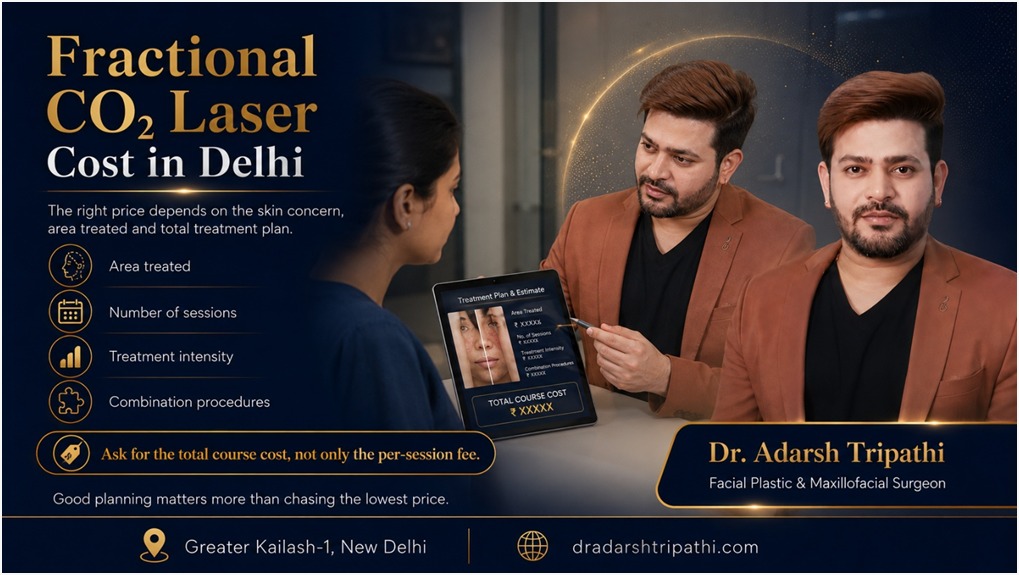
Fractional CO2 Laser Treatment Cost in Delhi
Direct answer: Fractional CO2 laser pricing in Delhi varies substantially between clinics and depends mainly on the area treated, the number of sessions needed and the intensity of treatment. Because most concerns need more than one session, the total course cost is a more useful figure than a single-session price, and it is worth asking for both at consultation.
What affects the cost ?
- Area treated – a single scar costs a fraction of a full face
- The condition being treated and its severity
- Number of sessions in the plan
- Treatment intensity and settings
- Whether it is combined with another procedure such as subcision or microneedling radiofrequency
- Practitioner qualification and experience
- The device used and its maintenance
- Follow-up appointments and any prescribed aftercare included
Why the lowest price is the wrong thing to optimise ?
With an ablative laser, price largely reflects who is holding the handpiece and what settings they have the judgement to choose. That matters more here than with gentler treatments, because the failure modes are worse.
An unusually low price may indicate an older or poorly maintained device, treatment delivered without proper medical assessment, settings applied from a preset rather than chosen for your skin, or a plan with no follow-up. On Indian skin in particular, treatment at the wrong settings can produce pigmentation that takes months to resolve and needs further treatment to correct – which costs more than the saving, in both money and time. This is a treatment where the sensible question is not what it costs but who is doing it and why they have chosen those parameters.
How Fractional CO2 Compares With Other Treatments ?
None of these is universally better. They do different things, and the right choice depends on the concern, the skin type and the downtime you can accept.
Fractional CO2 vs Microneedling
Treatment | Common uses | Downtime | Treatment depth | Considerations |
Fractional CO2 | Atrophic acne scars, texture, pores, photoaging | Several days | Ablative; removes tissue and heats dermis | Strongest resurfacing option; higher PIH risk on darker skin |
Microneedling | Mild texture, early scarring, skin quality | 1-2 days | Mechanical injury only; no thermal effect | Gentler and lower risk; needs more sessions; less effective for established scarring |
Fractional CO2 vs RF Microneedling
Treatment | Common uses | Downtime | Treatment depth | Considerations |
Fractional CO2 | Acne scars, texture, pores, fine lines | Several days | Ablative surface + dermal heating | Greater surface resurfacing; higher pigmentation risk |
Acne scars, texture, mild laxity | 2-4 days | Radiofrequency delivered below the surface via needles | Largely spares the epidermis, so generally lower PIH risk – often preferred as a first option on darker skin |
This is the most useful comparison on the page for most Delhi patients, and the clinic is well placed to make it honestly because it offers both. RF microneedling delivers energy beneath the surface through fine needles, which largely spares the epidermis – and since the epidermis is where pigment problems begin, that matters on Fitzpatrick IV-VI skin. Fractional CO2 resurfaces more powerfully but carries more pigmentation risk. For many patients with moderate acne scarring and darker skin, starting with RF microneedling and reserving CO2 for what remains is the more sensible sequence.
Fractional CO2 vs Chemical Peels
Treatment | Common uses | Downtime | Treatment depth | Considerations |
Fractional CO2 | Textural change, scarring | Several days | Controlled columns into the dermis | Better for texture and depressed scarring |
Pigmentation, dullness, superficial texture | None to about a week | Surface to mid-dermis depending on agent | Better for pigment and tone; gentler options are repeatable and lower risk |
Fractional CO2 vs Er:YAG Laser
Treatment | Common uses | Downtime | Treatment depth | Considerations |
Fractional CO2 | Deeper scarring, significant texture change | Several days | More residual thermal effect below the ablated column | More collagen stimulation; more downtime; more pigmentation risk |
Er:YAG | Superficial resurfacing, finer texture work | Usually shorter | More precise ablation, less surrounding heat | Less thermal stimulation so often less dramatic for deep scars, but a gentler healing profile |
Choosing a Doctor for Fractional CO2 Laser Treatment in Delhi
Direct answer: look for a medically qualified practitioner who assesses your skin type and scar type before proposing settings, who can explain why they have chosen a particular intensity for your skin, who discusses pigmentation risk without being prompted, who will tell you when another treatment would serve you better, and who provides structured follow-up. With an ablative laser the device is widely available; the judgement is not.
What to evaluate ?
- Medical qualification and specific experience with laser resurfacing
- Familiarity with Indian skin types and pigmentation management
- Ability to assess acne scar patterns and distinguish scar types
- Conservative treatment planning rather than maximum settings by default
- Understanding of facial anatomy, particularly for periocular and perioral treatment
- A stated plan for managing complications if they occur
- Structured follow-up rather than treatment and discharge
- Willingness to discuss realistic expectations and show consented results
Six questions worth asking
- What is my Fitzpatrick skin type, and how does that change your settings?
- What type or types of scarring do I have, and is CO2 the right tool for them?
- Would RF microneedling or a combination approach suit my skin better?
- How many sessions do you expect, and what downtime should I plan for each?
- What is your protocol if I develop post-inflammatory hyperpigmentation?
- Who performs the treatment, and what is the follow-up schedule?
About Dr. Adarsh Tripathi
Dr. Adarsh Tripathi is a maxillofacial and facial plastic surgeon practising at Sarayu Clinics in Greater Kailash-1, New Delhi. His publicly stated clinical focus includes the treatment of acne scars and burn and acid-burn scarring – indications for which fractional CO2 resurfacing is a core tool. Treatment planning, skin assessment and parameter selection are carried out as part of a consultation rather than from a standard protocol.
Frequently Asked Questions
What is fractional CO2 laser treatment?
Fractional CO2 laser is an ablative skin resurfacing treatment. A carbon dioxide laser beam is split into thousands of microscopic beams that create tiny columns of controlled injury in the skin, leaving untreated skin in between to speed healing. The skin repairs those columns and lays down new collagen over the following months. It is used mainly for acne scars, selected other scars, uneven texture, enlarged pores and photoaging.
What is the cost of fractional CO2 laser treatment in Delhi?
Cost depends mainly on the area treated, the number of sessions required and the treatment intensity, as well as whether it is combined with another procedure. Because most concerns need more than one session, ask for the total course cost as well as the per-session price.
Is fractional CO2 laser good for acne scars?
It is one of the more effective options for atrophic acne scars, particularly rolling and shallow boxcar types. But scar type matters a great deal. Ice-pick scars respond poorly to resurfacing and are often better treated with TCA CROSS or punch techniques, and tethered rolling scars usually need subcision first. Most people have more than one scar type, which is why a combination plan often works better than laser alone. See our acne scar treatment page for the wider picture.
How many sessions of fractional CO2 laser are required?
It varies and cannot be answered accurately without an assessment. Mild texture concerns may need only one or two sessions; established acne scarring usually needs a course, spaced several weeks apart to allow full healing. The number depends on scar severity, skin type, treatment intensity, the improvement you want and how much downtime you can accept.
Is fractional CO2 laser painful?
With topical numbing cream applied beforehand, most patients find it uncomfortable rather than painful – typically a hot prickling or snapping sensation. Areas around the eyes and mouth are more sensitive. Afterwards the skin feels like a moderate sunburn for a day or two. Deeper settings are more uncomfortable, and comfort measures can be adjusted.
How long is the downtime after fractional CO2 laser?
Downtime depends on treatment intensity. A typical pattern is marked redness and swelling for the first day or two, peeling and flaking around days four to seven, and pink new skin visible by the second week, fading gradually over the following weeks. More intensive settings mean longer recovery. Plan your calendar around the downtime you are quoted rather than hoping it will be shorter.
How long does redness last after CO2 laser?
Redness is expected for at least the first week and commonly fades over two to four weeks. After more intensive treatment it can persist longer. Prolonged redness beyond the window you were told to expect is worth reporting to your clinic rather than waiting out.
When will I see results from fractional CO2 laser?
Early improvement in texture is usually visible once the skin has healed, around two to four weeks. The more significant change comes from collagen remodelling, which continues for months – so the fuller effect of a session is generally assessed at around three to six months. Judging the result at three weeks means judging half the treatment.
Can fractional CO2 laser remove acne scars completely?
No. Improvement is the honest word, not removal. Well-selected patients often see meaningful improvement in the appearance of atrophic scars, particularly over a course of sessions and where laser is combined with other techniques. But scars are permanent tissue change, and any clinic promising complete removal is describing something that does not exist.
Can CO2 laser treat pigmentation?
Only in a limited way, and it is not a first-line pigmentation treatment – particularly in Indian skin. Some pigmentation associated with sun damage may improve as the surface is resurfaced, but ablative laser carries a risk of causing post-inflammatory hyperpigmentation, and it is generally avoided in melasma where heat can worsen the condition. For pigmentation, laser toning and chemical peels are usually more appropriate.
Is fractional CO2 laser suitable for Indian skin?
Yes, with appropriate precautions. Skin with more melanin carries a higher risk of post-inflammatory hyperpigmentation after ablative treatment, so settings are generally more conservative, priming may be used beforehand, treatment is avoided on tanned skin, and sun protection afterwards is essential rather than advisable. The trade-off is that a gentler approach may need more sessions – which is usually the better trade on darker skin.
What precautions are needed after fractional CO2 laser?
Cleanse gently, keep the skin moisturised as directed, do not pick or exfoliate the flaking skin, protect from sun rigorously, avoid active skincare until cleared, and avoid heat, sweating and swimming while the skin heals. Take any prescribed medication as instructed. Aftercare has a genuine effect on both the result and the risk of pigmentation.
Can I return to work after fractional CO2 laser?
It depends on the intensity of treatment and on how visible your face is in your work. Many people are comfortable in public around the second week, once peeling has finished and mineral makeup is permitted. Some return sooner after lighter treatment. Plan for several days of visible downtime rather than assuming you can work through it.
How often can fractional CO2 laser be performed?
Sessions are spaced several weeks apart to allow the skin to heal fully between treatments. Treating again before healing is complete increases risk without improving the result. Your doctor will set the interval based on the intensity used and how your skin responds.
Who should avoid fractional CO2 laser?
General considerations include active skin infection or cold sores in the area, active inflamed acne, recent isotretinoin use, a tendency to keloid scarring, active melasma, recent significant sun exposure or tanning, certain conditions affecting wound healing, and pregnancy or breastfeeding. Suitability is decided at individual assessment, not from a list.
What is the difference between CO2 laser and fractional CO2 laser?
Traditional CO2 resurfacing treats the entire skin surface at once, which is effective but involves lengthy recovery because the whole area heals together. Fractional CO2 splits the beam into thousands of microscopic beams, treating only a fraction of the surface and leaving untreated skin in between. That untreated skin speeds healing considerably, which is why fractional treatment recovers in days rather than weeks.
Is fractional CO2 laser safe?
It is a well-established procedure, but no medical treatment is completely without risk. Expected effects include redness, swelling and peeling. Less common risks include post-inflammatory hyperpigmentation, hypopigmentation, infection, prolonged redness and, uncommonly, scarring. Risk is reduced by appropriate patient selection, conservative settings on higher-risk skin, and careful aftercare.
Which doctor should I consult for fractional CO2 laser treatment in Delhi?
Consult a medically qualified practitioner with specific experience in laser resurfacing and familiarity with Indian skin types, who assesses your skin and scar type before proposing settings, discusses pigmentation risk openly, and provides structured follow-up. Dr. Adarsh Tripathi is a maxillofacial and facial plastic surgeon practising at Sarayu Clinics, Greater Kailash-1, New Delhi. A consultation is the appropriate first step for assessing suitability.
How to Reach Us:
Phone:+91 9289111083 ,+91 9289111084
Dr Adarsh’s website: https://dradarshtripathi.com/
Facebook: https://www.facebook.com/DrAdarshTripathi3011
Instagram: https://www.instagram.com/dr_adarsh_tripathi/
Youtube: https://www.youtube.com/@dr_adarsh_tripathi
Linkedin: https://www.linkedin.com/in/dr-adarsh-tripathi-a43005b8/
Online Booking: https://dradarshtripathi.com/contact-us/ to schedule appointments conveniently.