
Skin Boosters in Delhi
Quick answer: Skin boosters are injectable treatments – usually hyaluronic acid – delivered as tiny micro-injections spread across an area to improve the skin’s hydration, elasticity and texture from within. Unlike dermal fillers, they do not add volume or change facial shape; they improve skin quality. A typical course is two to three sessions spaced two to four weeks apart, with results lasting six to twelve months. In Delhi, expect roughly Rs 12,000-30,000 per session depending on the product. At Sarayu Clinics in Greater Kailash-1, treatment is planned and performed by Dr. Adarsh Tripathi, a maxillofacial and facial plastic surgeon with 18+ years of experience.
Skin boosters sit in an odd place in aesthetic medicine. They are injectable, so patients assume they work like fillers. They are hyaluronic acid, so patients assume they add volume. Neither is true, and the confusion means a lot of people either book them expecting a change they will not get, or skip them entirely because they think they are not ready for injectables.
What a booster actually does is unglamorous and genuinely useful: it improves the condition of your skin. Hydration, elasticity, fine surface lines, that tired dullness that no amount of moisturiser fixes because the problem is not on the surface. Think of it as treating the quality of the canvas rather than repainting the picture. For someone in their late twenties or thirties whose face has not lost volume or dropped yet but whose skin no longer looks the way it did, boosters are often exactly the right first treatment – and considerably more appropriate than the filler they might otherwise be sold.
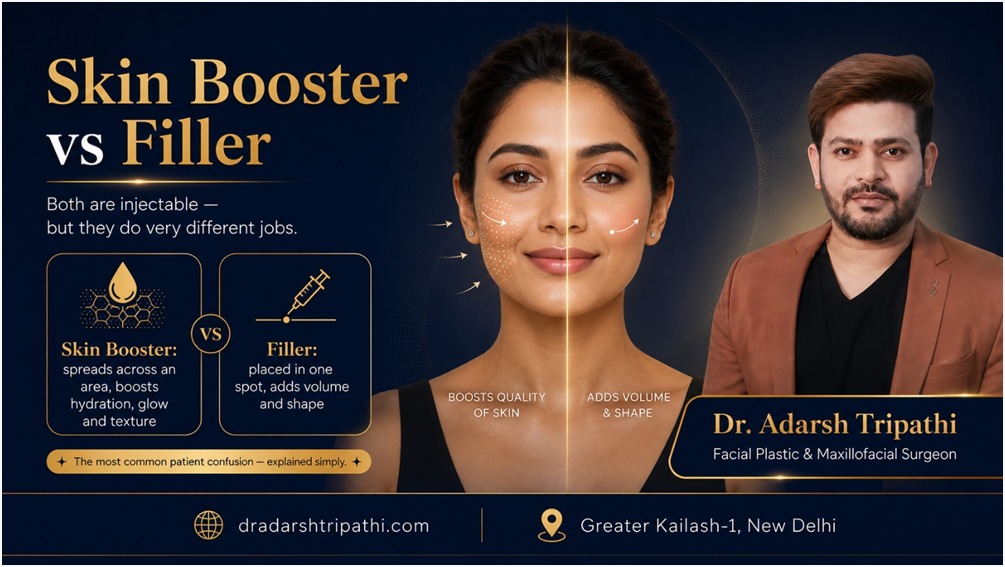
Skin Booster or Dermal Filler? The Distinction That Matters Most
Direct answer: a dermal filler is a firm, structured gel placed in one location to add volume and change shape – a fuller cheek, a defined chin, a more projected jawline. A skin booster is a thin, unstructured formulation spread in many tiny deposits across an area to hydrate and improve skin quality, with no change to shape at all. Both are usually hyaluronic acid; the difference is how the product is made and where it goes.
| Skin booster | Dermal filler |
What it does | Improves skin quality, hydration, texture | Adds volume, changes shape |
Product consistency | Thin, spreadable, unstructured | Firm, cohesive, holds shape |
How it is placed | Many micro-injections across an area | Targeted deposits in one location |
Visible change | Skin looks better; face looks the same | Contour visibly changes |
Typical course | 2-3 sessions, then maintenance | Single session, then top-up |
Lasts | 6-12 months | 6-24 months |
Best age to start | Late 20s onwards | When volume loss appears |
The two are not alternatives – they solve different problems and are frequently used together. A common plan for a patient in their forties is filler or fat grafting for the volume that has gone, Botox for expression lines, and boosters underneath all of it for the skin itself. If someone offers you a booster when your actual concern is a hollow cheek, or a filler when your actual concern is dull skin, you are being sold rather than advised.

The Different Types of Skin Booster
This is where most clinic pages stop at ‘we use high-quality hyaluronic acid’. In practice several distinct categories exist, they behave differently, and choosing between them is a clinical decision rather than a price comparison.
Classic hydrating HA boosters
Stabilised hyaluronic acid formulated to be thin and spreadable rather than volumising. Delivered as small deposits across the treatment area, they draw and hold water in the dermis, improving hydration, fine surface lines and that slightly crepey quality skin develops with age. This is the workhorse category – predictable, well tolerated, and the right starting point for most people whose main complaint is dryness and dullness.
- Best for: dehydrated, dull, slightly crepey skin; fine surface lines; general skin quality
- Typical course: 2-3 sessions, 2-4 weeks apart, then maintenance every 6-9 months
Bio-remodelling injectables
A newer category using highly concentrated hyaluronic acid that spreads through the tissue after injection and works less by hydration alone than by stimulating the skin’s own collagen and elastin production over the following weeks. Placed at a small number of specific points rather than across a grid. Results build gradually and tend to include a modest firming effect alongside the hydration – which is why these products have become popular for necks and for skin that has begun to lose tone rather than just moisture.
- Best for: skin laxity in its earliest stages, neck and jawline skin quality, firmness as well as hydration
- Typical course: 2 sessions 4 weeks apart, then maintenance every 6 months
Polynucleotide treatments
Purified polynucleotide chains that act as a regenerative signal rather than a hydrating agent, supporting tissue repair and skin quality over a course. Particularly interesting for delicate areas such as under the eyes, where the skin is thin and conventional products can be unforgiving, and for skin that is reactive or compromised. A newer category in India and one where evidence is still developing, so it should be discussed rather than assumed.
- Best for: thin or delicate skin, under-eye skin quality, compromised or reactive skin
- Typical course: 3-4 sessions 2-3 weeks apart
Mesotherapy-style cocktails
Blends of non-crosslinked hyaluronic acid with vitamins, amino acids, antioxidants and minerals, delivered superficially across the skin. Lighter and shorter-acting than the categories above, and often used as a glow treatment before an event or as maintenance alongside other work. Related to the mesotherapy used for hair loss in technique, though the formulations and purpose are entirely different.
- Best for: pre-event glow, general radiance, maintenance between stronger treatments
- Typical course: 3-6 sessions, then periodic top-ups
On brand names. Several well-known international products exist in each category, and patients often arrive asking for one by name. The honest position is that the category matters more than the brand – a bio-remodelling product will behave like a bio-remodelling product regardless of who makes it, and the right choice depends on your skin rather than on what is trending.
Which Booster for Which Concern
Your concern | Usual choice | Why | Typical course |
Dull, dehydrated skin | Classic HA booster | Direct hydration in the dermis | 2-3 sessions |
Fine surface lines | Classic HA booster | Plumps the dermis from within | 2-3 sessions |
Early laxity, loss of firmness | Bio-remodelling | Stimulates collagen and elastin | 2 sessions |
Crepey neck skin | Bio-remodelling | Firming plus hydration in thin skin | 2 sessions |
Under-eye skin quality | Polynucleotide | Gentler in delicate tissue | 3-4 sessions |
Reactive or compromised skin | Polynucleotide | Regenerative rather than volumising | 3-4 sessions |
Pre-event glow | Mesotherapy cocktail | Fast, superficial radiance | 1-3 sessions |
Ageing hands | Classic HA or bio-remodelling | Improves thin, crepey hand skin | 2-3 sessions |
Post-acne dullness | Booster + peels | Boosters improve quality; peels address marks | Combined plan |
Volume loss | Not a booster – see fillers | Boosters do not add volume | – |
Sagging or jowls | Boosters do not lift | – |
The last two rows matter as much as the first nine. A large part of choosing the right treatment is knowing when the one you came in asking about is not it.
What Skin Boosters Deliver ?
- Genuine hydration from within the dermis, which topical moisturiser cannot reach
- Improved skin elasticity and bounce
- Softening of fine surface lines – the ones visible when skin is dry, not the ones caused by expression
- A smoother, more even texture
- A natural glow that reads as well-rested rather than treated
- Improvement in thin, crepey skin on the neck, chest and hands
- Better makeup application, which patients mention more often than any other benefit
- No change to facial shape – your face looks like itself, in better condition
- Results building over weeks and lasting six to twelve months
- Minimal downtime – small injection marks that settle within a day or two
What they honestly cannot do ?
- They do not add volume. Hollow cheeks, flat temples or a recessed chin need fillers or fat grafting
- They do not lift. Sagging, jowls and loose skin need HIFU, threads or a facelift depending on severity
- They do not treat expression lines. Frown lines and crow’s feet are muscle-driven and need Botox
- They do not treat pigmentation. Melasma, tanning and dark marks need peels, laser toning or medical topicals
- They do not resurface. Acne scars, open pores and textural damage need MNRF, fractional CO2 or acne scar treatment
- They do not replace sun protection. Nothing does – and unprotected sun exposure will undo the improvement faster than the product wears off
Areas Treated
Face
The most commonly treated area – cheeks, mid-face, forehead and the perioral region. Boosters improve overall skin condition rather than targeting one feature, which is why the change reads as ‘you look well’ rather than as a treatment.
Under-eyes
The skin here is the thinnest on the face, and boosters can improve its quality and fine crepiness. An important distinction: this treats the skin, not the hollow. If your under-eye concern is a structural shadow from volume loss, that is a tear trough filler conversation and a different treatment. Many patients need both, and knowing which is which prevents disappointment.
Neck
Neck skin ages faster than facial skin and is chronically under-treated – people apply skincare to the face and stop at the jawline for decades. Boosters, particularly bio-remodelling products, improve crepiness and tone here. They do not tighten established neck laxity.
Decolletage
Sun damage on the upper chest shows as crepey texture and fine lines. Boosters improve skin quality, and often work best alongside pigment treatment, since the two problems usually arrive together.
Hands
Hands reveal age reliably, and thin, crepey hand skin responds well to boosters. Where the concern is prominent veins and tendons from volume loss rather than skin quality, filler or fat is the answer instead.

The Skin Booster Procedure, Step by Step
Consultation and skin assessment
Dr. Tripathi assesses skin hydration, elasticity, texture and thickness alongside your overall facial ageing pattern – because the most important judgement is whether skin quality is genuinely your main issue, or whether volume, laxity or pigmentation is doing more of the work. Product category is chosen on that basis, along with your skin type, the area and any history of reactions.
Preparation
Avoid blood thinners, fish oil and alcohol for 24-48 hours beforehand where medically safe, to limit bruising. Arrive with clean skin. Numbing cream is applied for 20-30 minutes; most modern booster products also contain a small amount of anaesthetic. Do not schedule a session within two weeks of an important event – small bruises are common and unpredictable.
The injections
The technique differs by product. Classic hydrating boosters are delivered as many small deposits across the area in a systematic grid, using a fine needle or a blunt cannula. Bio-remodelling products go into a small number of defined injection points, from which the product spreads through the tissue. Polynucleotides and mesotherapy cocktails are placed more superficially. A session takes 20-40 minutes depending on area and product.
Immediately after
Small raised bumps at each injection point are normal with grid-technique boosters and settle within a few hours to a day. Mild redness is common. You can return to normal activity immediately, though makeup is best avoided for the rest of the day.
The course
Boosters work cumulatively. Two to three sessions two to four weeks apart is standard for most products, with maintenance every six to nine months. A single session gives a modest, short-lived result – patients who try one and conclude boosters do not work have usually not completed a course.
Downtime and Aftercare
Timeframe | What to expect |
Day 0 | Small bumps at injection points, mild redness, occasional pinpoint bruising. Settles within hours to a day |
Days 1-2 | Bumps resolved. Any bruises visible and coverable with makeup |
Days 3-7 | Skin feels more hydrated. Bruising fades |
Weeks 2-4 | Second session. Cumulative improvement in texture and glow becoming clear |
Weeks 4-8 | Full effect of the course – hydration, elasticity and radiance at their best |
Aftercare is straightforward: no makeup for the rest of the treatment day; no strenuous exercise, sauna or steam for 24-48 hours; no facial massage or facials for a week; strict SPF 50 daily; and keep the skin well moisturised. Avoid alcohol for 24 hours, which meaningfully reduces bruising.

Cost of Skin Booster Treatment in Delhi
Direct answer: skin boosters in Delhi cost approximately Rs 12,000-30,000 per session depending on the product category and the area treated. Because boosters work as a course, the more useful figure is the course total – typically Rs 25,000-70,000 for the initial two to three sessions, with maintenance once or twice a year afterwards. Bio-remodelling and polynucleotide products sit at the higher end; mesotherapy-style cocktails at the lower.
Treatment | Per session | Typical course | Course total |
Classic HA booster – face | Rs 12,000-25,000 | 2-3 | Rs 25,000-60,000 |
Bio-remodelling – face | Rs 18,000-30,000 | 2 | Rs 35,000-60,000 |
Bio-remodelling – neck | Rs 18,000-30,000 | 2 | Rs 35,000-60,000 |
Polynucleotide – under-eye | Rs 15,000-28,000 | 3-4 | Rs 45,000-1,00,000 |
Mesotherapy cocktail | Rs 8,000-18,000 | 3-6 | Rs 25,000-70,000 |
Hands | Rs 12,000-25,000 | 2-3 | Rs 25,000-60,000 |
Decolletage | Rs 15,000-28,000 | 2-3 | Rs 30,000-70,000 |
Maintenance session | Rs 12,000-30,000 | 1, twice yearly | – |
What drives the price ?
- Product category – bio-remodelling and polynucleotide products cost considerably more per syringe than classic hydrating boosters
- Area and how many syringes it requires
- Number of sessions your skin genuinely needs, which cannot be assessed accurately without seeing it
- Whether a doctor assesses and injects, or a technician runs a standard protocol
One honest note on value. Boosters are a maintenance treatment, not a one-time correction – the cost recurs. For a patient whose skin quality is genuinely the issue, that is money well spent and the improvement is real. For a patient whose actual problem is volume loss or laxity, a course of boosters is an expensive way to be mildly disappointed, and the sensible advice is to spend it on the treatment that addresses the real concern instead. That is a judgement the consultation should make, not the price list.
Results - What to Expect and When
- Days 1-3: skin feels more hydrated almost immediately, though visible change is minimal
- Weeks 1-2: texture starts improving; skin holds moisture better
- Weeks 4-6: after the second session, clear improvement in glow, smoothness and elasticity
- Weeks 6-8: the full result of a course – this is when to judge it
- Bio-remodelling products specifically: collagen-driven firming continues developing for two to three months
- Months 6-12: results fade gradually as the product metabolises. Maintenance sessions sustain them
Boosters are among the more subtle treatments in aesthetics, and that is the point. Photographs in identical lighting usually show the change clearly; a glance in the mirror at the end of a long day sometimes does not. The improvement people report most consistently is not something they see so much as something they notice – makeup sitting better, skin feeling less tight, looking less tired in photographs.
Who Skin Boosters Suit ?
Good candidates
- Dry, dehydrated or dull skin that does not respond to topical skincare
- Fine surface lines and early crepiness
- Late twenties onwards, wanting a preventive or maintenance approach
- Anyone wanting improvement with no change to facial shape
- Patients not ready for fillers but wanting something more than skincare
- Crepey neck, chest or hand skin
- As the skin-quality layer alongside structural treatments
- Smokers and those with significant sun exposure, whose skin quality is usually the first thing to suffer
Discuss carefully, or defer
- Active skin infection, cold sores or inflammatory skin conditions in the area
- Known allergy to hyaluronic acid or lidocaine
- Autoimmune or connective tissue disease – assessed case by case
- Bleeding disorders or anticoagulant therapy without clearance
- Pregnancy or breastfeeding – deferred
- Keloid tendency, assessed individually
- An important event within two weeks – bruising is unpredictable
- Expecting volume, lift or wrinkle removal – boosters do none of these
Skin Boosters Compared with Other Skin-Quality Treatments
Treatment | How it works | Best for | Downtime | Lasts |
Skin boosters | Injectable hydration and dermal remodelling | Dehydration, fine lines, elasticity | 1-2 days | 6-12 months |
Chemical exfoliation of the surface | Pigmentation, dullness, texture | 2-7 days | Course-dependent | |
RF energy through microneedles | Texture, pores, scarring, mild laxity | 2-4 days | 12-18 months | |
Q-switched laser on melanin | Pigmentation, tanning, tone | None | Course-dependent | |
Medical facials | Superficial cleansing and infusion | Immediate glow, maintenance | None | Weeks |
Exosome therapy (skin application) | Regenerative signalling | Skin quality, post-procedure recovery | Minimal | Varies |
These are complementary rather than competing. A common combination for skin quality is boosters for hydration and elasticity, peels for pigmentation and surface texture, and MNRF where pores or scarring are also present. Where structure has changed as well – volume loss, laxity – boosters sit underneath that work rather than replacing it. Our full face sculpting page covers how these are sequenced across a plan.
Choosing a Skin Booster Doctor in Delhi
Direct answer: a skin booster doctor in Delhi should assess whether skin quality is genuinely your main concern before recommending a course, should choose the product category on clinical grounds rather than offering one house product to everyone, should inject personally or under close supervision, and should tell you plainly when a filler, an energy device or pigment treatment would serve you better. Boosters are low-risk as injectables go, which means the value of the doctor lies in the judgement rather than in the technique.
Questions worth asking
- Is skin quality actually my main problem, or is something else doing more of the work?
- Which product category are you recommending, and why that one for my skin?
- How many sessions will I need, and what is the full course cost?
- Who will inject – you or a therapist?
- What maintenance will this need, and at what annual cost?
- If boosters are not the right answer for me, what would you recommend instead?
Why patients choose Dr. Adarsh Tripathi ?
- Adarsh Tripathi is a Maxillofacial and Facial Plastic Surgeon with 18+ years of experience.
- Product category chosen on clinical assessment – hydration, bio-remodelling, polynucleotide or cocktail – rather than a single house product applied to everyone.
- A full-spectrum practice, so if your concern is really volume, laxity or pigmentation, you will be told – and fillers, fat grafting, HIFU and surgery are all available if that is the honest answer
- Boosters positioned as the skin-quality layer within a wider plan rather than sold as a standalone glow product
- Realistic expectation-setting: subtle, cumulative, maintenance-based improvement, stated before you commit to a course
- See before-and-after results and celebrity facial work
- Greater Kailash-1, New Delhi – convenient from GK-2, CR Park, Kailash Colony, Defence Colony, Hauz Khas, Nehru Place and South Extension.
Frequently Asked Questions
What is a skin booster?
A skin booster is an injectable treatment, usually hyaluronic acid, delivered as many tiny micro-injections across an area to improve the skin’s hydration, elasticity and texture from within. Unlike dermal fillers, boosters do not add volume or change facial shape – they improve the quality of the skin itself. A course is typically two to three sessions with results lasting six to twelve months.
How much do skin boosters cost in Delhi?
Skin boosters in Delhi cost approximately Rs 12,000-30,000 per session depending on the product category and area. Because boosters work as a course, the course total is more useful – typically Rs 25,000-70,000 for the initial two to three sessions, plus maintenance once or twice a year. Bio-remodelling and polynucleotide products cost more per session than classic hydrating boosters or mesotherapy cocktails.
What is the difference between a skin booster and a filler?
A filler is a firm, structured gel placed in one location to add volume and change shape – a fuller cheek or a more defined jawline. A skin booster is a thin, unstructured formulation spread across an area in many small deposits to hydrate and improve skin quality, with no change to shape. Both are usually hyaluronic acid; the difference is the product’s structure and where it goes. They are often used together, since they solve different problems – see our dermal fillers page for the volume side.
How many skin booster sessions do I need?
Most people need two to three sessions spaced two to four weeks apart for the initial course, then maintenance every six to nine months. Bio-remodelling products typically use two sessions four weeks apart; polynucleotides three to four sessions. Boosters work cumulatively, so a single session gives only a modest, short-lived effect – patients who try one and conclude boosters do not work have usually not completed a course.
How long do skin booster results last?
Six to twelve months for most products, with the effect fading gradually rather than stopping suddenly. Bio-remodelling products, which stimulate collagen as well as hydrating, often sit at the longer end. Longevity depends on the product, your skin, your age and lifestyle factors – sun exposure and smoking shorten it noticeably. Maintenance sessions once or twice a year sustain the improvement.
Who is the best skin booster doctor in Delhi?
One who first establishes whether skin quality is genuinely your main concern, chooses the product category on clinical grounds rather than offering one house product to everyone, and will say when a filler, energy device or pigment treatment would serve you better. Dr. Adarsh Tripathi is a Maxillofacial and Facial Plastic Surgeon with 18+ years of experience at Sarayu Clinics, Greater Kailash-1, offering the full range of treatments so the recommendation is not limited by what is on offer.
Do skin boosters hurt?
Discomfort is mild. Numbing cream is applied for 20-30 minutes beforehand and most modern booster products contain a small amount of local anaesthetic. Grid-technique boosters involve many small injections, which feels like repeated tiny pinpricks rather than pain. Cannula technique, used for some products and areas, involves fewer entry points and is often more comfortable.
Is there downtime after skin boosters?
Very little. Small raised bumps appear at each injection point with grid-technique products and settle within a few hours to a day. Mild redness is common and pinpoint bruising is possible. Most people return to normal activity immediately, though makeup is best avoided for the rest of the treatment day. Do not book within two weeks of an important event, since bruising is unpredictable.
Can skin boosters remove wrinkles?
Only partly, and only the right kind. Boosters soften fine surface lines – the ones that appear when skin is dry and dehydrated – by plumping the dermis from within. They do not treat expression lines caused by muscle movement, which need Botox, and they do not treat deep static folds, which need fillers. If your concern is established wrinkles rather than skin quality, boosters are not the right treatment.
Can skin boosters be used under the eyes?
Yes – the under-eye area is one of the more valuable places for boosters, because the skin there is the thinnest on the face and its quality shows. Polynucleotide products in particular are often chosen here. An important distinction: this improves the skin, not the hollow. If your under-eye concern is a structural shadow from volume loss, that needs a tear trough filler instead. Many patients benefit from both.
Which skin booster is best for me?
It depends on your main concern. Classic hydrating HA boosters suit dehydrated, dull skin and fine surface lines. Bio-remodelling products suit early laxity and crepey neck skin because they stimulate collagen as well as hydrating. Polynucleotides suit thin, delicate or reactive skin, particularly under the eyes. Mesotherapy cocktails suit pre-event glow and maintenance. The category matters more than the brand name, and the right choice comes from assessment rather than a price list.
Can skin boosters be combined with other treatments?
Yes, and they usually should be. Boosters address skin quality, so they sit naturally alongside Botox for expression lines, fillers for volume, peels for pigmentation and MNRF for texture. A sensible plan treats skin quality as the layer underneath structural work rather than as a substitute for it – see full face sculpting for how these are sequenced.
How to Reach Us:
Phone:+91 9289111083 ,+91 9289111084
Dr Adarsh’s website: https://dradarshtripathi.com/
Facebook: https://www.facebook.com/DrAdarshTripathi3011
Instagram: https://www.instagram.com/dr_adarsh_tripathi/
Youtube: https://www.youtube.com/@dr_adarsh_tripathi
Linkedin: https://www.linkedin.com/in/dr-adarsh-tripathi-a43005b8/
Online Booking: https://dradarshtripathi.com/contact-us/ to schedule appointments conveniently.