Liposuction in Delhi — Facial, Neck & Body Contouring by a Facial Plastic Surgeon
Liposuction is one of the most performed cosmetic surgeries in the world, and one of the most misunderstood. Done well, on the right candidate, it permanently removes stubborn fat deposits that resist diet and exercise — sculpting a more defined jawline, a slimmer neck, a flatter abdomen, or smoother contours. Done badly, or on the wrong candidate, it disappoints — leaving irregularities, loose skin, or unmet expectations. The difference comes down to three things: honest candidate selection, the surgeon’s technical skill and anatomical knowledge, and realistic expectations about what liposuction is — and what it isn’t.
Here’s where this clinic differs from the hospitals and body-contouring mills that dominate liposuction marketing in Delhi: Dr. Adarsh Tripathi is a Maxillofacial and Facial Plastic Surgeon, and his standout expertise is FACIAL and NECK liposuction — the submental (double chin) area, the jawline, the jowls, and the neck. This is precision work in an anatomically delicate region full of important nerves (notably the marginal mandibular nerve that controls the lower lip) and where millimetres determine the aesthetic result. A facial plastic surgeon’s daily work IS this anatomy — the same expertise that goes into facelift, neck lift, and jawline sculpting goes into facial and neck liposuction. For facial and neck contouring specifically, this specialist background is a genuine advantage that general body-contouring practices cannot match. Dr. Tripathi also performs body liposuction for appropriate areas and candidates.
The single most important honest point on this page: liposuction is NOT a weight-loss procedure. It is a body-CONTOURING procedure. It removes localised, stubborn fat deposits to improve shape — it does not treat obesity, it won’t help you lose significant weight on the scale, and it doesn’t address loose skin (which sometimes needs a skin-tightening or lifting procedure instead). The ideal liposuction candidate is at or near a stable, healthy weight with specific stubborn fat pockets that won’t budge despite diet and exercise. Anyone selling liposuction as a weight-loss solution is misrepresenting it. A responsible surgeon will tell you honestly whether you’re a good candidate — and sometimes recommend against it.
Dr. Adarsh Tripathi is a Maxillofacial and Facial Plastic Surgeon with over 18 years of experience at Sarayu Clinics, Greater Kailash-1, New Delhi. This page covers liposuction in depth — what it is and isn’t, the areas treated (with facial/neck as the specialist focus), who’s a good candidate and who isn’t, the techniques (VASER, laser-assisted, power-assisted, tumescent), the procedure, recovery, cost, realistic results timeline, the comparison with non-surgical fat reduction, and how to choose the right liposuction surgeon in Delhi.
Quick Answer — What is liposuction and what does it cost in Delhi?
Liposuction is a surgical body-contouring procedure that permanently removes localised, stubborn fat deposits using a thin cannula and suction — improving the SHAPE of an area, not reducing overall body weight. It treats stubborn fat in the chin/neck, jawline, abdomen, flanks (love handles), thighs, arms, back, and other areas. Techniques include tumescent, VASER (ultrasound-assisted), laser-assisted, and power-assisted liposuction. In Delhi, liposuction costs Rs. 45,000–80,000 for a single small area (e.g. chin/neck) and Rs. 90,000–3,00,000+ for larger or multiple body areas. It is NOT a weight-loss procedure — ideal candidates are near a stable healthy weight with stubborn fat pockets. Dr. Adarsh Tripathi, Facial Plastic Surgeon at Sarayu Clinics, specialises in facial and neck liposuction alongside body contouring.
The Honest Truth — Liposuction Is Contouring, Not Weight Loss
This section exists because the cost-bait marketing that dominates liposuction in Delhi rarely makes this clear — and getting it wrong is the main reason patients are disappointed.
What Liposuction IS
- A body-CONTOURING procedure that improves the SHAPE of specific areas
- Permanent removal of fat cells from treated areas (the removed fat cells don’t return)
- A solution for localised, stubborn fat that resists diet and exercise
- Best for specific pockets — double chin, love handles, outer thighs, etc.
- A sculpting tool in the hands of a skilled surgeon
What Liposuction IS NOT
- NOT a weight-loss procedure — the scale will barely move; it’s about shape, not kilograms
- NOT a treatment for obesity — that needs medical/surgical weight management
- NOT a cellulite treatment — liposuction doesn’t reliably improve cellulite (and can worsen it)
- NOT a skin-tightening procedure — loose skin may need a lifting/tightening procedure instead
- NOT a substitute for diet and exercise — and gaining weight afterward can distort results
- NOT permanent protection against future fat gain — remaining fat cells can still enlarge
The Weight-Stability Reality
Liposuction permanently removes fat CELLS from the treated area. But the remaining fat cells elsewhere (and the ones left in the treated area) can still enlarge if you gain weight. This means: liposuction gives a lasting result IF you maintain a stable weight. Significant weight gain after liposuction can distort the result, sometimes causing fat to deposit in new, uneven patterns. The best candidates are committed to maintaining their weight — liposuction refines a stable body, it doesn’t license unlimited weight gain.
Liposuction is real surgery — treat it with appropriate seriousness
Despite being marketed casually by some high-volume providers, liposuction is a genuine surgical procedure with real risks — anaesthesia risks, bleeding, infection, contour irregularities, fluid imbalance, and (rarely) more serious complications. Large-volume liposuction carries more risk than small-area work. It must be performed by a qualified surgeon in a proper surgical facility, NOT in a salon or by undertrained practitioners. Extremely cheap liposuction ‘packages’ often cut corners on safety. The procedure deserves the same seriousness as any surgery — proper assessment, qualified surgeon, accredited facility, and honest candidacy.
Benefits of Liposuction — Realistically Framed
For the right candidate, liposuction delivers genuine, lasting contour improvement. Here’s an honest list:
- Permanent removal of fat cells from treated areas
- Improved definition and contour — sharper jawline, slimmer neck, flatter abdomen, smoother flanks
- Targeting of stubborn fat that won’t respond to diet or exercise
- Facial/neck liposuction: more defined jawline and youthful neck profile (Dr. Tripathi’s specialty)
- Can be combined with other procedures (neck lift, facelift, tummy procedures) for comprehensive results
- Improved fit of clothing and proportion
- Lasting results when weight is maintained
- Modern techniques (VASER, laser) can offer some skin tightening alongside fat removal
- Significant confidence and self-image improvement for appropriate candidates
- Relatively quick procedure for small areas; can be done under local/sedation for facial work
An honest framing: liposuction benefits are real but specific. It improves CONTOUR, not weight. It works best on stubborn localised fat in a stable-weight patient with good skin elasticity. Patients with significant skin laxity may need a skin-tightening or lifting procedure alongside or instead, because removing fat from under loose skin can leave the skin looser. The benefit is maximised when the procedure is matched to the right candidate — which is why honest assessment matters.
Areas Treated with Liposuction
Liposuction can treat fat deposits across the face, neck, and body. Here they are — with facial and neck areas as Dr. Tripathi’s specialist focus.
SPECIALIST FOCUS — Face & Neck (Facial Plastic Surgeon Expertise)
Chin & Neck (Submental Liposuction)
The ‘double chin’ and fullness under the jaw. Submental liposuction removes the stubborn fat pad under the chin and along the neck to restore a defined jawline and youthful neck angle. This is precision work near important nerves — exactly the anatomy a facial plastic surgeon works with daily. Often the single most impactful facial-contouring procedure. (For comprehensive double-chin options including non-surgical, see our dedicated page.)
Jawline & Jowls
Refining the jawline definition and addressing early jowl fullness. Careful contouring to sharpen the jaw’s appearance — a facial-aesthetic decision requiring an eye for proportion.
Cheeks / Lower Face
Selective fat reduction in the lower face for a more sculpted appearance (distinct from buccal fat removal, which is a different procedure removing the buccal fat pad rather than liposuctioning subcutaneous fat).
BODY AREAS
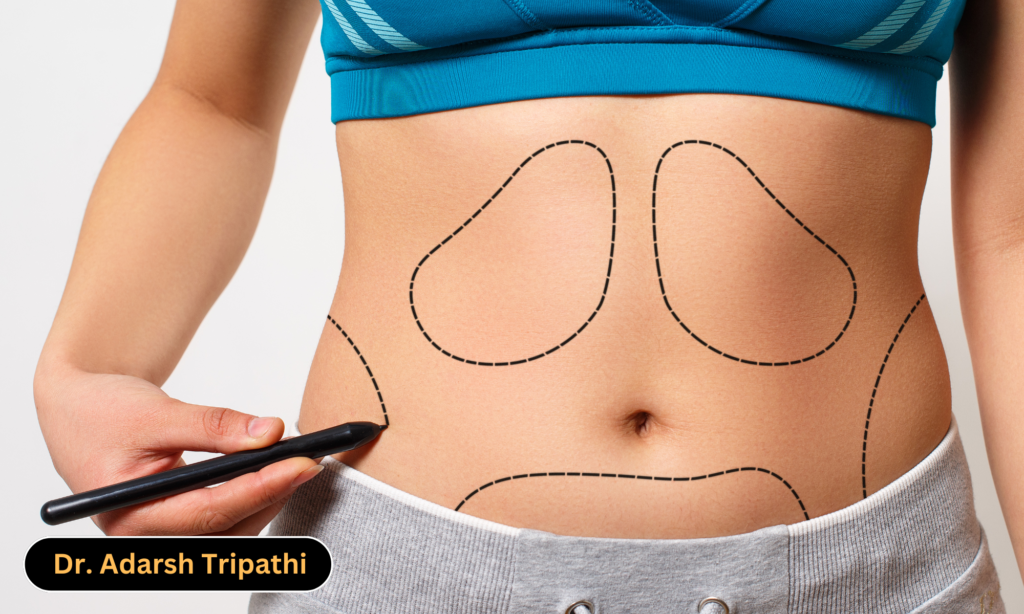
Abdomen (Tummy)
One of the most common body liposuction areas — removing stubborn belly fat for a flatter contour. Note: liposuction addresses fat, not loose skin or separated abdominal muscles (which may need a tummy tuck instead). Best for stable-weight patients with good skin tone and localised abdominal fat.
Flanks / Love Handles
The sides of the waist — ‘love handles’ in men and women. Responds well to liposuction for a smoother waistline.
Thighs (Inner & Outer)
Inner thigh fullness and outer thigh ‘saddlebags’. Careful technique needed to avoid irregularity; skin elasticity matters for the result.
Arms (Upper Arms)
Upper arm fullness. Skin elasticity is particularly important here — patients with significant skin laxity may need a skin-tightening approach.
Back & Bra Rolls
Upper and lower back fat, and bra-line rolls. Back fat is fibrous and can be more challenging; VASER is often useful here.
Knees, Calves, Ankles
Smaller, specific areas treated for refinement in selected cases.
Male Chest (Gynaecomastia-Related Fat)
Fatty component of male chest fullness. Note: true gynaecomastia (glandular tissue) needs gland excision, not just liposuction — proper assessment distinguishes fatty from glandular.
High-Definition / Etching
Advanced technique (often VASER) sculpting around muscle groups for athletic definition (e.g. abdominal etching). Specialised; requires good baseline fitness and realistic expectations.
Conditions & Candidacy — Who Liposuction Suits
Liposuction is a contouring procedure for specific candidates. Honest assessment is the first step.
You are likely a good candidate if:
- You’re at or near a stable, healthy weight (within ~30% of ideal)
- You have specific, localised stubborn fat pockets resistant to diet and exercise
- You have good skin elasticity (skin will retract over the new contour)
- You’re in good general health, non-smoker or willing to stop
- You have realistic expectations — contour improvement, not weight loss
- You’re committed to maintaining a stable weight afterward
- You don’t have a medical condition that makes surgery risky
You may NOT be a good candidate if:
- You’re significantly overweight and seeking weight loss — liposuction won’t achieve that
- You have significant skin laxity — fat removal may leave loose skin; a lifting procedure may be needed
- You expect the scale to change meaningfully — it won’t
- You have unrealistic expectations or body image concerns
- You have uncontrolled diabetes, heart disease, clotting disorders, or other surgical risks
- You’re a smoker unwilling to stop (impairs healing, increases risk)
- You’re seeking cellulite treatment — liposuction doesn’t reliably treat cellulite
- You’re not committed to weight maintenance — results can be distorted by weight gain
- You’re pregnant or breastfeeding (defer)
The Skin Elasticity Factor
This is crucial and often glossed over: liposuction removes fat from UNDER the skin. For a smooth result, the skin must retract over the new, smaller contour. Younger patients with good skin elasticity get smooth results. Patients with poor skin elasticity (from age, significant prior weight loss, or genetics) may be left with loose, hanging skin after fat removal — which can look worse than before. For these patients, a skin-tightening procedure (or a lifting procedure like a tummy tuck or neck lift) may be needed alongside or instead of liposuction. Honest assessment of skin elasticity is part of proper candidacy evaluation.
The Honest Conversation
A responsible liposuction consultation includes: assessing whether your fat is the localised stubborn type liposuction treats; evaluating your skin elasticity; confirming your weight is stable; setting realistic expectations about contour (not weight); and sometimes recommending AGAINST liposuction or suggesting an alternative or additional procedure. A surgeon who approves everyone for liposuction without this assessment is selling, not advising.
Liposuction Techniques — VASER, Laser, Power-Assisted & Tumescent
Liposuction has evolved well beyond the traditional approach. Understanding the techniques helps you have an informed conversation.
Tumescent Liposuction (The Foundation)
The standard modern foundation for most liposuction. A large volume of dilute local anaesthetic fluid (with adrenaline to reduce bleeding) is infiltrated into the fat, making it swollen and firm (‘tumescent’). Fat is then removed via cannula and suction. Reduces bleeding and bruising, allows larger volumes safely, and can often be done under local anaesthesia/sedation for smaller areas. Most modern techniques build on the tumescent foundation.
- Best for: most liposuction cases; the standard base technique
VASER Liposuction (Ultrasound-Assisted)
VASER (Vibration Amplification of Sound Energy at Resonance) uses ultrasound energy to liquefy/loosen fat before removal — making fat easier to extract, potentially with less trauma to surrounding tissue, and offering some skin-tightening benefit. Particularly useful for fibrous areas (back, male chest), high-definition sculpting, and where skin retraction matters. Popular for body contouring and definition work.
- Best for: fibrous areas, high-definition sculpting, some skin tightening
Laser-Assisted Liposuction (e.g. SmartLipo)
Uses laser energy to liquefy fat and stimulate some skin tightening via thermal effect. Useful for smaller areas and where modest skin tightening is wanted. Often marketed heavily; benefits are real but incremental over good tumescent technique.
- Best for: smaller areas; modest skin tightening
Power-Assisted Liposuction (PAL)
Uses a powered cannula that vibrates rapidly, making fat removal more efficient and less physically demanding for the surgeon — which can mean smoother, more controlled results, especially in larger or fibrous areas. A workhorse refinement of the technique.
- Best for: efficient removal; larger or fibrous areas
Facial / Microcannula Liposuction
For facial and neck work, fine microcannulas allow precise, delicate fat removal in the submental and jawline areas. This precision approach is essential for facial contouring near important nerves — the specialist domain of a facial plastic surgeon.
- Best for: facial/neck contouring (Dr. Tripathi’s specialty)
Which Technique Is Right?
The best technique depends on the area, the fat type, your skin elasticity, and the contour goal — and the surgeon’s skill matters far more than the brand of technology. A skilled surgeon selects the right approach (often a combination) for each case. Be wary of clinics marketing one branded technique as universally superior; the technique should be matched to your needs, and the surgeon’s hands matter most.
The Liposuction Procedure — Step by Step
Step 1: Consultation & Assessment
Dr. Tripathi assesses the areas of concern, evaluates your fat type and skin elasticity, confirms weight stability, reviews medical history, and discusses honestly whether liposuction suits you (and whether any additional procedure is needed). The technique, areas, and realistic outcome are discussed. Photos are taken for planning. For facial/neck work, the jawline and neck aesthetic goals are planned in detail.
Step 2: Pre-Operative Preparation
- Stop smoking at least 4 weeks before (critical for healing)
- Stop blood-thinning medications/supplements as advised (with clearance)
- Pre-operative blood tests and fitness assessment
- Arrange compression garments (you’ll wear these afterward)
- Avoid alcohol for 48 hours before
- Arrange transport and help at home for the first day or two
- Follow fasting instructions if sedation/general anaesthesia is planned
Step 3: Marking & Anaesthesia
The areas are marked while you’re standing (so the surgeon can see the contours under gravity). Anaesthesia depends on the extent: facial/neck and small areas can often be done under local anaesthesia with sedation; larger or multiple body areas may need general anaesthesia. Tumescent fluid is infiltrated into the treatment areas.
Step 4: Fat Removal
Tiny incisions (a few millimetres) are made in discreet locations. A thin cannula is inserted and moved through the fat in controlled passes, suctioning out fat while sculpting the contour. The chosen technique (VASER, laser, power-assisted) is applied as planned. The surgeon works to create a smooth, even result — this is where skill and artistry determine the outcome. For facial/neck work, fine microcannulas are used with care around the nerves.
Step 5: Closure & Garment
The tiny incisions are closed (or left to drain and heal, depending on technique). A compression garment is applied to the treated area to control swelling, support healing, and help the skin retract over the new contour. For facial/neck work, a chin/neck support garment is used.
Step 6: Recovery & Discharge
Small-area and facial/neck cases are typically day-care (home the same day). Larger body cases may need a short observation period or overnight stay. Detailed aftercare instructions are given. Total procedure time ranges from 1 hour (single small area) to several hours (multiple/large areas).
Areas Treated
Scalp — Frontal Hairline and Temples
The receding hairline and temple recessions — the most visible and commonly treated area. Hairline DESIGN matters most here (facial-aesthetic decision). Treated with transplant for established loss, regenerative treatments for early thinning.
Scalp — Crown and Vertex
The whirl area, often the second area to thin. Treated with the full range depending on stage.
Scalp — Mid-Scalp / Diffuse Thinning
Diffuse thinning across the top, common in both male and female pattern loss. Often responds well to medical and regenerative treatments before transplant is needed.
Female Hair Thinning
Diffuse crown thinning (Ludwig pattern) in women — often responds to medical therapy, regenerative treatments, and addressing underlying causes (iron, thyroid, hormones) before transplant.
Beard and Moustache
Patchy beard, absent areas — restored with beard transplant (FUE).
Eyebrows
Thin or absent eyebrows — restored with eyebrow transplant or supported with regenerative treatments.
Scars on Scalp
Hair restoration into surgical or traumatic scalp scars, or camouflage via scalp micropigmentation.
Downtime & Recovery After Liposuction
Liposuction recovery varies with the extent of the procedure. Here’s an honest timeline.
Days 1–3
Swelling, bruising, and soreness are expected — more for larger areas. Some drainage of tumescent fluid from incision sites is normal in the first day. Compression garment worn continuously. Pain is managed with prescribed medication; most describe it as soreness/achiness rather than severe pain. Rest, but light walking is encouraged to reduce clot risk. Facial/neck cases: chin/neck garment worn, facial swelling peaks around day 2-3.
Days 4–7
Swelling and bruising begin to settle. Many patients return to desk work around day 5-7 for small-to-moderate areas (longer for large body cases). Continue compression garment. Light activity; no strenuous exercise.
Weeks 2–4
Bruising largely resolves. Swelling continues to subside gradually. Compression garment usually continued (often 4-6 weeks total, per surgeon’s instruction). Return to most normal activities; gradual return to exercise as cleared.
Weeks 4–12
Swelling continues to resolve — this is gradual and can take months. The contour becomes progressively clearer. Most patients are comfortable in normal life. Final result still developing.
Recovery Essentials
- Wear the compression garment exactly as instructed (crucial for contour and skin retraction)
- Light walking from day 1 to reduce clot risk
- No strenuous exercise until cleared (typically 3-4 weeks)
- No smoking (impairs healing)
- Stay hydrated; eat well to support healing
- Attend follow-up appointments
- Be patient — swelling takes weeks-to-months to fully resolve
- Maintain stable weight to preserve the result
Possible Side Effects & Risks (Honestly Listed)
- Swelling and bruising (expected, temporary)
- Temporary numbness in treated areas
- Contour irregularities or asymmetry (minimised by skilled technique)
- Loose skin if elasticity was poor (assessment-dependent)
- Fluid collection (seroma), infection (uncommon with proper care)
- Temporary firmness/lumpiness as healing progresses
- For facial/neck: rare temporary nerve effects (e.g. lip asymmetry) — minimised by anatomical expertise
- Rare serious complications (clots, fluid imbalance in large-volume cases) — why qualified surgeon + proper facility matters
Liposuction Cost in Delhi — Transparent Pricing
Liposuction cost in Delhi depends on the area(s) treated, the technique used, the extent of fat, anaesthesia type, and the surgeon’s expertise and facility. Most pricing is per-area, with combined-area packages.
Approximate Cost at Sarayu Clinics, Delhi
Area / Type | Approx. Cost | Anaesthesia | Notes |
Chin & Neck (Submental) | Rs. 45,000–90,000 | Local/Sedation | Facial surgeon specialty |
Jawline / Jowls | Rs. 45,000–85,000 | Local/Sedation | Precision facial work |
Abdomen | Rs. 80,000–1,80,000 | Sedation/GA | Common body area |
Flanks / Love Handles | Rs. 70,000–1,50,000 | Sedation/GA | Often combined with abdomen |
Thighs (inner+outer) | Rs. 90,000–2,00,000 | GA | Skin elasticity matters |
Arms | Rs. 60,000–1,30,000 | Sedation/GA | Elasticity-dependent |
Back / Bra Rolls | Rs. 70,000–1,60,000 | Sedation/GA | Fibrous; VASER useful |
Male Chest (fatty) | Rs. 70,000–1,50,000 | Sedation/GA | Assess gland vs fat |
VASER (add-on / premium) | +15–30% over standard | — | Technique premium |
Multiple Areas (package) | Customised | GA | Package pricing |
Prices shown are for guidance only. Your final treatment cost will be confirmed during the initial consultation, based on your individual needs, concerns, and personalised treatment plan.
Why extremely cheap liposuction is a serious red flag
Liposuction is real surgery with real risks. Unusually cheap liposuction packages often involve: undertrained practitioners (not qualified surgeons), non-accredited facilities lacking proper anaesthesia and emergency support, excessive-volume removal in single sessions (dangerous), or hidden costs. Liposuction safety incidents — including serious ones — are disproportionately associated with cut-price, high-volume, under-qualified providers. The surgeon’s qualification, the facility’s accreditation, and proper anaesthesia/monitoring are not areas to economise on. Choose liposuction on safety and surgeon skill, not lowest price.
Results Timeline — Realistic Expectations
Immediately After
The area looks swollen — you will NOT see the result yet. Compression garment is on. Don’t judge anything at this stage.
Weeks 1–2
Swelling and bruising peak then begin to settle. Still too swollen to judge results.
Weeks 3–6
Significant swelling resolves. Contour starts to emerge. You begin to see the improvement, though residual swelling remains.
Months 2–3
Most swelling resolved. The contour is now clearly visible. Most patients are happy at this stage.
Months 3–6
Final result emerges as the last swelling resolves and skin fully retracts over the new contour. This is when you judge the true result.
Long-Term
Results are LASTING if you maintain a stable weight — the removed fat cells don’t return. However, remaining fat cells can enlarge with weight gain, so weight maintenance preserves the result. The contour improvement is permanent under stable-weight conditions.
Realistic Outcome
- Improved CONTOUR and definition of the treated area
- NOT significant weight change on the scale
- Lasting result with stable weight
- Smooth result dependent on skin elasticity and surgeon skill
- Full result visible at 3-6 months (patience needed for swelling)
Liposuction vs Non-Surgical Fat Reduction
Many patients weigh surgical liposuction against non-surgical fat reduction options. Here’s the honest comparison.
Option | Type | Fat Reduction | Sessions | Best For |
Liposuction | Surgical | Significant, immediate | 1 (one-time) | Larger stubborn fat, defined result |
CoolSculpting (Cryolipolysis) | Non-surgical | Modest per session | Multiple | Small pockets, no downtime |
Injection Lipolysis (e.g. deoxycholic acid) | Injectable | Modest, gradual | Multiple | Small areas e.g. chin |
Radiofrequency/Ultrasound fat reduction | Non-surgical | Modest | Multiple | Mild fat + some tightening |
Body Slimming treatments | Non-surgical | Modest | Multiple | Mild contouring, no surgery |
Surgical vs Non-Surgical — The Honest Take
Liposuction removes significant fat in a single procedure with a defined, immediate (after swelling) result — but it’s surgery, with downtime and surgical risk. Non-surgical fat reduction (CoolSculpting, injection lipolysis, RF/ultrasound) removes modest amounts of fat gradually over multiple sessions with no surgery and minimal downtime — but the results are subtler and less predictable for larger volumes. The choice depends on how much fat, how defined a result you want, and your tolerance for surgery vs multiple sessions. For larger stubborn fat or a sharply defined result, liposuction; for small pockets and no downtime, non-surgical options.
Liposuction vs Tummy Tuck (Abdominoplasty)
For the abdomen specifically: liposuction removes fat but does NOT address loose skin or separated abdominal muscles (common after pregnancy or major weight loss). A tummy tuck removes excess skin and repairs the muscle wall but is a bigger procedure. If your concern is purely stubborn fat with good skin, liposuction suffices; if you have loose skin and/or muscle separation, a tummy tuck (sometimes with liposuction) is more appropriate. Honest assessment determines which.
Why a Facial Plastic Surgeon for Facial/Neck Liposuction?
For facial and neck liposuction specifically, a facial plastic surgeon offers a genuine advantage: intimate daily knowledge of facial and neck anatomy, including the nerves that must be protected (the marginal mandibular nerve controlling the lower lip), and the aesthetic eye for jawline and neck proportion. Facial/neck contouring is millimetre work in a delicate, expression-critical area — the same domain as facelift and neck lift. This is why, for facial and neck liposuction, Dr. Tripathi’s facial plastic surgery background is a meaningful differentiator over general body-contouring practices.
Why Dr. Adarsh Tripathi Is a Trusted Liposuction Surgeon in Delhi ?
Liposuction outcomes depend on three things: honest candidate selection, the surgeon’s technical skill and anatomical knowledge, and proper safety standards. Here’s how to choose, and why patients choose Dr. Tripathi:
What to Look For in a Liposuction Surgeon
- Qualified surgeon (plastic/facial plastic surgeon) — NOT an undertrained practitioner
- Accredited surgical facility with proper anaesthesia and monitoring
- Honest candidacy assessment — including skin elasticity and weight stability
- Willingness to recommend against liposuction or suggest alternatives when appropriate
- Realistic expectation-setting (contour, not weight loss)
- Appropriate technique selection for your case
- For facial/neck work: facial anatomy expertise (nerve safety)
- Transparent pricing without unsafe cut-price packages
- Before/after evidence and genuine patient outcomes
Dr. Tripathi’s Credentials
- Maxillofacial and Facial Plastic Surgeon with 18+ years of experience
- SPECIALIST expertise in facial and neck liposuction (submental, jawline, neck)
- Daily facial/neck anatomy knowledge — nerve safety in delicate areas
- Body liposuction for appropriate areas and candidates
- Honest candidacy assessment including skin elasticity evaluation
- Modern techniques (tumescent, VASER, power-assisted) matched to each case
- Proper surgical facility and safety standards
- Consultations personally conducted by Dr. Tripathi
The Facial-Contouring Specialty
While Dr. Tripathi performs body liposuction for appropriate candidates, his standout strength is facial and neck contouring — the double chin, jawline, jowls, and neck. This is where his facial plastic surgery background is a genuine, defensible advantage: precision fat removal in an anatomically delicate, expression-critical area, with the aesthetic eye for jawline and neck proportion that defines his daily surgical work. For facial and neck liposuction in Delhi, this specialist focus sets him apart from general body-contouring practices and high-volume providers.
Frequently Asked Questions — Liposuction in Delhi
Q: Who is the best liposuction surgeon in Delhi?
A: The best liposuction surgeon in Delhi for you is a qualified plastic or facial plastic surgeon who operates in an accredited facility, honestly assesses your candidacy (including skin elasticity and weight stability), sets realistic contour-not-weight-loss expectations, and selects the right technique for your case. Dr. Adarsh Tripathi is a Maxillofacial and Facial Plastic Surgeon with 18+ years of experience, with specialist expertise in facial and neck liposuction alongside body contouring, at Sarayu Clinics, Greater Kailash.
Q: What is liposuction?
A: Liposuction is a surgical body-contouring procedure that permanently removes localised, stubborn fat deposits using a thin cannula and suction, improving the SHAPE of an area. It treats stubborn fat in the chin/neck, jawline, abdomen, flanks, thighs, arms, back, and other areas that resist diet and exercise. Liposuction is a contouring procedure, NOT a weight-loss treatment — it refines shape rather than reducing overall body weight. Modern techniques include tumescent, VASER, laser-assisted, and power-assisted liposuction.
Q: How much does liposuction cost in Delhi?
A: Liposuction in Delhi costs approximately Rs. 45,000–90,000 for a single small area (such as chin and neck) and Rs. 80,000–3,00,000+ for larger or multiple body areas, depending on the extent, technique (VASER and premium techniques cost more), anaesthesia, and surgeon. Facial/neck liposuction is typically at the lower end; multiple body areas at the higher end. Be cautious of unusually cheap packages, which often compromise on surgeon qualification and facility safety. A personalised quote follows consultation at Sarayu Clinics.
Q: Is liposuction a weight-loss procedure?
A: No — liposuction is NOT a weight-loss procedure. It is a body-contouring procedure that removes localised stubborn fat to improve SHAPE, not to reduce overall body weight. The scale barely moves after liposuction because the amount of fat removed weighs relatively little; the benefit is in contour and definition. Ideal candidates are at or near a stable, healthy weight with specific stubborn fat pockets. Anyone marketing liposuction as a weight-loss solution is misrepresenting it — for significant weight loss, medical weight management is the appropriate path.
Q: Is liposuction permanent?
A: Liposuction permanently removes fat cells from the treated area, and those specific cells do not return. However, the remaining fat cells (in the treated area and elsewhere) can still enlarge if you gain weight — so the lasting result depends on maintaining a stable weight. With stable weight, liposuction results are long-lasting and effectively permanent. Significant weight gain afterward can distort the result, sometimes causing uneven fat distribution. Weight maintenance is key to preserving the contour.
Q: What is VASER liposuction?
A: VASER (Vibration Amplification of Sound Energy at Resonance) liposuction uses ultrasound energy to liquefy and loosen fat before removal, making extraction easier with potentially less trauma to surrounding tissue and some skin-tightening benefit. It’s particularly useful for fibrous areas (like the back and male chest), high-definition body sculpting, and cases where skin retraction matters. VASER is a refinement of standard liposuction rather than a fundamentally different procedure — the surgeon’s skill matters more than the specific technology.
Q: How long is recovery after liposuction?
A: Liposuction recovery depends on the extent. For small areas (chin/neck), most patients return to desk work in 5-7 days. For larger or multiple body areas, 1-2 weeks off is typical. A compression garment is worn for about 4-6 weeks to control swelling and help skin retraction. Strenuous exercise resumes around 3-4 weeks (when cleared). Swelling resolves gradually over weeks to months, with the final result visible at 3-6 months. Light walking from day 1 aids recovery and reduces clot risk.
Q: Does liposuction tighten loose skin?
A: No — liposuction removes fat but does not tighten loose skin. For a smooth result, your skin must have enough elasticity to retract over the new, smaller contour. Patients with good skin elasticity get smooth results; those with poor elasticity (from age, major weight loss, or genetics) may be left with loose skin after fat removal. For these patients, a skin-tightening procedure or a lifting procedure (such as a tummy tuck or neck lift) may be needed alongside or instead of liposuction. Some techniques (VASER, laser) offer modest skin tightening, but not enough for significant laxity.
Q: Is facial or neck liposuction different from body liposuction?
A: Yes — facial and neck liposuction is more delicate and precise than body liposuction, performed with fine microcannulas in an anatomically complex area containing important nerves (notably the marginal mandibular nerve controlling the lower lip). It requires intimate knowledge of facial and neck anatomy and an aesthetic eye for jawline and neck proportion. This is why a facial plastic surgeon — whose daily work is this anatomy — offers a genuine advantage for facial and neck contouring. Dr. Adarsh Tripathi specialises in facial and neck liposuction at Sarayu Clinics.
Q: Is liposuction safe?
A: Liposuction is safe when performed by a qualified surgeon in an accredited facility with proper anaesthesia and monitoring, on an appropriate candidate. Like all surgery, it carries risks — bruising, swelling, contour irregularity, numbness, and (rarely) more serious complications such as infection, fluid imbalance, or clots, with risk increasing for large-volume procedures. Most safety incidents are associated with under-qualified providers, non-accredited facilities, and excessive-volume removal. Choosing a qualified surgeon and proper facility — not the cheapest package — is the key to safety.
Q: How much fat can be removed with liposuction?
A: Liposuction removes a limited, safe volume of fat — generally up to around 5 litres in a single session for safety, though this varies by patient, body size, and surgical setting (large-volume liposuction requires special precautions). Liposuction is about contour, not volume — removing more fat isn’t better and increases risk. The goal is a smooth, balanced result, not maximum extraction. This is another reason liposuction isn’t a weight-loss procedure — the safe fat volume removed contributes little to scale weight. Honest surgeons prioritise safe, aesthetic results over volume.
Q: How do I choose a liposuction doctor in Delhi?
A: Choose a qualified plastic or facial plastic surgeon (not an undertrained practitioner or salon) who operates in an accredited surgical facility with proper anaesthesia, who honestly assesses your candidacy including skin elasticity, who sets realistic contour-not-weight-loss expectations, who selects the appropriate technique for your case, and who shows genuine before/after evidence. For facial or neck liposuction specifically, choose a surgeon with facial anatomy expertise. Avoid unusually cheap packages — liposuction safety depends on surgeon qualification and facility standards, not low price.
How to Reach Us:
Phone:+91 9289111083 ,+91 9289111084
Email: sarayuinquiries@gmail.com
Dr Adarsh’s website: https://dradarshtripathi.com/
Facebook: https://www.facebook.com/DrAdarshTripathi3011
Instagram: https://www.instagram.com/dr_adarsh_tripathi/
Youtube: https://www.youtube.com/@dr_adarsh_tripathi
Linkedin: https://www.linkedin.com/in/dr-adarsh-tripathi-a43005b8/
Online Booking: https://dradarshtripathi.com/contact-us/ to schedule appointments conveniently.