Scalp Micropigmentation in Delhi
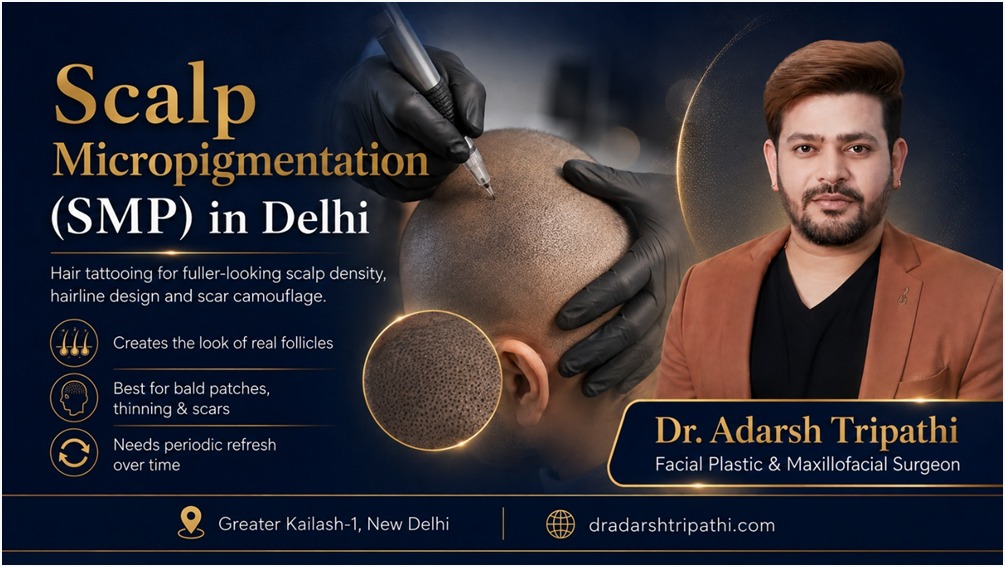
Quick answer: Scalp micropigmentation – SMP, sometimes called hair tattooing – deposits tiny dots of specialised pigment into the scalp to mimic the appearance of hair follicles. It creates the look of a closely shaved head, adds visual density to thinning areas, and camouflages scars. It is not hair and it does not grow: it is a permanent cosmetic tattoo that fades over roughly three to six years and needs refreshing. In Delhi, SMP costs approximately Rs 25,000-1,20,000 depending on the area covered, across two to four sessions. At Sarayu Clinics in Greater Kailash-1, it is planned by Dr. Adarsh Tripathi, a maxillofacial and facial plastic surgeon – which means you will also be told honestly if a hair transplant or medical treatment would serve you better.
Let us be straightforward about what this is, because most pages are not. SMP is a tattoo. It uses pigment formulated for the purpose rather than standard tattoo ink, and it is placed at a shallower depth using finer needles – but the principle is identical: pigment deposited into the skin, permanently. That is not a criticism. Done well it is genuinely transformative, and for some patients it is a better answer than surgery. But it means three things follow, and you should know all three before you book.
- It fades. Expect noticeable fading over three to six years, and plan for a refresh session rather than treating it as done forever.
- It does not grow. SMP creates the appearance of a closely shaved head or of denser hair viewed from a normal distance. It will not give you hair you can run your fingers through.
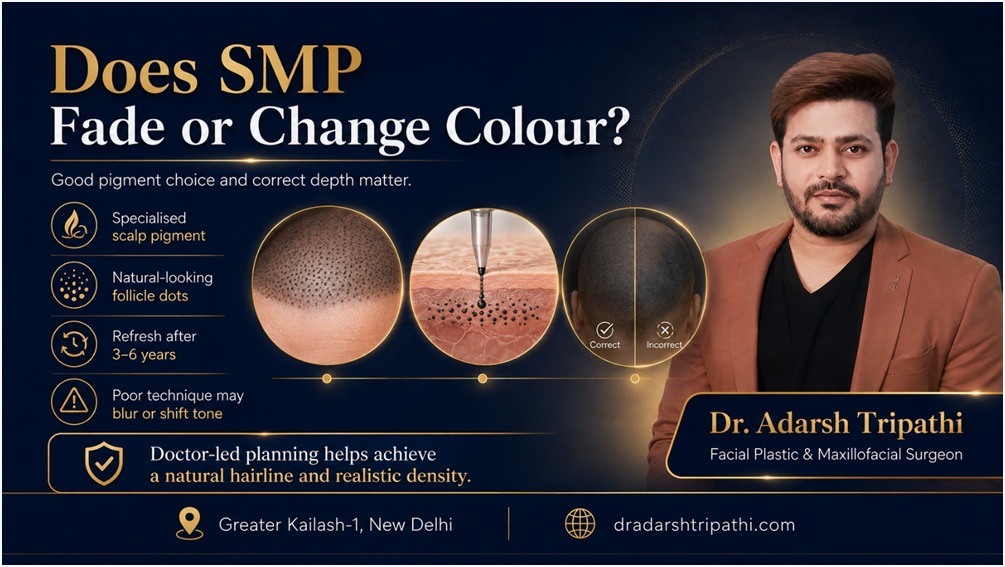
- Pigment and technique determine whether it ages well. The wrong pigment or the wrong depth can shift blue or green over years – which is the single most common thing that goes wrong with SMP.
What Scalp Micropigmentation Actually Does ?
A fine needle deposits pigment into the upper dermis in thousands of tiny dots, each sized and spaced to replicate the look of a hair follicle emerging from the scalp. Placed correctly and matched to your natural hair colour and skin tone, the effect at conversational distance is a scalp that looks closely shaved and evenly covered. Placed badly, the dots are too large, too uniform or too dark, and the result reads as a solid smudge rather than stubble.
The craft is in the variation – dot size, depth, spacing and shade all need to vary slightly to mimic how real follicles look, and the hairline needs designing rather than drawing. That is why practitioner skill matters more with SMP than with almost any other hair treatment: the equipment is inexpensive, the technique takes years to do well, and the difference between the two is visible on your head every day.
What SMP Is Used For ?
The shaved-head look
The most common use and the one that gives the cleanest results. For men with advanced pattern baldness who are comfortable keeping their hair very short, SMP recreates the appearance of a full head of closely cropped hair. This is where SMP genuinely competes with a transplant rather than substituting for one – because a shaved look is the goal rather than a compromise.
Density in thinning areas – hair camouflage
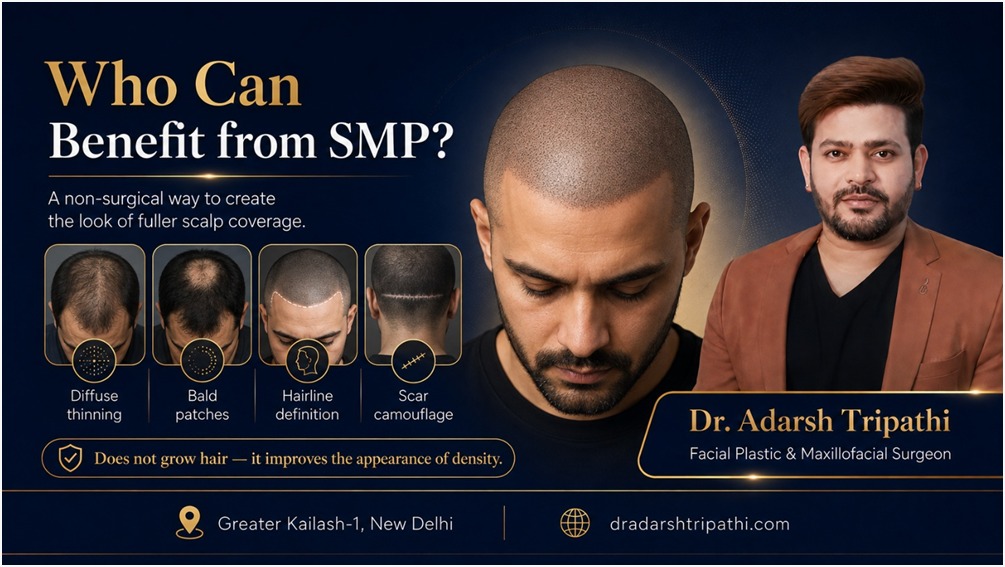
Where hair is thinning but still present, pigment applied between existing hairs darkens the scalp showing through, which dramatically reduces the contrast that makes thinning visible. The hair itself is unchanged; what changes is that the scalp no longer shines through. This works particularly well for diffuse thinning and is one of the few good options for women, who are often poor transplant candidates.
Bald patch camouflage
Discrete bald patches – from alopecia areata, from trauma, or from previous procedures – can be filled visually with pigment matched to the surrounding hair. For alopecia areata specifically, an important caveat: the condition can be unpredictable, and hair may regrow spontaneously into an area you have had tattooed. That is worth discussing before treating. Where the patch is caused by scarring, see below.
Scar camouflage – including transplant scars
One of SMP’s best applications, and one this clinic is unusually well placed to handle. A FUT hair transplant leaves a linear donor scar; even with trichophytic closure it can be visible at very short hair lengths. SMP over that scar breaks up the pale line and makes it far harder to see. The same applies to FUE dot scarring in the donor area, and to scars from injury or surgery. Scar tissue takes pigment differently from normal scalp – it can absorb more, hold less, or blur – so this needs a test patch and a practitioner who has done it before. Our scar revision page covers the surgical options where a scar needs treating rather than concealing.
Adding the appearance of a hairline
A receded hairline can be redrawn with pigment. This is the highest-risk application aesthetically, because a hairline that is too low, too straight or too defined ages badly and looks obviously artificial – the same design judgement that applies to a surgical hairline applies here, which is an argument for having it designed by someone who designs surgical hairlines.
Who SMP Suits ?
Good candidates
- Men with advanced pattern baldness who are comfortable keeping hair very short or shaved
- Anyone wanting an immediate result rather than waiting 12-18 months for transplanted hair to grow
- Patients who are not transplant candidates – insufficient donor supply, medical contraindications, or advanced loss
- Diffuse thinning where the scalp shows through, including in women
- Camouflaging a FUT donor scar or FUE dot scarring
- Patients wanting to add the appearance of density between transplanted grafts
- Anyone who wants a defined, low-maintenance look and accepts that it is not hair
SMP may not be right if
- You want to wear your hair long – SMP looks correct at very short lengths and becomes obvious as surrounding hair grows
- You have keloid tendency or a history of poor healing, which affects how the scalp takes pigment
- You have an active scalp condition – psoriasis, seborrhoeic dermatitis, folliculitis – which should be treated first
- You have unstable alopecia areata where patches may regrow or shift
- You have a known pigment or tattoo-ink allergy
- You are on isotretinoin, or have been recently – the scalp needs time to normalise
- You are not comfortable with something permanent. SMP fades but does not disappear, and removal is possible but slow and imperfect
- You expect it to feel like hair. It will not
The SMP Procedure, Step by Step
Consultation and design
The most important stage. Dr. Tripathi assesses your scalp condition, hair loss pattern, skin tone and hair colour, and discusses what look you actually want – shaved, denser, or a specific area concealed. The hairline is designed against your facial proportions, exactly as it would be for surgery. Pigment shade is matched to your natural hair colour, and this is also where you should be told honestly whether SMP, a transplant, medical therapy or a combination suits you best.
Patch test
A small test area is treated first to check how your skin takes the pigment and to confirm the shade. This matters more in scar tissue and in previously treated areas. Allow one to two weeks between the patch test and the first full session.
Session one – foundation
The scalp is cleansed and numbed with topical anaesthetic. Pigment is applied in the planned pattern, deliberately lighter than the final target – it is far easier to add density in a later session than to lighten something that has gone too dark. A session covering the full scalp takes two to four hours.
Sessions two and three – building density
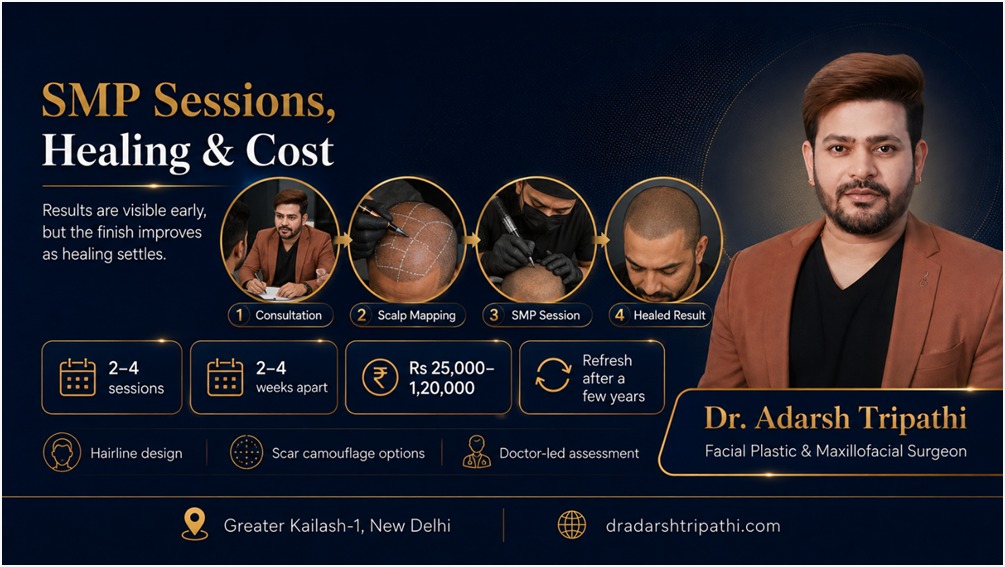
Spaced two to four weeks apart, subsequent sessions build density, correct any unevenness, and refine the hairline once the first layer has settled and its true colour has emerged. Most patients need two to four sessions total, depending on area and desired density.
Healing between sessions
Mild redness for a day or two, and small dots may look darker initially before settling to their true tone over about a week. No wetting the scalp for four to five days, no sweating heavily, no sun exposure without cover.
Downtime and Aftercare
Timeframe | What to expect |
Day 0 | Scalp pink or red; dots look darker and sharper than they will settle to. Back to normal activity immediately |
Days 1-4 | Redness settles. Do not wet the scalp, no washing, no sweating, no swimming |
Days 5-7 | Gentle washing resumes. Colour softens as the surface heals – this is normal and expected |
Weeks 2-4 | True colour visible. Next session scheduled once settled |
After the final session | Full result. Sun protection becomes the main long-term maintenance factor |
Long-term care is straightforward and matters more than people expect: sun protection is the single biggest factor in how slowly your SMP fades, so a hat or SPF on an exposed scalp is worth the habit. Avoid harsh scalp scrubs and strong exfoliating products. Moisturise a shaved scalp to keep the skin healthy. And plan for a refresh session every three to six years rather than being surprised by it.
Cost and Price of Scalp Micropigmentation in Delhi
Direct answer: scalp micropigmentation in Delhi costs approximately Rs 25,000-1,20,000 depending on how much of the scalp is treated and how many sessions are needed. Small areas such as a scar or a single patch start around Rs 25,000; a full shaved-look treatment across the whole scalp runs Rs 70,000-1,20,000 across three to four sessions. Refresh sessions every three to six years cost considerably less than the original treatment.
Treatment area | Typical sessions | Approx. total cost |
Scar camouflage (FUT line or small scar) | 1-2 | Rs 25,000-45,000 |
Single bald patch or small area | 1-2 | Rs 25,000-50,000 |
Hairline recreation and temples | 2-3 | Rs 35,000-65,000 |
Crown / vertex | 2-3 | Rs 40,000-70,000 |
Density between existing hair (diffuse thinning) | 2-3 | Rs 45,000-80,000 |
Full scalp – shaved look | 3-4 | Rs 70,000-1,20,000 |
Refresh session (after 3-6 years) | 1 | Rs 15,000-35,000 |
What drives the price ?
- Area treated – the dominant factor, and why a scar costs a fraction of a full scalp
- Number of sessions needed to reach the density you want
- Complexity – scar tissue, previous SMP needing correction, or an unusual hairline design all take longer
- Practitioner experience, which in SMP is the main variable in outcome quality
- Pigment quality [confirm what the clinic uses – see Part 9]
On cheap SMP. SMP has low consumable costs and a low barrier to entry, which means price varies enormously and the cheap end of the market is genuinely risky. The problems are not usually immediate – a fresh treatment often looks fine. They appear over years: pigment that shifts blue or green because the wrong ink was used, dots that spread and blur because they were placed too deep, or a hairline that looked sharp at 35 and looks artificial at 45. Those are expensive and slow to correct, and some of it cannot be fully undone. This is a treatment where paying for experience is a reasonable decision.
How Long SMP Lasts, and What Happens as It Fades ?
- Immediately: full visible result once the final session has healed
- Year 1-2: stable. Minor softening as the pigment settles
- Year 3-4: gradual lightening becomes noticeable, particularly with sun exposure
- Year 4-6: most patients want a refresh session by this point
- Long term: pigment does not disappear entirely – it lightens and can shift tone. Refreshing maintains the result; stopping leaves a faded version rather than a clean scalp
The honest note on permanence. SMP is often described as semi-permanent, which is a slightly generous framing. It fades, but the pigment is in your skin permanently and a faded SMP still looks like faded SMP rather than untreated scalp. If you later want it gone, laser tattoo removal can lighten it substantially, but it is a course of sessions over many months, results vary with the pigment used, and full clearance is not guaranteed. Go in understanding that this is a long-term commitment, not a trial.
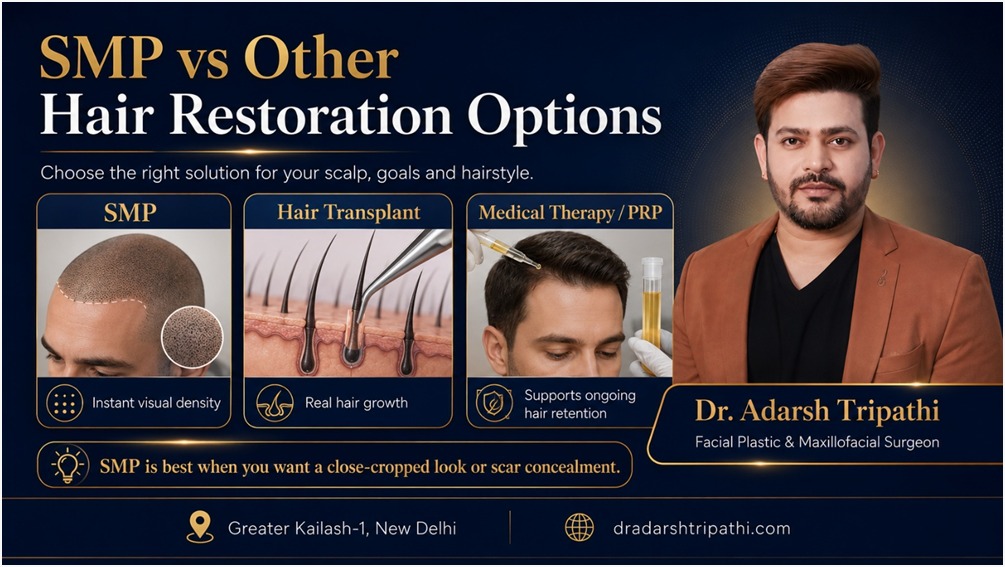
SMP vs Hair Transplant vs the Alternatives
| SMP | Hair transplant | Medical / injectable |
What it gives you | Appearance of density; no actual hair | Real growing hair | Slows loss, thickens existing hair |
Result visible | Immediately | 12-18 months | 3-6 months |
Surgery? | No | Yes | No |
Can you wear it long? | No – suits short hair | Yes | Yes |
Lasts | 3-6 years, then refresh | Permanent | While treatment continues |
Typical cost | Rs 25,000-1,20,000 | Rs 40-120 per graft | Rs 3,000-18,000 per session |
Reversible | Partially, via laser, slowly | No | Yes – simply stop |
Best for | Shaved look, scars, non-candidates | Established loss with good donor supply | Early thinning, protecting what remains |
SMP or a transplant?
They answer different questions. A hair transplant gives you real hair you can grow, style and run your fingers through – but it needs adequate donor supply, costs more for large areas, and takes 12-18 months to show. SMP gives an immediate result, works regardless of donor supply, and costs less for full coverage – but it is not hair and it commits you to short hair. The genuinely useful question is what you want your hair to look like in five years. If the answer involves length, SMP is the wrong choice. If the answer is a clean shaved look, SMP may be the better one – and spending Rs 3,00,000 on surgery to then keep it shaved would make little sense.
Using both together
This is common and often the best result. SMP between transplanted grafts adds visual density that makes a given number of grafts look thicker, which can reduce how many grafts you need. SMP over the donor area conceals FUT or FUE scarring. Timing matters – SMP is usually done after the transplant has fully grown out, at around 12 months, so the pigment is placed around the final hair rather than guessing.
SMP and medical treatment together
SMP conceals; it does not treat. Underneath the pigment, androgenetic hair loss continues – and if your remaining hair keeps thinning, the SMP that looked right at the outset will need adjusting. Which is why it makes sense alongside medical therapy, PRP or GFC rather than instead of them. A clinic that offers SMP but never mentions treating the underlying loss is selling you camouflage and leaving the cause alone.
Choosing Where to Have SMP in Delhi
An honest word about the market. A large share of SMP in Delhi is done by tattoo artists and specialist SMP studios rather than medical clinics, and some of them are genuinely excellent – this is an artistic craft as much as a clinical one, and years of practice show. The argument for having it done in a medical setting is not that studios are bad. It is that a clinic can assess whether SMP is the right treatment for you at all, identify and treat a scalp condition underneath, manage the hair loss that is still progressing, design the hairline with the same judgement used for surgery, and deal with it if something goes wrong. If you are choosing a studio instead, choose on portfolio and healed results rather than on price.
Questions worth asking wherever you go
- Can I see healed results – at least a year old – not just fresh work?
- What pigment do you use, and how does it age?
- Will you patch test me first?
- How will this look in five years as it fades, and what does a refresh cost?
- How will it look if my remaining hair keeps thinning?
- Would a transplant or medical treatment actually suit me better?
Why patients choose Dr. Adarsh Tripathi
- Adarsh Tripathi is a Maxillofacial and Facial Plastic Surgeon with 18+ years of experience.
- Hairline designed with the same facial-proportion judgement used for surgical hairlines, rather than drawn to a template
- The full hair spectrum available – transplant, PRP, GFC and medical therapy – so you will be told honestly if SMP is not the best answer for you
- Scalp assessed and any underlying condition treated before pigment is applied
- Patch testing as standard, particularly over scar tissue.
- Straight about fading, refresh cycles and what SMP cannot do
- Particular experience with camouflaging transplant scars, because this is a practice that performs the surgery
- See before-and-after results and celebrity work.
- Greater Kailash-1, New Delhi – convenient from GK-2, CR Park, Kailash Colony, Defence Colony, Hauz Khas, Nehru Place and South Extension.
Frequently Asked Questions
What is scalp micropigmentation (SMP)?
Scalp micropigmentation is a cosmetic procedure that deposits tiny dots of specialised pigment into the upper layer of the scalp to replicate the appearance of hair follicles. It creates the look of a closely shaved head, adds visual density to thinning areas, and camouflages scars. It is sometimes called hair tattooing, which is accurate – it is a permanent cosmetic tattoo using pigment formulated for the purpose rather than standard tattoo ink. It does not grow hair; for that, see hair transplant.
How much does scalp micropigmentation cost in Delhi?
SMP in Delhi costs approximately Rs 25,000-1,20,000 depending on the area treated. Scar camouflage or a single patch starts around Rs 25,000-50,000; hairline recreation Rs 35,000-65,000; a full shaved-look treatment across the whole scalp Rs 70,000-1,20,000 across three to four sessions. Refresh sessions every three to six years cost Rs 15,000-35,000.
Does SMP look natural?
When done well, yes – at conversational distance it reads as a closely shaved scalp. The craft is in varying dot size, depth, spacing and shade to mimic how real follicles look. Done poorly, the dots are too large, too uniform or too dark and the result looks like a solid smudge rather than stubble. This is why seeing healed results at least a year old, rather than fresh work, matters more than any other check.
Is scalp micropigmentation permanent?
It is permanent pigment that fades rather than disappears. Expect noticeable fading over three to six years and plan for a refresh session. A faded SMP still looks like faded SMP rather than untreated scalp. If you later want it removed, laser tattoo removal can lighten it substantially over a course of sessions, but full clearance is not guaranteed and results vary with the pigment used. Treat it as a long-term commitment.
Does SMP turn blue or green over time?
It can, and this is the most common thing that goes wrong. Standard tattoo ink and some cheaper pigments break down over years into blue or green tones, and pigment placed too deep is more likely to shift and blur. Properly formulated SMP pigment placed at the correct depth fades toward a lighter version of the original shade instead. Ask what pigment a practitioner uses and how it ages – it is a fair question and a good practitioner will have a clear answer.
Can SMP cover a hair transplant scar?
Yes, and it is one of SMP’s best applications. A FUT transplant leaves a linear donor scar that can be visible at very short hair lengths, and SMP breaks up the pale line so it is far harder to see. The same applies to FUE dot scarring. Scar tissue takes pigment differently from normal scalp, so a patch test and an experienced practitioner both matter here.
Does scalp micropigmentation hurt?
Discomfort is mild to moderate and well managed with topical anaesthetic applied beforehand. Most patients describe it as a scratching or prickling sensation rather than sharp pain, and it is generally reported as less uncomfortable than a conventional tattoo because the needles are finer and the depth shallower. Sessions run two to four hours for full scalp coverage.
How many SMP sessions will I need?
Most patients need two to four sessions spaced two to four weeks apart. The first session lays a deliberately light foundation, and subsequent sessions build density and refine the hairline once the first layer has settled and shown its true colour. Building gradually is deliberate – it is far easier to add density later than to lighten something that has gone too dark.
Can women have scalp micropigmentation?
Yes, and it is one of the more useful options for female hair loss. Women typically have diffuse thinning rather than defined bald areas, which often makes them poor transplant candidates. SMP applied between existing hairs darkens the scalp showing through and reduces the contrast that makes thinning visible. The hair is unchanged; what changes is that the scalp no longer shines through.
What is the difference between SMP and a hair transplant?
SMP creates the appearance of density using pigment – immediate result, no surgery, no actual hair, and it commits you to wearing your hair short. A hair transplant relocates real growing hair – it needs adequate donor supply, takes 12-18 months to show, and lets you wear your hair at any length. They are frequently combined: SMP between grafts adds visual density, and SMP over the donor area conceals scarring.
Will SMP stop my hair loss?
No. SMP conceals; it does not treat. Underneath the pigment, androgenetic hair loss continues – and if your remaining hair keeps thinning, SMP that looked right initially will need adjusting. It makes most sense alongside medical therapy, PRP or GFC rather than instead of them.
How do I care for my scalp after SMP?
For the first four to five days, do not wet the scalp – no washing, swimming or heavy sweating. Gentle washing resumes from around day five to seven. Long term, sun protection is the single biggest factor in how slowly SMP fades, so a hat or SPF on an exposed scalp is worth the habit. Avoid harsh scrubs and strong exfoliating products, and moisturise a shaved scalp to keep the skin healthy.
How to Reach Us:
Phone:+91 9289111083 ,+91 9289111084
Dr Adarsh’s website: https://dradarshtripathi.com/
Facebook: https://www.facebook.com/DrAdarshTripathi3011
Instagram: https://www.instagram.com/dr_adarsh_tripathi/
Youtube: https://www.youtube.com/@dr_adarsh_tripathi
Linkedin: https://www.linkedin.com/in/dr-adarsh-tripathi-a43005b8/
Online Booking: https://dradarshtripathi.com/contact-us/ to schedule appointments conveniently.