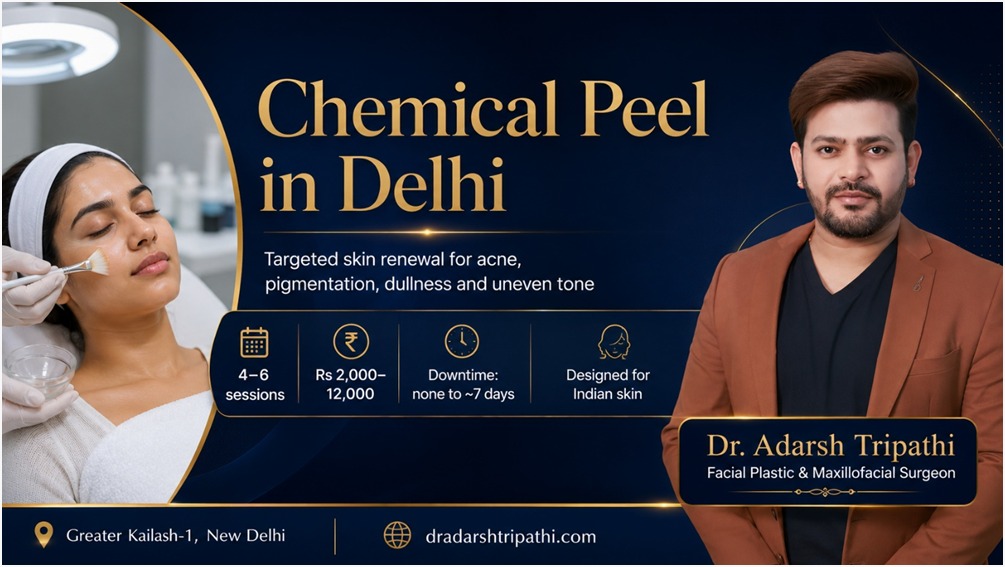
Chemical Peel in Delhi
Quick answer: A chemical peel in Delhi uses a medical-grade acid – glycolic, salicylic, mandelic, lactic, TCA or a combination – to exfoliate damaged skin and trigger fresh growth underneath. The right acid depends entirely on your concern: salicylic for acne, glycolic for dullness, mandelic for sensitive or darker Indian skin, TCA for deeper pigmentation. Sessions cost Rs 2,000-12,000 depending on peel type, most concerns need 4-6 sessions spaced 2-4 weeks apart, and downtime ranges from none to about a week. At Sarayu Clinics in Greater Kailash-1, peels are prescribed by Dr. Adarsh Tripathi, a facial plastic surgeon with 18+ years of experience, using protocols designed for Indian skin.
Chemical peels are among the most useful and most misunderstood treatments in skincare. Useful, because the right peel genuinely transforms dull, pigmented or acne-prone skin at a fraction of the cost of laser work. Misunderstood, because most people think a ‘chemical peel’ is one thing – when it is actually a family of treatments using different acids that do completely different jobs.
That confusion is the single biggest reason people come away unimpressed. Glycolic brightens dull skin and softens fine lines. Salicylic clears acne and unclogs pores. Mandelic is gentler and considerably safer on Indian skin. Lactic hydrates while it exfoliates. TCA goes deeper for stubborn pigmentation. Kojic and combination protocols target melasma. None of these are interchangeable, and a generic glycolic peel handed to everyone regardless of concern or skin tone is precisely why so many patients tell us their last peel ‘did nothing’.
Why Skin Tone Changes Everything (And Why Delhi Clinics Should Say So) ?
Indian and darker skin – Fitzpatrick IV to VI – carries a higher risk of post-inflammatory hyperpigmentation. In plain terms: an overly aggressive peel can leave dark marks that take months to fade, undoing the exact thing you came in to fix. The peels and strengths that work beautifully on fair European skin need adjusting for Indian skin, and some of them should not be used at all.
This is why mandelic acid deserves far more attention than it gets in Delhi. Its larger molecule penetrates more slowly and more evenly than glycolic, which makes it markedly safer for darker and sensitive skin while still delivering real brightening and mild acne control. It is genuinely under-prescribed. Equally, deep phenol peels – still recommended on some Delhi clinic pages – carry a high pigmentation risk on Indian skin and have largely been replaced by lasers and layered protocols in modern practice.
What Chemical Peels Actually Deliver ?
- Brighter, more even tone – fading dullness, tanning and superficial pigmentation
- Clearer skin – salicylic peels reach inside the pore where AHAs cannot, reducing active acne and blackheads
- Faded post-acne marks – the brown and red marks left after breakouts respond well and fast
- Smoother texture and refined-looking pores
- Softening of fine lines through collagen turnover across a course
- Improvement in melasma when specialised combination protocols are used alongside daily sun protection
- Better absorption of your skincare afterwards
- Affordable, low-downtime maintenance – peels work well as an ongoing routine every 6-8 weeks

Which Peel for Which Concern ?
Your concern | Peel we would usually choose | Why |
Dullness, tired-looking skin | Glycolic (AHA) | Surface exfoliation; fastest visible brightening |
Active acne, oily skin, blackheads | Salicylic (BHA) | Oil-soluble – works inside the pore, anti-inflammatory |
Sensitive or darker Indian skin | Mandelic (AHA) | Larger molecule, slower penetration, much lower PIH risk |
Dry, dehydrated, mature skin | Lactic (AHA) | Mildest AHA; hydrates as it exfoliates |
Post-acne brown marks | Glycolic, mandelic or kojic | Pigment-focused; marks respond far faster than scars |
Melasma | Mandelic, kojic or Cosmelan-type protocol | Gentle layered approach; aggressive peels worsen melasma |
Rosacea-prone, inflammatory acne | Azelaic | Works on both pigment and inflammation |
Sun damage, combined acne + pigment | Jessner’s solution | Salicylic + lactic + resorcinol combination |
Deeper pigmentation, early wrinkles | TCA (10-35%) | Reaches beyond AHA depth; needs experienced hands on Indian skin |
Instant glow before an event | Carbon ‘Hollywood’ peel | Laser-based, not an acid peel – no downtime |
One clarification worth making, because almost every clinic page gets it wrong: a carbon or ‘Hollywood’ peel is not a chemical peel. A carbon lotion is applied and then passed over with a Q-switched laser, which the carbon absorbs. It is a laser treatment using carbon as a target. Useful for glow, oil and pores – but it belongs in a different category, and if a clinic lists it as an acid peel that tells you something about their depth.
Where Peels Can Be Used ?
The face is the most common area, but peels are not limited to it. The neck and decolletage age faster than the face and respond well to gentler strengths. Sun-exposed hands benefit from glycolic or mild TCA for age spots. Back peels help body acne and the marks it leaves. Darkened underarms – a common concern on Indian skin – respond to brightening peels alongside a topical regimen. And peels can be applied as precise spot treatments: TCA CROSS places a high-strength acid into the base of individual ice-pick {link: acne scars}, which is a different technique from a full-face peel entirely.
What a Chemical Peel Session Involves ?
Before – preparation matters more on Indian skin
Priming skincare is prescribed for two to four weeks before the first peel, particularly for darker skin and for anyone with melasma. Alongside that: strict SPF 50+ daily, stop strong actives three to five days before, disclose any cold-sore history so antiviral cover can be arranged, and postpone if you have a fresh tan or sunburn.
During
The skin is cleansed and degreased so the acid penetrates evenly – this step is skipped in salon peels and is a common reason for patchy results. Eyes and sensitive areas are protected, the peel is applied with controlled timing while the skin’s response is watched in real time, then neutralised at the right moment. You will feel tingling or warmth; it passes quickly. A calming layer and sunscreen finish the session. Twenty to thirty minutes, start to finish.
After
Moisturise frequently – the skin will feel tight. SPF 50+ every day without exception. No exfoliants, retinol or acids for five to seven days. Do not pick or pull at peeling skin; let it shed. Avoid saunas, swimming and heavy sweating for two to three days.
Downtime by Peel Type
Peel | Visible after-effects | Downtime | Back to routine |
Mandelic / lactic | Slight redness, almost none | Minimal | Same day |
Carbon (‘Hollywood’) | Mild redness | None | Same day |
Glycolic (mild) | Mild redness, light flaking | 1-2 days | Same or next day |
Salicylic | Mild redness, flaking | 1-3 days | Same or next day |
Glycolic (medium) | Redness, peeling | 3-5 days | 2-3 days |
Jessner’s | Frosting, peeling | 5-7 days | 3-5 days |
TCA (medium) | Frosting, visible peeling | 5-10 days | 4-7 days |
Cosmelan-type protocol | Significant peeling | 7-10 days | With home regimen |
Most cosmetic peels have no real social downtime. The medium peels do peel visibly for several days – but that peeling is the treatment working, not a side effect of it. Plan those around a quiet week.
Planning Peels Around Delhi's Seasons and Your Calendar
Two practical points that matter here and appear on no competitor page.
Sun and tanning. A peel removes the protective outer layer of skin and leaves what is underneath temporarily more vulnerable to UV – which in a city with Delhi’s summer means a real, not theoretical, pigmentation risk. If you have just returned from a holiday or spent a fortnight outdoors, we will wait until your skin returns to baseline before peeling. Courses started in the cooler months, with disciplined SPF through summer, run considerably smoother.
Weddings and events. Peels work cumulatively – a course of four to six sessions spaced two to four weeks apart takes roughly two to three months, and the visible improvement builds session by session. If you are planning for a function, start three months ahead. What does not work is booking a TCA peel ten days before the event: medium peels peel visibly for five to seven days and the fresh skin underneath needs time to settle. For last-minute glow, a carbon peel or a gentle mandelic session a week out is the sensible choice.
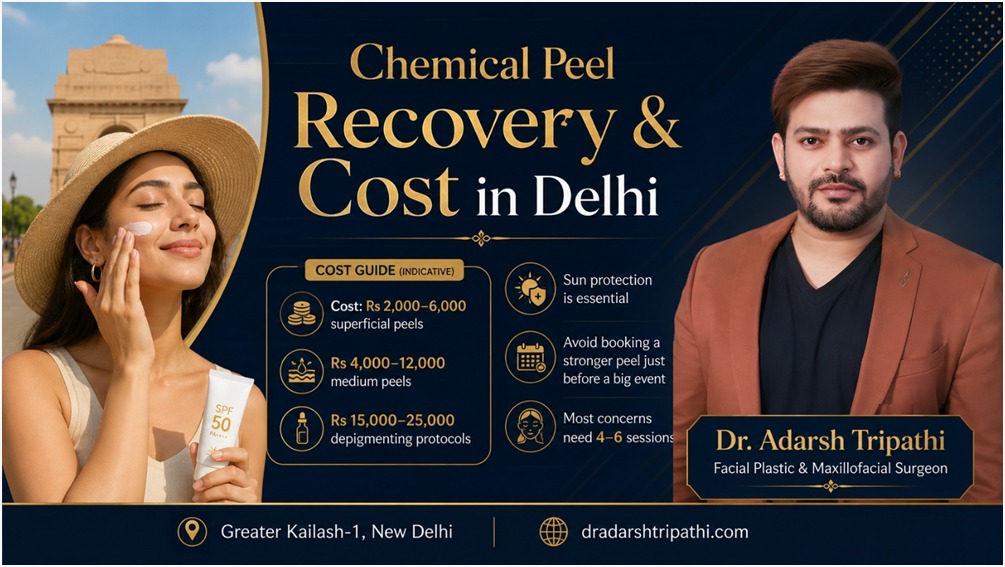
Chemical Peel Cost in Delhi
Cost varies by peel type, strength and area. Because almost every concern needs a course, think in total course cost rather than per-session price.
Peel type | Per session | Typical course | Best for |
Lactic | Rs 2,000 – 4,500 | 4-6 | Dry, sensitive skin |
Mandelic | Rs 2,500 – 5,000 | 4-6 | Indian/sensitive skin, gentle brightening |
Glycolic | Rs 2,500 – 6,000 | 4-6 | Dullness, fine lines |
Salicylic | Rs 3,000 – 6,000 | 4-6 | Acne, oily skin |
Azelaic / combination | Rs 3,500 – 7,000 | 4-6 | Rosacea, melasma, inflammatory acne |
Carbon (‘Hollywood’) | Rs 3,500 – 8,000 | 2-4 | Instant glow, pre-event |
Jessner’s | Rs 4,000 – 8,000 | 3-5 | Sun damage, acne + pigment |
TCA | Rs 5,000 – 12,000 | 3-5 | Deeper pigmentation, mild scars |
Cosmelan-type protocol | Rs 15,000 – 25,000 | 1 + home regimen | Stubborn melasma |
Maintenance afterwards is typically one session every six to eight weeks. Your final quote is confirmed at consultation.
Results Timeline
- Sessions 1-2: skin looks fresher; dullness starts lifting. Brightness responds fastest of all concerns
- Sessions 3-4: visible brightening; post-acne marks fading; texture smoother
- Sessions 5-6: full course result – clearer, more even, more radiant skin
- After the course: improvement continues for weeks as collagen turnover carries on; maintenance every 6-8 weeks holds it
- By concern: dullness responds in 1-2 sessions; active acne over 3-6; post-acne marks over 4-8; melasma needs 3-6 months of layered treatment and daily sun protection, not a quick course
Results fade as gradually as they arrive. With daily sun protection and sensible skincare, the improvement from a course lasts months. Without sun protection, pigmentation returns faster – which is why SPF is not an upsell, it is the treatment.

Peel or Something Else? An Honest Comparison
For this concern | Best treatment | Where peels fit |
Dullness, brightness | Chemical peel | Primary treatment |
Active acne | Salicylic peel + medication | Primary treatment |
Post-acne brown marks | Glycolic or mandelic peel | Primary treatment |
Deep textural acne scars | Laser / MNRF / subcision | Adjunct only |
Melasma | Combination peel + prescription skincare | Core, with skincare |
Fine lines | Peel + Botox or MNRF | Adjunct |
Sagging skin | HIFU / RF / facelift | Not appropriate |
Large pores, oily skin | Salicylic or carbon peel | Primary |
Sun damage | Glycolic or TCA peel | Primary |
Peels versus hydrafacial and microdermabrasion
Both are gentler and more superficial – good for glow and maintenance, but they do not reach the depth needed for real pigmentation, melasma or established acne marks. Fine as upkeep, insufficient as treatment.
Peels versus microneedling and lasers
Different jobs. Peels work on tone, brightness and pigment. Microneedling RF and lasers work on texture – scars, pores, fine lines, tightening. Many patients do best on a combination: peels for tone, MNRF or fractional CO2 for texture. Lasers are more powerful and more expensive; peels are the affordable, repeatable backbone of ongoing skin care.
Clinic peels versus at-home peel products
Over-the-counter pads and serums use very low-strength acids – fine for maintenance, ineffective for actual concerns. Medical-grade peels are considerably stronger, professionally applied and properly neutralised, which is what produces real change. One warning: do not layer strong home actives on top of a clinical peel course. That is how skin gets damaged.
Choosing a Chemical Peel Doctor in Delhi
The direct answer: a chemical peel doctor in Delhi should be medically qualified to assess your skin before choosing an acid, should offer a genuine range of peels rather than one house formula, should design protocols specifically for Indian skin tones, and should be willing to tell you when a peel is not the right treatment for your concern. The difference between a medical peel and a salon peel is not the bottle – it is the diagnosis behind it.
Peels are widely offered in Delhi, including by people with no medical training. That matters more than it sounds, because several conditions that look like ordinary pigmentation are not: melasma can be worsened by aggressive peeling, some facial rashes are fungal rather than inflammatory, and rosacea reacts badly to the wrong acid. Spotting these before applying anything is a medical judgement, not a beauty one.
Six questions worth asking before you book
- Which acid are you using on me, and why that one for my concern?
- What strength, and how have you adjusted it for my skin tone?
- Will a doctor assess my skin, or will a therapist apply a standard peel?
- What pre-peel skincare should I be on, and for how long?
- How many sessions will I realistically need, and what will the whole course cost?
- What happens if I get pigmentation afterwards – who manages it?
Why Patients Choose Dr. Adarsh Tripathi ?
- A maxillofacial and facial plastic surgeon with 18+ years of experience – a practice built around the face, not a retail peel menu
- The full range offered: mandelic, lactic, glycolic, salicylic, azelaic, Jessner’s, TCA, Cosmelan-type protocols and carbon.
- PIH-conscious protocols designed for Fitzpatrick IV-VI from the outset, not adapted from Western templates
- Prescribed pre-peel priming, not just the peel session itself
- Honest about when peels are not the answer – and which of MNRF, laser resurfacing or depigmentation protocols would serve you better
- Peels planned within broader facial-aesthetic care rather than sold as a standalone service
- Consultations conducted personally by Dr. Tripathi at Greater Kailash-1, convenient from GK-2, CR Park, Kailash Colony, Nehru Place, Defence Colony and South Extension.
Who Should Wait or Reconsider ?
Discuss carefully, or postpone, if you have very sensitive or rosacea-prone skin (gentler acids only), active eczema, herpes or open wounds in the area, a recent tan, or if you are pregnant or breastfeeding. If you are on isotretinoin, peels are normally deferred for six months after stopping. And if you are expecting an overnight transformation, the honest answer is that peels do not work that way – they work in courses.
Related Treatments
Patients considering peels often ask about the adjacent options: skin whitening and de-tan programmes for overall tone, laser toning for tanning and pigmentation, acne scar removal for textural scarring, skin boosters for hydration and glow, and Botox or dermal fillers where lines and volume are the actual concern rather than skin surface.
Frequently Asked Questions
What is a chemical peel and how does it work?
A chemical peel applies a medical-grade acid – glycolic, salicylic, mandelic, lactic, TCA or a combination – to exfoliate damaged outer skin and stimulate fresh growth underneath. Different acids treat different concerns: glycolic for dullness, salicylic for acne, mandelic for sensitive and darker Indian skin, TCA for deeper pigmentation.
How much does a chemical peel cost in Delhi?
Superficial peels (mandelic, lactic, glycolic, salicylic) cost around Rs 2,000-6,000 per session in Delhi. Medium peels such as TCA and Jessner’s run Rs 4,000-12,000. Specialised depigmenting protocols like Cosmelan cost Rs 15,000-25,000. Most concerns need 4-6 sessions, so ask for the course price rather than the per-session figure.
Which chemical peel is best for Indian skin?
Mandelic acid is one of the safest and most effective peels for Indian and darker skin. Its larger molecule penetrates more slowly and evenly than glycolic, which significantly reduces the risk of post-inflammatory hyperpigmentation. Lactic acid is also gentle, and mild glycolic works well with proper priming. Deep phenol peels are generally unsuitable for Indian skin.
Who is the best chemical peel doctor in Delhi?
The right chemical peel doctor in Delhi is medically qualified to diagnose your skin before choosing an acid, offers a genuine range of peels rather than one house formula, designs protocols specifically for Indian skin tones, and will tell you when a peel is not the right treatment. Dr. Adarsh Tripathi is a Maxillofacial and Facial Plastic Surgeon with 18+ years of experience practising at Sarayu Clinics, Greater Kailash-1.
Will my face actually peel?
It depends entirely on the peel. Mild peels – mandelic, lactic, gentle glycolic – usually cause only subtle shedding over a few days, not the dramatic peeling people picture. Medium peels such as TCA and Jessner’s do cause visible flaking for five to seven days, which is part of how they work. That peeling is a one-week event, not a permanent state.
Can chemical peels fix acne scars?
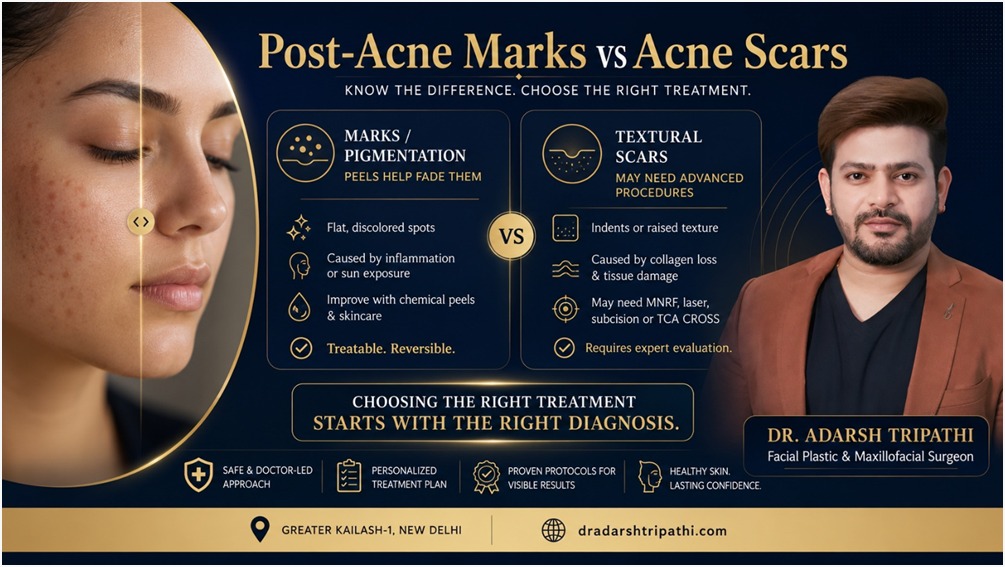
Peels fade post-acne marks – the flat brown and red discolouration left after breakouts – very effectively. They cannot erase true textural acne scars such as ice-pick, boxcar or rolling scars, which sit deeper in the skin and need laser, microneedling RF, subcision or TCA CROSS. Distinguishing marks from scars is the most important step in choosing the right treatment.
Are chemical peels good for melasma?
They can help, but only with a careful approach. Gentle peels such as mandelic and lactic, or specialised Cosmelan-type protocols, combined with prescription topicals and strict daily SPF, give the best results. Aggressive peeling can make melasma worse by triggering more pigment. Melasma is a long-term management problem, not a one-course fix.
How often should I have a chemical peel?
Most peels are spaced two to four weeks apart, with 4-6 sessions making a typical course. Medium peels such as TCA are spaced four to six weeks apart to allow full healing. After the course, maintenance every six to eight weeks preserves results.
Are chemical peels safe?
Yes, when the acid and strength are matched to your skin type and followed by proper aftercare. The main risk on Indian and darker skin is post-inflammatory hyperpigmentation, which is largely preventable through appropriate acid selection, conservative strengths, pre-peel priming and strict sun protection. Doctor-supervised medical peels are considerably safer than salon peels applied to a standard formula.
Is a carbon peel the same as a chemical peel?
No. A carbon or ‘Hollywood’ peel applies a carbon lotion which is then passed over with a Q-switched laser – the carbon absorbs the laser energy and exfoliates the surface. It is a laser treatment, not an acid peel, despite the name. Both are useful, but they work in completely different ways.
How should I prepare before a chemical peel?
Use prescribed priming skincare for two to four weeks beforehand, apply SPF 50+ daily, stop strong actives such as retinol and acids three to five days before, avoid any recent tanning, and disclose your full medical and skincare history including any cold-sore history. Preparation matters more on Indian skin because it directly reduces pigmentation risk.
What should I avoid after a chemical peel?
Avoid sun exposure and use SPF 50+ every day, skip retinol, acids and scrubs for five to seven days, do not pick or pull at peeling skin, and avoid saunas, swimming and heavy sweating for two to three days. Sun protection is the single factor that determines both your result and your pigmentation risk.
How to Reach Us:
Phone:+91 9289111083 ,+91 9289111084
Dr Adarsh’s website: https://dradarshtripathi.com/
Facebook: https://www.facebook.com/DrAdarshTripathi3011
Instagram: https://www.instagram.com/dr_adarsh_tripathi/
Youtube: https://www.youtube.com/@dr_adarsh_tripathi
Linkedin: https://www.linkedin.com/in/dr-adarsh-tripathi-a43005b8/
Online Booking: https://dradarshtripathi.com/contact-us/ to schedule appointments conveniently.