
Rhinoplasty Surgery in Delhi
Quick answer : Rhinoplasty (a “nose job”) reshapes the nose to improve its proportion, profile, or breathing — reducing a dorsal hump, refining a bulbous or drooping tip, straightening a crooked nose, or correcting a deviated septum. At Sarayu Clinics, Greater Kailash-1, surgical rhinoplasty takes 2–4 hours under general anaesthesia or sedation, costs Rs 80,000–Rs 3,00,000 depending on complexity (tip-only, full, septorhinoplasty, or revision), and needs about 1–2 weeks of social downtime. Results are permanent, and the tip keeps refining for up to a year. A non-surgical filler option exists for minor refinement.
The nose sits at the centre of the face, so even a small change to its shape can transform how the whole face looks — and how you feel about it. Whether it’s a bump on the bridge you’ve disliked since your teens, a tip that droops or looks bulbous, a nose that simply feels too big for your face, or a long-standing breathing problem from a deviated septum, rhinoplasty is the procedure that addresses it. The goal of good rhinoplasty isn’t a dramatic, obvious change — it’s a nose that looks like it always belonged on your face, just better balanced, with no one able to tell you’ve had anything done.
That natural result is harder to achieve than it sounds, and it’s why the choice of surgeon matters more for rhinoplasty than for almost any other facial procedure. The nose is a complex three-dimensional structure of bone, cartilage, and skin, and millimetres make the difference between an elegant result and an over-operated or ‘pinched’ one. An experienced rhinoplasty surgeon doesn’t just reshape what you point at — they read how your whole face is balanced, how your skin will behave, and how the nose will look as it heals over the following year.
Dr. Adarsh Tripathi is a Maxillofacial and Facial Plastic Surgeon with over 18 years of experience at Sarayu Clinics, Greater Kailash-1, New Delhi. Because his entire practice is the face, rhinoplasty is core, everyday work — and he offers the full range, from surgical reshaping and reduction to non-surgical refinement with fillers. This page explains the procedure, what it can and can’t do, who it suits, recovery, cost, and how to choose the right rhinoplasty surgeon in Delhi.
Benefits of Rhinoplasty — What It Actually Delivers
Rhinoplasty, done well, can be genuinely transformative for facial balance and, where breathing is involved, for daily comfort. Here’s an honest picture:
- A more balanced, harmonious profile — the nose brought into proportion with the rest of the face
- A smoother bridge — reducing or removing a dorsal hump or bump
- A refined nasal tip — reshaping a bulbous, drooping, or boxy tip
- A narrower or straighter nose — correcting width or a crooked appearance
- Correction of asymmetry — straightening a nose bent by genetics or injury
- Better breathing — correcting a deviated septum or internal valve collapse (functional rhinoplasty)
- Repair after injury — restoring a broken or post-traumatic nose
- Correction of a previous nose job — revision rhinoplasty for unsatisfactory earlier results
- Permanent results from surgery; reversible refinement from fillers
- A real boost in confidence — many patients say they stop being self-conscious in photos and profile
An honest note: rhinoplasty improves your nose and facial balance — it doesn’t transform you into a different person, and the best results are the ones that look natural rather than ‘done’. A good surgeon sets realistic expectations, shows you likely outcomes, and aims for refinement that suits your face and (where relevant) respects your ethnic features.
Areas of the Nose Rhinoplasty Treats
The nose is made of distinct parts — bone, cartilage, and skin — and rhinoplasty can address each. Understanding which area concerns you explains the technique involved.
The Nasal Bridge (Dorsum)
The bridge is where a dorsal hump or bump sits — one of the most common rhinoplasty concerns. The bone and cartilage are precisely reduced and smoothed to create a straighter, more elegant profile. The bridge can also be narrowed if it’s too wide.
The Nasal Tip
The most technically demanding area. A bulbous, boxy, drooping, or over-projected tip is reshaped using precise cartilage techniques for definition and the right amount of projection and rotation. Tip work is where surgical skill most shows — over-reduction here causes the dreaded ‘pinched’ look, so refined, conservative technique matters.
Nostrils and Nasal Width (Alar Base)
Wide or flaring nostrils, or an overall wide nose, can be narrowed (alar base reduction). This refines the base of the nose and its relationship to the rest of the face.
The Nasal Septum (Functional)
The septum is the internal wall between the nostrils. A deviated septum obstructs breathing and is corrected by septoplasty — often combined with cosmetic rhinoplasty in a single procedure (septorhinoplasty) so the nose both looks and works better.
Crooked or Deviated Nose
A nose bent to one side — from genetics or injury — is straightened by working on both the bone and cartilage to realign it, frequently alongside septal correction.
The Bridge Height (Reduction vs Augmentation)
Rhinoplasty can reduce an over-projected bridge. Where the need is the opposite — building up a flat or low bridge — that’s nose augmentation, covered on our dedicated page, as it uses different techniques (cartilage grafts or implants).
Concerns and Conditions Rhinoplasty Addresses
Cosmetic Concerns
- Dorsal hump or bump on the bridge
- Bulbous, boxy, drooping, or over-projected tip
- Nose too large or too long for the face
- Wide nose or flaring nostrils
- Crooked or deviated nose
- Asymmetry between the two sides
- Profile imbalance with the forehead, lips, and chin
Functional / Medical Concerns
- Deviated septum causing blocked breathing
- Internal nasal valve collapse
- Enlarged turbinates contributing to congestion
- Breathing problems following injury
Trauma and Reconstruction
- Broken nose that healed crooked
- Sports or accident-related nasal deformity
- Congenital nasal deformities
Revision Rhinoplasty
Correcting or refining the result of a previous nose surgery — whether it healed unexpectedly or didn’t meet your goals. Revision is more complex because of scar tissue and altered cartilage, sometimes needing cartilage grafts (from the ear or rib) where nasal cartilage was over-removed previously. A minimum of about 12 months after the original surgery is advised before revision. This is exactly the kind of demanding case where surgeon experience is decisive.
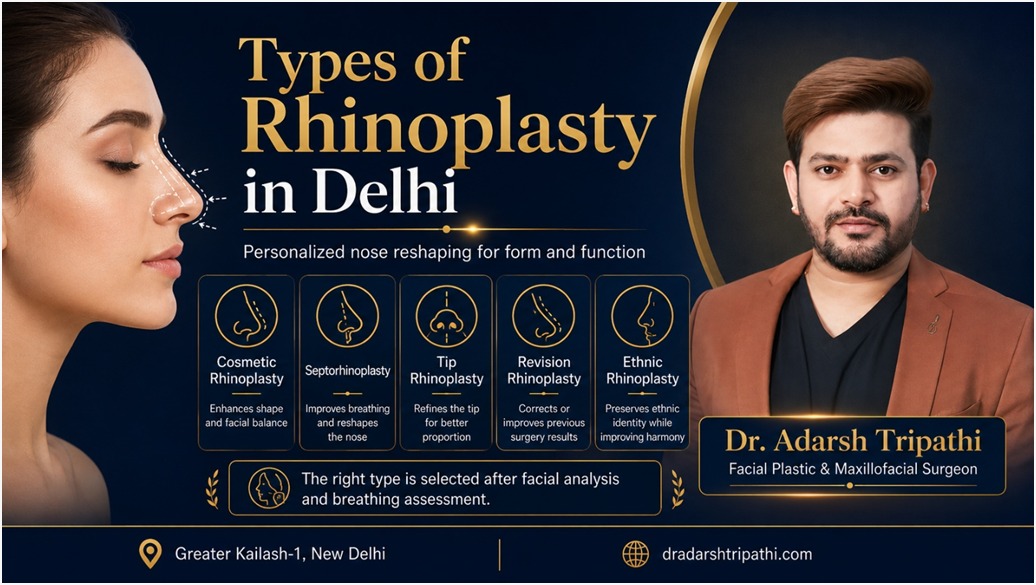
Types of Rhinoplasty Offered at Sarayu Clinics, Delhi
1. Open Rhinoplasty
A small incision across the columella (the strip between the nostrils) lets the surgeon lift the skin and see the nasal structures directly. This gives maximum precision and control, making it the preferred approach for complex reshaping, major tip work, crooked noses, and revision cases. The tiny columellar scar sits in a natural crease and becomes virtually invisible once healed.
- Best for: complex reshaping, tip work, crooked noses, revision
2. Closed Rhinoplasty
All incisions are made inside the nostrils — no external scar at all. The surgeon’s access is more limited, so it suits less complex corrections (moderate hump reduction, minor tip refinement). Recovery can be slightly quicker as less tissue is disturbed.
- Best for: moderate reshaping where less access is needed; no external scar
3. Septorhinoplasty (Cosmetic + Functional)
Combines cosmetic reshaping with correction of a deviated septum, so the nose both looks better and breathes better in one procedure. The most efficient route for those with both aesthetic and breathing concerns.
4. Tip Rhinoplasty (Tipplasty)
Focused on the nasal tip alone — refining a bulbous, drooping, or poorly defined tip without altering the bridge. A more limited procedure for those whose only concern is the tip.
5. Revision (Secondary) Rhinoplasty
Corrects or refines a previous rhinoplasty. Technically demanding due to scar tissue and altered structure, often requiring cartilage grafts. Best done by an experienced surgeon after at least a year from the original.
6. Ethnic Rhinoplasty
Reshaping tailored to the specific nasal anatomy and aesthetic goals of Indian, South Asian, East Asian, Middle Eastern, and other backgrounds — refining the nose while preserving ethnic identity, never imposing a generic ‘Western’ template. Thicker skin and softer cartilage in some ethnic noses require particular technique.
7. Non-Surgical Rhinoplasty (Liquid Rhinoplasty / Fillers)
Hyaluronic acid fillers refine the nose without surgery — camouflaging a minor hump, lifting the tip slightly, or improving symmetry. Quick (15–30 minutes), no downtime, immediate results lasting 12–18 months, and reversible. It cannot reduce nose size or fix breathing, and must be done by a vascular-aware medical injector for safety. A good option for minor refinement or to preview a change before surgery.
Are You a Good Candidate for Rhinoplasty?
Most healthy adults bothered by the shape or function of their nose are candidates. The right approach depends on your concern and whether breathing is involved.
You are likely a good candidate if:
- You’re unhappy with a hump, tip shape, size, width, or crookedness of your nose
- You have breathing difficulty from a deviated septum or structural issue
- Your facial growth is complete (generally 16–17+ for girls, 17–18+ for boys)
- You’re in good general health
- You’re a non-smoker, or willing to stop for several weeks around surgery (smoking impairs nasal healing)
- You have realistic expectations — natural improvement that suits your face
Approach depends on your goal:
- Hump, large or long nose, crooked nose → surgical rhinoplasty (reduction/reshaping)
- Breathing problems + cosmetic concern → septorhinoplasty
- Tip-only concern → tip rhinoplasty
- Minor refinement or want to preview a change → non-surgical (filler) rhinoplasty
- Flat/low bridge needing building up → nose augmentation (separate procedure)
Discuss carefully if you:
- Have had previous nasal surgery → revision planning and realistic expectations needed
- Seek surgery due to external pressure rather than your own wish
- Have body dysmorphic concerns → honest counselling is important
- Have unrealistic ‘celebrity nose’ expectations → natural results suited to your face are the goal
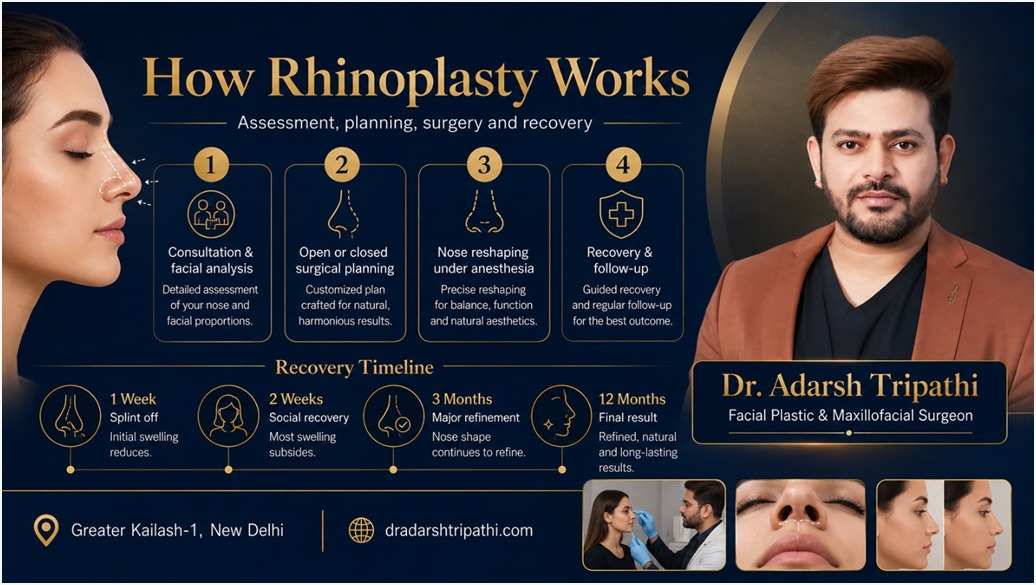
The Rhinoplasty Procedure — Step by Step
Step 1: Consultation & Planning
Dr. Tripathi examines your nose from all angles, assesses your skin thickness, cartilage, and bone, evaluates breathing if relevant, and discusses exactly what bothers you and what you want. Photographs and often digital simulation help you visualise the likely outcome and agree a plan. This is where realistic expectations are set and trust is built — don’t hesitate to ask about experience and to see before-and-after photos.
Step 2: Pre-Operative Preparation
- Stop aspirin, ibuprofen, and blood-thinning supplements for 2 weeks
- Stop smoking for at least 4 weeks before and after
- Arrange blood tests / medical clearance and someone to drive you home
- Avoid food and water from midnight before surgery (if under general anaesthesia)
Step 3: Anaesthesia
Surgical rhinoplasty is performed under general anaesthesia or deep sedation with local anaesthesia, depending on complexity. Non-surgical rhinoplasty needs only topical numbing.
Step 4: The Surgery
- Through an open or closed approach, the skin is lifted to access the bone and cartilage
- A dorsal hump is reduced and the bridge smoothed/narrowed as needed
- The tip cartilages are sculpted and sutured for refinement and the right projection
- The septum is corrected if deviated; nostrils narrowed if needed
- Cartilage grafts (septum, ear, or rib) are added where structure/support is required
- Incisions are closed and a splint applied to the nose
Surgical rhinoplasty typically takes 2–4 hours depending on complexity.
Step 5: Immediate Recovery
A splint protects and holds the new shape; soft internal splints may be placed for 24–48 hours. Most rhinoplasties are day procedures — you’re discharged the same day with aftercare instructions and follow-ups scheduled.
Non-Surgical Rhinoplasty Steps
- Numbing cream applied; filler injected precisely with a fine needle or cannula
- Nose gently moulded; result reviewed immediately
- You leave the same day — no downtime
Recovery and Downtime — What to Expect
Days 1–3
Swelling and bruising around the eyes peak; the nose feels blocked from internal swelling and any packing. Sleep head-elevated; cold compresses around (not on) the nose help. Discomfort is managed with prescribed medication.
Days 4–7
Bruising fades and yellows; the splint is removed at the one-week visit and you see the new shape for the first time (still swollen). Most patients return to desk work or study.
Weeks 2–4
Visible bruising resolves for most; the nose looks presentable socially, though still slightly swollen and stiff. Most resume normal routines and being photographed.
Months 2–6
Swelling continues to reduce gradually; the tip, which holds fluid longest, slowly refines month by month.
Month 12+
The final result is essentially visible by 12 months (up to 18 months for thicker skin, especially at the tip). This is why surgeons ask you to wait a year before judging the result or considering revision.
Things to Avoid During Recovery
- No nose-blowing for 2–3 weeks (dab gently)
- No glasses resting on the nose for 6–8 weeks (tape to the forehead or use contacts)
- No contact sport, swimming, or strenuous exercise for 6–8 weeks
- Strict sun protection of the nose (SPF 50)
- No smoking throughout — it seriously impairs healing
Non-Surgical Recovery
Essentially no downtime — minor swelling or tiny marks settle in 24–48 hours; light makeup the next day.
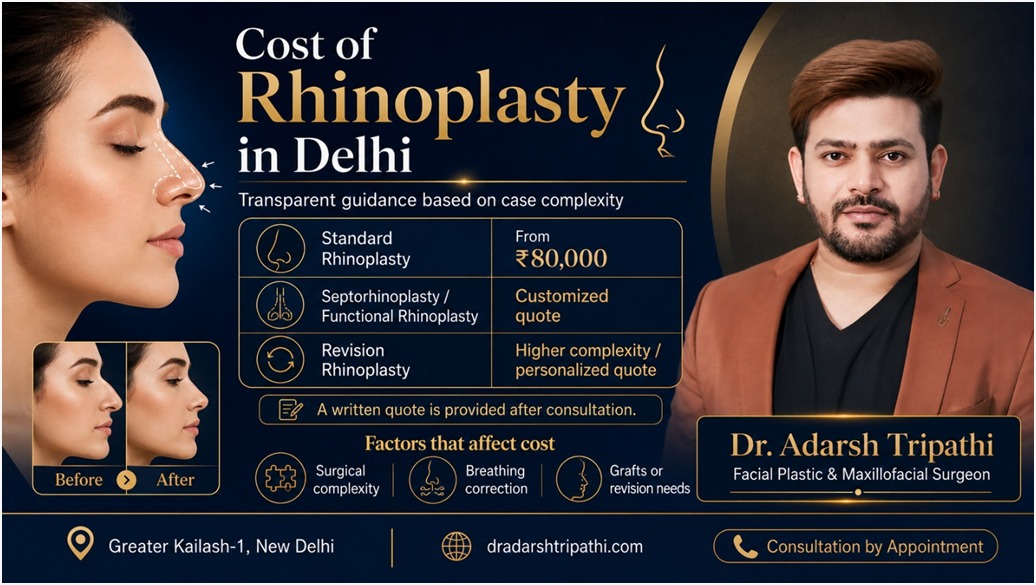
Rhinoplasty Cost in Delhi — Transparent Pricing
Cost depends on the type (surgical vs non-surgical), complexity (tip-only vs full vs septorhinoplasty), whether cartilage grafts are needed, primary vs revision, anaesthesia, and the surgeon’s expertise. Any clinic quoting a fixed price without examining you should be treated with caution.
Approximate Cost at Sarayu Clinics, Delhi
Procedure | Approx. Cost | Duration | Anaesthesia |
Non-Surgical (Liquid) Rhinoplasty | Rs. 25,000–60,000 | 15–30 mins | Topical |
Tip Rhinoplasty (surgical) | Rs. 80,000–1,20,000 | 1–2 hrs | GA / sedation |
Open / Full Rhinoplasty | Rs. 1,00,000–2,00,000 | 2–4 hrs | GA |
Septorhinoplasty | Rs. 1,20,000–2,50,000 | 2.5–4 hrs | GA |
Revision Rhinoplasty | Rs. 1,50,000–3,00,000 | 3–5 hrs | GA |
Prices shown are for guidance only. Your final treatment cost will be confirmed during the initial consultation, based on your individual needs, concerns, and personalised treatment plan.
Results Timeline — When Will I See My Final Nose?
Rhinoplasty rewards patience: the nose looks swollen at first and refines gradually over many months, especially at the tip.
Surgical Rhinoplasty
- Week 1: splint off — new shape visible but swollen; tip firm and numb
- Month 1: major swelling down, presentable socially — about 60–70% of the result
- Month 3: noticeably refined — about 80%
- Month 6: almost final — about 90%
- Months 12–18: final result, especially tip refinement in thicker skin
Non-Surgical Rhinoplasty
- Immediate result; minor day-1 swelling settles in 2–3 days
- Lasts 12–18 months; maintained with top-ups, reversible if needed
How Long Do Results Last?
Surgical rhinoplasty is permanent — the reshaped bone and cartilage are your nose’s new structure for life. The nose ages naturally and very gradually like the rest of the face, but the reshaping itself lasts. Non-surgical filler rhinoplasty is temporary (12–18 months). The key insight on surgical results: the tip always takes longest to refine because it has the least blood supply and densest skin — if you’re worried at 3 months, give it 6; at 6 months, give it 12.
Comparison — Surgical vs Non-Surgical Rhinoplasty
The right choice depends on what you want to change and whether you want permanence or flexibility.
Factor | Non-Surgical (Filler) | Surgical Rhinoplasty |
What it can change | Minor humps, tip lift, symmetry | All areas — full reshaping |
Can reduce nose size | No | Yes |
Can fix breathing | No | Yes (septoplasty) |
Permanence | 12–18 months | Permanent |
Reversible | Yes | No |
Anaesthesia | Topical only | GA / sedation |
Procedure time | 15–30 mins | 2–4 hours |
Downtime | None | 1–2 weeks social |
Cost (approx.) | Rs. 25,000–60,000 | Rs. 80,000–2,50,000+ |
Best for | Minor refinement, preview | Permanent, structural change |
A Practical Path
Some patients try non-surgical rhinoplasty first to preview a refinement they’re considering, then choose surgery for a permanent result if they love it. Fillers can’t reduce a nose or fix breathing, so for those goals surgery is the route. A good surgeon helps you choose honestly rather than defaulting to the more expensive option.
Why a Facial Plastic Surgeon for Rhinoplasty?
Rhinoplasty is widely regarded as one of the most difficult facial procedures — it’s a 3D structural reshaping where millimetres matter and the result keeps evolving for a year. A surgeon who specialises exclusively in the face, like Dr. Adarsh Tripathi, brings the anatomical precision, aesthetic judgement, and experience with diverse (including Indian and Asian) nasal anatomy that distinguish a natural result from an over-operated one. When you search for a rhinoplasty surgeon in Delhi, this depth of facial specialisation is exactly what to look for.
Why Dr. Adarsh Tripathi Is a Trusted Rhinoplasty Surgeon in Delhi ?
Of all facial procedures, rhinoplasty most rewards the surgeon’s skill and judgement — natural versus ‘done’ is entirely in the hands. Here’s how to choose, and why patients choose Dr. Tripathi:
What to Look For in a Rhinoplasty Surgeon ?
- Specialisation in the face, with extensive rhinoplasty experience (not occasional nose work)
- A portfolio of natural-looking before-and-after results, including noses like yours
- Experience with your ethnic nasal anatomy (Indian/Asian noses have specific needs)
- Honesty about what surgery can and cannot achieve, and realistic expectation-setting
- Comfort handling both cosmetic and functional (breathing) concerns
- A consultation conducted personally by the surgeon; genuine reviews and safe facilities
Dr. Tripathi’s Credentials
- Maxillofacial and Facial Plastic Surgeon with 18+ years of experience
- Practice focused exclusively on the face — rhinoplasty is core, frequent work
- Experienced across open, closed, septorhinoplasty, tip, revision, and ethnic rhinoplasty
- Skilled in both cosmetic reshaping and functional (breathing) correction
- Offers surgical and safe non-surgical options — for unbiased advice
- Consultations personally conducted by Dr. Tripathi; known for natural results, including work with public figures who are regularly photographed
A Natural-Results Philosophy
The giveaway of poor rhinoplasty is an over-operated look — a scooped bridge, a pinched or over-rotated tip, a nose that doesn’t suit the face. Dr. Tripathi’s approach is conservative and structure-preserving: refine and reshape to suit your individual face and (where relevant) your heritage, rather than impose a template. The aim is a nose that looks like it always belonged on your face.
Frequently Asked Questions — Rhinoplasty in Delhi
Who is the best rhinoplasty surgeon in Delhi?
The best rhinoplasty surgeon in Delhi for you is a surgeon who specialises exclusively in the face, has extensive experience across open, closed, septo, tip, revision and ethnic rhinoplasty, shows a portfolio of natural results, and is honest about what surgery can and cannot achieve. Dr. Adarsh Tripathi is a Maxillofacial and Facial Plastic Surgeon with 18+ years of face-focused practice, offering both surgical and non-surgical rhinoplasty at Sarayu Clinics, Greater Kailash.
What is the difference between open and closed rhinoplasty?
Open rhinoplasty uses a tiny incision across the columella (between the nostrils) to lift the skin and give the surgeon direct view and control – preferred for complex reshaping, major tip work, crooked noses and revision. Closed rhinoplasty places all incisions inside the nostrils with no external scar, suiting less complex corrections. Research shows both achieve similar outcomes; the right choice depends on your nose and the surgeon’s judgement, not a one-size rule.
Is rhinoplasty painful?
Rhinoplasty is performed under general anaesthesia or deep sedation, so the surgery itself is painless. Afterwards, most patients report congestion and pressure rather than significant pain – discomfort is mild to moderate and well controlled with prescribed medication for the first few days. The feeling of a blocked nose from internal swelling is usually more bothersome than actual pain.
What is septorhinoplasty, and will insurance cover it?
Septorhinoplasty combines cosmetic reshaping with correction of a deviated septum, so the nose both looks better and breathes better in one operation. Where there is a genuine functional breathing problem, the functional (septoplasty) portion may sometimes be considered by insurers with proper documentation, while the purely cosmetic portion is not covered. We provide the clinical documentation; your insurer decides.
How is ethnic rhinoplasty different for Indian noses?
Indian and South Asian noses often have thicker skin, softer cartilage, a lower bridge, and a less-defined or wider tip – which need different techniques from a typical Western nose. Ethnic rhinoplasty refines and defines while preserving your identity, often using structural cartilage grafting to build definition rather than simply reducing. The goal is a balanced, natural nose that still looks like it belongs on your face and heritage.
When can I judge my final rhinoplasty result?
The nose looks swollen at first and refines gradually – about 60-70% by one month, 80% by three months, 90% by six months, and the final result by 12 months (up to 18 for thicker skin). The tip refines slowest because it has the densest skin and least blood supply. Surgeons ask you to wait a full year before judging the result or considering any revision.
How to Reach Us:
Phone:+91 9289111083 ,+91 9289111084
Dr Adarsh’s website: https://dradarshtripathi.com/
Facebook: https://www.facebook.com/DrAdarshTripathi3011
Instagram: https://www.instagram.com/dr_adarsh_tripathi/
Youtube: https://www.youtube.com/@dr_adarsh_tripathi
Linkedin: https://www.linkedin.com/in/dr-adarsh-tripathi-a43005b8/
Online Booking: https://dradarshtripathi.com/contact-us/ to schedule appointments conveniently.