HIFU Treatment in Delhi
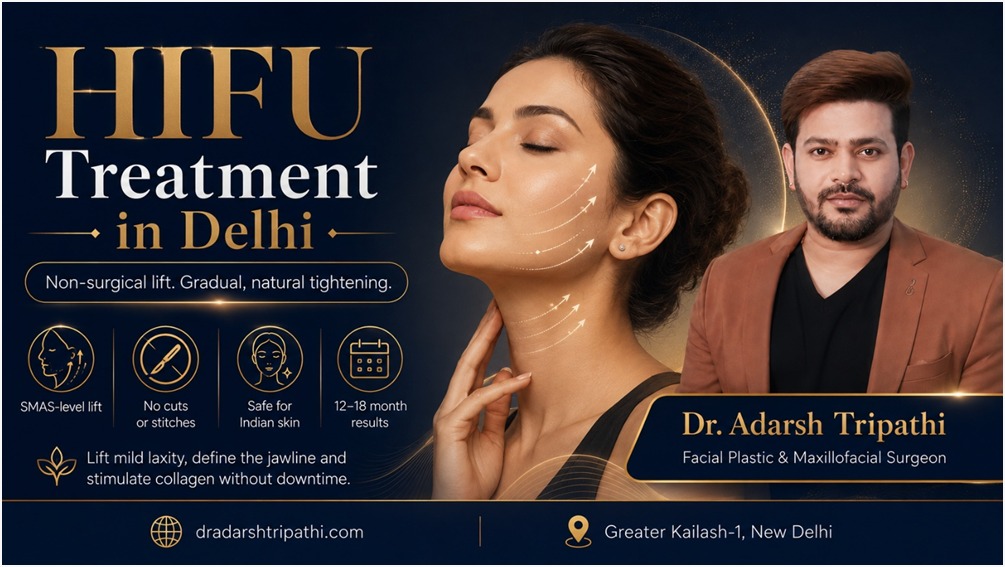
Quick answer: HIFU (High-Intensity Focused Ultrasound) is a non-surgical skin-tightening treatment that passes focused ultrasound energy harmlessly through the skin’s surface to heat precise depths beneath it – including the SMAS, the same layer a surgeon lifts during a facelift. It produces a gradual lift over two to six months, with no downtime. Realistically it delivers a fraction of a facelift’s effect, which is exactly right for mild-to-moderate laxity and not enough for significant sagging. In Delhi, HIFU costs approximately Rs 25,000-80,000 per session with results lasting 12-18 months. At Sarayu Clinics in Greater Kailash-1, it is performed by Dr. Adarsh Tripathi, a maxillofacial and facial plastic surgeon who also performs surgical facelifts – which means he has no reason to oversell either one.
Quick Facts
|
|
Anaesthesia | Topical numbing cream only |
Session time | 45-90 minutes depending on areas |
Downtime | Effectively none – back to normal the same day |
Discomfort | Mild – warmth and brief pulses under the skin |
First results | Slight immediate tightening; real change from 2-3 months |
Peak results | 4-6 months |
How long it lasts | 12-18 months |
Sessions needed | 1-2, then maintenance every 12-18 months |
Safe for Indian skin | Yes – no surface damage, so no pigmentation risk |
HIFU is one of the most useful non-surgical skin-tightening treatments available, and one of the most over-promised. Walk into the wrong clinic and you will be told it is a non-surgical facelift that takes years off your face in forty-five minutes. The reality is more interesting and, frankly, more useful: HIFU is a technically legitimate treatment that delivers a modest but meaningful lift for the right person, with no cuts, no downtime and no risk to the skin’s surface. Knowing whether you are that right person is the most valuable thing you can take from this page.
Here is the part that surprises people. HIFU is unrelated to lasers, radiofrequency or microneedling. It uses focused ultrasound that passes harmlessly through the skin’s surface and delivers precise heat at chosen depths beneath it. The deepest of those depths targets the SMAS – the fibrous layer that holds the face up against gravity, and the exact layer a facial plastic surgeon physically lifts during a facelift. That is not marketing language; it is the technical reason HIFU has a genuine lifting effect. The question is not whether HIFU works. It is how much it works in your particular case, and whether that amount is what you actually need.
Dr. Adarsh Tripathi performs both HIFU and surgical facelifts, which puts him in an unusual position to be honest about each. A clinic that only offers HIFU has every reason to oversell it. A surgeon who only operates may undersell it. Neither applies here – and on a treatment this widely mis-sold, a non-conflicted assessment is worth more than any device brochure.
How HIFU Works - and Why Depth Selection Matters ?
This is the most technically important section on the page, and it is almost always glossed over. Understanding it tells you exactly what you are paying for.
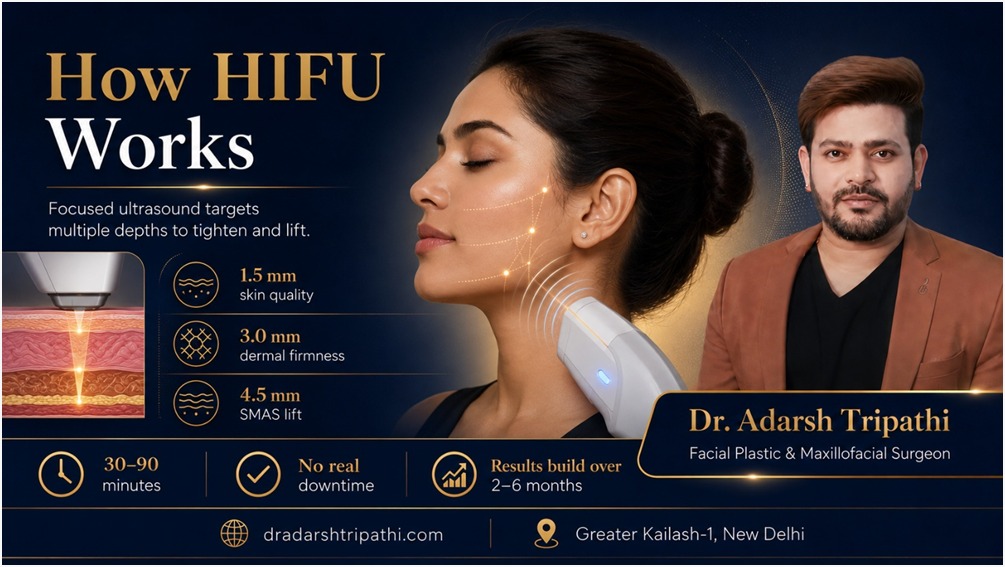
Modern HIFU machines use interchangeable cartridges, each focusing ultrasound energy at a different precise depth. Each depth reaches a different anatomical layer and produces a different effect.
Depth | Layer reached | What it does | What it is for |
1.5 mm | Superficial dermis | Stimulates collagen in the layer governing surface quality | Texture, fine lines, pore appearance |
3.0 mm | Deep dermis | Rebuilds the collagen and elastin network | Firmness, mild laxity |
4.5 mm | SMAS | Immediate tissue contraction plus long-term collagen remodelling | The actual lift – the same layer a facelift repositions |
Why this matters for your treatment. A proper HIFU session uses all three depths in combination – 4.5mm for structural lift, 3.0mm for firmness, 1.5mm for surface quality. A session that uses only one depth, usually to save time or cost, gives a partial result. When comparing clinics, ask two questions: which depths do you treat at, and how many shots per area? Those two answers tell you more about the quality of the treatment than any brand name. A thorough full-face treatment typically uses several hundred shots across the three depths.
What HIFU Honestly Delivers ?
- Gradual, natural-looking lift to the brows, mid-face, jowls, jawline and neck
- Improved firmness and skin quality as new collagen forms over weeks
- A sharper jawline contour – one of the most rewarding HIFU outcomes
- Softening of mild jowls and the under-chin area
- Neck tightening for early laxity, where non-surgical options are otherwise limited
- A small but visible brow-lift effect that opens the upper face
- No surface damage, and therefore no pigmentation risk – a genuine advantage on Indian skin
- Effectively zero downtime – work, exercise and social life resume the same day
- Results lasting 12-18 months, with maintenance possible indefinitely
- A legitimate preventive option for someone in their thirties seeing early changes
The honest framing on magnitude: industry estimates put HIFU’s lifting effect at roughly 10-30% of what a surgical facelift achieves. For mild laxity, that is often everything you need – a noticeable, refreshing change without surgery. For significant sagging, deep jowls or skin that has lost real elasticity, 10-30% will disappoint, and you will spend money chasing a result HIFU cannot deliver. Knowing where you sit on that spectrum is the whole conversation.
Areas Treated
Upper face and brow
Treatment around the brow and forehead opens the upper face, lifting heavy brows slightly and softening crow’s feet. A subtle effect, not a replacement for a surgical brow lift, but noticeable as part of a full-face session. For dynamic lines from expression rather than laxity, Botox is the appropriate treatment.
Mid-face and cheeks
As cheek fat pads descend, the mid-face flattens and nasolabial folds deepen. HIFU lifts the tissue and restores some contour. Where the problem is deflation rather than descent, cheek fillers or fat grafting address the actual cause – often the two are combined.
Lower face – jowls and jawline
The single most rewarding HIFU area for most patients. Mild-to-moderate jowls soften, the jawline is redefined, and the transition from face to neck becomes cleaner. Best in patients whose laxity has not yet become severe – beyond that point, a facelift is the honest answer.
Under the chin
Early submental laxity and soft under-chin skin respond well. Where the problem is genuine fat rather than loose skin, double chin treatment is the better route – distinguishing fat from laxity is part of the assessment.
Neck
Early neck laxity – the starting-to-loosen stage that precedes visible banding – is one of HIFU’s strongest applications, largely because the neck has fewer good non-surgical options than the face. Established platysmal banding, however, needs surgery.
Decolletage
Sun-damaged, crepey skin on the upper chest improves with HIFU, and is often combined with chemical peels or skin boosters for texture and pigment.
Body areas
Abdomen, arms, knees and thighs can be treated for mild laxity following modest weight loss. Results are subtle and depend heavily on realistic expectations.
What HIFU Treats - and Where It Honestly Disappoints ?
Concerns it addresses well
- Early-to-moderate facial laxity – the ‘I have started looking tired’ phase, typically thirties to early fifties
- A softened jaw angle with small jowls, where the skin still has elasticity
- Mild neck laxity before banding develops
- Loose skin after modest weight loss of five to ten kilograms
- Preventive maintenance in the thirties, slowing the visible progression of laxity
- Extending the results of a previous facelift
- General firmness and a denser collagen network, which reads as glow
Where it disappoints ?
HIFU disappoints when used for concerns it cannot address: significant sagging, deep jowls, established neck banding, substantial loose skin after major weight loss, or facial volume loss – which is a filler or fat grafting problem, not a tightening one. The common pattern is a patient hoping HIFU will be the answer for advanced ageing and feeling let down when it delivers a fraction of what they wanted. The kindest thing a doctor can do is say so before you spend the money.
HIFU Devices - What Is Actually Available
Device tier | What it is | Typical Delhi cost | Honest assessment |
Ultherapy (Merz) | The original FDA-cleared HIFU, with built-in ultrasound imaging so the operator can see the layer being treated | Rs 80,000-1,60,000 | Longest clinical track record; the imaging is a genuine safety feature. Premium price reflects both technology and brand |
Medical-grade HIFU (Ultraformer III, MMFU, Liftera and similar) | Newer multi-depth medical devices | Rs 25,000-60,000 | Clinical results comparable in skilled hands. This is what most legitimate HIFU in Delhi uses |
Sofwave | Ultrasound-based tightening, technically parallel-beam rather than classical HIFU | Varies | Works in similar therapeutic territory with a different delivery |
Salon-tier ‘HIFU’ | Sub-medical-grade machines | Rs 5,000-10,000 | Rarely reach therapeutic energy, often deliver one shallow depth only, few shots. Minimal real result |
Why a Rs 5,000 HIFU session is rarely real HIFU ?
Very low-priced HIFU promotions typically use sub-medical-grade machines that do not reach therapeutic energy levels, treat only one superficial depth, or deliver very few shots – producing little or no real change. Medical-grade HIFU at proper shot density across three depths costs what it costs because the technology, the training and the protocol all cost something. Paying properly for a treatment that works is better value than paying less for one that does not.
Are You a Good Candidate?
Likely a strong candidate
- Thirties to early fifties with mild-to-moderate laxity
- Early jowls or a softening jawline rather than significant sagging
- Skin that still has reasonable elasticity
- Wanting gradual, natural improvement without downtime
- Realistic – looking for refreshment rather than transformation
- Interested in preventive treatment while ageing is still early
- Postponing surgery and wanting a non-surgical bridge
- Unable to take recovery time for anything more invasive
Borderline – worth a combination discussion
- Moderate laxity in your fifties – HIFU helps, but a combination with Morpheus8, threads or fillers usually gives a better result than HIFU alone
- Previous facelift, wanting to extend the result – HIFU is a sensible maintenance option
- Under thirty with no real laxity – benefit may be minimal, and an honest conversation is needed
HIFU is not right for you if
- You have significant sagging or deep jowls – a surgical facelift is the genuine answer
- You have established neck banding – surgery is needed
- You have substantial loose skin after major weight loss – non-surgical options will not restore it
- Your main concern is volume loss such as hollow cheeks – that is fillers or fat grafting, not tightening
- Your main concern is expression lines – that is Botox
- You expect overnight or dramatic results – HIFU is gradual and modest by nature
Medical reasons to defer
Active skin infection or open wounds in the area; recent fillers in the area (typically wait two weeks); permanent fillers, implants or metal hardware in the treatment zone; pacemaker or implanted electrical devices; pregnancy or breastfeeding; active inflammatory skin conditions; and keloid tendency, assessed case by case.
The HIFU Treatment Procedure, Step by Step
Consultation and candidacy assessment
This is where a clinic that books everyone for HIFU differs from a doctor who tells you honestly whether you are a good candidate. Dr. Tripathi examines skin elasticity, the degree and pattern of laxity, facial volume status and your goals – then either recommends HIFU, suggests a combination, or says plainly that HIFU will not get you where you want to go and explains what would.
Preparation
- Arrive with clean skin – no makeup, oils or heavy moisturiser
- Avoid blood thinners and alcohol for 24 hours to limit minor bruising
- Disclose any recent fillers, implants or a pacemaker
- Eat normally beforehand – the treatment is well tolerated
- Allow 60-90 minutes for the appointment
Mapping and numbing
Treatment areas are cleansed and marked with a grid so coverage is systematic rather than approximate. Numbing cream is applied for 30-45 minutes. Ultrasound gel is applied to allow clean contact between the transducer and the skin.
The treatment itself
The right depth cartridge is selected for each area – typically 4.5mm first for the SMAS, then 3.0mm, then 1.5mm. Each shot delivers focused energy to that precise depth. You feel intermittent warmth or brief tingling as each line is delivered, well tolerated under numbing. Shot counts are tracked per area, because density is what determines the result. The neck and submental area, if included, are treated with the deeper settings.
Immediately after
Cooling and sun protection are applied. Mild redness or slight transient swelling are normal and settle within hours. You can return to work, exercise and social life the same day.
Maintenance
Most candidates see a clear result from one session, with an optional second at six months for a stronger effect. Maintenance every 12-18 months keeps results going. Many patients combine HIFU with Morpheus8, fillers or Botox within a broader plan – see full face sculpting for how these are sequenced.
Questions worth asking before you book anywhere
- Which device are you using, and is it medical-grade?
- Which depths will you treat at – all three, or fewer?
- How many shots per area will I get?
- Will a doctor perform the treatment or a technician?
- Realistically, how much lift should I expect in my case?
- If HIFU is not enough for me, what would you recommend instead?
Downtime and Side Effects
Timeframe | What to expect |
Immediately after | Mild redness for a few hours; treated areas may feel slightly tender or tight, like after a hard workout. Light makeup is fine. Normal activity resumes at once |
Days 1-3 | Most people feel essentially normal. Mild tenderness on pressure, especially along the jawline. Occasionally very small bruises at high-energy points |
Week 1 | Tenderness resolved. Skin may feel slightly tighter. Collagen building has begun internally but is not yet visible |
Weeks 2-8 | Active collagen remodelling. Some notice gradual change; others see little until later |
Months 2-6 | The lifting and tightening becomes clearly visible and continues improving. This is when to assess the result |
Side effects are minimal in skilled hands. Common and expected: mild redness and tenderness resolving within hours. Uncommon: small bruises, mild swelling for a day or two, or temporary numbness in small patches that settles over days to weeks. Rare: brief nerve irritation causing transient weakness in a facial muscle, which resolves. HIFU’s safety profile is excellent precisely because it does not damage the skin surface – which is also why it avoids the pigmentation risk that limits many laser treatments on Indian skin.

Cost of HIFU in Delhi
Direct answer: HIFU in Delhi costs approximately Rs 25,000-80,000 per session depending on the area treated and the device used. Lower face runs around Rs 25,000-45,000, full face Rs 35,000-60,000, and full face with neck Rs 45,000-80,000. The premium FDA-cleared Ultherapy device costs considerably more, at Rs 80,000-1,60,000. Prices well below this range usually indicate sub-medical-grade equipment or a session with far fewer shots than a proper treatment requires.
Area treated | Approx. cost | Session time | Sessions suggested |
Lower face only (jowls, jawline) | Rs 25,000-45,000 | 45-60 mins | 1-2 |
Full face | Rs 35,000-60,000 | 60-75 mins | 1-2 |
Neck only | Rs 20,000-35,000 | 30-45 mins | 1-2 |
Full face + neck | Rs 45,000-80,000 | 75-90 mins | 1-2 |
Submental (under-chin) | Rs 15,000-25,000 | 20-30 mins | 1-2 |
Decolletage | Rs 25,000-40,000 | 30-45 mins | 1-2 |
Body area (per zone) | Rs 25,000-50,000 | 30-60 mins | 1-3 |
Ultherapy (branded, FDA-cleared) | Rs 80,000-1,60,000 | 60-90 mins | 1 |
The cost comparison worth doing honestly
Five to eight HIFU sessions over a decade may approach the cost of a facelift without approaching its result, which lasts eight to twelve years. For a patient with mild laxity in their late thirties, HIFU is clearly the right call and surgery would be overkill. For a patient with established sagging who keeps repeating HIFU hoping it will eventually be enough, the arithmetic stops working fairly quickly. Which of those describes you is exactly what an honest consultation should establish – and it is why being assessed by someone who performs both treatments matters.
Results Timeline - When Will I See the Lift?
- Same day: some immediate tightening from tissue contraction – visible but subtle, and not the final result
- Weeks 1-4: modest change as the immediate effect settles and collagen remodelling begins. Do not judge yet
- Months 2-3: lifting and tightening become clearly visible. Jawline sharper, jowls softer, neck firmer. Roughly 60-70% of the eventual result
- Months 3-6: peak collagen formation and the full effect. This is when to evaluate whether a second session is worthwhile
- Months 6-18: results stabilise then gradually fade as collagen turns over. Maintenance extends them indefinitely
The single biggest reason people are disappointed by HIFU is judging it too early. The lift you have at one month is not the lift you will have at three. Patients who assess HIFU at four weeks often conclude it did not work; the same patients at four months are usually pleased. If you genuinely see no change at six months, the treatment did not work for your skin – but that judgement belongs at six months, not at one.
HIFU Compared with Other Treatments
Treatment | How it works | Best for | Downtime | Lasts |
HIFU | Focused ultrasound to three depths including SMAS | Mild-moderate laxity, jawline, neck | None | 12-18 months |
Microneedling plus radiofrequency | Laxity with texture or scarring | 2-4 days | 12-18 months | |
Barbed threads physically reposition tissue | Immediate modest lift for descent | 3-5 days | 12-18 months | |
Relaxes muscle | Dynamic expression lines | None | 3-4 months | |
Adds volume | Deflation, not descent | 1-3 days | 6-24 months | |
Transfers your own fat | Permanent volume restoration | 1-2 weeks | Permanent (50-70% survives) | |
Physically lifts SMAS and removes excess skin | Significant sagging | 2-3 weeks | Years |
HIFU and Morpheus8 – complementary, not competing
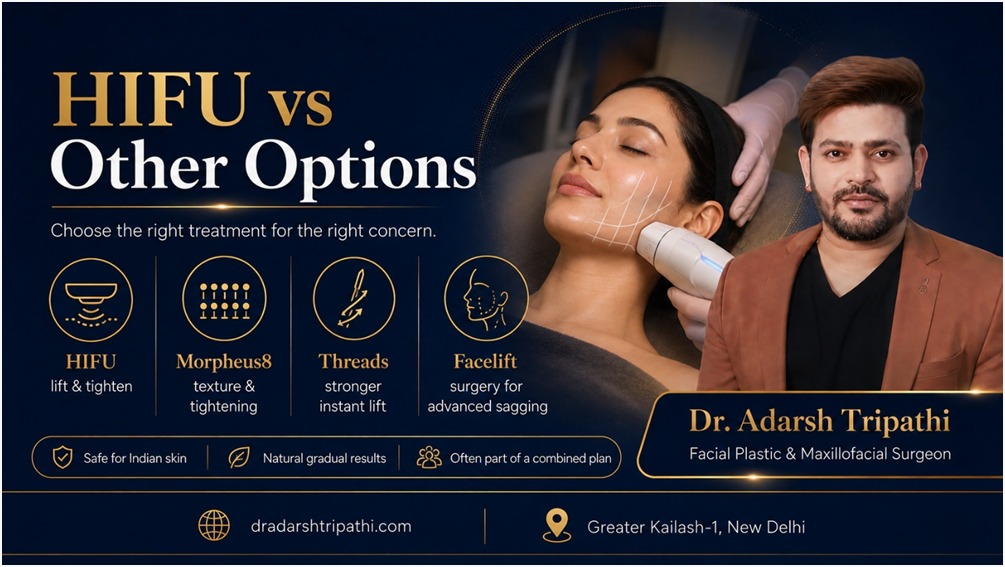
These are often pitched as alternatives but they layer well. HIFU reaches deepest, to the SMAS, for structural lift. Morpheus8 works broader and shallower for skin texture, pores and scarring. Many patients do best with both in a planned sequence – HIFU for the lift, RF microneedling for the skin. They do not cancel each other out.
HIFU or thread lift?
Thread lifts give a more immediate mechanical lift but involve inserting material under the skin, with genuine complication potential – visible threads, dimpling, asymmetry. HIFU is gentler, with nothing inserted, but the lift is gradual and modest. For mild laxity HIFU is usually the cleaner choice. Some patients start with HIFU and add threads later if more lift is needed.
HIFU or a surgical facelift?
The honest version, which most clinic pages avoid: a facelift lifts the SMAS physically and removes excess skin, giving a far greater degree of change that lasts years. HIFU heats the SMAS but removes nothing and delivers a fraction of that result. For mild-to-moderate laxity, HIFU is usually the right answer and far less invasive. For significant sagging, no number of HIFU sessions will equal surgery. A surgeon who performs both can tell you honestly which you are.
Why a facial plastic surgeon for HIFU?
HIFU is technically straightforward to operate. The judgement of whether it is right for you – and the protocol used, meaning depths, shot density and areas – is where experience makes the difference. A facial surgeon who also performs surgical lifts can give an unbiased assessment, because he has no reason to push one option over the other. The American Society of Plastic Surgeons publishes independent patient guidance on non-surgical skin tightening worth reading alongside any clinic’s own material.
Choosing a HIFU Treatment Doctor in Delhi
Direct answer: a HIFU treatment doctor in Delhi should be medically qualified, should use a medical-grade device rather than salon-tier equipment, should treat at all three depths with proper shot density, should assess candidacy honestly – including being willing to say HIFU is not right for you – and ideally should be able to offer the surgical alternative if that is what you actually need. HIFU is widely offered in Delhi and the quality of the assessment varies far more than the quality of the machines.
What to look for ?
- A doctor rather than a technician running the treatment
- Honest candidacy assessment, including willingness to decline
- Knowledge of all three depths and how to combine them
- A medical-grade device, named openly
- Awareness of when HIFU is enough, when combination is better, and when surgery is the honest answer
- Consultation conducted personally by the doctor
- Genuine before-and-after photographs of patients with similar concerns
Why patients choose Dr. Adarsh Tripathi
- Adarsh Tripathi is a Maxillofacial and Facial Plastic Surgeon with 18+ years of experience.
- He performs both HIFU and surgical facelifts – uniquely placed to advise which is right for you, because nothing rides on the answer
- A practice focused entirely on the face, with a working understanding of the SMAS layer HIFU targets – from operating on it, not from a device manual
- All three depths used in proper combination, with thorough shot density.
- Honest about HIFU’s modest-but-meaningful effect – never marketed as a non-surgical facelift to someone who needs actual surgery
- Integrates HIFU into a broader plan with Morpheus8, fillers, Botox and skincare where that serves the result better
- See before-and-after results and celebrity facial work
- Greater Kailash-1, New Delhi – convenient from GK-2, CR Park, Kailash Colony, Defence Colony, Hauz Khas, Nehru Place and South Extension.
Frequently Asked Questions
What is HIFU treatment?
HIFU (High-Intensity Focused Ultrasound) is a non-surgical skin-tightening treatment that uses focused ultrasound to deliver precise heat to deep layers of skin – including the SMAS layer that surgeons lift during a facelift – stimulating collagen production. Over two to six months this produces a gradual lifting and tightening effect on the brows, cheeks, jowls, jawline and neck. It is non-invasive, has essentially no downtime, and results last 12-18 months.
How much does HIFU cost in Delhi?
HIFU in Delhi costs approximately Rs 25,000-80,000 per session depending on the area and device. Lower face runs Rs 25,000-45,000, full face Rs 35,000-60,000, and full face with neck Rs 45,000-80,000. The branded FDA-cleared Ultherapy device costs Rs 80,000-1,60,000. Prices far below this range usually indicate sub-medical-grade machines or sessions with very few shots.
Is HIFU as good as a facelift?
No. HIFU delivers an estimated 10-30% of a facelift’s lifting effect – meaningful for mild-to-moderate laxity, and far short of what surgery achieves for significant sagging. The two are complementary rather than equivalent: HIFU suits the right candidate brilliantly, while a surgical facelift suits more advanced ageing. A surgeon who performs both can advise honestly which applies to you.
Who is the best doctor for HIFU treatment in Delhi?
One who assesses candidacy honestly, uses a medical-grade device with proper depth and shot-density protocols, and is willing to say when HIFU is not the right treatment. Dr. Adarsh Tripathi is a Maxillofacial and Facial Plastic Surgeon with 18+ years of experience who performs both HIFU and surgical facelifts, at Sarayu Clinics, Greater Kailash-1 – which means his recommendation is not shaped by what he can offer.
Who is a good candidate for HIFU?
The best candidates are aged roughly 30 to early 50s with mild-to-moderate laxity, early jowls or a softening jawline, and skin that still has reasonable elasticity – and who are realistic about gradual rather than overnight change. HIFU is also valuable preventively in the thirties and as maintenance after a previous facelift. It does not suit significant sagging, established neck banding, or major post-weight-loss skin laxity, which need surgical solutions.
Is HIFU painful?
HIFU causes mild-to-moderate sensation – most patients describe warmth, prickling or brief pulses of heat under the skin. Numbing cream applied beforehand makes it well tolerated. Some areas, particularly along the jawbone and forehead, feel more intense than others. The sensation is present only while each shot is delivered and stops immediately after, so it is not sustained pain.
How long do HIFU results last?
Typically 12-18 months. Visible improvement begins around two to three months as collagen forms, peaks at four to six months, then gradually fades as collagen turns over and natural ageing continues. Maintenance sessions at 12-18 months extend results indefinitely. The collagen formed is real and durable, but the underlying ageing process does not stop.
How many HIFU sessions do I need?
Most patients need one to two sessions for the initial result, with a second at six months if a stronger effect is wanted. Maintenance is then typically every 12-18 months. The exact number depends on the degree of laxity, the device used and how your skin responds – a doctor should plan the schedule around your situation rather than selling a fixed package.
What is the difference between HIFU and Ultherapy?
Ultherapy is a specific FDA-cleared brand of HIFU made by Merz, which includes built-in ultrasound imaging so the operator can see the layers being treated. Other medical-grade HIFU devices work on the same focused-ultrasound principle at significantly lower cost, and in skilled hands clinical results are comparable. The main differences are the imaging feature, the brand premium and the price. Salon-tier ‘HIFU’ is a different category altogether and is not medical-grade.
Is HIFU safe for Indian skin?
Yes – HIFU is one of the safest skin-tightening options for Indian and darker skin. Because the ultrasound energy passes through the skin’s surface without damaging it, there is no risk of post-inflammatory hyperpigmentation, which is the main concern with many laser-based treatments on Fitzpatrick IV-VI skin. That makes HIFU particularly valuable in India, where PIH risk often limits more aggressive options.
Are there side effects of HIFU?
Side effects are minimal in skilled hands. Common: mild redness, tenderness and a tight feeling for a few hours. Uncommon: small bruises, mild swelling for a day or two, temporary numbness in small patches. Rare: brief nerve irritation causing transient facial muscle weakness, which resolves. HIFU’s safety profile is strong precisely because it does not damage the skin surface.
When will I see HIFU results?
Some immediate slight tightening is visible the same day from tissue contraction. Genuine collagen-based improvement begins around two to three months and peaks at four to six. Do not judge the result before three months – patients who assess HIFU at one month often think it failed, and the same patients at four months are usually pleased.
HIFU or Morpheus8 – which should I choose?
They do different jobs and often work best together. HIFU reaches deepest, to the SMAS, for structural lift. Morpheus8 works broader and shallower for texture, pores and scarring alongside tightening. If your priority is lift, start with HIFU; if it is skin quality and texture, start with Morpheus8. Many patients benefit from both in a planned sequence rather than choosing between them.
How to Reach Us:
Phone:+91 9289111083 ,+91 9289111084
Dr Adarsh’s website: https://dradarshtripathi.com/
Facebook: https://www.facebook.com/DrAdarshTripathi3011
Instagram: https://www.instagram.com/dr_adarsh_tripathi/
Youtube: https://www.youtube.com/@dr_adarsh_tripathi
Linkedin: https://www.linkedin.com/in/dr-adarsh-tripathi-a43005b8/
Online Booking: https://dradarshtripathi.com/contact-us/ to schedule appointments conveniently.