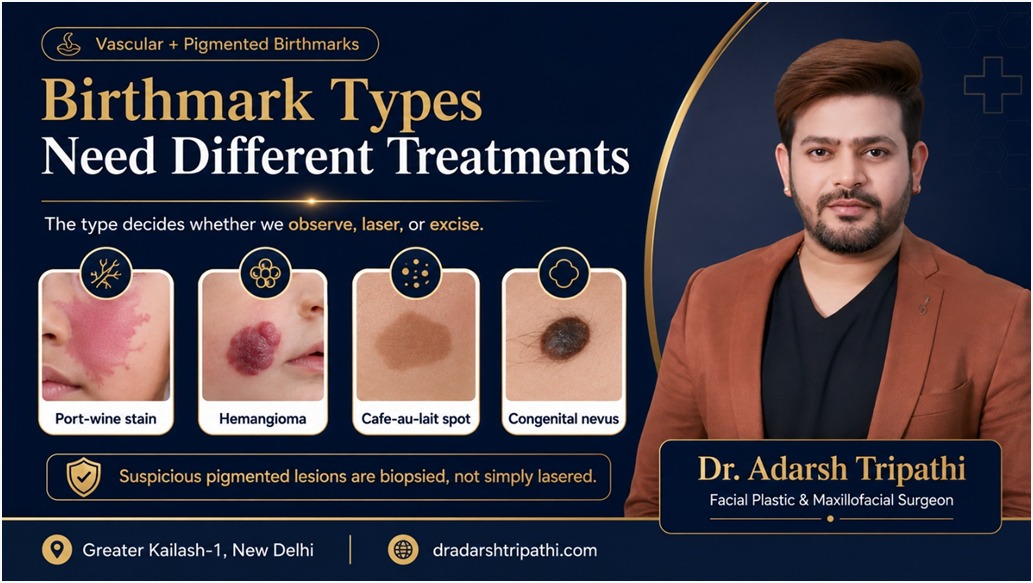
Birthmark Removal in Delhi — The Right Treatment for Your Birthmark Type
Almost everyone has a birthmark of some kind, and the truth is most are completely harmless — just natural variations in how the skin formed. People come for birthmark removal for several reasons: a mark on the face they’ve always disliked, one that catches and irritates, one that’s grown or changed, or one a doctor has suggested should be checked. Whichever applies to you, the path to a good result starts with one thing most clinic pages skip over: figuring out exactly what type of birthmark you have, because different birthmarks need completely different treatments.
This matters more than it might sound. A flat red port-wine stain needs a vascular laser (Pulsed Dye Laser) that targets blood vessels — and using a pigment laser on it does almost nothing. A brown café-au-lait spot needs a pigment laser, and a vascular laser does little for it. A large or atypical pigmented birthmark may need to be surgically removed and biopsied rather than lasered, because lasering destroys the tissue and rules out cancer screening if it ever turns out to be needed. Matching the right treatment to the right birthmark is the single biggest factor in whether you get a real result, and it’s where many quick-fix clinics go wrong.
Dr. Adarsh Tripathi is a Maxillofacial and Facial Plastic Surgeon with over 18 years of experience at Sarayu Clinics, Greater Kailash-1, New Delhi. Because his practice is focused on the face, birthmark removal is approached with two priorities most clinics can’t combine: medical judgement about whether the birthmark is safe to treat cosmetically, and the surgical skill to remove it with the least possible scarring on visible skin. This page explains the birthmark types, which treatment suits each, recovery, cost, and how to get a safe, natural result.
Benefits of Professional Birthmark Removal
When the treatment is matched correctly to the birthmark type, the results are genuine and often life-changing for visible birthmarks. Here’s an honest picture:
- Significant fading or removal of unwanted birthmarks — fully removed for some types, substantially lightened for others
- Smoother, more even skin appearance and tone
- Minimal scarring when treatment is matched to the birthmark and performed by a skilled surgeon
- Medical assessment that catches the rare cases where a birthmark needs biopsy or specialist attention
- Relief from physical irritation — birthmarks that catch on clothing or rub in skin folds
- Long-lasting results — a properly treated birthmark doesn’t return for most types
- Confidence in social, professional, and intimate settings — for facial birthmarks especially, the impact can be profound
An honest framing: birthmark removal is not always about complete erasure. Port-wine stains, for example, can be substantially faded over 6–10 sessions but rarely disappear entirely — yet they’re often lightened enough that they’re hard to notice in normal light. Mongolian spots usually fade on their own and don’t need treatment at all. A good doctor will tell you honestly what’s realistically achievable for your specific birthmark — and sometimes that means recommending observation rather than treatment.
Areas of the Body Where Birthmarks Are Treated
Birthmarks can appear anywhere, but the location strongly affects which treatment is best and how carefully scarring needs to be managed.
Face
The most common reason people seek birthmark removal, and the area where scarring matters most. Facial birthmarks — port-wine stains on the cheek or forehead, café-au-lait spots, pigmented patches, small hemangiomas — are treated with particular care for minimal scarring. As a facial plastic surgeon, Dr. Tripathi pays particular attention to closure technique and laser settings on facial skin.
Neck and Scalp
Birthmarks here are common and treatable; the scalp’s hair often conceals any mark after removal. Salmon patches at the nape of the neck (‘stork bites’) often fade naturally and may need no treatment.
Trunk (Chest, Back, Abdomen)
Often the site of congenital pigmented nevi (sometimes large), café-au-lait spots, and Mongolian spots. Larger pigmented birthmarks on the trunk are commonly excised both for cosmetic reasons and, where indicated, for biopsy.
Arms and Legs
Common location for port-wine stains, café-au-lait spots, and pigmented birthmarks. Port-wine stains on the limbs typically respond less completely to laser than facial ones — an honest expectation to set.
Hands and Feet
Birthmarks here are treatable but the skin is thicker and healing can be slower. Care is needed with treatment intensity.
Areas in Skin Folds (Underarms, Groin)
Birthmarks that rub against clothing in these areas often become irritated and are removed for comfort as well as appearance.
Types of Birthmarks — and the Right Treatment for Each
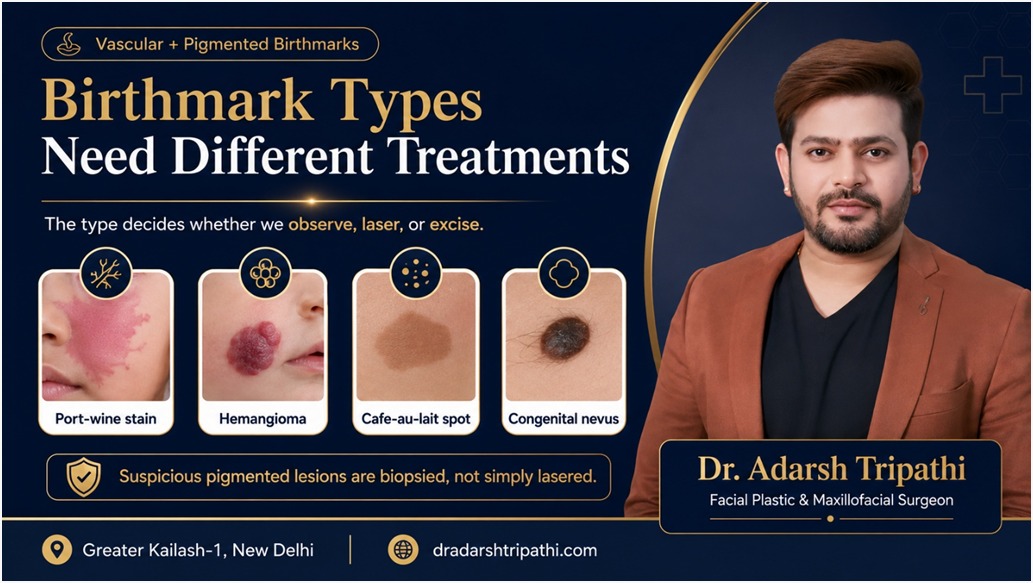
This is the heart of effective birthmark treatment. Identifying your birthmark correctly determines which method works. Most birthmarks fall into two broad families — vascular and pigmented — and within each there are several specific types, each with its own preferred treatment.
VASCULAR BIRTHMARKS (Red, Pink, Purple, or Blue)
Port-Wine Stain (Nevus Flammeus)
Flat, pink to deep red-purple patches caused by dilated blood vessels in the skin. Present from birth, they don’t fade — and often darken and thicken with age. The gold-standard treatment is the Pulsed Dye Laser (PDL), which targets the blood vessels selectively. Most port-wine stains need 6–10 sessions for meaningful fading, sometimes more. Facial port-wine stains respond best; those on hands and lower legs respond less completely. Important safety point: port-wine stains on the forehead, eyelid, or both sides of the face can be associated with Sturge-Weber syndrome (potential glaucoma or seizure issues) and warrant medical evaluation.
- Best treatment: Pulsed Dye Laser (PDL) — typically 6–10 sessions
Infantile Hemangioma (‘Strawberry’ Birthmark)
Raised, bright red lumps that appear in the first weeks of life from rapidly growing blood vessels. The crucial thing parents often aren’t told: most small hemangiomas naturally shrink and fade (‘involute’) over years, often without any treatment. Treatment is reserved for those that are large, in problematic locations (eye, lip, airway), ulcerating, or not involuting. Options include oral propranolol (a medical treatment under specialist care), laser, and occasionally surgery. Many small hemangiomas are best managed by observation, not intervention.
- Best approach: assessment first — many resolve naturally; treatment reserved for those needing it
Salmon Patch / Nevus Simplex (‘Stork Bite’, ‘Angel’s Kiss’)
Light pink, flat marks often on the nape of the neck (stork bite) or forehead/eyelids (angel’s kiss) in newborns. The vast majority fade naturally during the first few years of life, so treatment is usually unnecessary. Persistent forehead salmon patches can be treated with PDL if needed.
- Best approach: observation — most fade naturally; PDL only if persistent
Venous Malformation / Cavernous Hemangioma
Deeper blue or purple birthmarks made of larger blood vessels. These may need specialist vascular assessment, sclerotherapy, deeper-acting laser (like long-pulse Nd:YAG), or surgery depending on size and location.
- Best approach: specialist assessment; sclerotherapy, Nd:YAG laser, or surgery
PIGMENTED BIRTHMARKS (Brown, Black, or Blue)
Café-au-Lait Spots
Light brown, flat, oval-to-irregular patches of even colour. Mostly harmless, treated cosmetically with Q-switched or Pico lasers, which target the excess pigment. Multiple sessions are usually needed; results vary and recurrence is possible, especially in the first few years. Worth knowing: six or more café-au-lait spots can be a sign of neurofibromatosis and warrant medical assessment — a single mark, however, is almost always purely cosmetic.
- Best treatment: Q-switched / Pico laser — multiple sessions; possible recurrence
Congenital Melanocytic Nevi (Pigmented Moles Present from Birth)
Brown to black pigmented patches present from birth. Small ones are usually harmless and can be removed cosmetically. Large or ‘giant’ congenital nevi carry a small but real lifetime risk of melanoma and need careful specialist assessment — they’re usually best managed by surgical excision with biopsy, not by laser (which destroys the tissue). This is the safety-critical category.
- Best treatment: surgical excision (allows biopsy) for larger/atypical; cosmetic options for small benign ones
Mongolian Spots / Congenital Dermal Melanocytosis
Bluish-grey, flat patches usually on the lower back and buttocks of newborns, especially of South Asian, East Asian, and Middle Eastern heritage. They are completely harmless and almost always fade naturally during early childhood. Treatment is essentially never needed, and an honest doctor will tell you that rather than offering laser. Persistent ones in adults can be treated with Q-switched laser if cosmetically bothersome.
- Best approach: observation — almost all fade naturally; Q-switched laser only if persistent and bothersome
Becker’s Nevus
A darker brown patch, often on the shoulder or back, sometimes with increased hair. Tends to appear or darken at puberty. Treatment with Q-switched laser can lighten the pigment, and laser hair reduction can address the hair. Results are variable; recurrence is possible.
- Best treatment: Q-switched laser ± laser hair reduction
Atypical / Suspicious Pigmented Birthmarks
Any pigmented birthmark that has changed, has irregular borders, mixed colours, or is growing, must be assessed and is usually best surgically excised with biopsy — not lasered — to rule out melanoma. This is the same safety principle that applies to suspicious moles.
- Best approach: surgical excision with biopsy — never simply lasered
Are You a Good Candidate for Birthmark Removal?
Most healthy people with an unwanted, irritating, or concerning birthmark are candidates for at least one treatment — provided the birthmark is correctly identified and assessed first.
You are a good candidate if:
- You have a birthmark that bothers you cosmetically, catches and irritates, or you’re concerned about
- The birthmark has been properly assessed and is suitable for cosmetic removal
- You’re in good general health with no active skin infection at the site
- You have realistic expectations — significant fading for some types, complete removal for others, multiple sessions usually needed
- You’re willing to follow aftercare, especially strict sun protection during healing
Special considerations for children and infants
Many birthmark consultations are for children, and the right approach is often different. Many salmon patches and most Mongolian spots fade on their own and don’t need treatment. Infantile hemangiomas often involute naturally; specialist medical treatment (propranolol) is reserved for problematic cases. Port-wine stains, however, respond best to laser treatment started early — so children with port-wine stains may benefit from beginning treatment in childhood rather than waiting. A proper paediatric-friendly assessment guides this.
Important — biopsy first if there’s any suspicion
As with moles, any pigmented birthmark that has changed, has irregular features, or is large/atypical should be surgically removed and biopsied — not lasered. Laser destroys the tissue and would prevent diagnosis if it ever turned out to be skin cancer. This assessment-first approach is what distinguishes safe, responsible birthmark removal from a purely cosmetic service.
Discuss carefully if you:
- Have a birthmark with any warning signs (rapid growth, change, irregular borders, mixed colours) — needs assessment and possibly biopsy
- Have darker skin (Fitzpatrick IV–VI) — laser settings must be adjusted for higher PIH risk
- Have a tendency to keloid scarring — surgical options are planned cautiously
- Have an active tan — wait until it fades before laser treatment
- Are pregnant — non-urgent cosmetic treatment is usually deferred
Birthmark Removal Methods at Sarayu Clinics, Delhi
The right method depends on what type of birthmark you have. Here are the options with honest guidance on when each is appropriate.
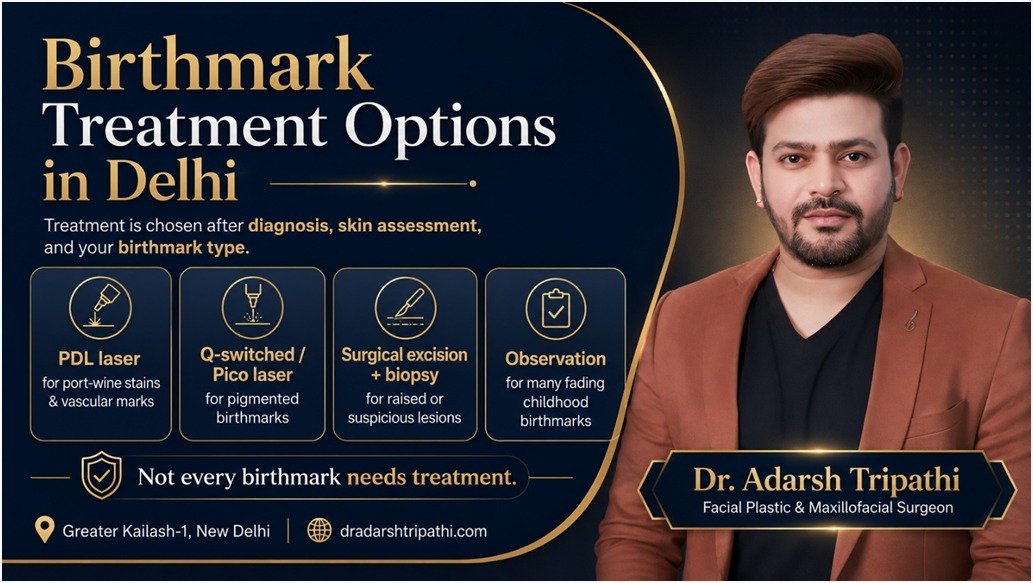
1. Pulsed Dye Laser (PDL) — for Vascular Birthmarks
The gold standard for port-wine stains and many hemangiomas. PDL emits a specific wavelength of light absorbed by haemoglobin in blood vessels, selectively damaging the abnormal vessels without harming surrounding skin. Best for flat, red-purple birthmarks. Most port-wine stains need 6–10 sessions, spaced 6–8 weeks apart, with progressive fading session by session. Some bruising and temporary darkening for a few days afterwards is normal.
- Best for: port-wine stains, superficial hemangiomas, persistent salmon patches
2. Q-Switched / Pico Lasers — for Pigmented Birthmarks
Q-switched (Nd:YAG, alexandrite, ruby) and the newer Pico lasers deliver ultra-short pulses absorbed by melanin pigment, shattering the excess pigment into tiny fragments the body clears naturally. Best for café-au-lait spots, Becker’s nevus, and persistent Mongolian spots. Multiple sessions are usually needed, and pigmented birthmarks can sometimes recur — an honest expectation to set.
- Best for: café-au-lait spots, Becker’s nevus, persistent pigmented marks
3. Long-Pulse Nd:YAG Laser — for Deeper Vascular Birthmarks
Penetrates deeper than PDL, useful for deeper or thicker vascular birthmarks where PDL alone is insufficient. Often used in combination protocols for complex vascular lesions.
- Best for: deeper vascular birthmarks, venous malformations
4. Surgical Excision (with Biopsy)
The right choice for larger pigmented birthmarks, raised birthmarks, congenital melanocytic nevi (especially larger ones), and any atypical or suspicious lesion. The birthmark is surgically removed with fine margins and the wound closed precisely — and the excised tissue can be sent for histopathology to confirm it’s benign or detect any abnormality. As a facial plastic surgeon, Dr. Tripathi pays particular attention to closure for the finest possible scar, which matters most on the face.
- Best for: larger/raised/suspicious pigmented birthmarks; biopsy needed
5. Cryotherapy
Freezes the birthmark using liquid nitrogen, causing it to gradually scab and fall off. Useful for selected small, superficial lesions where appropriate. Less commonly used for birthmarks compared with laser or excision, as it doesn’t preserve tissue for biopsy.
- Best for: small, superficial, clearly benign lesions
6. Electrosurgery (Electrocautery)
Uses controlled electrical current to remove birthmark tissue. Quick and effective for certain small, raised, benign lesions; not used for suspicious birthmarks because tissue isn’t preserved for biopsy.
- Best for: small benign raised lesions
7. Medical Treatment (Specialist Care)
Some birthmarks, especially problematic infantile hemangiomas, are best managed medically with oral propranolol (a beta-blocker that shrinks hemangiomas) under specialist supervision — sometimes alongside laser. This is paediatric specialist territory and is mentioned here so you know it exists as an option for the right cases.
- Best for: problematic infantile hemangiomas (specialist care)
8. Observation (No Treatment Required)
Worth saying clearly because most clinics won’t: many birthmarks don’t need treatment. Mongolian spots almost always fade. Most salmon patches fade. Many small infantile hemangiomas involute naturally. A responsible doctor will sometimes advise watching rather than treating — and that’s a genuine recommendation, not a missed sale.
- Best for: Mongolian spots, fading salmon patches, small involuting hemangiomas
Choosing the Right Method — The Honest Principle
The rule that protects you: if there’s any doubt about whether a pigmented birthmark might be (or could become) abnormal, it’s surgically excised and biopsied — never simply lasered. Laser is excellent for clearly benign vascular and pigmented birthmarks; surgical excision is for larger, raised, atypical, or suspicious ones; observation is for the many birthmarks that resolve on their own. Matching the method to the type is the whole game.
The Birthmark Removal Procedure — Step by Step
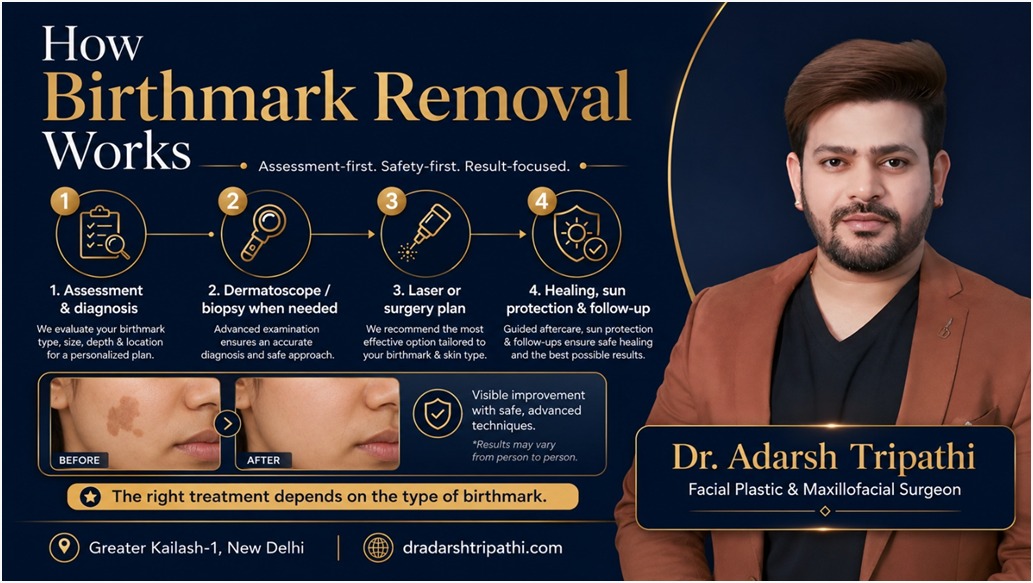
Step 1: Consultation & Assessment
Dr. Tripathi examines the birthmark carefully — type, size, depth, colour, location, any changes — sometimes with a dermatoscope. Your medical history is reviewed, and for facial port-wine stains (especially near the eye), associated conditions are screened for. This determines whether the birthmark is suitable for cosmetic treatment, needs surgical excision and biopsy, needs specialist input, or doesn’t need treatment at all. You’ll get an honest recommendation, not a default sales pitch.
Step 2: Preparation
- Avoid sun and tanning for 2 weeks before laser treatment (essential for safety, especially Indian skin)
- Stop blood-thinning medications/supplements for a few days before surgery if advised
- Arrive with the area clean, free of makeup, lotions, or creams
- Antiviral medication if treating near the lips with a cold-sore history
Step 3: Anaesthesia
Most laser treatments need only topical numbing cream applied 30–45 minutes beforehand. Surgical excision is done under local anaesthetic injection (and occasionally with sedation for larger lesions or anxious patients/children). The actual procedure is essentially painless.
Step 4: The Treatment
- The numbed birthmark is treated using the chosen method — laser, excision, etc.
- For surgical excision, tissue is preserved and sent for biopsy if indicated
- Cooling, soothing product, and (if relevant) a dressing are applied
- Sun protection is applied; aftercare instructions are given
Most laser sessions take 15–30 minutes; surgical excisions 30–60 minutes.
Step 5: Biopsy Results (When Applicable)
Where tissue was sent for histopathology, results typically return within about a week. Almost all are benign; in the rare event of an abnormal result, Dr. Tripathi discusses findings and next steps — which is precisely the safety value of choosing surgical excision for atypical lesions.
Step 6: Aftercare
- Keep the area clean; apply prescribed ointment as instructed
- Strict sun protection (SPF 50+) — essential for results and to prevent pigmentation
- Don’t pick at scabs (laser/excision) — let them heal naturally
- Sutures (if used) removed at 5–7 days for face, 10–14 days for body
- Attend follow-up sessions on schedule — most birthmarks need multiple
Downtime — What to Expect by Method
Method | Discomfort | Visible After-Effects | Downtime | Back to Routine |
Pulsed Dye Laser (PDL) | Mild snapping | Bruising 5–10 days | ~1 week (bruising) | Same/next day |
Q-Switched / Pico Laser | Mild | Redness, mild darkening | 2–5 days | Same/next day |
Long-Pulse Nd:YAG | Mild | Redness, possible bruising | 3–7 days | Next day |
Surgical Excision | Numbed | Sutures, fine wound | 1–2 weeks | Next day (covered) |
Cryotherapy | Brief sting | Scab, then pink skin | 1–2 weeks | Same day |
Electrosurgery | Brief | Small scab | ~1 week | Same day |
The practical takeaway: most birthmark treatments have modest downtime. The unusual feature with PDL is temporary bruising-like darkening for a few days to a week after each session — this is normal and expected, and is part of how the laser works (it’s called purpura, and it fades). Surgical excision has the longest healing but is essentially the only option that allows biopsy.
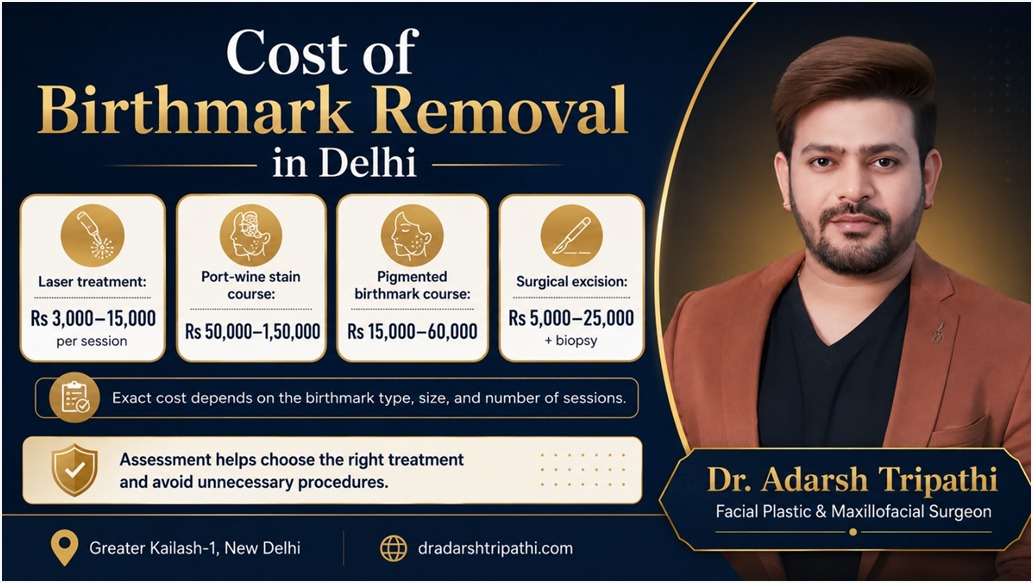
Birthmark Removal Cost in Delhi — Transparent Pricing
Cost depends on the birthmark type, size, the treatment used, the number of sessions needed, and whether biopsy is required. Because many birthmarks need a course rather than a single session, it’s best to think of total course cost rather than per-session price.
Approximate Cost at Sarayu Clinics, Delhi
Treatment | Cost Per Session | Typical Sessions | Suited To |
Pulsed Dye Laser (PDL) | Rs. 5,000–15,000 | 6–10 | Port-wine stains, vascular |
Q-Switched / Pico Laser | Rs. 4,000–12,000 | 3–6 | Café-au-lait, pigmented |
Long-Pulse Nd:YAG | Rs. 5,000–12,000 | 3–6 | Deep vascular |
Surgical Excision | Rs. 5,000–25,000 | Usually 1 | Larger/atypical, biopsy |
Cryotherapy | Rs. 3,000–7,000 | 1–3 | Small benign lesions |
Electrosurgery | Rs. 2,500–7,000 | Usually 1 | Small benign raised |
Biopsy / Histopathology (add-on) | Rs. 1,000–3,000 | — | Confirming diagnosis |
Prices shown are for guidance only. Your final treatment cost will be confirmed during the initial consultation, based on your individual needs, concerns, and personalised treatment plan.
Results Timeline — When Will I See Improvement?
Different birthmarks fade on different timelines, and managing expectations is part of getting a good outcome.
Port-Wine Stains (PDL)
- Session 1: temporary bruising 5–10 days, then mild lightening
- Sessions 2–4 (months 2–6): progressive fading visible each session
- Sessions 5–10 (months 6–18): main fading achieved; 50–80% lightening typical
- Maintenance: occasional touch-ups may be needed long-term
Pigmented Birthmarks (Café-au-Lait, Becker’s, etc.)
- After each Q-switched session: brief darkening, then gradual fading over 4–6 weeks
- After 3–4 sessions: meaningful lightening usually visible
- Final result over 6–12 months; some recurrence possible (more so with café-au-lait)
Surgical Excision
- Day 0: immediate removal; sutures for 5–14 days
- Week 1–2: sutures removed; pink new skin
- Months 1–6: scar softens and fades to its final inconspicuous appearance
How Long Do Results Last?
Surgical excision is permanent — once removed, the birthmark does not return. Laser-treated vascular birthmarks (port-wine stains) tend to stay faded but may slowly darken again over years, occasionally needing maintenance sessions. Laser-treated pigmented birthmarks can sometimes partially recur, especially café-au-lait spots, which may need retreatment. Untreated naturally-fading birthmarks (Mongolian spots, salmon patches) simply continue fading.
Comparison — Which Treatment for Which Birthmark?
If Your Birthmark Is… | Best Treatment | Biopsy? | Why |
Port-wine stain (red/purple flat) | Pulsed Dye Laser | No | Targets blood vessels |
Hemangioma (raised, red, infant) | Often observation; PDL or propranolol | Rarely | Many resolve naturally |
Salmon patch (‘stork bite’) | Usually no treatment | No | Fades naturally |
Café-au-lait (brown, flat) | Q-switched / Pico laser | No | Targets pigment |
Mongolian spot (blue-grey) | No treatment usually | No | Fades in childhood |
Small benign pigmented mole | Excision or laser | If excised | Cosmetic + safety |
Large / atypical pigmented | Surgical excision | Yes — essential | Allows biopsy |
Becker’s nevus | Q-switched + hair laser | No | Pigment + hair |
Suspicious / changing | Surgical excision | Yes — essential | Rule out cancer |
Cosmetic Clinic / Salon vs Qualified Facial Surgeon — The Honest Comparison
Salons and some cosmetic clinics will laser any birthmark cheaply with no assessment. A qualified surgeon does three things differently that matter: identifies the birthmark type accurately and selects the correct laser or method, biopsies anything atypical, and removes surgical cases with refined closure for minimal scarring (vital on the face). For a clearly trivial birthmark the outcome might be similar — but you can’t always know in advance which are trivial, and choosing wrongly can mean either a poor cosmetic result or, rarely but seriously, missing an early skin cancer.
Why a Facial Plastic Surgeon for Birthmark Removal?
On the face especially, birthmark removal is as much about the result you’re left with as about removing the mark. A facial plastic surgeon like Dr. Adarsh Tripathi brings medical judgement (which birthmark is safe to treat? does it need biopsy? which laser is right?) plus the surgical skill that keeps scarring minimal and conforms to the face’s natural lines — the combination most clinics offering only one approach can’t match.
Why Choose Dr. Adarsh Tripathi for Birthmark Removal in Delhi
Birthmark removal seems straightforward but the right doctor brings two things a single-device clinic cannot: the medical judgement to keep you safe and choose the correct method, and the surgical skill to keep visible skin looking good. Here’s how to choose, and why patients choose Dr. Tripathi:
What to Look For in a Birthmark Specialist ?
- Medical qualification to identify birthmark types accurately and recognise warning signs
- Access to the right laser and surgical options — not just one device for everything
- Willingness to biopsy suspicious lesions rather than blindly lasering
- Honesty about when treatment isn’t needed (Mongolian spots, salmon patches, many infant hemangiomas)
- Surgical closure skill for inconspicuous scarring — especially on the face
- A consultation conducted personally by the doctor; genuine reviews and clinical facilities
Frequently Asked Questions — Birthmark Removal in Delhi
Q: How are birthmarks removed?
A: Birthmarks are removed using different methods depending on type. Vascular birthmarks like port-wine stains are treated with Pulsed Dye Laser (PDL); pigmented birthmarks like café-au-lait spots are treated with Q-switched or Pico lasers; larger, raised, or suspicious pigmented birthmarks are surgically excised so the tissue can be biopsied; and some birthmarks (Mongolian spots, many salmon patches) don’t need treatment because they fade naturally.
Q: How much does birthmark removal cost in Delhi?
A: Birthmark removal in Delhi costs approximately Rs. 3,000–15,000 per session, with most birthmarks needing multiple sessions. A port-wine stain course (6–10 PDL sessions) totals roughly Rs. 50,000–1,50,000. Pigmented birthmark courses (3–6 Q-switched sessions) total Rs. 15,000–60,000. Surgical excision is Rs. 5,000–25,000 per lesion plus biopsy. The exact cost depends on type, size, and number of sessions, confirmed after consultation.
Q: Can birthmarks be completely removed?
A: Some birthmarks can be completely removed and others can be significantly lightened but not fully erased. Surgical excision removes a birthmark entirely. Laser treatment of port-wine stains typically achieves 50–80% lightening over a course — substantial improvement, but rarely complete erasure. Pigmented birthmarks can fade dramatically with laser, though some recurrence is possible. A realistic discussion at consultation sets expectations matched to your specific birthmark.
Q: What is the best treatment for a port-wine stain?
A: The best treatment for a port-wine stain is Pulsed Dye Laser (PDL), the gold standard worldwide. PDL targets the abnormal blood vessels selectively, fading the birthmark progressively over multiple sessions. Most port-wine stains need 6–10 sessions spaced 6–8 weeks apart for meaningful results. Treating earlier in life often gives better outcomes, as port-wine stains tend to darken and thicken with age.
Q: Will my child’s birthmark go away on its own?
A: Some birthmarks fade naturally and others don’t. Mongolian spots almost always fade during early childhood and don’t need treatment. Salmon patches (‘stork bites’) usually fade in the first few years. Many infantile hemangiomas (‘strawberry birthmarks’) shrink naturally over years. Port-wine stains, however, do not fade and may darken with age — they often benefit from early laser treatment. A proper assessment determines whether to treat or watch.
Q: Should a suspicious birthmark be lasered off?
A: No. A pigmented birthmark that has changed, has irregular features, or looks atypical should never simply be lasered off, because laser destroys the tissue and prevents biopsy. Suspicious pigmented birthmarks should be surgically excised so the tissue can be sent for histopathology to rule out melanoma. This safety principle is the same as for moles, and it’s why proper assessment before treatment matters.
Q: Are facial port-wine stains linked to other health conditions?
A: Sometimes, yes. Port-wine stains located on the forehead, eyelid, or both sides of the face can be associated with Sturge-Weber syndrome, which involves potential glaucoma (raised eye pressure) and seizures. This isn’t common, but warrants medical assessment — particularly an eye check — for facial port-wine stains in those locations. Most port-wine stains elsewhere are purely cosmetic.
Q: How many laser sessions are needed for birthmark removal?
A: Most birthmarks need multiple laser sessions for meaningful results. Port-wine stains typically need 6–10 PDL sessions; pigmented birthmarks like café-au-lait spots typically need 3–6 Q-switched sessions. Sessions are spaced 4–8 weeks apart to allow healing between them. The exact number depends on the birthmark’s type, depth, size, and location.
Q: Is birthmark removal painful?
A: Birthmark removal is not very painful because a topical numbing cream is applied before laser treatments, and surgical excisions are done under local anaesthetic injection. Most patients describe laser treatment as a mild snapping or warm sensation rather than real pain. Any tenderness afterwards is mild and short-lived.
Q: Will birthmark removal leave a scar?
A: Birthmark removal is designed to leave minimal scarring. Laser treatments typically heal without visible scars when performed by an experienced doctor. Surgical excision leaves a fine line that fades over months and is positioned and closed carefully — especially on the face. A facial plastic surgeon’s skill in closure and your sun protection during healing are what keep any scar as inconspicuous as possible.
Q: Is birthmark removal covered by insurance in Delhi?
A: Birthmark removal for purely cosmetic reasons is generally not covered by health insurance. Medically necessary removal — for a birthmark needing biopsy, for an associated medical condition, or for functional reasons (e.g. obstructing vision) — may be partly covered. Check your individual policy and ask the clinic for the documentation your insurer requires.
Q: How do I choose a birthmark removal doctor in Delhi?
A: Choose a medically qualified doctor — ideally a facial plastic or dermatological surgeon — who assesses the birthmark before treating, can identify its type accurately, offers the correct treatment (different lasers for different birthmarks, surgical excision when appropriate), and is honest about when no treatment is needed. Look for a consultation conducted by the doctor personally, clinical (not salon) facilities, and avoid any provider who lasers birthmarks without proper assessment.
How to Reach Us:
Phone:+91 9289111083 ,+91 9289111084
Dr Adarsh’s website: https://dradarshtripathi.com/
Facebook: https://www.facebook.com/DrAdarshTripathi3011
Instagram: https://www.instagram.com/dr_adarsh_tripathi/
Youtube: https://www.youtube.com/@dr_adarsh_tripathi
Linkedin: https://www.linkedin.com/in/dr-adarsh-tripathi-a43005b8/
Online Booking: https://dradarshtripathi.com/contact-us/ to schedule appointments conveniently.