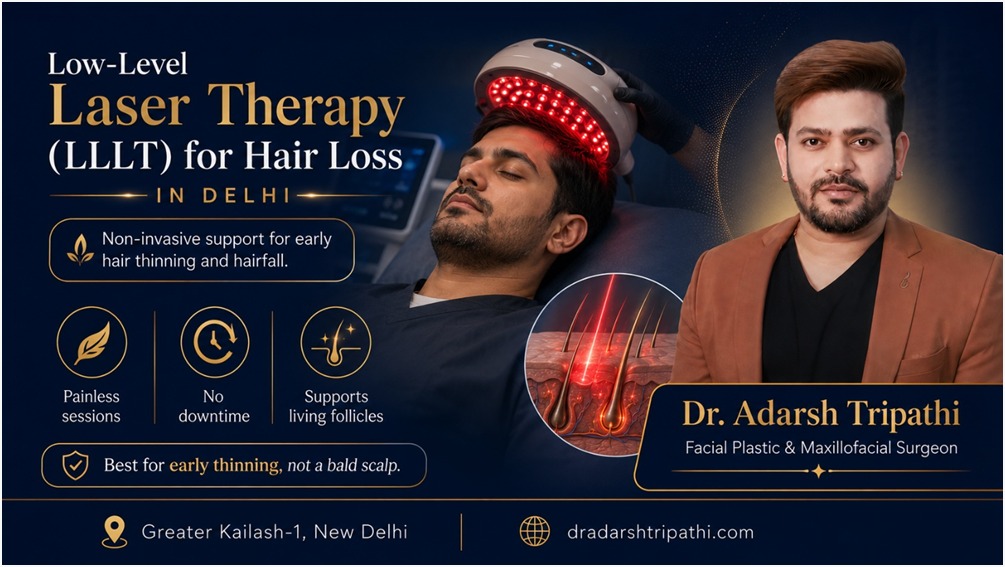
Low-Level Laser Therapy (LLLT) for Hair Loss in Delhi
Quick answer: Low-level laser therapy – LLLT, also called red light therapy or photobiomodulation – uses low-intensity red laser or LED light, typically around 650-680nm, to stimulate activity in weakening hair follicles. It is non-invasive, painless, and has no downtime. It suits early thinning and hairfall where follicles are miniaturising but still alive; it does nothing on a genuinely bald scalp. In Delhi, clinic sessions cost roughly Rs 2,000-5,000 each, with a home laser cap costing Rs 25,000-60,000 as a one-off. Results take four to six months and require consistency. At Sarayu Clinics in Greater Kailash-1, LLLT is prescribed by Dr. Adarsh Tripathi as part of a wider hair plan rather than as a standalone answer.
One clarification first, because the terminology is genuinely confusing. Low-level laser therapy is also used by physiotherapists for pain and inflammation – the same underlying principle applied to a completely different problem. This page is about LLLT for hair. If you are looking for laser therapy for back pain or a sports injury, a physiotherapy clinic is the right place. For the clinic’s cosmetic laser treatments – pigmentation, resurfacing, hair removal – see our laser and light treatments page instead.
LLLT occupies an honest but modest place in hair restoration. It is genuinely safe, genuinely painless, and there is reasonable clinical evidence that it helps early androgenetic hair loss. It is also frequently oversold – as a standalone answer to hairfall, or as something that can regrow hair on a bald scalp. It cannot. What it does, reliably enough to be worth including in a plan, is support follicles that are weakening but still alive.
How LLLT Actually Works ?
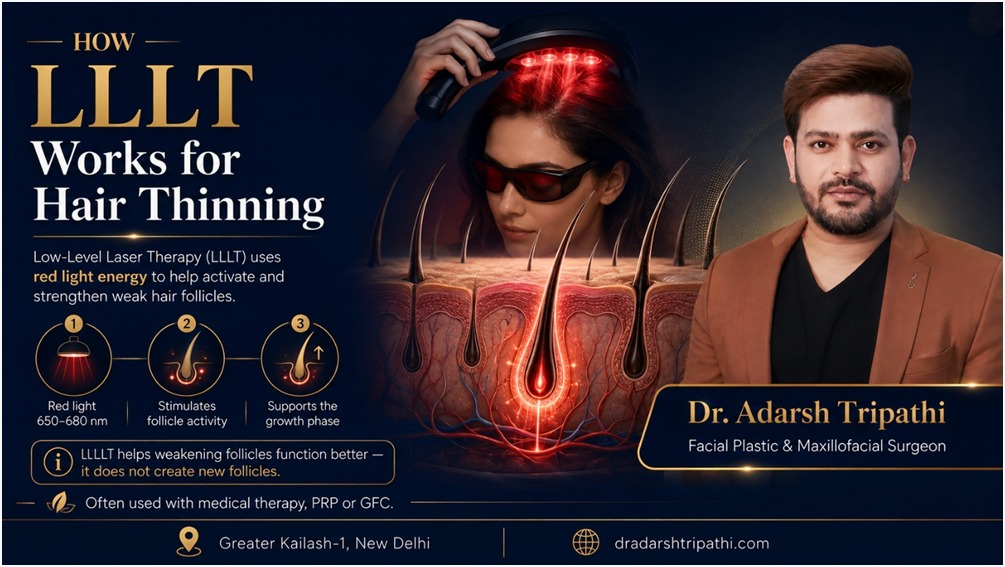
The mechanism is called photobiomodulation, which sounds more complicated than it is. Red light at specific wavelengths – typically 650 to 680 nanometres – penetrates a few millimetres into the scalp and is absorbed by the mitochondria inside follicle cells. That absorption increases ATP production, which is the cell’s energy currency. Better-fuelled follicle cells are more able to sustain the growth phase of the hair cycle.
There is a second, simpler effect: the light causes local vasodilation, improving blood flow to the scalp and therefore the delivery of oxygen and nutrients to the follicles. Both effects push follicles that have slipped into the resting or shedding phase back towards active growth.
The dose matters more than people realise. LLLT follows a biphasic dose response – too little light does nothing, and beyond a certain point more light does not help and may even suppress the effect. The therapeutic window is generally cited at around 2 to 4 joules per square centimetre. This is why session duration and device power are not arbitrary, and why a cheap device with too few diodes may deliver nothing useful no matter how long you wear it. It is also why ‘more sessions must be better’ is not true here.
What LLLT Honestly Delivers ?
- Reduced hairfall, usually the first thing patients notice, often within two to three months
- Improved hair calibre – existing thin hairs growing back with more body
- Support for follicles that are miniaturising but still active
- Better scalp circulation and follicle environment
- A useful maintenance treatment after a hair transplant or a course of injectables
- Completely non-invasive – no needles, no blood draw, no medication
- Painless, with no heat and no sensation beyond mild warmth
- Zero downtime; you walk out and carry on
- Safe for repeated long-term use, and safe alongside almost every other hair treatment
- One of the few options suitable for women with diffuse thinning who are not transplant candidates
What LLLT honestly cannot do ?
- It cannot regrow hair on a bald scalp. Where follicles are gone there is nothing to stimulate – that is a hair transplant conversation
- It is not a cure and not permanent. Stop the treatment and the benefit fades, because LLLT does not change the underlying cause
- It does not block DHT the way finasteride does. Some pages claim LLLT reduces DHT; the evidence for that specific mechanism is weak, and it is not why LLLT works – see Part 9
- It works slowly. Four to six months of consistent use before a fair judgement, which defeats patients looking for a quick fix
- It is a supportive treatment, not a primary one. On its own it produces modest results; combined with medical therapy and injectables it earns its place
- It will not help hair loss with an untreated medical cause – thyroid disease, iron deficiency, a scarring alopecia. Those need diagnosis first
Who LLLT Suits - Hair Loss, Hairfall and Thinning ?
Good candidates
- Early to moderate androgenetic hair loss – Norwood 2-3 in men, Ludwig 1-2 in women
- Ongoing hairfall where density is still largely intact
- Diffuse thinning, particularly in women, where transplant is not appropriate
- Patients who want a non-invasive option with no needles or medication
- Post-transplant patients supporting grafts and surrounding native hair
- Anyone on medical therapy or injectables wanting to add a supportive layer
- Patients who can commit to consistency – this is the whole ball game with LLLT
LLLT is not the right treatment if
- You have completely bald areas with no follicular activity
- You have advanced loss (Norwood 5-7) – a transplant is the appropriate answer
- You have scarring alopecia, where follicles have been replaced by scar tissue
- Your hairfall has an untreated medical cause that needs addressing first
- You are taking photosensitising medication – this should be stopped, with medical advice, at least three days before treatment
- You expect fast or dramatic results
- You will not use it consistently – intermittent use produces nothing
On hairfall specifically. Hairfall and hair loss are used interchangeably in everyday speech but they are not always the same problem. Shedding that has increased suddenly over weeks – after illness, weight loss, childbirth, or a period of stress – is usually telogen effluvium, and it typically resolves on its own once the trigger passes. LLLT may support recovery but the cause needs identifying. Gradual thinning with a receding pattern is androgenetic, and that is where LLLT genuinely belongs. Blood tests at the first consultation are what separate the two.
The LLLT Procedure - What a Session Involves
Consultation and diagnosis
Dr. Tripathi examines the scalp, assesses your pattern and stage of loss, and checks whether follicles in the affected areas are still active – which determines whether LLLT can do anything for you at all. Blood tests are arranged where indicated to rule out thyroid dysfunction, iron deficiency and other contributors. Baseline photographs are taken, because hair changes slowly and memory is unreliable at four months.
Preparation
Arrive with a clean, dry scalp – no oils, gels, sprays or heavy styling product, all of which can block or scatter the light. Stop photosensitising medication at least three days beforehand if advised. No other preparation is needed.
The session
A laser device – typically a hood, helmet or handheld panel in clinic – is positioned over the scalp and the light is delivered for a set duration, usually 15 to 30 minutes. You feel nothing beyond mild warmth. Protective eyewear is provided. You can read or sit quietly; there is nothing to do.
Frequency and the course
LLLT is a frequency treatment rather than an intensity one. Typical protocols run two to three sessions a week for the first three to four months, then reduce to maintenance. This is precisely why the home-device question below matters so much – a treatment needing 100+ sessions a year is a different logistical proposition from one needing four.
Aftercare
There is none. No downtime, no restrictions, no recovery. Wash your hair normally, resume everything immediately. The only requirement is consistency.
Clinic Sessions or a Home Laser Cap? An Honest Answer
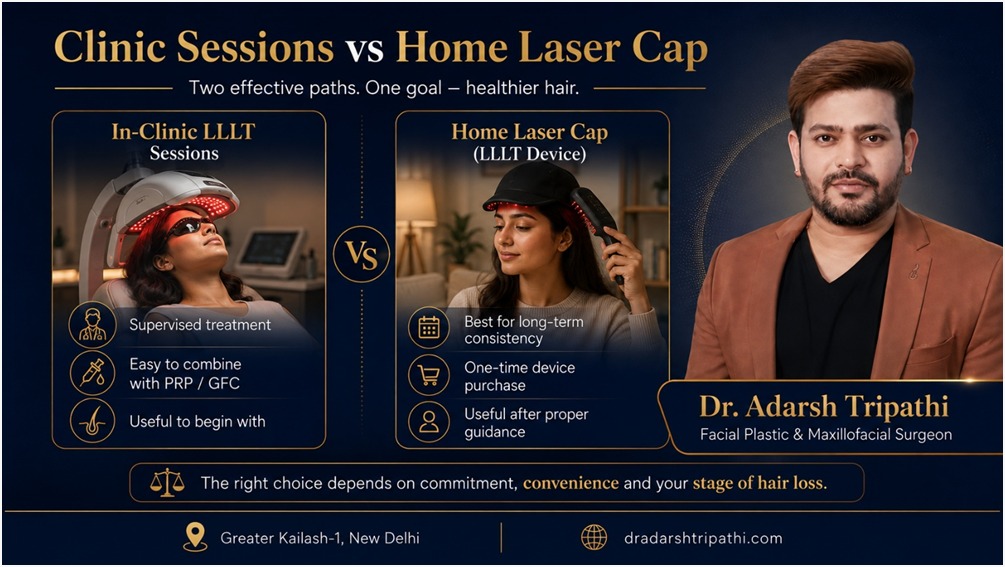
This is the question most pages avoid, because the honest answer costs bookings. LLLT is one of very few clinic treatments with a genuinely equivalent home version. Laser caps and helmets – the well-known international brands and their Indian equivalents – cost roughly Rs 25,000-60,000 as a one-off purchase, and they deliver the same photobiomodulation as a clinic device.
| Clinic sessions | Home laser cap |
Cost | Rs 2,000-5,000 per session | Rs 25,000-60,000 one-off |
Cost over 2 years | Substantial – protocol needs frequent sessions | Fixed, then nothing |
Convenience | Requires travelling 2-3 times weekly | Use at home, hands-free |
Consistency | Depends on your schedule holding up | Far easier to sustain |
Device quality | Medical-grade, professionally maintained | Varies enormously – diode count matters |
Supervision | Doctor monitors progress and adjusts the plan | None unless you book reviews |
Best for | Trialling LLLT; combining with in-clinic injectables | Long-term maintenance once committed |
The honest recommendation: for most patients committing to LLLT long-term, a good home device is the more sensible purchase – the treatment needs frequency, and frequency is far easier to sustain at home. Where clinic sessions earn their place is at the start, when you want the device quality and the supervision while establishing whether LLLT is doing anything for you, and when LLLT is being combined with in-clinic treatments like PRP or GFC in the same visit. If you do buy a device, diode count and actual output matter far more than brand – a cheap cap with too few diodes delivers below the therapeutic dose and does nothing. Bring the specifications to your consultation and we will tell you honestly whether it is worth the money.
Cost and Price of LLLT in Delhi
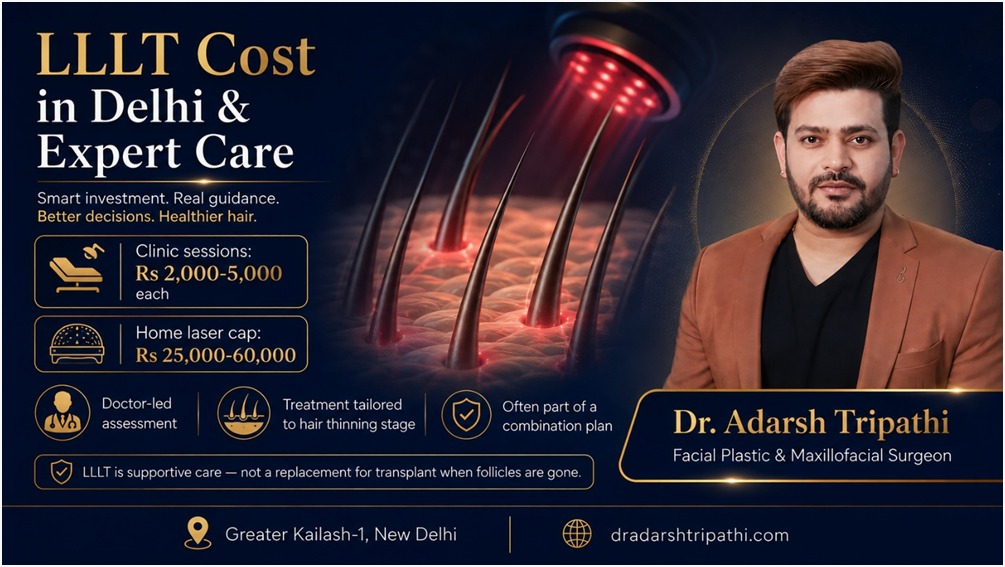
Direct answer: low-level laser therapy in Delhi costs approximately Rs 2,000-5,000 per clinic session, with protocols typically requiring two to three sessions weekly for the first three to four months. A home laser cap costs Rs 25,000-60,000 as a one-off. Because LLLT is a frequency-dependent treatment, the price question is really a total-cost-over-time question, and the table below sets both out.
Option | Price | Frequency | Typical first-year cost |
Clinic session – single | Rs 2,000-5,000 | Per visit | – |
Clinic package – 12 sessions | Rs 20,000-45,000 | Over 4-6 weeks | – |
Clinic protocol – first 4 months | Package pricing | 2-3 x weekly | Rs 60,000-1,50,000 |
Home laser cap (entry-level) | Rs 25,000-40,000 | One-off purchase | Rs 25,000-40,000 |
Home laser cap (higher diode count) | Rs 40,000-60,000 | One-off purchase | Rs 40,000-60,000 |
LLLT combined with PRP or GFC | Added to injectable session | Per visit | Varies by plan |
Maintenance after initial course | Reduced frequency | 1-2 x weekly | Lower |
What drives the price ?
- Session frequency, which is the dominant factor – LLLT needs repetition rather than intensity
- Whether you use clinic devices or purchase a home unit
- Device specification – diode count and output determine whether the therapeutic dose is actually delivered
- Whether LLLT is added to an existing injectable appointment or booked as a standalone visit
- Whether the plan includes monitoring, photography and review
A note on value. LLLT is the cheapest thing in the hair toolkit per session and one of the more expensive per unit of result, because the effect is modest and requires sustained use. That is not a reason to avoid it – it is a reason to be clear about what you are buying. As a supportive layer alongside medical therapy it is good value. As a substitute for medical therapy or a transplant it is not.
Results - What to Expect and When
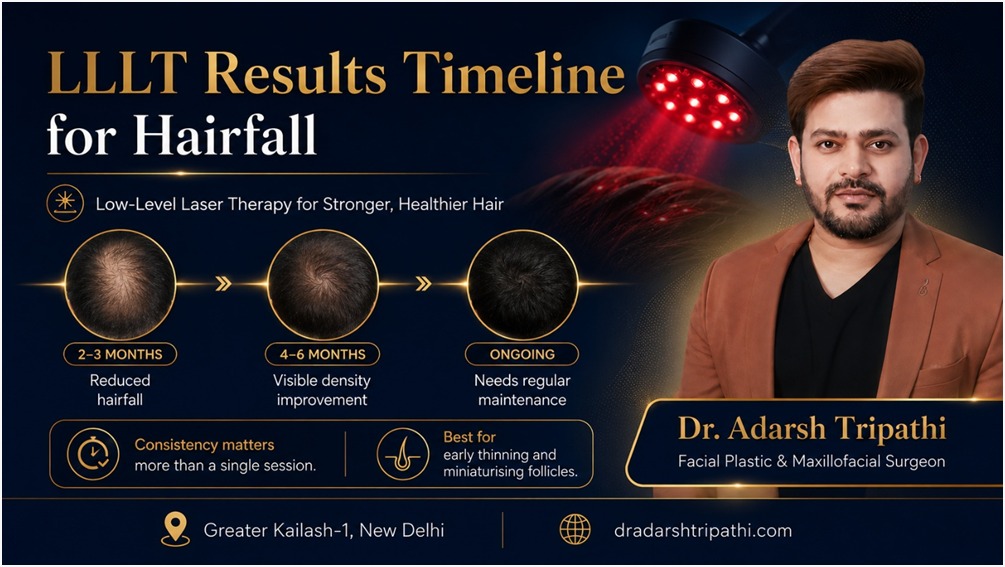
- Weeks 1-8: nothing visible. This is normal and it is where most people give up
- Months 2-3: reduced hairfall, usually the first perceptible change
- Months 4-6: improved calibre and density become visible in photographs. This is the earliest fair point to judge
- Months 6-12: the fuller effect of consistent use, and the point to decide whether to continue
- Ongoing: benefit is maintained only with continued use. Stop, and the effect fades over months
Two honest points. First, baseline photographs are not optional here – LLLT’s effect is subtle enough that without a before image you will be comparing against memory, which is unreliable. Second, if you have seen nothing at six months of genuinely consistent use, LLLT is not working for you and continuing is spending money on hope. A good clinic will tell you that rather than sell you another package.
LLLT Compared with Other Hair Treatments
Treatment | How it works | Intensity | Typical cost | Where LLLT sits |
LLLT | Red light stimulates follicle metabolism | Mild, cumulative | Rs 2,000-5,000/session | The supportive layer |
Platelet growth factors injected | Moderate | Rs 6,000-15,000/session | More intensive; LLLT complements | |
Concentrated growth factors injected | Moderate | Rs 8,000-18,000/session | More intensive; LLLT complements | |
Regenerative signalling | Moderate | Rs 20,000-50,000/session | Newest and priciest | |
Nutrient micro-injections | Mild-moderate | Lower | Parallel adjunct | |
Medical therapy (finasteride, minoxidil) | Blocks or slows the underlying process | Strong evidence | Low, ongoing | LLLT works best alongside this |
Relocates permanent follicles | Definitive | Rs 40-120/graft | For loss LLLT cannot reach |
LLLT or PRP – which first?
They are not really alternatives. PRP and GFC are more intensive, produce a faster visible response, and cost considerably more per session. LLLT is gentler, slower and cheaper per session but needs far more of them. For most patients with early thinning the sensible sequence is medical therapy first, then an injectable course if more is needed, with LLLT running underneath as ongoing support. Starting with LLLT alone and expecting it to hold the line is where disappointment usually comes from.
Why medical therapy still matters most ?
In androgenetic hair loss, finasteride and minoxidil have substantially stronger evidence behind them than LLLT, and they address the underlying process rather than supporting the follicles around it. LLLT is a good companion to medical therapy and a poor substitute for it. Any clinic recommending an expensive LLLT programme without first discussing medical therapy is not giving you the full picture.
Why Dr. Adarsh Tripathi ?
- Adarsh Tripathi is a Maxillofacial and Facial Plastic Surgeon with 18+ years of experience.
- The full hair spectrum available – LLLT, PRP, GFC, exosome therapy, mesotherapy, medical therapy and hair transplant surgery – so the recommendation reflects your stage rather than what the clinic sells
- Diagnosis before treatment, including blood tests where indicated
- Honest about LLLT’s modest, supportive role – it is prescribed as part of a plan, not sold as an answer
- Straight advice on home devices, including when a cap makes more sense than clinic sessions.
- Baseline photography so progress is measured rather than remembered
- See before-and-after results and celebrity work
- Greater Kailash-1, New Delhi – convenient from GK-2, CR Park, Kailash Colony, Defence Colony, Hauz Khas, Nehru Place and South Extension.
Frequently Asked Questions
What is low-level laser therapy for hair loss?
Low-level laser therapy (LLLT), also called red light therapy or photobiomodulation, uses low-intensity red laser or LED light at around 650-680nm to stimulate hair follicles. The light is absorbed by mitochondria in follicle cells, increasing ATP production and improving scalp circulation, which helps follicles sustain the growth phase. It is non-invasive, painless and has no downtime. It supports follicles that are weakening but still alive – it cannot regrow hair where follicles are gone, which needs a hair transplant.
How much does LLLT cost in Delhi?
Clinic sessions in Delhi cost approximately Rs 2,000-5,000 each, with protocols typically needing two to three sessions weekly for the first three to four months – so first-year clinic costs commonly run Rs 60,000-1,50,000. A home laser cap costs Rs 25,000-60,000 as a one-off purchase. Because LLLT depends on frequency rather than intensity, total cost over time matters more than the per-session price.
Does LLLT actually work for hairfall?
It can help early-stage androgenetic hairfall where follicles are miniaturising but still active, with reasonable clinical evidence supporting modest improvement in density and reduced shedding. It is a supportive treatment rather than a primary one – it works considerably better alongside medical therapy such as finasteride or minoxidil than on its own. It will not help hairfall caused by an untreated medical problem such as thyroid dysfunction or iron deficiency, which is why blood tests come first.
How many LLLT sessions will I need?
LLLT is frequency-dependent. Typical protocols are two to three sessions per week for the first three to four months, then reduced maintenance. This is a large number of visits, which is exactly why many patients on long-term LLLT eventually buy a home device instead – the treatment needs consistency, and consistency is easier to sustain at home.
Should I buy a home laser cap or come to the clinic?
For most patients committing to LLLT long-term, a good home device is the more sensible purchase, because the treatment needs frequency and that is far easier to sustain at home. Clinic sessions earn their place at the start – for device quality and supervision while you establish whether LLLT is helping – and when LLLT is combined with in-clinic injectables in the same visit. If buying a device, diode count and actual output matter more than brand; a cheap cap with too few diodes may not reach the therapeutic dose.
How long before I see results from LLLT?
Reduced hairfall is usually the first change, at around two to three months. Visible improvement in density and calibre appears at four to six months, which is the earliest fair point to judge. Baseline photographs matter here more than with most treatments, because the effect is subtle enough that memory is unreliable. If you have seen nothing at six months of genuinely consistent use, LLLT is not working for you.
Is LLLT safe?
Yes. LLLT uses non-thermal light at low intensity, produces no heat and no tissue damage, and has an excellent safety record with no significant reported side effects. It is safe for repeated long-term use and safe alongside almost every other hair treatment. The main precaution is photosensitising medication, which should be stopped at least three days before treatment on medical advice. For general information on laser device regulation, the US FDA publishes guidance on laser products.
Is LLLT better than PRP for hair loss?
They do different jobs and are usually combined rather than compared. PRP and GFC are injectable, more intensive, produce a faster visible response and cost considerably more per session. LLLT is gentler, slower and cheaper per session but needs far more sessions. For most patients the sensible sequence is medical therapy first, an injectable course if needed, and LLLT running underneath as ongoing support.
Does LLLT reduce DHT?
Probably not, and it is not why LLLT works. Some clinic pages claim LLLT lowers DHT, the hormone that drives androgenetic hair loss, but the evidence for that specific mechanism is weak. LLLT works through photobiomodulation – increasing cellular energy production and improving scalp circulation. If DHT reduction is what you need, that is what finasteride does, and it should be discussed on its own terms rather than implied as a benefit of light therapy.
Can LLLT be used after a hair transplant?
Yes, and it is one of its more sensible applications. After a hair transplant LLLT can support graft recovery and, more importantly, help maintain the native hair around the grafted area – which matters because transplanted hair is permanent while surrounding native hair can keep thinning. Timing should be agreed with your surgeon, as protocols vary in the immediate post-operative period.
Can women use LLLT for hair thinning?
Yes, and it is one of the more useful options for women. Female pattern hair loss is typically diffuse rather than focal, which often makes women poor transplant candidates, and finasteride is generally not prescribed for women of childbearing age. LLLT is non-hormonal, non-invasive and safe for long-term use, which is why it features more prominently in female hair-loss plans than in male ones.
What should I avoid during LLLT treatment?
Arrive with a clean, dry scalp – oils, gels, sprays and heavy styling products can block or scatter the light. Stop photosensitising medication at least three days before treatment on medical advice. Beyond that there are no restrictions: no downtime, no recovery, and you can wash your hair and resume everything immediately. The single thing that determines results is consistency.
How to Reach Us:
Phone:+91 9289111083 ,+91 9289111084
Dr Adarsh’s website: https://dradarshtripathi.com/
Facebook: https://www.facebook.com/DrAdarshTripathi3011
Instagram: https://www.instagram.com/dr_adarsh_tripathi/
Youtube: https://www.youtube.com/@dr_adarsh_tripathi
Linkedin: https://www.linkedin.com/in/dr-adarsh-tripathi-a43005b8/
Online Booking: https://dradarshtripathi.com/contact-us/ to schedule appointments conveniently.