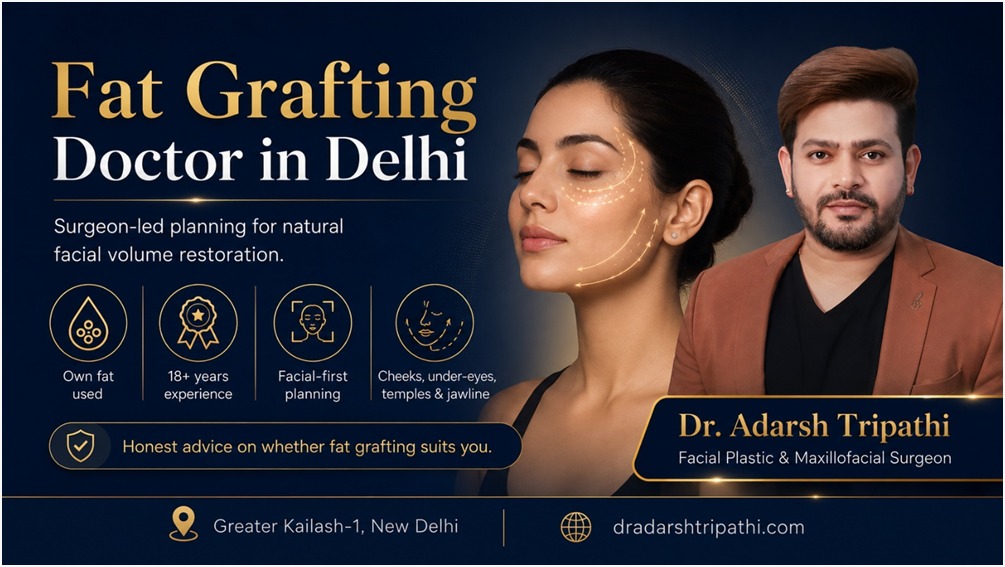
Fat Grafting in Delhi
Quick answer: Fat grafting – also called fat transfer, fat injection or lipofilling – takes fat from your own body, usually the abdomen or thighs, processes it, and injects it where volume has been lost. Because it is your own tissue, the result feels natural and, crucially, the fat that survives stays for life. The honest figure most clinics avoid: roughly 50-70% of grafted fat survives permanently, with the rest reabsorbed over three to six months. In Delhi, facial fat grafting costs approximately Rs 60,000-2,50,000 depending on the areas treated. At Sarayu Clinics in Greater Kailash-1, it is performed by Dr. Adarsh Tripathi, a maxillofacial and facial plastic surgeon with 18+ years of experience, using micro-fat and nano-fat techniques matched to each area of the face.
Quick Facts
Anaesthesia | Local with sedation for facial work; general for larger or combined cases |
Procedure time | 1-3 hours depending on areas treated |
Hospital stay | Day care – home the same day |
Back to work | 5-7 days for most facial cases |
Social downtime | 7-10 days |
Fat survival | 50-70% permanent |
Final result | 3-6 months |
Longevity | Permanent for surviving fat |
Fat grafting is one of the more elegant ideas in facial surgery. Rather than injecting a manufactured gel, fat is taken from somewhere you would rather not have it, gently processed, and placed where volume has gone. The body accepts what is biologically its own, so the result behaves like the rest of your face – soft, warm, mobile – instead of like a foreign material sitting under the skin.
There is one truth that separates an honest fat grafting consultation from a sales pitch, and it belongs near the top of the page rather than buried in the small print: not all the fat injected survives. Transplanted fat has to establish a new blood supply in its new home, and realistically 50-70% of it manages that. The remainder is quietly reabsorbed over the first three to six months. That is not a complication – it is the biology of moving living tissue – and a good surgeon plans for it by deliberately over-correcting at the time of surgery. Any clinic promising that every cell injected will survive is telling you something that is not true.
There is a second point that gets less attention than it deserves. Fat is not inert. It carries adipose-derived stem cells and growth factors, which is why grafted areas often show improved skin quality – brighter, more even, slightly firmer – beyond the volume change alone. That regenerative dimension is unique to fat and is a large part of why the procedure has held its place even as synthetic fillers have improved.
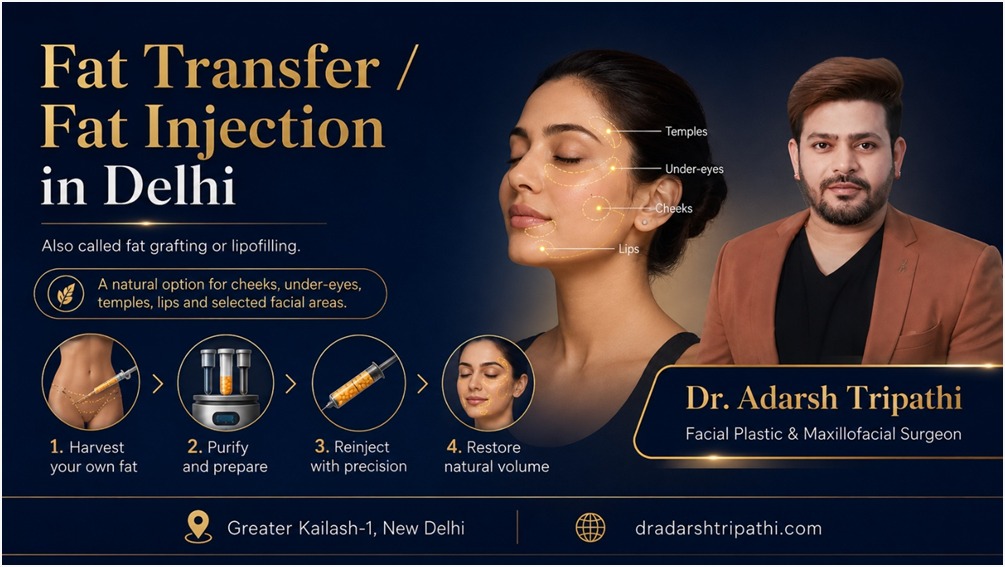
Fat Grafting, Fat Transfer, Fat Injection - Are They the Same Thing?
Yes. Fat grafting, fat transfer, fat injection, autologous fat grafting and lipofilling all describe the same procedure: harvesting your own fat and re-injecting it elsewhere. Surgeons tend to say fat grafting or lipofilling; patients more often search fat transfer or fat injection. The variation in terminology causes real confusion when people are comparing clinics, so it is worth stating plainly – if a clinic offers any of these, they are offering the same operation. What genuinely differs between clinics is technique: how gently the fat is harvested, how it is processed, and how precisely it is placed.
What Fat Grafting Delivers ?
- Natural-looking and natural-feeling results – your own tissue integrates with surrounding tissue
- Permanent volume from the fat that survives; it does not dissolve the way hyaluronic acid does
- Improved skin quality in the treated area, from the regenerative cells fat carries
- A dual benefit – fat is reduced at the donor site while volume is restored where you want it
- No allergic reaction risk and no synthetic material in the face
- Particularly strong for comprehensive volume restoration in thin or aged faces, where relying on repeated filler becomes expensive and less natural
- Combines well with other facial surgery in a single recovery
- Often lower lifetime cost than years of filler maintenance
Honest framing: fat grafting is not right for everyone. The 50-70% survival means a touch-up is sometimes needed. Very thin patients may not have enough donor fat. And if you want a small, specific, reversible change – one syringe in the lips, say – dermal fillers are simpler, cheaper and undoable. Fat grafting is a surgical commitment, not an appointment.
Areas Treated
Our focus is the face. Facial fat grafting is where a facial plastic surgeon’s anatomical knowledge matters most, and it is the work this clinic does. Hands are also treated. For breast fat grafting or buttock fat grafting, we refer to plastic surgeons who specialise in body procedures – those operations need different training and different facility infrastructure, and we would rather send you to the right person than take the case.
Cheeks and mid-face
The most common and most rewarding area. Cheek fat pads descend and deflate with age, flattening the cheekbone. Micro-fat restores that volume more substantially than filler can, and permanently. For the non-surgical alternative, see cheek fillers.
Tear troughs and under-eyes
The hollow between eyelid and cheek that casts a structural shadow. This area takes nano-fat, not micro-fat – the skin is thin and unforgiving, and coarser fat here is precisely how lumpy, visible under-eyes happen. Done properly, nano-fat softens the hollow and improves the overlying skin at the same time. One of the highest-skill areas in facial fat grafting.
Temples
Temple hollowing ages the upper face quickly and is easy to miss when you are focused on the cheeks. Restoring temple volume often does more for overall facial youth than the patient expects. Usually done alongside cheek work.
Nasolabial folds and marionette lines
Fat restores the volume whose loss created the fold, which is usually a more natural correction than filling the crease itself. Best combined with mid-face restoration that addresses the underlying cause.
Chin and jawline
Fat gives subtle, integrated definition. For strong structural projection, a chin implant remains the more predictable answer – fat is softer and better suited to refinement than to dramatic structural change.
Lips
Fat can augment lips permanently with your own tissue rather than requiring filler every 6-12 months. The caveat is that lips move constantly, so they absorb more fat than static areas and touch-ups are more common here. For a reversible or temporary option, see lip augmentation.
Acne scars and depressed scars
Nano-fat lifts depressed scars from beneath while the regenerative cells improve scar texture. A useful adjunct within a broader plan – see acne scar removal and scar revision.
Facial asymmetry and post-surgical defects
Subtle asymmetry, or a depression left by previous surgery or injury, can be evened out with precisely placed fat without operating on the area again.
Hands
Hands often reveal age before the face does – veins and tendons become prominent as volume is lost. Fat grafting to the back of the hands restores fullness and improves the skin. A genuinely satisfying area to treat.
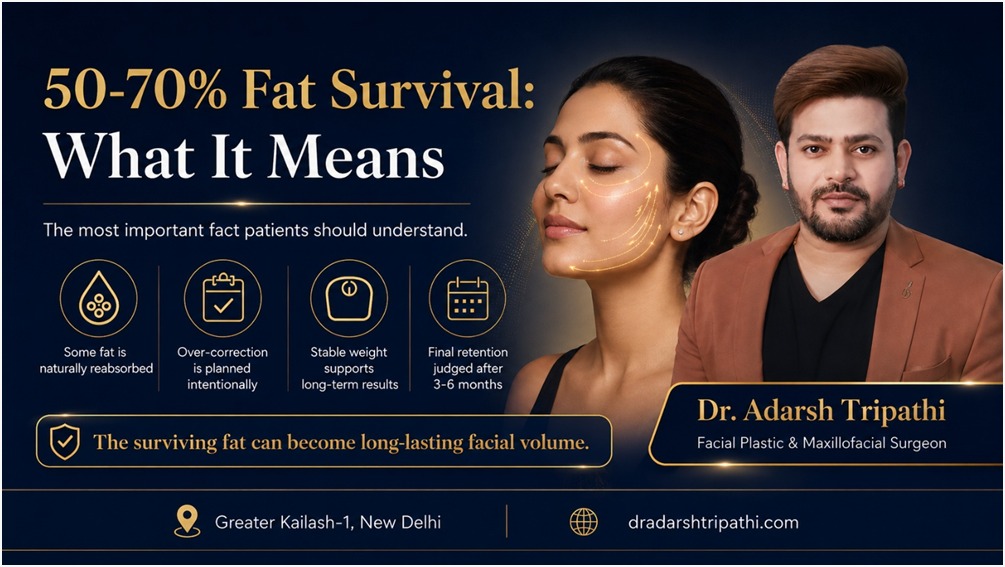
The Techniques - Macro-Fat, Micro-Fat and Nano-Fat
Fat grafting is not one technique. The fat is processed to different degrees depending on where it is going, and matching preparation to area is where clinical judgement shows.
Preparation | What it is | What it does | Where it belongs |
Macro-fat | Larger fat parcels, standard cannula | Bulk volume | Body areas; deep facial volume |
Micro-fat | Harvested through fine 1.5-2.4mm cannulas | Precise volume, better survival in delicate tissue | Cheeks, temples, jawline, nasolabial, lips |
Nano-fat | Mechanically emulsified to near-liquid | Few viable fat cells but rich in stem cells and growth factors – regeneration rather than volume | Tear troughs, fine lines, eyelid skin, skin quality |
SVF (stromal vascular fraction) | Cellular fraction concentrated from the fat | Maximises regenerative effect; may aid survival | Selected complex cases |
PRP-enhanced | Platelet-rich plasma added before injection | Growth factors that may improve integration | Adjunct in selected cases |
The distinction that matters most: micro-fat is for volume, nano-fat is for skin quality and delicate areas. Putting micro-fat into a tear trough is exactly how visible, lumpy under-eyes are created. Using nano-fat to restore a cheek is how patients end up disappointed that nothing changed. In practice a good facial result usually layers all of it – deep micro-fat for structure on the cheekbone and temple, mid-layer micro-fat for soft tissue, and superficial nano-fat for skin quality and fine lines. That multi-layer approach is what makes a result look integrated rather than injected.
Who Fat Grafting Suits ?
Good candidates
- Facial volume loss from age, weight loss or genetics that you want restored naturally
- Adequate donor fat – even relatively thin patients usually have enough for facial work
- A preference for a permanent result over ongoing filler maintenance
- Good general health; not actively immunocompromised
- Non-smoker, or willing to stop for at least four weeks around surgery – smoking dramatically reduces fat survival
- Realistic expectations: 50-70% survival, a possible touch-up, a natural rather than dramatic change
- Able to take one to two weeks of recovery
Fillers may suit you better if
- You want a small, specific change in one area – dermal fillers are simpler
- You want the option to reverse the result – hyaluronic acid can be dissolved; fat cannot
- You are not ready for surgery, or cannot take a week or two of downtime
- You want to preview a volume change before committing to something permanent
Discuss carefully, or defer
- Very limited donor fat – there may not be enough for meaningful grafting
- Active smoking – fat survival falls sharply; cessation is required, not advised
- Significant weight fluctuation, or planned weight loss – wait until weight is stable
- Autoimmune or connective tissue conditions – case by case
- Pregnancy or breastfeeding – deferred
- Expectations of dramatic transformation – fat grafting is subtle by nature
The weight-stability point nobody mentions
Grafted fat behaves exactly like the rest of your body fat. Gain weight and it expands with you; lose weight and it shrinks. That means fat grafting works best on a stable weight, and that your grafted face will subtly track your weight over the years. It is worth knowing before rather than after.
The Procedure, Step by Step
Consultation and planning
Dr. Tripathi assesses the whole face rather than the single area you came in about – comprehensive restoration across mid-face, temples and the perioral area usually produces a more natural result than treating one zone. Donor sites are chosen (lower abdomen first, then flanks or inner thighs), volumes estimated, and the technique combination planned: micro-fat where volume is needed, nano-fat where it is not. Realistic survival and the possibility of a touch-up are discussed before you commit.
Preparation
- Stop smoking at least four weeks before – the single biggest modifiable factor in fat survival
- Stop blood-thinning medications and supplements two weeks before, with medical clearance
- Pre-operative blood work and fitness assessment
- No alcohol for 48 hours; fasting from midnight if general anaesthesia is planned
- Arrange someone to take you home and help for the first day
- Plan 7-10 days of social downtime – this is not a lunchtime procedure
Harvesting
Small 3-4mm entry points are made at the donor site. Tumescent fluid is infiltrated to numb the area, limit bleeding and protect the fat cells. Fat is then harvested through fine cannulas at deliberately low suction pressure – high suction damages fat cells and reduces how much survives, which is why gentle harvesting is a technique decision rather than a preference. More fat is taken than the target volume requires, because absorption is expected.
Processing
The harvested fat is purified to remove blood, oil, anaesthetic fluid and damaged cells – by centrifugation, sedimentation, filtration or washing depending on the case. For nano-fat, an additional emulsification step breaks it down to a fine consistency. PRP or SVF is prepared and added at this point if planned. Gentle handling throughout preserves cell viability, which directly affects your result.
Injection
Fat is placed through tiny entry points using fine blunt-tip cannulas – safer than sharp needles in a face full of vessels. It goes in as many small aliquots across multiple layers rather than as a single deposit, using fanning and crosshatching patterns so it distributes evenly and each parcel sits close enough to a blood supply to survive. Symmetry is checked continuously. Entry points are closed with a single fine suture or steri-strips, compression is applied to the donor site, and you go home the same day.
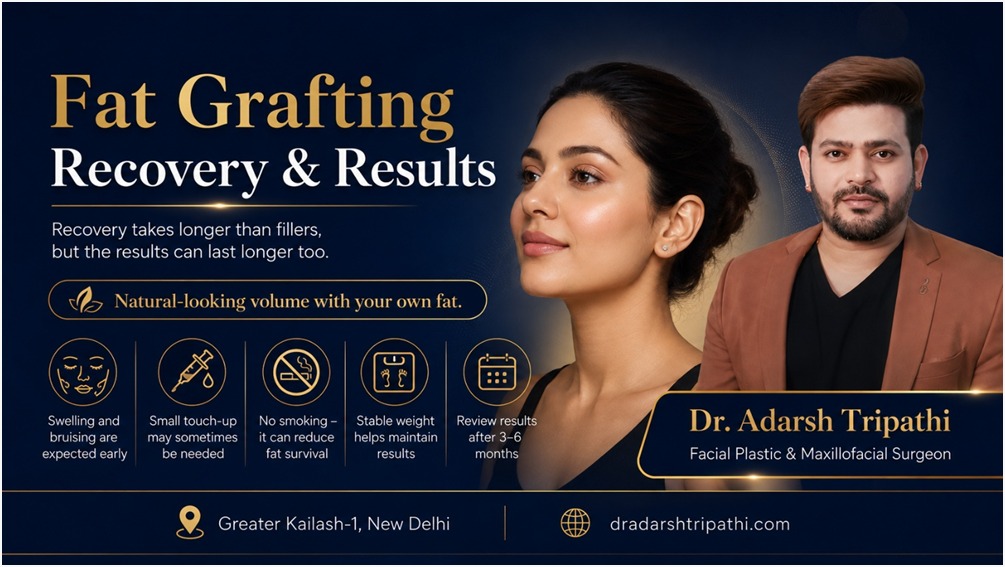
Downtime and Recovery
Timeframe | What to expect |
Days 1-3 | Significant facial swelling – you will look fuller than the final result. Bruising, especially at the donor site. Mild discomfort; head elevated when sleeping |
Days 4-7 | Major swelling settles, bruising yellows and fades. Donor site still sore. Most people manage light activity or work from home |
Weeks 2-4 | Visible swelling resolves. The face now looks deliberately over-corrected – fuller than it will end up. This is planned, not a problem. Social return is comfortable |
Months 1-3 | Active settling. Surviving fat integrates permanently; the rest reabsorbs. Skin quality improvement becomes noticeable |
Months 3-6 | Final result. Around 50-70% of the injected fat remains as permanent volume. Touch-up assessed if needed |
Beyond 6 months | Permanent. The surviving fat is now part of your face and ages naturally with it |
Recovery essentials: sleep with your head elevated for a week; cold compresses around rather than on the grafted areas for the first 48 hours; wear the donor-site compression garment as instructed; do not massage, press or sleep face-down on grafted areas for two weeks; no hot showers, saunas or heavy exercise for two to three weeks; strict sun protection; and no smoking, which matters more here than in almost any other procedure.
Planning around events
Fat grafting needs a longer runway than fillers and patients routinely underestimate it. Visible swelling takes two to four weeks to settle, and the face is intentionally over-corrected for the first month. If you are planning around a wedding or a significant event, allow three months minimum, and six if you want the settled final result rather than an in-between stage.
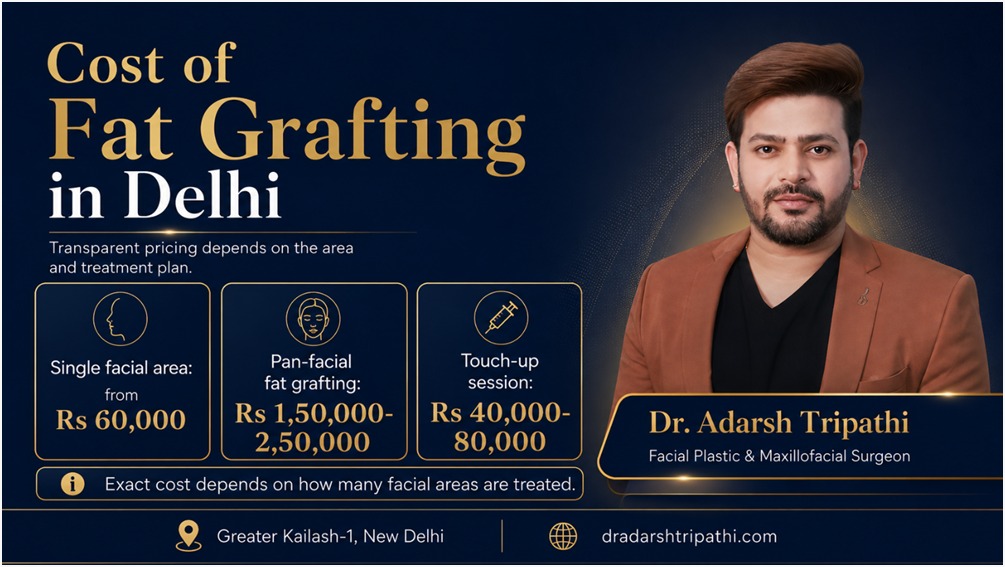
Cost of Fat Grafting in Delhi
Direct answer: fat grafting in Delhi costs approximately Rs 60,000-2,50,000 depending on how many areas are treated and how complex the case is. A single facial area starts around Rs 60,000; comprehensive pan-facial fat grafting runs Rs 1,50,000-2,50,000; a touch-up session at three to six months, if needed, is Rs 40,000-80,000. The upfront cost is higher than fillers because this is surgery – but the result is permanent rather than needing renewal every 12-18 months, which changes the lifetime maths considerably.
Procedure | Approx. cost | Anaesthesia | Recovery |
Facial fat grafting – single area | Rs 60,000-1,20,000 | Local + sedation | 1-2 weeks |
Facial fat grafting – multiple areas | Rs 1,00,000-2,00,000 | Local or GA | 1-2 weeks |
Pan-facial fat grafting | Rs 1,50,000-2,50,000 | GA | 2 weeks |
Tear trough (nano-fat) | Rs 60,000-1,20,000 | Local | 1 week |
Lip fat grafting | Rs 60,000-1,00,000 | Local | 1 week |
Hand fat grafting | Rs 60,000-1,20,000 | Local | 1 week |
Fat grafting with facelift | Customised | GA | 2-3 weeks |
Fat grafting with blepharoplasty | Customised | Local or GA | 1-2 weeks |
Touch-up session (3-6 months) | Rs 40,000-80,000 | Local | 1 week |
PRP-enhanced add-on | +Rs 8,000-15,000 | Same | Same |
Why fat grafting is often cheaper over time than fillers ?
Consider the arithmetic honestly. Maintaining mid-face volume with dermal fillers at around Rs 50,000 every 18 months comes to roughly Rs 2,00,000 across six years – and between sessions the result fades. A single well-executed fat grafting at Rs 1,50,000 is more expensive today and less expensive over a decade, with a permanent result. For a patient in their late thirties planning long-term volume restoration, that calculation quietly favours fat. For someone wanting a small reversible change, it does not. Which is the right answer depends on your face and your horizon, not on what a clinic prefers to sell.
Results - What to Expect and When
- Same day: volume visible, but swollen. Do not judge anything in the first week
- Weeks 2-4: swelling resolves; the face looks deliberately over-corrected. This phase worries patients who were not warned about it
- Months 1-3: settling. Surviving fat integrates; the rest reabsorbs. Skin quality improvements become visible
- Months 3-6: the true result. Roughly 50-70% of injected fat remains permanently
- Beyond 6 months: permanent. It ages with your face and shifts with your weight, but it does not dissolve
Will I need a touch-up?
Around 20-30% of patients benefit from a smaller second session at three to six months to top up areas that absorbed more than expected. This is refinement rather than failure – the body has now shown where it held the fat, and a small additional graft optimises the result. The touch-up uses less fat and involves less recovery than the original procedure. An honest surgeon raises this possibility before the first operation, not after it.
Fat Grafting vs Fillers vs Implants
Factor | Fat grafting | HA fillers | Implants |
Material | Your own tissue | Synthetic gel | Solid silicone or porous polyethylene |
Permanence | Permanent (50-70% survives) | 6-24 months | Permanent |
Reversible | No | Yes, with hyaluronidase | Surgically removable |
Feel | Most natural | Natural with the right product | Firmer, more defined |
Skin quality benefit | Yes – regenerative cells | No | No |
Recovery | 1-2 weeks | 1-2 days | 2-3 weeks |
Upfront cost | Higher | Lower | Mid to high |
Lifetime cost | Lower – one-time | Higher – recurring | Lower – one-time |
Touch-up likely | 20-30% need refinement | Every 12-18 months | Rarely |
Best for | Significant volume, permanence | Small specific reversible changes | Defined structural projection |
A perfectly valid strategy, and one we discuss openly: start with fillers to preview the volume change, then move to fat grafting for permanence once you know you like it. Because this clinic performs both – along with chin implants and facelift surgery – the recommendation you get is not limited by what we happen to offer.
Combining fat grafting with other procedures
- With facelift surgery – a facelift lifts descended tissue, fat grafting replaces lost volume. Ageing does both, and treating only one gives an incomplete, sometimes hollow result
- With blepharoplasty – removing excess eyelid skin while restoring tear-trough volume addresses the upper face properly
- With rhinoplasty – reshaping the nose while correcting minor adjacent contour deficits
- Within full face sculpting – where fat is one component of a wider plan
Combining consolidates recovery into one event and treats ageing comprehensively rather than piecemeal.
How fat grafting differs from liposuction ?
Liposuction removes fat and discards it – the goal is reduction. Fat grafting uses a gentler version of the same harvesting step, then re-injects what it collects. The technical difference is real: finer cannulas, lower suction pressure and careful handling, all aimed at keeping the fat cells alive for transfer. Many patients appreciate the dual benefit – less fat where they did not want it, more where they did.
Choosing a Fat Grafting Doctor in Delhi
Direct answer: a fat grafting doctor in Delhi should be a qualified surgeon – facial plastic, plastic or maxillofacial – with specific facial fat grafting experience rather than body-only practice, should harvest gently with fine cannulas at low pressure, should offer both micro-fat and nano-fat rather than one preparation for everything, should inject with blunt cannulas in the face, and should tell you the realistic survival figure and touch-up possibility before you book. Fat grafting results depend more on technique than on equipment, which makes the surgeon’s method the thing worth asking about.
Questions worth asking ?
- What fat survival rate do you expect in my case, and what happens if it is lower?
- Do you use micro-fat and nano-fat, and which will you use where on my face?
- How do you harvest – cannula size and suction pressure?
- Do you over-correct at the time of surgery, and by how much?
- Is a touch-up included, and what would it cost?
- Would fillers or an implant actually suit me better than fat?
Why patients choose Dr. Adarsh Tripathi ?
- Adarsh Tripathi is a Maxillofacial and Facial Plastic Surgeon with 18+ years of experience.
- A face-focused practice – facial fat grafting is routine work here rather than an occasional add-on to body surgery
- The full technique range: micro-fat for volume, nano-fat for delicate areas and skin quality, multi-layer placement.
- Gentle low-pressure harvesting with fine cannulas, and blunt-cannula injection for vascular safety
- Honest about the 50-70% reality, the over-correction principle, and the possibility of a touch-up – stated before surgery, not after
- Combined-procedure capability with facelift, blepharoplasty and rhinoplasty where comprehensive rejuvenation is the goal
- See before-and-after results and celebrity facial work
- Greater Kailash-1, New Delhi – a genuine Delhi address, convenient from GK-2, CR Park, Kailash Colony, Defence Colony, Hauz Khas and South Extension.
Frequently Asked Questions
What is fat grafting and how does it work?
Fat grafting – also called fat transfer, fat injection or lipofilling – harvests fat from your own body via fine-cannula liposuction, usually from the abdomen, flanks or thighs, processes it to remove blood and damaged cells, and injects it into areas needing volume. The fat that establishes a new blood supply, typically 50-70%, becomes permanent natural volume.
How much does fat grafting cost in Delhi?
Fat grafting in Delhi costs approximately Rs 60,000-2,50,000 depending on the areas treated. A single facial area starts around Rs 60,000; multiple areas run Rs 1,00,000-2,00,000; pan-facial fat grafting Rs 1,50,000-2,50,000. A touch-up at three to six months, if needed, costs Rs 40,000-80,000. Combined procedures are quoted individually.
Who is the best fat grafting doctor in Delhi?
A qualified facial plastic, plastic or maxillofacial surgeon with specific facial fat grafting experience, gentle low-pressure harvesting, mastery of both micro-fat and nano-fat, blunt-cannula injection technique, and honest discussion of survival rates and touch-ups. Dr. Adarsh Tripathi is a Maxillofacial and Facial Plastic Surgeon with 18+ years of experience practising at Sarayu Clinics, Greater Kailash-1, New Delhi.
Why does only 50-70% of grafted fat survive?
Because transplanted fat must establish a new blood supply in its new location to stay alive. The portion that successfully connects with new blood vessels survives permanently; the rest is reabsorbed by the body over three to six months. This is biology rather than a complication, and good surgeons account for it by deliberately over-correcting during the procedure.
How long does fat grafting last?
Permanently, for the fat that survives. The surviving 50-70% becomes part of your facial volume for life – it ages naturally with the rest of your face and expands or shrinks with your body weight, but it does not dissolve the way hyaluronic acid fillers do.
Is fat grafting better than fillers?
Neither is universally better. Fat grafting suits significant volume restoration, patients wanting permanence, and anyone tired of ongoing maintenance – and it improves skin quality through its regenerative cells. Dermal fillers suit small specific changes, patients wanting reversibility, and anyone not ready for surgery. A common and sensible path is fillers first to preview the change, then fat grafting for permanence.
Is fat transfer the same as fat grafting?
Yes. Fat transfer, fat grafting, fat injection, autologous fat grafting and lipofilling all describe the same procedure – harvesting your own fat and re-injecting it elsewhere for volume restoration. Surgeons tend to use fat grafting or lipofilling; patients more often search fat transfer or fat injection.
What areas can fat grafting treat?
Facial areas include the cheeks and mid-face, tear troughs, temples, nasolabial folds, marionette lines, chin, jawline and lips, plus depressed acne and traumatic scars and post-surgical volume defects. Hands are also commonly treated. Different preparations suit different areas – micro-fat for volume, nano-fat for tear troughs and skin quality. For breast or buttock fat grafting we refer to plastic surgeons specialising in body procedures. See also cheek fillers for the non-surgical mid-face alternative.
Is fat grafting painful?
Less than most people expect. It is performed under local anaesthesia with sedation, or general anaesthesia for larger cases. Afterwards, most patients report the donor site – abdomen or thighs – as more uncomfortable than the facial injection sites, similar to muscle soreness after a hard workout, lasting a few days. Facial discomfort is mild and manageable.
Will I need a touch-up after fat grafting?
Around 20-30% of patients benefit from a smaller second session at three to six months to add volume where absorption was greater than expected. This is refinement, not failure – the body has shown where it retained the fat. A touch-up uses less fat and involves less recovery than the first procedure, and an honest surgeon mentions the possibility beforehand.
Does smoking affect fat grafting results?
Significantly. Smoking constricts blood vessels, which directly impairs the new blood supply grafted fat needs to survive – so fat survival falls substantially in smokers. Stopping for at least four weeks before and after surgery is a requirement rather than a suggestion, and it is one of the few factors genuinely within the patient’s control.
Can fat grafting be combined with a facelift?
Yes, and increasingly it is the standard for comprehensive facial rejuvenation. A facelift addresses descent – tissues that have dropped – while fat grafting addresses deflation, the volume that has gone. Ageing causes both, and correcting only one can leave a lifted but hollow result. Combining them treats the face properly and consolidates recovery into a single event.
How do I choose a fat grafting doctor in Delhi?
Choose a qualified surgeon with specific facial fat grafting experience, gentle low-pressure harvesting technique, both micro-fat and nano-fat preparations available, blunt-cannula injection for facial vascular safety, and honest discussion of the 50-70% survival figure and touch-up possibility. The consultation should be with the surgeon personally, in accredited surgical facilities. For facial work specifically, a facial surgeon’s anatomical expertise is the strongest credential – this is fundamentally facial surgery.
How to Reach Us:
Phone:+91 9289111083 ,+91 9289111084
Dr Adarsh’s website: https://dradarshtripathi.com/
Facebook: https://www.facebook.com/DrAdarshTripathi3011
Instagram: https://www.instagram.com/dr_adarsh_tripathi/
Youtube: https://www.youtube.com/@dr_adarsh_tripathi
Linkedin: https://www.linkedin.com/in/dr-adarsh-tripathi-a43005b8/
Online Booking: https://dradarshtripathi.com/contact-us/ to schedule appointments conveniently.