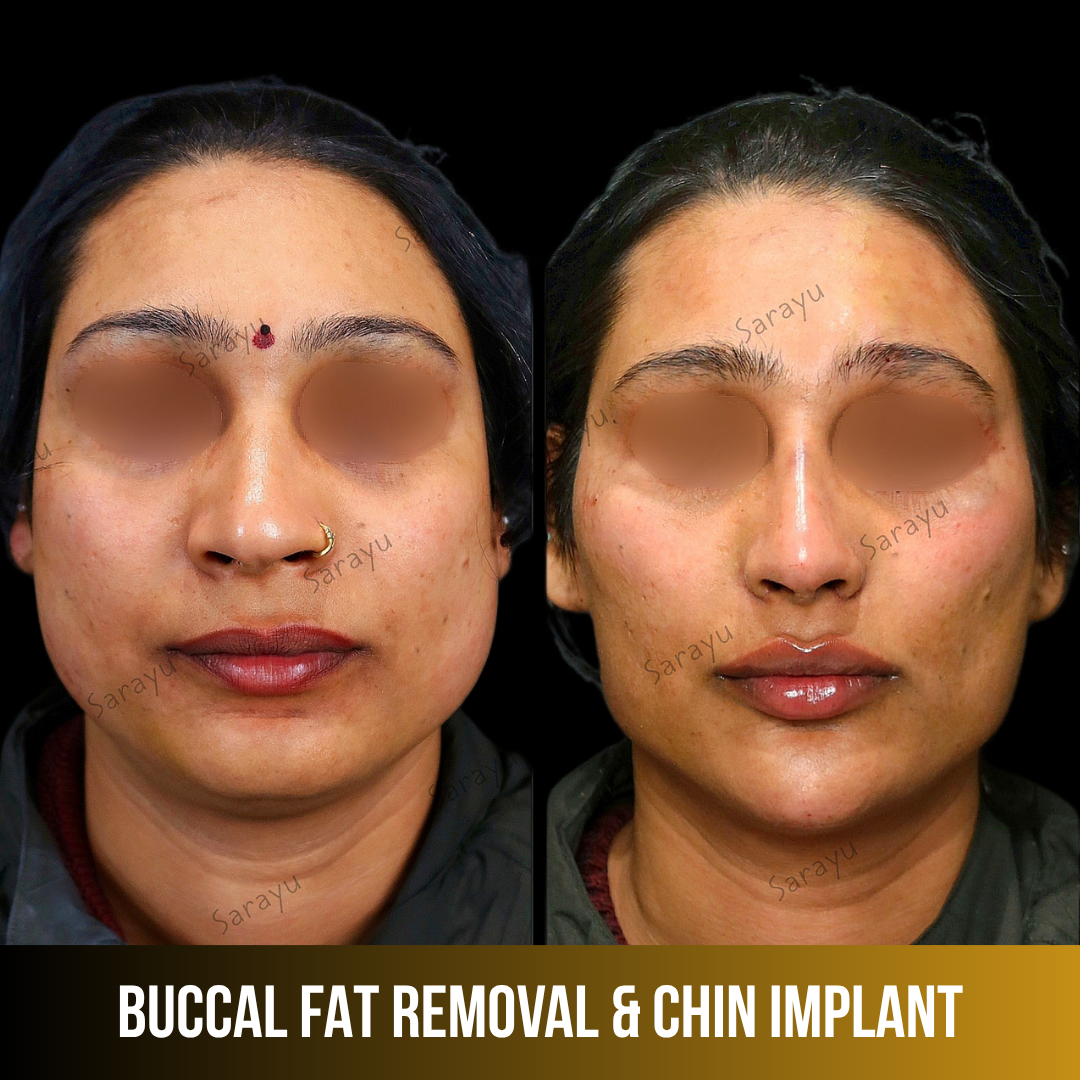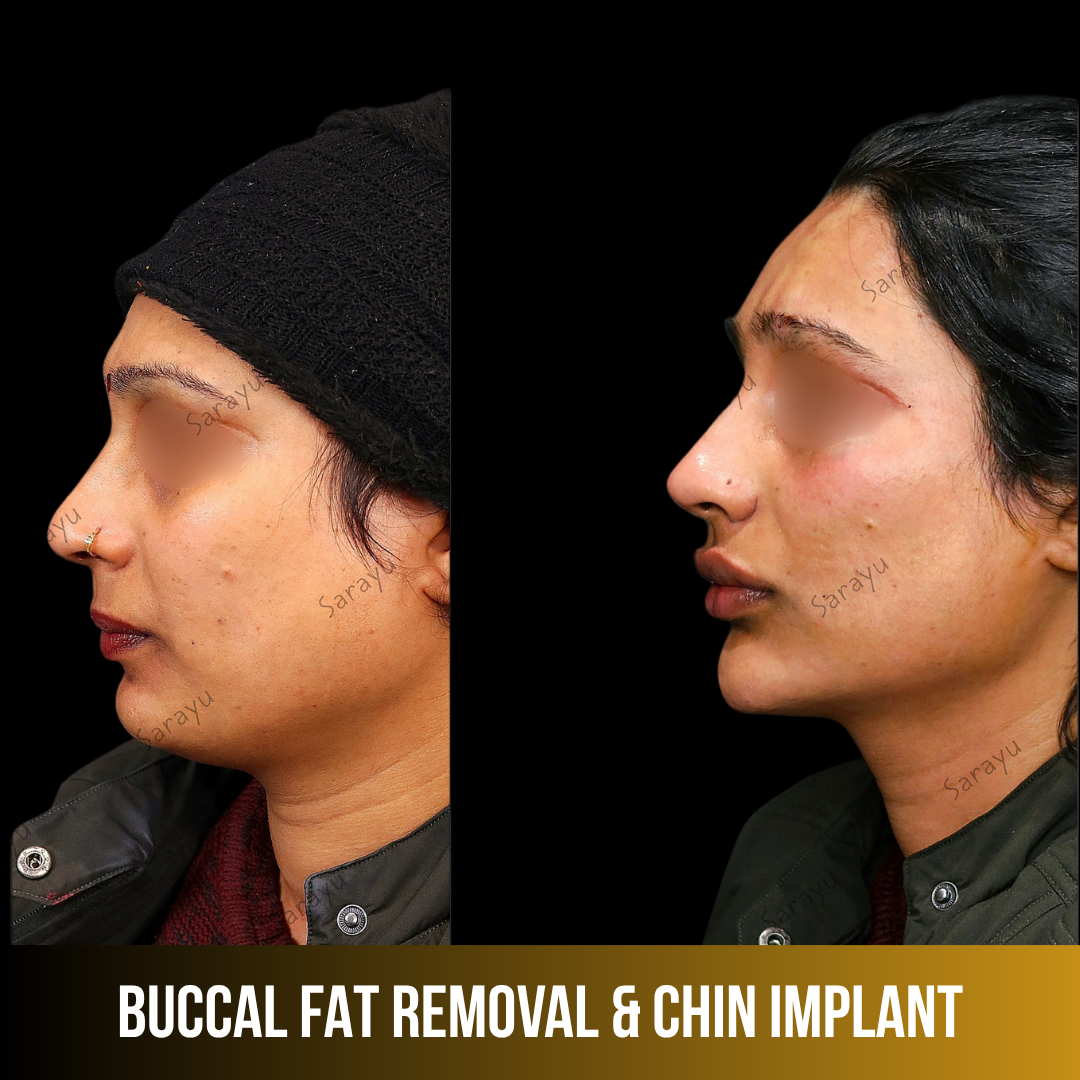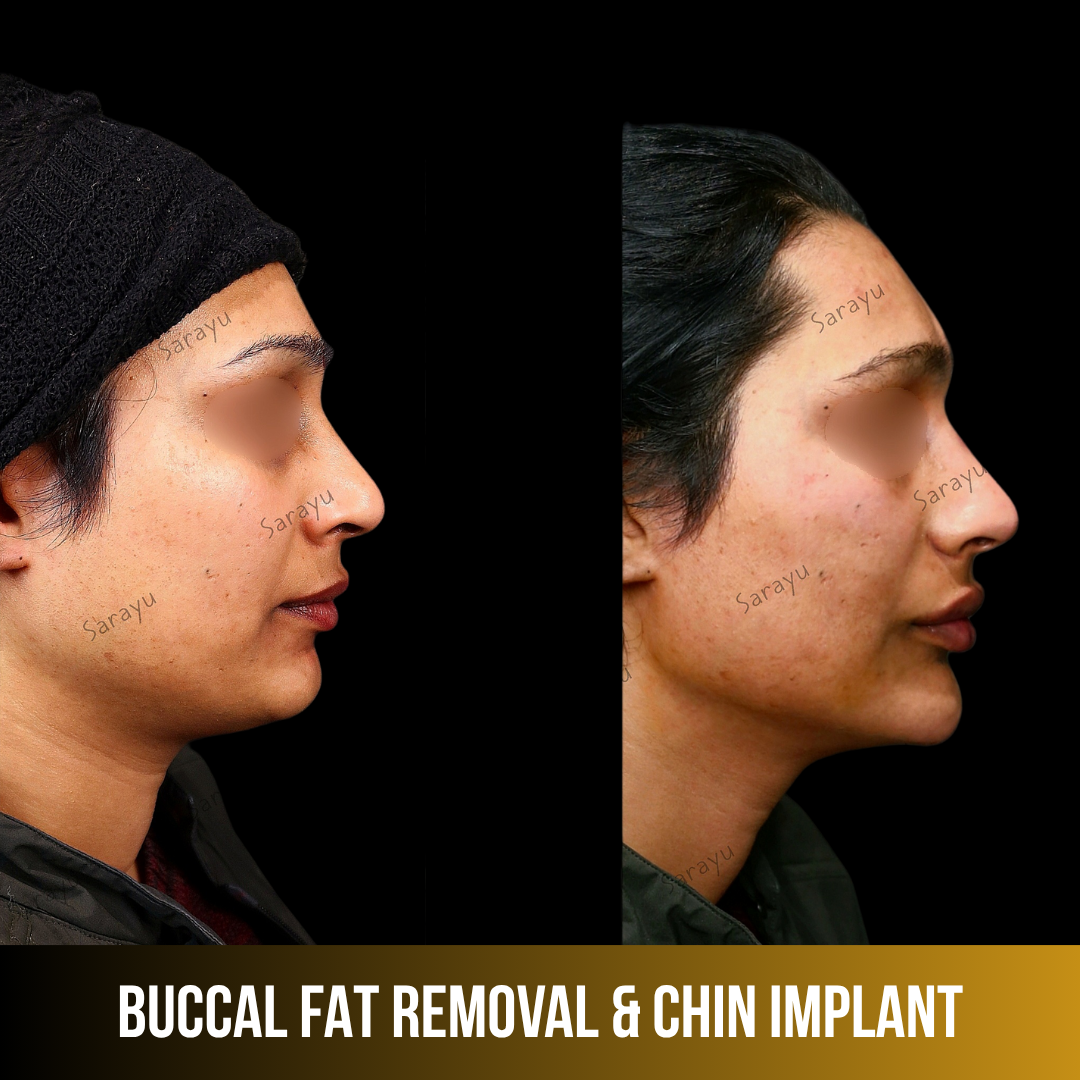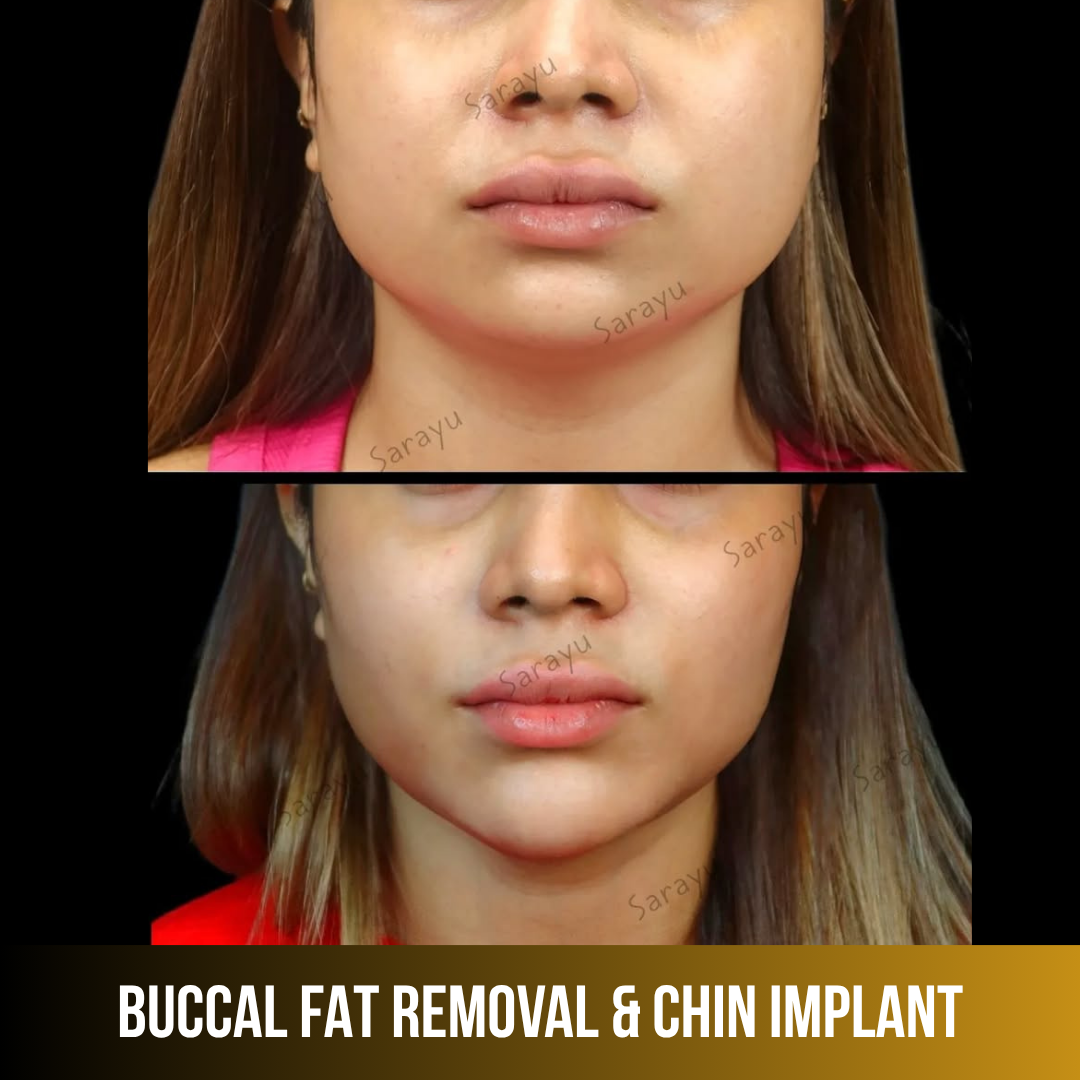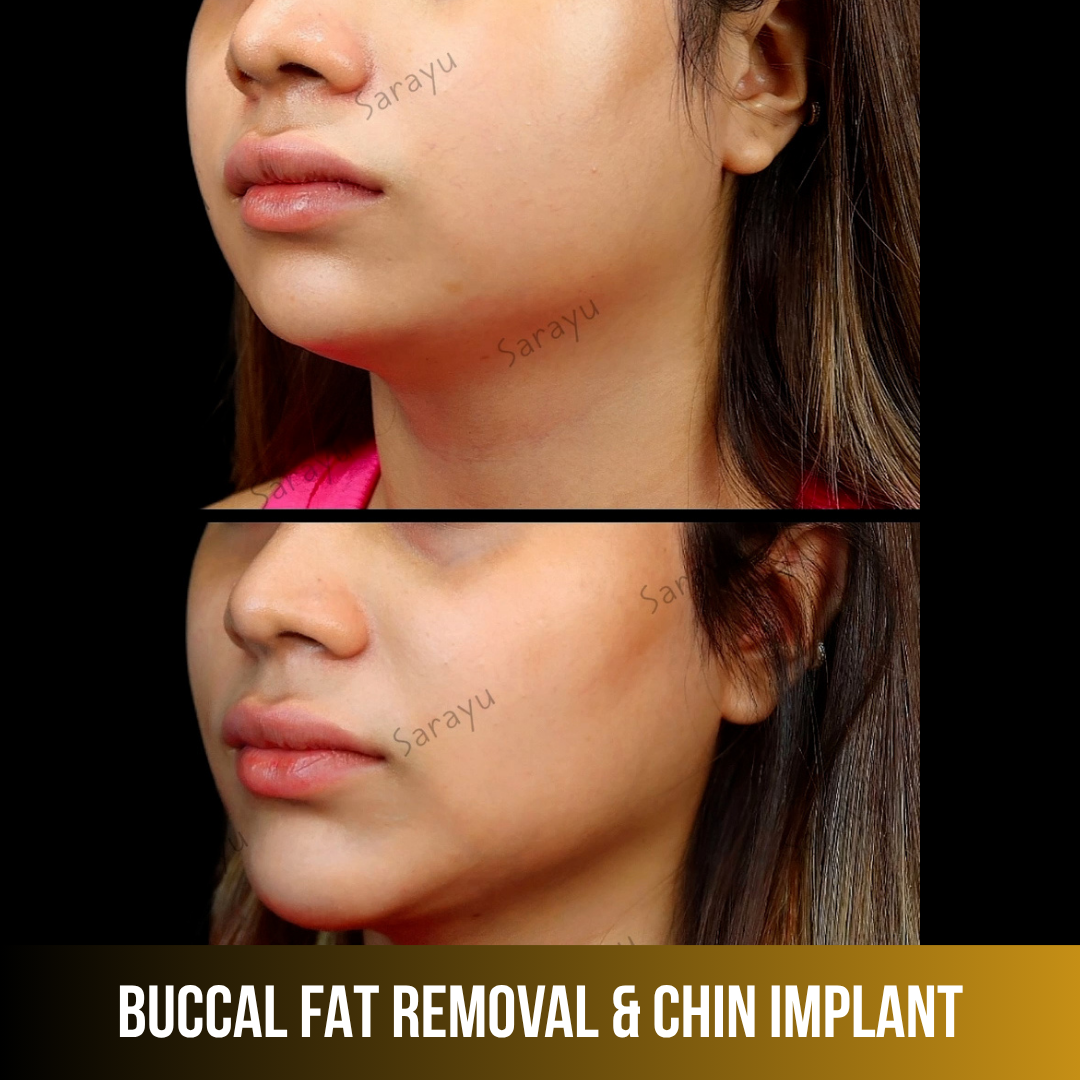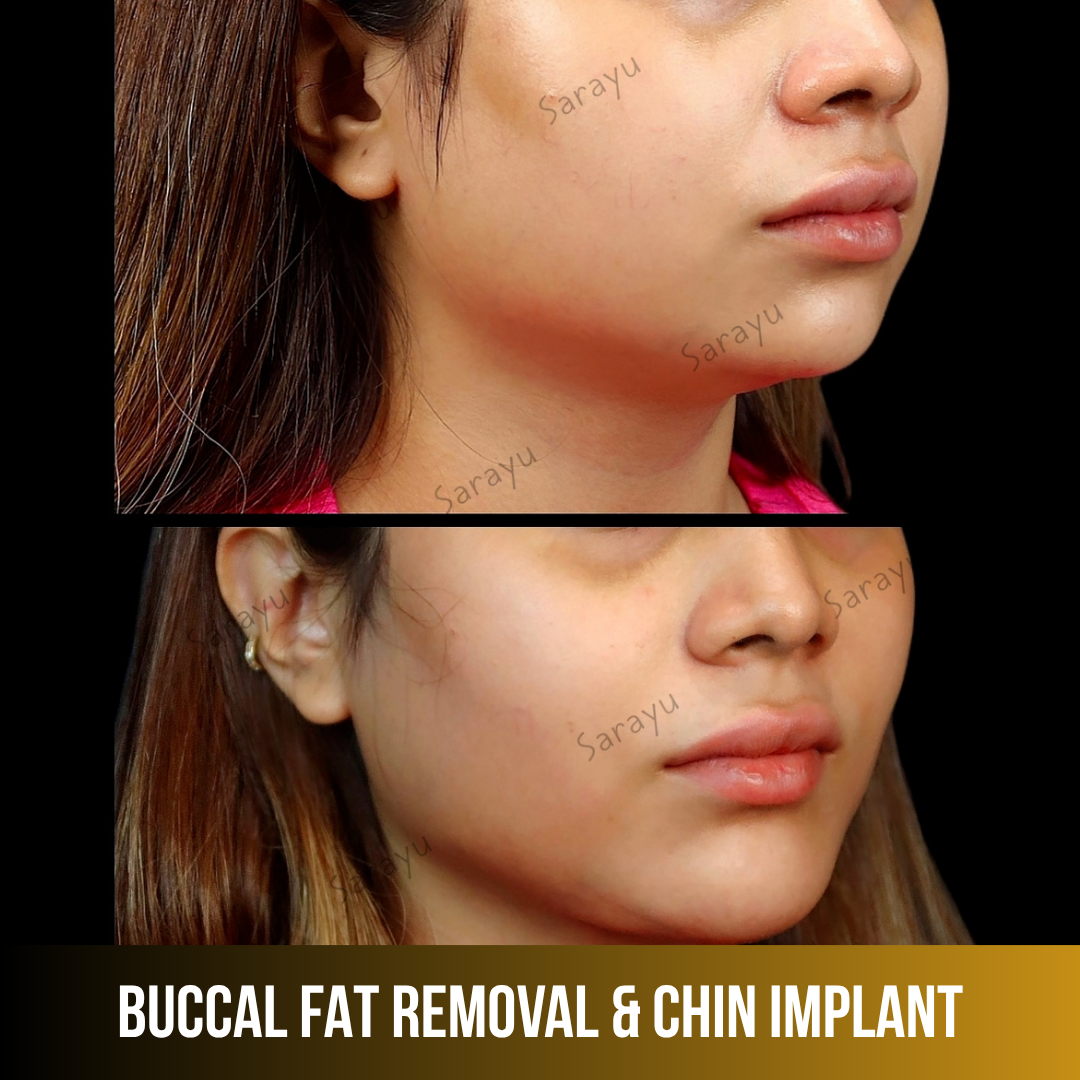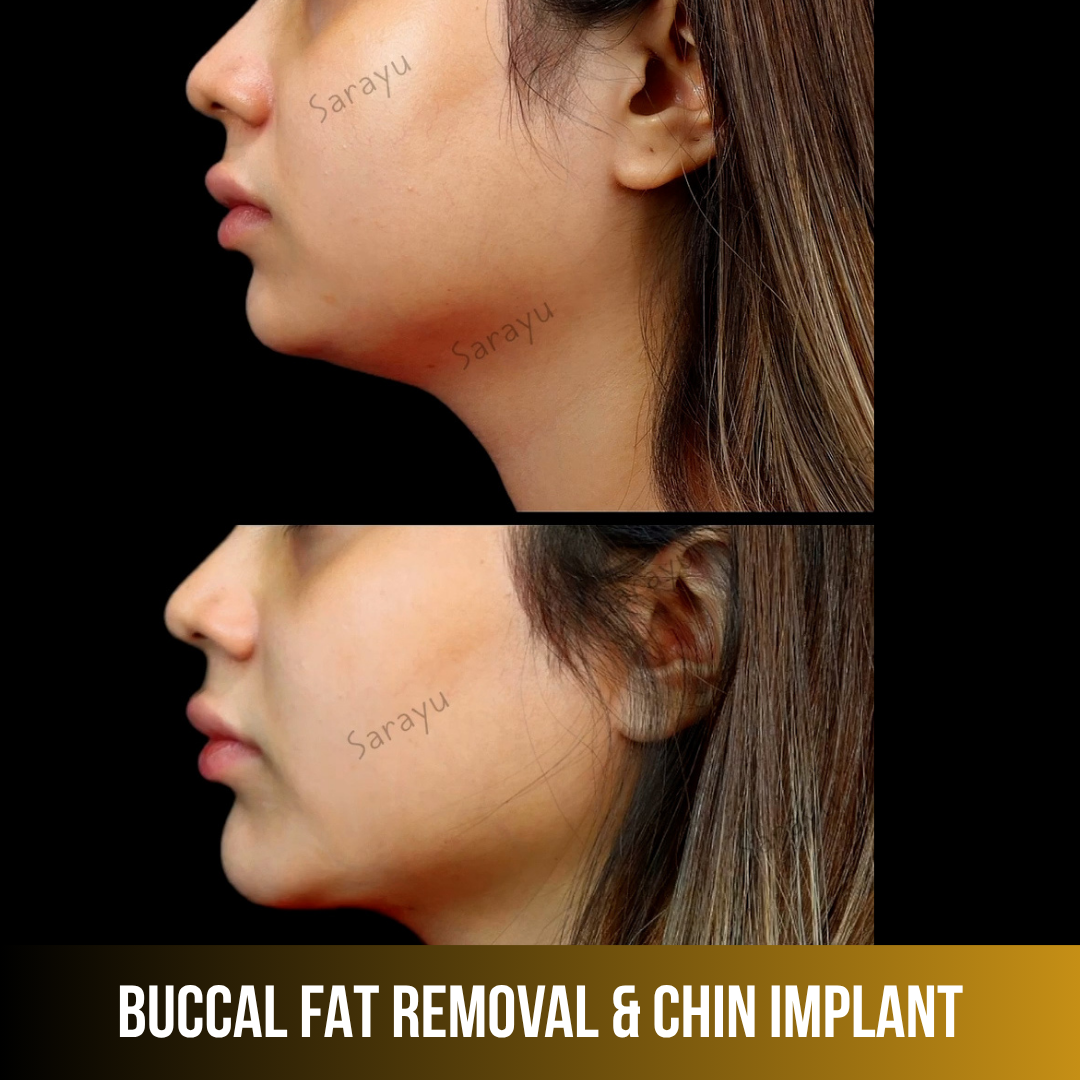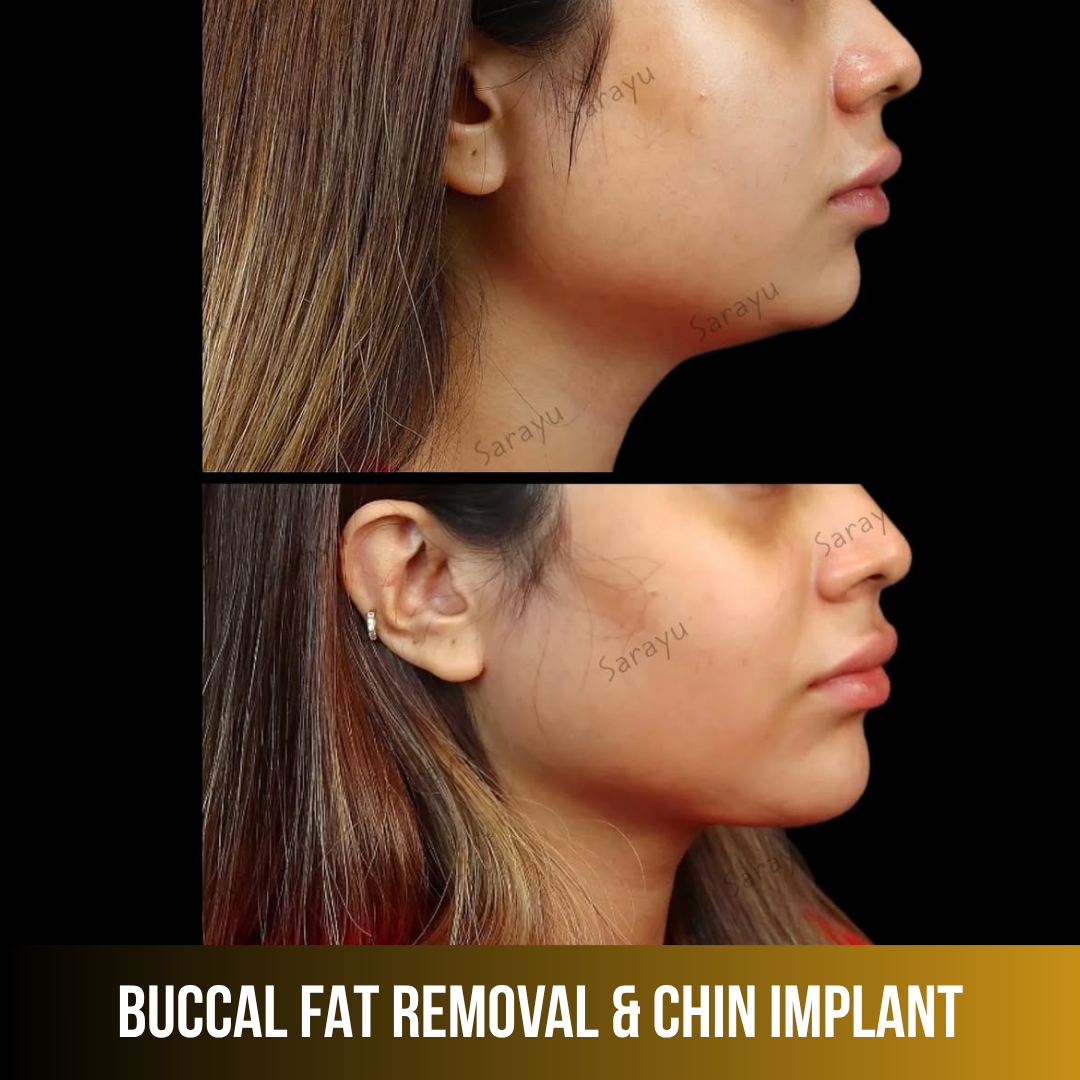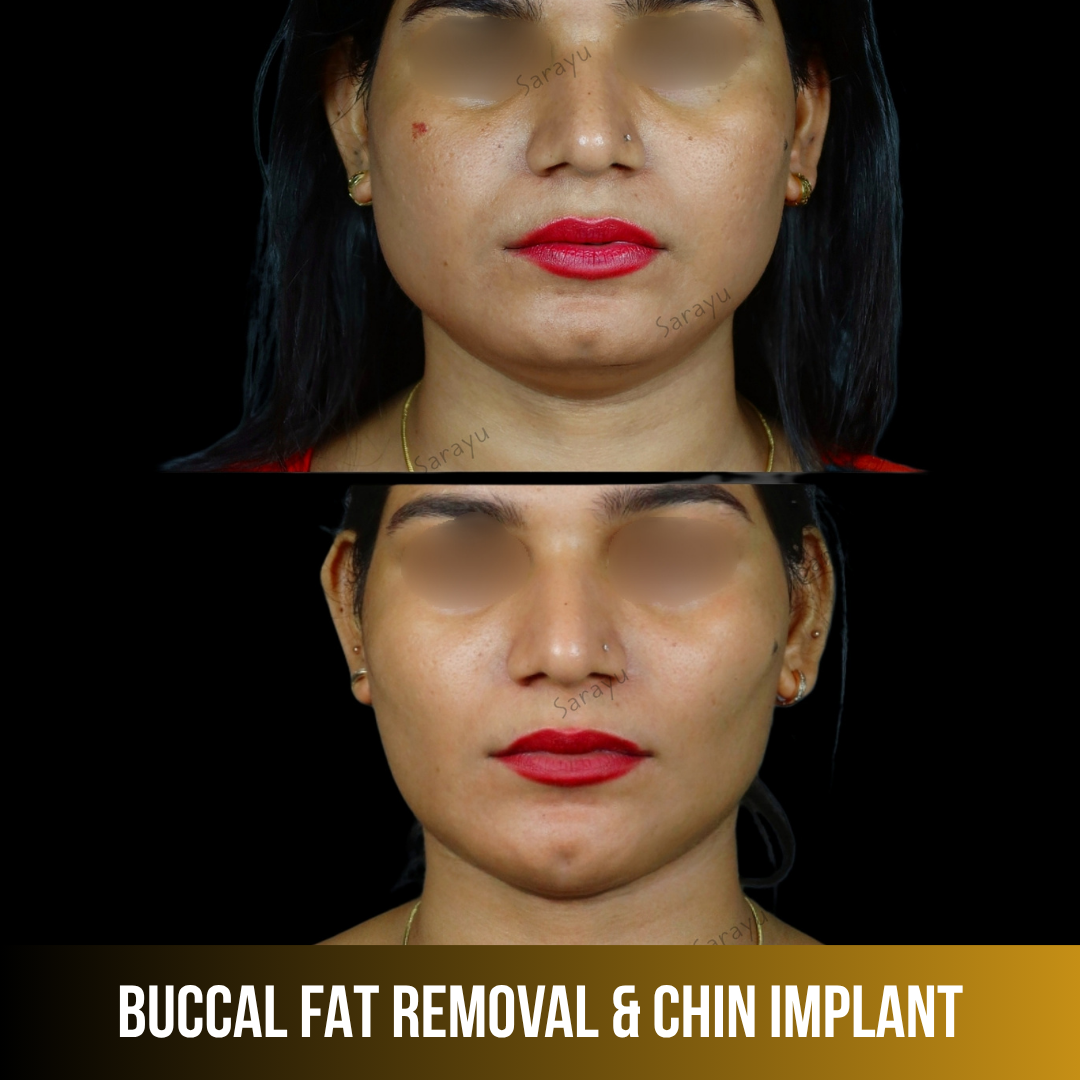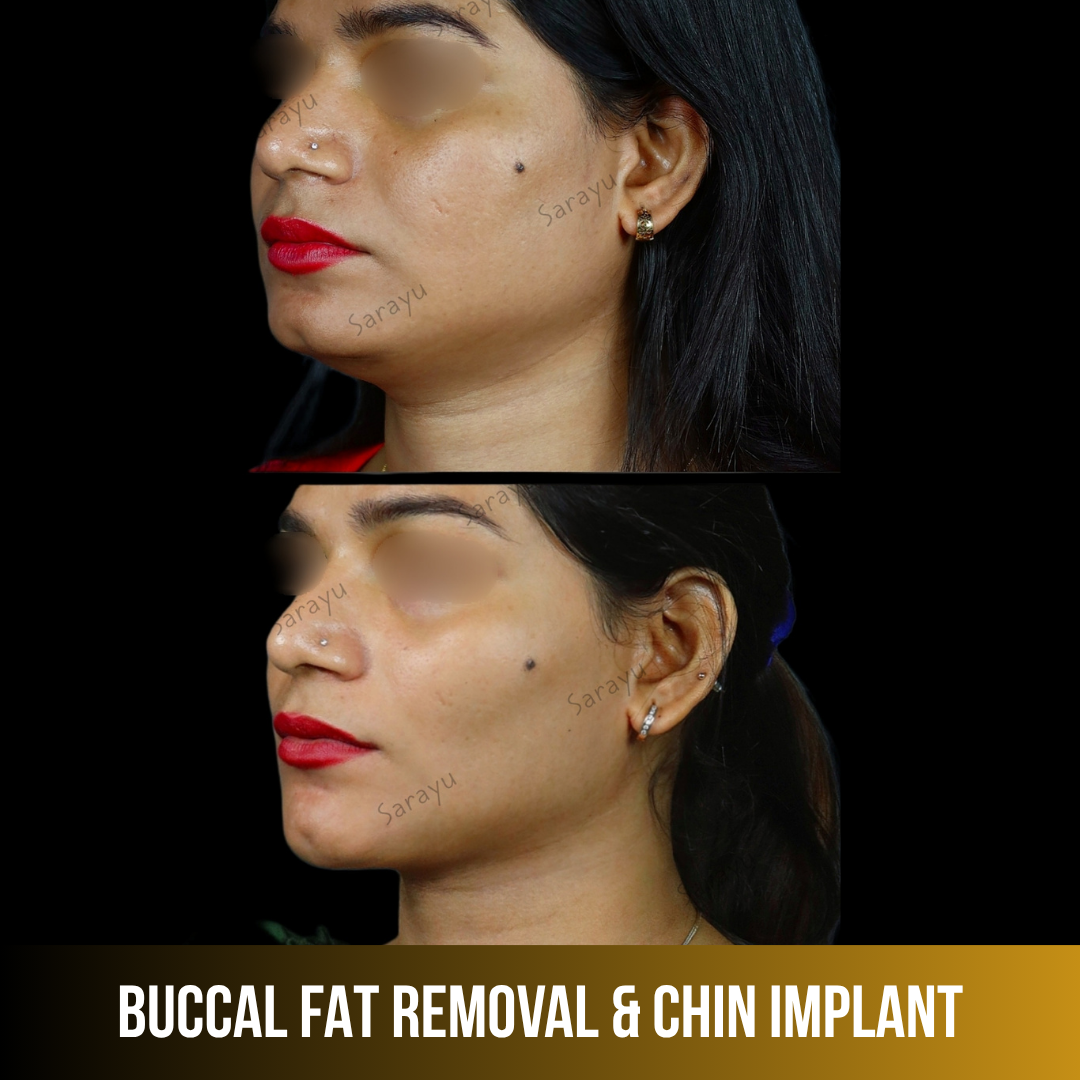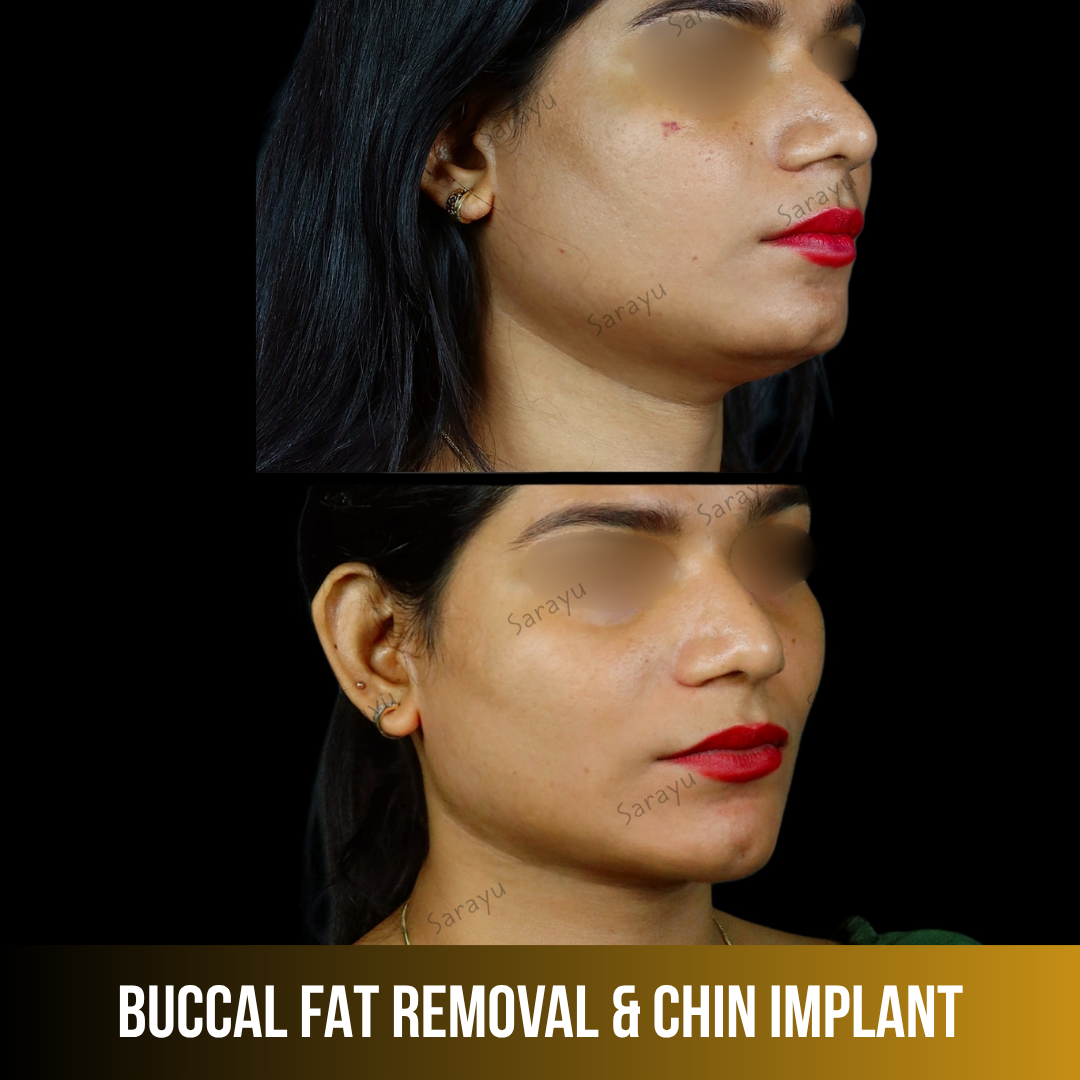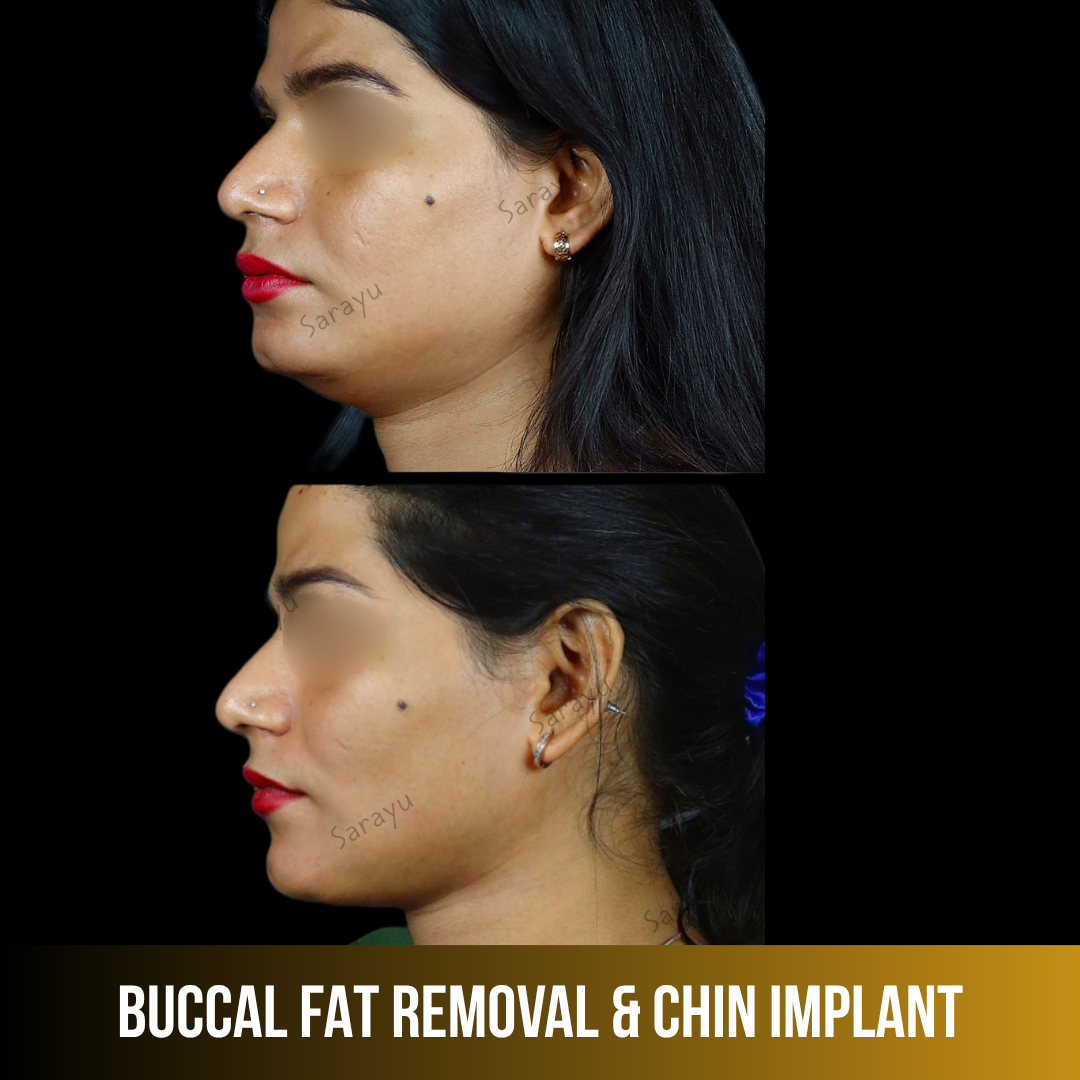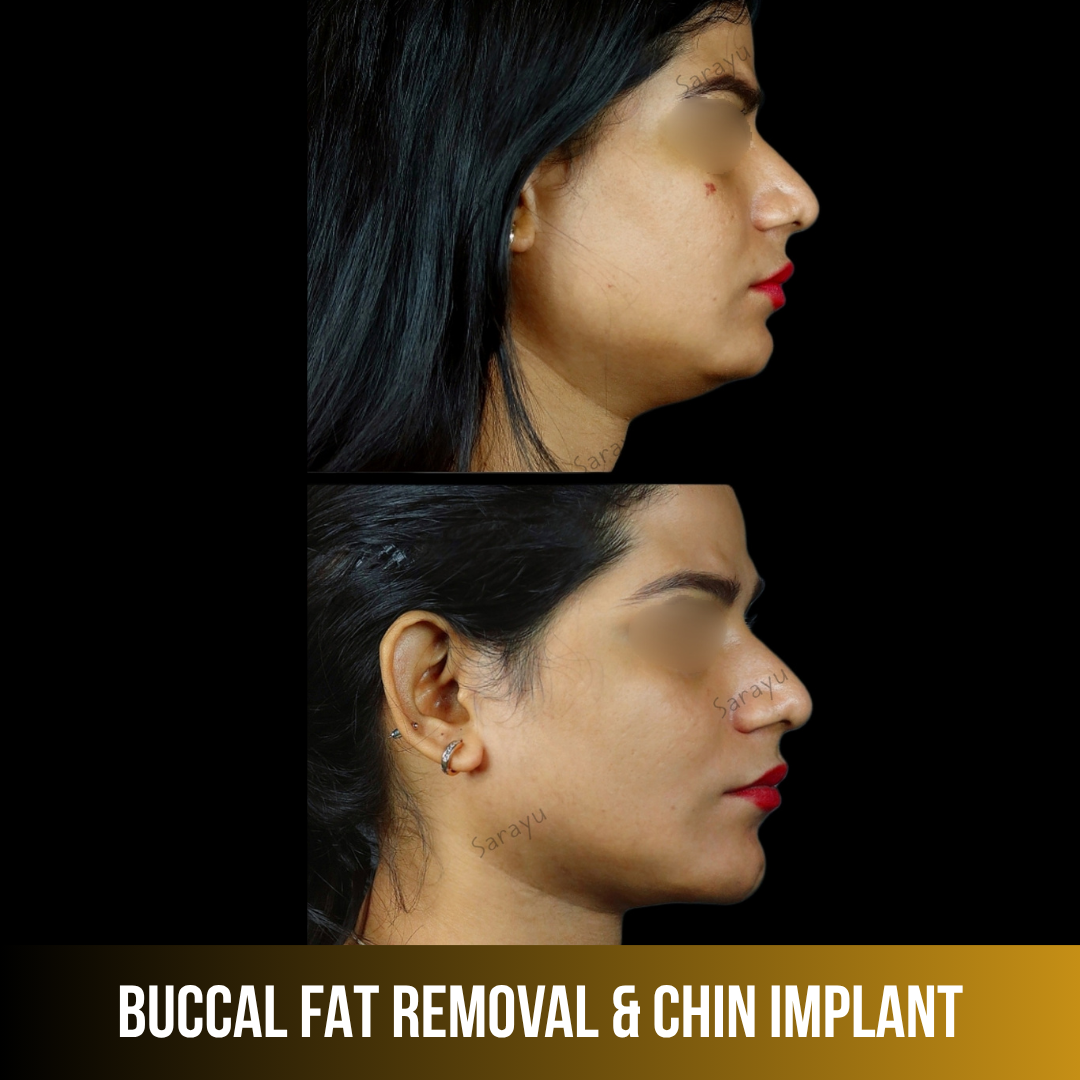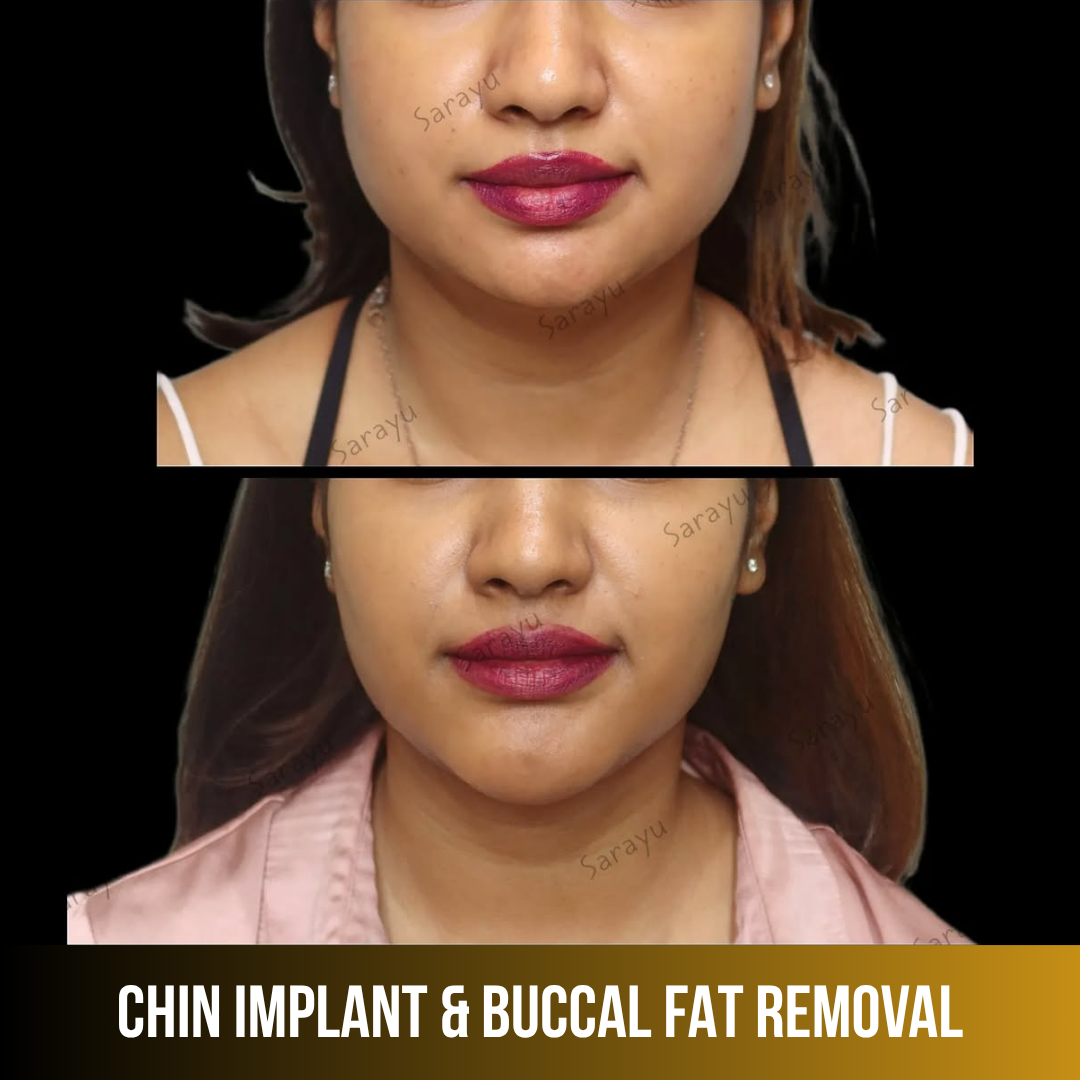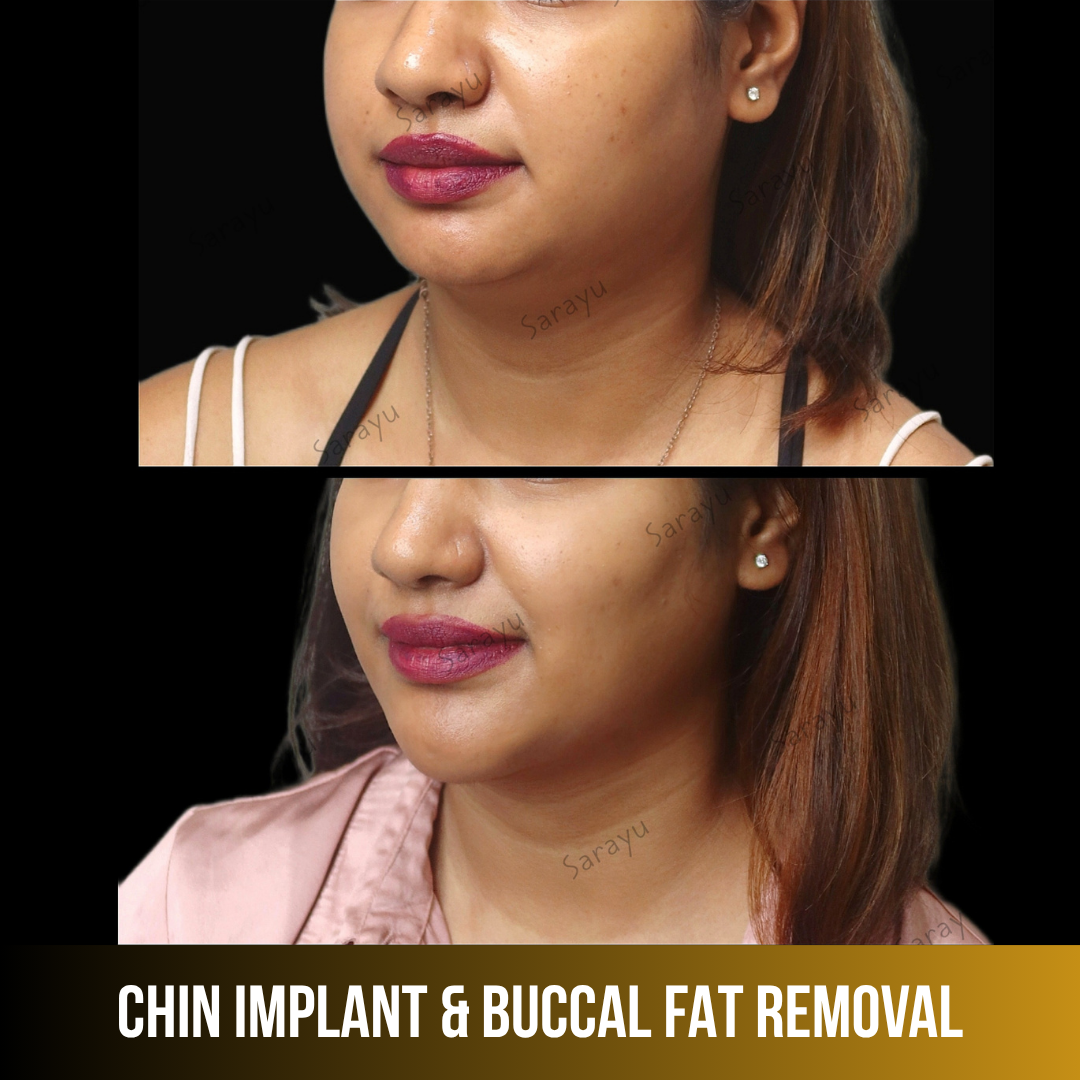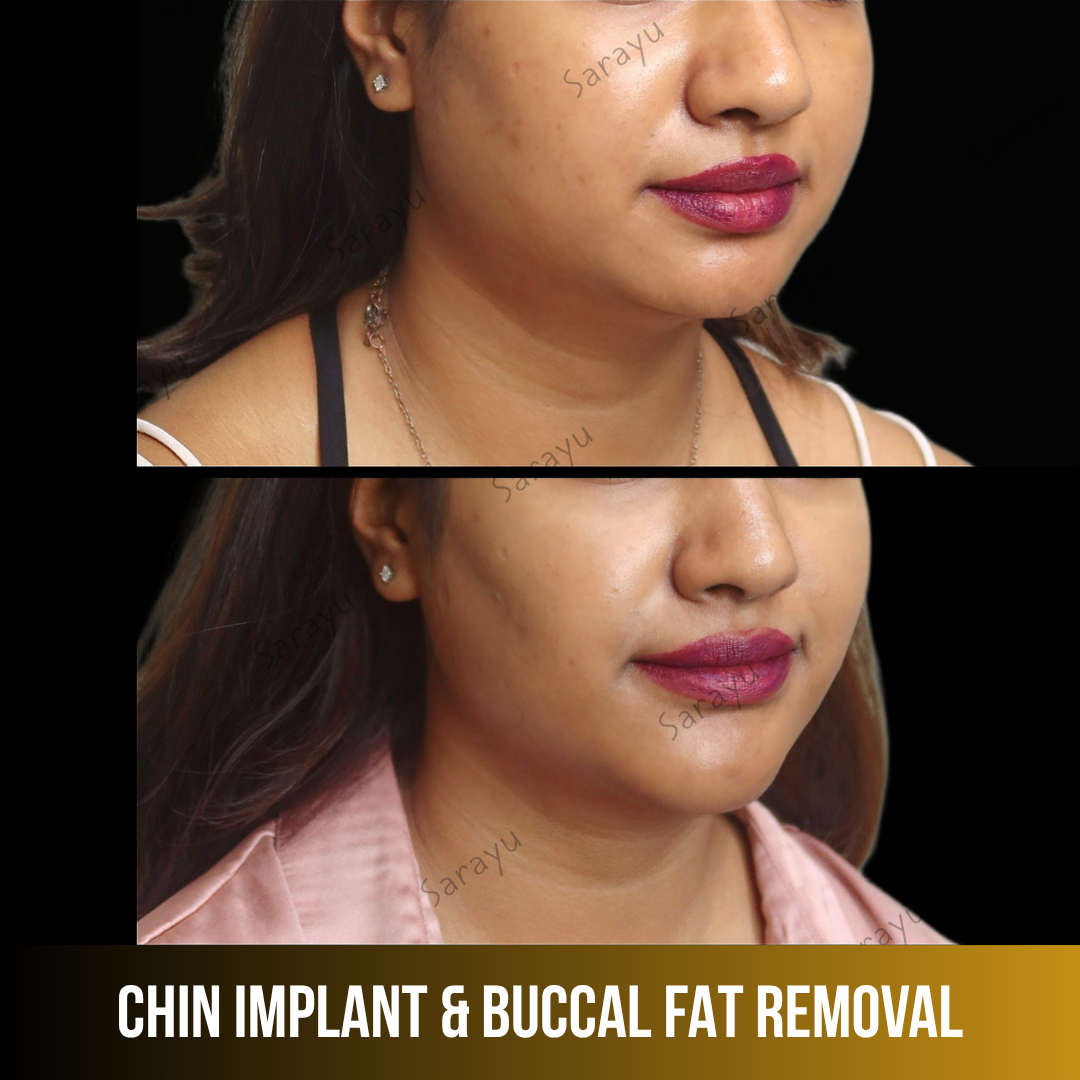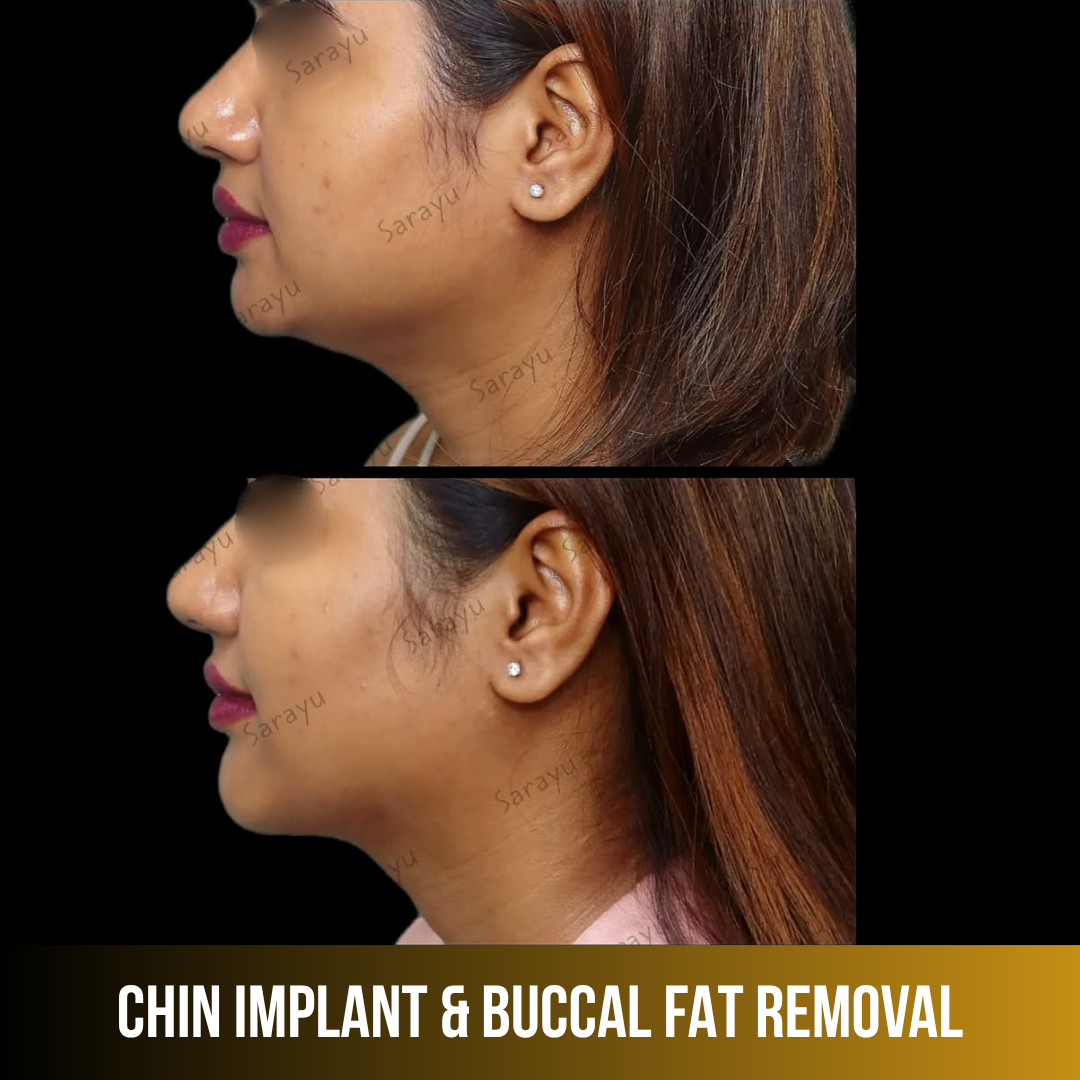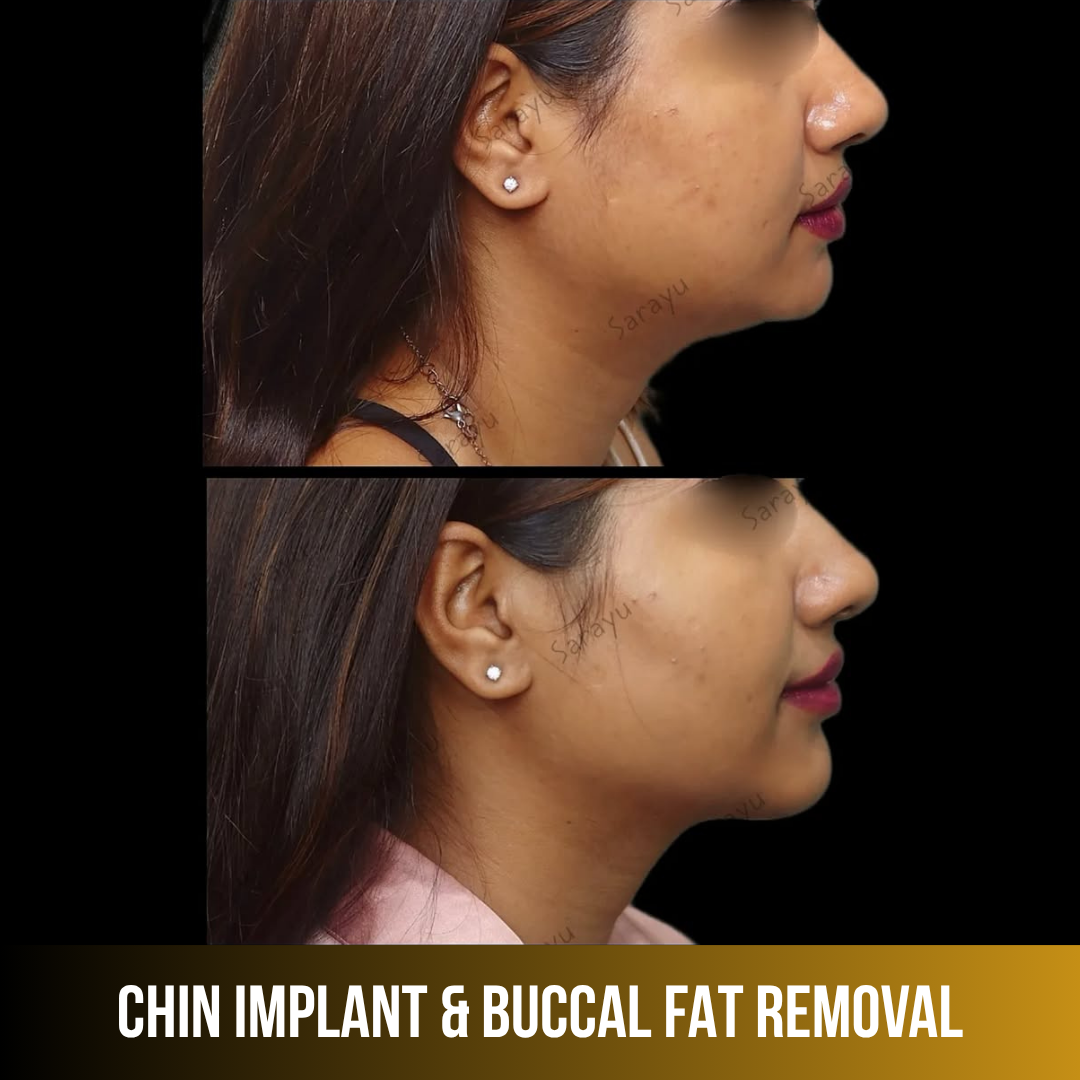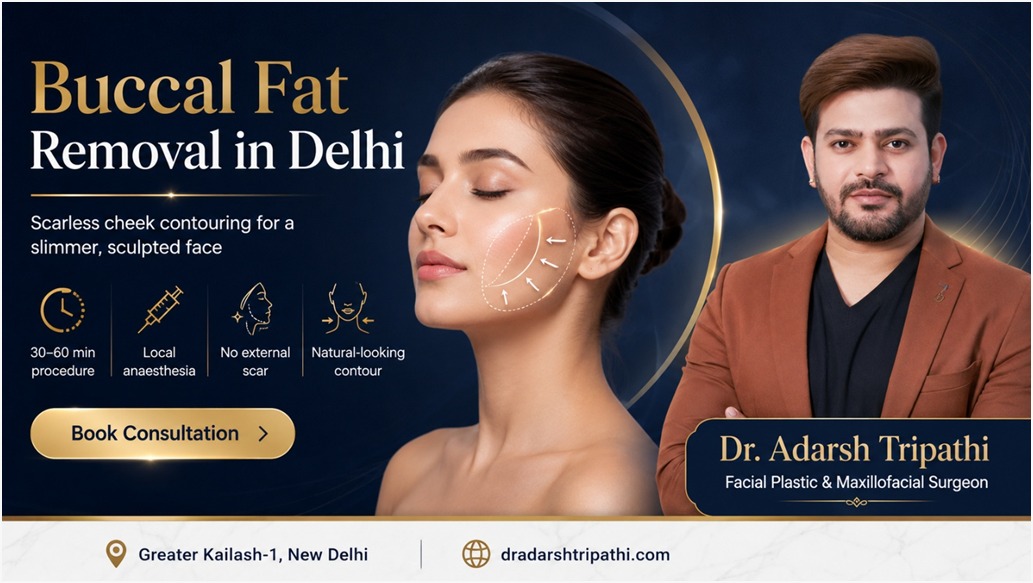
Buccal Fat Removal in Delhi
Quick answer : Buccal fat removal (bichectomy) slims genuinely full lower cheeks by removing a measured portion of the deep buccal fat pad through a small incision inside the mouth — no visible scar. At Sarayu Clinics, Greater Kailash-1, it takes 30–60 minutes under local anaesthesia, costs Rs 35,000–75,000 for both cheeks, and has most people back at work in 5–7 days. Results are permanent, which is exactly why conservative removal — typically under 3 ml per cheek — matters.
If your face looks rounder or fuller than you’d like — particularly in the lower cheeks — no amount of dieting or exercise seems to change it. That’s because the fullness usually isn’t ordinary fat that responds to weight loss. It’s the buccal fat pad, a deep, distinct structure sitting between the cheek muscles that gives some faces a soft, rounded ‘baby face’ look well into adulthood. Buccal fat removal is the procedure that addresses it directly.
Done well, buccal fat removal slims the lower cheeks, brings out the cheekbones, and creates a more sculpted, defined facial profile — the look people often describe as a ‘V-line’ or ‘snatched’ face. But here’s something most clinic pages won’t tell you upfront, and it’s the single most important thing to understand: this procedure is permanent and, done too aggressively, it can leave the face looking gaunt and prematurely aged years later. The skill is not in removing fat — that’s the easy part. The skill is in judging exactly how much to remove for your face, your age, and how your face will naturally change over time. That judgement is what separates an experienced facial surgeon from the rest.
Dr. Adarsh Tripathi is a Maxillofacial and Facial Plastic Surgeon with over 18 years of experience at Sarayu Clinics, Greater Kailash-1, New Delhi. Because his entire practice is focused on the face — its structure, proportion, and how it ages — buccal fat removal is everyday, considered work for him. This page covers the procedure in full, who it genuinely suits (and who it doesn’t), recovery, cost, and how to choose the right buccal fat removal surgeon in Delhi.
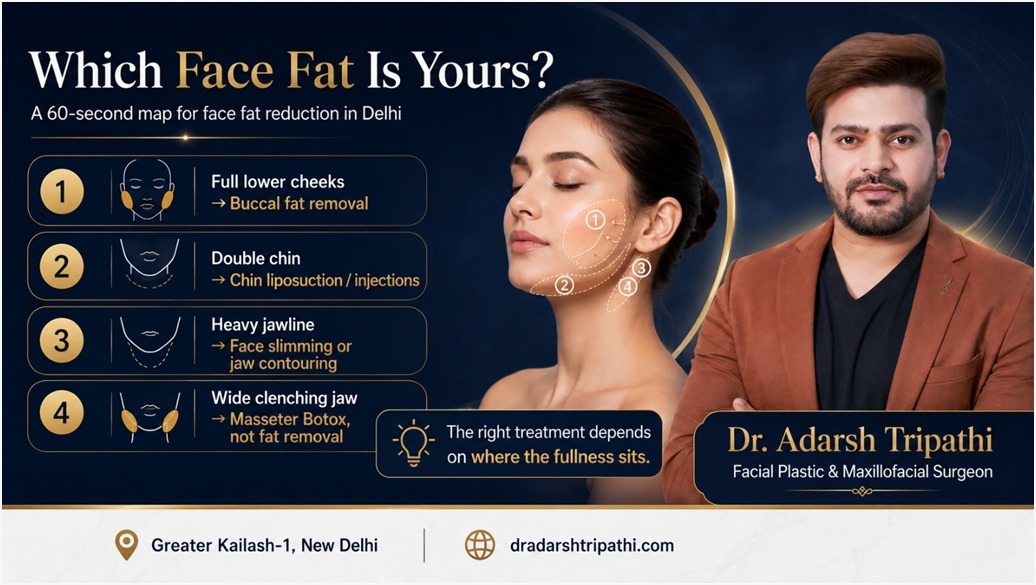
Which Face Fat Is Yours? A 60-Second Map
“Face fat removal” means six different things depending on where the fullness sits — and each has a different right answer. Before assuming buccal fat removal is your procedure, find your face in this table. Getting this mapping right is most of what a good consultation does; getting it wrong is how people buy the wrong surgery.
What you see in the mirror | What it usually is | The right treatment |
Round lower cheeks, present since childhood, unchanged by weight loss | The buccal fat pad — deep, structural, diet-proof | |
Fullness under the chin, worse in photos taken from below | Submental fat | |
Heaviness along the jaw; early jowls | Lower-face fat with early skin laxity | Facial liposuction – /liposuction-in-delhi/ and HIFU – /hifu-treatment-in-delhi/ |
A wide lower face that clenches hard; teeth grinding | Masseter muscle, not fat at all | |
Overall softness with little definition anywhere | Mild fat plus skin quality | Face slimming treatments – /face-slimming-treatment-in-delhi/ |
Cheeks that look full because cheekbones are flat | Volume distribution, not excess fat |
More than one zone? That is common — and it is exactly what our full face sculpting planning is for: one coordinated plan across cheeks, chin and jawline instead of piecemeal procedures.
Benefits of Buccal Fat Removal — What It Realistically Achieves
When buccal fat removal is the right procedure for the right face, the benefits are genuine and long-lasting. Here’s an honest picture:
- Slimmer lower cheeks — directly reduces the rounded fullness that dieting can’t shift
- More defined cheekbones — as the lower cheek flattens, the cheekbones become more prominent
- A sharper, more sculpted facial profile — the contoured ‘V-line’ look many patients want
- Better facial balance — particularly for faces that look disproportionately round relative to the jaw and chin
- Permanent results — the removed fat pad does not grow back or regenerate
- No visible scarring — the incision is inside the mouth
- Quick procedure and recovery — 30–60 minutes, most people back to routine within a week
- Often combined with other contouring procedures (chin implant, jawline filler) for a complete profile improvement
An honest caveat worth repeating: buccal fat removal suits some faces and not others. People who are already slim-faced, or who are likely to lose facial volume with age, can end up looking hollow or older if the procedure is done — which is exactly why Dr. Tripathi will sometimes advise against it. A genuine benefit only exists when the procedure matches your anatomy.
Areas of the Face Addressed by Buccal Fat Removal
Buccal fat removal specifically targets the mid-to-lower cheek, but understanding the surrounding anatomy explains why it works and where its limits are.
The Lower Cheek / Mid-Face Hollow
This is the primary target. The buccal fat pad sits deep in the cheek, below the cheekbone and between the facial muscles. Removing a measured portion creates a subtle concavity below the cheekbone — the defined, sculpted look that makes the face appear slimmer and the cheekbones more prominent.
The Cheekbone Region (Indirectly)
Buccal fat removal doesn’t touch the cheekbone itself, but by reducing the fullness below it, the cheekbone naturally appears more defined and elevated. For patients who also want more cheekbone projection, this is where cheek fillers or implants can complement the procedure.
The Jawline and Lower Face (Related, Not Treated)
A common misunderstanding is that buccal fat removal sharpens the jawline. It generally does not — the buccal fat pad sits higher in the cheek, not along the jaw. Jawline definition is better addressed with jawline filler, chin augmentation, or in some cases liposuction of the lower face. An honest surgeon will tell you this rather than overselling buccal fat removal as a jawline solution.
What Buccal Fat Removal Cannot Address ?
- It does not slim the upper face or temples
- It does not tighten loose or sagging skin (that needs skin-tightening or a facelift)
- It does not sharpen the jawline directly
- It does not reduce a double chin (that’s submental fat — addressed by liposuction or fat-dissolving treatment)
Concerns and Facial Types Buccal Fat Removal Addresses
Round or ‘Chubby’ Cheeks (‘Chipmunk Cheeks’)
The most common reason patients seek the procedure. A naturally full lower cheek — often present since childhood and unchanged by weight loss — gives the face a rounded, youthful-to-the-point-of-soft appearance. Buccal fat removal directly reduces this fullness.
A Round Face Disproportionate to the Body
Some people are slim everywhere except the face, which stubbornly stays full. For these patients — provided they’re not at risk of future facial volume loss — buccal fat removal can bring the face into better balance with the rest of the body.
Lack of Cheekbone Definition
Where full lower cheeks obscure the cheekbones, removing buccal fat reveals the underlying bone structure for a more sculpted, photogenic look.
Pseudoherniation of the Buccal Fat Pad
In some people the buccal fat pad bulges or sits lower than normal, creating visible fullness in the mid-cheek. This is a specific anatomical indication that responds well to the procedure.
Desire for a ‘V-Line’ or Contoured Aesthetic
The sculpted, tapering lower face popularised across social media. Buccal fat removal is one component of achieving this, often alongside jawline and chin work — and best approached with realistic, individualised planning rather than chasing a trend.
Parry-Romberg Syndrome and Facial Asymmetry (Specialised)
In rare reconstructive cases involving facial asymmetry, targeted buccal fat procedures may form part of a wider plan. These complex cases require a surgeon with deep maxillofacial training — an area within Dr. Tripathi’s expertise.
Are You a Good Candidate for Buccal Fat Removal?
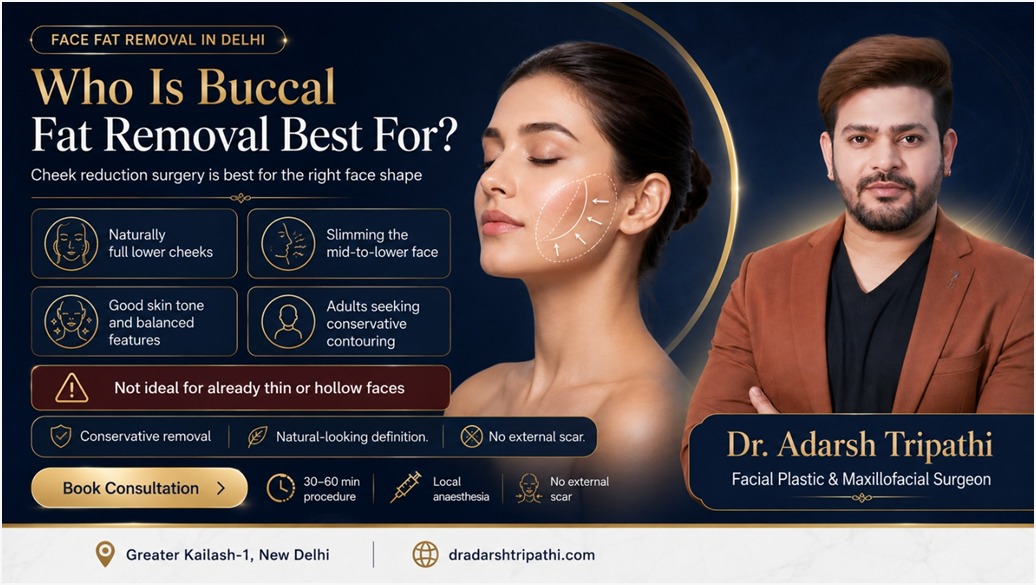
Candidate selection is the single most important factor in a good buccal fat removal outcome — more than surgical technique itself. Here’s an honest breakdown:
You are likely a good candidate if:
- You have genuinely full, round lower cheeks that don’t respond to weight loss
- You are at a stable, healthy weight
- You are typically between 20 and 40 (the fat pad finishes growing around age 20)
- Your face has enough volume that removing some won’t risk a hollow look later
- You have realistic expectations — a subtle, natural slimming, not a dramatic transformation
- You are in good general health and a non-smoker (or willing to stop around surgery)
You should reconsider or may not be suitable if:
- Your face is already slim or angular — removal risks a gaunt appearance
- You are over 40 with a thin face — natural age-related fat loss compounds the effect
- You are seeking jawline definition specifically — a different procedure suits you better
- Your facial fullness is from weight that could be addressed by overall weight loss first
- You have unrealistic expectations of a dramatic ‘model’ transformation
- You have a tendency toward significant future weight loss or facial volume loss
This is genuinely a procedure where the right answer for some people is ‘don’t.’ Dr. Tripathi’s consultation includes an honest assessment of whether buccal fat removal will still look good on your face in 10–15 years — not just next month.
The Buccal Fat Removal Procedure — Step by Step
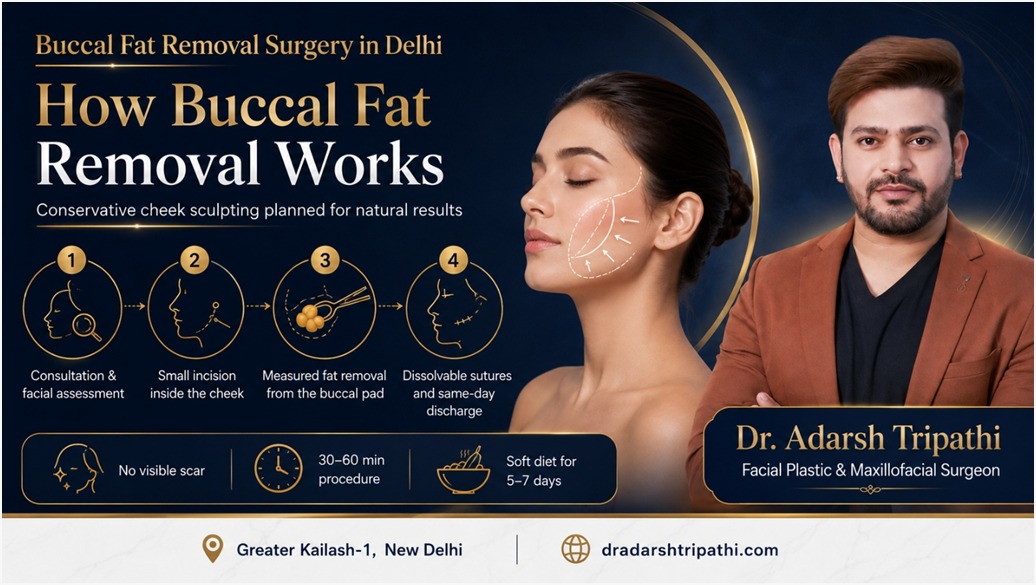
Step 1: Consultation & Facial Assessment
Dr. Tripathi examines your facial proportions, assesses the volume and position of the buccal fat pads, evaluates your skin quality and likely aging pattern, and discusses your goals honestly. This is where suitability is determined — and where you’ll get a frank answer about whether the procedure is right for you. Photographs and sometimes digital simulation help visualise the likely result.
Step 2: Pre-Operative Preparation
- Avoid aspirin, ibuprofen, and blood-thinning supplements for 1–2 weeks
- Stop smoking for at least 2–3 weeks before and after (it impairs oral healing)
- Arrange a light meal beforehand if only local anaesthesia is used
- Arrange transport home, especially if sedation is planned
Step 3: Anaesthesia
Buccal fat removal is usually performed under local anaesthesia, sometimes with light sedation for comfort. General anaesthesia is rarely needed unless combined with other procedures.
Step 4: The Surgery
- A small incision (about 1 cm) is made on the inside of the cheek, near the back upper teeth — entirely inside the mouth, no external cut
- Gentle pressure exposes the buccal fat pad through the incision
- A measured, conservative portion of the fat pad is carefully teased out and removed — the surgeon removes only what proportion analysis indicates, never the whole pad
- The same is done symmetrically on the other side, with careful comparison to ensure even results
- The incision is closed with dissolvable sutures that don’t need removal
The procedure typically takes 30–60 minutes.
Step 5: Immediate Aftercare
You’re observed briefly, then discharged the same day with a prescribed antiseptic mouthwash, pain relief, and written aftercare instructions. The cheeks will feel numb for a few hours as the anaesthetic wears off.
Recovery and Downtime — What to Expect
Day 1–3
Mild to moderate swelling in the cheeks (you may look temporarily fuller, not slimmer — this is normal and expected). Some tenderness inside the mouth. A soft, lukewarm diet is important. Rinse with the prescribed mouthwash after eating. Sleep with the head slightly elevated.
Days 4–7
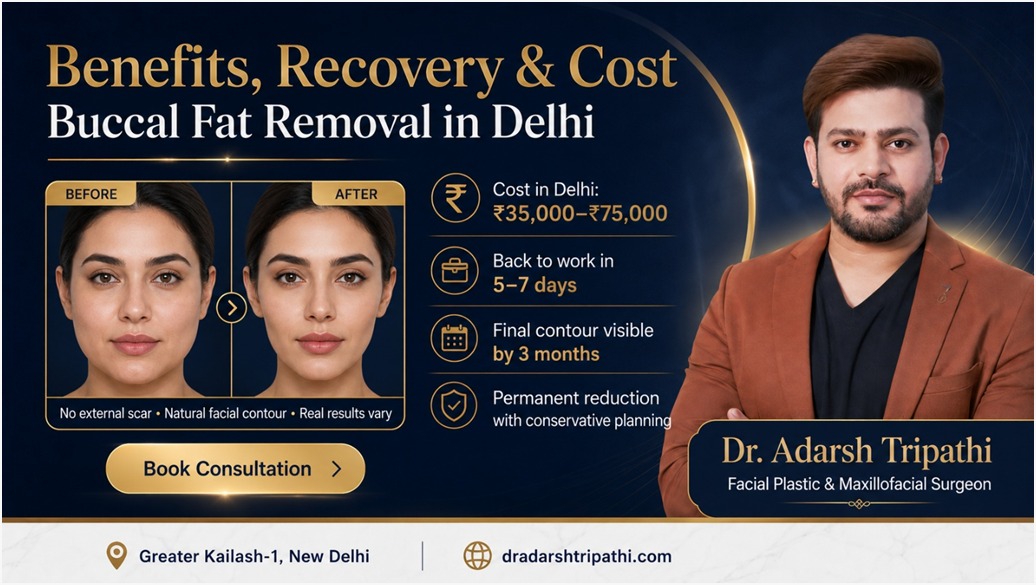
Swelling begins to settle. Eating becomes more comfortable. Most patients return to work and social activities within this window — the inside-the-mouth incision means there’s nothing visible externally. The internal sutures dissolve over this period.
Weeks 2–4
Most swelling resolves. The face starts to look like the intended result, though some residual puffiness remains. Normal diet fully resumed.
Month 1–3
The final sculpted result becomes clearly visible as the last of the deep swelling settles and the tissues conform to the new contour.
Aftercare Essentials
- Soft diet for the first 5–7 days — avoid hard, crunchy, or very hot foods
- Antiseptic mouthwash after every meal for about a week to keep the incision clean
- No smoking — it significantly impairs oral wound healing
- Avoid strenuous exercise for 1–2 weeks
- Maintain good oral hygiene, gently, around the incision area
- Attend follow-up so healing and symmetry can be checked
Buccal Fat Removal Cost in Delhi — Transparent Pricing
Cost depends on the surgeon’s experience, the clinic, anaesthesia type, and whether the procedure is combined with other facial contouring. Here’s a clear breakdown:
What Affects the Cost ?
- Surgeon’s experience and specialisation in facial surgery
- Anaesthesia — local only vs local with sedation
- Whether combined with chin implant, jawline filler, or other contouring
- Clinic facilities and post-operative care included
Approximate Cost at Sarayu Clinics, Delhi
Procedure | Approx. Cost | Duration | Anaesthesia | Permanence |
Buccal Fat Removal (both cheeks) | Rs. 35,000–75,000 | 30–60 mins | Local ± sedation | Permanent |
Buccal Fat Removal + Chin Filler | Rs. 55,000–1,00,000 | 45–75 mins | Local ± sedation | Filler 12–18 mo |
Buccal Fat Removal + Chin Implant | Rs. 90,000–1,60,000 | 1.5–2 hrs | Sedation/GA | Permanent |
Combined Full-Face Contouring | Customised | Varies | Sedation/GA | Varies |
Prices shown are for guidance only. Your final treatment cost will be confirmed during the initial consultation, based on your individual needs, concerns, and personalised treatment plan.

Results Timeline — When Will You See Your Final Face?
Buccal fat removal has a counterintuitive early phase: you look fuller before you look slimmer, because of swelling. Understanding the timeline prevents unnecessary worry.
- Day 1–7: swollen — the face may look rounder than before (expected, not a failure)
- Weeks 2–4: swelling subsides, the slimming effect begins to show
- Month 1–2: clear improvement; about 70–80% of the final result visible
- Month 3: deep swelling fully resolved; the sculpted contour is essentially final
- Month 3–6: tissues fully settle into the final, stable shape
How Long Do Results Last?
The results are permanent — the removed buccal fat does not grow back. The contour you have at 3–6 months is essentially what you keep. This permanence is the procedure’s strength and its responsibility: it’s why conservative removal matters, because as the face naturally loses some volume with age, an aggressively removed buccal pad can’t be put back.
Comparison — Buccal Fat Removal vs Alternatives
Facial slimming and definition can be approached several ways. The right choice depends on your anatomy and whether you want something permanent, reversible, or non-surgical.
Option | What It Does | Permanence | Downtime | Best For |
Buccal Fat Removal | Removes deep cheek fat | Permanent | 5–7 days | Genuinely full lower cheeks |
Jawline / Cheek Filler | Adds definition by contouring | 12–18 months | Minimal | Definition without removing volume |
Chin Implant | Projects the chin for balance | Permanent | 1 week | Weak chin / profile balance |
Facial Liposuction | Removes superficial fat (jowls/chin) | Permanent | 1 week | Double chin, lower-face fat |
HIFU / RF Tightening | Tightens skin, mild contour | 6–12 months | None | Mild laxity, non-surgical |
Fat-Dissolving Injections | Dissolves small fat pockets | Semi-permanent | Few days | Small submental fat |
Buccal Fat Removal vs Fillers — A Key Distinction
These are opposites, and people sometimes confuse them. Buccal fat removal takes volume away to slim the cheek. Fillers add volume to contour or define. Interestingly, some patients who want a sculpted look are actually better served by filler placed at the cheekbone (to create definition) than by removing buccal fat (which risks future hollowing). Determining which you actually need is a core part of the consultation.
Why a Facial Plastic Surgeon, Not a General Cosmetic Clinic?
The buccal fat pad sits close to the facial nerve and the parotid duct. Removing it safely and symmetrically — and judging the right amount — requires intimate knowledge of facial anatomy. A surgeon whose practice is the face, like Dr. Adarsh Tripathi, performs this with the anatomical precision and aesthetic judgement that protect both your safety and your long-term appearance. When you search for a buccal fat removal surgeon in Delhi, this facial specialisation is exactly what to look for.
Why Dr. Adarsh Tripathi Is a Trusted Buccal Fat Removal Surgeon in Delhi ?
Choosing the right surgeon matters more for buccal fat removal than for almost any other facial procedure, precisely because it’s permanent and judgement-dependent. Here’s how to choose — and why patients choose Dr. Tripathi:
What to Look For in a Buccal Fat Removal Surgeon ?
- Specialisation in the face — ideally a facial plastic or maxillofacial surgeon, not a general cosmetic provider
- A conservative philosophy that prioritises how you’ll look in 10+ years, not just immediately
- Willingness to decline the procedure when it isn’t right for your face
- Before-and-after photos showing natural, not over-done, results
- A consultation conducted personally by the surgeon
- Genuine patient reviews and clear safety protocols
Dr. Tripathi’s Credentials
- Maxillofacial and Facial Plastic Surgeon with 18+ years of experience
- Practice focused exclusively on the face and neck — facial contouring is core work
- Deep anatomical training relevant to safe buccal fat pad surgery (facial nerve, parotid duct)
- Conservative, proportion-led approach that protects long-term facial appearance
- Consultations personally conducted by Dr. Tripathi, not a coordinator
- Known for natural results, including work with public figures who are regularly photographed
A Conservative, Future-Proof Philosophy
The hallmark of poor buccal fat removal is the gaunt, sunken look that appears years later. It comes from removing too much in a face that needed less — or needed none. Dr. Tripathi removes only the measured amount his proportion analysis supports, and treats your facial future as part of the plan. The goal is a face that looks better now and still looks good a decade from now.
Frequently Asked Questions — Buccal Fat Removal in Delhi
Q: Who is the best buccal fat removal surgeon in Delhi?
A: The best buccal fat removal surgeon in Delhi for you is one who specialises in the face, removes fat conservatively, and is honest about whether the procedure suits you. Dr. Adarsh Tripathi is a Maxillofacial and Facial Plastic Surgeon with 18+ years of experience whose practice is focused exclusively on the face, performing buccal fat removal with a proportion-led, future-proof approach at Sarayu Clinics, Greater Kailash.
Q: What is buccal fat removal surgery?
A: Buccal fat removal (buccal lipectomy) is a minimally invasive surgical procedure that removes a measured portion of the buccal fat pad from the lower cheeks to create a slimmer, more sculpted face. It’s performed through a small incision inside the mouth, leaving no visible scars, and takes 30–60 minutes under local anaesthesia.
Q: How much does buccal fat removal cost in Delhi?
A: Buccal fat removal in Delhi costs approximately Rs. 35,000–75,000 for both cheeks. Cost varies with the surgeon’s experience, anaesthesia type, and whether it’s combined with other procedures like a chin implant. A personalised quote is given after consultation at Sarayu Clinics.
Q: Is buccal fat removal permanent?
A: Yes, buccal fat removal is permanent. The removed buccal fat pad does not grow back. This is why conservative removal is so important — because the face naturally loses some volume with age, removing too much can cause a hollow look later that’s difficult to correct.
Q: Does buccal fat removal leave scars?
A: No, buccal fat removal leaves no visible scars. The incision is made entirely inside the cheek, near the back upper teeth, and is closed with dissolvable sutures. Nothing is cut on the outside of the face.
Q: Is buccal fat removal painful?
A: Buccal fat removal is performed under local anaesthesia, so the procedure is painless. Afterwards most patients describe mild tenderness and tightness inside the cheek rather than significant pain, easily managed with simple pain relief for a few days.
Q: How long is recovery after buccal fat removal?
A: Most patients return to work and social activities within 5–7 days of buccal fat removal, since the incision is inside the mouth with nothing visible externally. Mild swelling settles over 2–4 weeks, and the final sculpted result appears at around 3 months.
Q: Will buccal fat removal make me look older as I age?
A: It can if too much fat is removed. Because the face naturally loses volume with age, over-aggressive buccal fat removal can cause a gaunt, prematurely aged appearance years later. This is why an experienced surgeon removes only a measured, conservative amount and declines the procedure for patients whose faces are likely to thin with age.
Q: Does buccal fat removal sharpen the jawline?
A: Not directly. The buccal fat pad sits in the mid-to-lower cheek, not along the jaw, so buccal fat removal slims the cheeks rather than sharpening the jawline. Jawline definition is better achieved with jawline filler, a chin implant, or lower-face liposuction, which can be combined with buccal fat removal.
Q: What is the right age for buccal fat removal?
A: The right age for buccal fat removal is typically 20 and above, because the buccal fat pad continues developing until around age 20. There’s no strict upper limit, but patients over 40 with thinner faces need careful assessment, as age-related facial fat loss can make the procedure unsuitable.
Q: Can buccal fat removal be combined with other procedures?
A: Yes, buccal fat removal is commonly combined with a chin implant, jawline filler, or rhinoplasty for complete facial profile balancing. Combining procedures allows comprehensive contouring in a single planning process and one recovery period. Dr. Adarsh Tripathi discusses suitable combinations during consultation.
Q: How do I choose a buccal fat removal surgeon in Delhi?
A: Choose a facial plastic or maxillofacial surgeon with specific facial-contouring experience rather than a general cosmetic provider. Look for a conservative approach, before-and-after photos with natural results, a consultation conducted by the surgeon personally, and honesty about whether the procedure suits your face. Be cautious of very low-cost offers, since over-removal is permanent and hard to correct.
Q : Which treatment is best for face fat removal in Delhi?
A : It depends on which fat is yours. Genuinely full lower cheeks respond to buccal fat removal; a double chin needs submental liposuction or fat-dissolving injections; jowls suit facial liposuction or skin-tightening; a wide clenching jaw is muscle and responds to Botox, not fat removal. A facial assessment maps your face to the right treatment — sometimes a combination, sometimes none.
Schedule a consultation with Dr. Adarsh Tripathi at Sarayu Clinics.
- Phone: +91-9990333300,+91 8882870882
- Email: sarayuinquiries@gmail.com
- Sarayu Clinics website: https://sarayuclinics.com/
- Facebook: https://www.facebook.com/sarayuclinics/
- Instagram: https://www.instagram.com/sarayuclinics/
- Youtube: https://www.youtube.com/channel/UCnHOtwgrzMKAPQthvVShftg
- Adarsh Tripathi’s profile: https://sarayuclinics.com/luxury/about-us/
- Adarsh Tripathi’s Linkedin profile: https://in.linkedin.com/in/dr-adarsh-tripathi-a43005b8
- Online Booking: Visit our website at https://sarayuclinics.com/beauty/appointment/to schedule appointments conveniently.
Our Patients