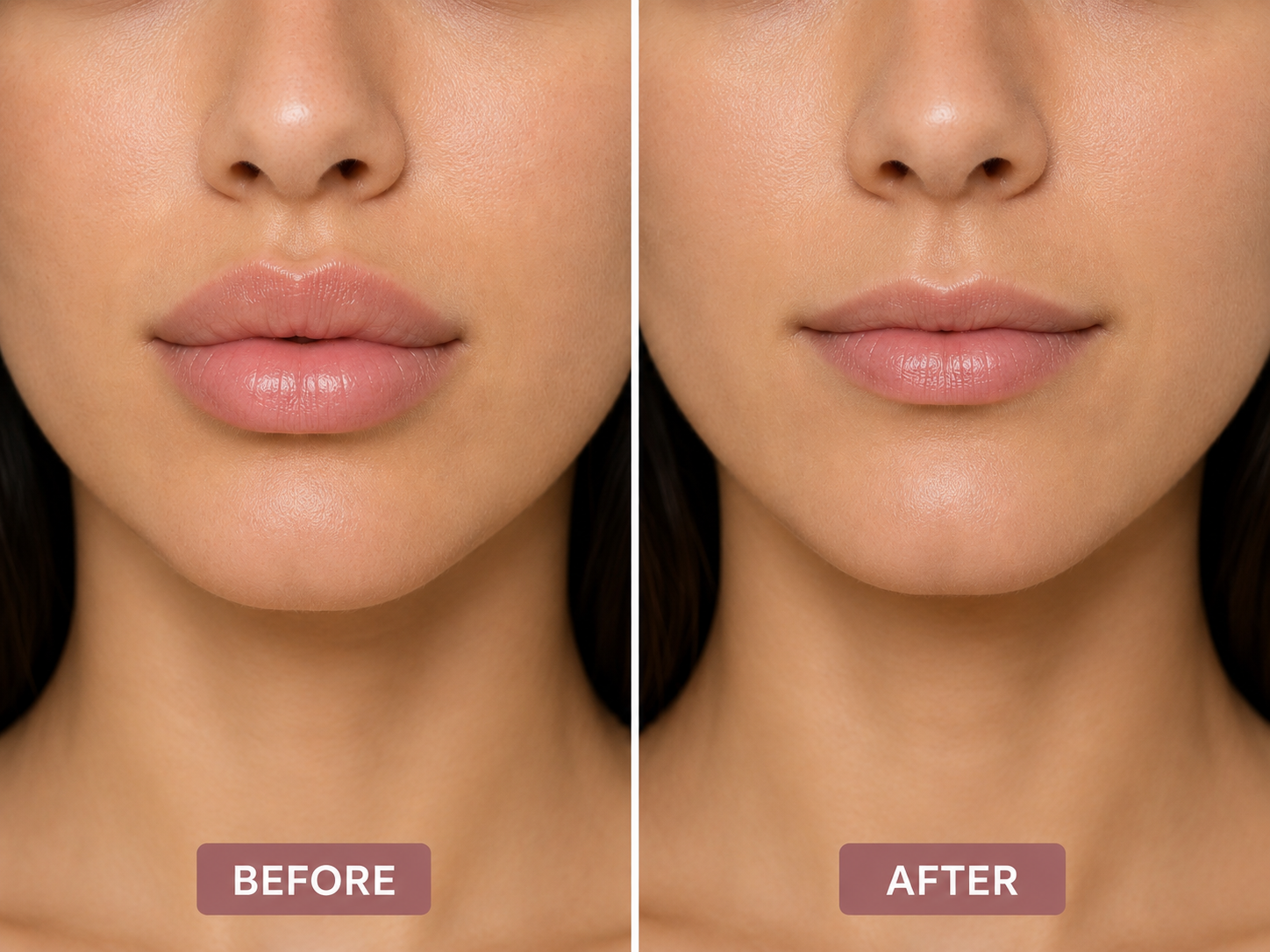
Lip Reduction Surgery in Delhi
Lips that feel too large for your face are something a surprising number of people quietly live with. It might be an upper lip that makes smiling feel self-conscious, a lower lip so full it creates visible tension when you close your mouth, or both lips together that simply feel out of proportion with your nose, chin, and cheekbones. Some people are born this way. Others developed it through heredity. A few are dealing with the aftermath of lip filler that went too far and never quite reversed.
Whatever the reason, the feeling is the same: your lips draw attention in a way that makes you uncomfortable rather than confident. And unlike a feature you can minimise with makeup or hairstyle, the mouth is always visible, always moving, and always part of how people read your face.
Lip reduction surgery — medically called reduction cheiloplasty — is a procedure that permanently reduces the size of one or both lips. It takes about 45 minutes to an hour, is done under local anaesthesia, leaves no visible scar (the incision is placed inside the mouth), and the recovery is mild compared to most facial surgical procedures.
Dr. Adarsh Tripathi is a Maxillofacial and Facial Plastic Surgeon with over 18 years of experience at Sarayu Clinics, Greater Kailash-1, New Delhi. Lip reduction is part of a broader range of lip treatments he performs — from surgical reduction and lip flip surgery to non-surgical options like lip fillers, Botox lip flip, and permanent lip tint. This page covers all of them, so you can understand your options before deciding what suits you.
What Lip Reduction Can Do — Real Benefits Without Exaggeration ?
The benefits of lip reduction surgery are largely functional and aesthetic in equal measure. Here is an honest breakdown of what patients typically gain:
Cosmetic Benefits
- Better facial proportion — lips that are sized in harmony with the nose, chin, jawline, and cheeks create a face that reads as naturally balanced
- Reduced protrusion — lips that push forward noticeably can be brought in, giving the face a more relaxed, resting expression
- Improved lip symmetry — if one lip is visibly larger than the other, both can be adjusted together
- More defined lip line — when lip tissue is excessive, the vermilion border (the natural edge of the lip) can appear blurred; reduction clarifies it
- Natural-looking results that hold permanently — unlike filler, lip reduction does not need repeating
Functional Benefits
- Easier lip closure — people with macrocheilia (medically large lips) sometimes struggle to close their lips comfortably at rest; surgery corrects this
- Reduced drooling — in some patients, excessive lip size contributes to labial incompetence and uncontrolled saliva; lip reduction can improve oral seal
- Improved speech clarity — very large lips can subtly affect pronunciation of certain sounds; reduction can improve this
- Relief from self-consciousness — patients consistently report that the psychological impact is significant, particularly in social or professional settings where they previously avoided being photographed or filmed
What Lip Reduction Cannot Do ?
- It does not change skin colour, pigmentation, or texture of the lip surface
- It does not address a ‘gummy smile’ (that is a different procedure — lip flip surgery or gum contouring)
- It does not change lip shape unless the surgeon specifically plans shape adjustments alongside size reduction
- It cannot reverse severe scarring from prior lip trauma — scar revision may be needed in addition
Which Part of the Lip Is Being Treated?
The lip is not one uniform structure. Understanding what ‘large’ means in clinical terms — and which part of the anatomy is responsible for the excess — determines how the procedure is planned.
Upper Lip (Cheiloplasty of the Upper Lip)
The upper lip has two components: the dry vermilion (the pink or red surface you see) and the wet mucosa (the inner moist lining). When the upper lip appears overly full or protrudes, it is usually because there is excess tissue in the wet vermilion and mucosa. The incision is placed at the junction between the dry and wet areas inside the lip, tissue is removed in an elliptical pattern, and the incision is closed with dissolvable sutures. The scar is entirely inside the mouth and invisible.
Upper lip reduction is by far the more commonly requested procedure. The upper lip is more visible during speech and expression, and even a modest reduction has a visually significant effect on facial balance.
Lower Lip (Cheiloplasty of the Lower Lip)
Lower lip reduction follows the same principle — an internal incision along the wet-dry junction, tissue removal, and closure with absorbable sutures. The lower lip tends to be naturally fuller than the upper, so what is considered ‘excess’ for the lower lip is calibrated differently. The goal is usually to bring the lower lip into a 2:1.6 ratio with the upper (the natural golden proportion), not to make them equal.
Lower lip reduction alone is less common but is performed when the lower lip is the primary concern — or when a previous upper lip reduction has improved the upper but left the lower still disproportionate.
Both Lips Together (Bilateral Cheiloplasty)
The most comprehensive approach, addressing upper and lower lips in the same procedure. Planning both simultaneously allows Dr. Adarsh Tripathi to achieve optimal proportion between them, rather than treating one and having to re-evaluate the other separately. Recovery is the same as for a single lip — both heal simultaneously.
The Vermilion Border
The vermilion border is the line where the lip meets the surrounding skin — the edge that lip liner traces. In some patients, this border has become irregular, asymmetrical, or indistinct due to natural anatomy, prior procedures, or trauma. Border definition can be addressed surgically (refined during reduction) or non-surgically (permanent makeup / lip tint, or precise filler micro-injection). This is often discussed during consultation as a complementary refinement alongside lip reduction.
Corners of the Mouth (Commissuroplasty)
Occasionally patients seeking lip reduction also notice that the corners of their mouth are turned downward, contributing to a sad or stern resting expression. Corner of mouth lift (commissuroplasty) is a small procedure that repositions the oral commissures. Dr. Adarsh Tripathi can assess whether this complements lip reduction in your case.
Conditions and Situations Where Lip Reduction Is Appropriate
Macrocheilia (Congenitally Large Lips)
Macrocheilia is the medical term for lips that are structurally larger than normal from birth. It is a hereditary trait that runs in families and can affect either or both lips. The condition is not a disease but a structural anatomical variation. It does not resolve with age and cannot be corrected non-surgically. Lip reduction is the definitive treatment.
Disproportionate Lips After Lip Filler
Lip filler has become extremely popular — but it can go wrong. Overfilling, migration of filler over time, or repeated treatments that cumulatively add too much volume can leave patients with lips they no longer recognise as their own. Hyaluronidase (filler dissolving enzyme) can reverse hyaluronic acid filler, but repeated dissolution cycles over many years can sometimes leave residual tissue changes. In cases where filler has been repeatedly placed over many years, surgical reduction may give a cleaner and more controllable result than further dissolution.
Lip Trauma or Injury
Accident-related lip injury — from a road traffic accident, a sports impact, or a burn — can leave tissue that has healed with excess bulk, irregular scarring, or asymmetry. Lip reduction combined with scar revision can restore a more normal appearance. The surgical planning for trauma cases is more detailed than for straightforward cosmetic reduction.
Dissatisfaction After Prior Lip Surgery
Botched or overcorrected prior lip surgery — whether from a lip augmentation, a cleft lip repair in childhood that left asymmetry, or a prior reduction that was insufficiently conservative — is a reason some patients seek revision lip reduction. Dr. Adarsh Tripathi performs revision lip cases and recommends waiting 6–12 months after the original procedure before considering revision.
Labial Hypertrophy Associated With Medical Conditions
Certain conditions — including Crohn’s disease, melkersson-Rosenthal syndrome, and lymphangioma — can cause lip swelling or enlargement that is not cosmetic in origin. These cases require medical management alongside any surgical consideration. Dr. Adarsh Tripathi coordinates with relevant specialists for medically complex cases and does not perform lip reduction in the presence of active inflammatory disease.
Ethnic and Cultural Considerations
Aesthetic preferences around lip size vary significantly across cultures. What one culture regards as beautiful, another may find disproportionate. Lip reduction for patients from South Asian, African, Middle Eastern, or Southeast Asian backgrounds requires a surgeon who understands ethnic facial proportions and does not apply a single standard. Dr. Adarsh Tripathi’s approach is explicitly patient-defined — the goal is what you want your face to look like, not an external standard imposed by the surgeon.
All Lip Treatments Available at Sarayu Clinics, Delhi
Lip reduction surgery is the primary focus of this page, but it exists within a broader menu of lip procedures. Understanding the full picture helps you find the right solution for your specific concern — or the right combination of treatments.
1. Lip Reduction Surgery (Reduction Cheiloplasty)
The surgical procedure that permanently reduces the size of one or both lips by removing excess wet mucosa and vermilion tissue through an internal incision. No external scar. Local anaesthesia. Permanent results. Best for people with macrocheilia, proportionately oversized lips, or excess volume from prior filler treatments.
Covered in full detail throughout this page.
2. Lip Augmentation (Lip Fillers)
The opposite of reduction — adding volume to lips that are thin, asymmetrical, or have lost volume with age. Hyaluronic acid dermal fillers (such as Juvederm Volift or Restylane Kysse) are injected into specific areas of the lips to add volume, define the cupid’s bow, enhance the vermilion border, or improve overall proportion. Results last 6–12 months and are reversible with hyaluronidase.
Lip fillers are the most commonly performed lip procedure globally, and at Sarayu Clinics they are used with restraint — the aim is always proportion and naturalness, not simply ‘more volume’.
3. Botox Lip Flip
A non-surgical technique where 4–6 units of botulinum toxin are injected into the orbicularis oris muscle just above the upper lip. This relaxes the muscle and allows the upper lip to gently evert (flip outward), appearing fuller without adding any volume. Particularly useful for people whose upper lip disappears when they smile, or those with a mild gummy smile. Results last 8–12 weeks and require maintenance injections.
The Botox lip flip is often used as a ‘try before you commit’ option for patients considering surgical lip procedures — it gives a preview of a slightly more prominent upper lip without permanence.
4. Surgical Lip Flip (Upper Lip Vermilion Advancement)
A permanent surgical alternative to the Botox lip flip for patients who want a lasting result without repeated injections. A fine incision is made along the skin-vermilion junction (the white roll), and the vermilion is advanced slightly outward and upward, creating a permanent eversion of the upper lip. No tissue is added — the lip’s own pink vermilion is repositioned. The scar sits precisely along the lip border where it blends with the natural colour transition.
This is distinct from lip augmentation — it changes the position of the lip rather than its volume. It is ideal for patients with a very thin vermilion show who want definition and permanent eversion without filler dependency.
5. Lip Tint / Permanent Makeup (PMU)
A cosmetic tattooing procedure that deposits pigment into the lip tissue to enhance natural colour, improve lip border definition, and create the appearance of fuller, more defined lips — all without surgery or filler. Lip blush and lip tint are the most natural-looking PMU styles; full lip colour replication is more dramatic. Results last 1–3 years before fading, and colour can be refreshed with touch-up sessions.
Lip tint works well for people who want subtle definition without volume changes, or as a complement to lip reduction (to redefine the border after reduction). It is not a substitute for structural correction.
6. Corner of Mouth Lift (Commissuroplasty)
A small surgical procedure that addresses downturned corners of the mouth — the feature that gives a resting sad or stern expression. A small amount of skin is excised at each corner, and the tissue is repositioned to lift the commissures. The scar sits at the corner of the mouth where it is naturally concealed. This is commonly combined with lip reduction, as patients seeking a smaller lip often simultaneously want a more uplifted resting expression.
7. Lip-Perk by Hydrafacial
A completely non-invasive, no-downtime treatment that exfoliates the lips with a small vortex tip, then infuses them with a peptide and antioxidant serum. Lips feel softer, smoother, and slightly more plump for 2–4 weeks. Ideal as a regular maintenance treatment between other procedures, or for patients who want a refresh before an event. Takes approximately 10–15 minutes.
Who Is a Good Candidate for Lip Reduction Surgery?
Lip reduction is one of the more accessible cosmetic surgical procedures in terms of eligibility — most adults in reasonable health can undergo it safely. But ‘can’ and ‘should’ are two different questions. Here is a straightforward breakdown.
You are likely a good candidate if:
- Your lips are disproportionately large relative to your nose, chin, and overall facial structure
- The size of your lips has caused self-consciousness, difficulty with expression, or functional discomfort (lip closure, drooling, speech)
- You have researched the procedure and understand it is permanent — the tissue removed does not grow back
- You are at least 18 years old and ideally past the period of significant facial growth
- You are a non-smoker or willing to stop smoking for 3–4 weeks around the procedure (smoking impairs mucosal healing)
- You have realistic expectations — lip reduction reduces size and improves proportion, it does not make your face look like someone else’s
- You are in good general health with no active oral infections or inflammatory conditions
You should pause or discuss carefully if:
- Your concern is primarily about the colour or texture of your lips rather than their size — different treatments address those
- You recently had lip filler and have not yet waited for it to fully dissolve or settle — assessment with filler present can skew the planning
- You are seeking reduction primarily because of social pressure rather than personal desire
- You have active cold sores (herpes labialis) — surgery around active infections is not appropriate; antiviral prophylaxis is standard pre-operatively
- You have a bleeding disorder or are on anticoagulant medication that cannot be safely stopped
- You have autoimmune conditions affecting the mouth or lips
The Lip Reduction Procedure — Step by Step
Step 1: Consultation
The consultation with Dr. Adarsh Tripathi covers your specific concern (upper, lower, or both), your facial proportions and how the lips relate to your other features, your medical history including any lip conditions, and your aesthetic goal. Photographs are taken from multiple angles. If you are coming with concerns about prior filler, the assessment includes whether dissolution should precede surgery.
This is also the consultation where you ask questions — and you should. Ask to see before-and-after photographs of similar cases. Ask about Dr. Tripathi’s specific experience with lip reduction. Ask what happens if the result is slightly more or less than expected. A surgeon who answers these questions directly and unhurriedly is a surgeon worth trusting.
Step 2: Pre-Operative Instructions
- Stop aspirin, ibuprofen, and blood-thinning supplements (vitamin E, fish oil, ginkgo) 10–14 days before surgery
- Stop smoking for at least 3 weeks before (and 3 weeks after) the procedure
- If you have a history of cold sores, begin prescribed antiviral medication 2 days before surgery
- Do not eat or drink anything for 4 hours before the procedure if sedation is planned; for pure local anaesthesia, a light meal beforehand is fine
- Arrange transport home — you will not be in any condition to drive after even mild sedation
Step 3: Anaesthesia
Lip reduction is almost universally performed under local anaesthesia — a dental-style injection of lignocaine into the lip tissue. This stings momentarily and then the lip goes completely numb within 2–3 minutes. The procedure itself is then entirely painless. Some patients prefer to add light oral or intravenous sedation for comfort; this is arranged in advance.
Step 4: The Surgery
- Markings are drawn on the inner lip surface, showing precisely how much tissue will be removed and in what shape (usually a horizontal ellipse along the wet-dry junction)
- Local anaesthetic is injected and the lip is confirmed fully numb
- An elliptical incision is made along the wet vermilion just inside the lip — entirely within the oral cavity, no external cut
- The strip of excess mucosa and submucosal tissue is removed. For upper lip: the incision follows the natural curve of the lip. For lower lip: the same principle, calibrated separately
- Haemostasis (bleeding control) is achieved with gentle diathermy
- The incision is closed with fine dissolvable sutures (typically 4-0 or 5-0 vicryl rapide) — these do not need to be removed
The procedure takes 40–60 minutes for a single lip and 75–90 minutes for both lips simultaneously.
Step 5: Immediate Post-Operative Care
You are observed for 30–45 minutes after completion. The lip will remain numb for 3–4 hours as the local anaesthetic wears off. An ice pack wrapped in cloth is applied to the outside of the lip to begin reducing swelling immediately. You are discharged with written post-operative instructions, prescribed pain relief, a chlorhexidine mouthwash (to keep the oral wound clean), and — if applicable — your antiviral medication continuation.
Recovery and Downtime — What to Realistically Expect
Lip reduction has one of the more manageable recovery profiles among facial surgical procedures. The main challenges in the first week are swelling and temporary dietary restriction rather than pain.
Day 1–2
The lip will be noticeably swollen — sometimes significantly so. This is not an indication of a problem; it is the expected inflammatory response to any surgical procedure on well-vascularised tissue like the lip. The lip may feel tight, slightly numb, and tender. Pain is usually mild and managed with paracetamol. Ice packs (15 minutes on, 15 minutes off while awake) help. Sleep with the head slightly elevated to reduce morning swelling.
Days 3–5
Swelling begins to reduce. The lip is still larger than the intended final size — this is normal and expected. The wound inside the mouth is healing under the dissolvable sutures. A soft diet is important during this period — no foods that require biting (crusty bread, raw vegetables, large sandwiches) and nothing very spicy or acidic that would irritate the healing tissue. Mouthwash after every meal.
Days 6–10
The majority of the swelling has resolved. Patients who work in desk jobs or study typically return during this period. The lip begins to look like the intended result — though still slightly fuller than final due to residual swelling. Most patients are comfortable in social settings at this point, though some prefer to wait the full 2 weeks before being photographed.
Weeks 2–4
Residual swelling continues to reduce gradually. The lip feels progressively more natural and less stiff. Any minor firmness at the incision line inside the mouth softens as the internal scar matures.
Month 1–3
The final result becomes clear. The lip is fully healed, feels natural, and the internal scar is completely imperceptible. No external scar exists. Patients report that by this point the result simply feels like their natural lip — because the healing is complete and the new proportions have become familiar.
Activity Restrictions During Recovery
- Soft diet for the first 7 days — avoid anything that requires significant biting or stretching of the lip
- No kissing or lip contact for 2 weeks — puts tension on the healing wound
- No very hot food or drinks for the first week — heat increases swelling
- No strenuous exercise for 2 weeks — raises blood pressure and can increase bruising
- No smoking throughout recovery — critically impairs mucosal wound healing
- Rinse with prescribed chlorhexidine mouthwash after every meal for 10 days
- Avoid alcohol for 1 week — interferes with healing and interacts with pain medication
- Avoid lip cosmetics (lipstick, gloss) until the incision is fully healed — typically 2 weeks
Lip Reduction Cost in Delhi — A Clear, Honest Breakdown
One of the first things most people search for after deciding they want lip reduction is what it costs. The honest answer is that the price depends on a few straightforward factors — and any clinic giving you a firm quote without seeing you first should be treated with scepticism.
What Affects the Cost ?
- Upper lip only vs lower lip only vs both lips together
- Whether any additional procedures are combined (corner lift, scar revision, lip tint)
- Anaesthesia choice — local anaesthesia vs light sedation (sedation adds anaesthetist fees and facility cost)
- Complexity of the case — straightforward macrocheilia vs post-filler or post-trauma cases that require more planning
Approximate Cost at Sarayu Clinics, Delhi
Procedure | Approx. Cost Range | Duration | Anaesthesia | Permanence |
Upper Lip Reduction | Rs. 35,000 – 55,000 | 40–60 mins | Local | Permanent |
Lower Lip Reduction | Rs. 35,000 – 55,000 | 40–60 mins | Local | Permanent |
Both Lips (Bilateral) | Rs. 55,000 – 90,000 | 75–90 mins | Local/Sedation | Permanent |
Surgical Lip Flip | Rs. 30,000 – 55,000 | 30–45 mins | Local | Permanent |
Corner of Mouth Lift | Rs. 25,000 – 45,000 | 30–45 mins | Local | Permanent |
Lip Fillers (Augmentation) | Rs. 15,000 – 35,000 | 20–30 mins | Topical | 6–12 months |
Botox Lip Flip | Rs. 8,000 – 15,000 | 10–15 mins | None | 8–12 weeks |
Lip Tint / PMU | Rs. 10,000 – 25,000 | 60–90 mins | Topical | 1–3 years |
Lip-Perk (Hydrafacial) | Rs. 3,000 – 6,000 | 10–15 mins | None | 2–4 weeks |
Lip reduction surgery is classified as a cosmetic procedure and is not covered by health insurance in India. In rare cases where lip hypertrophy has a documented medical cause (such as lymphangioma or specific genetic conditions), a portion of costs may be partly recoverable — discuss with your insurer and bring relevant medical documentation.
When Will You See Your Final Result?
Lip reduction has a quicker results timeline than many facial surgical procedures, primarily because the lip heals fast due to its rich blood supply. That said, swelling in the first week can make the result look nothing like the final outcome — which is why patience matters.
Lip Reduction Surgery — Results Week by Week
- Day 1–3: Lip is swollen significantly — noticeably larger than before surgery during this phase. This is normal. The final result is not visible.
- Day 4–7: Swelling decreasing. The lip begins to approach its intended size. Still fuller than final.
- Week 2: Approximately 70–80% of the final result is visible. Most patients at this stage feel positive about what they see.
- Week 3–4: Continued subtle improvement. Residual firmness inside the lip softens further.
- Month 1–2: The result is essentially final. The lip looks and feels completely natural.
- Month 3 onwards: Internal scar fully matured. Result is stable and permanent.
How Permanent Is Lip Reduction?
Lip reduction is a genuinely permanent procedure. The tissue that is removed does not regenerate. Normal age-related changes will continue to affect the lips over decades — lip tissue can lose volume with age, and the body’s general aging affects skin quality — but the proportional reduction achieved by surgery is permanent. Patients in their 40s who had lip reduction in their 20s report that their lips remain proportionately smaller than they would have been without surgery.
This permanence is both the strength and the responsibility of the procedure. Dr. Adarsh Tripathi is conservative in planning — it is always easier to take a little more if needed at review, than to wish more had been preserved.
Non-Surgical Lip Treatments — Results Timeline
- Lip fillers: immediate result (with 20–30% more swelling for 24–48 hours). Result seen fully at 72 hours. Lasts 6–12 months.
- Botox lip flip: visible at 3–5 days, full effect at 10–14 days. Lasts 8–12 weeks.
- Lip tint / PMU: result visible immediately but 20–30% darker for the first 7–10 days as the skin heals and pigment settles. Final colour emerges at 4–6 weeks. Lasts 1–3 years.
- Lip-Perk Hydrafacial: immediate soft, hydrated result. No downtime. Lasts 2–4 weeks.
Surgical Lip Reduction vs Non-Surgical Alternatives — Which Is Right for You?
The right choice depends entirely on what you want to change, how much change you need, and whether you want a permanent or reversible outcome. This table makes the decision clearer:
Factor | Surgical Lip Reduction | Lip Filler Reversal (Hyaluronidase) | Botox Lip Flip | Lip Tint / PMU |
What it addresses | Size, volume, proportion | Only filler-added volume | Lip position/eversion | Colour, definition |
Permanence | Permanent | Temporary reversal only | 8–12 weeks | 1–3 years |
Suitable for macrocheilia | Yes — ideal | No | No | No |
Downtime | 7–10 days | 1–2 days | None | 5–7 days |
Anaesthesia | Local injection | Topical only | None | Topical |
Cost (approx.) | Rs. 35K–90K | Rs. 5K–12K per session | Rs. 8K–15K | Rs. 10K–25K |
Reversible | No | N/A (it IS the reversal) | Yes | Fades naturally |
Ideal for | Congenital large lips / overfilled lips | Post-filler correction | Thin upper lip / gummy smile | Colour/definition only |
Can You Combine Treatments?
Absolutely. Combination approaches are common and often give the most complete result. Some frequently used combinations at Sarayu Clinics:
- Lip reduction + lip tint: reduction achieves the proportional change; PMU then redefines the vermilion border for crisp definition
- Lip reduction + corner of mouth lift: reduces size while simultaneously lifting the corners for a more positive resting expression
- Lip reduction + full face sculpting: for patients wanting overall facial proportion improvement, not just lip-specific change
- Botox lip flip + filler: for patients wanting subtle enhancement — the Botox flip prevents the upper lip from ‘using up’ all the filler volume when smiling
Risks and Safety — An Honest Assessment
Lip reduction is a relatively low-risk procedure compared to deeper facial surgeries, but all surgical procedures carry some risk and informed consent requires understanding them.
Common and Expected Effects (Not Complications)
- Swelling — normal and expected for 1–2 weeks. More pronounced in the first 3 days.
- Mild bruising — less common than with surgery in other areas, as the incision is internal. If bruising appears externally, it fades within 10 days.
- Tightness — the repaired lip feels firmer than usual for 2–4 weeks. Resolves as the internal scar matures.
- Temporary change in sensation — the lip may feel numb or hypersensitive for a few weeks post-operatively.
Less Common Risks
- Infection — rare when oral hygiene is maintained with prescribed mouthwash. Treated with antibiotics if it occurs.
- Wound dehiscence (partial opening of the incision) — very uncommon. Usually heals without re-suturing if oral hygiene is good and diet restrictions are followed.
- Asymmetry — minor asymmetry in early healing is common and usually self-corrects. Persistent significant asymmetry at 3 months can be addressed with a minor revision.
- Cold sore reactivation — in patients with HSV-1 history. Prevented with prophylactic antiviral medication.
Rare Risks
- Visible scar — the internal incision is entirely within the mouth. A visible external scar from lip reduction surgery is not expected and would represent a deviation from correct technique.
- Chronic firmness — very rarely the internal scar can remain firm for several months. Usually resolves with massage. Steroid injection can help in persistent cases.
- Over-reduction — if too much tissue is removed, the lip may appear thinner than intended. This is why Dr. Adarsh Tripathi errs on the conservative side — it is better to do a conservative primary reduction with a minor touch-up if needed, than to over-correct.
- Altered lip function — in very rare cases, extensive reduction can affect muscle movement. Not expected with standard cheiloplasty technique.
About Dr. Adarsh Tripathi — Facial Plastic Surgeon, New Delhi
Dr. Adarsh Tripathi is a Maxillofacial and Facial Plastic Surgeon with over 18 years of clinical experience, based at Sarayu Clinics, Greater Kailash-1, New Delhi. His practice focuses exclusively on the face, which means lip surgery — alongside rhinoplasty, blepharoplasty, facelift, and related procedures — is something he performs regularly and with the depth of experience that specialisation brings.
Lip reduction is a procedure where judgement matters as much as technique. The decision of how much tissue to remove, where exactly to place the incision, how to calibrate the upper and lower lips relative to each other and to the rest of the face — these require both surgical skill and an eye for facial proportion that develops through years of dedicated facial surgery practice.
What Sets Dr. Tripathi Apart for Lip Procedures ?
- 18+ years of experience exclusively in facial plastic and maxillofacial surgery
- Offers the full spectrum of lip treatments: surgical reduction, augmentation, flip surgery, Botox lip flip, lip tint, and lip-perk — meaning recommendations are based on your needs, not on which treatment the clinic offers most
- Conservative surgical philosophy — results look like your face with better proportions, not like a surgical outcome
- Consultations are personal — you meet Dr. Tripathi himself, not a patient coordinator
- Experience with complex cases including post-filler lip correction, post-trauma lip reconstruction, and revision lip surgery
- Work with high-profile public figures (Bollywood and music industry) where natural, undetectable results are a professional requirement
Clinic Location
Sarayu Clinics: 1st Floor, R-87, Greater Kailash-1, Block R, New Delhi, Delhi 110048. Accessible from South Delhi, Central Delhi, Noida, Gurgaon, and the wider NCR region.
How to Reach Us:
Phone:+91 9289111083 ,+91 9289111084
Email: sarayuinquiries@gmail.com
Dr Adarsh’s website: https://dradarshtripathi.com/
Facebook: https://www.facebook.com/DrAdarshTripathi3011
Instagram: https://www.instagram.com/dr_adarsh_tripathi/
Youtube: https://www.youtube.com/@dr_adarsh_tripathi
Linkedin: https://www.linkedin.com/in/dr-adarsh-tripathi-a43005b8/
Online Booking: https://dradarshtripathi.com/contact-us/ to schedule appointments conveniently.