
Forehead Reduction Surgery in Delhi
Quick answer : Forehead reduction surgery — also called hairline lowering — shortens a tall forehead by moving the hairline forward and removing a strip of forehead skin, with the scar hidden right at the hairline. At Sarayu Clinics, Greater Kailash-1, it takes 1–2 hours under local anaesthesia with sedation, lowers the hairline by around 1.5–2.5 cm in a single session, costs approximately Rs 1,20,000–Rs 2,50,000, and lets most people return to desk work in about a week. Results are immediate and permanent.
A high forehead is one of those features people manage for years before they fix it — the fringe kept long, the hairline never pulled back in photos, the constant low-level awareness in every passport picture. It is not about vanity so much as proportion: when the top third of the face is noticeably longer than the middle and lower thirds, the whole face reads as slightly off-balance, and no haircut fully solves it. Forehead reduction fixes the proportion directly, at its source, in a single afternoon.
I am Dr. Adarsh Tripathi , facial plastic and maxillofacial surgeon at Sarayu Clinics, Greater Kailash-1. Because my practice is the face and I also work in hair restoration, I can give you the one thing this topic most needs and least often gets: an honest answer to which procedure you actually need — hairline lowering, a hair transplant, or both — rather than whichever one a clinic happens to sell. This page explains the surgery, the two distinctions that confuse almost everyone, candidacy, recovery, honest risks with real numbers, and cost.
First, Two Things People Constantly Mix Up
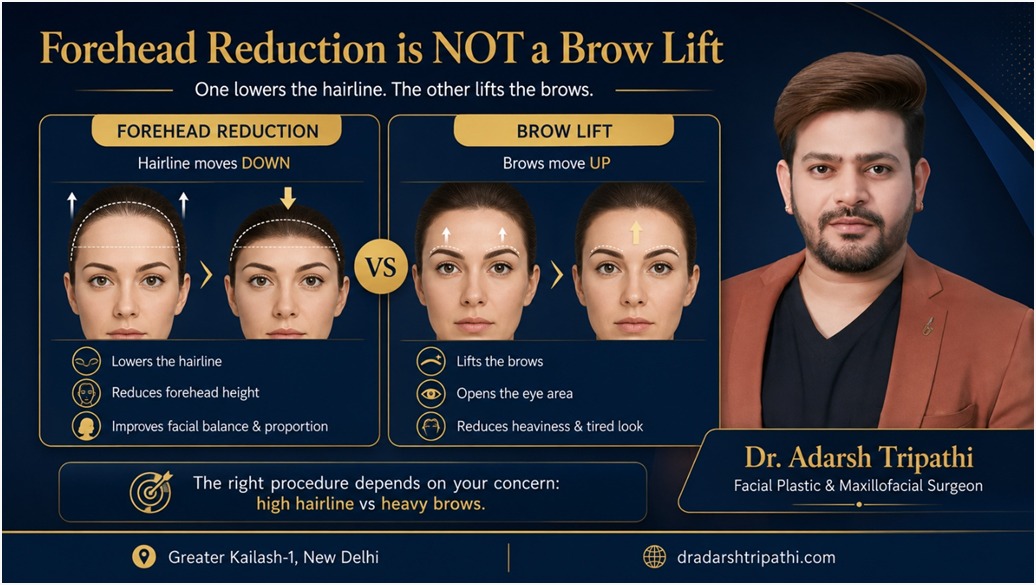
Forehead Reduction is NOT a Forehead Lift (Brow Lift)
This confuses even some clinic websites. Forehead reduction (hairline lowering) moves the hairline DOWN to make a tall forehead shorter. A “forehead lift” or brow lift does the opposite — it raises drooping eyebrows, and can actually make the forehead look slightly longer. They solve different problems in opposite directions. If your concern is a high hairline, you want reduction; if it is heavy or sagging brows, you want a brow-lift approach or Botox brow lift . Some people want both, and they can be planned together — but knowing which is which is the first step.
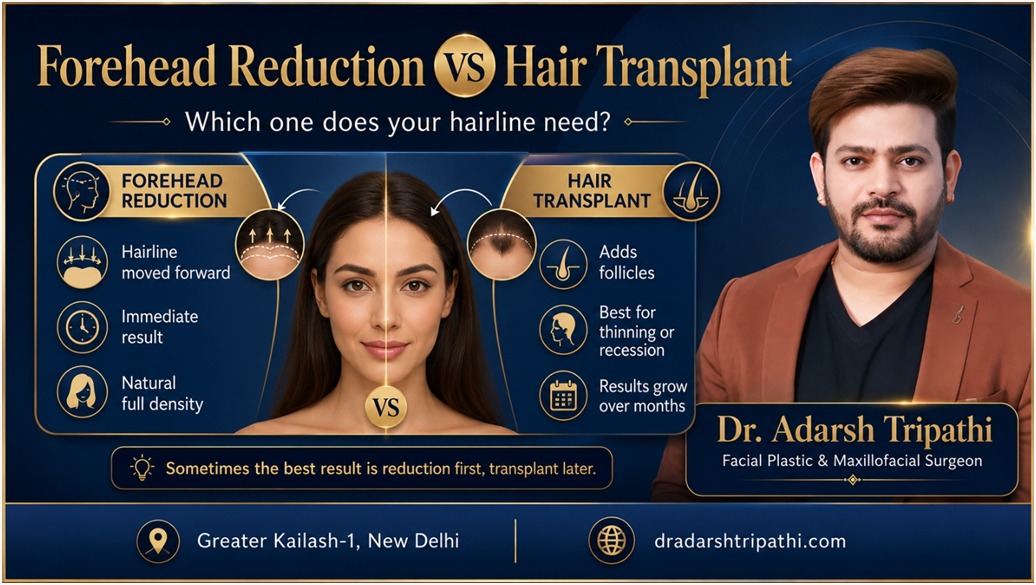
Forehead Reduction vs Hair Transplant — Which One Do You Need?
Both change the hairline, very differently. Forehead reduction physically advances your existing hairline forward in one operation, so the change is visible immediately and the density is your own natural, full hairline. A hair transplant instead adds individual follicles to fill or extend a hairline, with results maturing over about 12 months. The honest rule: if you have a good, stable hairline that simply sits too high, reduction is the more direct and fuller-looking answer; if your hairline is receding or thinning, a transplant is more appropriate; and when scalp laxity limits how far the hairline can advance, the best result is often reduction first, then a transplant a few months later to refine the new hairline and soften the temples. Because both are done here, that recommendation follows your scalp — not a sales sheet.
What Is Forehead Reduction Surgery?
The procedure is elegantly simple in principle. A fine incision is made right along the front hairline (a “pretrichial” or trichophytic incision, designed so hair later grows through and in front of the scar to camouflage it). A measured strip of forehead skin is removed, the scalp behind the hairline is gently released so it can stretch forward, and the hairline is advanced and secured in its new, lower position. The forehead is now shorter; the scar sits at the hairline where surrounding hair hides it. The whole thing takes one to two hours, and because the incision is at the hairline rather than inside the scalp, the change is visible the moment the dressing comes off.
The Proportion Behind It: Why Facial Thirds Matter
Surgeons plan faces in vertical thirds: hairline to brow (upper), brow to base of nose (middle), and base of nose to chin (lower). A balanced face has these roughly equal. A high hairline makes the upper third dominate, which the eye reads as “long forehead” even when every other feature is lovely. Forehead reduction shortens that upper third back toward balance — which is why the change can look dramatic on camera while being just a couple of centimetres in reality. At your consultation we measure your thirds, assess how far your scalp will comfortably advance, and mark a new hairline position that fits your face rather than a generic template. Getting that position and shape right — including softening the temples — is the art of the procedure.
Benefits of Forehead Reduction Surgery
- Immediate, visible change: unlike a hair transplant’s 12-month timeline, the shorter forehead is there the day of surgery.
- Your own full hairline: advancing the existing hairline keeps natural density — no waiting for grafts to grow, no thin transplanted zone.
- Permanent: the hairline stays where it is moved; the result does not reverse.
- A scar built to hide: the hairline incision is designed for hair to grow through and in front of it — well-healed, it is genuinely hard to find.
- Balanced facial proportions: restores the upper third toward the classic equal-thirds harmony, which lifts the look of the whole face.
- Combines with other procedures: frequently planned with a brow lift, a hair transplant , or rhinoplasty for comprehensive facial balance in one session.
Am I a Good Candidate for Forehead Reduction?
You are likely a good candidate if:
- Your forehead measures more than about 6–7 cm from brows to hairline, and it bothers you in photos and daily life.
- Your hairline is high but relatively stable and straight — not actively receding.
- Your scalp has reasonable laxity (flexibility) to allow the hairline to advance — we test this at consultation.
- You are in good general health and have realistic expectations about a 1–2 cm change.
You may be better suited to another plan if:
- Your hairline is significantly receding or thinning — a hair transplant is likely the better tool, alone or combined.
- Your scalp is very tight with low laxity — advancement will be limited; a staged reduction-plus-transplant approach may suit better.
- You have a history of keloid or abnormal scarring — we counsel this carefully first.
- You smoke and cannot pause — smoking meaningfully impairs scalp healing and raises the risk of skin and hair complications at the incision.
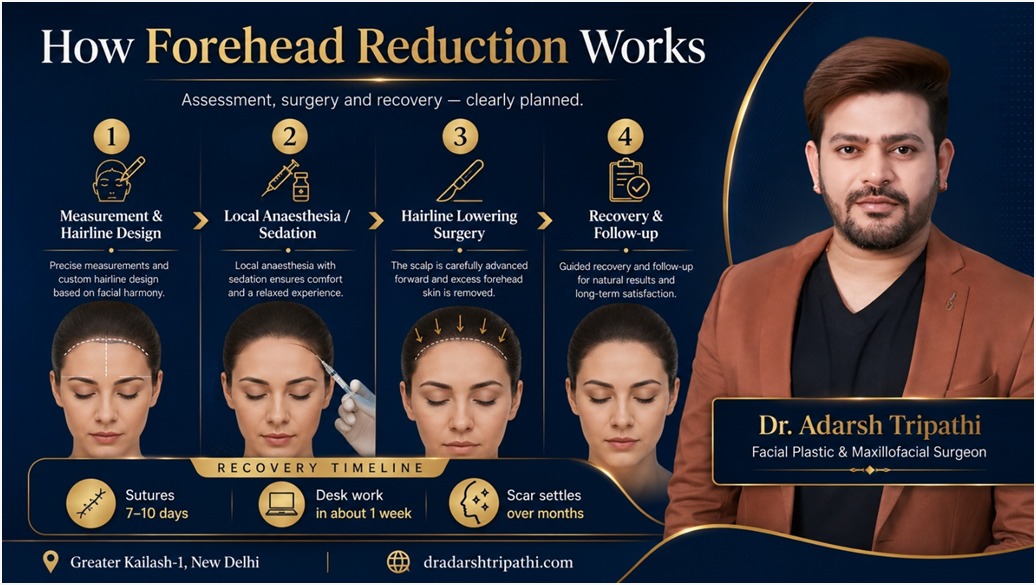
Forehead Reduction Surgery in Delhi: Step by Step
Step 1 — Consultation, measurement and hairline design
We measure your facial thirds and forehead height, test scalp laxity, assess hairline shape and density, and mark a new hairline position and shape together — including the temples. Photographs and planning confirm what is realistically achievable in one session versus a staged plan.
Step 2 — Anaesthesia
Local anaesthesia with sedation for most cases, or general anaesthesia by preference and clinical assessment. You are comfortable throughout; it is day-care surgery.
Step 3 — Incision, advancement and closure (1–2 hours)
The hairline incision is made, a measured strip of forehead skin removed, the scalp released and advanced forward, and the hairline secured in its new position [confirm fixation method used — e.g. bone tunnels, resorbable devices]. Closure is meticulous, because scar quality at the hairline depends almost entirely on incision design and closure technique.
Step 4 — Dressing and home the same day
A light dressing, written aftercare, pain relief, and a follow-up booked for suture removal at 7–10 days. You go home the same day and see the new hairline immediately.
Recovery Timeline After Forehead Reduction
Stage | What to expect |
Week 1 | Swelling, tightness and some bruising around the forehead and hairline; sleep head-elevated, avoid bending forward, keep the incision dry. Discomfort is well managed with prescribed medication. |
Days 7–10 | Sutures removed at the clinic. Most people return to desk work now; the shorter forehead is already clearly visible. |
Weeks 2–4 | Swelling largely settled; comfortable in public. A tight sensation and numbness along the hairline are normal as nerves recover; avoid strenuous activity and direct sun on the scar. |
Months 1–3 | The scar is present but fading; hair begins growing through and in front of it, starting the camouflage. Numbness steadily improves. |
Months 3–6 | Scar faded considerably for most; hairline looks and feels natural. Final result assessed at six months. |
A note on the incision hair-growth: a well-designed trichophytic hairline heals so that hair grows through the scar line, which is what makes a mature result so hard to detect. Protect it from sun for the first few months and follow the scar-care plan — and if a small area ever needs refining, a few grafts or a minor scar revision resolves it.
Risks, Honestly — With the Numbers
Forehead reduction has a genuinely reassuring evidence base. A 2026 systematic review of 3,213 patients reported patient satisfaction at 99.9%, with alopecia (hair loss) at the incision itself in under 1% of cases; the common, temporary things were a brief folliculitis (small hair-follicle inflammation, easily treated) and a tight or numb sensation along the hairline that settles as nerves recover. An earlier meta-analysis put the overall complication rate at 1% or less and the average lowering at about 1.6 cm. The risks that actually depend on your surgeon are scar quality and hairline shape — both governed by incision design and closure, which is why this is not a procedure to hand to a junior. Two honest limits to set expectations: how far the hairline can move is capped by your scalp laxity, and temple recession is only partly addressed by advancement. We tell you your realistic centimetres before, not after.
Cost of Forehead Reduction in Delhi (2026)
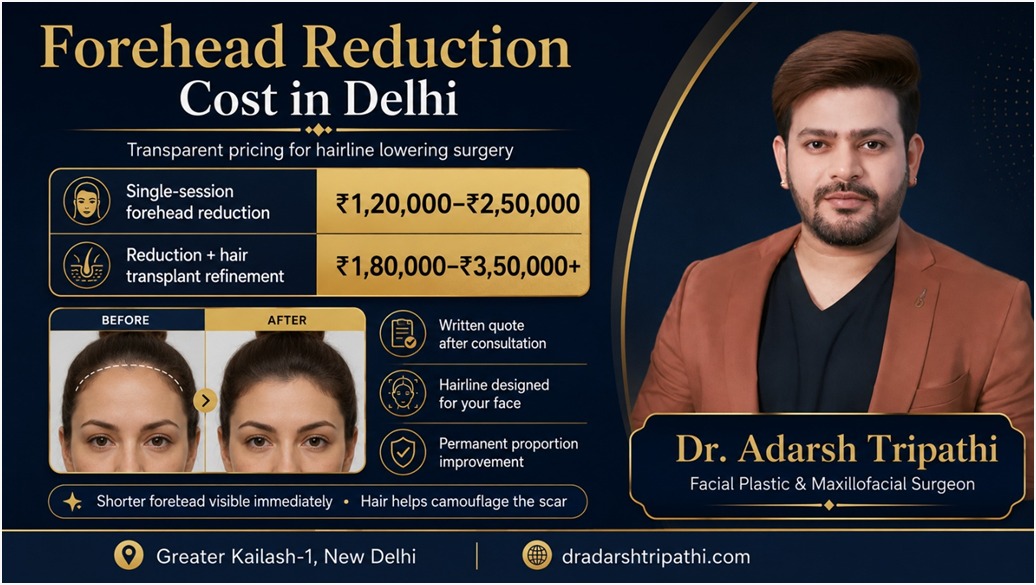
The cost of forehead reduction in Delhi depends on scalp laxity and complexity, whether it is combined with a hair transplant or brow lift, and the anaesthesia used. Realistic ranges:
Option | Approx. Delhi market cost | Notes |
Forehead reduction (hairline lowering), single session | Rs 1,20,000 – Rs 2,50,000 | Local + sedation or GA; day-care; [insert Sarayu Clinics pricing] |
Reduction + hairline hair transplant (staged) | Rs 1,80,000 – Rs 3,50,000+ | Transplant 6–9 months later to refine density/temples |
Reduction combined with brow lift | Quoted after assessment | Planned together where clinically appropriate |
Consultation & scalp-laxity assessment | Contact for this. | Adjusted against surgery if you proceed |
Your exact quote is fixed in writing after examination — because how far your hairline can safely advance genuinely varies person to person, an honest measured plan beats a headline price. Forehead reduction is cosmetic and not covered by insurance in India. For context, the same surgery abroad typically costs several times these figures, which is part of why Delhi sees international patients for it.
Prices shown are for guidance only. Your final treatment cost will be confirmed during the initial consultation, based on your individual needs, concerns, and personalised treatment plan.
Forehead Reduction vs the Alternatives
| Forehead Reduction | Hair Transplant | Brow Lift | Hairline Micropigmentation |
Does what | Moves hairline down, shortens forehead | Adds follicles to fill/extend hairline | Raises brows (can lengthen forehead) | Tattoos density illusion, no real hair |
Result timing | Immediate | ~12 months | Immediate–weeks | Immediate |
Permanence | Permanent | Permanent | Long-lasting | Fades, needs top-ups |
Downtime | ~1 week | ~1 week | ~1 week | Minimal |
Best for | High but stable hairline, good laxity | Receding/thinning hairline | Heavy or drooping brows | Camouflage, not proportion change |
The through-line: forehead reduction is the only option that actually shortens the forehead. Explore the partners where they fit — hair transplant , scalp micropigmentation , and for the whole upper face, full face sculpting
Choosing Your Forehead Reduction Surgeon in Delhi — Why Patients Choose Dr. Tripathi
- Face and hairline, one specialist: Adarsh Tripathi is a facial plastic and maxillofacial surgeon with 18+ years of experience who also works in hair restoration — so the reduction-vs-transplant decision is made by someone who performs both, not someone selling one.
- Scar quality is the whole game: hairline incision design and meticulous closure are what make the scar disappear — the parts that reward a specialist’s hands and judgement.
- Proportion-led planning: facial-thirds measurement and a hairline designed for your face, temples included — not a generic line.
- Honest candidacy: including “your scalp will allow this much” and “you’d do better with a transplant” — the truth that protects your money and your result.
Related Procedures at Our Delhi Clinic
Hairline & scalp | Upper face | Facial balance |
Frequently Asked Questions About Forehead Reduction in Delhi
What is the cost of forehead reduction in Delhi?
Forehead reduction (hairline lowering) in Delhi costs approximately Rs 1,20,000-2,50,000 for a single-session procedure. Combined with a staged hair transplant to refine the hairline it runs Rs 1,80,000-3,50,000 or more. The final figure depends on scalp laxity and complexity, anaesthesia, and any combined brow lift or transplant. A written quote is given after examination, because how far the hairline can safely advance varies from person to person.
What is the difference between forehead reduction and a forehead lift?
They move in opposite directions. Forehead reduction (hairline lowering) brings the hairline down to shorten a tall forehead. A forehead lift, or brow lift, raises drooping eyebrows and can actually make the forehead look slightly longer. If your concern is a high hairline you want reduction; if it is heavy or sagging brows you want a brow lift. Some people plan both together.
Forehead reduction or hair transplant – which do I need?
It depends on your hairline. If you have a good, stable hairline that simply sits too high, forehead reduction moves it forward in one session with immediate, full-density results. If your hairline is receding or thinning, a hair transplant is more appropriate. When scalp laxity limits advancement, the best result is often reduction first, then a transplant a few months later to refine density and temples. Because both are offered here, the recommendation follows your scalp.
How much can the forehead be reduced in one procedure?
Most patients achieve about 1.5-2.5 cm of lowering in a single session, with published studies reporting an average around 1.6 cm. The exact amount depends on your scalp laxity – how much the scalp will comfortably stretch forward. Patients with limited laxity may achieve less initially and benefit from a combined hair-transplant approach for additional refinement over time.
Will the scar be visible after forehead reduction?
The incision is placed right at the hairline using a technique designed so that hair grows through and in front of the scar, camouflaging it. With careful closure and healing, it becomes very difficult to spot within a few months – published satisfaction rates are around 99.9%. Scar quality depends heavily on the surgeon’s incision design and closure technique, which is why specialist experience matters.
Is forehead reduction surgery permanent?
Yes. The hairline is surgically advanced and stays in its new, lower position permanently – the result does not reverse. Natural ageing continues around the hairline as it would anyway, but the shorter forehead and improved proportion are lasting from a single procedure.
Is forehead reduction surgery painful? What anaesthesia is used?
The procedure is done under local anaesthesia with sedation, or general anaesthesia by preference, so it is painless during surgery. Afterwards, expect tightness, mild soreness and scalp numbness along the hairline for the first few weeks rather than significant pain, well managed with prescribed medication. The numbness settles gradually as nerves recover.
How long is recovery after forehead reduction?
Most people return to desk work within about a week, when sutures are removed at day 7-10 and the shorter forehead is already clearly visible. Swelling settles over two to four weeks, and the scar fades and hair grows through it over three to six months, when the final natural result is assessed. Strenuous activity and direct sun on the scar are avoided in the early weeks.
Am I a good candidate for forehead reduction?
Good candidates have a forehead taller than about 6-7 cm, a high but stable (not receding) hairline, and reasonable scalp laxity to allow advancement. You may be better suited to a hair transplant if your hairline is receding or thinning, or to a staged approach if your scalp is very tight. A history of keloid scarring and smoking both need careful discussion first. Scalp laxity is assessed at consultation.
Is forehead reduction safe? What are the risks?
It has a favourable safety profile – a 2026 review of over 3,000 patients found a complication rate under 1% for incision-site hair loss and 99.9% patient satisfaction. Common, temporary effects include brief folliculitis and hairline numbness or tightness that resolve as healing progresses. The surgeon-dependent factors are scar quality and hairline shape, governed by incision design and closure – which is exactly why choosing an experienced facial surgeon matters.
Can forehead reduction be combined with other procedures?
Yes. It is frequently planned alongside a brow lift, a hair transplant (to refine density and temples), or a rhinoplasty, as a single surgical plan where clinically appropriate, which streamlines recovery. Combining reduction with a hair transplant is especially common for patients whose scalp laxity limits how far the hairline can advance in one session.
Is forehead reduction surgery suitable for Indian skin and men?
Yes on both counts. Incision placement, closure technique and aftercare are adapted for how South Asian skin heals and scars, reducing the risk of pigmentation along the hairline. Men are candidates too, though a receding male hairline more often calls for a hair transplant instead of, or alongside, reduction – which is assessed individually at consultation.
How to Reach Us:
Phone:+91 9289111083 ,+91 9289111084
Dr Adarsh’s website: https://dradarshtripathi.com/
Facebook: https://www.facebook.com/DrAdarshTripathi3011
Instagram: https://www.instagram.com/dr_adarsh_tripathi/
Youtube: https://www.youtube.com/@dr_adarsh_tripathi
Linkedin: https://www.linkedin.com/in/dr-adarsh-tripathi-a43005b8/
Online Booking: https://dradarshtripathi.com/contact-us/ to schedule appointments conveniently.