What Current Research Actually Supports About Buccal Fat Removal and Facial Contouring
Buccal fat removal in Delhi has become one of the most argued-about procedures in facial aesthetics, and most of the argument is being conducted without reference to what is actually known. One side insists everyone who has it will look gaunt by forty. The other insists there is nothing to worry about. Neither position is supported.
What follows separates three different categories of claim: what is established anatomically, what is reasonably inferred from that anatomy, and what is speculation. The distinction matters, because the decision you are making is permanent.
What is genuinely established
The buccal fat pad is a discrete, deep structure
It is not the same tissue as the fat that sits just under the skin of the cheek. The buccal fat pad lies deeper, between the facial muscles, with a body and several extensions. This is well described anatomically and is not in dispute.
It matters because it explains why weight loss often does not change the fullness people want to address. Superficial cheek fat responds to overall body fat; the buccal pad is relatively independent of it. A slim person can still have full lower cheeks for exactly this reason.
Removal is permanent
The pad does not regenerate. This is not a treatment that wears off, and that is the central fact around which every other consideration turns.
Faces lose volume with age, independently of surgery
Ageing involves loss and redistribution of both deep and superficial facial fat, alongside changes in the underlying skeleton — the orbital rims widen, the maxilla recedes slightly, the jaw angle changes. This happens to everyone. It is well documented and has nothing to do with whether anyone has had surgery.
What is reasonably inferred but not proven
Direct answer: the concern that buccal fat removal accelerates a hollowed appearance later in life is an anatomically reasoned inference, not a demonstrated finding. There is no substantial long-term outcome literature following buccal fat removal patients into their fifties and sixties. Anyone stating it as established fact — in either direction — is going beyond the evidence.
The reasoning behind the concern is sound as far as it goes. If the face naturally loses deep facial volume with age, and a portion of deep facial volume has been surgically removed in the twenties, the starting point for that decline is lower. Whether that translates into a visibly different outcome at fifty, and by how much, has not been measured in any robust way.
The honest position is that the concern is plausible enough to shape surgical planning — which is why conservative removal has become the prevailing approach — without being certain enough to justify telling every patient they will regret it.
What is speculation
- That buccal fat removal universally causes premature ageing. Not demonstrated. Outcomes vary with how much was removed, the patient’s baseline facial fullness, and their age at surgery.
- That celebrity cases seen online represent typical results. They represent selected, publicised, often heavily filtered cases — sometimes combined with other procedures or significant weight change.
- That there are no long-term consequences at all. Also unsupported, and the more commercially convenient of the two absolutes.
- That a specific percentage of the pad should be removed as standard. Anatomical variation in pad size is considerable; a standard quantity would be arbitrary.
The question that should replace ‘can this fat be removed?
Direct answer: the more useful question is whether removing it improves facial proportions now and remains sensible as the face changes. Those are different questions, and a face that benefits from the first may not from the second.
Proper planning involves looking at rather more than the cheeks:
- Facial width at the cheekbones versus at the lower cheek. Fullness low on the face reads differently from fullness at the midface.
- Cheekbone projection. A patient with flat cheekbones who loses lower-cheek volume can end up with a face that reads as flat overall rather than sculpted.
- Midface volume. If it is already modest, removing deep volume below it accentuates that.
- Jawline definition and chin projection. Sometimes the lower face looks heavy because the jaw lacks definition, not because the cheek is full.
- Submental fullness under the chin, which is a separate compartment entirely and does not respond to buccal fat removal in Delhi.
- Skin quality and elasticity, which determines how the skin redrapes.
- Age and baseline facial leanness. A round-faced twenty-five-year-old and a moderately full forty-five-year-old are not the same case.
Why cheek fullness may not be the buccal fat pad at all
This deserves its own section because it is one of the more common reasons for disappointment.
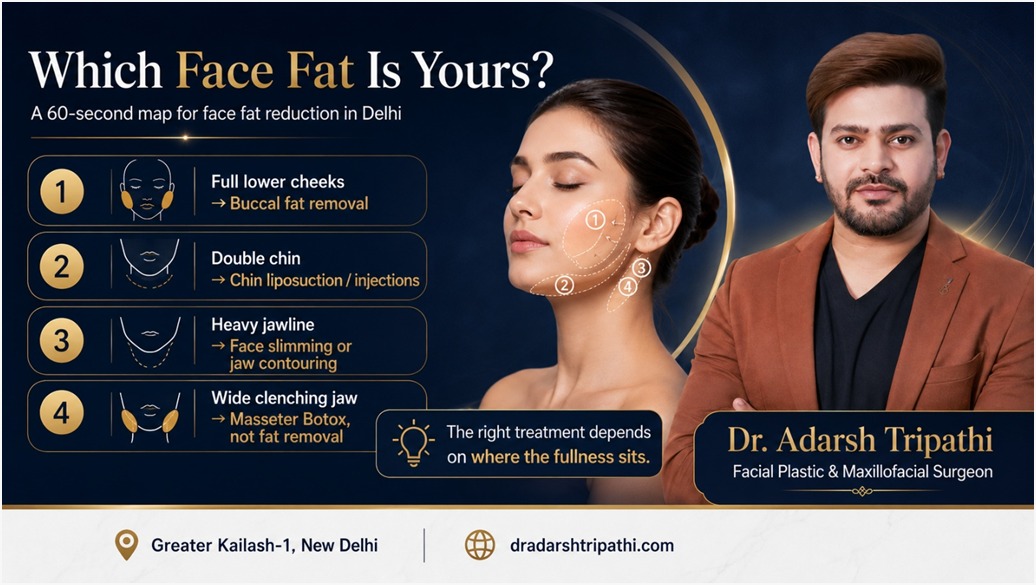
Fullness in the cheek area can come from the buccal pad, from superficial cheek fat, from masseter muscle bulk at the jaw angle, from a wide skeletal base, or from a combination. Buccal fat removal addresses only the first. A patient whose fullness is largely masseter — which is common, particularly in people who clench or grind — may see very little change from buccal fat removal, because the bulk was never in that compartment. That situation is usually better addressed with masseter Botox, and our face slimming page sets out how the different causes are distinguished.
Conservative versus aggressive removal
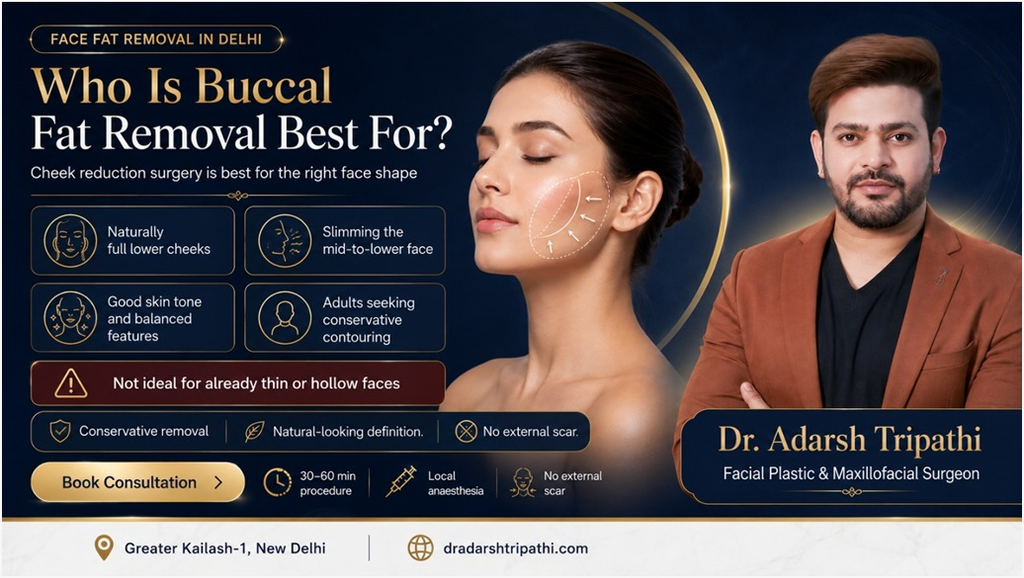
Direct answer: partial, conservative removal is the prevailing approach among experienced surgeons, and the reasoning is straightforward: the outcome of removing too little is a modest result that can be revisited, while the outcome of removing too much is permanent and difficult to correct. The asymmetry of those two failure modes drives the decision.
Adding volume back is possible in principle — fat grafting or fillers — but grafted fat in this deep compartment does not reliably restore the original contour, and the result is a reconstruction rather than a reversal. That is a meaningfully worse position than simply having taken less in the first place.
No responsible article can specify how much should be removed in a given case. That is a decision made with the patient in front of you, based on pad size, facial proportion and age.
Where other procedures solve different problems
Note: These are not alternatives in the sense of interchangeable options. They address different anatomy, and confusing them is how patients end up with the wrong procedure.
| If the concern is… | Buccal fat removal? | Worth discussing instead |
| Deep, isolated lower-cheek fullness in a slim face | Possibly appropriate | — |
| Fullness under the chin | No — different compartment | Double chin treatment |
| A jaw that looks wide at the angle | No — likely muscle | Masseter Botox |
| Lower face looks heavy but the jawline is undefined | Usually no | Chin implant or jawline filler |
| Sagging or jowling rather than fullness | No — removing volume worsens it | HIFU or Morpheus 8 |
| Cheeks already lean but the face looks flat | No | Volume addition rather than removal |
Why a surgeon may recommend leaving it alone
It is worth knowing that a recommendation against surgery is a legitimate outcome of a consultation, and in this procedure a reasonably common one.
Reasons a careful surgeon might decline: the face is already lean and the fullness is modest; the fullness is not in the buccal compartment; the patient is young enough that facial maturation is still altering proportions; the expectation is a degree of hollowing that would not look natural on that bone structure; or the patient’s reference images show faces with a fundamentally different skeletal shape.
None of those is a comment on the procedure’s validity. They are comments on fit.
If you are considering it
The useful consultation is one that establishes where your fullness actually sits before discussing whether to remove anything. Our buccal fat removal page covers the procedure, recovery, costs and candidacy. Dr. Adarsh Tripathi is a maxillofacial and facial plastic surgeon at Sarayu Clinics, Greater Kailash-1 — and because the practice also offers the non-surgical options above, the assessment is not limited to what surgery can do.
Medically reviewed by Dr. Adarsh Tripathi, Maxillofacial & Facial Plastic Surgeon. Last medically reviewed: [DATE] — publish this line only if Dr. Tripathi has genuinely read and approved the article.
This article is general information and does not replace an in-person consultation. Individual anatomy, suitability and outcomes vary.
FAQS
Does buccal fat removal age your face?
The honest answer is that we do not have long-term outcome studies to say definitively. What is established is that faces lose deep facial volume with age regardless of surgery. The concern that prior removal lowers the starting point for that decline is anatomically reasonable, which is why conservative removal is now standard. Stating it as certain in either direction goes beyond the evidence.
Does buccal fat grow back?
No. The buccal fat pad does not regenerate once removed. Significant weight gain can increase superficial facial fat, which may partly mask the change, but the pad itself does not return.
How much buccal fat should be removed?
There is no standard amount, because pad size varies considerably between individuals. Experienced surgeons tend toward conservative partial removal, because taking too little can be revisited while taking too much is permanent and difficult to correct.
Is buccal fat removal the same as cheek reduction?
Not necessarily. Cheek fullness can come from the buccal pad, superficial fat, masseter muscle bulk or bone structure. Buccal fat removal addresses only the deep pad. This is why assessment matters more than the procedure name.
Can buccal fat removal be reversed?
Not in the true sense. Volume can be added back with fat grafting or fillers, but grafted fat in this deep compartment does not reliably recreate the original contour. It is a reconstruction, not a reversal — which is the main argument for conservative removal.
What is the best age for buccal fat removal?
There is no evidence-based age threshold, and arbitrary cut-offs are not justified. What matters more is whether facial proportions have settled and whether the fullness is likely to reduce naturally with age. Younger patients warrant a more conservative approach because they have more ageing ahead of them.