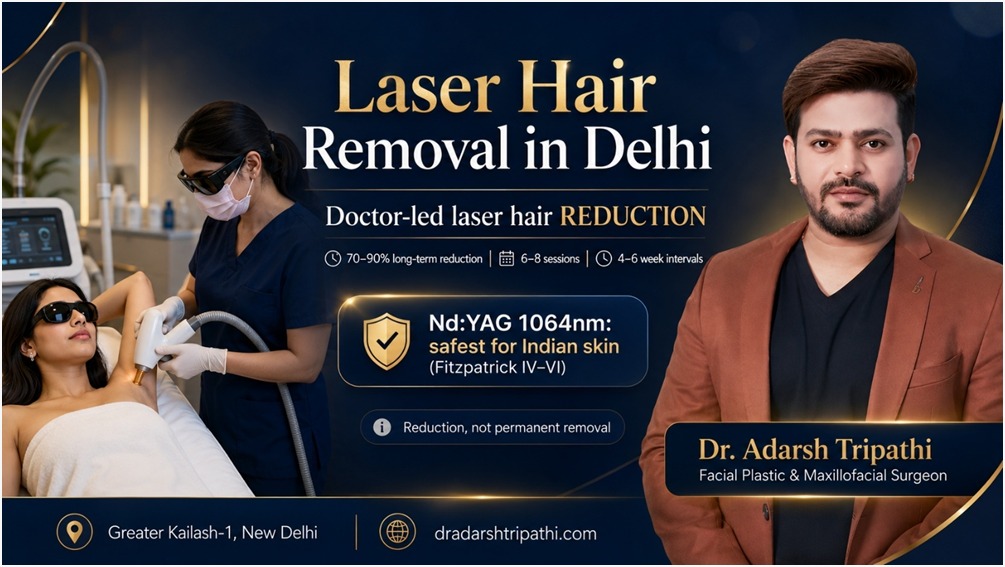
A patient undergoing Laser Hair removal in Delhi, highlighting the advanced technology used for effective hair removal.

Laser Hair Removal in Delhi — Honest Laser Hair Reduction for Indian Skin

Laser hair removal is one of the most life-changing treatments in aesthetic medicine when it’s done right — and one of the most overpromised. The technology is real, the science is sound, and for the right person treated with the right laser, the result is genuinely transformative: no more daily shaving, no more waxing appointments, no more ingrown hairs, no more stubble shadow. But here’s the truth almost no clinic page is willing to write: laser doesn’t permanently REMOVE every hair. The US FDA approves laser systems as ‘permanent hair REDUCTION’ — and the medical literature is consistent on this. Realistic outcomes are 70-90% long-term reduction; some maintenance is typically needed; certain hair types (white, grey, blonde, red, peach fuzz) don’t respond at all because they lack the melanin the laser targets. The honest framing is reduction, not removal. The reason this page targets both keywords (‘Laser Hair Removal in Delhi’ and ‘Laser Hair Reduction in Delhi’) is to capture the popular search term while delivering the medically honest reality.

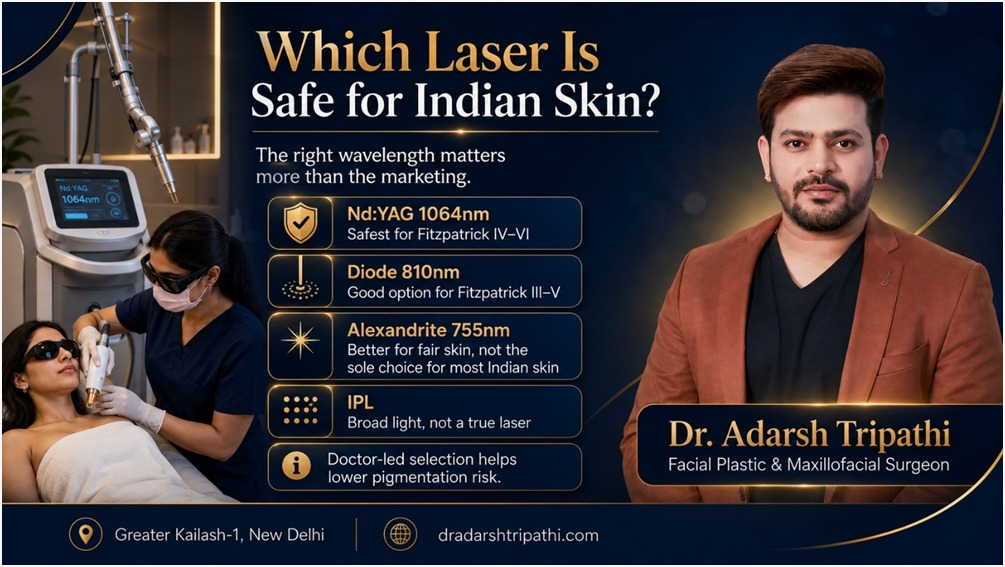
Here’s the most important technical insight on this page, and it’s where most Delhi clinic pages get vague: not all lasers are equal, and for Indian skin specifically, the wavelength matters enormously. Nd:YAG (1064nm) is the SAFEST laser for Indian and darker skin (Fitzpatrick IV-VI) because its longer wavelength bypasses surface melanin and reduces the risk of post-inflammatory hyperpigmentation (PIH). Diode (810nm) is the workhorse middle ground — effective and reasonably safe with proper settings. Alexandrite (755nm) is the gold standard for LIGHTER skin (Fitzpatrick I-III) but is RISKY for Indian skin because it strongly absorbs in surface melanin. A clinic using primarily Alexandrite on Indian patients is doing it wrong; a clinic using primarily Nd:YAG (or Diode with conservative settings) is using the right approach. Asking specifically about the laser type used and why is one of the most useful questions you can ask before booking.

There’s also a clinical reality rarely discussed: laser hair reduction outcomes depend significantly on WHY the hair is growing. For genetically dark coarse hair on someone with no hormonal issues, laser produces excellent long-term reduction. For hormonally-driven hair growth — PCOS, hyperandrogenism, thyroid disorders, certain medications — laser reduces the visible hair, but the underlying hormonal source keeps stimulating new follicles, meaning ongoing maintenance sessions are part of the picture. Treating PCOS-related facial hair without acknowledging the hormonal component is treating the symptom, not the cause. A responsible consultation includes evaluating whether there’s a hormonal source that should be assessed alongside the laser treatment.

Dr. Adarsh Tripathi is a Maxillofacial and Facial Plastic Surgeon with over 18 years of experience at Sarayu Clinics, Greater Kailash-1, New Delhi. His approach to laser hair reduction is built on honest expectations, Indian-skin-conscious laser selection (Nd:YAG priority), and recognition of underlying hormonal factors when relevant. This page covers laser hair removal in depth — what it is and isn’t, the laser types, hair growth cycle science, areas treated, candidates, the procedure, recovery, cost, realistic results timeline, comparison with other methods, and how to choose the right laser hair reduction clinic in Delhi.

Quick Answer — What is laser hair removal and what does it cost in Delhi?

Laser hair removal (medically more accurate: laser hair REDUCTION) uses focused light energy targeting the melanin in hair follicles to disable hair growth over multiple sessions. The FDA approves laser systems as ‘permanent hair reduction’ — realistic outcomes are 70-90% long-term reduction with maintenance sessions typically needed. For Indian skin (Fitzpatrick IV-VI), Nd:YAG (1064nm) is the safest laser; Diode (810nm) is the workhorse alternative. In Delhi, laser hair reduction costs Rs. 1,500–8,000 per session depending on area, with 6-8 sessions typically needed spaced 4-6 weeks apart. Dr. Adarsh Tripathi at Sarayu Clinics provides doctor-led, Indian-skin-conscious laser hair reduction with realistic expectation-setting.

The Honest Truth — Reduction, Not Removal

This section exists because no other Delhi clinic page is willing to write it clearly. Patients deserve honest framing before committing to a treatment course.

What the FDA Actually Approves ?

US FDA approval for laser hair removal devices specifies ‘permanent hair REDUCTION’ — defined as a stable, long-term reduction in the number of regrowing hairs after a treatment regimen. The term ‘removal’ is colloquial; the medically accurate term is ‘reduction’. This isn’t pedantry — it reflects the biology of what laser actually does: it disables a significant percentage of follicles permanently, while some follicles survive (in varying degrees of activity) and others regenerate over time.

Realistic Outcomes

  • 70-90% long-term reduction in hair density (typical course of 6-8 sessions)
  • Remaining hair is usually finer, lighter, and less noticeable than original
  • Some patients see 95%+ reduction; some see less than 70% — individual response varies
  • Maintenance sessions every 6-18 months are typically needed for most patients
  • ‘Touch-up’ sessions over years often part of long-term care

What Laser Cannot Treat ?

  • White, grey, blonde, red hair — no melanin pigment for laser to target; doesn’t respond
  • Vellus ‘peach fuzz’ hair — too fine to absorb meaningful laser energy
  • Hair that’s already been removed by waxing/plucking in the past month (no follicle present)
  • Tattooed skin (laser would target the tattoo pigment, causing burns)
  • Areas with active infection, severe sun damage, or open wounds

The Hormonal Hair Growth Issue

Some hair growth is driven by underlying hormonal conditions — PCOS (polycystic ovary syndrome), hyperandrogenism, thyroid disorders, certain medications. For these patients, laser reduces the visible hair but the underlying hormonal source keeps stimulating new follicles. This means:

  • Ongoing maintenance treatment may be needed indefinitely
  • Underlying hormonal evaluation is often appropriate
  • Combined approach (laser + hormonal management) gives better long-term results than laser alone
  • Female facial hair (chin, upper lip, sideburns) commonly has hormonal contribution worth investigating

Why This Honesty Matters ?

A clinic that promises ‘permanent removal’ without these caveats may be selling the procedure rather than delivering the result. A clinic that honestly explains ‘permanent reduction with realistic expectations’ is telling you the truth. Pre-treatment expectations are everything for treatment satisfaction — if you expect 100% permanent removal and get 80% reduction with some maintenance, you’ll feel cheated even though you got an excellent result. If you expect 70-90% long-term reduction and get 85%, you’ll feel delighted. Same treatment outcome, different satisfaction — determined by honest expectation-setting at consultation.

If a clinic promises ‘permanent removal’ without qualifiers, it’s a yellow flag

FDA-approved laser hair systems are approved as ‘permanent hair REDUCTION’ — not 100% removal. Realistic outcomes are 70-90% long-term reduction. Some maintenance is typically needed. Certain hair types don’t respond. Honest expectation-setting protects you from disappointment AND signals the clinic is operating with integrity. A ‘permanent removal forever in 6 sessions guaranteed’ pitch is a sales claim, not a medical commitment

Benefits of Laser Hair Reduction — Realistically Framed

When done with the right laser and realistic expectations, laser hair reduction delivers genuine quality-of-life improvement. Here’s the honest list:

  • 70-90% long-term reduction in hair density — meaningful, lasting change
  • Significantly finer, lighter regrowth of any remaining hair
  • End of daily shaving, weekly waxing, or threading appointments for most patients
  • Significant reduction in ingrown hairs and folliculitis — important for sensitive areas (bikini, beard line)
  • Reduced PIH risk vs frequent waxing in Indian skin (waxing causes more PIH than laser does)
  • Smoother skin texture in treated areas
  • Cost-effective long-term — one laser course often replaces years of waxing/threading costs
  • Time savings — millions of hours over a lifetime not spent on hair removal
  • Confidence in showing skin — particularly important for sensitive cultural/personal contexts in Indian women
  • Safe and well-established procedure when performed with the right laser for your skin
  • Minimal downtime — back to normal activities the same day
  • Can be done year-round for most areas (with sun protection)

An honest framing: laser hair reduction is not painless, not a single-session miracle, and not entirely permanent for everyone. The typical course is 6-8 sessions over 8-12 months, plus periodic maintenance sessions. Some discomfort during treatment is normal (manageable with cooling). Hormonal hair growth needs ongoing management. The investment of time and cost is meaningful — but the long-term benefit for most candidates is substantial.

Areas Treated with Laser Hair Reduction

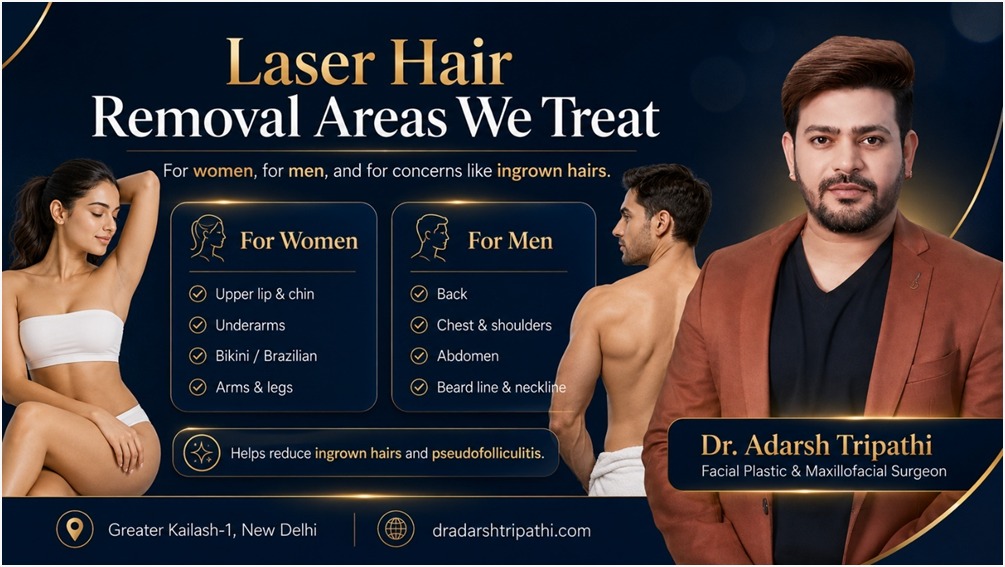
Face — Upper Lip, Chin, Sideburns

The most commonly treated facial areas for women, particularly important for those with PCOS-driven facial hair, hereditary thick facial hair, or persistent dark hair growth. Facial laser requires careful technique — the face has more melanin sensitivity than body areas, and Indian facial skin specifically benefits from Nd:YAG priority. Sessions are quick (10-20 minutes) but should be doctor-led for safety. Excellent quality-of-life impact.

Face — Beard Area (Men)

For men with patchy beards or scarring within the beard area, full beard reduction is generally NOT recommended (you can’t grow it back if you change your mind). However, neck-line reshaping (below the natural beard), beard contouring, and treating selective patchy areas are reasonable. For sensitive folliculitis or ingrown hairs, beard-line reduction can solve the problem permanently.

Underarms

One of the most rewarding areas — the underarms have dense, often dark hair and respond well to laser. Significantly reduces shaving frequency, eliminates underarm dark patches (often caused by frequent shaving and waxing), and reduces sweat-trapping. Sessions are very quick (5-10 minutes per side).

Bikini Area / Brazilian

Highly requested area. Reduces frustrating ingrown hairs, reduces post-wax PIH, eliminates daily/weekly maintenance. Sensitive area requiring conservative settings and proper technique. Women’s bikini reduction is one of the most consistently satisfying treatments.

Legs (Full or Half)

Large area with substantial time-saving impact. Full legs take 45-60 minutes per session. Excellent results for darker leg hair on Indian skin with Nd:YAG. Cost-effective over the course because of the area treated.

Arms (Full or Half)

Forearm hair reduction is one of the most popular requests, particularly for women in professional contexts. Full arm laser delivers significant reduction over 6-8 sessions.

Back (Men)

Major area for many men. Back laser dramatically reduces visible body hair, eliminates the need for shaving inaccessible areas, and helps with folliculitis. Takes 30-45 minutes per session.

Chest and Abdomen (Men)

Body hair reduction for men, often combined with back. Allows shirt-off confidence and ends ongoing trimming/grooming routines.

Shoulders

Often treated alongside back/chest for men. Smaller area, shorter sessions.

Buttocks

Common for both men and women, particularly when combined with bikini area treatment.

Feet, Toes, Hands

Smaller treatment areas often added on alongside primary areas. Quick to treat.

Full Body Programs

Some patients opt for comprehensive full-body programs over a 12-18 month course — combining face, underarms, bikini, arms, legs, and other areas. Package pricing typically applies and gives meaningful cost savings vs treating each area separately.

Conditions Laser Hair Reduction Addresses

Hereditary Dark Coarse Hair

The most common indication — genetically dark, coarse hair growth without underlying hormonal contribution. Best response to laser; cleanest long-term results.

Female Facial Hair (Hirsutism)

Excess facial hair growth in women — chin, upper lip, sideburns. May or may not have hormonal contribution. PCOS is the most common underlying cause; hyperandrogenism, post-menopausal hormonal shifts, family history, and certain medications also contribute. Laser is highly effective, but evaluation of the underlying cause is part of comprehensive care.

PCOS-Related Hair Growth

Polycystic Ovary Syndrome causes androgen excess that drives facial and body hair growth in women. Laser reduces the visible hair beautifully, but the hormonal source keeps stimulating new follicles. The right approach: laser for visible hair management + medical management of the PCOS (with a gynaecologist or endocrinologist) for underlying control. Ongoing maintenance laser sessions are typically part of long-term care.

Ingrown Hair / Folliculitis

Recurrent ingrown hairs and folliculitis (particularly in bikini area, beard line, underarms) often resolve permanently with laser hair reduction. The hair that causes the problem is reduced; the irritation cycle ends. One of the best clinical indications for laser when other approaches have failed.

Pseudofolliculitis Barbae

Beard-area inflammation from ingrown hairs, common in men with curly coarse beard hair. Laser-line shaping or selective reduction can resolve persistent inflammation.

Hidradenitis Suppurativa

In selected cases, laser hair reduction in affected areas (axilla, groin) can help reduce the cycle of follicular inflammation. Adjunctive to medical management of the underlying condition.

Hyperandrogenism / Endocrine Hair Growth

Various endocrine conditions (Cushing’s, congenital adrenal hyperplasia, certain medications, late-onset hyperandrogenism) cause excess hair growth. Underlying medical management is the priority; laser addresses visible symptoms.

Excessive Body Hair (Hypertrichosis)

Excessive hair growth without specific hormonal pattern, often genetic. Laser provides significant relief.

Transgender Care

Laser hair reduction is an important part of feminising treatments for transgender women — reducing facial and body hair as part of broader transition care. Specialised, considerate approach essential.

Laser Types & Why Indian Skin Needs Specific Wavelengths

This is the technical depth most clinic pages skip — and it’s the single most important factor for safe, effective treatment on Indian skin. Different lasers work at different wavelengths, each better suited to different skin tones.

Nd:YAG (1064nm) — The Safest Laser for Indian Skin

Long-wavelength laser that bypasses surface melanin and targets the deeper follicle. The SAFEST choice for darker Indian skin (Fitzpatrick IV-VI) because the wavelength doesn’t interact strongly with epidermal melanin, dramatically reducing PIH (post-inflammatory hyperpigmentation) risk. May need more sessions for full results vs shorter wavelengths in lighter skin, but the safety profile is the priority for Indian skin. Devices: Cynosure Apogee Elite, Cutera CoolGlide, Lumenis Lightsheer Duet/Desire.

  • Best for: Fitzpatrick IV-VI (Indian/darker skin)
  • Indian-skin priority — primary choice for safe treatment

Diode (810nm) — The Workhorse Middle Ground

Medium-wavelength laser, the most widely used laser in Indian aesthetic clinics. Reasonable safety for medium-to-dark Indian skin with proper conservative settings; effective on coarse dark hair. The Soprano ICE/Titanium variant uses an ‘in-motion’ technique with continuous cooling for maximum comfort and is particularly popular in Indian clinics. Devices: Lumenis LightSheer, Soprano ICE/Titanium, Vectus.

  • Best for: Fitzpatrick III-V; medium-to-coarse hair
  • Effective and reasonably safe with proper Indian-skin settings

Alexandrite (755nm) — Excellent for Light Skin, Risky for Indian Skin

Shorter-wavelength laser, the gold standard for LIGHTER skin (Fitzpatrick I-III) — fast, effective. However, this wavelength is STRONGLY absorbed by surface melanin, making it RISKY for Indian and darker skin (higher PIH risk, surface burns). An Alexandrite-only practice treating Indian patients is using the wrong tool for the population. Best used in combination platforms (Alexandrite + Nd:YAG) where the right wavelength can be selected per case. Devices: Cynosure GentleLase Pro, GentleMax Pro (combines Alex + Nd:YAG).

  • Best for: Fitzpatrick I-III only (lighter skin)
  • Avoid as sole laser for Indian skin

Ruby (694nm) — Largely Obsolete for Hair Reduction

First laser used for hair removal historically; effective only on lighter skin and largely replaced by Alexandrite and Diode for that population. Rarely used today for hair reduction. Mention only for completeness.

  • Best for: Limited modern use

IPL (Intense Pulsed Light) — Not Technically a Laser

Broadband light source used for hair reduction. Cheaper, more widely available (including home devices), but generally LESS effective long-term than true laser. For Indian skin, IPL is particularly risky due to broadband wavelengths interacting with surface melanin. May produce some reduction but not at the consistency of medical laser systems.

  • Best for: Light skin with light-to-medium hair; cost-conscious cases
  • Not recommended as primary choice for Indian skin

Combination Platforms — Best of Multiple Wavelengths

Many modern systems combine multiple wavelengths (e.g. GentleMax Pro: Alexandrite + Nd:YAG; some Soprano systems: triple-wavelength) — allowing the surgeon to select the right wavelength for each patient’s skin and hair. This is the ideal setup for diverse patient populations including Indian skin.

  • Best for: clinics treating diverse skin tones; flexibility

Laser-to-Skin-Type Matching Table

Skin Type (Fitzpatrick)

Primary Laser

Alternative

Avoid

I-II (very fair)

Alexandrite or Diode

Nd:YAG

III (light brown)

Diode or Alexandrite

Nd:YAG

IV (medium brown — typical North Indian)

Diode or Nd:YAG

Combo platform

Alexandrite as sole laser

V (medium-dark brown)

Nd:YAG

Diode (conservative settings)

Alexandrite, Ruby

VI (dark brown/black)

Nd:YAG only

Alexandrite, Ruby, IPL

Practical takeaway: most Indian patients (Fitzpatrick III-V majority, IV-VI common) are best treated with Nd:YAG or Diode lasers. A clinic offering only Alexandrite is using the wrong tool for the majority of Indian patients. Asking which laser they use and why is one of the most important questions before booking.

Cooling Technology

Modern laser systems include integrated cooling — either contact cooling (cooled sapphire tip), cryogen spray, or forced air cooling — which dramatically improves comfort during treatment and protects surface skin. The ‘Soprano ICE’ brand specifically markets its sapphire cooling tip. Quality cooling is a sign of a quality system.

A patient undergoing Laser Hair removal in Delhi, showcasing the advanced technology used for effective hair removal.

The Science — Hair Growth Cycles and Why Multiple Sessions Are Needed

Patients often wonder why 6-8 sessions are needed. The answer is biology — and understanding the science helps set realistic expectations.

Three Phases of Hair Growth

Anagen (Active Growth) — Laser Works

Hair actively growing from the follicle. Melanin concentration is highest, hair shaft is connected to the follicle, laser energy effectively reaches and disables the follicle. Approximately 65-90% of scalp hair is in anagen at any time; for body areas, only 20-40% is in anagen at any given moment.

Catagen (Transition) — Partial Effect

Brief transitional phase where hair detaches from blood supply. Some laser effect possible but less reliable than anagen phase.

Telogen (Resting) — Laser Doesn’t Work

Dormant phase. No active hair shaft connecting to the follicle; laser cannot effectively reach the follicle. The hair eventually sheds. Approximately 10-20% of body hair is in telogen at any time, varying by body area.

Why 6-8 Sessions?

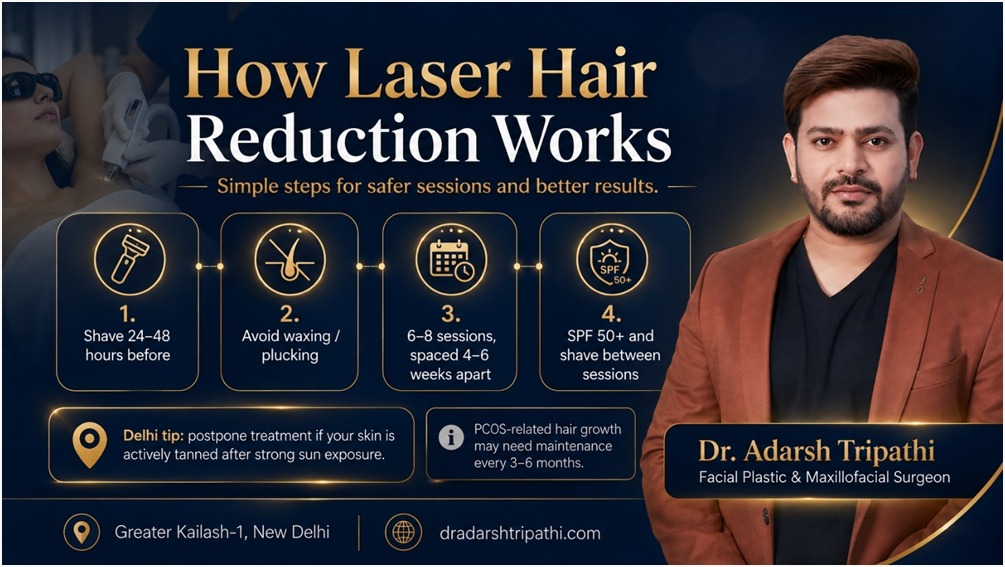
Because only a fraction of follicles are in the laser-responsive anagen phase at any given session, you need multiple sessions spaced apart to catch all follicles during their anagen phase. The session spacing (typically 4-6 weeks for face, 6-8 weeks for body) matches the natural cycle so different follicles are in anagen at each session. By session 6-8, the majority of follicles have been treated during anagen, achieving the 70-90% long-term reduction outcome.

Why Body Areas Need More Sessions Than Face

Different body areas have different proportions of follicles in anagen at any time. Face has more follicles in active growth; legs and back have fewer in active growth simultaneously. This is why face often responds with 4-6 sessions while back and legs may need 8-10 sessions for similar outcome levels.

Why Maintenance Sessions Are Needed ?

Follicles in deep telogen during your initial course may emerge in anagen years later. New follicle activation can occur from hormonal changes, age, or other factors. Maintenance sessions every 6-18 months catch these re-activated follicles and maintain long-term reduction. For hormonally-driven hair growth (PCOS), ongoing maintenance may be needed indefinitely.

Are You a Good Candidate for Laser Hair Reduction?

Most adults with unwanted dark hair are candidates — but specific factors affect outcomes.

You are likely a good candidate if:

  • You have dark coarse hair (best response)
  • Your skin tone is consistent (not actively tanned or sun-damaged)
  • You’re in good general health
  • You’re not pregnant or breastfeeding (defer non-urgent treatment)
  • You’re willing to shave (not wax or pluck) between sessions
  • You can commit to 6-8 sessions over 8-12 months plus maintenance
  • You have realistic expectations — 70-90% reduction, not 100% removal
  • You’re willing to follow sun protection protocols

Special considerations for Indian skin

Indian and darker skin (Fitzpatrick IV-VI) is well-served by appropriate laser hair reduction, but requires:

  • Nd:YAG (1064nm) priority — primary laser of choice
  • Diode (810nm) as alternative with conservative settings
  • AVOID Alexandrite (755nm) as sole laser — high PIH risk
  • Conservative energy settings — slow, safe approach
  • Pre-treatment hyperpigmentation assessment
  • Strict sun avoidance for 2 weeks before and after each session
  • Possibly pre-priming with skin-brightening agents in selected cases

You may NOT be a good candidate or need special considerations if:

  • You have white, grey, blonde, or red hair — no melanin to target; laser won’t work
  • You have vellus ‘peach fuzz’ hair only — too fine for effective treatment
  • You have an active tan or recent sun exposure — wait until skin returns to baseline
  • You’re on photosensitising medications (isotretinoin, certain antibiotics, retinoids) — defer or specific protocols needed
  • You’re on isotretinoin — wait 6 months after stopping
  • You have active skin infection, severe dermatitis, or open wounds in treatment area
  • You have history of significant PIH or keloid scarring — case-by-case caution
  • You have epilepsy with photosensitive seizures — case-by-case medical assessment
  • You expect ONE session to remove all hair — counsel for realistic expectations
  • You have hormonal cause (PCOS) without willingness to manage underlying — set ongoing maintenance expectations

The PCOS / Hormonal Conversation

If you have facial hair as a woman, irregular periods, persistent acne, or other PCOS markers — your laser consultation is also a moment to consider whether an endocrinology or gynaecology evaluation would be useful. Treating the visible hair without addressing the hormonal source means continuous maintenance and a less complete result. Combined laser + hormonal management gives the best long-term outcome for PCOS-driven hair growth. A responsible laser doctor recognises and discusses this rather than ignoring it.

The Laser Hair Reduction Procedure — Step by Step

Step 1: Consultation & Skin/Hair Assessment

Dr. Tripathi assesses your skin type (Fitzpatrick), hair characteristics (color, coarseness, density), medical history (medications, hormonal conditions, skin conditions, previous laser experience), and goals. The right laser type for your skin is identified. Areas, session count estimate, and realistic outcomes are discussed. Underlying hormonal evaluation is discussed if relevant. Photos are taken for baseline. A test patch may be planned for sensitive skin or if there’s any concern about pigmentation response.

Step 2: Pre-Treatment Preparation

  • Strict sun avoidance and SPF 50+ for 2 weeks before each session
  • Avoid tanning beds; no recent sunbathing
  • SHAVE the treatment area 24-48 hours before — do NOT wax, pluck, or use depilatory creams (this removes the follicle the laser needs to target)
  • Avoid skin irritants in the days before — strong actives, retinoids, AHAs/BHAs
  • Inform doctor of any new medications, particularly photosensitising ones
  • Arrive with clean skin — no makeup, deodorant (for underarms), or products in treatment area
  • Eat normally; no fasting required

Step 3: Skin Preparation & Cooling

Treatment area is cleansed thoroughly. Cooling gel is applied to enhance comfort and skin protection. Protective eyewear is provided to both patient and operator. The laser device’s integrated cooling (contact cooling, cryogen spray, or forced air) is activated.

Step 4: The Laser Session

  1. Laser parameters are calibrated to your skin type, hair characteristics, and treatment area
  2. Laser handpiece is moved across the treatment area in overlapping pulses (or with the in-motion technique for newer Soprano-style devices)
  3. Each pulse delivers controlled energy through the skin to target follicle melanin
  4. Cooling is continuous throughout treatment to protect surface skin
  5. Discomfort is typically described as a ‘rubber band snap’ sensation; modern systems with cooling are well-tolerated
  6. Session duration: 5-10 minutes for small areas (upper lip, underarms), 30-60 minutes for larger areas (back, full legs)

Step 5: Immediate Post-Treatment

  1. Cooling gel is removed; cool compress may be applied
  2. Aloe vera or cooling lotion is applied to treated area
  3. SPF is applied before leaving
  4. Detailed aftercare instructions are provided
  5. Skin may appear pink for a few hours, like mild sunburn

Step 6: Session Spacing

Sessions are spaced according to hair growth cycle of the area:

  • Face (upper lip, chin): every 4 weeks
  • Underarms, bikini: every 4-6 weeks
  • Arms, chest, back: every 6-8 weeks
  • Legs: every 6-8 weeks

Following the spacing precisely is important — treating too soon doesn’t help (follicles not yet in anagen) and treating too late may miss the optimal window.

Downtime — What to Expect After Laser Hair Reduction

Day 0 (Immediately After)

Treated area looks pink/red, slightly swollen around hair follicles (‘perifollicular oedema’ — small red bumps at each follicle). Sensation similar to mild sunburn. Feels warm. Lasts 2-24 hours typically.

Day 1-2

Redness fades. Skin returns to normal appearance. Treated hair appears to keep growing — in fact, the dead hair shafts are being expelled from the follicles. This ‘shedding’ phase looks like hair regrowth but is actually the treated follicles shedding their dead hair over 1-3 weeks.

Week 1-3 — The Shedding Phase

Treated hair shafts gradually fall out as the body sheds them. You can gently exfoliate or rub the skin to help. By week 3, most treated hair has shed. Skin looks smoother. This shedding can be mistaken for ‘continued hair growth’ — it’s actually the treatment working.

Week 3 – Session Spacing

Skin remains hair-free until follicles in the next anagen phase produce new hair. The duration of the hair-free period depends on body area. Next session is scheduled when this regrowth becomes visible (typically the 4-8 week mark per area).

Possible Side Effects (Honestly Listed)

  • Mild redness and swelling for 2-24 hours (expected)
  • Perifollicular oedema — small red bumps at each follicle (resolves within hours-days)
  • Mild dryness or flaking in treated area
  • Post-inflammatory hyperpigmentation (PIH) — uncommon with proper Indian-skin laser selection but possible
  • Hypopigmentation — rare; small lighter patches
  • Rare burns or blistering — minimised by proper laser-to-skin matching and conservative settings
  • Paradoxical hair stimulation — rare phenomenon where hair growth increases (sometimes seen with darker skin treated with inappropriate wavelengths)
  • Rare scarring — extremely rare with proper protocols

Aftercare Essentials

  • Strict SPF 50+ daily on treated areas for the entire treatment course AND beyond
  • Avoid sun exposure for 2 weeks after each session
  • No tanning beds during the treatment course
  • Cool compresses for comfort in first 24 hours if needed
  • Gentle moisturiser; avoid harsh products for 3-5 days
  • No retinoids, AHAs, BHAs, or strong actives for 5-7 days
  • No hot showers, saunas, hot yoga, or excessive sweating for 48 hours
  • No swimming pools (chlorine) for 5-7 days
  • Don’t pick, pull, or shave aggressively at treated area
  • Continue shaving (not waxing/plucking) between sessions
  • Don’t use depilatory creams between sessions

Laser Hair Reduction Cost in Delhi — Transparent Pricing

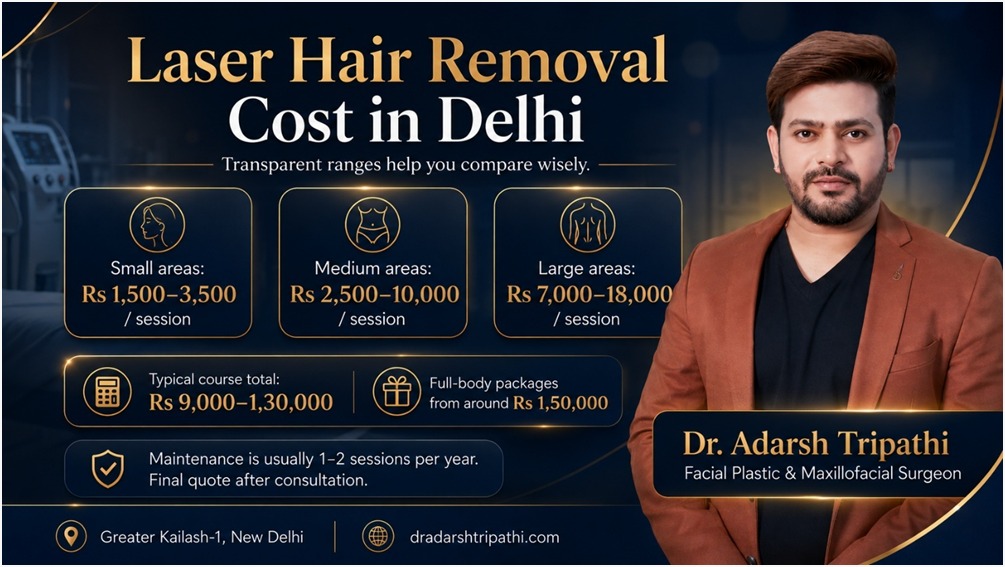
Laser hair reduction costs in Delhi depend on the area treated, the laser system used, the clinic, and whether sessions are booked individually or as packages. Most clinics offer per-session pricing and package pricing for full 6-8 session courses.

Approximate Cost at Sarayu Clinics, Delhi

Area Treated

Per-Session Cost

Typical Sessions

Course Cost

Upper Lip

Rs. 1,500–3,500

6–8

Rs. 9,000–25,000

Chin

Rs. 1,500–3,500

6–8

Rs. 9,000–25,000

Sideburns

Rs. 2,000–4,000

6–8

Rs. 12,000–30,000

Full Face (women)

Rs. 4,500–10,000

6–8

Rs. 27,000–75,000

Underarms

Rs. 1,500–4,000

6–8

Rs. 9,000–28,000

Bikini Line

Rs. 2,500–6,000

6–8

Rs. 15,000–45,000

Brazilian / Full Bikini

Rs. 4,000–9,000

6–8

Rs. 24,000–65,000

Lower Arms

Rs. 2,500–6,000

6–8

Rs. 15,000–45,000

Full Arms

Rs. 4,500–10,000

6–8

Rs. 27,000–75,000

Lower Legs

Rs. 4,500–10,000

6–8

Rs. 27,000–75,000

Full Legs

Rs. 7,500–18,000

6–8

Rs. 45,000–1,30,000

Chest (men)

Rs. 4,500–10,000

6–8

Rs. 27,000–75,000

Back (men)

Rs. 7,000–15,000

6–8

Rs. 42,000–1,10,000

Full Body Package

Customised

Course

Rs. 1,50,000–3,50,000+


Premium vs Budget Pricing — What You're Paying For

Laser hair reduction prices vary widely across Delhi. The differences typically reflect:

  • Laser system quality — Soprano ICE, GentleMax Pro, Lumenis Light Sheer cost more than older or generic systems
  • Doctor-led vs technician-only treatment
  • Skin-type-matched laser selection vs single-laser approaches
  • Sterility and clinical standards vs salon-style operations
  • Number of sessions included in package
  • Maintenance and follow-up policy


Extremely cheap laser hair reduction — a yellow flag

Some clinics offer laser packages at prices that seem too good to be true (e.g. Rs. 5,000 for full body course). These typically involve: older laser equipment with reduced effectiveness, single-laser systems wrong for your skin type, technician-only treatment without doctor oversight, IPL (not true laser) marketed as laser, or sessions stopped early. The cheapest laser hair reduction is often the one that delivers the least result — meaning a second proper course later. Quality laser hair reduction with the right laser for your skin is worth the price difference.

Results Timeline — Realistic Expectations Across the Course

After Single Session

  • Day 0: redness, mild swelling
  • Days 1-21: treated hair sheds gradually
  • By week 3-4: visibly hair-free in treated area until new follicles emerge from telogen
  • Weeks 4-8 (depending on area): some regrowth as new follicles enter anagen

Across the Course (6-8 Sessions over 8-12 Months)

  • Session 1-2 (months 1-2): noticeable initial reduction; subtle changes
  • Session 3-4 (months 3-5): significant reduction; hair growing back finer and slower
  • Session 5-6 (months 5-8): substantial reduction; minimal regrowth; significantly finer remaining hair
  • Session 7-8 (months 8-12): final result emerging; 70-90% long-term reduction achieved

After the Course (Months 12+)

  • Stable 70-90% reduction maintained for years
  • Remaining hair is significantly finer, lighter, slower-growing
  • Maintenance session every 6-18 months catches re-activated follicles

For Hormonally-Driven Hair Growth (PCOS)

Initial course gives same reduction as non-hormonal cases. However, ongoing maintenance is typically more frequent (every 3-6 months) because the underlying hormonal source keeps stimulating new follicles. Combined with hormonal management, results stabilise; without, ongoing periodic treatment may be needed indefinitely.

Realistic Long-Term Outcome

  • 70-90% long-term reduction (typical)
  • Some patients see >95% reduction
  • Some patients see <70% (often hormonal contribution)
  • Maintenance sessions every 6-18 months typical
  • Hair is fundamentally different — finer, lighter, sparser
  • Daily shaving / weekly waxing typically eliminated
  • Significant quality-of-life improvement

Laser Hair Reduction vs Other Hair Removal Methods

Most patients try multiple hair removal methods before settling on laser. Here’s the honest direct comparison:

Method

Effectiveness

Duration

Cost (Long-Term)

Pain

Skin Effect

Laser Hair Reduction

70-90% long-term

Permanent reduction + maintenance

High upfront; low long-term

Moderate

Generally beneficial

Waxing

Temporary

2-4 weeks

Cumulative — significant

High

Can cause PIH

Threading (Face)

Temporary

2-3 weeks

Cumulative — moderate

Moderate

Generally safe

Shaving

Temporary

1-3 days

Lifetime cumulative

None

Possible ingrowns

Depilatory Cream

Temporary

3-7 days

Cumulative — moderate

None

Possible irritation

Electrolysis

Permanent (individual hair)

Permanent

Very high — sessions per hair

Moderate

Generally safe

IPL (home/clinic)

Variable; less than true laser

Variable

Mid

Mild

Variable; risky on dark skin

Plucking

Temporary

2-6 weeks

Cumulative

High

Can cause folliculitis

Laser vs Waxing — Long-Term Math

A patient waxing both legs and bikini area every 4-6 weeks for life spends Rs. 2,000-4,000 per visit, or Rs. 16,000-48,000 per year. Over 10 years: Rs. 1,60,000-4,80,000. A one-time laser course of Rs. 50,000-1,30,000 plus occasional maintenance is often LESS expensive over a decade than continuous waxing — with significantly less pain, less PIH risk, fewer ingrown hairs, and dramatically less time spent on appointments. For most patients, laser is the cost-effective long-term choice.

Laser vs Electrolysis

Electrolysis treats one hair at a time with an electric current — produces truly permanent removal of treated hairs but is extremely time-intensive (each hair takes seconds) and expensive over large areas. Best suited for: white/grey/blonde/red hair (which laser can’t treat), small specific areas, individual stray hairs after laser course. Not a primary choice for full body or large area treatment.

Laser vs IPL

IPL (Intense Pulsed Light) is broadband light, not laser. Generally less effective long-term than true laser, less precise targeting, and more risky on darker Indian skin. Home IPL devices have a market but typically give modest results. For Indian skin, IPL is particularly suboptimal compared to proper Nd:YAG or Diode laser. Cheaper upfront but often less satisfying.

Why a Doctor for Laser Hair Reduction?

Laser hair reduction is offered everywhere — salons, medspas, dermatology clinics, plastic surgery practices. So why specifically a doctor? Because: (a) accurate skin type assessment determines which laser to use safely; (b) recognition of hormonal causes (PCOS) that affect treatment outcomes; (c) ability to manage rare complications (burns, severe PIH, paradoxical stimulation) if they occur; (d) honest expectation-setting based on medical understanding; (e) integration with other treatments where appropriate. Doctor-led treatment is the safety floor — particularly for Indian skin where wrong-laser selection has real consequences.

Why Dr. Adarsh Tripathi Is a Trusted Laser Hair Reduction Doctor in Delhi ?

Laser hair reduction success depends on three things: correct laser selection for your specific skin and hair, honest expectation-setting, and appropriate management of underlying causes (hormonal, where relevant). Here’s how to choose, and why patients choose Dr. Tripathi:

What to Look For in a Laser Hair Reduction Doctor ?

  • Medical qualification — doctor performing or directly overseeing treatment
  • Access to MULTIPLE laser wavelengths (Nd:YAG, Diode) for skin-type matching
  • Nd:YAG (1064nm) priority for Indian skin (Fitzpatrick IV-VI)
  • HONEST ‘reduction not removal’ framing — realistic expectations
  • Recognition and discussion of hormonal contributions (PCOS)
  • Conservative settings prioritising safety over aggressive single-session results
  • Strict sun protection counselling
  • Pre-treatment patch testing where appropriate
  • Clinical (not salon) facilities; doctor-led
  • Transparent pricing without high-pressure ‘limited-time’ tactics

Dr. Tripathi’s Approach

  • Maxillofacial and Facial Plastic Surgeon with 18+ years of experience
  • Indian-skin-conscious laser selection — Nd:YAG priority
  • Multiple laser wavelengths available — right tool for your skin
  • Honest reduction-not-removal expectation-setting
  • Recognition of hormonal contributions; appropriate referrals for PCOS evaluation
  • Conservative, safety-first protocols
  • Doctor-led treatment with personal involvement
  • Consultations personally conducted by Dr. Tripathi

The Honest Approach Philosophy

Laser hair reduction’s reputation has suffered from oversold ‘permanent removal’ claims that disappoint patients when reality is 70-90% reduction with maintenance. Dr. Tripathi’s approach is built on honest framing: laser delivers excellent permanent reduction (not removal) when the right wavelength is used on the right skin type with realistic expectations. The right patient with the right laser gets life-changing reduction; the patient mis-matched to the wrong laser or with unrealistic expectations gets disappointment. The honest matching at consultation is part of the value.

Frequently Asked Questions — Laser Hair Removal in Delhi

Q: Who is the best laser hair removal doctor in Delhi?

A: The best laser hair removal doctor in Delhi for you is a medically qualified specialist with access to multiple laser wavelengths (Nd:YAG, Diode), who uses Indian-skin-conscious protocols (Nd:YAG priority for Fitzpatrick IV-VI), who honestly explains the reduction-not-removal reality, recognises hormonal contributions to hair growth where present (PCOS), and uses conservative safety-first settings. Dr. Adarsh Tripathi is a Maxillofacial and Facial Plastic Surgeon with 18+ years of experience offering doctor-led, Indian-skin-conscious laser hair reduction at Sarayu Clinics, Greater Kailash.

Q: Is laser hair removal actually permanent?

A: Laser hair removal — more medically accurate as laser hair REDUCTION — produces permanent long-term REDUCTION of hair, not complete permanent removal. The US FDA approves laser systems as ‘permanent hair reduction’. Realistic outcomes are 70-90% long-term reduction in hair density after a full course of 6-8 sessions. Some maintenance sessions every 6-18 months are typically needed. Hormonally-driven hair growth (PCOS) often requires more frequent maintenance. Any clinic promising 100% permanent removal is overpromising.

Q: How much does laser hair removal cost in Delhi?

A: Laser hair removal in Delhi costs Rs. 1,500–3,500 per session for small areas (upper lip, chin), Rs. 4,500–10,000 for medium areas (face, underarms, bikini, half legs/arms), and Rs. 7,500–18,000 for large areas (full legs, back). Most patients need 6-8 sessions for the initial course, with course totals ranging Rs. 9,000 (single small area) to Rs. 1,30,000+ (full legs) or Rs. 3,50,000+ (full body). Package pricing typically offers 15-20% savings. A personalised quote follows consultation at Sarayu Clinics.

Q: Is laser hair removal safe for Indian skin?

A: Laser hair removal is safe for Indian and darker skin (Fitzpatrick IV-VI) when performed with the right laser — specifically Nd:YAG (1064nm), which is the SAFEST laser for Indian skin because its longer wavelength bypasses surface melanin and reduces post-inflammatory hyperpigmentation (PIH) risk. Diode (810nm) is an acceptable alternative with conservative settings. Alexandrite (755nm) is GENERALLY RISKY for Indian skin and should be avoided as the sole laser. Asking which laser the clinic uses on Indian patients is one of the most important pre-treatment questions.

Q: How many laser hair removal sessions are needed?

A: Most patients need 6-8 sessions of laser hair removal for the initial course, spaced 4-6 weeks apart for face and 6-8 weeks for body areas — total course of 8-12 months. The reason for multiple sessions is biology: only follicles in the active anagen growth phase respond to laser, and different follicles are in anagen at different times. By session 6-8, the majority of follicles have been treated during their anagen phase. Maintenance sessions every 6-18 months after the course catch re-activated follicles.

Q: Does laser hair removal work on white, grey, or blonde hair?

A: No — laser hair removal does NOT work on white, grey, blonde, red, or very light hair because these hair types lack the melanin pigment that the laser targets. Without melanin, the laser energy has nothing to absorb in the follicle, so no follicle disabling occurs. For light-hair patients, electrolysis (treats one hair at a time with electric current) is the only effective permanent option. For peach fuzz / vellus hair, even electrolysis is challenging — these very fine hairs generally don’t respond to permanent treatments.

Q: Is laser hair removal painful?

A: Laser hair removal involves mild-to-moderate discomfort, often described as a ‘rubber band snap’ sensation against the skin. Modern laser systems with integrated cooling (sapphire cooling tip, cryogen spray, or forced air) significantly reduce discomfort. Sensitivity varies by area — face and bikini are more sensitive than legs or arms. Topical numbing cream can be applied 30-45 minutes before treatment for sensitive areas if needed. Most patients describe modern laser hair reduction as ‘tolerable and worth it’ rather than significantly painful.

Q: What is the difference between laser hair removal and IPL?

A: Laser hair removal uses focused light at a SPECIFIC wavelength precisely targeting hair follicle melanin. IPL (Intense Pulsed Light) uses BROADBAND light covering multiple wavelengths — less precise, less effective long-term, and more risky on darker Indian skin. True laser systems (Nd:YAG, Diode, Alexandrite) are generally more effective and safer for Indian skin than IPL. Home IPL devices give modest results at best. For meaningful long-term reduction on Indian skin, true medical laser is the appropriate choice.

Q: Can I have laser hair removal during pregnancy?

A: No — laser hair removal is generally deferred during pregnancy. While there’s no specific evidence of harm to the foetus from laser hair reduction, the standard recommendation is to wait until after pregnancy (and breastfeeding) to resume non-urgent cosmetic treatments. Hormonal changes during pregnancy also commonly affect hair growth patterns temporarily, making it a suboptimal time for laser treatment anyway. Resume laser hair reduction once pregnancy and breastfeeding are complete.

Q: Does laser hair removal help with PCOS hair growth?

A: Yes — laser hair removal effectively reduces visible PCOS-related hair growth (facial hair, body hair). However, the underlying hormonal condition (excess androgens) keeps stimulating new follicles, meaning ongoing maintenance sessions are typically needed indefinitely. The best long-term approach combines laser hair reduction (for the visible hair) with medical management of PCOS by a gynaecologist or endocrinologist (for the underlying hormonal control). Combined treatment gives the most stable, satisfying result.

Q: Can I shave between laser hair removal sessions?

A: Yes — you SHOULD shave between laser hair removal sessions, never wax or pluck. Shaving removes the hair shaft but leaves the follicle intact for the next laser session to target. Waxing, plucking, or threading remove the entire follicle/root, leaving nothing for the laser to target at the next session. Depilatory creams should also be avoided during the treatment course. Shave 24-48 hours before each session for optimal treatment results.

Q: How do I choose a laser hair reduction clinic in Delhi?

A: Choose a clinic where a doctor (not just a technician) personally assesses you and oversees treatment, where multiple laser wavelengths are available (especially Nd:YAG for Indian skin), where realistic ‘reduction not removal’ expectations are set, where the specific laser used and why is openly explained, where hormonal contributions to hair growth are recognised and discussed, where pre-treatment patch testing is offered for sensitive cases, and where the facility is clinical (not salon). Avoid clinics offering ‘permanent removal forever guaranteed in 6 sessions’ — that’s a sales claim, not a medical commitment.