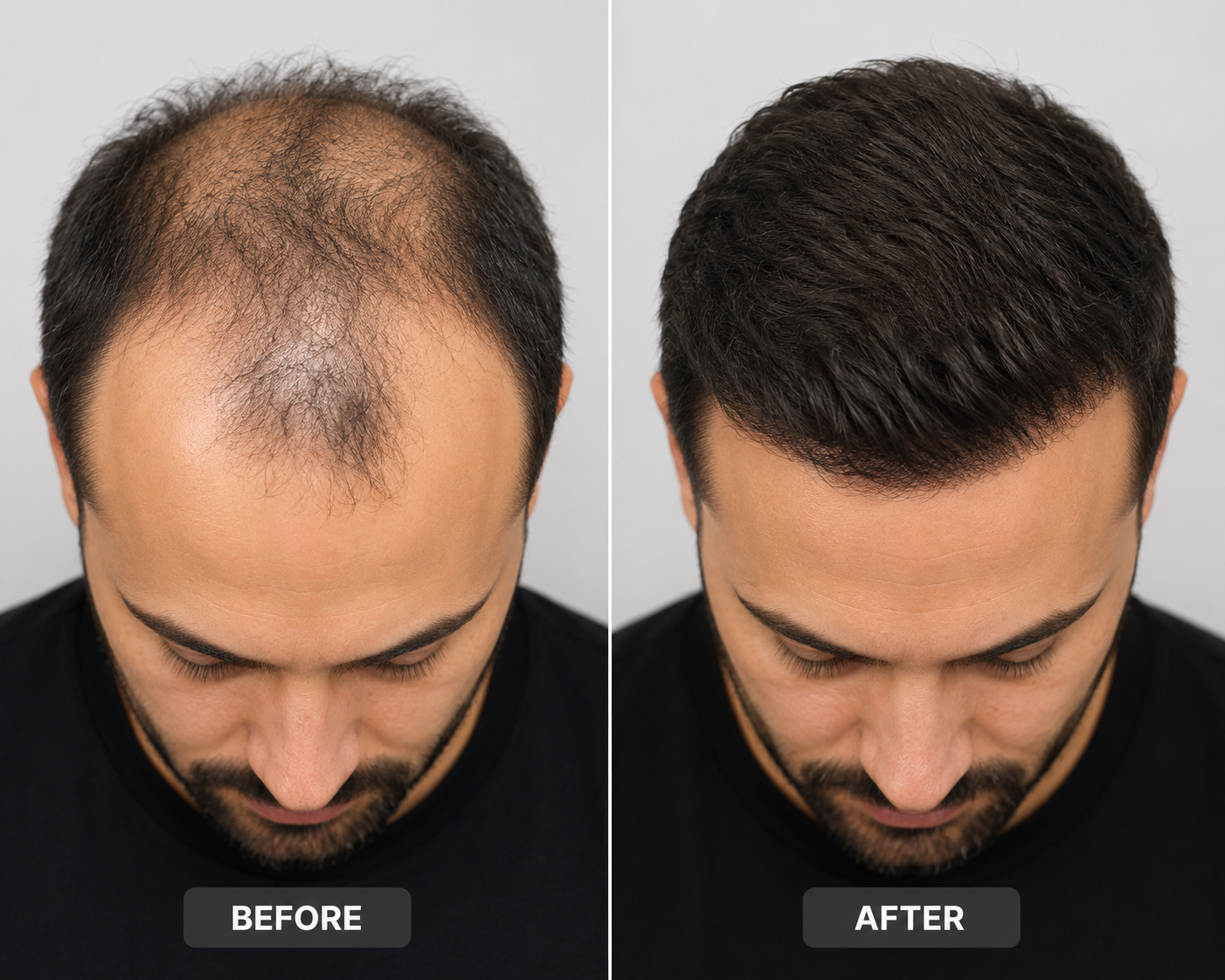
Hair Treatments in Delhi — Diagnosis-First Hair Loss Solutions by a Facial Plastic Surgeon
Hair loss is one of the most common — and most emotionally significant — concerns people bring to a clinic. It affects how you see yourself in the mirror, in photographs, in professional and social settings. The good news: modern hair treatment offers genuinely effective solutions across the full spectrum, from early thinning to advanced baldness. The crucial thing most clinic pages skip: the RIGHT hair treatment depends entirely on WHY you’re losing hair, and matching the wrong treatment to the wrong cause wastes time, money, and the precious window during which hair can be preserved. This is why the most important step in hair treatment isn’t a procedure — it’s an accurate diagnosis.
Here’s the central insight that distinguishes a proper hair clinic from a treatment-selling operation: hair loss has many different causes, and each responds to different treatments. Androgenetic alopecia (genetic pattern baldness) responds to medical therapy, PRP, and ultimately hair transplant. Telogen effluvium (stress/illness-related diffuse shedding) often resolves once the trigger is addressed — and may need NO procedural treatment at all. Alopecia areata (autoimmune patchy loss) needs medical management, not a transplant. Scarring alopecia must be inactive for years before any transplant. Nutritional deficiencies (iron, vitamin D, B12, protein), thyroid disorders, and hormonal conditions (PCOS) cause hair loss that resolves when the underlying issue is treated. A clinic that recommends the same treatment (or the most expensive treatment) to everyone, without diagnosing the cause, is selling rather than treating. The diagnosis comes first.
As a Maxillofacial and Facial Plastic Surgeon, Dr. Adarsh Tripathi brings two things to hair treatment that hair-only chains often lack: the medical depth to diagnose the actual cause of hair loss (rather than defaulting to the most profitable procedure), and the facial-aesthetic eye for hairline design that makes surgical results look natural. At Sarayu Clinics, Greater Kailash-1, New Delhi, the approach is diagnosis-first: understand why you’re losing hair, then match the right treatment — whether that’s medical therapy, a regenerative treatment like PRP or exosomes, a hair transplant, or addressing an underlying medical cause. This page is your complete guide to hair treatments in Delhi, covering every option with honest framing about what each can and can’t do, and how to choose the right doctor for hair treatments in Delhi.
Quick Answer — What hair treatments are available in Delhi and how do I choose?
Hair treatments in Delhi span medical therapy (finasteride, minoxidil), regenerative treatments (PRP, GFC, exosomes, mesotherapy), low-level laser therapy (LLLT), surgical hair transplant (FUE, FUT, DHI), and cosmetic scalp micropigmentation. The right treatment depends on WHY you’re losing hair and the stage of loss: early/preventive cases suit medical therapy plus PRP; active thinning suits regenerative treatments; established baldness suits hair transplant; and some hair loss (telogen effluvium, nutritional, thyroid) resolves by treating the underlying cause. Dr. Adarsh Tripathi at Sarayu Clinics, Greater Kailash, uses a diagnosis-first approach — identifying the cause before recommending treatment. Costs range from Rs. 6,000/session (PRP) to Rs. 3,00,000+ (large hair transplant).
Why Diagnosis Comes First — The Foundation of Effective Hair Treatment ?
Before any treatment recommendation, the cause of your hair loss must be identified. This is the step that separates effective hair treatment from expensive guesswork.
The Diagnostic Workup
- Detailed history — onset, pattern, family history, recent illness/stress, medications, diet, hormonal symptoms
- Scalp examination — pattern of loss, miniaturisation, scarring, inflammation
- Pull test and hair density assessment
- Trichoscopy (dermoscopic scalp examination) where needed
- Blood tests where indicated — thyroid (TSH), iron studies (ferritin), vitamin D, B12, hormonal panel (for suspected PCOS/hyperandrogenism)
- Sometimes scalp biopsy for scarring or unclear cases
Why This Matters — A Real Example
Consider two patients with similar-looking thinning. Patient A has genetic male pattern baldness — they’ll benefit from finasteride, minoxidil, PRP, and eventually transplant. Patient B has telogen effluvium from a recent illness plus low ferritin — their hair will largely recover once the iron is corrected and the illness resolves, with NO transplant needed. If both are sold the same hair transplant, Patient B has spent lakhs on a procedure they didn’t need (and the underlying shedding may even compromise the result). Same appearance, completely different correct treatment. Only diagnosis tells them apart.
The diagnosis-first principle — what to expect from a proper hair clinic
A proper hair treatment consultation should: (1) ask detailed questions about your history, not just look at your scalp; (2) consider blood tests for thyroid, iron, vitamin D, and hormones where relevant; (3) explain the LIKELY CAUSE of your hair loss; (4) recommend treatment matched to that cause; (5) be willing to say ‘you don’t need a transplant’ or ‘let’s correct this deficiency first’ when that’s the truth. A clinic that recommends the same expensive procedure to everyone, or pushes a transplant without diagnosing the cause, is selling rather than treating. Dr. Tripathi’s approach is diagnosis-first.
Understanding Hair Loss — Causes and Conditions
Here are the main causes of hair loss, each of which needs a different treatment approach.
Androgenetic Alopecia (Male & Female Pattern Baldness)
The most common cause — genetic sensitivity to DHT (dihydrotestosterone) causing progressive follicle miniaturisation. In men: receding hairline and crown thinning (Norwood pattern). In women: diffuse crown thinning with preserved hairline (Ludwig pattern). Responds to: medical therapy (finasteride, minoxidil), PRP, GFC, exosomes, and ultimately hair transplant for established loss.
Telogen Effluvium (Diffuse Shedding)
Sudden diffuse shedding triggered by stress, illness, surgery, childbirth, crash dieting, or medication. Hair shifts prematurely into the shedding phase. Usually TEMPORARY — resolves once the trigger is addressed. Often needs NO procedural treatment, just identification and correction of the trigger plus supportive care. Important not to misdiagnose as pattern baldness.
Alopecia Areata (Autoimmune Patchy Loss)
Autoimmune condition causing sudden patchy hair loss (round bald patches). Needs MEDICAL management (topical/intralesional steroids, immunotherapy, newer JAK inhibitors) — NOT a hair transplant (transplanting into active autoimmune areas fails). Dermatological treatment is the priority.
Nutritional Deficiency Hair Loss
Iron deficiency (low ferritin), vitamin D deficiency, B12 deficiency, protein deficiency, and zinc deficiency all cause hair loss. Extremely common, especially in Indian women. Resolves when the deficiency is corrected. This is why blood tests matter — correcting a deficiency is cheaper and more effective than any procedure for these patients.
Thyroid-Related Hair Loss
Both hypothyroidism and hyperthyroidism cause hair loss. Resolves when thyroid function is corrected with appropriate medical treatment. A simple TSH blood test identifies it.
Hormonal Hair Loss (PCOS, Hyperandrogenism)
PCOS and other hormonal conditions cause hair loss (and sometimes excess facial/body hair simultaneously). Needs management of the underlying hormonal condition alongside hair-directed treatment.
Scarring Alopecia (Cicatricial)
Inflammatory conditions (lichen planopilaris, frontal fibrosing alopecia, discoid lupus, folliculitis decalvans) that destroy follicles and replace them with scar tissue. Needs prompt dermatological treatment to halt progression. Hair transplant possible ONLY when the condition has been inactive for years.
Traction Alopecia
Hair loss from tight hairstyles, braids, extensions, or turbans over time. If caught early (follicles still present), changing the styling habit plus minoxidil may recover hair. If permanent (follicles lost), transplant restores hair.
Medication & Medical Hair Loss
Certain medications (chemotherapy, some blood thinners, retinoids, etc.) and medical conditions cause hair loss. Often resolves when the medication is stopped or condition treated.
Benefits of Doctor-Led, Diagnosis-First Hair Treatment
- Accurate diagnosis — treating the actual cause, not guessing
- Avoiding unnecessary procedures — saving money where the cause is correctable (deficiency, thyroid, telogen effluvium)
- Right treatment matched to right cause and stage
- Combined approaches for best results — medical + regenerative + surgical as appropriate
- Hairline design as a facial-aesthetic decision (for transplant cases)
- Honest expectations — what each treatment can and can’t do
- Recognition of underlying medical issues (hormonal, nutritional, autoimmune)
- Long-term management plan, not just a single procedure
- Medical management of complications if they arise
- Preservation of native hair via medical therapy alongside procedures
An honest framing: no hair treatment is magic, and most hair loss management is a long-term commitment rather than a one-time fix. Pattern baldness, in particular, is progressive — meaning ongoing management (medical therapy to preserve native hair, periodic regenerative sessions, and sometimes staged transplants) is the realistic picture. A diagnosis-first, doctor-led approach gives you the honest roadmap rather than a single oversold procedure.
Areas Treated
Scalp — Frontal Hairline and Temples
The receding hairline and temple recessions — the most visible and commonly treated area. Hairline DESIGN matters most here (facial-aesthetic decision). Treated with transplant for established loss, regenerative treatments for early thinning.
Scalp — Crown and Vertex
The whirl area, often the second area to thin. Treated with the full range depending on stage.
Scalp — Mid-Scalp / Diffuse Thinning
Diffuse thinning across the top, common in both male and female pattern loss. Often responds well to medical and regenerative treatments before transplant is needed.
Female Hair Thinning
Diffuse crown thinning (Ludwig pattern) in women — often responds to medical therapy, regenerative treatments, and addressing underlying causes (iron, thyroid, hormones) before transplant.
Beard and Moustache
Patchy beard, absent areas — restored with beard transplant (FUE).
Eyebrows
Thin or absent eyebrows — restored with eyebrow transplant or supported with regenerative treatments.
Scars on Scalp
Hair restoration into surgical or traumatic scalp scars, or camouflage via scalp micropigmentation.
The Complete Hair Treatment Menu at Sarayu Clinics
Here’s the full range of hair treatments, each with a concise overview. For surgical hair transplant techniques, follow the links to detailed pages.
1. Hair Transplant (FUE, FUT, DHI)
Surgical relocation of bald-resistant follicles from the donor area to areas of loss — the definitive solution for established hair loss. FUE (scarless individual extraction), FUT (strip method, high yield for large cases), and DHI (Choi-pen FUE variant) are the main techniques. Permanent results; the transplanted hair grows for life. Best for established loss where medical/regenerative treatments alone won’t restore the lost density. Hairline design as a facial-aesthetic decision is Dr. Tripathi’s particular strength here.
2. PRP (Platelet-Rich Plasma) Therapy
Uses growth factors concentrated from your own blood, injected into the scalp to stimulate follicle activity and the growth phase. Well-established (15+ years of literature), uses your own tissue, minimal downtime. Best for early-to-moderate thinning, as a hair transplant adjunct, and as ongoing maintenance. Typically 3-6 initial sessions then maintenance. The established, cost-effective first-line regenerative treatment.
3. GFC (Growth Factor Concentrate)
An advanced preparation concentrating growth factors from your own blood (processed differently from standard PRP, often yielding higher growth factor concentration). Similar indications to PRP — early-to-moderate thinning, adjunct to other treatments. A refined alternative to standard PRP.
4. Exosome Therapy
Uses microscopic signalling vesicles (derived from stem cells or platelets) carrying growth factors to support follicle regeneration. A newer regenerative treatment — genuinely promising for early hair loss but with an evolving evidence base. Best for early thinning and as an adjunct. More expensive than PRP.
5. Mesotherapy for Hair
Micro-injections of a customised cocktail of vitamins, minerals, amino acids, and other nutrients directly into the scalp to nourish follicles. Supports follicle health and can be combined with other treatments. Best as supportive/adjunctive treatment for nutritional support of the scalp.
6. Low-Level Laser Therapy (LLLT)
Red-light therapy (in-clinic devices or approved home caps/combs) that stimulates follicles. Non-invasive, painless, can be done at home with approved devices. Modest but real supportive effect; best as an adjunct to other treatments rather than a standalone solution. Requires consistent long-term use.
7. Medical Therapy (Finasteride, Minoxidil)
The proven pharmaceutical foundation of hair loss management. Finasteride (oral, for men) blocks DHT — the hormone driving pattern baldness. Minoxidil (topical/oral, both sexes) prolongs the growth phase and improves follicle activity. These are the most evidence-based hair loss treatments and the foundation that should accompany most other treatments — because they address the underlying loss process that procedures alone don’t stop. Prescribed and monitored medically.
8. Scalp Micropigmentation (SMP)
A cosmetic tattooing technique that deposits pigment in the scalp to create the appearance of closely-shaved hair follicles or to add density illusion to thinning areas. Also camouflages transplant scars. Non-surgical, immediate cosmetic effect, low maintenance (touch-ups every few years). Best for: the shaved-head look, camouflaging scars, adding density illusion. A cosmetic (not regenerative) solution.
9. Combination Protocols
In practice, the best results often come from combining treatments — for example, finasteride + minoxidil (medical foundation) + PRP (regenerative) for early-to-moderate loss; or hair transplant + ongoing medical therapy to preserve native hair around the grafts. Dr. Tripathi builds combination plans matched to your diagnosis and goals.
A note on Stem Cell Therapy for hair loss
You may have seen stem cell therapy marketed for hair loss. Honest guidance: stem cell therapy for hair loss is NOT currently approved by Indian regulatory authorities (DCGI) for this indication, and following recent regulatory developments (including a January 2026 Supreme Court judgment and March 2026 NMC advisory), clinics promoting it are on legally questionable ground. The regenerative benefits patients seek from ‘stem cell therapy’ are genuinely available through approved, evidence-supported treatments — PRP, GFC, exosomes, and mesotherapy — which is what Sarayu Clinics offers. We do not offer or promote unapproved stem cell therapy for hair loss. If a clinic offers you ‘stem cell therapy’ for hair loss, ask specifically what the product is, what regulatory approval it has, and what evidence supports it — the answers are revealing.
Treatment-Matching Framework — Which Treatment for Your Situation
Here’s how treatments map to hair loss situations — the framework Dr. Tripathi uses to build your plan.
Your Situation | First-Line Approach | May Add | Notes |
Early thinning (genetic) | Finasteride/Minoxidil + PRP | GFC, exosomes, LLLT | Preserve before you lose |
Moderate thinning (genetic) | Medical + PRP/GFC | Exosomes, mesotherapy | Combination works best |
Established baldness | Hair Transplant | Medical therapy for native hair | Transplant for lost density |
Diffuse shedding (telogen) | Identify & treat trigger | Supportive care | Often resolves; rarely needs procedure |
Patchy loss (alopecia areata) | Dermatological treatment | — | NOT transplant; medical management |
Nutritional deficiency | Correct deficiency | Supportive treatment | Blood tests reveal; cheap fix |
Thyroid-related | Treat thyroid | Supportive | Resolves with thyroid control |
Hormonal (PCOS) | Treat hormones + hair treatment | PRP, medical | Combined approach |
Scarring alopecia | Halt with dermatology first | Transplant only if inactive years | Diagnosis critical |
Want shaved-head look | Scalp Micropigmentation | — | Cosmetic solution |
Transplant scar to hide | SMP or FUE into scar | — | Camouflage options |
This framework illustrates why diagnosis comes first — the same ‘thinning hair’ could need medical therapy, a deficiency correction, regenerative treatment, a transplant, or dermatological management depending entirely on the cause. The consultation determines which path is right for you.
The Hair Treatment Process — Step by Step
Step 1: Consultation & Diagnosis
Dr. Tripathi takes a detailed history, examines your scalp and hair, performs trichoscopy where useful, and orders blood tests if an underlying cause (thyroid, iron, vitamin D, hormones) is suspected. The LIKELY CAUSE of your hair loss is identified — this is the foundation of everything that follows. Photos are taken for baseline tracking.
Step 2: Treatment Plan
Based on the diagnosis, a treatment plan is built — matched to your specific cause, stage, goals, and budget. This may be medical therapy alone, a regenerative treatment course, a hair transplant, addressing an underlying medical cause, or (most commonly) a combination. Realistic expectations and timeline are discussed honestly.
Step 3: Treatment Delivery
Depending on the plan: medical therapy is prescribed and monitored; regenerative treatments (PRP, GFC, exosomes, mesotherapy) are delivered in sessions spaced weeks apart; hair transplant is performed as an outpatient surgical procedure; LLLT may be in-clinic or home-based; SMP is delivered over a few sessions. Each treatment has its own protocol covered on its detailed page.
Step 4: Monitoring & Long-Term Management
Hair loss management is ongoing — follow-up visits track progress, medical therapy preserves native hair, maintenance regenerative sessions sustain results, and the plan is adjusted as needed. Pattern baldness is progressive, so long-term management (not a single procedure) is the realistic approach for lasting results.
Downtime by Treatment
Treatment | Discomfort | Downtime | Back to Routine |
Medical Therapy (pills/topical) | None | None | Immediate |
PRP / GFC | Mild (numbed) | 1–2 days mild tenderness | Same/next day |
Exosome Therapy | Mild (numbed) | 1–2 days | Same/next day |
Mesotherapy | Mild (numbed) | 1 day | Same day |
LLLT | None | None | Immediate |
Hair Transplant (FUE) | Numbed | 5–7 days | Next day (desk work) |
Hair Transplant (FUT) | Numbed | 10–14 days | 7–10 days |
Scalp Micropigmentation | Mild | 2–5 days mild redness | Same/next day |
Most non-surgical hair treatments have minimal downtime — you can return to normal activities the same or next day. Hair transplant requires more recovery (covered in detail on the transplant pages). The shedding phase (2-4 weeks after transplant) and gradual regrowth (visible results from 3-4 months) apply specifically to transplant.
Why Exosome Therapy Costs More Than PRP ?
PRP is made from your own blood at the clinic — the main cost is the kit, processing, and clinic time (Rs. 6,000–15,000 per session typically). Exosome therapy requires purchasing manufactured exosome products from specialised suppliers, which is itself expensive — the product cost is the main driver of the higher per-session price. Higher-quality, well-characterised exosome products from reputable manufacturers cost more than less rigorously characterized alternatives — and this difference shows up in clinic pricing.
The cost-vs-evidence consideration
Exosome therapy costs 2-4x more than PRP for similar indications. For some patients and some indications, the additional cost may be justified by potentially stronger or more consistent results. For others, established alternatives like PRP, finasteride/minoxidil for hair, or MNRF for skin may give better value. The right answer depends on YOUR specific indication, response to other treatments, and budget. An honest consultation includes this cost-benefit discussion — not just a sales pitch for the more expensive option.
Hair Treatment Cost in Delhi — Overview
Costs vary widely across the treatment range. Here’s a transparent overview; detailed pricing for each is on its respective page or provided at consultation.
Treatment | Approx. Cost | Sessions / Course |
Medical Therapy (monthly) | Rs. 500–2,500/month | Ongoing |
PRP Therapy | Rs. 6,000–15,000/session | 4–6 + maintenance |
GFC Therapy | Rs. 8,000–20,000/session | 4–6 + maintenance |
Exosome Therapy | Rs. 20,000–50,000/session | 3–6 |
Mesotherapy | Rs. 3,000–8,000/session | 6–10 |
LLLT | Rs. 1,500–5,000/session or device purchase | Ongoing |
FUE Hair Transplant | Rs. 40–90/graft | Rs. 60,000–3,00,000+ |
FUT Hair Transplant | Rs. 30–60/graft | Rs. 60,000–2,70,000 |
Scalp Micropigmentation | Rs. 25,000–80,000 | 2–4 sessions |
The cost-efficiency insight — diagnosis saves money
The most cost-efficient hair treatment is the RIGHT one for your cause. Correcting an iron deficiency (a few hundred rupees of supplements) may resolve hair loss that would otherwise prompt lakhs in unnecessary procedures. Starting medical therapy early (finasteride/minoxidil) may preserve hair and delay or reduce the need for transplant. Diagnosis-first treatment isn’t just more effective — it’s more cost-efficient, because it directs your money to what will actually work for your specific cause.
Results Timeline by Treatment
Medical Therapy (Finasteride/Minoxidil)
Initial shedding possible in first weeks (normal). Stabilisation of loss by 3-6 months. Visible improvement by 6-12 months. Ongoing use required to maintain.
PRP / GFC / Exosomes
Gradual improvement over the treatment course. Reduced shedding by 2-3 months. Visible density/quality improvement by 4-6 months. Maintenance sessions sustain results.
Mesotherapy
Supportive effect over the course; works alongside other treatments. Gradual scalp/hair quality improvement over months.
LLLT
Slow, modest effect requiring consistent use. Results, if any, visible after several months of regular use.
Hair Transplant
Shedding phase at 2-4 weeks (transplanted hair sheds — normal). Regrowth from 3-4 months. 50% result by 6 months, 90% by 12 months, final at 12-18 months. Permanent.
Scalp Micropigmentation
Immediate cosmetic effect after the session course. Lasts several years before touch-ups needed.
Treating Underlying Causes
Nutritional/thyroid/hormonal hair loss: improvement follows correction of the underlying issue, typically over 3-6 months as the hair cycle normalises.
Comparing Hair Treatments
Treatment | Type | Best For | Permanence |
Hair Transplant | Surgical | Established loss | Permanent (transplanted hair) |
PRP | Regenerative | Early-moderate thinning | Needs maintenance |
GFC | Regenerative | Early-moderate thinning | Needs maintenance |
Exosomes | Regenerative | Early thinning (newer) | Needs maintenance |
Mesotherapy | Supportive | Scalp nourishment adjunct | Needs maintenance |
LLLT | Supportive | Mild support adjunct | Ongoing use |
Medical Therapy | Pharmaceutical | Preserving native hair | Ongoing use |
SMP | Cosmetic | Shaved look / camouflage | Years; touch-ups |
Surgical vs Non-Surgical
Surgical (hair transplant) is the only treatment that restores hair to areas where follicles are already lost — it’s the definitive solution for established baldness. Non-surgical treatments (medical, regenerative, supportive) work on EXISTING follicles — preserving, strengthening, and stimulating hair that’s still present. They can’t regrow hair where follicles are gone, but they’re essential for early loss and for preserving native hair around transplants. The two categories are complementary, not competing — most comprehensive plans use both.
Why a Facial Plastic Surgeon for Hair Treatment?
Hair treatment spans medical, regenerative, and surgical domains. A facial plastic surgeon brings: the medical depth to diagnose causes accurately; the surgical skill for hair transplant; and uniquely, the facial-aesthetic eye for hairline design that makes transplant results look natural (hairline placement is a facial proportion decision). For comprehensive hair treatment — especially where surgery may be involved — this combination of diagnostic, surgical, and aesthetic expertise is genuinely valuable.
Why Dr. Adarsh Tripathi Is a Trusted Doctor for Hair Treatments in Delhi ?
Choosing a hair treatment doctor is about finding someone who diagnoses before treating, offers the full range of options (not just the most profitable), and is honest about what each treatment can achieve. Here’s how to choose, and why patients choose Dr. Tripathi:
What to Look For in a Hair Treatment Doctor
- Medical qualification — diagnoses the actual cause, not just sells procedures
- Willingness to order blood tests and identify underlying causes (thyroid, iron, hormones)
- Full range of treatments available — medical, regenerative, surgical, cosmetic
- Honest about which treatment suits your specific cause and stage
- Willingness to say ‘you don’t need a transplant’ or ‘correct this deficiency first’
- Compliant, ethical practice — no unapproved ‘stem cell’ marketing
- Hairline design expertise for transplant cases (facial-aesthetic eye)
- Combined medical + procedural approach for lasting results
- Personal consultation by the doctor; clinical facilities
Dr. Tripathi’s Approach
- Maxillofacial and Facial Plastic Surgeon with 18+ years of experience
- Diagnosis-first — identifies the cause before recommending treatment
- Full treatment range — medical, PRP, GFC, exosomes, mesotherapy, LLLT, hair transplant, SMP
- Honest, compliant practice — no unapproved stem cell marketing
- Facial-aesthetic hairline design for transplant cases
- Combined medical + procedural plans for lasting results
- Recognises and addresses underlying medical causes
- Consultations personally conducted by Dr. Tripathi
The Diagnosis-First, Honest Philosophy
Dr. Tripathi’s approach to hair treatment is built on diagnosing the actual cause before recommending treatment, offering the full range of options matched to that diagnosis, and being honest about what each treatment can and can’t achieve. This means sometimes recommending a simple deficiency correction over an expensive procedure, sometimes recommending medical therapy before surgery, and always being transparent about realistic outcomes. The honest, diagnosis-first approach is what distinguishes proper hair treatment from procedure-selling.
Frequently Asked Questions — Hair Treatments in Delhi
Q: Who is the best doctor for hair treatments in Delhi?
A: The best doctor for hair treatments in Delhi for you is a medically qualified specialist who diagnoses the actual cause of your hair loss before recommending treatment, offers the full range of options (medical, regenerative, surgical, cosmetic), is honest about what each can achieve, and practices ethically without unapproved ‘stem cell’ marketing. Dr. Adarsh Tripathi is a Maxillofacial and Facial Plastic Surgeon with 18+ years of experience offering diagnosis-first, comprehensive hair treatment at Sarayu Clinics, Greater Kailash.
Q: What hair treatments are available in Delhi?
A: Hair treatments in Delhi include medical therapy (finasteride, minoxidil), regenerative treatments (PRP, GFC, exosomes, mesotherapy), low-level laser therapy (LLLT), surgical hair transplant (FUE, FUT, DHI), and cosmetic scalp micropigmentation. The right treatment depends on the cause and stage of your hair loss — which is why an accurate diagnosis comes first. Many patients benefit from a combination, such as medical therapy plus PRP for early loss, or hair transplant plus medical therapy for established loss.
Q: Which hair treatment is best for me?
A: The best hair treatment depends entirely on WHY you’re losing hair. Genetic pattern baldness suits medical therapy, PRP, and eventually transplant; diffuse shedding (telogen effluvium) often resolves by treating the trigger; nutritional deficiency hair loss resolves by correcting the deficiency; autoimmune patchy loss needs dermatological treatment, not transplant. This is why a proper consultation diagnoses the cause first — only then can the right treatment be matched. A clinic recommending the same treatment to everyone isn’t diagnosing properly.
Q: How much do hair treatments cost in Delhi?
A: Hair treatments in Delhi range from Rs. 500–2,500/month for medical therapy, Rs. 6,000–15,000/session for PRP, Rs. 20,000–50,000/session for exosomes, to Rs. 60,000–3,00,000+ for hair transplant, and Rs. 25,000–80,000 for scalp micropigmentation. The most cost-efficient treatment is the right one for your cause — correcting a nutritional deficiency may resolve hair loss for a few hundred rupees, while established baldness needs transplant. A consultation provides personalised pricing based on your diagnosis and plan.
Q: Is stem cell therapy good for hair loss?
A: Stem cell therapy for hair loss is NOT currently approved by Indian regulatory authorities (DCGI) for this indication, and following recent regulatory developments, clinics promoting it are on legally questionable ground. The regenerative benefits patients seek are genuinely available through approved, evidence-supported treatments — PRP, GFC, exosomes, and mesotherapy. Sarayu Clinics does not offer or promote unapproved stem cell therapy for hair loss. If offered ‘stem cell therapy’, ask what the product is, what regulatory approval it has, and what evidence supports it.
Q: Can hair loss be reversed without surgery?
A: Some hair loss can be reversed or significantly improved without surgery, depending on the cause. Telogen effluvium, nutritional deficiency, and thyroid-related hair loss often recover once the underlying issue is corrected. Early pattern baldness can be slowed or partly reversed with medical therapy (finasteride, minoxidil) and regenerative treatments (PRP, GFC, exosomes). However, established baldness where follicles are already lost can only be restored with hair transplant — non-surgical treatments work on existing follicles, not lost ones.
Q: Do I need blood tests for hair loss?
A: Often yes — blood tests are an important part of diagnosing hair loss, especially for diffuse thinning or shedding. Common tests include thyroid function (TSH), iron studies (ferritin), vitamin D, vitamin B12, and hormonal panels (for suspected PCOS or hyperandrogenism). These reveal correctable causes — a nutritional deficiency or thyroid issue causing hair loss can be resolved by treating the underlying problem rather than with expensive hair procedures. This is why diagnosis-first treatment matters.
Q: What is the difference between PRP, GFC, and exosomes?
A: All three are regenerative hair treatments that deliver growth factors to the scalp. PRP (platelet-rich plasma) uses concentrated platelets from your own blood — established 15+ years, cost-effective. GFC (growth factor concentrate) is a refined preparation from your blood, often with higher growth factor concentration. Exosomes are microscopic signalling vesicles (from stem cells or platelets) — newer, more expensive, promising but with an evolving evidence base. PRP is the established first-line; GFC and exosomes are alternatives or step-ups in selected cases.
Q: How long do hair treatment results take?
A: Hair treatment results vary by treatment. Medical therapy shows stabilisation by 3-6 months and improvement by 6-12 months. Regenerative treatments (PRP, GFC, exosomes) show reduced shedding by 2-3 months and visible density improvement by 4-6 months. Hair transplant shows regrowth from 3-4 months, 90% result by 12 months, final at 12-18 months. Treating underlying causes (deficiency, thyroid) shows improvement over 3-6 months. Patience is needed — hair grows slowly, and most treatments work gradually.
Q: Will hair treatments stop my hair loss permanently?
A: Most hair loss management is ongoing rather than a permanent one-time fix, because pattern baldness is progressive. Hair transplant permanently restores the transplanted hair, but native hair can continue thinning without medical therapy. Regenerative treatments need maintenance sessions. Medical therapy works while you take it. The realistic approach is long-term management — typically combining medical therapy (to preserve native hair) with periodic regenerative treatments or transplant as needed. Treating a correctable cause (deficiency, thyroid) can resolve that specific hair loss.
Q: Can women get hair treatments?
A: Yes — women can have the full range of hair treatments, with careful attention to female-specific patterns and causes. Female hair loss is often diffuse (Ludwig pattern) and commonly has correctable underlying causes — iron deficiency, thyroid issues, hormonal conditions (PCOS), or telogen effluvium — which is why diagnosis is especially important for women. Treatments include medical therapy, PRP, GFC, exosomes, mesotherapy, and hair transplant for suitable candidates. Many women benefit from addressing underlying causes alongside hair-directed treatment.
Q: How do I choose a hair treatment clinic in Delhi?
A: Choose a clinic where a qualified doctor diagnoses the cause of your hair loss (including blood tests where relevant) before recommending treatment, where the full range of treatments is available (not just the most profitable), where you’re given honest expectations, where ethical compliant practice is followed (no unapproved stem cell marketing), and where the consultation is personally conducted by the doctor in clinical facilities. Avoid clinics that recommend the same expensive procedure to everyone or push treatments without diagnosing the underlying cause.
How to Reach Us:
Phone:+91 9289111083 ,+91 9289111084
Email: sarayuinquiries@gmail.com
Dr Adarsh’s website: https://dradarshtripathi.com/
Facebook: https://www.facebook.com/DrAdarshTripathi3011
Instagram: https://www.instagram.com/dr_adarsh_tripathi/
Youtube: https://www.youtube.com/@dr_adarsh_tripathi
Linkedin: https://www.linkedin.com/in/dr-adarsh-tripathi-a43005b8/
Online Booking: https://dradarshtripathi.com/contact-us/ to schedule appointments conveniently.