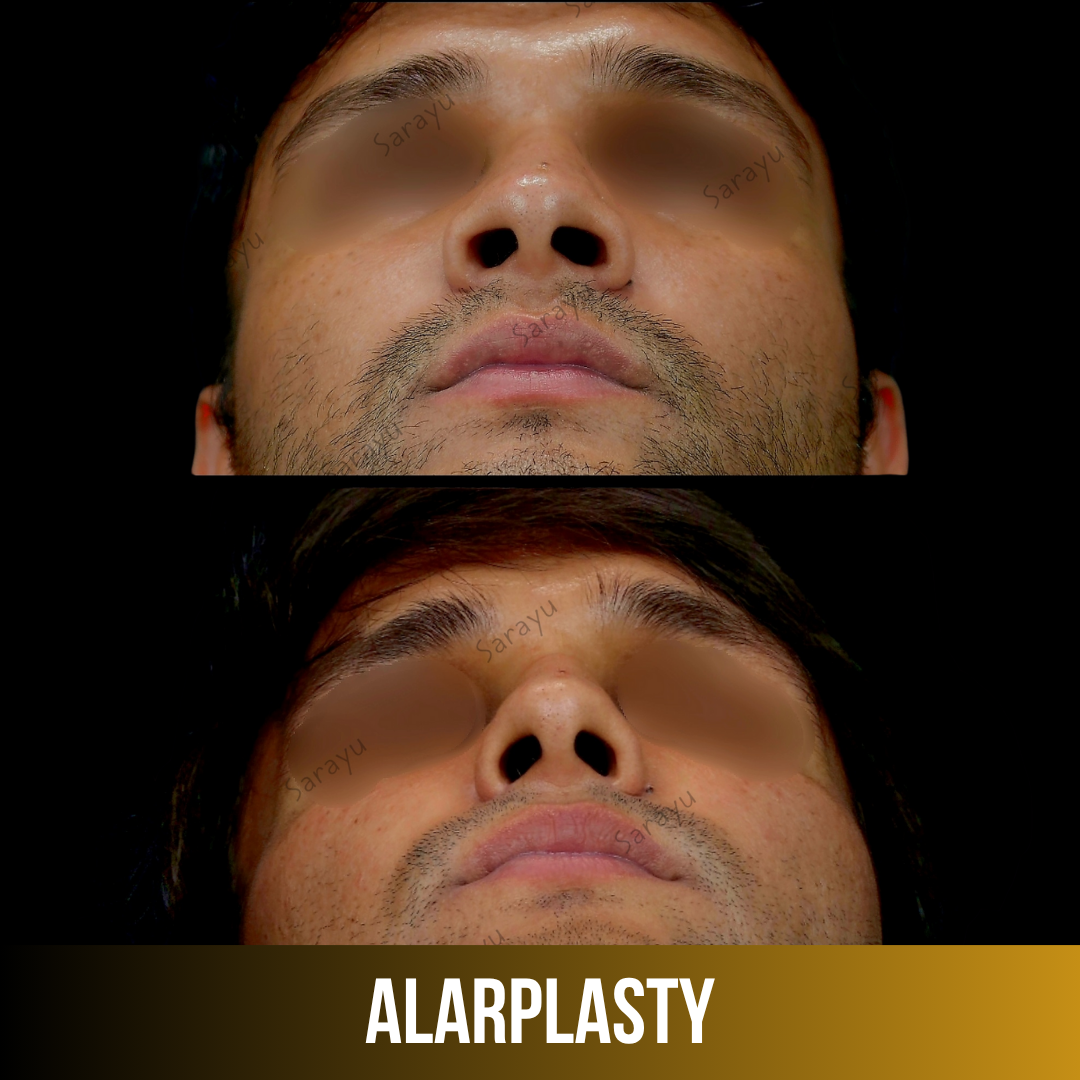
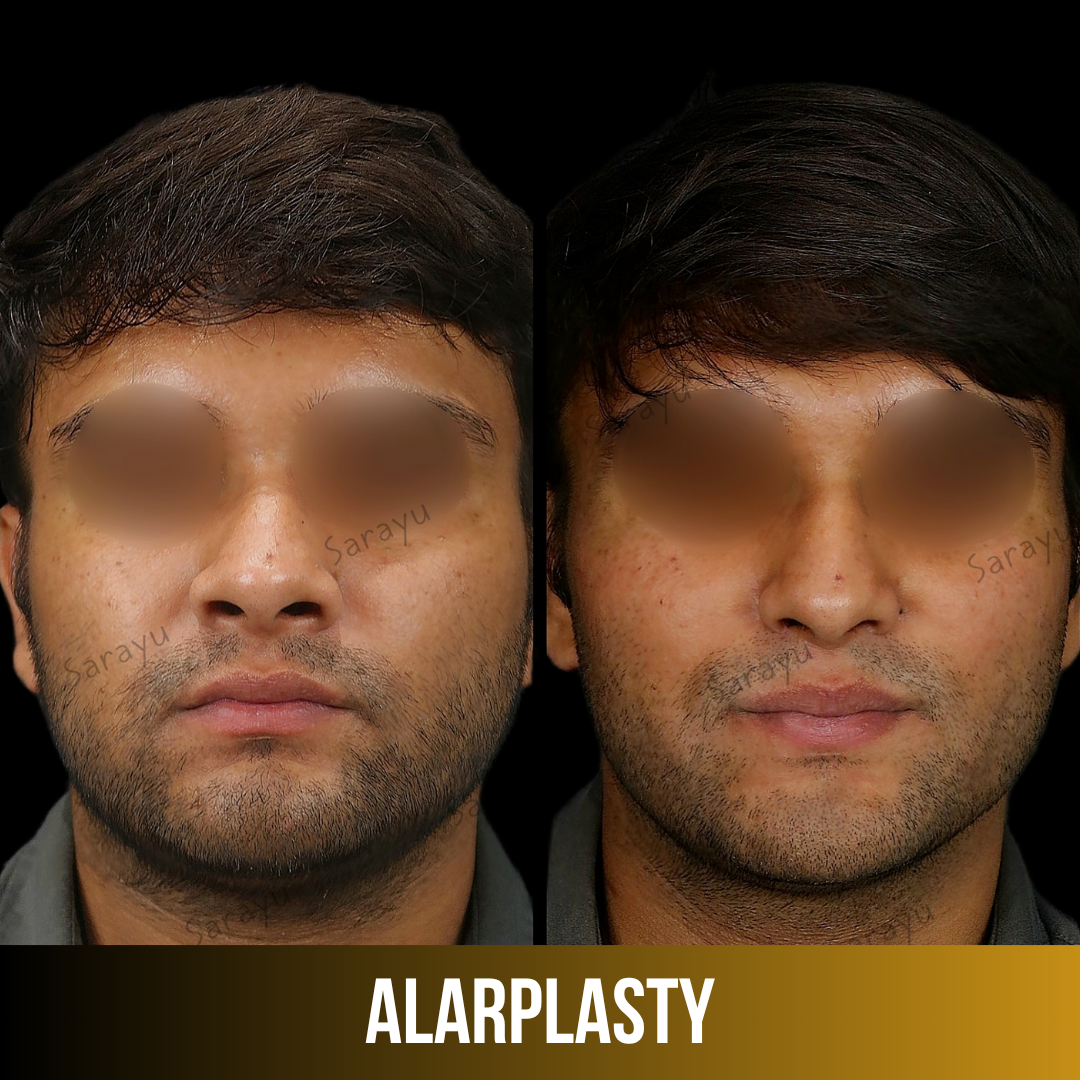
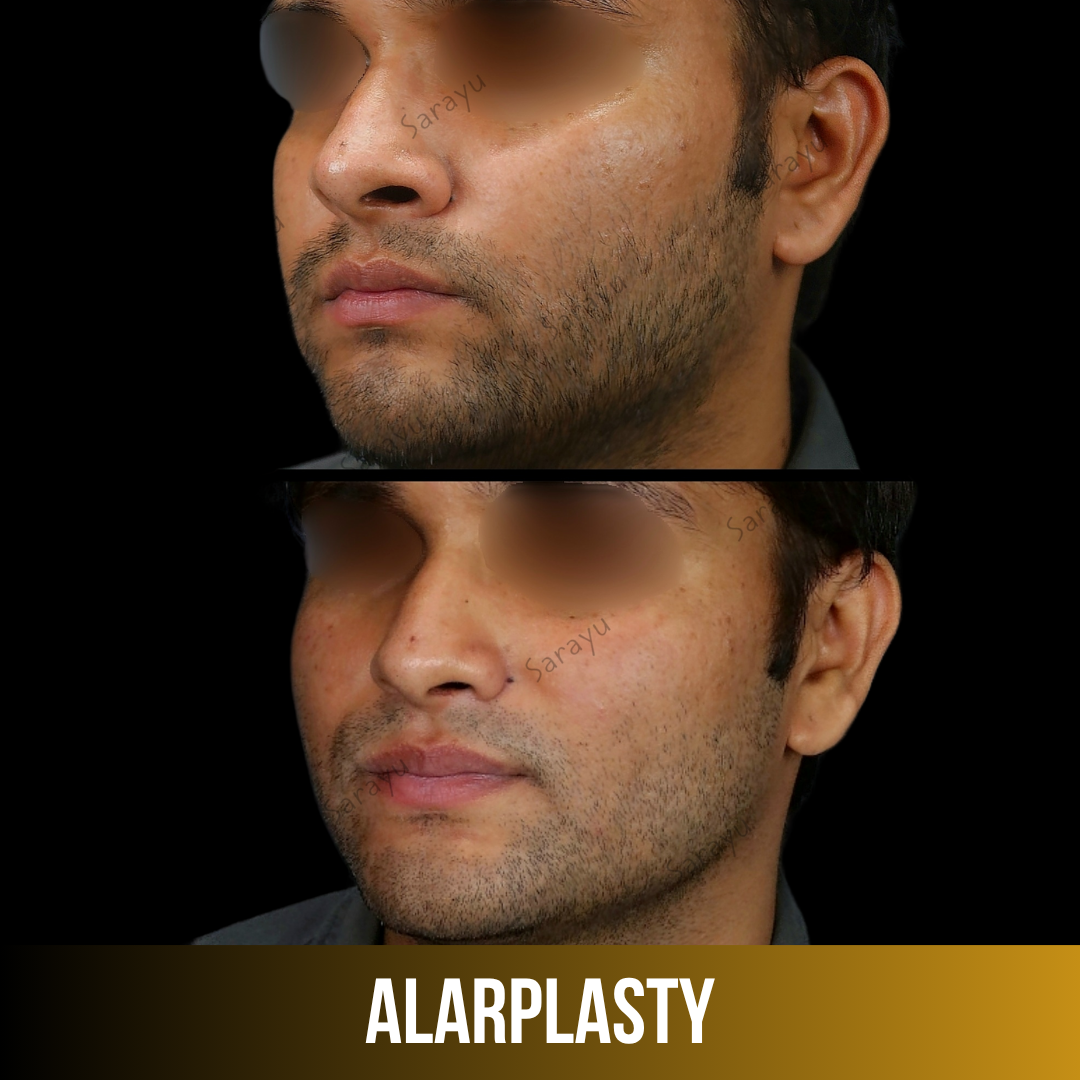
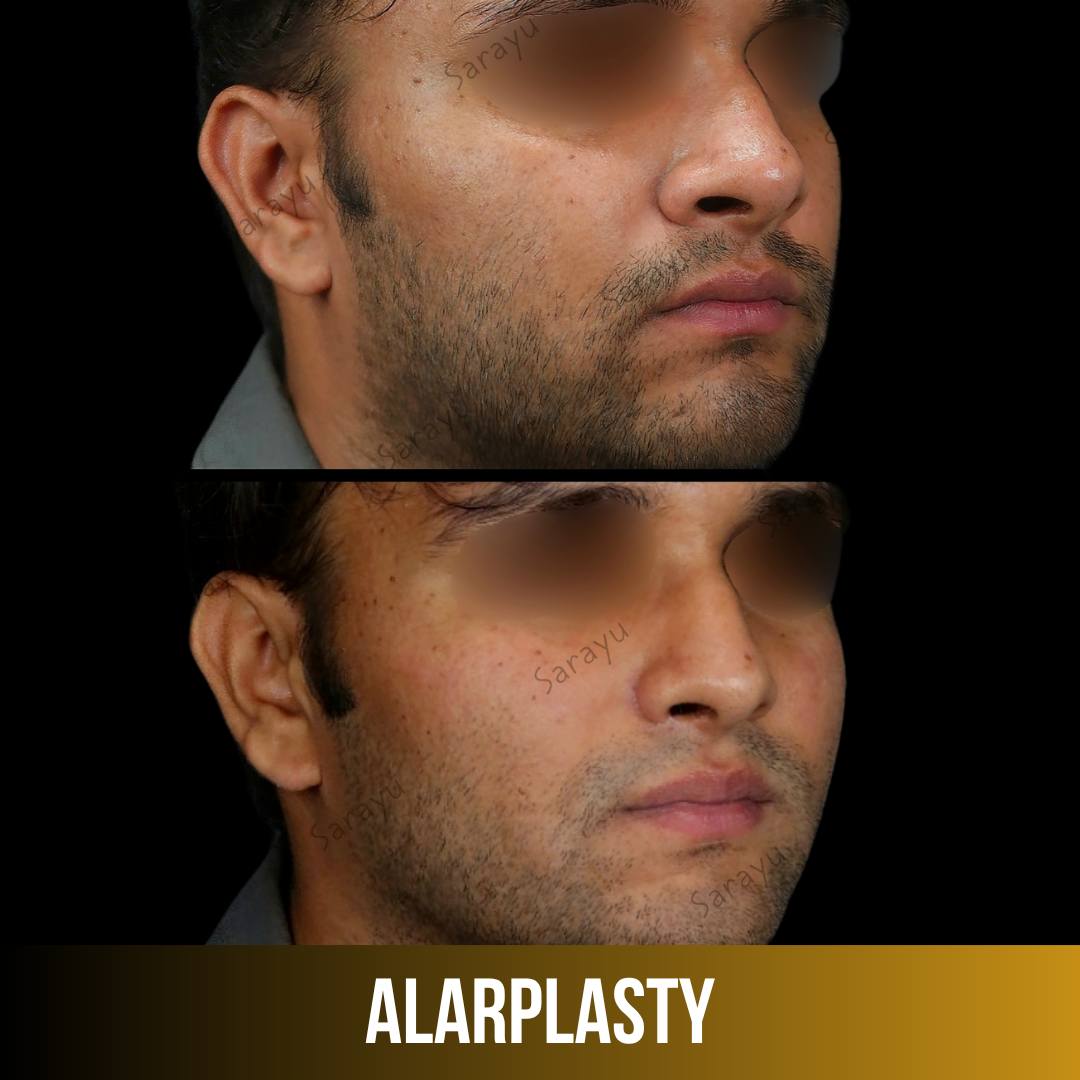
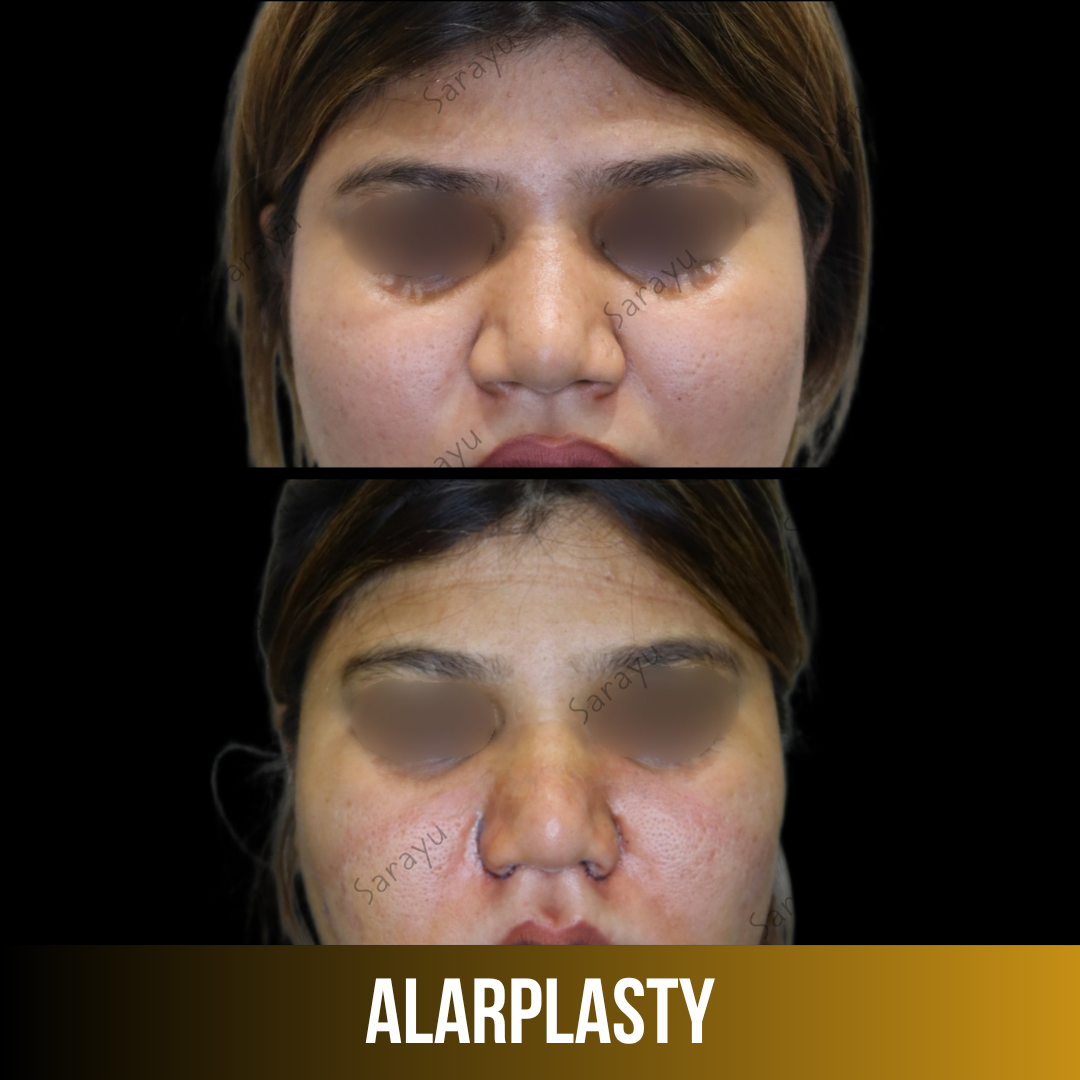
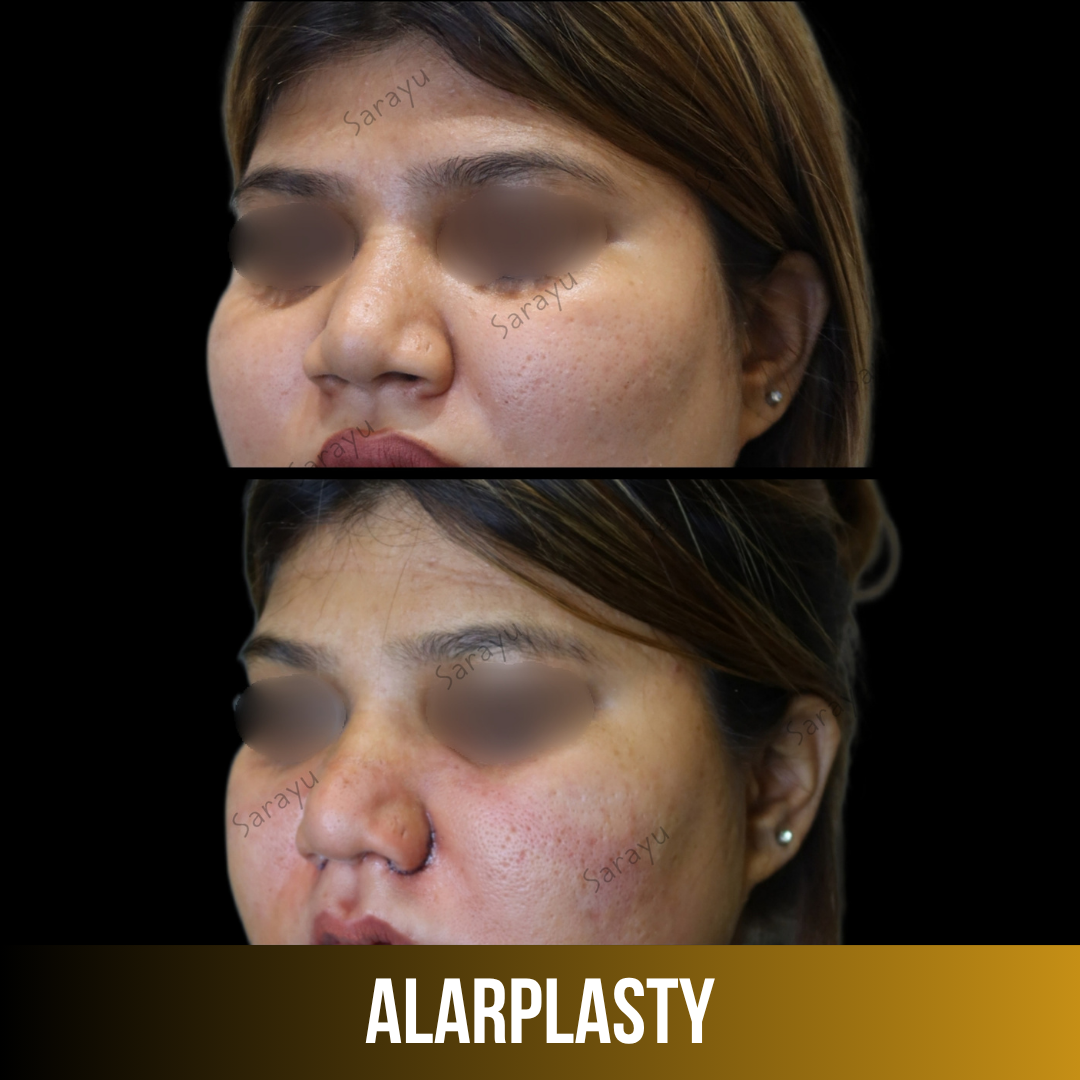
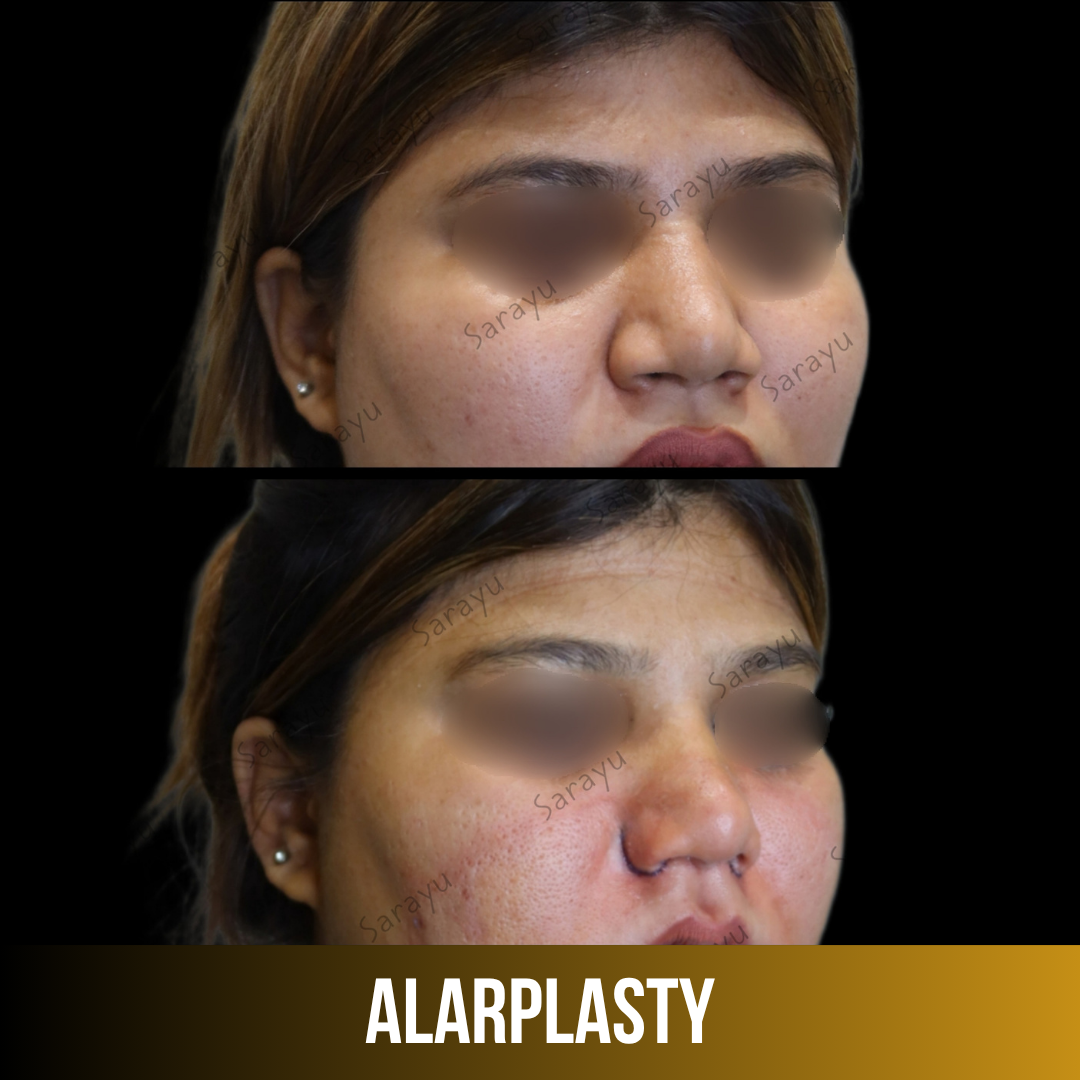
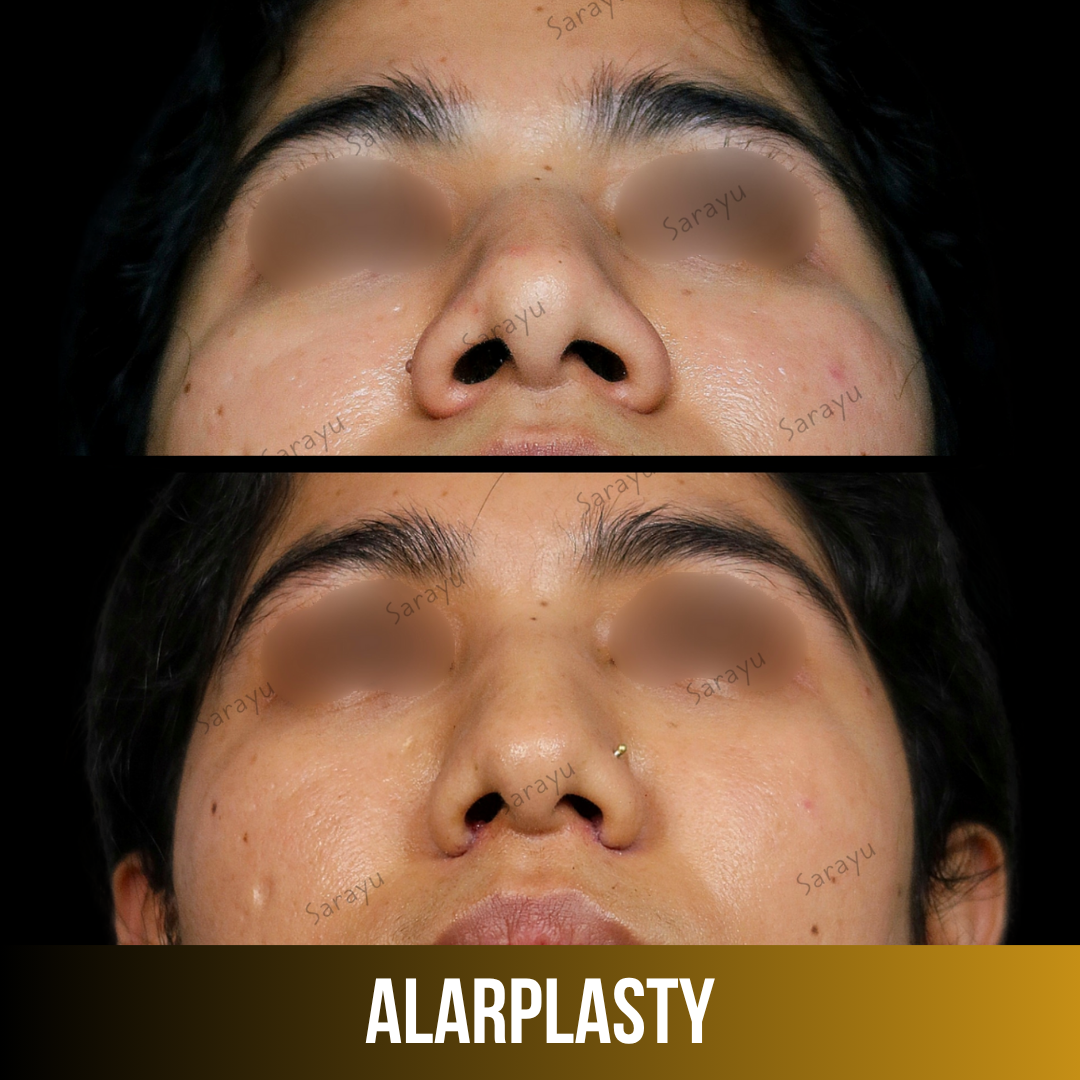
Alarplasty (Nostril Reduction) Treatment in Delhi
Quick answer : Alarplasty — also called nostril reduction surgery or alar base reduction — narrows wide or flared nostrils by removing a few millimetres of tissue at the base of the nose. At Sarayu Clinics, Greater Kailash-1, it is a 45–60 minute procedure under local anaesthesia, costs Rs 40,000–Rs 80,000, hides its scar in the natural nose-cheek crease, and lets most people return to work within 5–7 days. Results are permanent.
If you have ever liked your nose in the mirror but not in photographs — especially the ones taken with flash, straight on, mid-smile — the alar base is usually the reason. The nostrils sit at the widest, most light-catching part of the nose, and when they flare or spread wider than the eyes’ inner corners, they pull attention from every other feature. It is a small anatomical detail with an outsized effect, which is exactly why the fix is also small: not a full nose job, just a precise adjustment at the base.
I am Dr. Adarsh Tripathi , facial plastic and maxillofacial surgeon at Sarayu Clinics, Greater Kailash-1, and alarplasty is one of the procedures I am asked about most. On this page: what the surgery changes and what it cannot, the techniques I use and why, the real recovery week by week, honest risks, cost, and how it compares with rhinoplasty and non-surgical options — so you arrive at your consultation already knowing the right questions.
Alarplasty, Alar Base Reduction, Nostril Reduction — One Surgery, Many Names
Before anything else, the vocabulary — because it confuses almost everyone who researches this procedure. Alarplasty, alar base reduction, alar trimming, nostril reduction surgery and nostril reshaping all describe the same operation: surgically reducing the width or flare of the nostrils at their base (the “alae”). What it is not: a full rhinoplasty (which reshapes the bridge and tip), and not a tip plasty (which refines only the nasal tip). If a clinic quotes you wildly different prices for “alarplasty” and “nostril reduction”, you are being quoted twice for one procedure.
What Alarplasty Can Change — and What It Cannot
At the alar base, we can adjust several things independently or together:
- Nostril width: the distance across the base, brought closer to the classic guide of the width between your inner eye corners.
- Alar flare: the outward curve of the nostril walls — the part that widens noticeably when you smile.
- Nostril sill: the floor of the nostril opening, narrowed when the openings themselves are large.
- Asymmetry: when one nostril sits wider, rounder or lower than the other.
What alarplasty cannot change: the bridge, a hump, the tip’s shape or projection, or breathing problems from a deviated septum. Those belong to rhinoplasty or nose augmentation — and part of my job at consultation is telling you plainly which category your concern falls into, even when the answer is the bigger procedure.

Benefits of Alarplasty
- A subtle change with a big effect: people notice you look better in photos; they rarely guess why.
- Local anaesthesia, home the same day: no general anaesthesia, no hospital stay — 45–60 minutes in a sterile minor-OT.
- Permanent result: the removed tissue does not grow back; one careful surgery lasts a lifetime.
- A scar designed to disappear: the incision sits in the natural crease where nostril meets cheek — research confirms this placement heals the least visibly (more under Risks).
- Short, predictable recovery: stitches out at 5–7 days; most desk-workers are back within a week.
- Plays well with other procedures: commonly combined with rhinoplasty, tip work or chin augmentation in a single plan for overall balance.
Who Is a Good Candidate for Nostril Reduction?
Alarplasty suits you if:
- You are happy with your bridge and tip but bothered by nostril width, flare or asymmetry.
- Your nostrils widen noticeably when you smile, or spread wider than your inner eye corners at rest.
- You want a refinement that reads as “you, on a good day” — not a different nose.
- You are in good health, with facial growth complete (generally 17–18+; we assess younger cases individually [confirm clinic age policy]).
We advise waiting or a different plan if:
- Your main concern is the bridge, hump, tip or breathing — that is rhinoplasty territory, and doing alarplasty first can complicate it.
- There is an active skin infection or acne flare at the nasal base — we treat that first.
- You smoke and cannot pause around surgery — nicotine measurably slows this kind of healing.
- The concern feels all-consuming out of proportion to what others see — we will talk honestly before operating; good surgeons decline surgeries that will not bring peace of mind.
The Techniques We Use — and Why Conservative Wins
Alarplasty is often called millimetre surgery, and the technique must match your anatomy, not a template. The three established approaches — described in a 20-year, 124-patient study that remains the reference algorithm — are the alar wedge excision (a sliver of the flared wall is removed, for flare), the nasal sill excision (tissue from the nostril floor, for wide openings), and combinations with V-Y closure where both need addressing. At your consultation I measure, photograph and mark exactly which pattern your nose needs.
One principle governs everything: tissue removed from the alar base cannot be put back. That is why I plan conservatively — it is far better to refine slightly and keep a natural look (with the rare option of a small touch-up) than to over-resect and create pinched, notched nostrils that need complex reconstruction. When you compare surgeons, ask each one how they avoid over-resection; the answer tells you most of what you need to know.

Nostril Reduction Surgery in Delhi: Step by Step
Step 1 — Consultation, measurement and imaging
We analyse your nose against your whole face — base width versus inner-eye distance, flare at rest and while smiling, sill size, symmetry — and use photographs and digital imaging so you can see the planned change before agreeing to it. You get the technique, the millimetres, and the written cost.
Step 2 — Marking and local anaesthesia
On surgery day, the excision pattern is marked with you sitting upright (gravity matters), then the base is numbed with local anaesthetic. You are awake, comfortable and can speak with us throughout; most patients say the injection is the only part they felt.
Step 3 — Excision and closure (45–60 minutes)
The planned slivers of tissue are removed and the incisions closed with fine sutures placed to sit invisibly inside the alar crease. Both sides are measured and matched before closure.
Step 4 — Home the same day
A small dressing, simple pain relief, written aftercare, and you are driven home within the hour. No hospital stay, no drains, no packing.

Recovery Timeline After Alarplasty
Stage | What to expect |
Day 0–1 | Mild soreness and swelling at the base; manageable with prescribed tablets. Sleep with your head elevated. |
Days 2–4 | Swelling peaks then starts settling; slight bruising possible. Desk work from home is fine; avoid bending and lifting. |
Days 5–7 | Sutures removed at the clinic. Most patients return to office and social life now — makeup can cover residual pinkness from day 7. |
Weeks 2–4 | Swelling largely gone; the new width is visible. Avoid heavy exercise until week 2–3 and glasses resting on the area if advised. |
Months 3–6 | The scar matures from pink to a fine pale line inside the crease. Daily sunscreen and silicone gel [if prescribed] speed this along. |
Scar care matters more than most clinics admit: keep the line protected from sun for three months, do not pick healing crusts, and use the silicone-based gel we recommend. In the uncommon case a scar stays more visible than expected, refinement options exist — from dermabrasion to formal scar revision — but with correct incision placement they are rarely needed.
Risks, Honestly — and How We Minimise Them
Alarplasty is one of the safest facial surgeries when done well: expect temporary swelling and bruising; infection is rare with basic hygiene and, if it occurs, responds to medication. The risks that actually matter are surgical-judgement risks: a visible scar, nostril-rim notching, asymmetry, and over-resection. Published research is direct about this — a comparative study of incision placement found that hiding the incision precisely in the alar-facial groove gives significantly better scar outcomes, and long-term technique reviews list visible incisions as the most common downside of the procedure overall. In practice, that means three protections: exact incision placement in the groove, conservative millimetre planning, and symmetric measurement before closure. This is also why choosing your alarplasty surgeon in Delhi on price alone is a false economy — revision of an over-resected nostril costs several times the original surgery and never quite matches doing it right once.
Alarplasty Cost in Delhi (2026)
At Sarayu Clinics, alarplasty costs Rs 40,000 to Rs 80,000 [confirm current pricing], with the exact figure fixed in writing after your consultation. Across Delhi, quotes typically run Rs 30,000–Rs 1,00,000 depending on the surgeon’s experience and facility standards. Our quote includes:
Included in your quote | What affects the price |
Surgeon’s fee and local anaesthesia | Complexity — flare-only versus combined wedge + sill work |
Sterile minor-OT and consumables | Whether alarplasty is combined with rhinoplasty or tip work (combined plans are priced together, usually at an advantage) |
Suture removal and scheduled follow-ups | Revision cases (correcting previous surgery elsewhere costs more than primary surgery) |
Post-operative care instructions and scar-care guidance | Consultation fee [insert amount], adjusted against surgery if you proceed |
Alarplasty vs Rhinoplasty vs Tip Plasty vs Liquid Rhinoplasty
| Alarplasty | Full Rhinoplasty | Tip Plasty | Liquid (Filler) Rhinoplasty |
Changes | Nostril width, flare, sill, symmetry | Bridge, hump, tip, overall shape, breathing | Tip shape and projection only | Camouflages bumps, lifts tip visually — adds, never reduces |
Anaesthesia | Local | General | Local or general | Numbing cream |
Time | 45–60 min | 2–3 hours | 1–1.5 hours | 15–30 min |
Downtime | 5–7 days | 10–14 days | 7–10 days | None |
Lasts | Permanent | Permanent | Permanent | 9–18 months |
Delhi cost | Rs 40,000–80,000 | Rs 1,00,000–3,00,000+ | Rs 60,000–1,50,000 | Rs 20,000–50,000 |
Explore the alternatives in depth: rhinoplasty in Delhi , nose augmentation and non-surgical options with dermal fillers . Many patients combine alarplasty with rhinoplasty in one surgery — one anaesthesia, one recovery — or pair it with a chin implant when the profile, not just the nose, is the real goal. As a facial plastic surgeon I plan the face as a whole; the nostrils are one instrument in that orchestra, not the entire score.
Choosing Your Alarplasty Surgeon in Delhi — Why Patients Choose Dr. Tripathi
- Training built for this exact anatomy: as a facial plastic and maxillofacial & Plastic surgeon, Dr. Adarsh Tripathi works on the nasal base, lip and midface every operating week — alarplasty sits at the centre of his field, not the edge of it. 18+ years of experience .
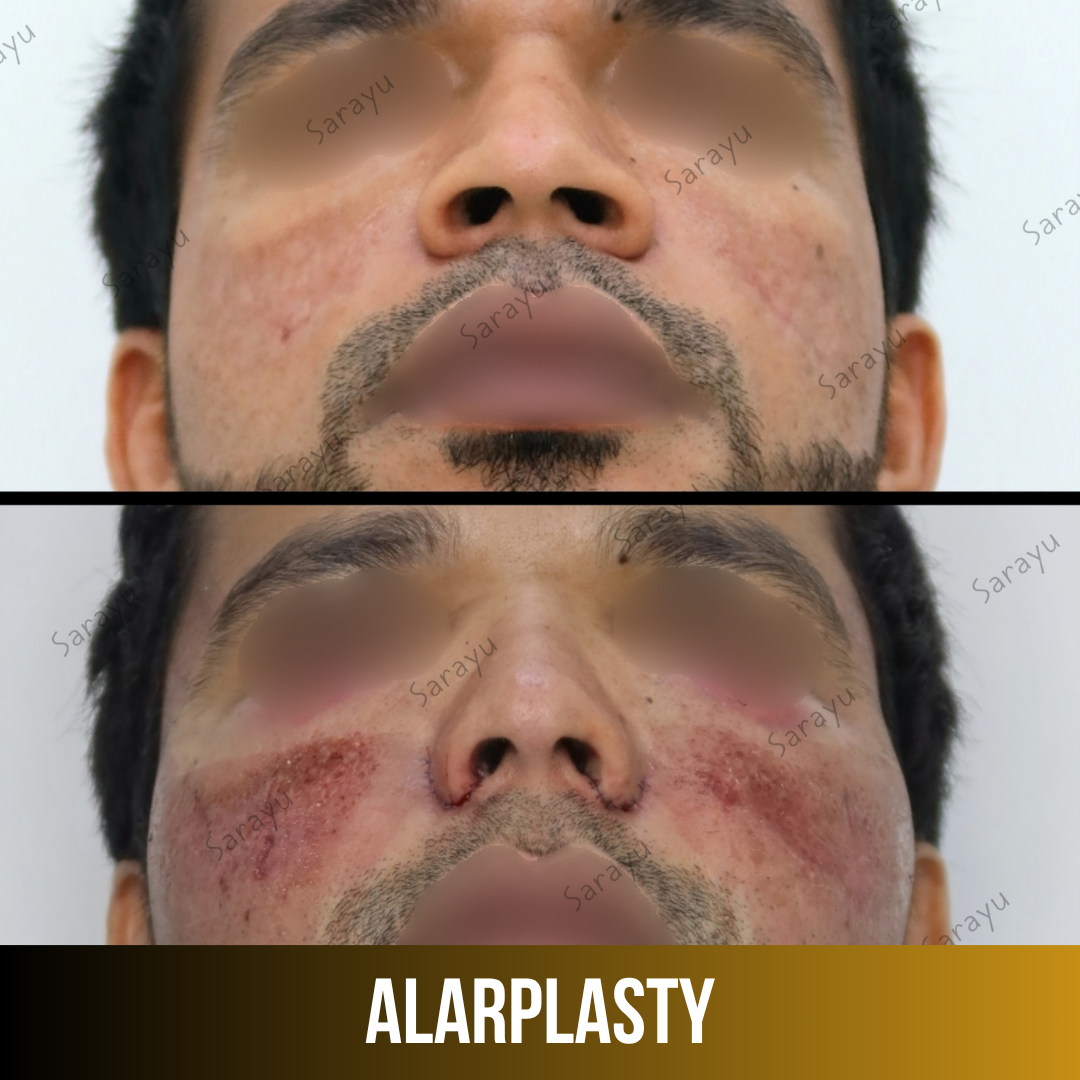
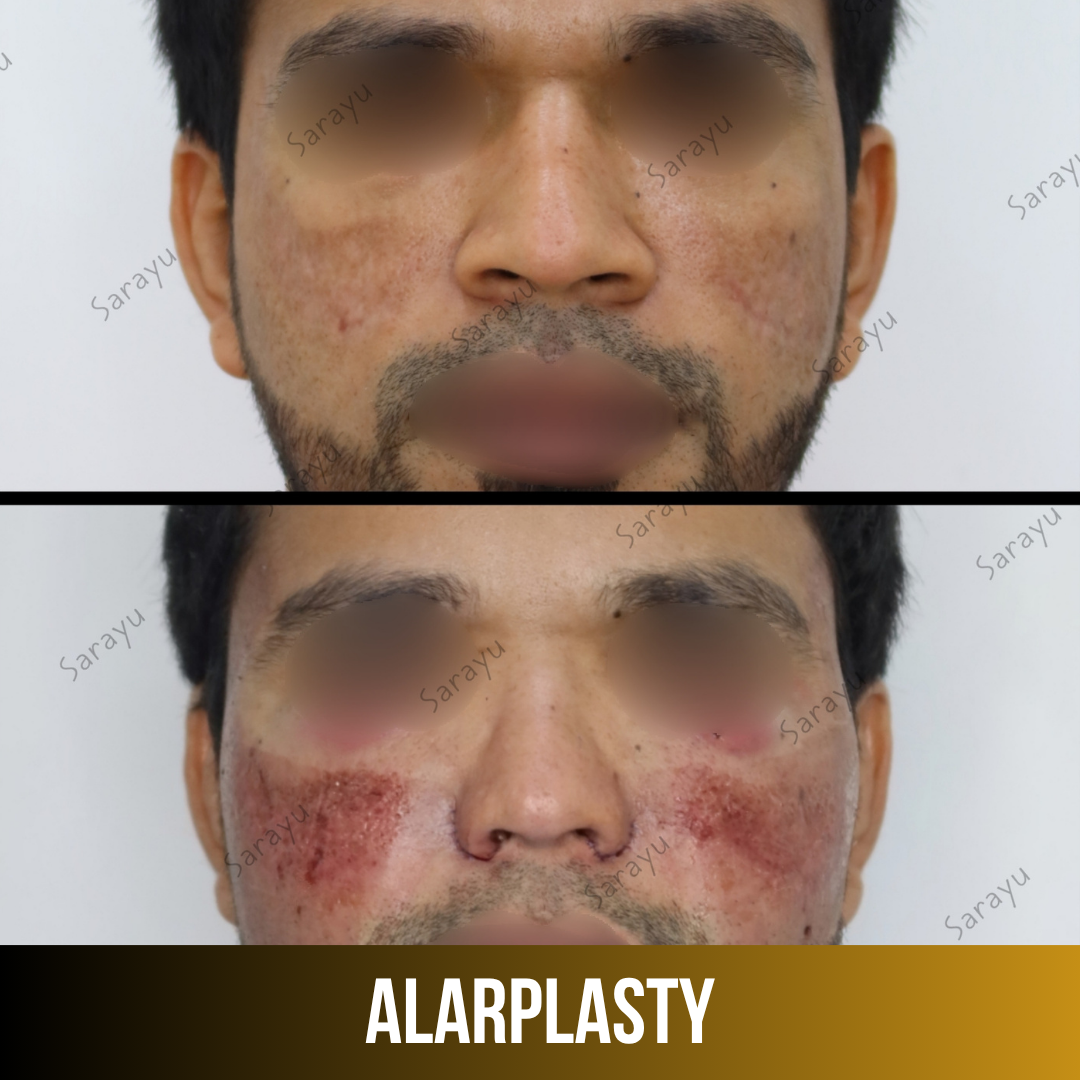
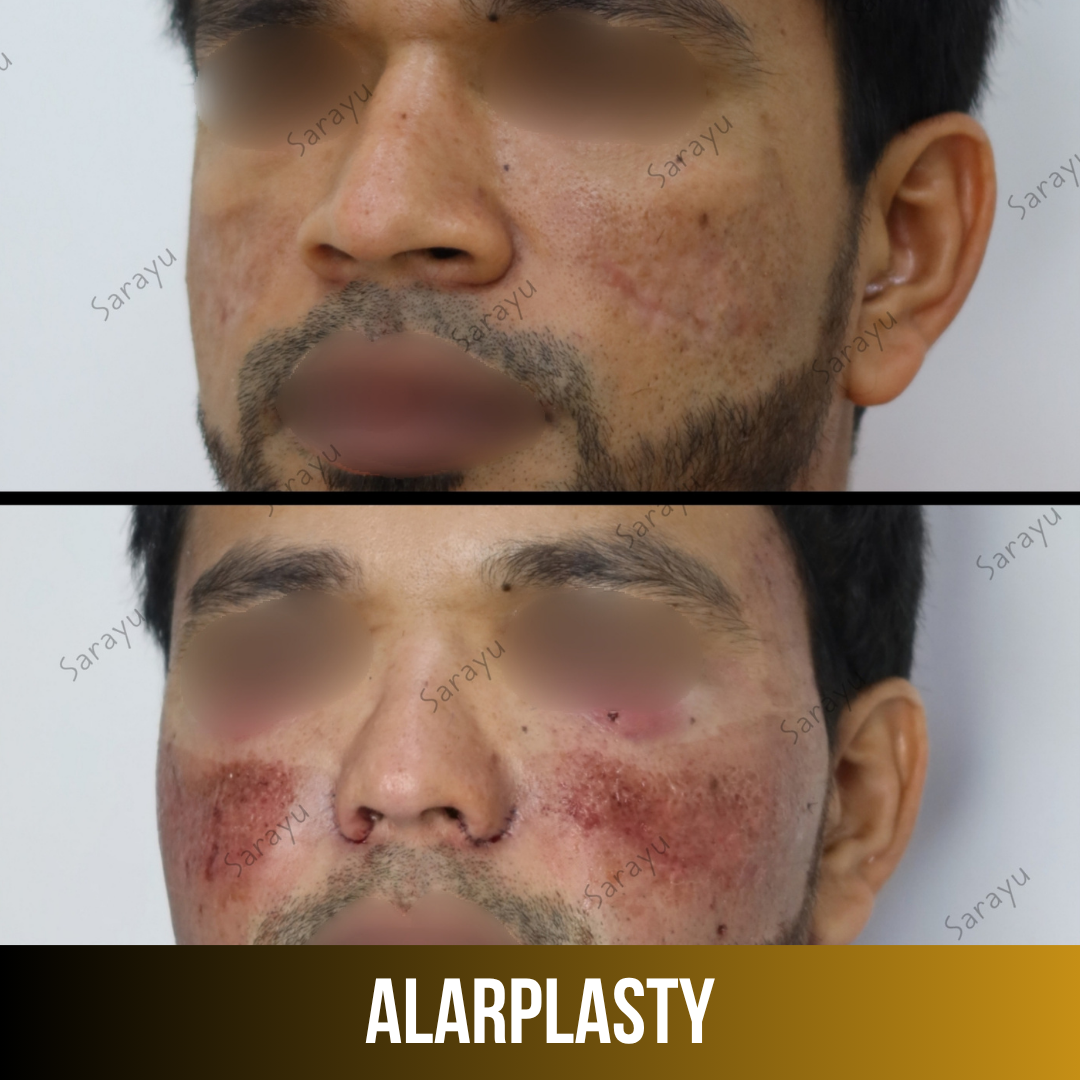
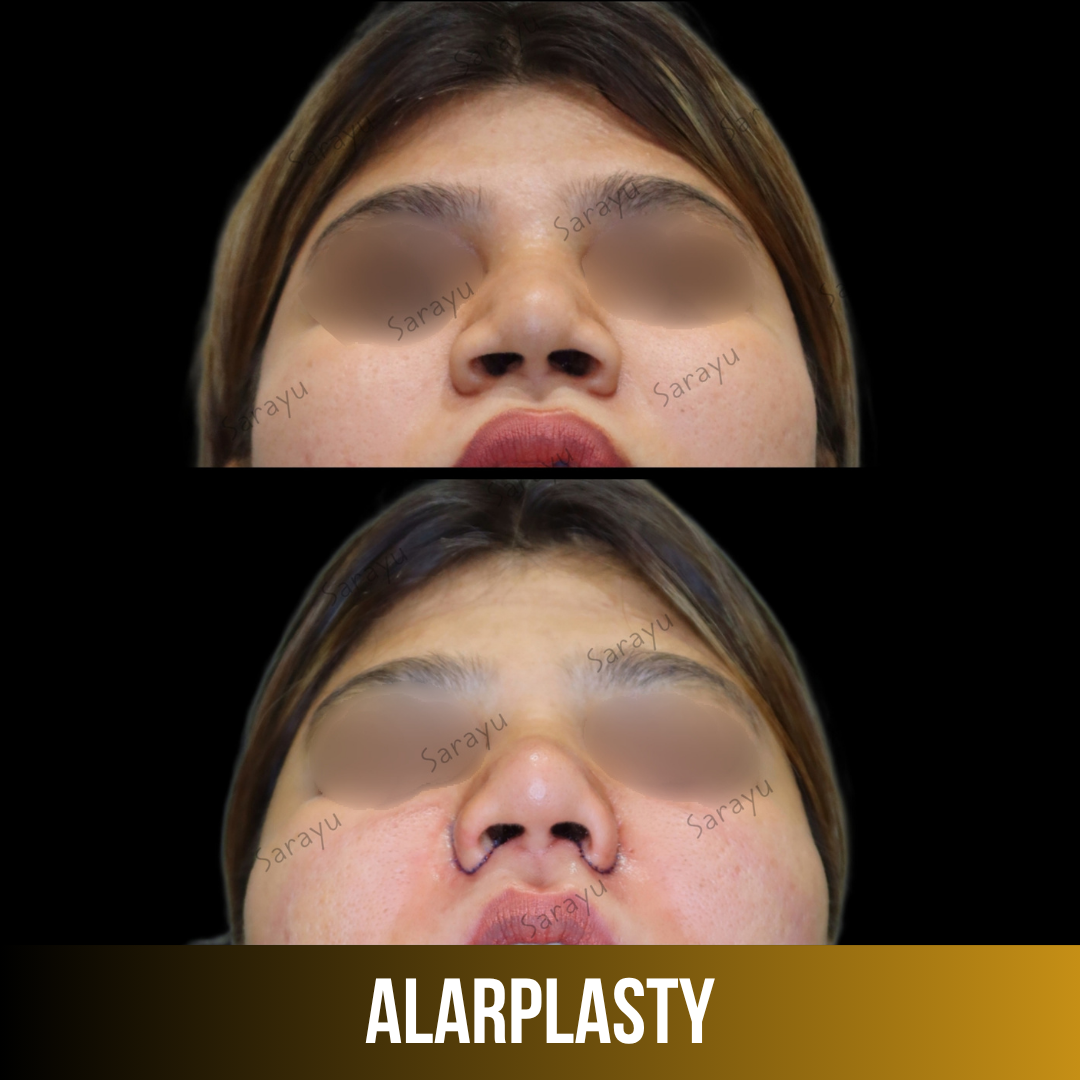
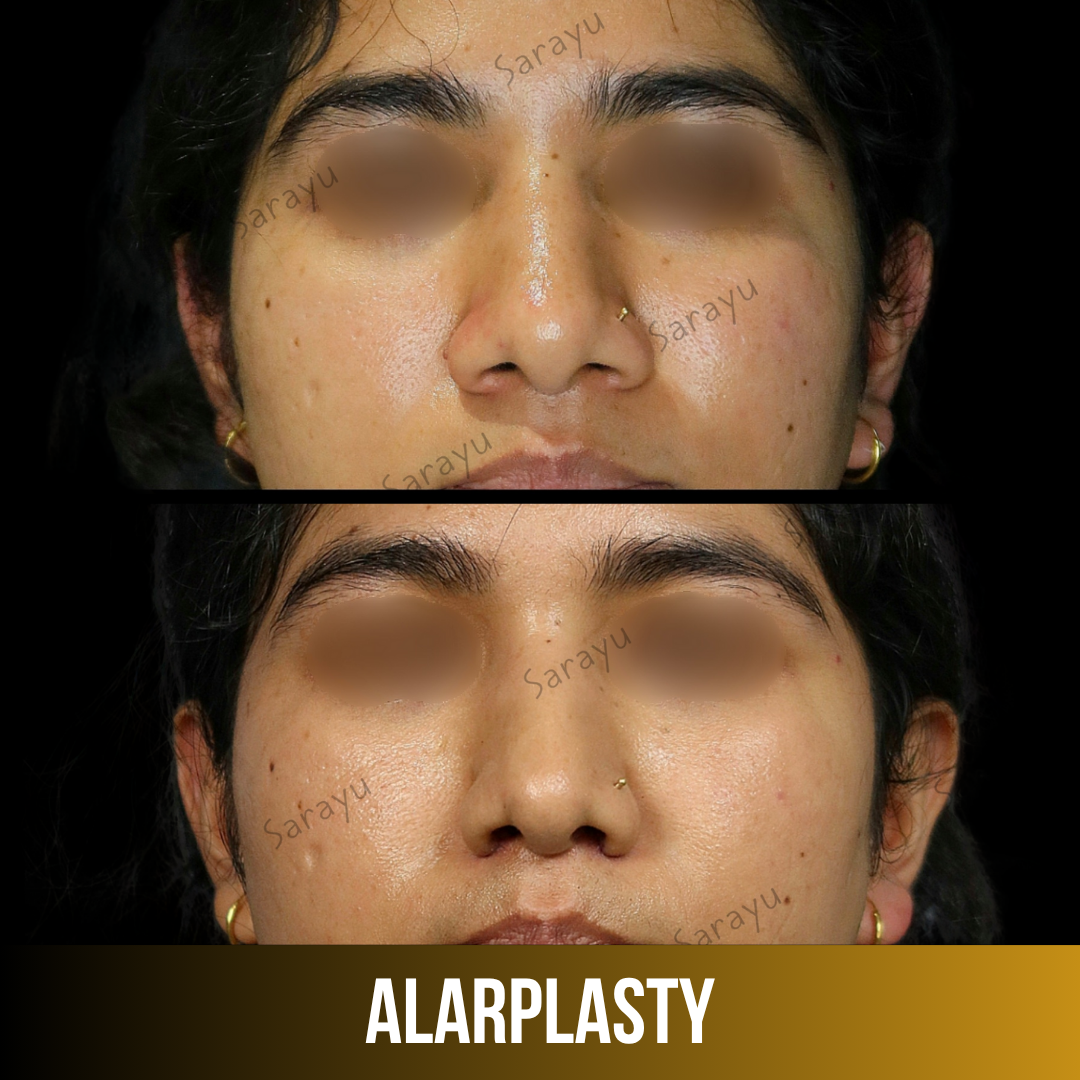
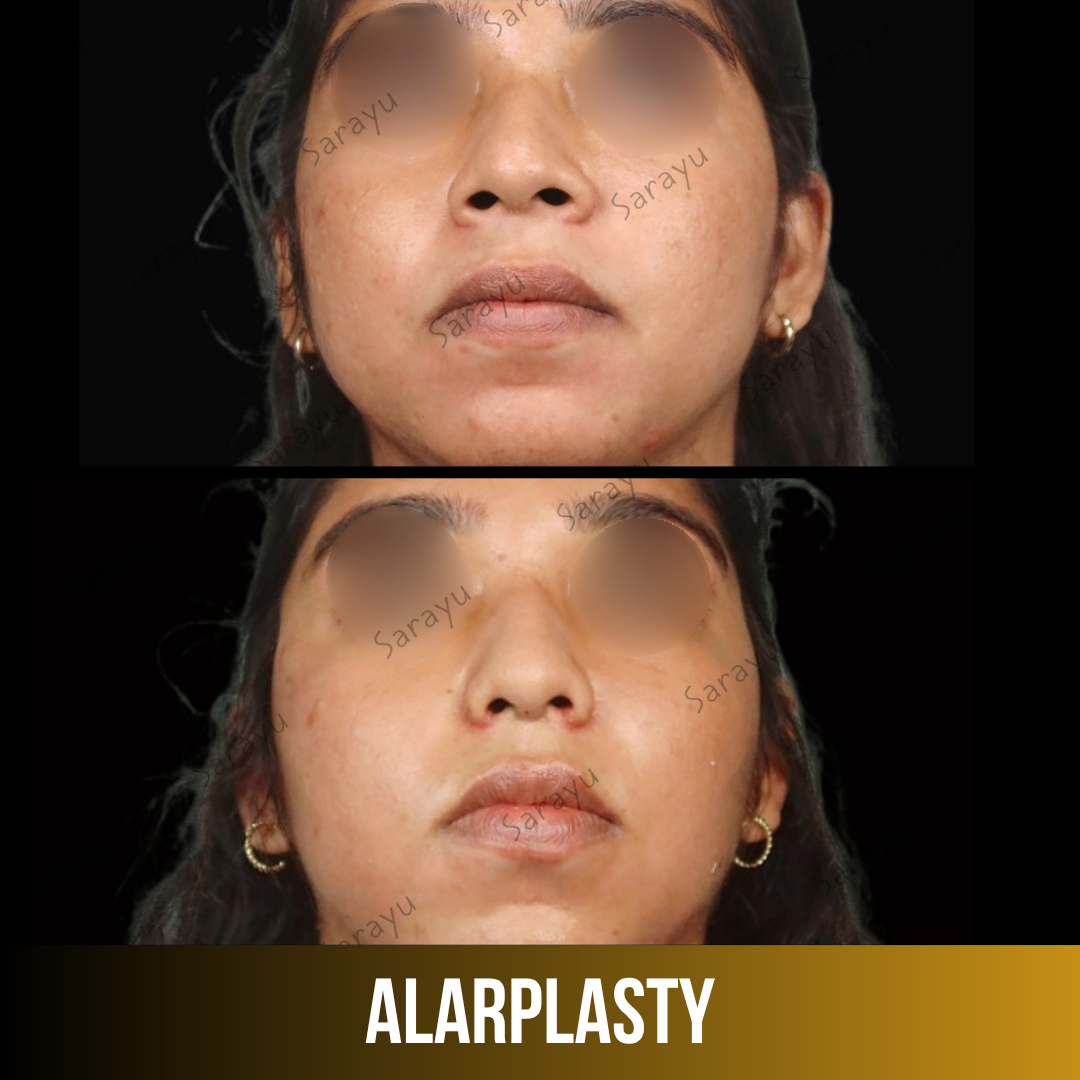
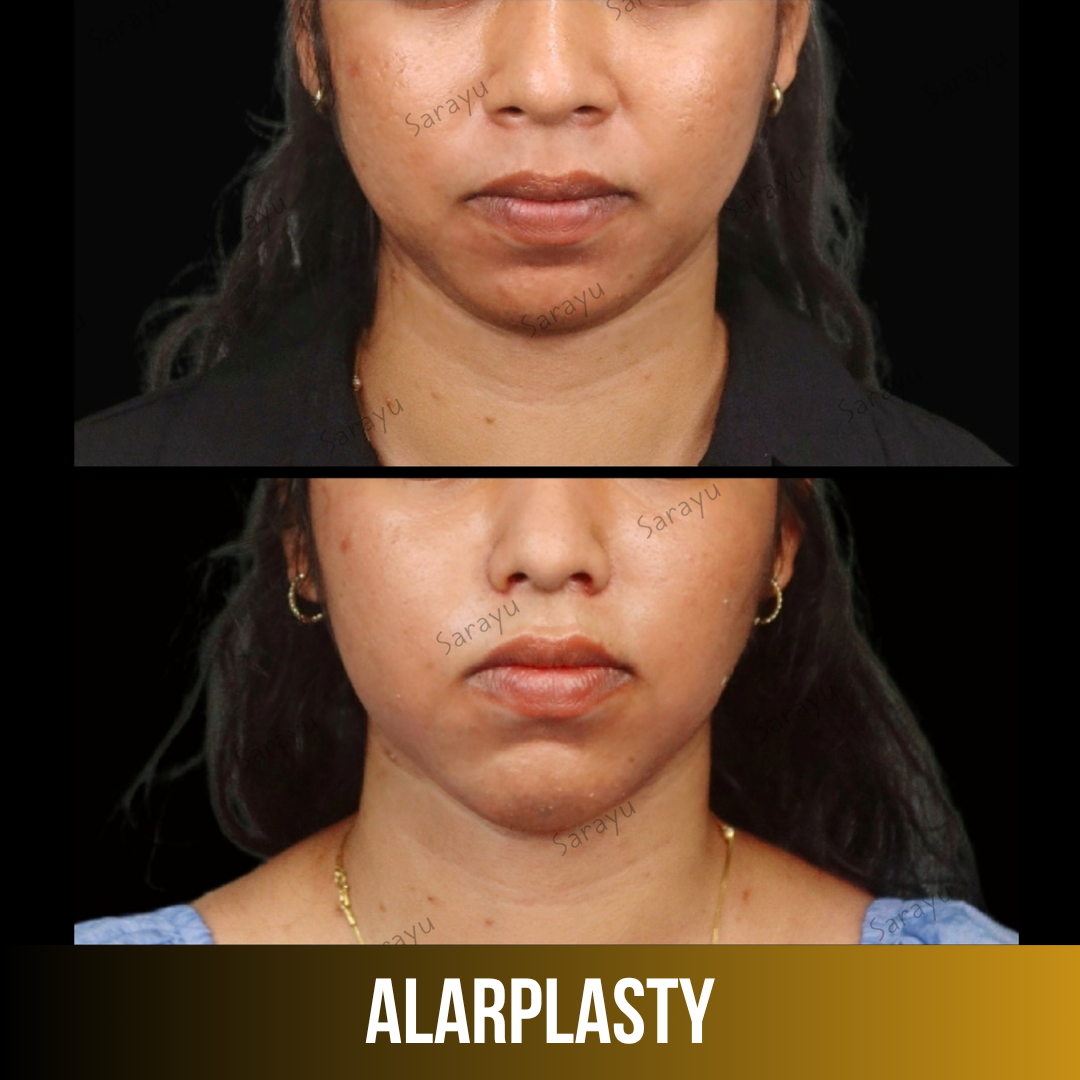
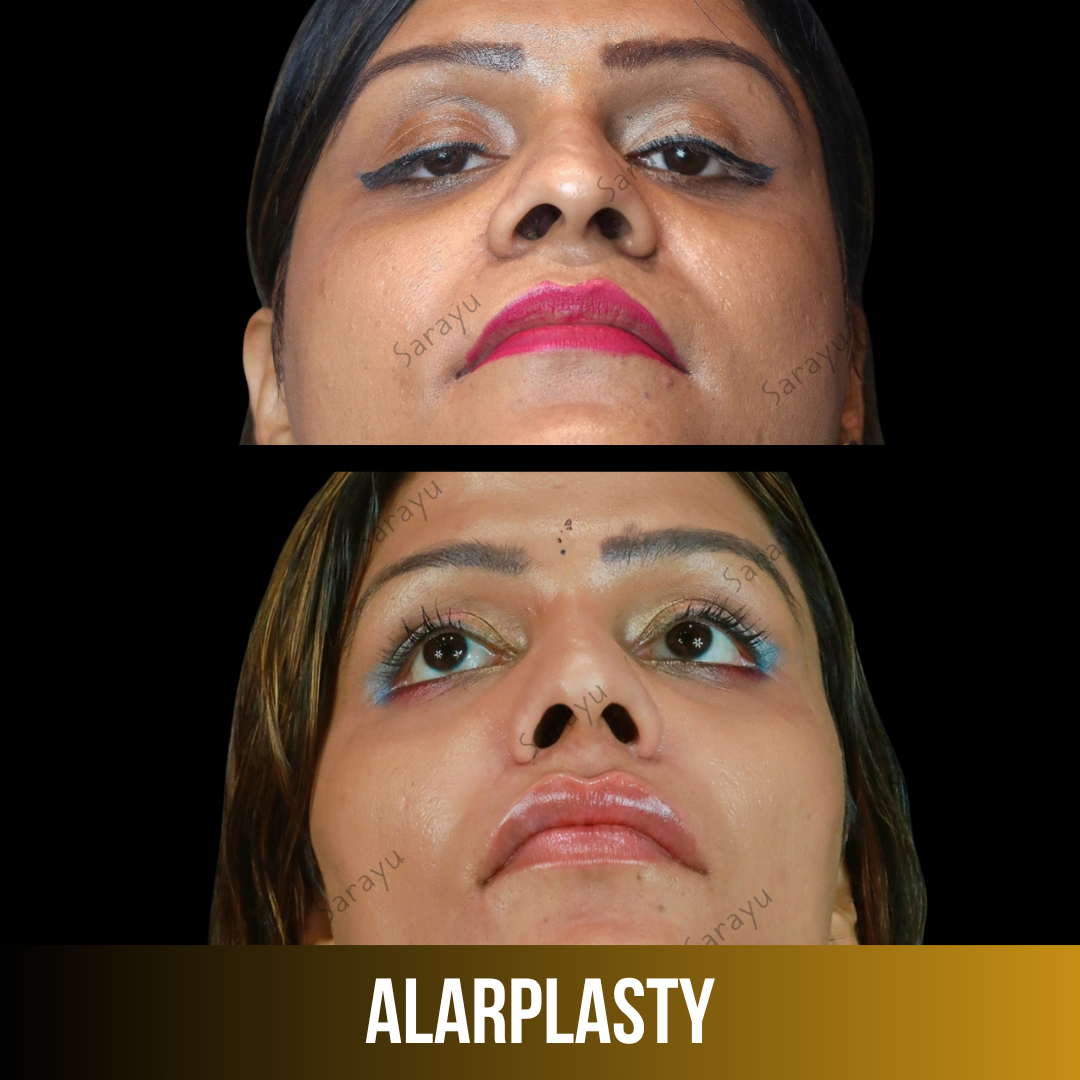
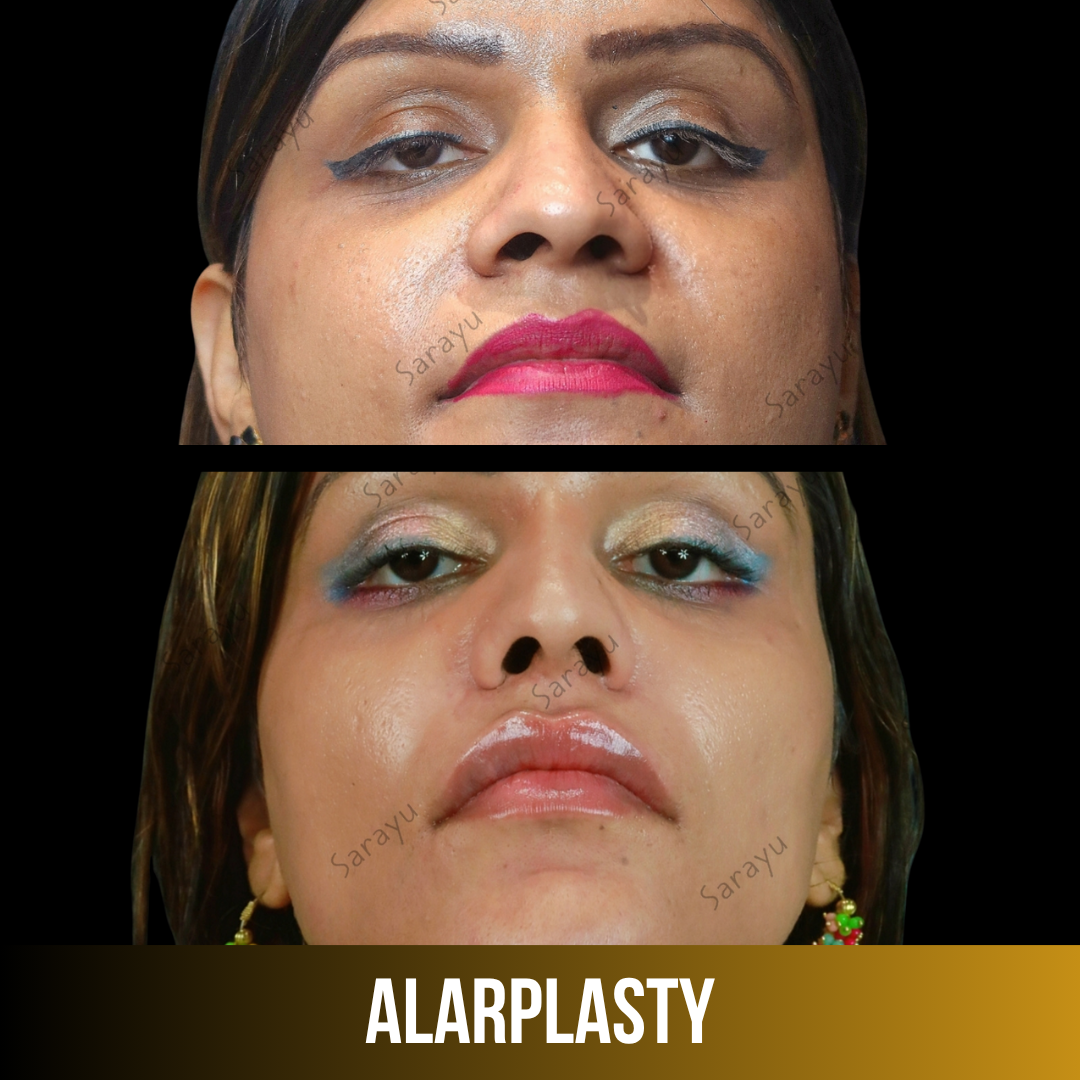
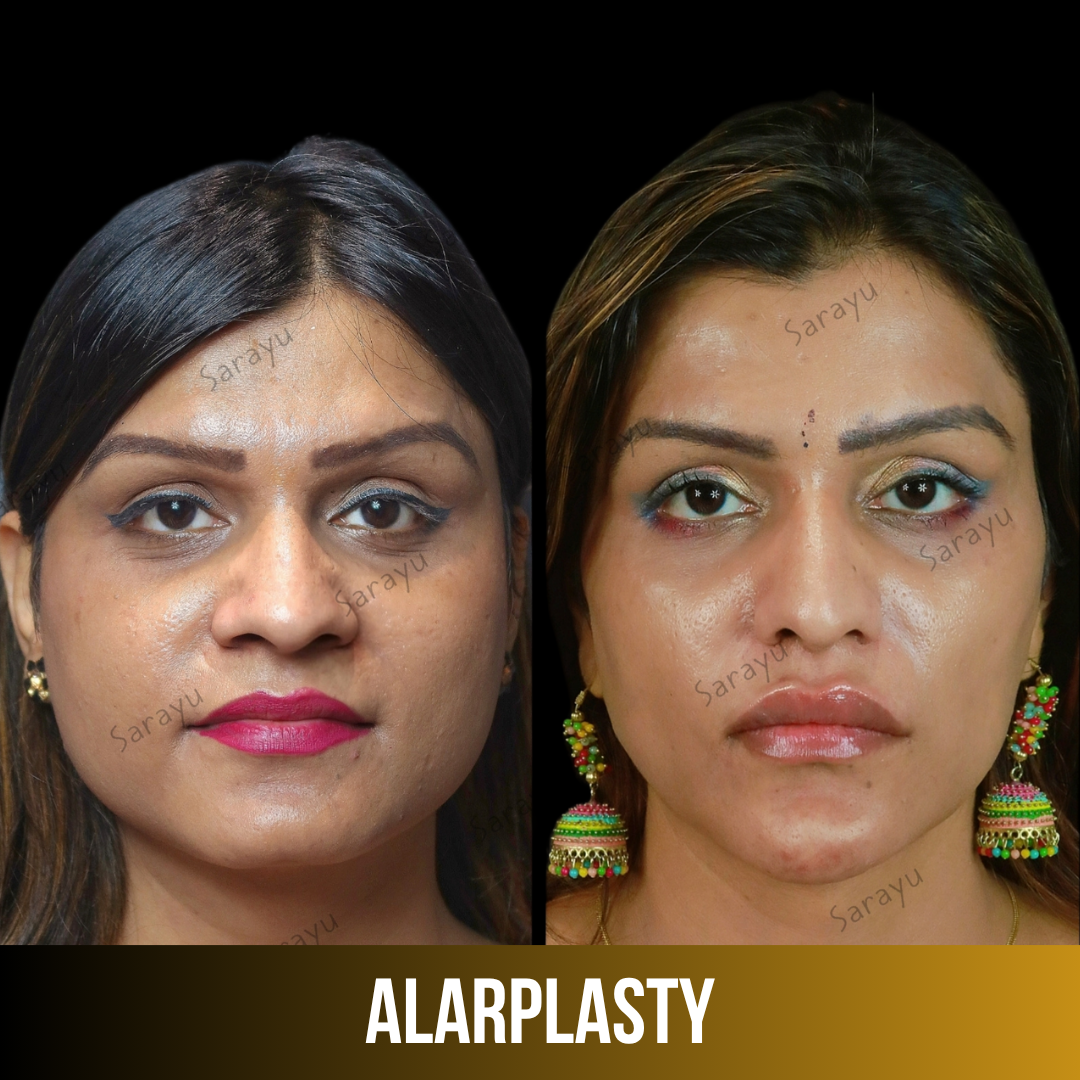
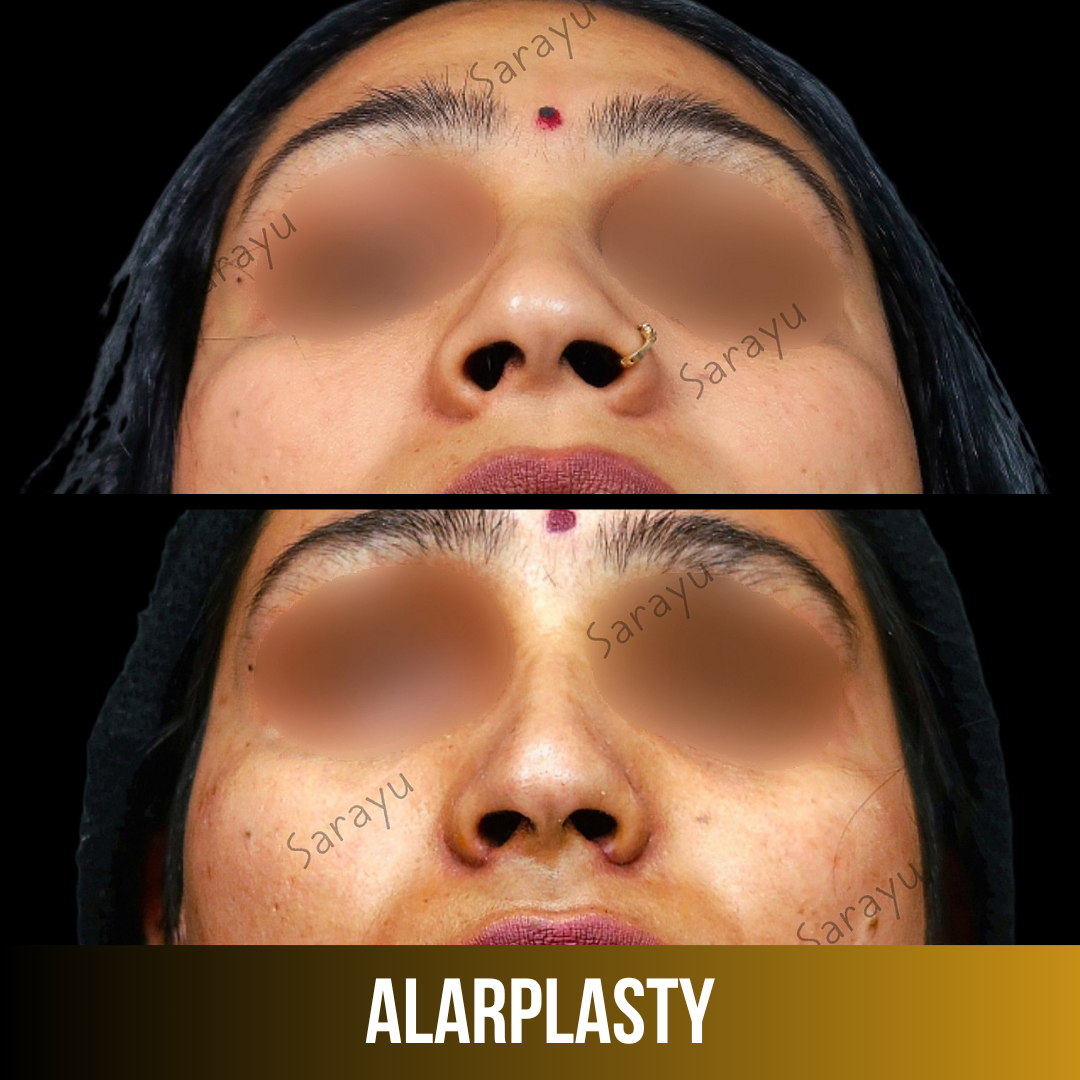
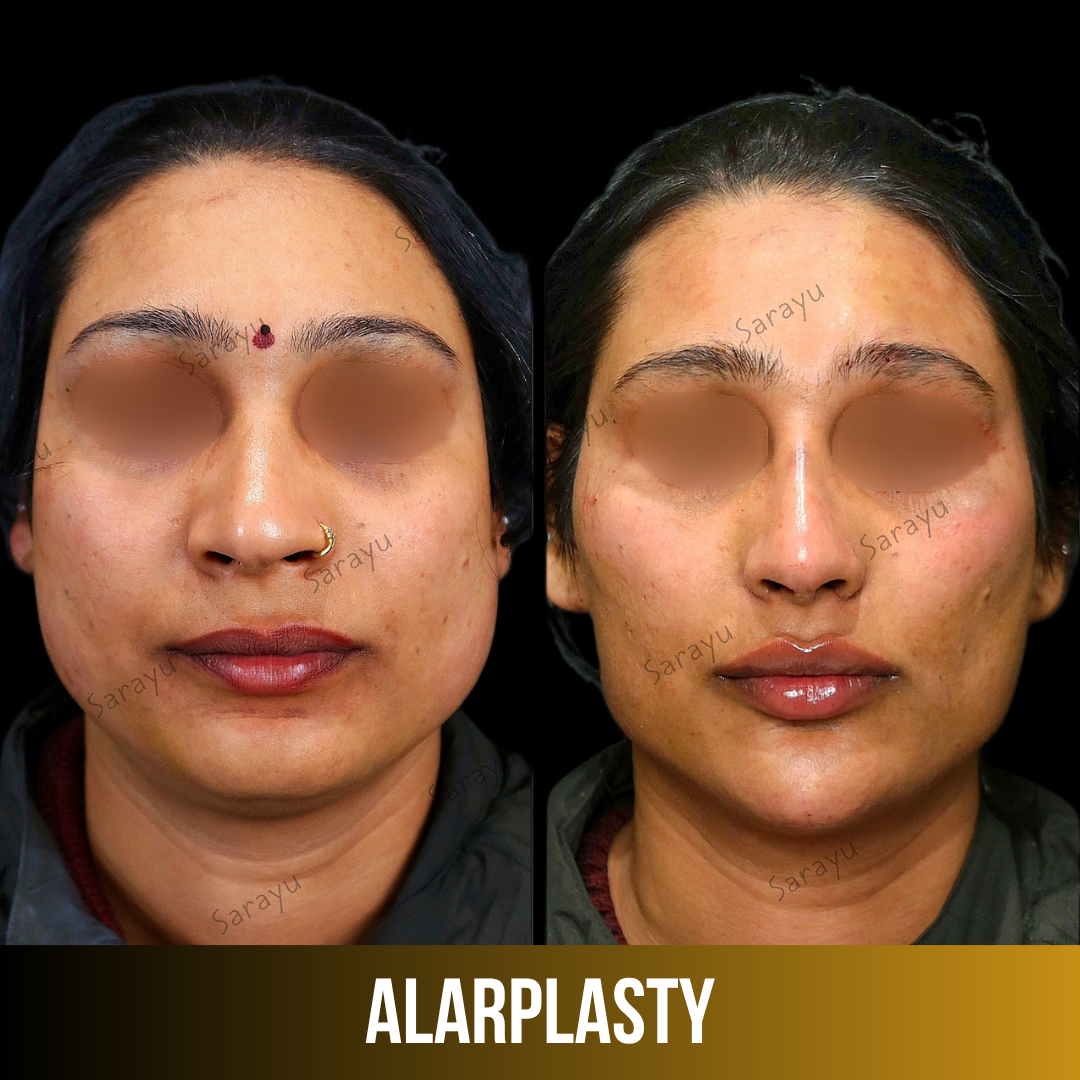
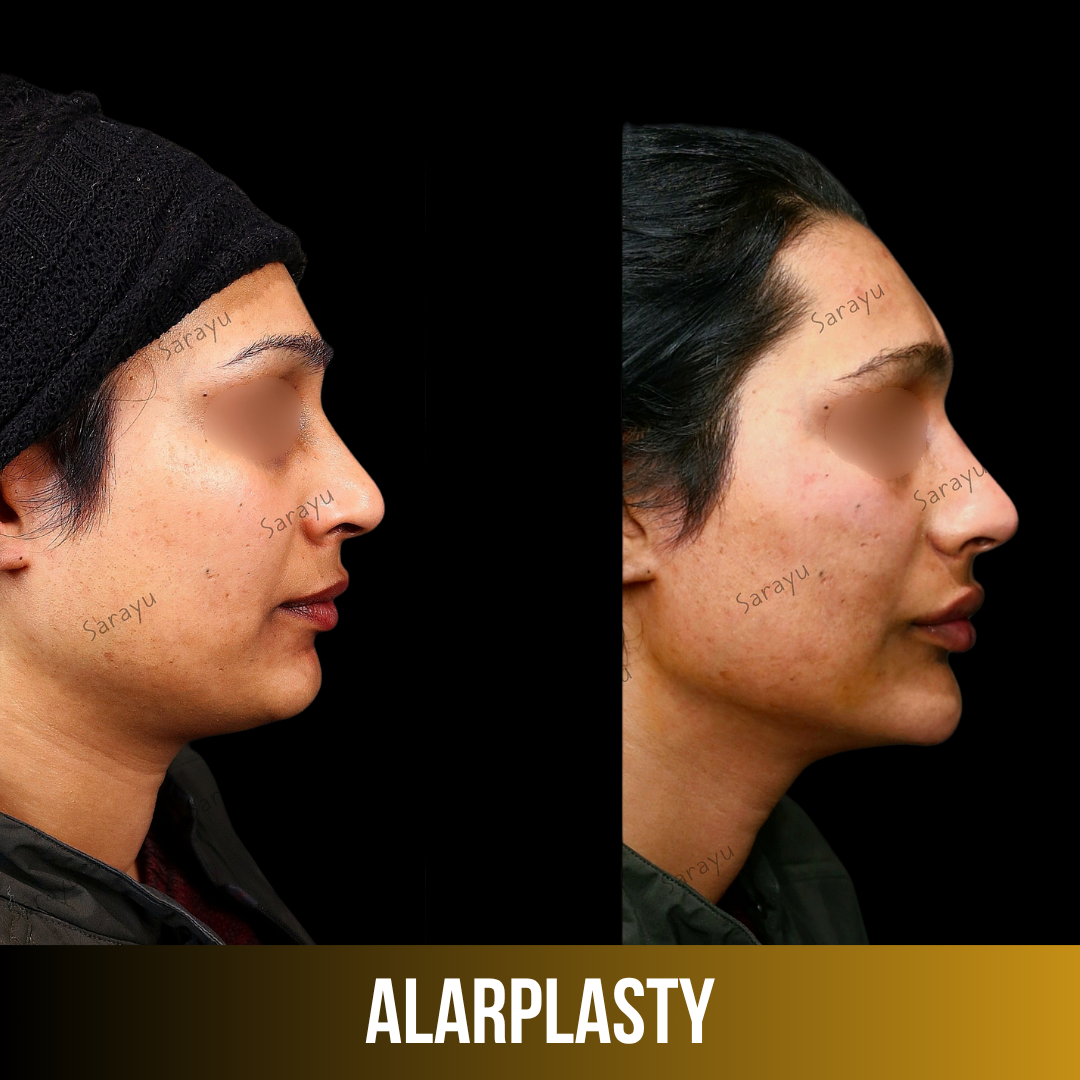
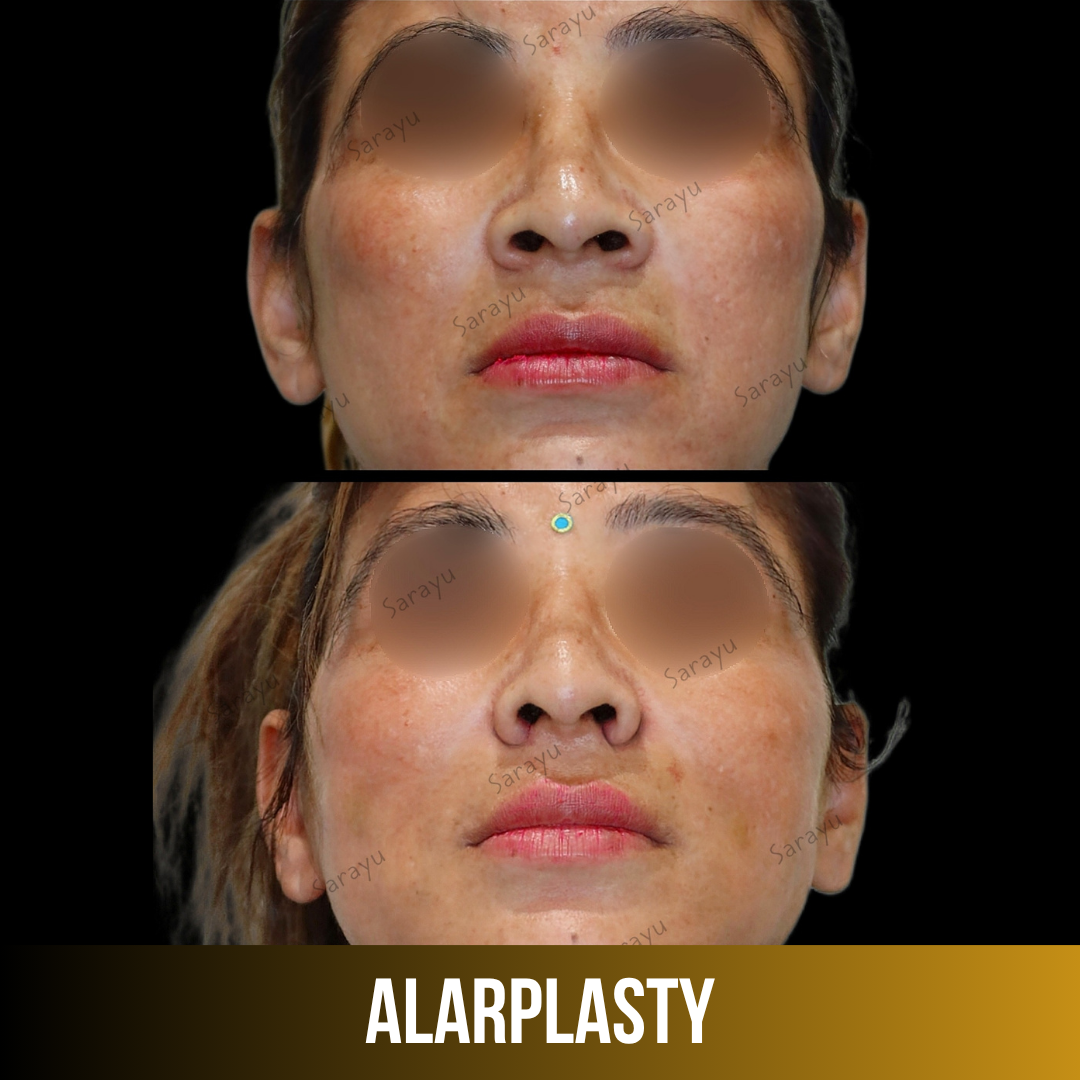
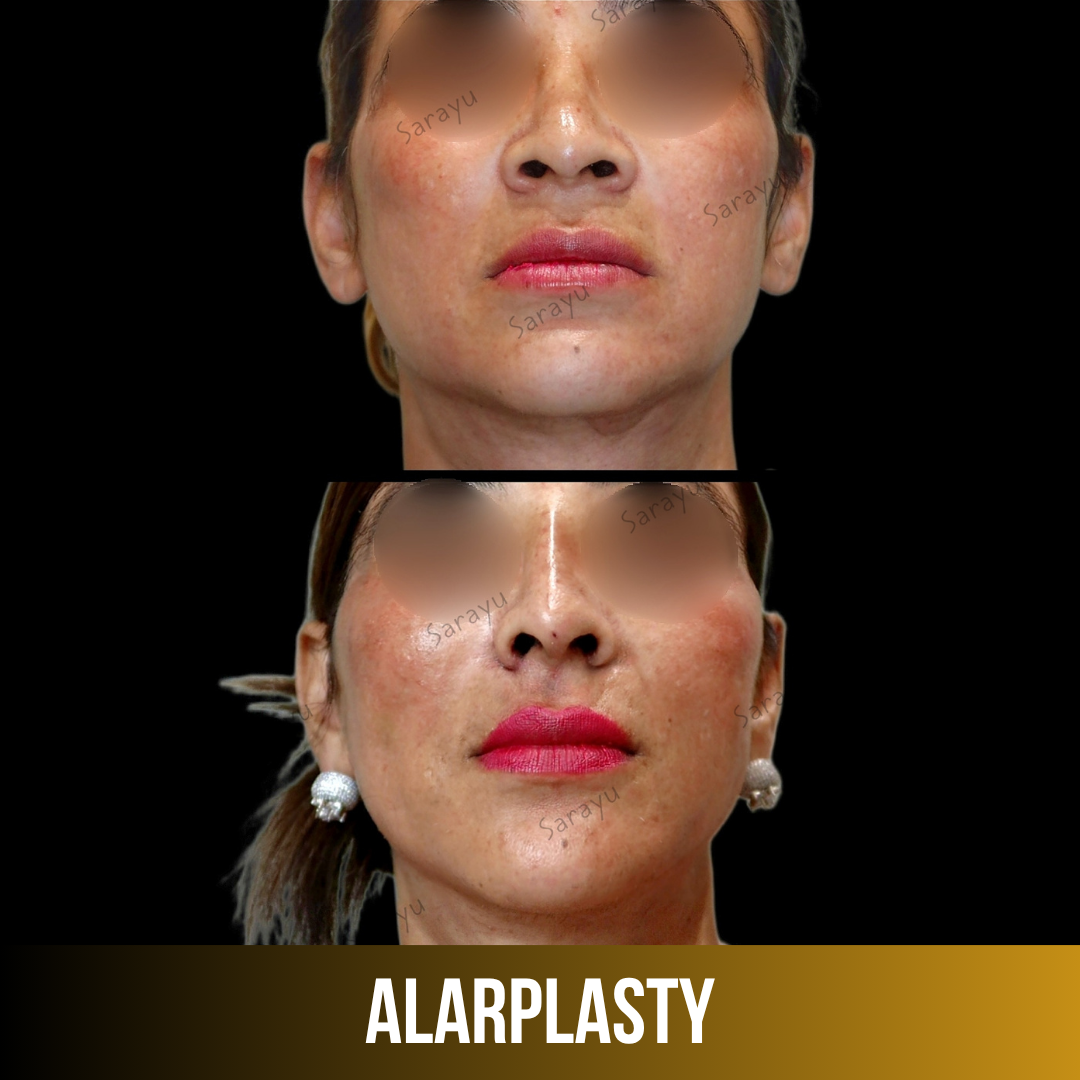
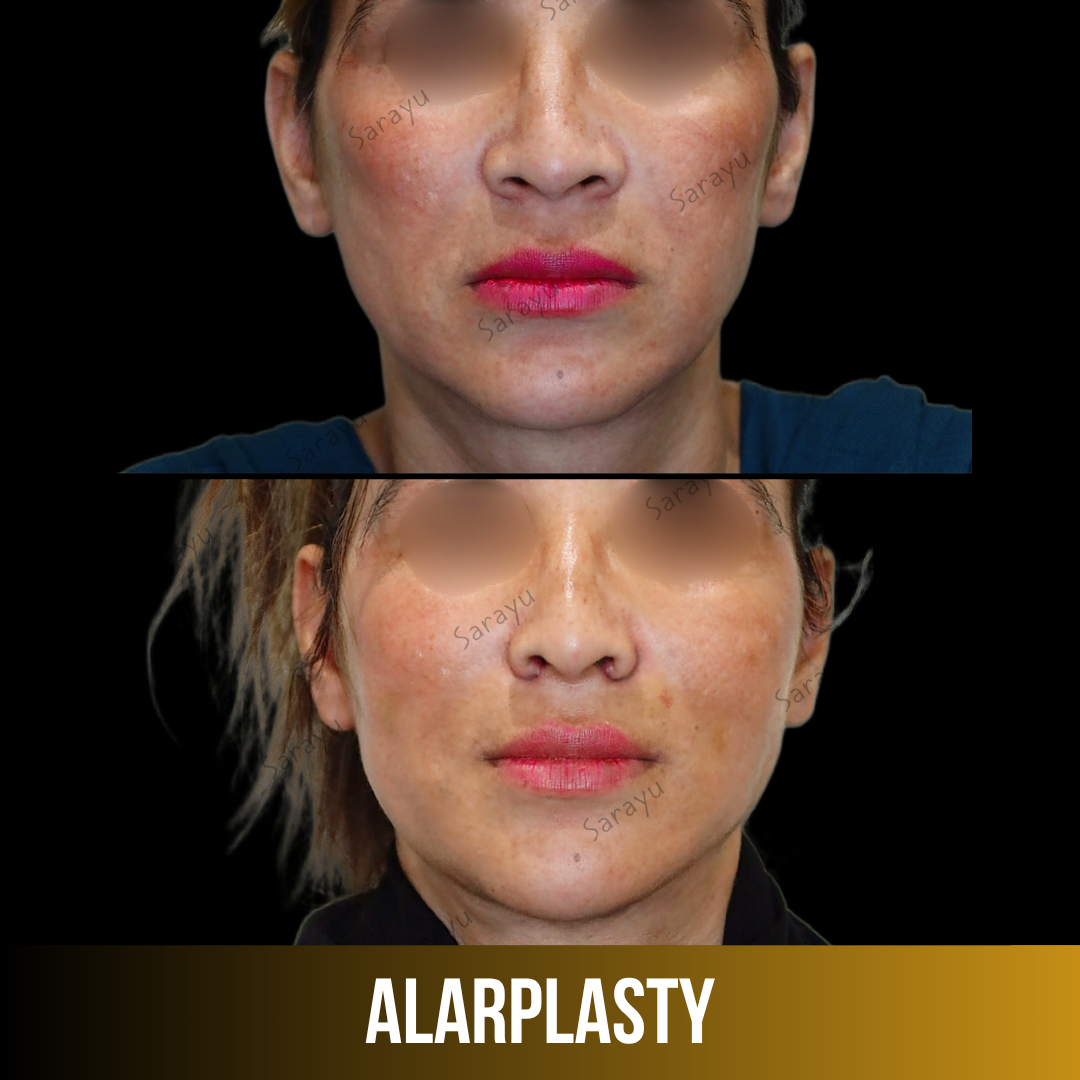
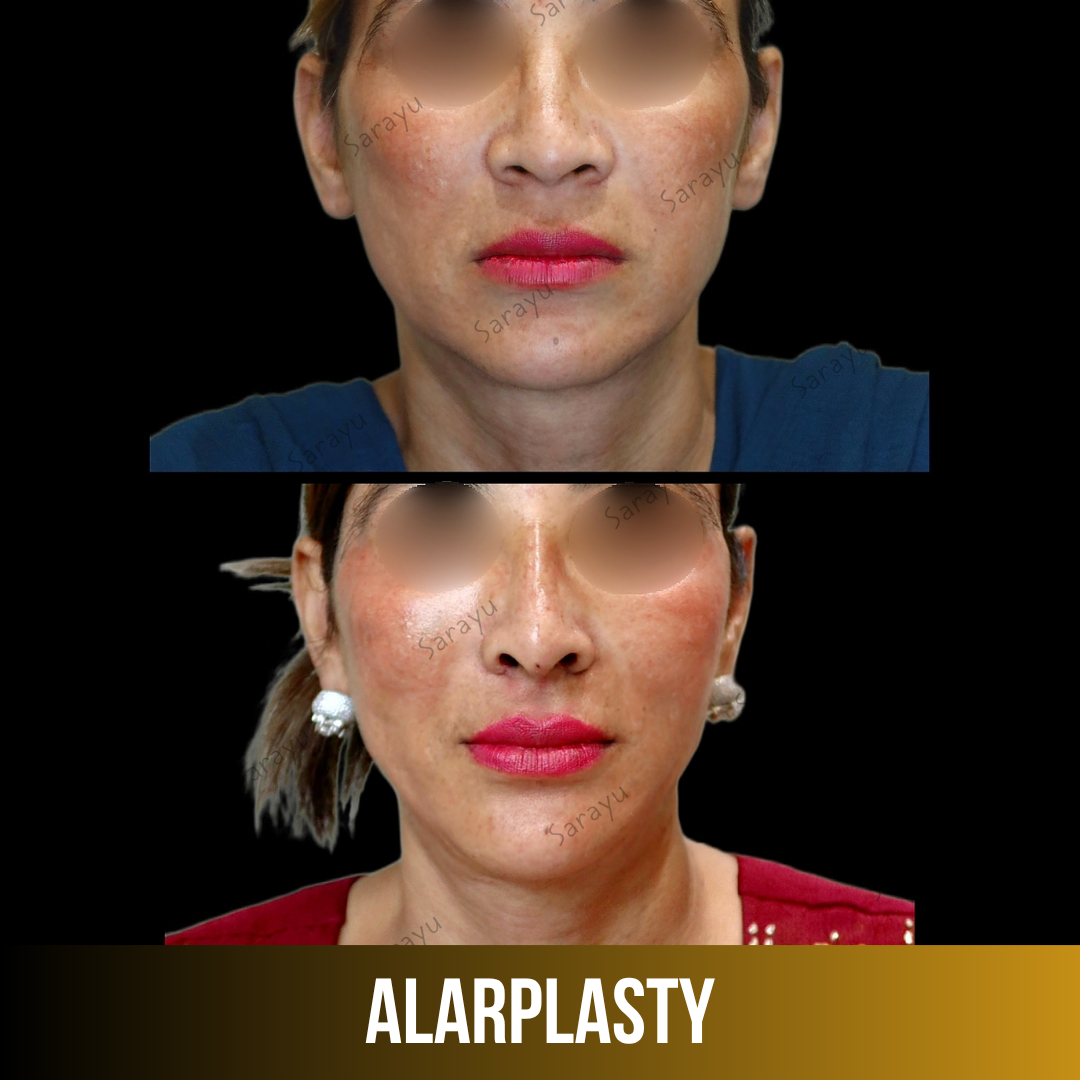
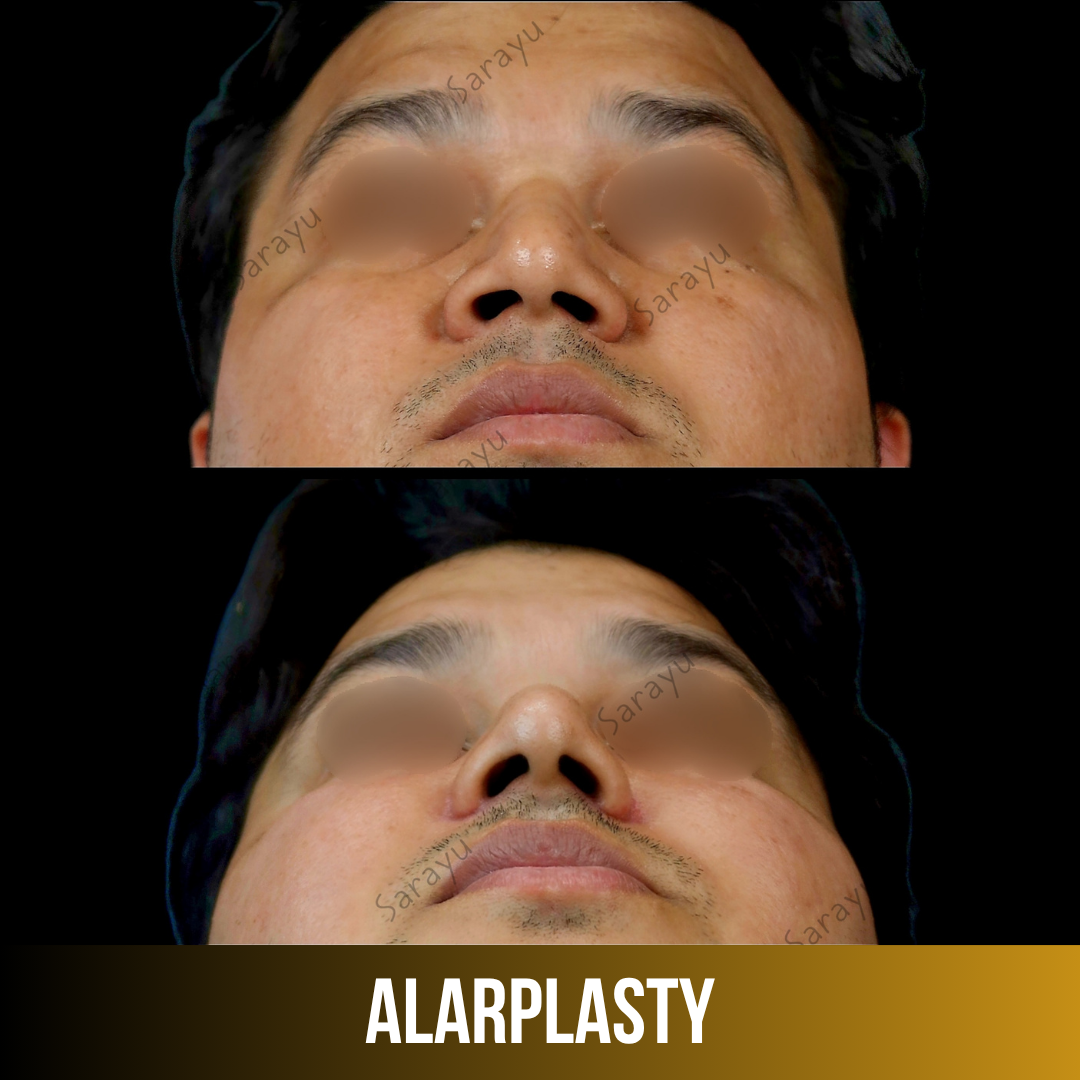
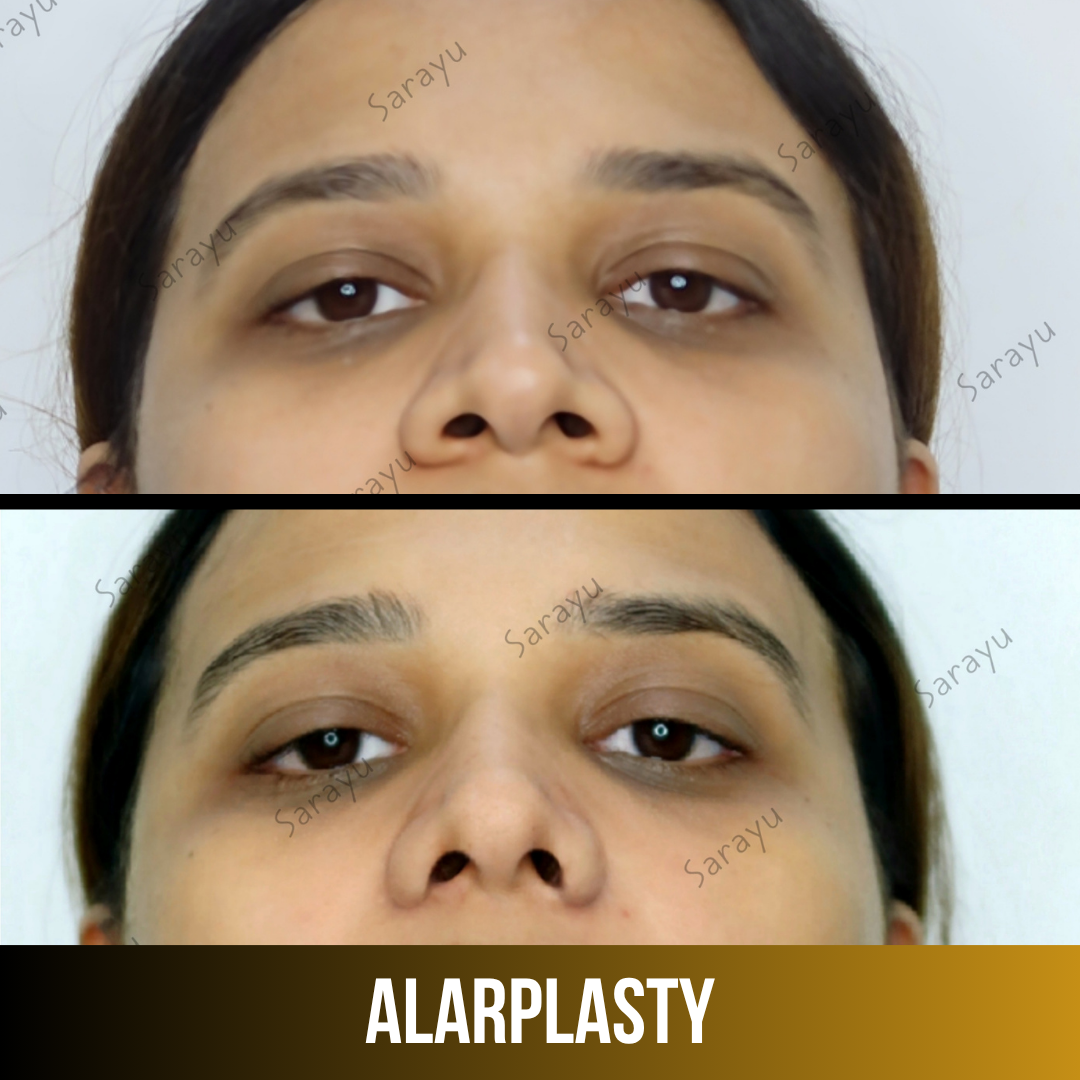
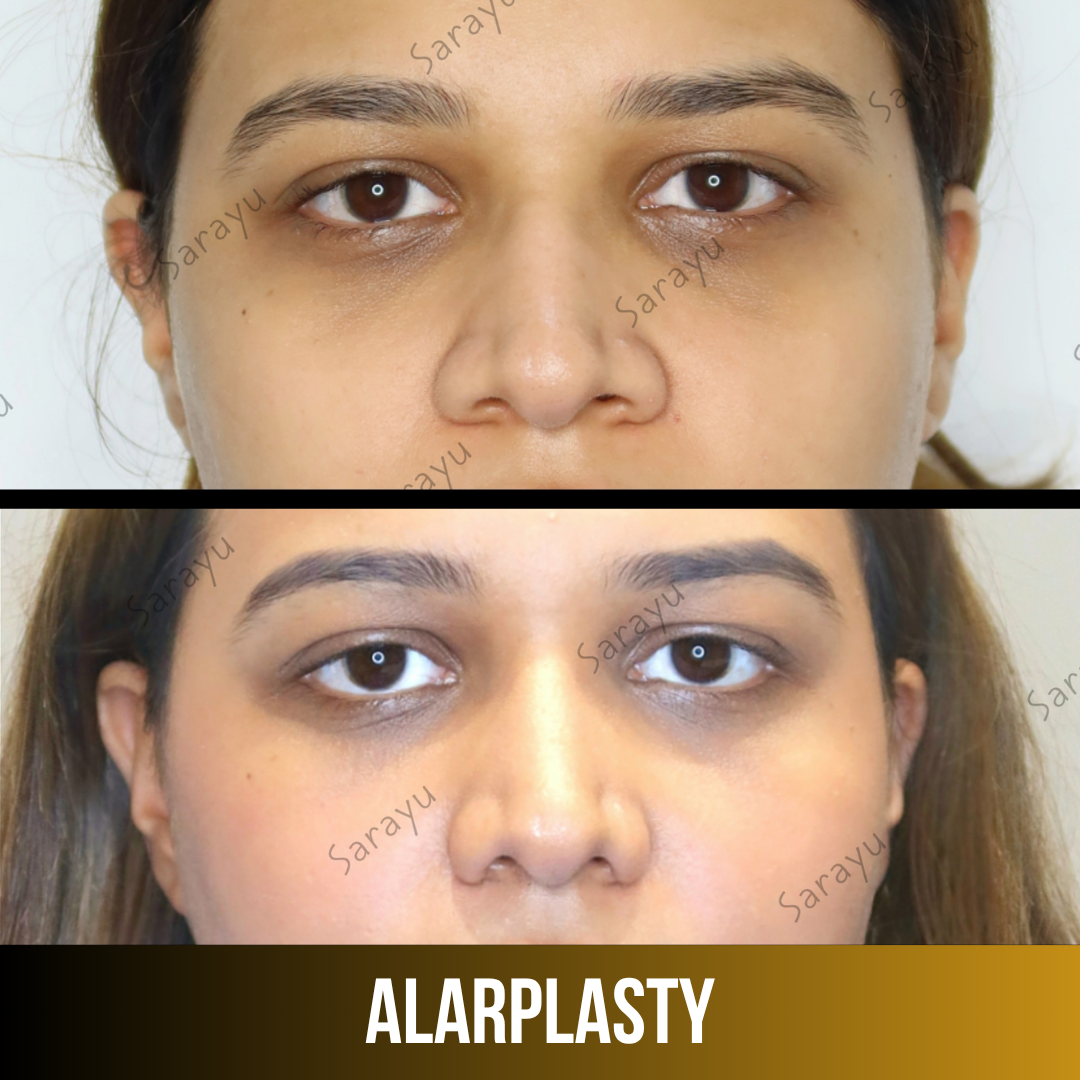
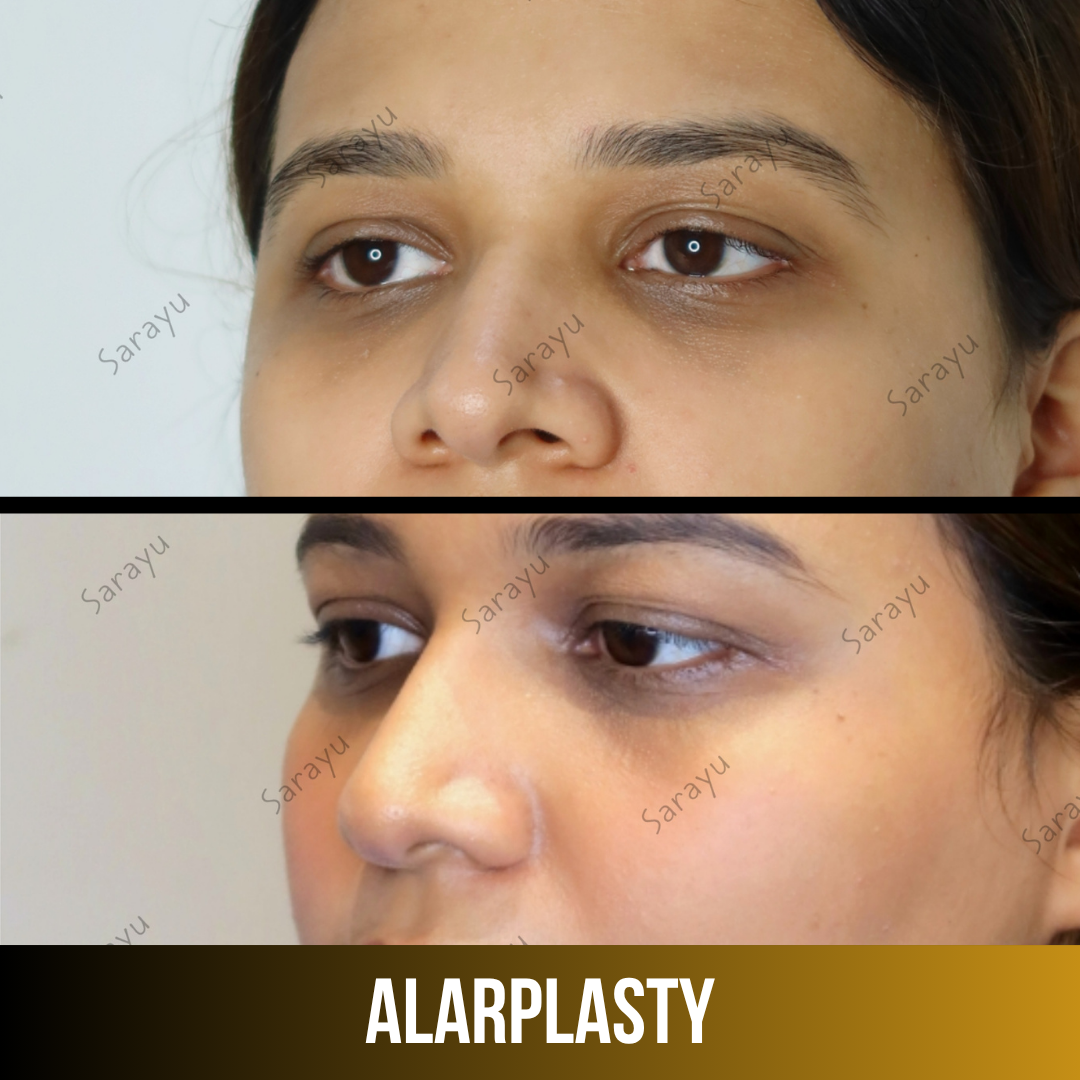
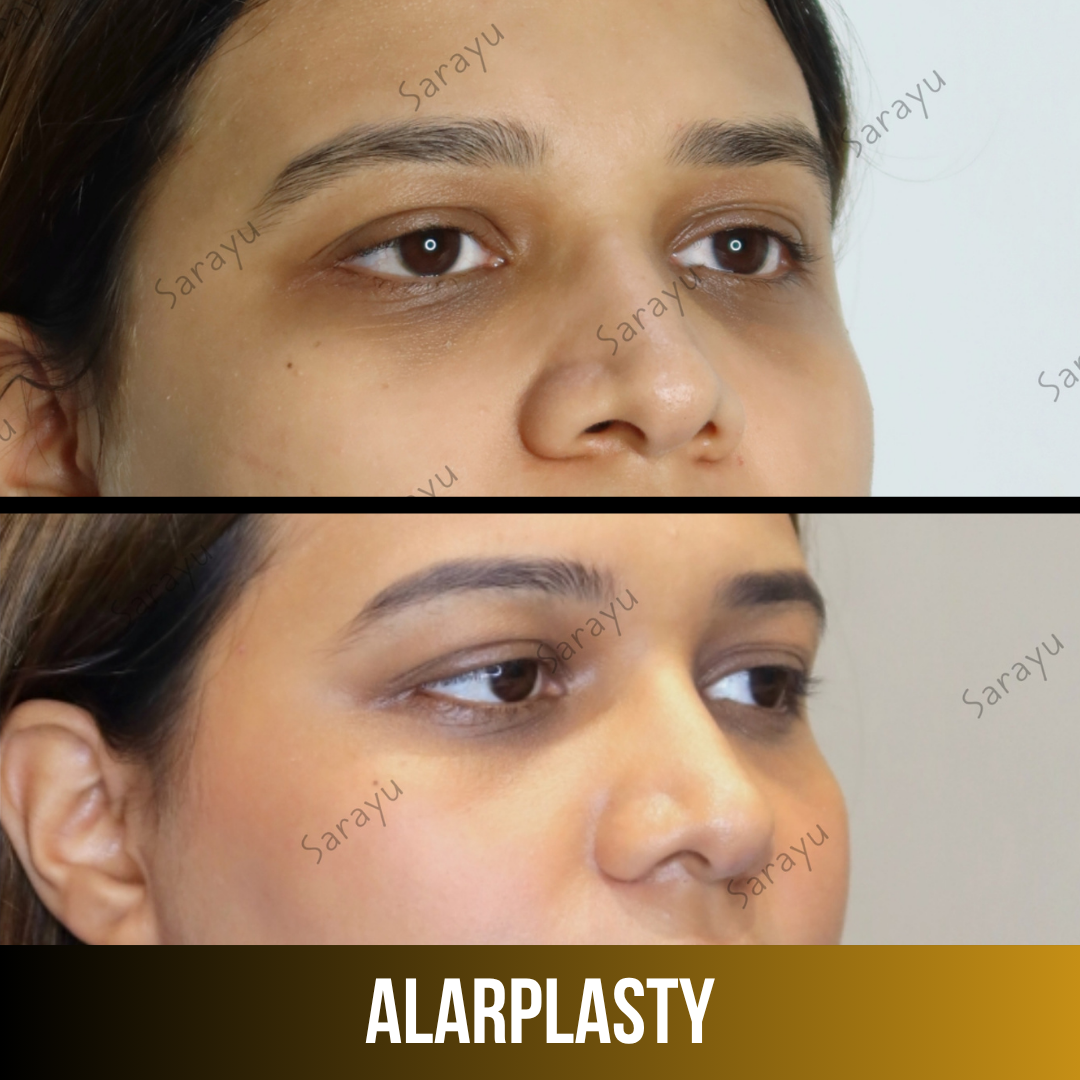
- A documented track record: the before/after gallery below shows real Sarayu Clinics patients — men and women, front and three-quarter views — with alarplasty procedures performed to date .
- Conservative by conviction: millimetre planning, groove-placed incisions and matched measurement before closure — the three habits that prevent the complications patients fear most.
- Trusted by well-known faces: see the story behind Yo Yo Honey Singh’s transformation and further results in our gallery and media section .
- Straight answers: including “you do not need this surgery” when that is the truth — ask around; it is the reputation that fills a surgeon’s diary in the long run.
Frequently Asked Questions About Alarplasty in Delhi
How much does alarplasty cost in Delhi?
Alarplasty in Delhi costs Rs 40,000-80,000 at Sarayu Clinics, with quotes across the city typically ranging Rs 30,000-1,00,000 depending on the surgeon and facility. The written quote covers the surgeon fee, local anaesthesia, the sterile procedure room, suture removal and follow-ups. Combining alarplasty with rhinoplasty is priced as one plan.
Is alarplasty painful? What anaesthesia is used?
Alarplasty is done under local anaesthesia – you are awake and comfortable, and most patients say the numbing injection is the only thing they feel. Afterwards, expect mild soreness for a day or two, easily managed with simple prescribed tablets. No general anaesthesia and no hospital stay are needed.
Will there be a visible scar after nostril reduction?
The incision is placed precisely inside the natural crease where the nostril meets the cheek, and published research confirms this placement gives the least visible scars. It fades from a pink line to a fine pale mark over 3-6 months with sunscreen and scar-gel care. Visible scarring is uncommon and, if it occurs, treatable.
Is nostril reduction permanent? Can it be reversed?
Yes, results are permanent – the removed tissue does not grow back. That is also why it cannot simply be reversed, and why we plan conservatively: refining slightly and preserving a natural look always beats over-resecting. Reconstruction of an over-reduced nostril is possible but complex, so choose your surgeon carefully the first time.
How much narrower can my nostrils get?
Usually 2-4 millimetres per side – which sounds small until you see it on a face, where it is the difference between flared and refined. The exact amount is measured against your facial proportions (the inner-corner-of-the-eyes guide) at consultation, and shown to you with imaging before you decide.
What is the difference between alarplasty and rhinoplasty?
Alarplasty changes only the nostril base – width, flare and symmetry – in a 45-60 minute local-anaesthesia procedure with about a week of recovery. Rhinoplasty reshapes the bridge, hump and tip under general anaesthesia with 10-14 days of downtime. If your only concern is the nostrils, alarplasty alone is usually the right-sized answer.
Can alarplasty be combined with rhinoplasty or other procedures?
Yes, very commonly. Combining alarplasty with rhinoplasty or tip plasty means one anaesthesia, one recovery and a result planned as a whole. Patients also pair it with chin augmentation or face-contouring procedures when overall profile balance is the real goal. Combined plans are assessed and priced together at consultation.
When are the stitches removed, and when can I go back to work?
Sutures come out at the clinic on day 5-7. Most people with desk jobs return to office within a week, and light home-based work is possible from day 2-3. Heavy exercise waits until week 2-3, and anything resting on the nose (heavy spectacles) as advised.
When will I see the final result of my alarplasty?
The new nostril width is visible as soon as the first swelling settles – within 2-4 weeks – and looks fully natural by 6-8 weeks. The scar continues maturing and fading for 3-6 months. Photographs taken at your follow-ups let you compare the change objectively against your pre-surgery images.
Will alarplasty affect my breathing?
No – done correctly, alarplasty removes small amounts of tissue from the nostril rim and floor without touching the internal breathing passages, and studies report no airflow compromise with conservative technique. If you already have breathing issues from a deviated septum, that is a separate problem we assess for rhinoplasty instead.
What is the right age for nostril reduction surgery?
Facial growth should be complete, which generally means 17-18 or older; we assess younger patients case by case with parental involvement [confirm clinic age policy]. There is no upper age limit for healthy adults – suitability depends on health, skin quality and expectations rather than the number itself.
How do I choose the best alarplasty surgeon in Delhi?
Look for four things: formal facial plastic or maxillofacial surgical training, a gallery of that surgeon’s own before/after results (not stock photos), a clear answer to “how do you avoid over-resection”, and a written quote with follow-up care included. Be cautious of price-first clinics – revision surgery costs far more than doing it right once.
How to Reach Us:
Phone:+91 9289111083 ,+91 9289111084
Dr Adarsh’s website: https://dradarshtripathi.com/
Facebook: https://www.facebook.com/DrAdarshTripathi3011
Instagram: https://www.instagram.com/dr_adarsh_tripathi/
Youtube: https://www.youtube.com/@dr_adarsh_tripathi
Linkedin: https://www.linkedin.com/in/dr-adarsh-tripathi-a43005b8/
Online Booking: https://dradarshtripathi.com/contact-us/ to schedule appointments conveniently.
Our Patients