PRP for Hair Loss in Delhi
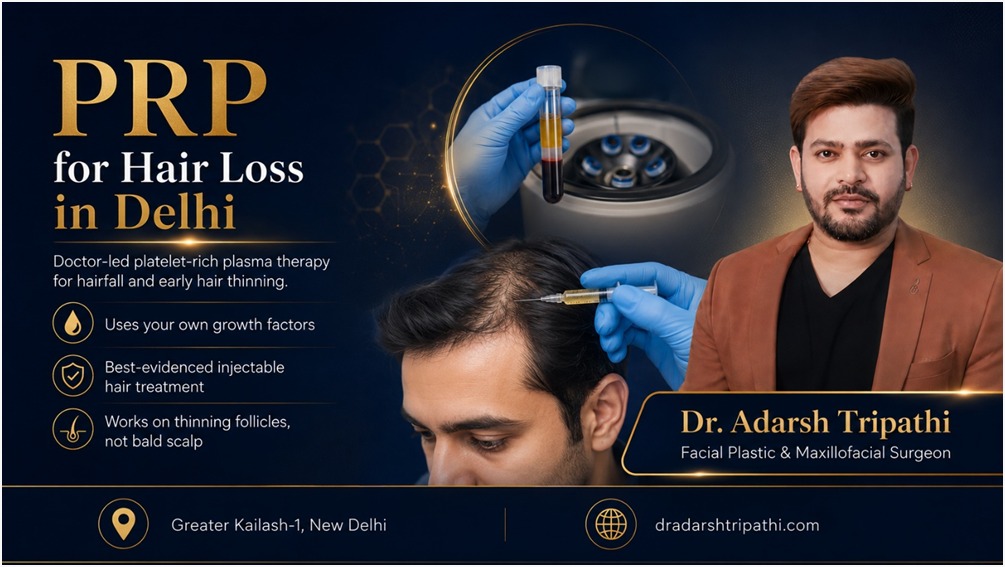
Quick answer: PRP – platelet-rich plasma – uses your own blood to treat hair loss. A sample is drawn, spun in a centrifuge to concentrate the platelets and the growth factors they carry, and injected into the scalp. It has the longest and strongest evidence base of any injectable hair treatment, which is why it remains the standard first-line option. In Delhi, PRP costs roughly Rs 6,000-15,000 per session, with most protocols running four to six sessions a month apart and maintenance every four to six months afterwards. It works on follicles that are thinning but still alive – it does nothing on a bald scalp. At Sarayu Clinics in Greater Kailash-1, PRP is prescribed by Dr. Adarsh Tripathi as part of a plan, and only after establishing what is actually causing your hair loss.
PRP has been used in hair restoration for roughly fifteen years, which makes it the most established of the injectable treatments by a wide margin. Newer options get marketed as advances on it – growth factor concentrates, exosomes, various proprietary cocktails – and some of them are genuinely refinements. But when a clinic recommends something newer and more expensive, it is worth asking what it does that PRP does not, because on evidence PRP is still the one to beat.
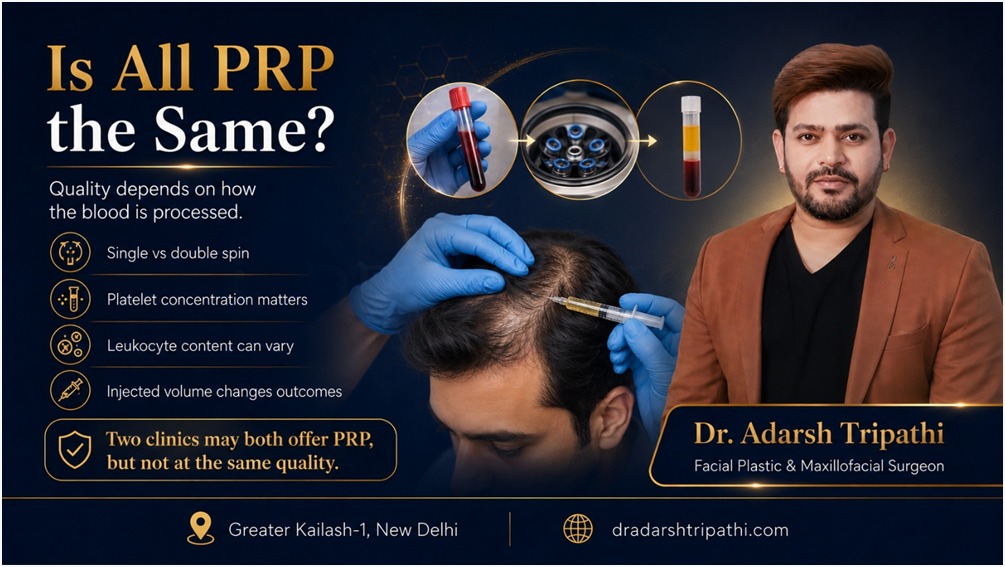
The part most pages leave out: PRP is not a standardised product. It is your blood, processed – and how it is processed changes what you receive. Two clinics can draw the same volume from you and produce preparations that differ several-fold in platelet concentration. That is the real variable behind why some patients rate PRP highly and others say it did nothing, and it is worth understanding before you compare quotes.
How PRP Works, and Why Preparation Quality Matters ?
Platelets are best known for clotting, but they also carry a dense payload of growth factors – PDGF, VEGF, TGF-beta, IGF-1 and others – that signal tissue repair. Concentrating them and delivering them into the scalp aims to prolong the growth phase of the hair cycle, improve blood supply around the follicle, and support follicles that are miniaturising.
The variables that change what you actually get
- Single versus double centrifugation. A double-spin protocol concentrates platelets substantially more than a single spin. Most published evidence for hair uses higher-concentration preparations
- Platelet concentration achieved – typically expressed as a multiple of your baseline. Higher is not infinitely better, but too low is simply ineffective
- Leukocyte content – whether white cells are included or excluded. Leukocyte-poor preparations are generally preferred for scalp work because they provoke less inflammation
- Activation – whether calcium chloride or another activator is added to trigger growth factor release before injection
- Injected volume and injection density across the treatment area
- Whether a closed proprietary kit or an open manual protocol is used, which affects both consistency and sterility
What to do with this: ask the clinic what protocol they use. Single or double spin, roughly what platelet concentration they achieve, and how much they inject. You are not expected to evaluate the numbers – the point is that a clinic that can answer clearly is a clinic that has thought about it, and one that cannot is running whatever the kit does. This is the closest thing PRP has to a quality standard, and almost nobody asks.
What PRP Honestly Delivers ?
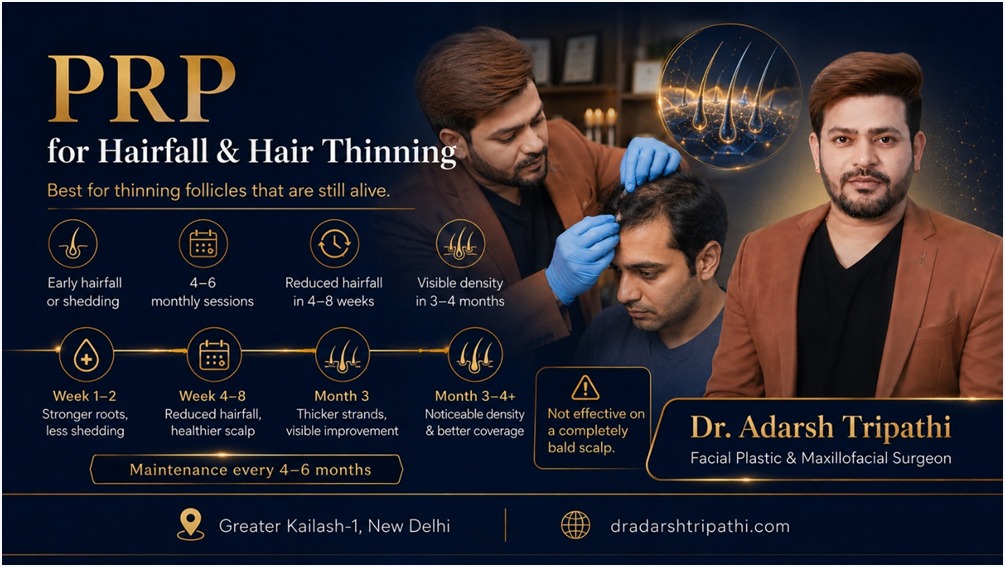
- Reduced hairfall, usually the first change patients notice, often within four to eight weeks
- Improved hair calibre – thinning hairs regaining thickness over the course
- Increased density in areas where follicles are miniaturising but still active
- Better scalp condition and circulation around the follicle
- Support for transplanted grafts and surrounding native hair after surgery
- No allergy or rejection risk, because the material is entirely your own
- No downtime; back to normal activity the same day
- The strongest published evidence base of any injectable hair treatment
- Lower cost than GFC and considerably lower than exosome therapy
What PRP honestly cannot do ?
- It cannot regrow hair where follicles are gone. A bald scalp has nothing to stimulate – that is a hair transplant conversation
- It is not permanent. Results fade without maintenance because PRP does not change the underlying cause
- It does not block DHT. In androgenetic hair loss the hormonal process continues regardless, which is why PRP works considerably better alongside medical therapy than on its own
- Response varies genuinely between individuals. Some patients respond well, some modestly, a few not at all – and preparation quality explains only part of that
- It will not correct hair loss with an untreated medical cause – thyroid disease, iron deficiency, PCOS. Those need diagnosis and treatment first
- It is not a substitute for surgery at advanced stages. At Norwood 5 and beyond, no injectable course will produce what a transplant does, and a clinic suggesting otherwise is not being straight with you
PRP Beyond Hair - A Note on Scope
PRP is a technique rather than a single treatment, and the same principle is used in three quite different contexts. This page covers the hair application. PRP is also used for skin – sometimes marketed as a vampire facial – where it aims at skin quality rather than follicles; our skin boosters page covers the injectable options for skin quality. PRP is used extensively in orthopaedics for joint and tendon problems, which is an entirely separate specialty this clinic does not practise. If you searched simply for PRP treatment in Delhi, this page covers the hair application.
Who PRP Suits - Hair Loss, Hairfall and Thinning ?
Good candidates
- Early to moderate androgenetic hair loss – Norwood 2-4 in men, Ludwig 1-2 in women
- Ongoing hairfall where density is still largely intact
- Visible miniaturisation – hair getting finer rather than disappearing
- Diffuse thinning in women, where transplant is often not appropriate and finasteride is generally not prescribed
- Post-transplant patients supporting grafts and native hair
- Patients wanting a treatment using their own biology rather than an external product
- Anyone able to commit to a course and to maintenance
PRP is not the right treatment if
- You have completely bald areas with no follicular activity
- You have advanced hair loss at Norwood 5-7 – surgery is the appropriate answer
- You have scarring alopecia, where follicles have been replaced by scar tissue
- You have a platelet disorder, are on anticoagulants without clearance, or have an active blood-borne infection
- You have an active scalp infection or inflammatory scalp condition
- You are pregnant or breastfeeding – deferred
- Your hair loss has an untreated medical cause that needs addressing first
- You expect permanent results from a course of injections
On hairfall versus hair loss. These are used interchangeably but they are not always the same problem. Shedding that increased suddenly over weeks – after illness, weight loss, childbirth or a stressful period – is usually telogen effluvium, and it typically resolves once the trigger passes. PRP may support recovery, but the cause matters more. Gradual thinning in a recognisable pattern is androgenetic, and that is where PRP genuinely belongs. Blood tests at the first consultation are what separate the two, and they are worth doing before spending on a course.
The PRP Procedure, Step by Step
Consultation and diagnosis
Dr. Tripathi examines the scalp, assesses pattern and stage, and reviews your history. Blood tests are arranged where indicated – typically ferritin, thyroid function, vitamin D and B12 – because treating an undiagnosed deficiency with injections is expensive and ineffective. Baseline photographs are taken. This is also where you should be told honestly whether PRP suits your stage or whether something else would serve you better.
Blood draw
Around 15-30ml of blood is drawn from your arm, exactly as for a routine blood test. The volume depends on the protocol and the area being treated.
Processing
The sample is spun in a centrifuge to separate the components and concentrate the platelets. A double-spin protocol involves a second centrifugation to concentrate further. The platelet-rich fraction is drawn off, and an activator may be added. This takes roughly 15-20 minutes while you wait.
Scalp preparation and injection
The scalp is cleansed and topical anaesthetic applied for 20-30 minutes. The PRP is then injected across the thinning areas in a systematic grid at the level of the follicles, using fine needles. A session takes 30-45 minutes in total. Some protocols combine this with microneedling to improve distribution.
The course
A standard course is four to six sessions spaced about a month apart, followed by maintenance every four to six months. PRP is cumulative – a single session tells you very little, and patients who try one and conclude it does not work have not completed a course.
Downtime and Aftercare
Timeframe | What to expect |
Immediately after | Mild redness and small injection points; occasional pinpoint bleeding. Scalp may feel tight or tender |
Day 1 | Redness settles. Mild tenderness is normal, and a dull ache for a few hours is common |
Days 2-3 | Entirely normal. Hair washing resumes after 24 hours |
Weeks 4-8 | Reduced hairfall – usually the first perceptible change |
Months 3-4 | Improved calibre and density becoming visible in photographs |
Aftercare: no hair wash for 24 hours; no swimming, sauna or heavy sweating for 48 hours; avoid hair colouring or chemical treatment for a week; no anti-inflammatory painkillers for a few days where possible, since they may blunt the inflammatory signalling PRP relies on; and no scratching or massaging the treated area.
Cost and Price of PRP for Hair Loss in Delhi
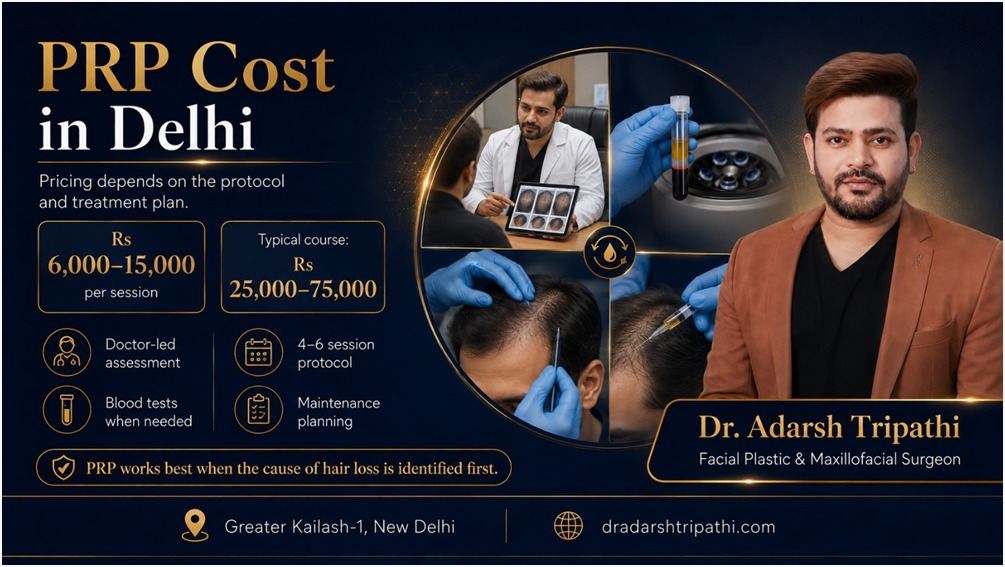
Direct answer: PRP for hair loss in Delhi costs approximately Rs 6,000-15,000 per session. Most protocols need four to six sessions, putting an initial course at Rs 25,000-75,000, with maintenance sessions every four to six months afterwards. Price varies with the preparation protocol, the kit used and the area treated – and a notably cheap PRP session usually means a single-spin preparation at lower platelet concentration.
Option | Per session | Typical course | Course total |
PRP – single area (crown or hairline) | Rs 6,000-10,000 | 4-6 | Rs 25,000-55,000 |
PRP – full scalp | Rs 8,000-15,000 | 4-6 | Rs 35,000-75,000 |
PRP with double-spin protocol | Rs 10,000-15,000 | 4-6 | Rs 45,000-75,000 |
PRP combined with microneedling | Rs 9,000-16,000 | 4-6 | Rs 40,000-80,000 |
PRP post-transplant support | Rs 6,000-12,000 | 2-3 | Rs 15,000-35,000 |
Maintenance session | Rs 6,000-15,000 | Every 4-6 months | – |
For comparison – GFC | Rs 8,000-18,000 | 3-4 | Rs 25,000-65,000 |
For comparison – Exosome therapy | Rs 20,000-50,000 | 3-6 | Rs 60,000-2,50,000 |
What drives the price ?
- Preparation protocol – double-spin and closed proprietary kits cost more per session than a basic single-spin
- Area treated – full scalp versus a single zone
- Volume of blood drawn and PRP produced
- Whether microneedling or other adjuncts are combined
- Whether a doctor performs the injection or a technician runs a standard protocol
The honest note on cheap PRP. Because PRP uses your own blood, the consumable cost is low – which means the price largely reflects the protocol and the operator rather than the material. A session priced well below the range above usually indicates a single-spin preparation producing a lower platelet concentration, and at low enough concentrations the treatment simply does not do much. This is one of the few areas in aesthetics where the cheapest option is not a bargain but a different, weaker treatment sold under the same name.
Results - What to Expect and When
- Weeks 1-3: nothing visible. Normal, and where impatient patients give up
- Weeks 4-8: reduced hairfall – the first and most reassuring change
- Months 3-4: improved calibre and density visible in photographs. The earliest fair point to judge
- Months 4-6: full effect of the initial course
- Beyond 6 months: gradual fading without maintenance. Sessions every four to six months sustain the result
Baseline photographs matter more than patients expect. Hair changes slowly and daily observation is unreliable – without a before image at month four you are comparing against memory. And if a properly executed course has produced nothing at four to six months, PRP is not working for you; continuing is spending on hope rather than evidence, and a good clinic will say so.
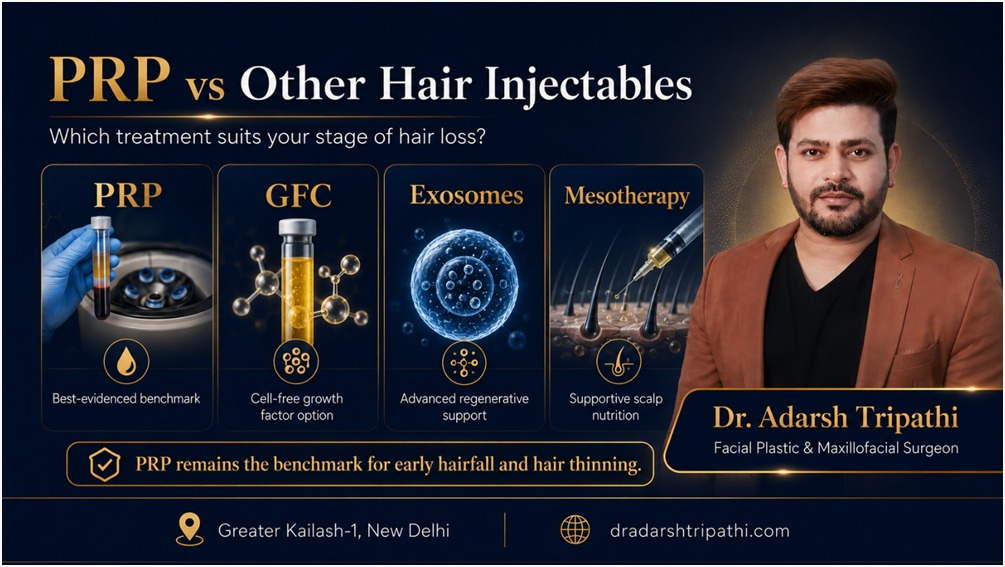
PRP vs GFC vs Exosomes vs Mesotherapy
This is the comparison the page has been missing, and as the best-evidenced treatment PRP is the right page to host it.
Treatment | What is injected | Evidence base | Per session | Honest position |
PRP | Your own concentrated platelets | Longest, ~15 years, strongest | Rs 6,000-15,000 | The sensible first-line injectable |
Cell-free growth factors from your platelets | Growing; less than PRP | Rs 8,000-18,000 | More standardised, costs more | |
Regenerative signalling vesicles | Newest; regulatory questions | Rs 20,000-50,000 | Newest and priciest | |
Vitamins and amino acids, or a DHT blocker | Weakest for nutrient versions | Rs 3,000-8,000 | Supportive layer | |
Nothing – red light therapy | Reasonable, modest effect | Rs 2,000-5,000 | Ongoing support, needs frequency | |
Medical therapy (finasteride, minoxidil) | Oral or topical | Strongest of all | Low, ongoing | The foundation everything else supports |
PRP or GFC?
GFC releases the growth factors from your platelets first and injects them as a cell-free concentrate, which gives a more standardised preparation with less variation between sessions. That consistency is a genuine advantage. But PRP has the longer track record and costs less, and in skilled hands with a good protocol the outcomes are broadly comparable. If predictability matters most to you, GFC is the refinement worth paying for. If evidence and value matter most, PRP remains the sensible starting point. What is not true is that GFC is a different order of treatment.
PRP or a hair transplant?
They answer different questions. PRP supports follicles that are still alive; a hair transplant relocates permanent follicles into areas where they have been lost. For early loss PRP is appropriate and surgery would be premature. At Norwood 5 and beyond, no injectable course substitutes for surgery. Between those, many patients do both – PRP to protect what remains, surgery to restore what has gone. Because this clinic performs FUE and FUT as well as PRP, the recommendation reflects your stage rather than what is on the menu.
Why medical therapy still matters most
Finasteride and minoxidil have substantially stronger evidence than any injectable and address the underlying process rather than supporting the follicles around it. PRP, GFC, exosomes and mesotherapy all work better alongside medical therapy than instead of it. A clinic recommending a course of injections without first discussing medical therapy is not giving you the full picture.
Common Myths About PRP
‘PRP gives instant results’
It does not. Reduced hairfall appears at four to eight weeks; visible density change takes three to four months. Anything faster is not PRP working.
‘One session is enough’
It is not. PRP is cumulative and a standard course is four to six sessions. A single session is a trial, not a treatment.
‘PRP works for complete baldness’
It does not. PRP stimulates existing follicles. Where they are gone there is nothing to stimulate, and no number of sessions changes that.
‘All PRP is the same’
It is not, and this is the myth that costs patients the most. Preparation protocol determines platelet concentration, and preparations vary several-fold between clinics. A cheap session is often a weaker preparation rather than a better deal.
‘PRP is a permanent cure’
It is not. PRP does not stop androgenetic hair loss – the hormonal process continues, which is why maintenance and medical therapy both matter.
Why Dr. Adarsh Tripathi ?
- Adarsh Tripathi is a Maxillofacial and Facial Plastic Surgeon with 18+ years of experience.
- The full hair spectrum available – PRP, GFC, exosome therapy, mesotherapy, LLLT, medical therapy and hair transplant surgery – so the recommendation reflects your stage rather than what the clinic sells
- A defined PRP preparation protocol, stated openly rather than left as ‘advanced technology’.
- Blood tests before treatment where indicated, rather than assuming androgenetic loss
- Baseline photography so progress is measured rather than remembered
- Honest about response variability and about the point at which injectables stop being the answer
- See before-and-after results and celebrity work
- Greater Kailash-1, New Delhi – convenient from GK-2, CR Park, Kailash Colony, Defence Colony, Hauz Khas, Nehru Place and South Extension.
Frequently Asked Questions
What is PRP treatment for hair loss?
PRP – platelet-rich plasma – uses your own blood to treat hair loss. A sample is drawn, spun in a centrifuge to concentrate the platelets and the growth factors they carry, and injected into the scalp at the level of the follicles. It aims to prolong the growth phase and support follicles that are thinning but still alive. It has the longest and strongest evidence base of any injectable hair treatment. It cannot regrow hair where follicles are gone, which needs a hair transplant.
How much does PRP for hair loss cost in Delhi?
PRP in Delhi costs approximately Rs 6,000-15,000 per session depending on the preparation protocol and area treated. Most protocols need four to six sessions, putting an initial course at Rs 25,000-75,000, plus maintenance every four to six months. Sessions priced well below this range usually indicate a single-spin preparation with lower platelet concentration.
How many PRP sessions do I need for hair?
A standard course is four to six sessions spaced about a month apart, followed by maintenance every four to six months. PRP works cumulatively, so a single session tells you very little – patients who try one and conclude it does not work have not completed a course. The exact number depends on your stage of loss and response.
Does PRP actually work for hairfall?
For early to moderate androgenetic hairfall where follicles are miniaturising but still active, yes – PRP has around fifteen years of published use and the strongest evidence base of any injectable hair treatment. Response varies between individuals, and it works considerably better alongside medical therapy than on its own. It will not help hairfall caused by an untreated problem such as thyroid dysfunction or iron deficiency, which is why blood tests come first.
Is all PRP the same?
No, and this is the most useful thing to know before comparing clinics. PRP is your blood processed, and how it is processed changes what you receive. Single versus double centrifugation, platelet concentration achieved, whether white cells are included, whether the plasma is activated, and how much is injected all vary between clinics. Two preparations from the same blood volume can differ several-fold in strength. Ask the clinic what protocol they use.
Is PRP better than GFC?
Neither is universally better. GFC releases growth factors from your platelets and delivers them cell-free, giving a more standardised preparation with less session-to-session variation. PRP has the longer track record and costs less, and outcomes are broadly comparable in skilled hands with a good protocol. If predictability matters most, GFC is the refinement; if evidence and value matter most, PRP is the sensible starting point.
Is PRP painful?
Discomfort is mild. Topical numbing cream is applied for 20-30 minutes beforehand, after which most patients describe the injections as brief pinpricks or pressure rather than pain. The blood draw is the same as a routine blood test. A session takes 30-45 minutes, and mild scalp tenderness for a day afterwards is normal.
Is PRP safe?
Yes. PRP uses your own blood, so there is no risk of allergic reaction or rejection and no foreign material introduced. Side effects are limited to mild redness, tenderness and occasional pinpoint bleeding at injection sites. The main precautions are platelet disorders, anticoagulant therapy without clearance, active scalp infection, and pregnancy – all of which should be disclosed at consultation.
When will I see results from PRP?
Reduced hairfall is usually the first change, at around four to eight weeks. Improved calibre and density become visible in photographs at three to four months, with the full effect of the initial course at four to six months. Baseline photographs matter, because the change is gradual enough that memory is unreliable. If a properly completed course has produced nothing at four to six months, PRP is not working for you.
Can PRP be used after a hair transplant?
Yes, and it is one of its better-established applications. After a hair transplant PRP can support graft recovery and, importantly, help maintain the native hair around the grafted area – which matters because transplanted hair is permanent while surrounding native hair can keep thinning. Timing should be agreed with your surgeon, as protocols vary in the immediate post-operative period.
Does PRP work for female hair loss?
Yes, and it is one of the more useful options for women. Female pattern hair loss is typically diffuse rather than focal, which often makes women poor transplant candidates, and finasteride is generally not prescribed for women of childbearing age. PRP is non-hormonal and uses the patient’s own biology, which is why it features prominently in female hair-loss plans. Blood tests are particularly important here, as iron deficiency and thyroid dysfunction are common contributors.
Do I need blood tests before PRP?
Ideally yes. PRP is frequently started on the assumption that hair loss is androgenetic, when iron deficiency, thyroid dysfunction and vitamin D deficiency are all common causes of hairfall that respond far better to correcting the underlying problem. Ferritin, thyroid function, vitamin D and B12 are the usual starting tests, and they cost a fraction of a PRP course.
How to Reach Us:
Phone:+91 9289111083 ,+91 9289111084
Dr Adarsh’s website: https://dradarshtripathi.com/
Facebook: https://www.facebook.com/DrAdarshTripathi3011
Instagram: https://www.instagram.com/dr_adarsh_tripathi/
Youtube: https://www.youtube.com/@dr_adarsh_tripathi
Linkedin: https://www.linkedin.com/in/dr-adarsh-tripathi-a43005b8/
Online Booking: https://dradarshtripathi.com/contact-us/ to schedule appointments conveniently.