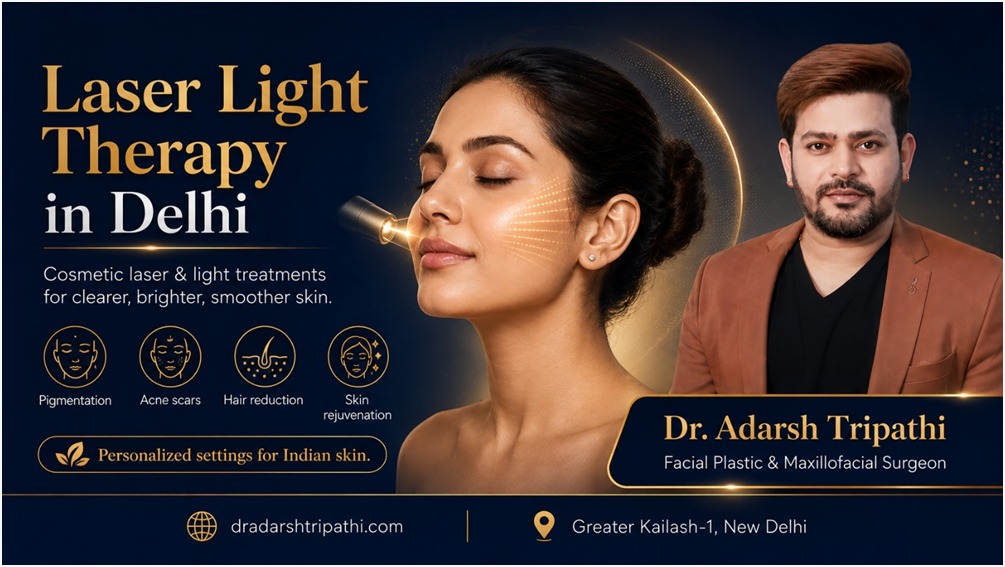
Laser Light Therapy in Delhi
Quick answer: Laser light therapy uses focused light energy to treat skin concerns without surgery – different wavelengths do different jobs, which is why there is no single ‘laser treatment’. At our Delhi clinic the laser and light treatments cover pigmentation and tanning, acne scars and texture, unwanted hair, tattoos, skin tightening and redness. Sessions cost roughly Rs 3,000-30,000 depending on the device and area, most concerns need a course of three to six sessions, and downtime ranges from none to about a week. All treatment is planned by Dr. Adarsh Tripathi, a maxillofacial and facial plastic surgeon with 18+ years of experience, with device settings chosen for Indian skin.
A note on scope, because the term is used two ways. ‘Laser light therapy’ also describes low-level laser used by physiotherapists for pain and inflammation. That is a different specialty and we do not offer it – if you are looking for laser therapy for back pain or a sports injury, a physiotherapy clinic is the right place. This page covers laser and light treatments for cosmetic and skin concerns, which is what a facial plastic surgery practice does. The one exception is low-level laser for hair loss, which we do offer and which has its own page: LLLT treatment in Delhi.
Why There Is No Such Thing as One 'Laser Treatment'
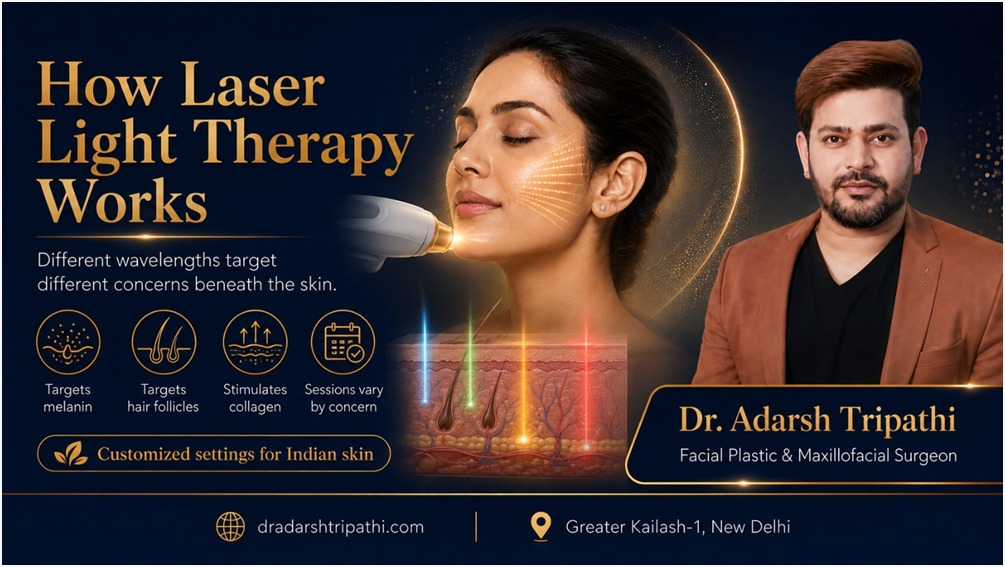
Patients often arrive asking for ‘laser’ as though it were a single treatment, in the way one might ask for a facial. It is not. Laser is a category of technology, and what a given device does depends almost entirely on its wavelength – the specific colour of light it emits – and how that light is delivered.
The underlying principle is selective photothermolysis, which sounds forbidding but means something simple: different targets in the skin absorb different wavelengths. Melanin absorbs certain wavelengths, so those lasers treat pigment and hair. Haemoglobin absorbs others, so those treat redness and vessels. Water absorbs others still, so those resurface skin. Choosing the wrong wavelength for your concern does not give a weaker result – it gives no result, and on Indian skin it can give a worse one.
This matters more on Indian skin than on lighter skin. Higher melanin means more competition for the laser’s energy at the surface, which raises the risk of post-inflammatory hyperpigmentation – dark marks appearing after treatment, sometimes worse than the problem being treated. This is why device selection and settings are a clinical decision rather than a menu choice, and why the same treatment that suits European skin may need different parameters, a different device, or a different approach entirely here.
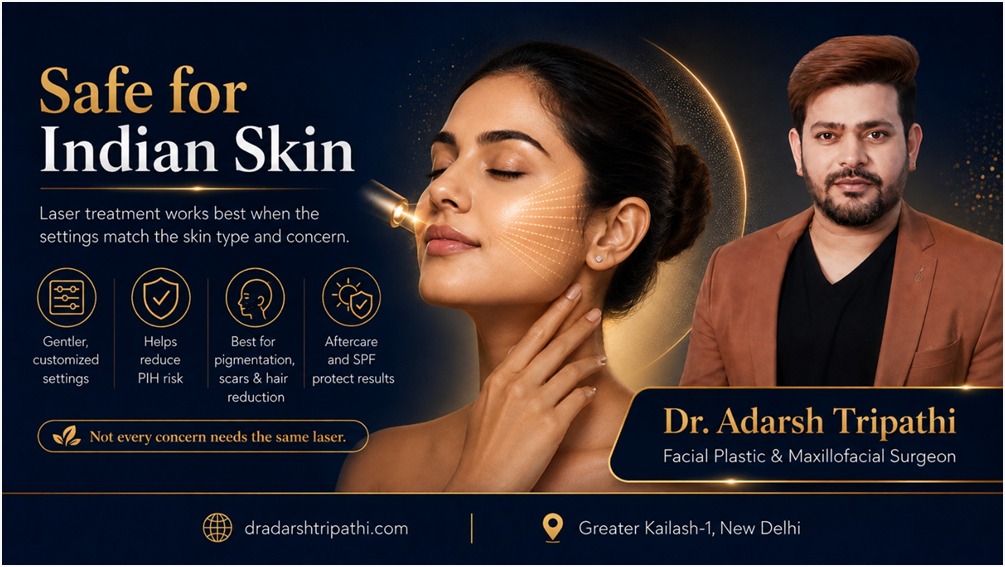
The Laser and Light Treatments We Offer
For pigmentation, tanning and dull skin
Laser toning uses a Q-switched laser at low fluence to break down excess melanin gradually across a course of sessions. It suits melasma, sun damage, uneven tone and general dullness, and is one of the safest laser options for Indian skin because it works gently and repeatedly rather than aggressively once. Hollywood Spectra is a specific Q-switched platform used for the same purpose along with the carbon peel, where a carbon layer is applied and then targeted with the laser for immediate brightness and pore refinement.
For pigmentation that is stubborn or hormonally driven, lasers are usually one part of a plan rather than the whole of it – see depigmentation treatment and chemical peels, which often work better in combination with light-based treatment than either does alone.
For acne scars, texture and pores
Fractional CO2 laser is the most powerful resurfacing option available. It creates microscopic columns of controlled injury that trigger substantial collagen remodelling, which is what genuinely improves the depth of atrophic scars. It is also the treatment with real downtime – typically five to seven days – and the one requiring the most careful settings on Indian skin. MNRF (microneedling radiofrequency) delivers radiofrequency energy through fine needles below the surface, which makes it considerably safer for darker skin because the epidermis is largely spared. Morpheus8 is an RF microneedling platform working on the same principle with deeper penetration.
For scarring specifically, laser is usually one component – subcision, fillers and fat grafting address different scar types. The full picture is on our acne scar removal page.
For unwanted hair
Laser hair reduction targets melanin in the hair follicle. For Indian skin the wavelength choice is critical – Nd:YAG at 1064nm is the safest option for Fitzpatrick IV-VI, diode at 810nm is a reasonable middle ground, and Alexandrite at 755nm should not be the sole laser used on darker skin. Realistic outcomes are 70-90% long-term reduction over six to eight sessions, not permanent removal.
For tattoos and unwanted pigment
Tattoo removal uses Q-switched or picosecond lasers to shatter ink particles into fragments small enough for the body to clear. Different ink colours absorb different wavelengths, which is why multi-colour tattoos need multiple devices and why some colours – particularly greens and light blues – are considerably harder to clear. Expect a course of six to twelve sessions spaced six to eight weeks apart.
For skin tightening
Strictly, HIFU uses focused ultrasound rather than light, but it belongs in any honest discussion of non-surgical tightening because patients compare the two. HIFU reaches the SMAS layer for structural lift; RF-based devices like Morpheus8 work broader and shallower for skin firmness and texture. Neither is a laser, and neither replaces a facelift for established sagging.
For hair loss
Low-level laser therapy for hair uses light at doses too low to heat tissue, aiming instead to stimulate follicular activity. It is a genuine adjunct rather than a standalone answer, and works best alongside medical therapy or PRP. Full detail on the LLLT treatment page.
LED light therapy
LED therapy uses non-coherent light at specific wavelengths – blue for acne bacteria, red for inflammation and healing – at intensities far below any laser. It is gentle, has no downtime, and is genuinely useful as an adjunct after other treatments or as part of a facial protocol. It is not, on its own, a substitute for laser treatment of established concerns, and pages that market it as a standalone solution to ageing or scarring overstate it considerably.
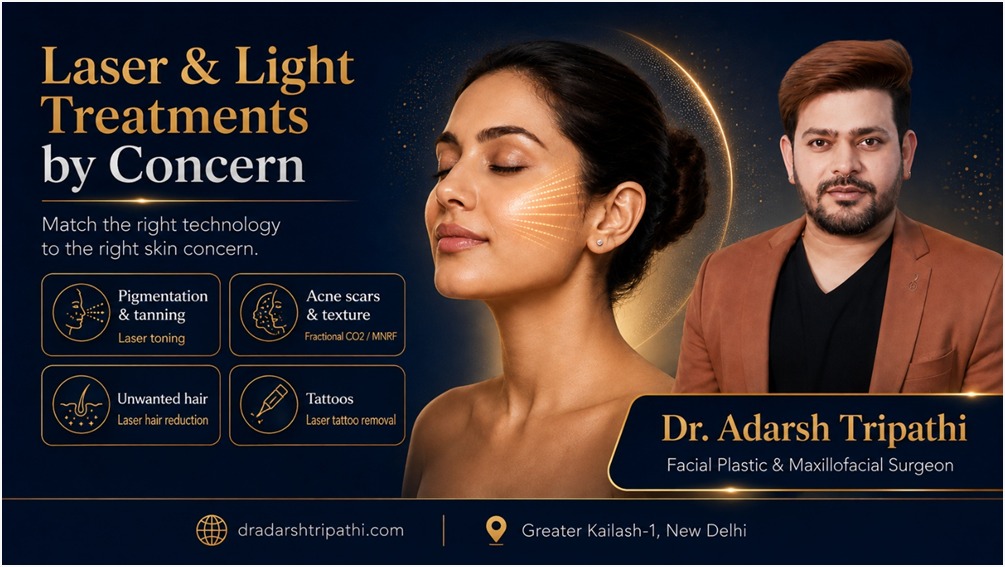
Which Laser for Which Concern
This is the table most patients actually need, and the one no competitor provides.
Your concern | Usual first choice | Why | Indian skin note |
Tanning, dullness, uneven tone | Gentle Q-switched melanin breakdown across sessions | Among the safest laser options | |
Melasma | Laser toning + medical therapy | Needs gentle, layered approach | Aggressive lasers worsen melasma |
Sun spots, freckles | Q-switched laser | Targets discrete pigment | Careful settings essential |
Acne scars – atrophic | Collagen remodelling at depth | MNRF safer; CO2 needs experienced hands | |
Open pores, rough texture | Dermal remodelling with epidermis spared | Well suited | |
Pre-event glow | Carbon peel (Q-switched) | Immediate brightness, no downtime | Safe |
Unwanted hair | Targets follicular melanin | Nd:YAG 1064nm safest for IV-VI | |
Tattoo | Shatters ink for clearance | Multiple wavelengths for colours | |
Skin laxity | HIFU (ultrasound, not laser) | Reaches SMAS for lift | No surface damage, so no PIH risk |
Active acne | LED blue light as adjunct | Targets acne bacteria | Gentle; adjunct only |
Hair thinning | LLLT as adjunct | Stimulates follicular activity | Best alongside medical therapy |
Two honest caveats on this table. First, most real concerns are mixed – pigmentation with texture, scarring with pores – so plans usually combine treatments rather than picking one. Second, the right answer sometimes is not a laser at all: volume loss needs filler or fat, sagging needs tightening or surgery, and active hormonal acne needs medical treatment before any device is worth using.
What a Session Actually Involves ?
Protocols differ substantially between devices, but the shape of a visit is consistent.
Consultation and skin assessment
Your Fitzpatrick skin type is established, the concern is examined properly, and any history of pigmentation, keloid tendency, cold sores, isotretinoin use or photosensitising medication is taken. This determines device, wavelength and settings. For higher-risk treatments or reactive skin, a patch test is done first.
Preparation
Strict sun avoidance and SPF 50 for two weeks beforehand – an active tan is a genuine reason to postpone, because tanned skin has more surface melanin competing for the laser’s energy. Strong actives such as retinoids and acids are paused for several days. Numbing cream is applied where needed, typically 30-45 minutes ahead for resurfacing and hair reduction.
The treatment
Protective eyewear for you and the operator. The device is calibrated to your skin type and the area is treated in systematic passes with continuous cooling where the device provides it. Sessions run from ten minutes for a small area to an hour for full-face resurfacing.
Aftercare
Cooling, barrier repair and sunscreen before you leave. Sun protection afterwards is not optional – it is the single factor that most determines whether you get the result you paid for or a pigmentation problem instead. Specific aftercare varies by treatment and is given in writing.
Downtime by Treatment
Treatment | Discomfort | Visible downtime | Back to routine |
Laser toning | Minimal | Mild redness, hours | Same day |
Carbon peel | Minimal | None | Same day |
LED light therapy | None | None | Immediately |
Laser hair reduction | Mild (numbed) | Redness few hours | Same day |
MNRF / Morpheus8 | Mild (numbed) | 2-4 days redness | 2-3 days |
Tattoo removal | Moderate (numbed) | Few days, possible blistering | 1-3 days |
Fractional CO2 | Moderate (numbed) | 5-7 days peeling | 5-7 days |
The pattern is straightforward: the more the treatment resurfaces the skin surface, the more downtime it involves – and the more powerful the result. Treatments that work below the surface, or gently across repeated sessions, have little or no downtime and build results more gradually.
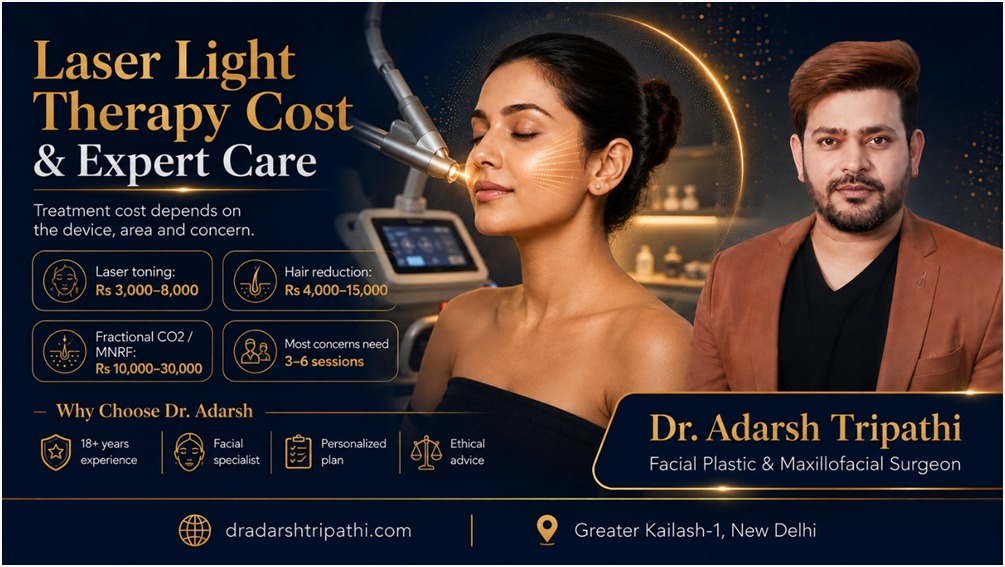
Cost of Laser Light Therapy in Delhi
Direct answer: laser and light treatments in Delhi cost roughly Rs 3,000-30,000 per session depending on the device and the area treated. Laser toning and carbon peels sit at the lower end, around Rs 3,000-8,000; RF microneedling and fractional CO2 at the higher end, Rs 10,000-30,000. Because most concerns need a course of three to six sessions, the course total is the more useful figure to plan around.
Treatment | Per session | Typical course | Course total |
Laser toning | Rs 3,000-8,000 | 4-6 | Rs 15,000-40,000 |
Carbon peel | Rs 3,500-8,000 | 2-4 | Rs 10,000-28,000 |
LED light therapy | Rs 1,500-4,000 | 6-10 | Rs 10,000-30,000 |
Laser hair reduction (per area) | Rs 1,500-18,000 | 6-8 | Varies widely by area |
MNRF / Morpheus8 | Rs 10,000-30,000 | 3-4 | Rs 35,000-1,00,000 |
Fractional CO2 | Rs 12,000-30,000 | 2-4 | Rs 30,000-1,00,000 |
Tattoo removal (per session) | Rs 3,000-15,000 | 6-12 | Depends on size and colour |
What drives the price ?
- The device – fractional CO2 and RF microneedling platforms cost far more to run than a Q-switched toning laser
- Area treated and session length
- Number of sessions your concern genuinely needs, which is not something anyone can quote accurately without seeing your skin
- Whether a doctor sets the parameters or a technician runs a preset
- Whether the device is medical-grade – and this is where unusually cheap laser packages usually fall down
On very cheap laser offers. Laser is a technology plus a judgement, and the judgement is the expensive part. Sub-medical-grade devices, single settings applied to every skin type, and technicians operating without medical oversight are how pigmentation injuries happen – and on Indian skin a laser burn or post-inflammatory hyperpigmentation can take many months to resolve, sometimes needing more treatment than the original concern. Choosing on lowest price is the wrong optimisation for this category specifically.
Results - What to Expect and When
- Carbon peel and LED: visible glow the same day, though the effect is short-lived without a course
- Laser toning: gradual lightening across sessions; most patients see clear change by session three or four
- Laser hair reduction: shedding over one to three weeks after each session, with substantial reduction by session five or six
- MNRF and Morpheus8: collagen-driven, so results build over two to three months after a course
- Fractional CO2: initial improvement as healing completes at two weeks, with continued collagen remodelling for three to six months
- Tattoo removal: progressive fading over a course of six to twelve sessions across a year or more
The common thread: except for the immediate-glow treatments, laser results are cumulative and collagen-driven. Judging a collagen treatment at two weeks is judging it before it has done anything. Sun protection between sessions determines how much of each session’s gain you keep.
Laser Compared with Non-Laser Alternatives
Concern | Laser option | Non-laser alternative | Which usually first |
Pigmentation | Laser toning | Chemical peels, topicals | Often peels and topicals first; laser for resistant cases |
Acne scars | Fractional CO2, MNRF | Subcision, fat grafting, fillers | Depends on scar type – most need combination |
Skin laxity | RF microneedling | HIFU or RF for mild; surgery for established sagging | |
Unwanted hair | Laser hair reduction | Waxing, threading, electrolysis | Laser for long-term reduction; electrolysis for white hair |
Volume loss | Not a laser concern | Lasers cannot restore volume | |
Expression lines | Not a laser concern | Muscle relaxation, not resurfacing |
A page selling lasers has an obvious incentive to present them as the answer to everything. They are not. Lasers are excellent at pigment, texture, hair and ink – and largely irrelevant to volume loss, expression lines and established sagging. Knowing which of those you actually have is what the consultation is for.
Who Laser and Light Treatments Suit ?
Good candidates
- Pigmentation, tanning, uneven tone, sun damage
- Acne scarring, rough texture, enlarged pores
- Unwanted hair with dark, coarse growth
- Unwanted tattoos
- Realistic expectations of a course rather than a single dramatic session
- Willing to commit to daily sun protection, which is non-negotiable
Discuss carefully, or defer
- Active tan or recent significant sun exposure – postpone until skin returns to baseline
- History of keloid or hypertrophic scarring
- Recent isotretinoin – resurfacing is typically deferred six months after stopping
- Active infection, cold sores or inflammatory skin conditions in the area
- Photosensitising medication
- Melasma, where aggressive laser can worsen the pigmentation it is meant to treat
- Pregnancy or breastfeeding – deferred
- Expecting one session to resolve an established concern
Choosing a Laser Light Therapy Doctor in Delhi
Direct answer: a laser doctor in Delhi should establish your Fitzpatrick skin type before choosing a device, should have more than one wavelength available rather than fitting every concern to the single machine they own, should patch test reactive or pigmentation-prone skin, should set the parameters personally rather than delegating to a preset, and should be willing to say when a laser is not the right treatment. On Indian skin especially, the operator’s judgement matters more than the device’s brand name.
Questions worth asking
- What is my skin type, and which device and wavelength are you using for it?
- Do you have more than one laser, or will my concern be fitted to the one you have?
- Will you patch test me first?
- Who sets the parameters – a doctor or a technician?
- How many sessions will I realistically need, and what is the course cost?
- What happens if I develop pigmentation afterwards – who manages it?
Why patients choose Dr. Adarsh Tripathi ?
- Adarsh Tripathi is a Maxillofacial and Facial Plastic Surgeon with 18+ years of experience.
- Multiple laser and energy platforms under one roof – Fractional CO2, Hollywood Spectra, MNRF and Morpheus8 – so the device is matched to your skin rather than your skin matched to the only device available.
- PIH-conscious protocols designed for Fitzpatrick IV-VI from the outset, not adapted from Western settings
- Parameters set by the doctor, not by preset
- A full-spectrum practice, so if your concern needs fillers, fat grafting or surgery rather than a laser, you will be told
- See before-and-after results and celebrity facial work.
- Greater Kailash-1, New Delhi – convenient from GK-2, CR Park, Kailash Colony, Defence Colony, Hauz Khas, Nehru Place and South Extension.
Frequently Asked Questions
What is laser light therapy?
Laser light therapy uses focused light energy to treat specific targets in the skin. Different wavelengths are absorbed by different targets – melanin for pigmentation and hair, haemoglobin for redness, water for resurfacing – which is why there is no single ‘laser treatment’ and why device selection matters so much. In cosmetic practice it covers pigmentation, acne scars, hair reduction, tattoo removal and skin texture. The term is also used in physiotherapy for low-level laser applied to pain and inflammation, which is a different specialty; our LLLT page covers the hair-loss application we do offer.
How much does laser light therapy cost in Delhi?
Laser and light treatments in Delhi cost approximately Rs 3,000-30,000 per session depending on the device and area. Laser toning and carbon peels run Rs 3,000-8,000; RF microneedling and fractional CO2 Rs 10,000-30,000. Most concerns need three to six sessions, so ask for the course total rather than the per-session price when comparing clinics.
Which laser is best for pigmentation on Indian skin?
For most Indian patients, laser toning with a Q-switched laser at low fluence is the safest effective option – it breaks down melanin gradually across sessions rather than aggressively in one, which matters because aggressive treatment on darker skin can trigger post-inflammatory hyperpigmentation and make the problem worse. For melasma specifically, laser works best as part of a plan that includes medical topicals and peels rather than as a standalone treatment.
Is laser treatment safe for Indian skin?
Yes, when the wavelength and settings are chosen for your skin type. Indian skin (Fitzpatrick IV-VI) has more surface melanin competing for the laser’s energy, which raises the risk of post-inflammatory hyperpigmentation if treatment is too aggressive. Devices that work below the surface, such as RF microneedling, and gentler repeated protocols such as laser toning are generally safer here. Patch testing and doctor-set parameters matter more on darker skin than on lighter skin.
Which laser is best for acne scars?
It depends on the scar type. Fractional CO2 gives the most powerful collagen remodelling for atrophic scars but involves five to seven days of downtime and needs careful settings on Indian skin. MNRF is safer for darker skin because it spares the surface. Most established scarring needs a combination – laser plus subcision, and sometimes filler – which is covered on our acne scar removal page.
How many laser sessions will I need?
Most concerns need a course rather than a single session. Laser toning typically takes four to six sessions, RF microneedling three to four, fractional CO2 two to four, laser hair reduction six to eight, and tattoo removal six to twelve. The exact number depends on your concern, your skin and how it responds – anyone quoting a fixed number before seeing your skin is guessing.
Is there downtime after laser treatment?
It varies by treatment. Laser toning, carbon peel and LED have essentially none. Laser hair reduction causes redness for a few hours. RF microneedling involves two to four days of redness. Fractional CO2 involves five to seven days of visible peeling. The general rule is that the more a treatment resurfaces the skin surface, the more downtime it involves and the more powerful the result.
Does laser treatment hurt?
Most laser treatments cause discomfort rather than pain, and numbing cream is applied where needed. Laser toning and carbon peels feel like light warmth. Hair reduction is often described as a rubber band snapping against the skin. Fractional CO2 and tattoo removal are more intense and are always numbed beforehand. Modern devices with integrated cooling make most treatments comfortably tolerable.
Who is the best laser light therapy doctor in Delhi?
One who establishes your Fitzpatrick skin type before selecting a device, has more than one wavelength available, patch tests reactive skin, sets parameters personally rather than using presets, and will tell you when a laser is not the right treatment. Dr. Adarsh Tripathi is a Maxillofacial and Facial Plastic Surgeon with 18+ years of experience running multiple laser platforms at Sarayu Clinics, Greater Kailash-1.
Can laser treatment remove tattoos completely?
Often, but not always, and not quickly. Tattoo removal uses Q-switched or picosecond lasers to shatter ink into fragments the body clears over weeks. Black and dark blue inks respond best; greens, light blues and some yellows are considerably harder and may not clear completely. Expect six to twelve sessions spaced six to eight weeks apart, and expect professional tattoos to take longer than amateur ones.
Do you offer laser therapy for pain relief?
No. Low-level laser therapy for musculoskeletal pain and inflammation is a physiotherapy service, and a physiotherapy clinic is the right place for it. This practice is facial plastic surgery and aesthetic medicine, so our laser and light treatments address cosmetic and skin concerns. The one light-based treatment we offer outside pure aesthetics is LLLT for hair loss.
What should I avoid before and after laser treatment?
Before: avoid sun exposure and tanning for two weeks, pause retinoids and acids for several days, and postpone if you have an active tan. After: strict SPF 50 daily, avoid direct sun for two weeks, skip saunas, steam and heavy sweating for 48 hours, and avoid harsh actives for five to seven days. Sun protection is the single factor that most determines whether you keep your result or develop pigmentation instead.
How to Reach Us:
Phone:+91 9289111083 ,+91 9289111084
Dr Adarsh’s website: https://dradarshtripathi.com/
Facebook: https://www.facebook.com/DrAdarshTripathi3011
Instagram: https://www.instagram.com/dr_adarsh_tripathi/
Youtube: https://www.youtube.com/@dr_adarsh_tripathi
Linkedin: https://www.linkedin.com/in/dr-adarsh-tripathi-a43005b8/
Online Booking: https://dradarshtripathi.com/contact-us/ to schedule appointments conveniently.