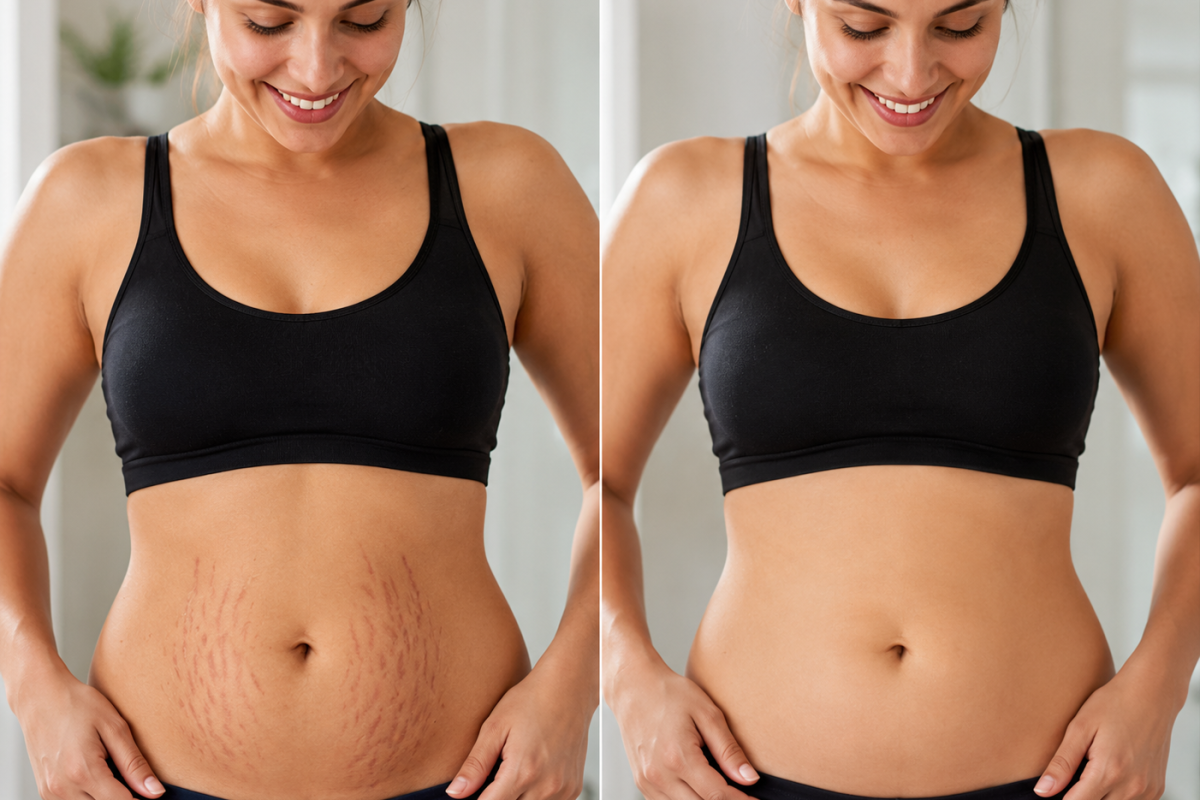
Stretch Mark Removal in Delhi — A Practical, Honest Guide
Stretch marks are one of those things almost everyone has, very few people talk about, and a surprising number quietly wish they could do something about. They show up after pregnancy, after a growth spurt in the teenage years, after rapid muscle gain at the gym, or after any significant change in body size. Medically they’re called striae, and they are essentially a form of scarring that occurs in the deeper layer of the skin when it stretches faster than it can adapt.
Here’s the honest part that most clinic websites won’t tell you upfront: stretch marks cannot always be completely erased. What modern treatment can do — and do well — is fade them substantially, improve the skin’s texture and colour so they blend into the surrounding skin, and in many cases reduce their visibility by 50 to 80 percent. For most people, that’s the difference between marks they feel they have to hide and skin they feel comfortable in again.
At Sarayu Clinics, Greater Kailash-1, New Delhi, Dr. Adarsh Tripathi — a Maxillofacial and Facial Plastic Surgeon with over 18 years of experience — offers a full range of evidence-based stretch mark treatments. Because stretch marks are fundamentally a scarring problem, having them treated by a surgeon with deep experience in skin healing, collagen remodelling, and scar revision is a genuine advantage. This page walks you through every treatment, what realistically works for which type of stretch mark, costs, recovery, and how to get the best possible outcome.
What Stretch Mark Treatment Can Realistically Achieve ?
Let’s be clear about benefits, because honesty here builds trust — and frankly it’s what Google’s quality guidelines reward too. Here is what professional stretch mark removal actually delivers:
Real, Achievable Benefits
- Significant fading — newer red or purple stretch marks can fade by 70-80%; older white marks typically improve 40-60%
- Improved skin texture — the indented, ridged, or wrinkled feel of stretch marks is smoothed as new collagen fills the area
- Better colour match — red, purple, and dark brown marks are brought closer to your natural skin tone
- Reduced visibility under normal lighting — marks that were obvious become difficult to notice
- Firmer, more resilient skin in the treated area, due to new collagen and elastin production
- Long-lasting results — once collagen is rebuilt, the improvement is durable, though new marks can form with future skin stretching
- Renewed confidence — patients consistently report comfort wearing swimwear, fitted clothes, and being intimate without self-consciousness
An Honest Note on Expectations
No treatment, anywhere in the world, guarantees 100% removal of stretch marks — particularly old, white, mature ones. Any clinic promising complete erasure is overpromising. What a well-designed treatment plan reliably achieves is meaningful, visible improvement that makes the marks far less noticeable. Setting this expectation honestly upfront is part of how Dr. Adarsh Tripathi approaches every consultation — you’ll always know what’s realistically achievable for your specific marks before any treatment begins.
Body Areas Where Stretch Marks Are Treated
Stretch marks can appear anywhere the skin has stretched rapidly. Different body areas have different skin thickness and respond slightly differently to treatment. Dr. Adarsh Tripathi’s clinic treats stretch marks on all of the following:
Abdomen / Stomach
The most common location, especially after pregnancy (where they’re often called striae gravidarum) and after significant weight changes. Post-pregnancy abdominal stretch marks typically run horizontally and vertically below the navel. This area responds well to combined microneedling RF and laser treatment. For women who also have loose abdominal skin after pregnancy, treatment can be discussed alongside skin-tightening options.
Thighs
Inner and outer thighs are very common sites, affected by both weight fluctuation and the natural changes of puberty. Thigh stretch marks often appear in clusters of parallel lines. The skin here is thicker, which means it tolerates slightly more aggressive treatment settings and responds reliably to fractional laser and microneedling RF.
Hips and Buttocks
Frequently affected during adolescent growth spurts and weight changes. These marks are often deeper and wider. A combination approach of microneedling RF (to remodel the deeper dermis) plus laser (to address surface texture and colour) gives the best results here.
Breasts and Chest
Common after pregnancy, breastfeeding, breast growth during puberty, or weight change. The skin here is delicate, so gentler settings and careful technique are used. Stretch marks on the upper chest and around the breasts respond well to microneedling and PRP, which are well-tolerated in this sensitive area.
Upper Arms
Particularly common in people who have gained muscle rapidly (bodybuilders) or experienced weight fluctuations. Arm stretch marks are often on the inner upper arm and respond well to laser and microneedling RF treatment.
Lower Back
More common in men, often appearing as horizontal lines across the lower back during adolescent growth or rapid muscle gain. These can be wide and prominent but respond well to fractional laser resurfacing.
Calves and Knees
Less common but seen in athletes and during growth spurts. The skin over the calves responds well to treatment, though the area near the knee requires careful technique due to skin movement.
Shoulders
Seen in those who’ve gained significant upper body muscle mass. Shoulder stretch marks respond well to standard laser and microneedling protocols.
Types of Stretch Marks and What Causes Them
Understanding which type of stretch mark you have is the single most important factor in predicting how well treatment will work. This is a critical piece of information that most competitor pages skip entirely — and it’s exactly what determines your realistic outcome.
Striae Rubrae (Red / Purple Stretch Marks) — The ‘New’ Marks
These are recent stretch marks, typically less than 12 months old. They appear red, pink, or purple because the blood vessels in the dermis are still visible through the thinned skin. This is the golden window for treatment — striae rubrae respond dramatically better than older marks because the skin is still in an active healing phase, and treatment can guide that healing toward better collagen formation. If you have red or purple stretch marks, the best advice is: don’t wait. Treat them now.
Striae Albae (White / Silver Stretch Marks) — The ‘Mature’ Marks
These are older stretch marks, usually more than a year old, that have faded to white, silver, or pale colour. The blood vessels have receded and the marks are now essentially mature scars with reduced collagen and pigment. They are more challenging to treat than red marks, but meaningful improvement is still very achievable — typically 40-60% — particularly with microneedling RF and fractional laser, which stimulate fresh collagen production in the depleted dermis.
Striae Gravidarum (Pregnancy Stretch Marks)
A specific subtype that develops during pregnancy, usually in the second and third trimester, on the abdomen, breasts, and hips. They are caused by the combination of rapid skin stretching and the hormonal changes of pregnancy, which affect skin elasticity. Treatment is deferred until after pregnancy and breastfeeding. They begin as striae rubrae and mature into striae albae, so treating them in the first few months postpartum (once cleared by your doctor) gives better results than waiting years.
Striae Distensae from Bodybuilding / Rapid Muscle Gain
Common in men who gain muscle mass rapidly, appearing on the shoulders, upper arms, chest, and lower back. The mechanism is the same — skin stretching faster than it can adapt. These respond well to treatment, particularly when caught early.
Steroid-Induced Stretch Marks
Prolonged use of oral or topical corticosteroids, or conditions like Cushing’s syndrome that involve excess natural cortisol, can cause stretch marks by reducing collagen production in the skin. These can be wider and more numerous. If steroid use is ongoing, addressing that with the prescribing doctor is important, as treatment results will be limited while the underlying cause continues.
Adolescent / Growth Spurt Stretch Marks
Very common during puberty, when rapid height and body changes outpace skin growth. Seen on the thighs, hips, lower back, and breasts. Often these begin to fade naturally over time, but treatment can accelerate and improve the outcome significantly.
Stretch Mark Treatments Available at Sarayu Clinics, Delhi
There is no single best treatment for every stretch mark — the right choice depends on the type, age, location, depth, and your skin tone. In practice, the best results almost always come from combining two or more of the following:
1. Fractional Laser Resurfacing
The most established and effective stretch mark treatment. Fractional lasers (both ablative CO2 and non-ablative erbium/Nd:YAG depending on the case) create thousands of microscopic columns of controlled thermal injury in the skin. This triggers the body’s wound-healing response, stimulating fresh collagen and elastin production that remodels the stretched, scarred tissue over the following weeks and months. The ‘fractional’ approach means only a fraction of the skin is treated at once, leaving surrounding tissue intact to speed healing.
- Best for: both red and white stretch marks; texture and colour improvement
- Sessions: 4-6, spaced 4-6 weeks apart
- Downtime: 3-7 days of redness and mild peeling (more for ablative CO2)
- Note: laser settings are adjusted carefully for Indian (Fitzpatrick IV-V) skin to avoid post-inflammatory pigmentation
2. Microneedling Radiofrequency (RF Microneedling / Morpheus8-type treatment)
One of the most effective modern treatments for stretch marks, especially deeper and older ones. Fine needles penetrate to a precise depth in the dermis and deliver radiofrequency energy directly into the tissue. This combines the collagen-stimulating effect of microneedling with the deep heating effect of RF — remodelling the dermis from within. Because the RF energy bypasses the skin surface, microneedling RF is generally safer for darker skin tones than ablative laser, with lower risk of pigmentation issues.
- Best for: deep stretch marks, white/mature marks, darker skin tones
- Sessions: 4-6, spaced 4 weeks apart
- Downtime: 1-3 days of redness and tiny dot marks
3. Traditional Microneedling (Dermaroller / Dermapen)
A mechanical collagen-induction therapy using fine needles to create controlled micro-injuries in the skin, prompting natural collagen repair. It’s gentler and more affordable than RF microneedling, and works well for newer, more superficial stretch marks. Often combined with PRP or topical growth factors applied immediately after to enhance results. A good entry-level treatment or maintenance option.
- Best for: newer stretch marks, superficial marks, budget-conscious patients
- Sessions: 5-8, spaced 3-4 weeks apart
- Downtime: 1-2 days of redness
4. Platelet-Rich Plasma (PRP) Therapy
PRP uses a concentration of growth factors derived from your own blood. A small sample of your blood is drawn, spun in a centrifuge to concentrate the platelets and growth factors, and the resulting PRP is applied to or injected into the stretch marks — usually in combination with microneedling or laser, which create channels for the PRP to penetrate. The growth factors accelerate collagen production and tissue healing. Because PRP comes from your own body, there’s no risk of allergic reaction.
- Best for: enhancing results of microneedling or laser; natural collagen boost
- Sessions: combined with 3-4 microneedling/laser sessions
- Downtime: same as the procedure it’s combined with
5. Carboxytherapy
A treatment where small amounts of medical carbon dioxide gas are injected just beneath the skin. This improves local circulation, stimulates collagen production, and improves skin elasticity in the treated area. It’s used as an adjunct treatment for stretch marks, often alongside microneedling, and is particularly useful for improving the colour and texture of marks.
- Best for: improving circulation and colour in stretch mark areas; adjunct therapy
- Sessions: 6-10, spaced 1-2 weeks apart
- Downtime: minimal — mild bruising possible
6. Chemical Peels
Medical-grade peels (glycolic acid, TCA) can improve the surface appearance and colour of stretch marks by accelerating skin cell turnover and stimulating mild collagen renewal. Peels work best on newer, more superficial marks and are often used in combination with other treatments rather than as a standalone solution for deep marks.
- Best for: newer marks, colour/texture improvement, combination protocols
- Sessions: 4-6, spaced 2-3 weeks apart
- Downtime: mild peeling 3-5 days
7. Topical Prescription Therapy (Retinoids and Supportive Skincare)
Prescription retinoids (tretinoin) applied topically can improve the appearance of early, red stretch marks by boosting collagen production — though they must NOT be used during pregnancy or breastfeeding. Supportive skincare with ingredients like hyaluronic acid, centella asiatica, and silicone gels can help maintain results between clinic treatments. Topicals alone produce modest results but are a valuable part of a complete plan, particularly for very new marks.
- Best for: very early red marks; maintenance between clinic sessions
- Note: retinoids are contraindicated in pregnancy and breastfeeding
8. Combination Protocols — The Real Best Practice
In practice, the best stretch mark results almost never come from a single treatment used in isolation. The protocols that consistently deliver the strongest improvement combine modalities — for example, microneedling RF to remodel the deep dermis, plus fractional laser for surface texture and colour, plus PRP to accelerate healing, supported by a topical home regimen. Dr. Adarsh Tripathi designs combination protocols based on your specific stretch mark type rather than offering a one-size-fits-all package.
Who Is a Good Candidate for Stretch Mark Removal?
Most people with stretch marks are suitable candidates for at least one of the available treatments. The key factors are the age and type of your marks, your skin tone, and your general health.
You’re likely a good candidate if:
- You have stretch marks that bother you cosmetically — whether new (red/purple) or old (white)
- You have realistic expectations — significant fading and texture improvement, not necessarily 100% erasure
- You’re in good general health with no active skin infection in the treatment area
- You’re not currently pregnant or breastfeeding (treatment is deferred until after)
- You’re willing to complete a full course of sessions and follow aftercare (sun protection is essential)
- Your weight is relatively stable — treating marks while still gaining or losing significant weight risks new marks forming
Best results are seen when:
- Stretch marks are still red or purple (the active healing window)
- Marks are on thicker-skinned areas like thighs and abdomen
- You’re a non-smoker (smoking significantly impairs collagen production and healing)
- Your weight has been stable for at least 6 months
You should wait or discuss carefully if:
- You’re pregnant or breastfeeding — wait until you’ve finished and been cleared by your doctor
- You have an active tan — treatment on tanned skin increases pigmentation risk; wait for the tan to fade
- You have a history of keloid scarring — needs careful assessment before any skin-injuring treatment
- You’re on isotretinoin (for acne) — most laser and microneedling treatments are deferred until 6 months after stopping
- You have an active skin infection, eczema flare, or open wound in the area
The Stretch Mark Removal Process — Step by Step
Step 1: Consultation and Assessment
Your first appointment involves a detailed assessment of your stretch marks — their type (red vs white), age, depth, location, and extent — along with your skin tone (Fitzpatrick type), medical history, and any factors like recent pregnancy, ongoing weight change, or medications. Dr. Adarsh Tripathi will explain realistically what improvement is achievable for your specific marks and recommend the most effective treatment combination. This honest, individualised assessment is the foundation of a good outcome.
Step 2: Personalised Treatment Plan
Based on the assessment, a treatment plan specifies which modalities will be used, how many sessions are likely needed, the spacing between sessions, and the home skincare regimen. For most patients this is a combination protocol rather than a single treatment. The plan also includes a realistic timeline and cost breakdown so there are no surprises.
Step 3: Pre-Treatment Preparation
- Avoid sun exposure and tanning for 2 weeks before treatment
- Stop retinoids and exfoliating acids 5-7 days before laser or microneedling
- Stay well hydrated and moisturise the area in the days before treatment
- Avoid blood-thinning medications and supplements for a week before (if PRP or microneedling is planned), as advised
- Arrive with clean skin, free of lotions or oils, on the treatment day
Step 4: The Treatment Session
What happens depends on the treatment, but a typical microneedling RF or laser session follows this pattern:
- The treatment area is cleansed and a topical numbing cream is applied for 30-45 minutes
- The area is cleaned again and the numbing confirmed
- The treatment device (laser handpiece or microneedling RF applicator) is moved systematically across the marks
- If PRP is part of the plan, blood is drawn and processed during the numbing period, then applied
- A soothing, cooling product is applied, followed by sun protection
A session typically takes 30-60 minutes depending on the size of the area treated.
Step 5: Aftercare
- Apply prescribed soothing/healing cream as directed
- Strict sun protection — SPF 50+ on exposed treated areas, every day
- Keep the area clean and moisturised
- Avoid swimming, saunas, and strenuous exercise for 48-72 hours
- Don’t pick at any flaking or scabbing — let it heal naturally
- Resume retinoids and active skincare only once the skin has fully settled (as advised)
Downtime and Recovery — What to Expect
One of the advantages of modern stretch mark treatments is that most involve little social downtime. Here’s a realistic comparison across treatments:
Treatment | Discomfort Level | Visible After-Effects | Downtime | Back to Routine |
Fractional Laser (non-ablative) | Mild-moderate | Redness, mild swelling | 3-5 days | Next day |
Fractional Laser (ablative CO2) | Moderate | Redness, peeling, crusting | 5-7 days | 2-3 days |
Microneedling RF | Mild (numbed) | Redness, pinpoint marks | 1-3 days | Same/next day |
Traditional Microneedling | Mild (numbed) | Redness | 1-2 days | Next day |
PRP (with microneedling) | Mild | Redness, mild bruising | 1-2 days | Next day |
Carboxytherapy | Mild | Possible mild bruising | Minimal | Same day |
Chemical Peel | Mild stinging | Mild peeling | 3-5 days | Next day |
General Recovery Notes
- Redness is the most common after-effect and is usually the only visible sign — it fades within a few days
- The treated area may feel like a mild sunburn for the first 24 hours
- Because stretch marks are usually on the body (not the face), they’re easily covered by clothing during recovery
- Results develop gradually over weeks to months as new collagen forms — this is normal and expected
- Sun protection during recovery is the single most important factor in preventing pigmentation and protecting results
Stretch Mark Removal Cost in Delhi — Transparent Pricing
Cost is one of the most common search queries, and clinics across Delhi quote a wide range. Pricing depends on the treatment type, the size of the area, the number of sessions needed, and the clinic’s expertise and equipment. Here’s a clear breakdown:
What Affects the Cost ?
- Treatment type — laser and RF microneedling cost more than traditional microneedling or peels
- Size of the treatment area — a small area (e.g. inner arms) costs less than a large area (e.g. full abdomen and hips)
- Number of sessions — most people need 4-6 sessions for meaningful results
- Type and age of stretch marks — older, more extensive marks need more sessions
- Whether combination treatments (laser + PRP, etc.) are used
Approximate Cost at Sarayu Clinics, Delhi
Treatment | Cost Per Session | Recommended Sessions | Approx. Total |
Fractional Laser Resurfacing | Rs. 8,000-15,000 | 4-6 | Rs. 32,000-90,000 |
Microneedling RF (Morpheus8-type) | Rs. 10,000-20,000 | 4-6 | Rs. 40,000-1,20,000 |
Traditional Microneedling | Rs. 4,000-8,000 | 5-8 | Rs. 20,000-64,000 |
PRP Therapy (add-on) | Rs. 5,000-10,000 | 3-4 | Rs. 15,000-40,000 |
Carboxytherapy | Rs. 3,000-6,000 | 6-10 | Rs. 18,000-60,000 |
Chemical Peel | Rs. 2,000-4,000 | 4-6 | Rs. 8,000-24,000 |
Combination Protocol | Customised | 4-6 | Quoted at consultation |
Results Timeline — When Will You See Improvement?
Stretch mark treatment works by stimulating new collagen, and collagen takes time to form and remodel. This means results are gradual — and understanding the timeline prevents the unnecessary worry that comes from expecting instant change.
The Realistic Timeline
- First 2 weeks after a session: the treated area heals; you may notice minimal change at first
- Weeks 3-6: early collagen remodelling begins; subtle improvement in texture starts to show
- After 2-3 sessions (months 2-3): visible improvement in colour and texture becomes clear
- After the full course (months 4-6): the main results are evident — significant fading and smoother texture
- Months 6-12: collagen continues to remodel and results keep improving even after sessions finish
Results by Stretch Mark Type
- Red/purple (new) marks: often 70-80% improvement; respond fastest and most dramatically
- White/silver (mature) marks: typically 40-60% improvement; need more sessions and patience
- Deep, wide marks: improve in texture and depth but may not flatten completely
- Pregnancy marks treated early (within months postpartum): respond significantly better than those left for years
How Long Do Results Last?
Once new collagen has rebuilt the treated area, the improvement is long-lasting and durable. The treated stretch marks don’t ‘come back’. However, the skin can form new stretch marks if it stretches rapidly again in future — for example, with another pregnancy or significant weight gain. Maintaining a stable weight and good skin hydration helps preserve results and prevent new marks.
Treatment Comparison — Which Is Right for You?
Your Situation | Best First Choice | Strong Alternative | Why |
New red/purple marks | Fractional laser | Microneedling + PRP | Active healing window responds fast |
Old white marks | Microneedling RF | Fractional CO2 laser | Deep collagen stimulation needed |
Deep/wide marks | Microneedling RF | RF + laser combo | RF reaches deep dermis |
Darker skin (Fitz IV-VI) | Microneedling RF | Traditional microneedling | Lower pigmentation risk than laser |
Sensitive areas (chest) | Microneedling + PRP | Carboxytherapy | Gentle, well tolerated |
Budget-conscious | Traditional microneedling | Chemical peels | Effective and affordable |
Post-pregnancy (cleared) | Microneedling RF + PRP | Fractional laser | Treats both colour and texture |
Best possible result | Combination protocol | — | Multi-modality outperforms single |
Professional Treatment vs At-Home Products and Creams
This question deserves an honest answer, because the stretch mark cream industry is enormous and the claims are often overstated.
- Stretch mark creams (cocoa butter, shea butter, bio-oil): keep skin hydrated and may modestly help very new marks, but no cream can rebuild the deep dermal collagen that determines stretch mark appearance. They cannot replicate clinical results.
- Retinoid creams (prescription): genuinely help early red marks by stimulating collagen — but are weaker than clinical treatments and unsafe in pregnancy
- Hyaluronic acid and centella products: support skin health and are useful for maintenance, but won’t remove established marks
- Derma rollers (at-home): the needles are too short to reach the dermis effectively and carry infection risk if not used correctly — clinical microneedling reaches the proper depth safely
The honest bottom line: creams are good for prevention and maintenance. For visibly improving existing stretch marks — especially mature ones — professional treatments that stimulate deep collagen are in a different league entirely.
Safety, Side Effects, and Risk Management
Stretch mark treatments are safe when performed by an experienced practitioner with appropriate equipment and settings for your skin type. Here’s an honest overview of what to expect and what to watch for.
Common, Expected Effects
- Redness and mild swelling for 1-5 days depending on treatment intensity
- A sunburn-like sensation for the first 24 hours
- Pinpoint marks or mild bruising after microneedling or PRP — resolves in a few days
- Mild peeling or flaking after laser or chemical peels
Less Common Risks
- Post-inflammatory hyperpigmentation (temporary darkening) — more likely in darker skin; minimised with correct settings and sun protection
- Temporary hypopigmentation (lightening) — uncommon, usually resolves
- Infection — rare with proper sterile technique and aftercare
- Prolonged redness — uncommon, settles with time
Rare Risks
- Burns or scarring from incorrect laser settings — prevented by experienced practitioners and conservative settings for Indian skin
- Worsened pigmentation from treating tanned skin — prevented by avoiding treatment on tanned or sun-exposed skin
- Keloid formation in predisposed individuals — screened for during consultation
How Sarayu Clinics Manages Risk
- Thorough consultation and skin typing before any treatment
- Patch testing for new patients before laser treatment
- Conservative, skin-tone-appropriate settings for Fitzpatrick IV-VI Indian skin
- Sterile technique for all microneedling and PRP procedures
- Clear written aftercare instructions and post-treatment support
Why Choose Dr. Adarsh Tripathi for Stretch Mark Removal?
Dr. Adarsh Tripathi is a Maxillofacial and Facial Plastic Surgeon with over 18 years of clinical experience at Sarayu Clinics, Greater Kailash-1, New Delhi. Here’s why his background is particularly relevant to stretch mark treatment specifically:
- Stretch marks are fundamentally a scarring problem — and as a plastic surgeon with extensive scar revision experience, Dr. Tripathi understands skin healing, collagen remodelling, and how to guide damaged skin toward better repair
- Deep knowledge of skin anatomy across different body areas — meaning treatment depth and intensity are calibrated correctly for the abdomen versus the delicate chest versus the thicker thighs
- Experience treating Indian skin tones as the default patient demographic — critical for avoiding the pigmentation complications that can occur with poorly calibrated treatment
- Access to a full range of treatment modalities — so your plan is built around what actually works for your marks, not limited to whatever single device a clinic happens to own
- An honest, expectation-setting approach — you’ll always know what’s realistically achievable before treatment begins
- Consultations conducted personally by Dr. Tripathi, not delegated to a coordinator
Frequently Asked Questions — Stretch Mark Removal in Delhi
Q: Can stretch marks be completely removed?
A: Stretch marks can be significantly faded but rarely removed 100%. Modern treatments like fractional laser, microneedling RF, and PRP can reduce their visibility by 70-80% for new (red/purple) marks and 40-60% for old (white) marks. The goal is making them far less noticeable rather than complete erasure — any clinic promising total removal is overpromising.
Q: How much does stretch mark removal cost in Delhi?
A: Stretch mark removal in Delhi costs approximately Rs. 5,000-Rs. 15,000 per session for most treatments, with laser and RF microneedling at the higher end. Most people need 4-6 sessions, bringing total costs to roughly Rs. 30,000-Rs. 1,20,000 depending on the treatment type and area size. A personalised quote is given after consultation at Sarayu Clinics.
Q: What is the best treatment for stretch marks?
A: The best treatment depends on the type of stretch mark. For new red marks, fractional laser works very well. For old white marks and deep marks, microneedling radiofrequency is most effective. In practice, the strongest results come from combining treatments — for example microneedling RF plus laser plus PRP — rather than relying on a single modality. Dr. Adarsh Tripathi designs combination protocols based on your specific marks.
Q: How many sessions are needed to remove stretch marks?
A: Most people need 4-6 sessions for meaningful stretch mark improvement, spaced 4-6 weeks apart. Newer marks may respond in fewer sessions, while old, extensive, or deep marks may need more. Results continue to improve for several months after the final session as new collagen forms.
Q: Do stretch mark treatments work on old white stretch marks?
A: Yes, but old white stretch marks improve more modestly than new ones — typically 40-60% versus 70-80% for red marks. White marks are mature scars with depleted collagen, so they need treatments that stimulate fresh collagen deep in the skin, like microneedling radiofrequency and fractional laser. More sessions are usually required, but meaningful improvement is genuinely achievable.
Q: Is stretch mark removal painful?
A: Stretch mark treatments cause minimal pain because a topical numbing cream is applied beforehand. During treatment most people feel mild warmth, tingling, or a light prickling sensation. Microneedling and laser feel like mild discomfort rather than real pain. After treatment, the area feels like a mild sunburn for about 24 hours.
Q: When can I treat stretch marks after pregnancy?
A: Stretch mark treatment after pregnancy can usually begin once you’ve finished breastfeeding and been cleared by your doctor — often a few months postpartum. Treating pregnancy stretch marks while they’re still red or purple gives significantly better results than waiting years for them to turn white. Retinoid creams and several procedures are not safe during pregnancy or breastfeeding, so timing matters.
Q: Is laser stretch mark removal safe for Indian skin?
A: Yes, laser stretch mark removal is safe for Indian skin when performed by an experienced practitioner using appropriate, conservative settings. Indian (Fitzpatrick IV-VI) skin has a higher risk of post-treatment pigmentation, so microneedling radiofrequency is often preferred over ablative laser as it carries lower pigmentation risk. Correct settings and proper sun protection are essential.
Q: Do stretch mark creams actually work?
A: Stretch mark creams have limited effectiveness. Moisturising creams like cocoa butter and bio-oil keep skin hydrated and may modestly help very new marks, but no cream can rebuild the deep dermal collagen that determines a stretch mark’s appearance. Prescription retinoid creams help early red marks somewhat, but for visible improvement of existing marks, professional treatments are far more effective.
Q: Will stretch marks come back after treatment?
A: Treated stretch marks do not come back — once new collagen rebuilds the area, the improvement is durable. However, the skin can develop new stretch marks if it stretches rapidly again in future, such as during another pregnancy or significant weight gain. Maintaining a stable weight and well-hydrated skin helps prevent new marks from forming.
Q: What’s the difference between red and white stretch marks for treatment?
A: Red or purple stretch marks (striae rubrae) are newer, less than about a year old, and respond dramatically better to treatment because the skin is still actively healing. White or silver marks (striae albae) are mature scars with reduced collagen and pigment, and improve more modestly with more sessions needed. The practical advice: treat stretch marks while they’re still red for the best results.
Q: How soon will I see results from stretch mark treatment?
A: Visible improvement in stretch marks typically becomes clear after 2-3 sessions, around months 2-3 of treatment. Because the treatments work by stimulating new collagen, which takes time to form, results are gradual and continue improving for up to 6-12 months even after the sessions finish. Immediate dramatic change after a single session is not realistic.
How to Reach Us:
Phone:+91 9289111083 ,+91 9289111084
Email: sarayuinquiries@gmail.com
Dr Adarsh’s website: https://dradarshtripathi.com/
Facebook: https://www.facebook.com/DrAdarshTripathi3011
Instagram: https://www.instagram.com/dr_adarsh_tripathi/
Youtube: https://www.youtube.com/@dr_adarsh_tripathi
Linkedin: https://www.linkedin.com/in/dr-adarsh-tripathi-a43005b8/
Online Booking: https://dradarshtripathi.com/contact-us/ to schedule appointments conveniently.