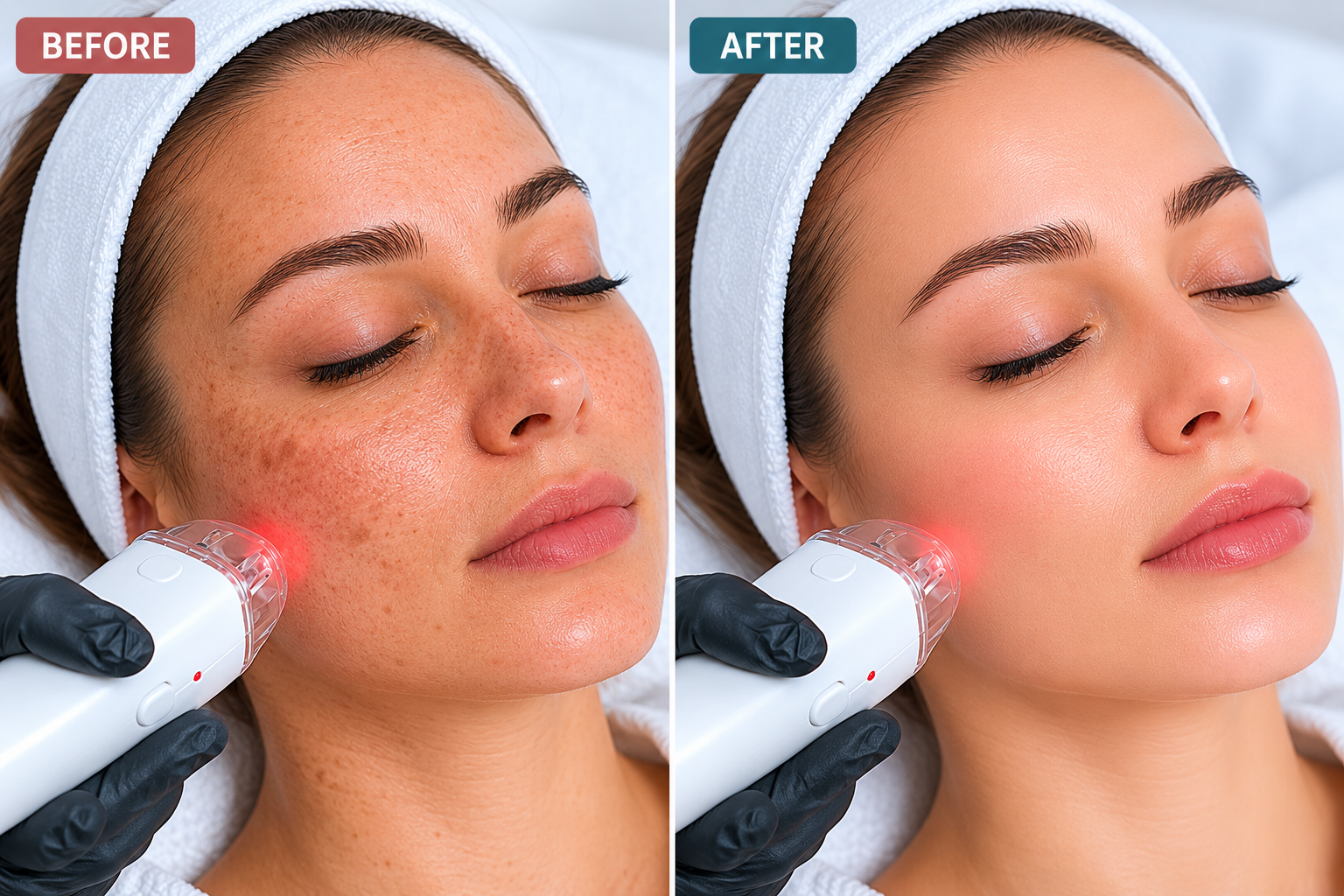
Laser Toning Treatment in Delhi: The Complete Guide for Indian Skin
Look around at the skin concerns that bring most people to a clinic in Delhi — dark spots, uneven skin tone, persistent dullness, melasma that refuses to respond to creams, pigmentation that returns every summer. These are not vanity problems. They are predictable consequences of living in a high-UV environment with skin types that produce melanin readily and, in many cases, excessively.
Laser toning is one of the most effective treatments for exactly these concerns — and it has been used successfully for over two decades. But most clinics in Delhi describe it in the same way: a paragraph about Q-switched Nd:YAG lasers, a list of conditions treated, a cost range, and a call to action. Very few tell you what the different laser technologies actually do, which one suits your skin type, why Indian skin needs to be treated differently from skin in a Western clinical setting, or what realistic results look like session by session.
This page does all of that. Dr. Adarsh Tripathi’s approach to laser toning at Sarayu Clinics is grounded in a specific understanding of South Asian skin — its strengths, its tendencies, and the risks that must be managed carefully. If you are considering laser toning in Delhi, reading this guide first will help you ask the right questions and make a genuinely informed decision.
What Is Laser Toning and How Does It Work?
Laser toning is a non-ablative laser procedure that uses precisely controlled pulses of laser light to target and break down excess melanin (the pigment responsible for dark spots and uneven tone) in the skin, while simultaneously stimulating collagen production in the deeper layers.
‘Non-ablative’ means the laser does not remove or damage the top layer of skin the way ablative lasers (like CO2) do. Instead, the energy passes through the surface and acts selectively on the pigment beneath — a principle called selective photothermolysis. The laser is attracted to melanin and creates a photoacoustic shock within the pigment granule that breaks it apart. The fragments are then naturally cleared by the immune system over the following weeks.
At the same time, the controlled energy reaching the dermis (the deeper skin layer) stimulates fibroblasts — the cells that produce collagen and elastin. Over a course of treatment, this produces a gradual improvement in skin firmness, texture, and overall radiance that goes beyond just pigmentation correction.
Why Two Wavelengths Matter: 1064 nm vs 532 nm ?
The Q-switched Nd:YAG laser used in laser toning operates at two wavelengths: 1064 nanometres (nm) and 532 nm. The 1064 nm wavelength penetrates deeper into the skin and is the primary workhorse — it targets deeper melanin deposits, stimulates collagen, and is particularly safe for darker Indian skin because it passes through the surface melanin without exciting it excessively. The 532 nm wavelength is more superficial, useful for lighter surface pigmentation, red spots, and vascular concerns near the skin surface.
Dr. Tripathi selects the appropriate wavelength — and the appropriate energy settings — based on your specific skin type, the depth of pigmentation, and the concern being treated. This is not a uniform protocol applied identically to every patient. The settings used for a fair-skinned patient with sunspots are different from those used for a Fitzpatrick type V patient with melasma. This distinction matters enormously for both safety and results.
What Is 'Low Fluence' Mode and Why Does It Matter?
You may see clinics advertise ‘low fluence Q-switched laser toning’ — this refers to using lower energy levels delivered in multiple rapid passes across the skin, rather than fewer high-energy pulses. For Indian skin types — which tend to be more reactive to laser energy — low fluence mode is often the safer, more controlled approach for conditions like melasma. It reduces the risk of post-inflammatory hyperpigmentation (PIH) — a condition where the skin responds to laser trauma by producing even more pigment. Low fluence mode is one of the most important technical distinctions that separates a good outcome from a bad one in Indian patients.
Laser Technologies Used for Toning at Sarayu Clinics
Not every skin concern requires the same laser. At Sarayu Clinics, Dr. Tripathi uses a range of laser platforms and selects the most appropriate one based on your specific concern, skin type, and treatment history. Here is a plain-language guide to each:
Q-Switched Nd:YAG Laser (1064 nm / 532 nm) · The foundation of laser toning for Indian skin
The Q-switched Nd:YAG is the most widely used and thoroughly validated laser for toning and pigmentation in South Asian skin. Its 1064 nm wavelength has a high safety profile for Fitzpatrick types III to V (which covers the majority of patients in Delhi), because it is less aggressively absorbed by surface melanin and penetrates deeper to target melanin in the dermis as well as the epidermis. It is used in both standard mode and low-fluence mode depending on the concern.
Best for: Melasma, PIH (post-inflammatory hyperpigmentation), sun damage, tanning, overall dullness, large pores, mild acne marks.
Sessions typically required: 4 to 8 sessions spaced 3 to 4 weeks apart.
Pico Laser (Picosecond Technology) · Next-generation precision for stubborn pigmentation
Pico lasers deliver energy in picoseconds (trillionths of a second) rather than the nanoseconds of conventional Q-switched lasers. This ultra-short pulse duration produces a photoacoustic shattering of pigment particles rather than a thermal (heat) effect — meaning the pigment is broken into finer particles with significantly less heat transferred to surrounding tissue. The result is more effective pigment clearance with lower risk of thermal side effects, including PIH.
Pico laser is particularly useful for stubborn melasma that has not responded to conventional Q-switched treatment, for deeper pigmentation, and for patients who have had adverse reactions to standard laser toning in the past. It is also the preferred technology for tattoo removal when available.
Best for: Stubborn or recurrent melasma, deep pigmentation, acne scars (photoacoustic effect aids collagen remodelling), skin rejuvenation in patients with previous PIH from laser.
Sessions typically required: 4 to 6 sessions spaced 3 to 4 weeks apart. Results build more slowly than Q-switched but are often more stable.
Carbon Laser Peel (Hollywood Peel) · Pore refinement and oil control — ideal for acne-prone skin
The carbon laser peel is a different procedure from standard laser toning, even though it also uses a Q-switched Nd:YAG laser. In this treatment, a layer of medical-grade liquid carbon is applied to the skin. The carbon particles absorb deeply into pores. The laser is then passed over the face — the laser vaporises the carbon particles, and in doing so lifts away the sebum, dead skin cells, and debris that had absorbed into the carbon layer. The result is an immediate pore-cleansing, oil-controlling, and skin-brightening effect.
Carbon peels are lighter and more surface-level than standard laser toning. They are not the primary treatment for deep pigmentation or melasma, but they are excellent for acne-prone skin, oily skin, enlarged pores, and as a maintenance treatment between deeper sessions.
Best for: Acne-prone or oily skin, enlarged pores, surface blackheads, skin dullness, pre-event skin brightening (hence the ‘Hollywood’ moniker — quick visible result with zero downtime).
Sessions typically required: 1 session for an immediate event-ready result. For sustained improvement: 4 to 6 sessions monthly.
Downtime: None. Most patients return to their day immediately.
Feature | Q-Switched Nd:YAG | Pico Laser | Carbon Laser Peel |
Technology | Nanosecond pulses | Picosecond pulses | Q-switched + carbon |
Primary mechanism | Photothermal + photoacoustic | Photoacoustic (less heat) | Carbon vaporisation + pore cleanse |
Depth of action | Epidermis + upper dermis | Epidermis + mid dermis | Superficial |
Best for | Melasma, PIH, tanning, dullness | Stubborn pigmentation, deep marks | Oily skin, large pores, surface glow |
Indian skin safety | High (low fluence mode) | Very high (no thermal risk) | High |
Downtime | None to minimal | None | None |
Sessions (avg) | 4 to 8 | 4 to 6 | 1 to 6 (maintenance) |
Cost per session | Rs. 3,000 to 8,000 | Rs. 8,000 to 18,000 | Rs. 3,500 to 7,000 |
Conditions Treated with Laser Toning in Delhi
Laser toning is one of the most versatile non-surgical skin treatments available. At Sarayu Clinics, the following conditions are routinely treated:
- Melasma: Brown or greyish patches on the cheeks, upper lip, forehead, and chin — triggered or worsened by sun exposure, hormones (particularly in women during pregnancy or on oral contraceptives), and heat. Melasma is one of the most challenging pigmentation conditions to treat because it is chronic and tends to recur. Laser toning does not ‘cure’ melasma, but it significantly reduces it when combined with appropriate topical maintenance and strict sun protection.
- Post-Inflammatory Hyperpigmentation (PIH): Dark marks left after acne, insect bites, minor injuries, or previous skin treatments. Extremely common in Indian skin. Laser toning accelerates the clearance of these marks significantly compared to topical treatments alone.
- Sun Damage and Tanning: Uneven skin tone, dark patches, and diffuse tanning from UV exposure. Laser toning breaks down the excess melanin from sun exposure and restores a more even, radiant complexion.
- Freckles and Lentigines (Age Spots): Discrete small dark spots from UV exposure, particularly visible on cheeks and nose. Respond very well to laser toning — often cleared in 2 to 3 sessions.
- Dull, Tired-Looking Skin: Loss of radiance and vibrancy caused by accumulated dead skin cells, poor circulation, and reduced collagen. Laser toning stimulates collagen and clears the surface, restoring glow.
- Enlarged Pores: The thermal effect of laser toning contracts pores over a series of sessions, improving skin texture and a smoother surface appearance.
- Acne Marks and Mild Acne Scarring: Laser toning reduces the red and brown post-acne discolouration. For textural scars (pitted or raised), fractional CO2 or pico laser with specific settings is more effective — Dr. Tripathi can advise which is appropriate for your type of scarring.
- Uneven Skin Tone from Previous Skin Treatments: Patients who have used bleaching products, had adverse reactions to chemical treatments, or experienced uneven results from other cosmetic procedures. Laser toning can help re-homogenise the skin tone.
- Periorbital Pigmentation (Dark Circles from Pigmentation): For dark circles caused primarily by melanin in the skin under the eye (brown type), targeted low-fluence laser toning can reduce pigmentation. Note: dark circles caused by hollowing require fillers or fat grafting, not laser.
- Neck and Body Pigmentation: Sun damage, uneven tone, and pigmentation on the neck, decolletage, hands, arms, and back. See Areas Treated section below.
Body Areas Treated with Laser Toning
Most competitor pages in Delhi describe laser toning only for the face. At Sarayu Clinics, the treatment is available for multiple areas — all of which benefit from the same melanin-reduction and collagen-stimulation mechanisms:
Area | Common Concerns Addressed | Sessions Typically Required |
Face | Melasma, PIH, sun damage, tanning, dullness, freckles, large pores | 4 to 8 sessions |
Neck | Uneven tone from sun exposure, contrast with face colour, tanning lines | 4 to 6 sessions |
Décolletage (chest) | Sun damage, dark spots, skin roughness, age-related discolouration | 4 to 6 sessions |
Hands | Age spots, sun damage, uneven tone — hands age visibly and are often neglected | 3 to 5 sessions |
Arms (forearms, elbows) | Tanning lines, elbow darkening, uneven tone from sun or friction | 4 to 6 sessions |
Back and shoulders | Acne marks and PIH, sun damage, uneven pigmentation | 4 to 6 sessions |
Under-eye area | Pigmentation-type dark circles (brown tone), periorbital hyperpigmentation | 4 to 6 sessions |
Lips (perioral area) | Lip darkening from sun exposure, smoking, or post-inflammatory marks | 3 to 5 sessions |
Who Is a Good Candidate for Laser Toning?
Laser toning is one of the more broadly applicable cosmetic treatments — but it is not right for everyone, and not every skin concern responds to it. Here is an honest assessment of who benefits most and who should not proceed.
You are likely a good candidate if:
- You have pigmentation concerns — melasma, PIH, sun damage, freckles, uneven tone — as your primary complaint.
- Your skin is generally healthy with no active infections, open acne, or inflamed lesions in the treatment area.
- You are willing to commit to proper sun protection before, during, and after your treatment course. This is non-negotiable for laser toning to work.
- You are not currently pregnant or breastfeeding.
- You understand that laser toning is a course of treatment — not a one-session cure — and are prepared for gradual improvement over 4 to 8 sessions.
- You have realistic expectations: laser toning significantly improves pigmentation and skin quality. It does not permanently ‘fix’ melasma, as melasma is a chronic condition.
- You are not currently on photosensitising medications (such as certain antibiotics, retinoids, or anti-malaria drugs) — or are willing to pause them as advised.
You may NOT be a good candidate (or should proceed with caution) if:
- You have active acne breakouts in the treatment area — laser can spread bacteria and worsen active acne.
- You have had a tan or significant sun exposure within 2 to 4 weeks of your planned session. Laser on freshly tanned skin has a significantly higher risk of PIH in Indian patients.
- You have a history of keloid scarring — even though laser toning is non-ablative, there is a small risk of a hyper-reactive healing response.
- You are on isotretinoin (Accutane) — wait at least 6 months after completing the course before any laser treatment.
- Your dark circles are caused by hollowing (tear trough) rather than pigmentation — laser will not help, and fillers or fat grafting are the correct treatment.
- Your skin concern is primarily wrinkles or sagging — laser toning has limited effect on deep lines or tissue laxity. Other treatments are more appropriate.
- You have vitiligo — laser toning should be used with extreme caution, as it can alter the melanocyte function in adjacent skin.
What Happens During a Laser Toning Session: Step by Step ?
Here is a detailed account of what to expect on the day of your treatment. There should be no surprises.
Before Your First Session
- Consultation: Tripathi or a trained member of the clinical team assesses your skin type, concern, and treatment history. A Wood’s lamp or dermoscopy examination may be used to assess pigment depth. The most appropriate laser technology and settings are selected.
- Pre-treatment preparation: In the two weeks before laser toning, you will be advised to avoid sun exposure, stop any topical retinoids or photosensitising products, and apply a broad-spectrum SPF 50 sunscreen daily. In some cases (particularly for melasma), a topical tyrosinase inhibitor (such as hydroquinone or kojic acid) is prescribed in advance to ‘pre-condition’ the skin and reduce the risk of PIH.
- Patch test (where indicated): For new patients with darker skin types or a history of post-laser reactions, a small test area is treated and reviewed after 48 to 72 hours before proceeding to the full session.
On the Day of Your Session
- Skin cleansing: The treatment area is thoroughly cleansed to remove all makeup, sunscreen, oils, and debris. This is important — any surface residue can affect how the laser energy is distributed.
- Eye protection: Protective eye shields are placed over the eyes for all facial laser treatments. This is non-negotiable — your eyes must be protected from scattered laser energy.
- Cooling gel or air-cooling: A cooling gel or a chilled air device (Zimmer cryo-cooling) is used to keep the skin surface cool during the procedure, improving comfort and protecting the epidermis.
- Laser application: The laser handpiece is passed across the treatment area in a series of controlled passes at the pre-determined settings. You will feel a warm sensation, sometimes a mild snapping feeling — like a light flick of a rubber band. Most patients tolerate this easily without topical anaesthetic. If you have very sensitive skin, a topical numbing cream can be applied 30 to 45 minutes before.
- Post-treatment soothing: Immediately after the session, a cold compress or soothing mask (often containing aloe vera, hyaluronic acid, or centella asiatica extract) is applied to calm the skin and reduce the mild redness that follows.
- Sunscreen application: A broad-spectrum SPF 50 sunscreen is applied before you leave the clinic — even on overcast days. This is the single most important thing you do after each session.
- Aftercare instructions: A written post-treatment care sheet is provided. You are given a follow-up appointment for 3 to 4 weeks later.
Each session takes approximately 20 to 40 minutes for the face. Larger body areas take longer.
Downtime and Recovery After Laser Toning
One of the most appealing aspects of laser toning is its minimal downtime profile. Here is what to expect:
Timeline | What You Can Expect |
0 to 2 hours | Mild to moderate redness (erythema) in the treated area. Similar to a mild sunburn. This is normal and expected. |
Hours 2 to 24 | Redness subsides significantly in most patients. Mild warmth and sensitivity. Skin may feel slightly tight. Continue with your day normally — no significant social downtime. |
Day 1 to 3 | Skin may look slightly bronzed or darker in the treated pigmented areas — this is the pigment ‘rising to the surface’ as it fragments and begins clearing. Do not pick or scrub. Apply sunscreen diligently. |
Day 3 to 7 | The darkened pigment fragments shed naturally as the skin cells turn over. Skin may feel slightly flaky in treated areas. Use a gentle, non-exfoliating cleanser. Avoid active ingredients (retinoids, AHAs) for 7 days. |
Week 1 to 2 | The treated areas look cleaner, more even, and often brighter as the broken-down pigment clears. Continued improvement as collagen remodelling begins. |
Week 3 to 4 | Optimal time for next session (once every 3 to 4 weeks is the standard interval). Cumulative improvement builds with each session. |
Post-Treatment Do’s and Don’ts
- Do: Apply SPF 50 broad-spectrum sunscreen every 2 to 3 hours when outdoors — for at least 4 weeks after each session. This is the single most important instruction.
- Do: Keep the skin well-moisturised. Use a gentle, fragrance-free moisturiser.
- Do: Use a gentle, non-foaming cleanser for the first week.
- Do: Attend your follow-up sessions at the recommended intervals.
- Don’t: Scratch, pick, or aggressively rub the treated area.
- Don’t: Use AHA, BHA, retinoids, or vitamin C serums for the first 7 days post-treatment.
- Don’t: Have a facial, chemical peel, or any other skin treatment for 2 weeks after laser toning.
- Don’t: Go into direct sun without sunscreen. Even 10 minutes of unprotected sun after laser toning can reverse the results of an entire session.
- Don’t: Use steam rooms, saunas, or intense exercise for 24 to 48 hours post-treatment.
Results Timeline: What to Expect Session by Session
Most patients want to know when they will see results. Here is an honest, session-by-session guide. Results vary based on skin type, pigmentation depth, and consistency with sun protection.
Stage | What Most Patients Experience |
After Session 1 | Skin looks and feels cleaner. Minor dark spots may appear temporarily darker before fading (a normal sign the laser is working). Overall, skin looks more radiant within 1 to 2 weeks of the first session. Do not judge the full effect yet. |
After Sessions 2 to 3 | Noticeable reduction in surface-level dark spots, freckles, and tanning. Skin tone appears more even. Pores may look slightly finer. Collagen stimulation has begun but improvement is not yet fully visible. |
After Sessions 4 to 5 | More substantial improvement in melasma and PIH. The overall skin tone is visibly more uniform. Fine lines appear slightly softer. Patients typically start hearing comments from others that their skin looks ‘fresh’ or ‘glowing’. |
After Sessions 6 to 8 | Optimal result for most patients. Maximum pigmentation improvement achieved. Skin texture, radiance, and firmness are at their best. Maintenance sessions (every 2 to 3 months) are recommended to sustain results, particularly for melasma. |
Ongoing Maintenance | Without maintenance and strict sun protection, pigmentation (especially melasma) tends to gradually return, particularly with sun exposure. Maintenance sessions at Sarayu Clinics help sustain the result long-term. |
Laser Toning Cost in Delhi: A Transparent Breakdown
The cost of laser toning in Delhi varies considerably across clinics. Here is a straightforward breakdown of what affects pricing and what to expect at Sarayu Clinics:
Cost Factor | Detail |
Type of laser technology | Q-switched Nd:YAG: Rs. 3,000 to 8,000 per session. Pico Laser: Rs. 8,000 to 18,000 per session. Carbon Laser Peel: Rs. 3,500 to 7,000 per session. |
Treatment area | Face (most common): base pricing above. Neck or décolletage: similar to face. Full back or arms: Rs. 6,000 to 15,000 per session. Hands: Rs. 3,000 to 5,000. Combined face + neck: Rs. 5,000 to 12,000. |
Number of sessions needed | Most patients require 4 to 8 sessions. Mild concerns may need 3 to 4. Melasma or chronic PIH may require 6 to 10 sessions plus maintenance. Clinics offering a ‘package’ price (e.g. 6-session packages) typically offer a 10 to 20 percent discount. |
Condition severity | Deeper, more chronic pigmentation requires more sessions and sometimes a combination of laser types — this affects total cost. |
Combination with other treatments | Laser toning is often combined with chemical peels, skin boosters, or topical prescription treatments. Combined sessions are planned and priced at consultation. |
Clinic expertise and equipment | Premium South Delhi clinics with FDA-approved laser technology and experienced operators charge more. This directly correlates with safety and outcome quality. Do not choose a laser clinic on price alone. |
Laser Toning vs. Other Skin Brightening Treatments: Which Is Right for You?
Laser toning is one of several options for treating pigmentation and dull skin. Here is how it compares to the main alternatives so you can have an informed conversation at your consultation:
Treatment | Type | Downtime | Longevity | Best Suited For |
Laser Toning (Q-switched / Pico) | Non-invasive | None to minimal | Months to years with maintenance | Melasma, PIH, sun damage, overall tone |
Carbon Laser Peel | Non-invasive | None | 2 to 4 weeks | Oily skin, pores, surface glow, acne-prone |
Chemical Peels | Non-invasive | 1 to 7 days depending on depth | 2 to 6 months | Surface pigmentation, acne marks, dullness |
Topical treatments (creams) | Non-invasive | None | Ongoing (must continue) | Mild pigmentation, maintenance support |
Microneedling / RF Microneedling | Minimally invasive | 2 to 5 days | 6 to 18 months | Acne scars, texture, mild laxity; not primary pigmentation treatment |
Fractional CO2 Laser | Ablative | 5 to 14 days | 1 to 3 years | Deep acne scars, significant texture; higher risk for Indian skin |
Skin Boosters (HA injections) | Non-invasive | 1 to 2 days | 6 months | Skin hydration and glow; not a pigmentation treatment |
Facelift / Surgical resurfacing | Surgical | 2 to 6 weeks | 5 to 10 years | Significant laxity and ageing; not for pigmentation |
Combining Laser Toning with Other Treatments
Laser toning works well as a standalone treatment. But for patients who want faster or more comprehensive results, Dr. Tripathi frequently combines it with complementary procedures in a planned sequence:
- Laser Toning + Chemical Peel: Chemical peels address surface-level pigmentation and exfoliate the top layer of skin, while laser toning works deeper. Used alternately — one per session — they can produce faster clearance of pigmentation than either alone.
- Laser Toning + Skin Boosters: After a laser toning session, skin booster injections (highly diluted hyaluronic acid) improve hydration, skin quality, and radiance — complementing the toning’s collagen-stimulating effect.
- Laser Toning + Topical Prescription Programme: A medical-grade topical routine (vitamin C, niacinamide, hydroquinone if appropriate, and SPF 50) prescribed alongside laser sessions significantly improves outcomes and reduces the number of sessions needed.
- Laser Toning + Fat Grafting to Tear Trough: For patients with both pigmentation-type dark circles AND hollowing under the eyes — the laser addresses the pigment while fat grafting addresses the shadow from hollowing. Together they produce a much more complete result than either treatment alone.
Frequently Asked Questions About Laser Toning in Delhi
Q: Is laser toning safe for Indian skin?
A: Yes — when performed correctly with the right settings for Indian skin types (Fitzpatrick III to V). The Q-switched Nd:YAG at 1064 nm and pico laser technologies are both validated as safe for darker skin. The critical variable is using low-fluence settings, a properly trained operator, and thorough pre-assessment. The main risk — post-inflammatory hyperpigmentation — is greatly reduced with the correct protocol and strict sun protection.
Q: How many sessions of laser toning do I need?
A: Most patients require 4 to 8 sessions spaced 3 to 4 weeks apart for a full course of treatment. Mild concerns like surface sunspots may clear in 3 to 4 sessions. Chronic melasma or deep PIH typically needs 6 to 8 sessions plus ongoing maintenance. Dr. Tripathi will give you a personalised estimate at your consultation based on your specific concern and skin type.
Q: What is the cost of laser toning at Sarayu Clinics in Delhi?
A: Q-switched Nd:YAG laser toning starts from Rs. 3,000 to Rs. 8,000 per session depending on the area treated. Pico laser sessions range from Rs. 8,000 to Rs. 18,000. Carbon laser peel sessions are Rs. 3,500 to Rs. 7,000. Multi-session packages are available at a discounted rate. A personalised written cost plan is provided at your consultation.
Q: What is the difference between laser toning and a carbon laser peel?
A: Laser toning (Q-switched or Pico) works by penetrating the skin to break down melanin pigment and stimulate collagen — it treats deeper pigmentation concerns like melasma and PIH. A carbon laser peel uses the same laser to vaporise a carbon layer applied to the skin, producing an immediate pore-cleansing, oil-reducing, and surface-brightening effect with zero downtime. They serve different purposes: laser toning for pigmentation correction, carbon peel for oily skin and surface glow.
Q: Can laser toning permanently remove melasma?
A: No — and any clinic that promises this is being misleading. Melasma is a chronic condition driven by UV exposure and hormonal factors. Laser toning significantly reduces melasma and in some cases produces a dramatic improvement, but without ongoing sun protection and maintenance, it will gradually return. The honest goal is to manage melasma effectively — keeping it at a minimum with periodic treatment — rather than to eliminate it permanently.
Q: Does laser toning hurt?
A: Most patients describe the sensation as mild warmth or a light snapping feeling — similar to a rubber band flick. It is well-tolerated without anaesthesia for the majority of patients. If you have sensitive skin or are having a more intensive session, topical anaesthetic cream can be applied 30 to 45 minutes before treatment.
Q: How long do results from laser toning last?
A: Results from a full course of laser toning typically last 6 to 12 months before pigmentation (particularly melasma) begins returning with ongoing sun exposure. With strict daily SPF 50 sun protection, a prescribed topical maintenance programme, and maintenance sessions every 2 to 3 months, results can be sustained significantly longer.
Q: Can laser toning make my skin worse?
A: If incorrectly performed — wrong settings for your skin type, treatment on recently tanned skin, or inadequate post-treatment sun protection — laser toning can cause post-inflammatory hyperpigmentation (PIH), where the treated area becomes darker rather than lighter. This is one of the most preventable complications in aesthetic medicine and is why clinical assessment, experienced operators, and a strict aftercare protocol matter so much.
Q: Can I combine laser toning with other skincare treatments?
A: Yes, and it is often beneficial to do so. A topical prescription programme with vitamin C, niacinamide, and sun protection used alongside laser sessions significantly improves outcomes. Chemical peels can be alternated with laser sessions for faster results. Skin boosters can be added post-session. Dr. Tripathi plans combination approaches where appropriate. Active ingredients like retinoids should be paused in the week before and after each session.
Q: Is laser toning suitable for the body (not just the face)?
A: Yes. Laser toning can be safely applied to the neck, décolletage, hands, arms, back, and other body areas. Settings differ from the face and must be adjusted appropriately. At Sarayu Clinics, body area laser toning is planned with the same care as facial treatments. Body tanning, acne marks on the back, and age spots on the hands are among the most common body area concerns treated.
Q: How soon will I see results after laser toning?
A: Many patients notice their skin looking more radiant and even within 1 to 2 weeks of the first session, as the surface-level pigment begins clearing. More significant improvement in deeper pigmentation (melasma, chronic PIH) becomes visible after sessions 3 to 5. Full, optimal results from a complete course are typically visible 4 to 8 weeks after the final session as collagen remodelling matures.
Q: Can laser toning be done in the summer in Delhi?
A: It is best done during cooler months (October to March) when UV intensity is lower and post-treatment sun protection is easier to maintain. However, it can be performed year-round provided you are committed to strict daily SPF 50 application and sun avoidance. Summer months require extra vigilance — one poorly protected afternoon in the Delhi sun can significantly reverse a session’s results.
Why Patients Choose Sarayu Clinics for Laser Toning in Delhi ?
Laser toning is not a complicated procedure in terms of the machine itself — it is a complicated procedure in terms of the decision-making before and during it. Which laser technology? What fluence? How many passes? How does this patient’s Fitzpatrick type affect the plan? What topical programme supports the result? What should be done differently in session 3 versus session 1?
These questions are answered differently at every clinic, and the answers determine whether you get a good result, no result, or worse pigmentation than you started with. Here is why patients at Sarayu Clinics consistently report positive outcomes:
- Skin-type-specific protocols: Tripathi’s team uses treatment protocols specifically calibrated for South Asian skin — not adapted from Western clinical guides. Fitzpatrick types III to V require different parameter choices than types I and II, and this understanding is built into every treatment plan.
- Technology selection based on your concern: The clinic offers Q-switched Nd:YAG, Pico laser, and carbon laser technology. You receive the one that suits your concern — not the only one the clinic owns.
- Integration with a full facial assessment: Laser toning at Sarayu Clinics is planned in the context of your full facial picture. If your concern is dark circles, Dr. Tripathi identifies whether they are from pigmentation (laser), hollowing (fillers or fat grafting), or both — and plans accordingly.
- Honest management of expectations: You are told what the treatment can realistically achieve and what it cannot. If your concern is better addressed by a different treatment, that is what will be recommended.
- 16+ years of clinical experience: Adarsh Tripathi is a Facial Plastic and Maxillofacial Surgeon with over 16 years of dedicated experience in facial aesthetics — including both surgical and non-surgical approaches. His understanding of facial anatomy and skin physiology informs every treatment decision.
How to Reach Us:
Phone:+91 9289111083 ,+91 9289111084
Email: sarayuinquiries@gmail.com
Dr Adarsh’s website: https://dradarshtripathi.com/
Facebook: https://www.facebook.com/DrAdarshTripathi3011
Instagram: https://www.instagram.com/dr_adarsh_tripathi/
Youtube: https://www.youtube.com/@dr_adarsh_tripathi
Linkedin: https://www.linkedin.com/in/dr-adarsh-tripathi-a43005b8/
Online Booking: https://dradarshtripathi.com/contact-us/ to schedule appointments conveniently.