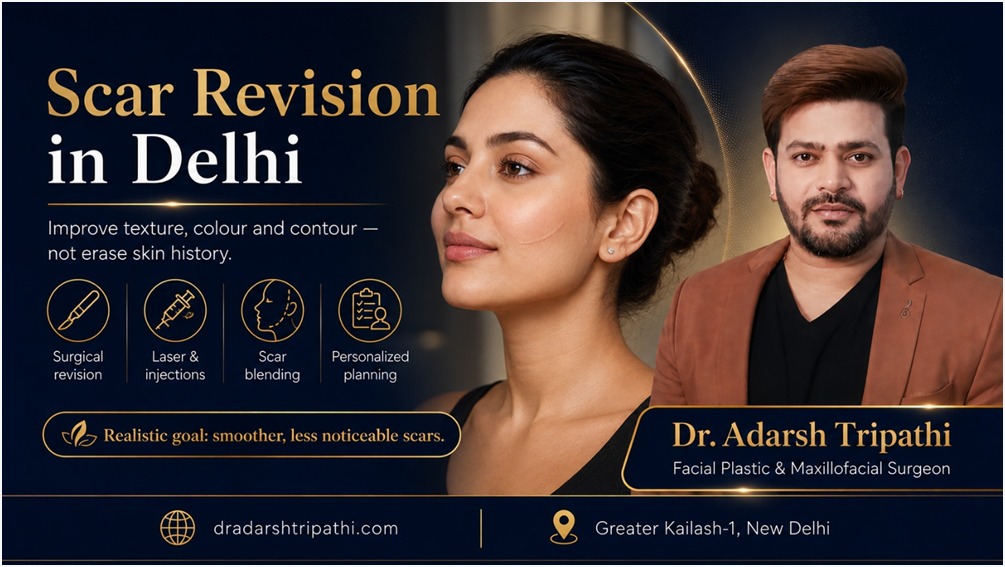
Scar Revision Surgery in Delhi — Honest, Type-Specific Treatment by a Facial Surgeon
Living with a scar is a quietly frustrating thing. The scar itself is just one part of it — the bigger frustration is the gap between what people expect from scar treatment and what actually works. The single most important thing on this page is this: a scar that responds beautifully to one treatment may get worse with another, and the difference between a great result and a disappointing one (or worse, a recurrence) starts with correctly identifying what type of scar you have and matching the treatment to it. Not every scar needs surgery. Not every keloid should be cut out. Not every depressed scar needs laser. The match is everything.
Here’s the most useful insight in scar revision, and it’s one most clinic pages quietly skip past: keloid scars — the thick, raised scars that grow beyond the original wound — should almost never be simply excised on their own. Keloids are a genetic tendency to overgrow scar tissue, so cutting one out without combination treatment (steroid injections, sometimes radiation, pressure therapy, silicone) usually causes it to come back, often bigger and angrier than before. Excision is part of the treatment, never the whole treatment. If a clinic offers to just ‘cut your keloid out’, that’s the moment to ask more questions.
Dr. Adarsh Tripathi is a Maxillofacial and Facial Plastic Surgeon with over 18 years of experience at Sarayu Clinics, Greater Kailash-1, New Delhi. Scar revision is core work for a facial surgeon — both because facial scars demand the most refined closure technique (positioning incisions along the face’s natural lines, using specialised plasties like Z-plasty and W-plasty), and because scar revision is fundamentally a surgical specialty. This page explains the scar types, which treatment suits each, when timing matters most, what surgery looks like, recovery, cost, and how to choose the right scar revision surgeon in Delhi.
Quick Answer — What is scar revision and what does it cost in Delhi?
Scar revision is a combination of surgical and non-surgical procedures that improve the appearance, texture, and function of scars from surgery, injury, burns, acne, or infection. Treatment is matched to the scar type: surgical excision and Z-plasty/W-plasty for problematic linear and contracture scars; steroid injections combined with excision for keloids; laser, microneedling RF, and subcision for acne and depressed scars; dermal fillers for instant lift; silicone and pressure therapy for fresh scars. In Delhi, scar revision costs approximately Rs. 5,000–30,000 per session for non-surgical treatment and Rs. 20,000–1,50,000 for surgical revision. Dr. Adarsh Tripathi at Sarayu Clinics, Greater Kailash, offers the full range matched to your specific scar.
Benefits of Scar Revision — What It Honestly Delivers
Done well, scar revision can transform how a scar looks and (for restrictive scars) how it feels and works. Here’s the honest picture:
- Significantly less visible scar — typically 50–90% improvement in appearance with the right combination
- Smoother, more even skin texture — depressed scars lifted, raised scars flattened
- Better skin colour match — pink/red scars fade; pigmented scars lighten
- Improved scar orientation — reorienting scars along natural skin lines makes them blend
- Released contractures — for burn scars restricting movement, surgery can restore function
- Reduced symptoms — itchy, painful, or tender scars (especially keloids) calmed by treatment
- Halted keloid recurrence — combination protocols prevent the regrowth that surgery alone causes
- Restored confidence — particularly for facial scars, the psychological impact of improvement is real
An absolutely necessary honest framing: no scar can be erased 100%. Scar revision makes scars dramatically less noticeable — often to the point where they’re hard to see in normal light and no longer something you think about — but the goal is improvement, not erasure. Any clinic promising complete removal is overpromising. The realistic, honest target — and what a good surgeon will help you achieve — is a scar that looks like a small natural skin variation rather than the scar it was.
Areas Treated for Scar Revision
Scars can be on any part of the body, and the location strongly affects the technique, the goal, and the result. Here’s what scar revision involves in different areas.
Face
Where scar revision matters most — facial scars are highly visible and the skin here heals with the finest results when correctly treated. Facial scar revision uses refined techniques: incision placement along relaxed skin tension lines (the face’s natural creases), Z-plasty or W-plasty to break up linear scars, and precise multi-layer closure for invisible final scars. This is where a facial surgeon’s expertise most directly translates into result.
Neck and Décolletage
The neck and chest area is prone to hypertrophic and keloid scars (genetic and tension-related). Treatment often combines steroid injections, silicone therapy, and (for keloids) careful surgical revision with adjunctive treatments.
Chest and Sternum
The chest, especially over the sternum, is a high-tension area where keloid scars commonly form — even from minor procedures. Combination protocols are essential here.
Shoulders and Upper Back
Another high-tension keloid-prone area. Scars from vaccinations, surgery, or acne respond best to layered combination treatment including pressure therapy.
Abdomen (C-Section and Surgical Scars)
C-section scars, appendectomy, hernia repair, and other abdominal surgical scars can be refined surgically (excision and refined closure) or with combination non-surgical protocols. Stretch-mark-like scars also respond to microneedling RF and laser.
Arms and Legs
Sun-exposed limb scars need particularly careful protection (UV worsens pigmentation). Surgical revision plus topical/laser support gives best results.
Hands
Hand scars from injury or surgery can affect both appearance and function. Z-plasty is particularly useful here for scars across joints.
Across Joints (Contracture Scars)
Scars that cross a joint — particularly from burns — can contract and restrict movement. These need specialised surgical release (Z-plasty, skin grafts, or flap surgery) before they can fully recover function and movement. Functional improvement is the priority before cosmetic refinement.
Burn Scars (Various Areas)
Burn scars require their own protocol — often involving release surgery for contractures, skin grafting where tissue is lost, fractional laser for texture, and long-term pressure garments and silicone therapy. A multi-stage approach over months to years.
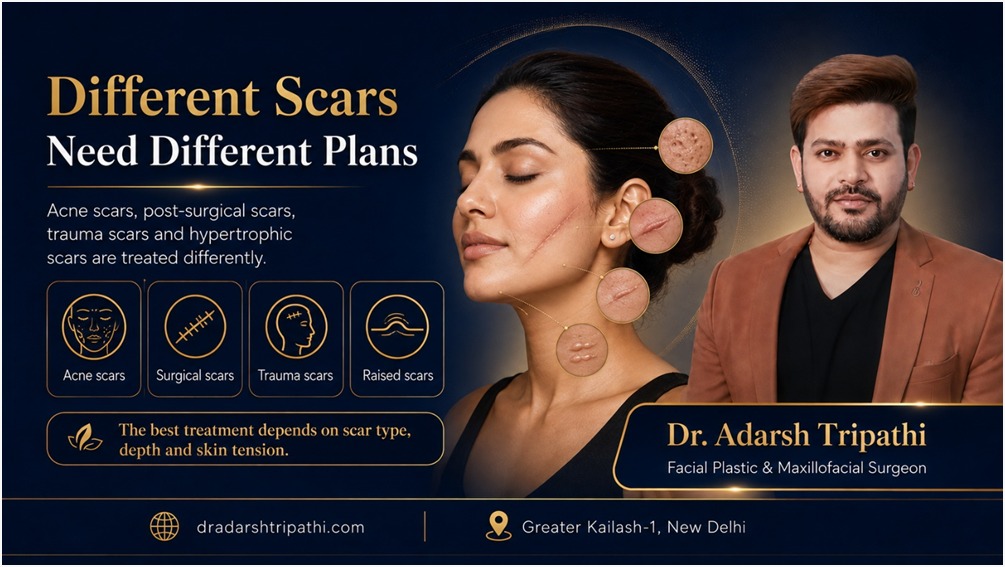
Conditions Treated — Scar Types and the Right Treatment for Each
This is the heart of effective scar revision. Identifying your scar type correctly determines which treatment will actually work — and which will fail or backfire.
Hypertrophic Scars
Raised, firm, sometimes red or itchy scars that stay within the boundaries of the original wound. They form when healing produces excess collagen. Often improve with time but can be substantially flattened with steroid injections, silicone gel/sheets, pressure therapy, and laser treatment. Surgical revision is occasionally added for symptomatic or unresponsive cases, always with adjunctive treatment to prevent recurrence.
- Best treatments: steroid injections, silicone therapy, laser, pressure (sometimes surgical revision + adjuncts)
Keloid Scars — The Most Important Category
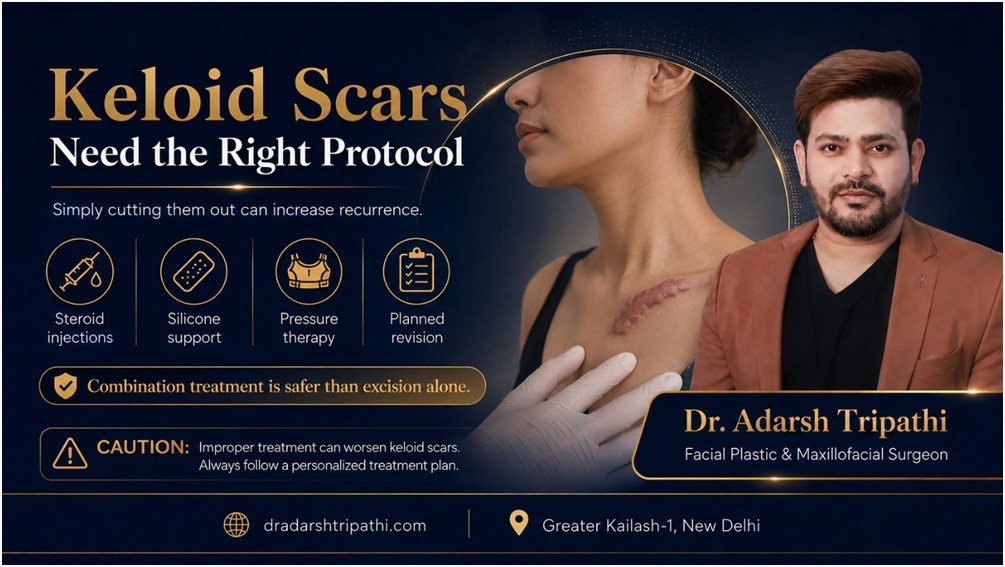
Thick, firm, raised scars that grow BEYOND the boundaries of the original wound. Keloids are a genetic tendency to overgrow scar tissue — they often itch, burn, or hurt, and they recur if treated badly. The standard treatment is intralesional steroid injections (often a course over months), silicone therapy, and pressure therapy. Surgical excision alone is high-risk because the new wound itself becomes a fresh, often bigger keloid. When excision is appropriate, it MUST be combined with steroid injections, sometimes superficial radiation therapy (post-operative), pressure therapy, and silicone — as a multi-modality protocol. Keloids are managed, not simply ‘removed’.
- Best treatments: combination protocol — never excision alone
Atrophic Scars (Depressed)
Sunken or pitted scars from tissue loss — most commonly acne scars (ice-pick, boxcar, rolling), but also from chickenpox, infection, or surgery. Treatment involves rebuilding the lost dermal tissue: subcision for tethered scars, fractional laser or microneedling RF for resurfacing, TCA CROSS for deep ice-pick scars, dermal fillers for instant lift, punch excision for individual deep scars. Combination approaches give best results.
- Best treatments: subcision, MNRF, laser, TCA CROSS, fillers, punch excision
Contracture Scars (Restrictive)
Scars that tighten the skin, often from burns, and that may restrict movement when they cross a joint. These need specialised surgical release — Z-plasty to redirect tension, skin grafting where tissue is lost, sometimes flap surgery for larger areas. Functional improvement is the priority, with cosmetic refinement following. Not a procedure for cosmetic clinics; this is reconstructive surgery.
- Best treatments: surgical release (Z-plasty, grafts, flaps), then resurfacing
Linear (Surgical & Traumatic) Scars
Straight-line scars from surgery, lacerations, or accidents. If poorly positioned (across natural skin lines), wide, depressed, or pigmented, they can be excised and re-closed with refined technique — sometimes using Z-plasty or W-plasty to break the line up and align it with natural skin creases. Often combined with post-operative silicone therapy and laser refinement.
- Best treatments: surgical excision + Z-/W-plasty + silicone + laser
Stretched / Widened Scars
Surgical scars that have stretched and widened over time, often from areas under high tension. Surgical re-excision with meticulous tension-relieving closure and silicone therapy afterwards usually gives a much improved result.
- Best treatments: surgical re-excision + tension management + silicone
Pigmented Scars (Dark or Light)
Scars that healed darker (post-inflammatory hyperpigmentation) or lighter (hypopigmentation) than surrounding skin. Pigmented scars respond to chemical peels, Q-switched laser, topical brightening, and strict sun protection. Hypopigmented (lighter) scars are harder to treat — sometimes melanocyte transplantation is considered.
- Best treatments: peels, Q-switched laser, brightening for dark; specialised approaches for light
Acne Scars (Combination Category)
A mix of atrophic, sometimes hypertrophic, often with pigmentation. Always a combination problem requiring a combination protocol. Covered in detail on our dedicated acne scar page.
The single most important medical insight on this page: keloids are NOT just big scars
Keloids are a genetic tendency to overgrow scar tissue. Simply excising a keloid — without combination treatment — usually causes it to recur, often as a larger, more troublesome keloid. This is a real risk that competitor pages routinely gloss over. The standard, internationally recognised approach for keloid revision is a multi-modality protocol: intralesional steroid injections (often a course over months), silicone gel/sheets, pressure therapy, and where surgical excision is needed, it must be combined with post-operative steroid injections, sometimes superficial radiation, and ongoing pressure and silicone therapy. Indian and darker skin types have a higher genetic predisposition to keloid formation, making this knowledge especially important. If a clinic offers to simply ‘cut your keloid out’, ask exactly what their post-operative recurrence-prevention protocol is — that answer separates a safe approach from an unsafe one.
Are You a Good Candidate for Scar Revision?
Most people with a scar that bothers them are candidates for at least one treatment — the key is correct identification, realistic expectations, and right timing.
You are likely a good candidate if:
- You have a scar that bothers you cosmetically, restricts movement, itches, hurts, or is otherwise symptomatic
- Your scar has been correctly identified and the right treatment is being matched
- You’re in good general health
- You’re a non-smoker, or willing to stop around any surgical revision (smoking impairs healing)
- You have realistic expectations — significant improvement, not erasure
- You can commit to the protocol (combination treatments often need several sessions over months)
- You’re prepared to follow long-term care (sun protection, silicone, pressure where prescribed)
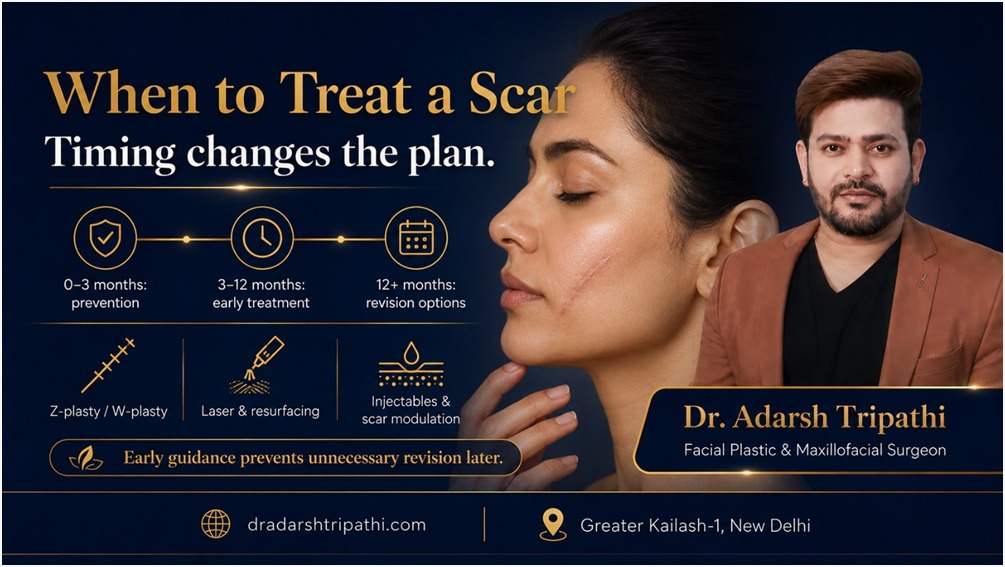
Timing matters dramatically
When you intervene affects the outcome more than most people realise. Here’s the honest timeline:
- 0–3 months (fresh wound/scar): focus on PREVENTION — silicone gel/sheets, pressure therapy, sun protection. Don’t excise yet — the scar hasn’t matured
- 3–12 months (maturing scar): EARLY INTERVENTION — steroid injections for raised scars, laser for redness, silicone continued. This is the prime window for many scars
- Beyond 12 months (mature scar): SURGICAL REVISION OPTIONS — once the scar has fully matured, revision surgery (Z-plasty, excision, etc.) gives predictable results
A frustrating reality: many patients want immediate revision of a scar that’s only weeks old, when waiting and supporting natural healing would give a better final result. A good surgeon will sometimes recommend waiting — that’s not a sales failure, it’s a genuine clinical recommendation.
Discuss carefully if you:
- Have a tendency to keloids (personal or family history) — combination protocols are essential, and certain procedures may need to be approached cautiously
- Have very dark skin (Fitzpatrick V–VI) — higher keloid and PIH risk; treatment planning adjusts accordingly
- Have active infection or skin condition in the area — treat first
- Are pregnant — non-urgent revisions usually deferred
- Are on isotretinoin (acne medication) — most surgical revision deferred 6 months after stopping
- Have unrealistic ‘erase it completely’ expectations — honest counselling about achievable outcome
Surgical Scar Revision Techniques at Sarayu Clinics
Surgical scar revision is a specialised facial-surgery skill. Different scars need different techniques — here are the main ones, each suited to specific situations.
1. Scar Excision and Refined Closure
The most fundamental technique: the old scar is precisely excised and the wound closed with meticulous multi-layer technique using fine sutures. Used for linear, wide, depressed, or poorly positioned scars. The new scar is positioned where possible along the face’s natural relaxed skin tension lines. Often combined with post-operative silicone therapy and laser refinement for the best final result.
- Best for: linear, wide, depressed, or stretched scars
2. Z-Plasty
A geometric technique where small triangular flaps are created either side of the scar and transposed, breaking up a straight line into a zigzag and redirecting it along natural skin creases. Particularly useful for scars crossing joints (releasing contracture) or for scars that cross natural skin lines awkwardly. Z-plasty is a hallmark of refined plastic surgery — done well, the scar becomes far less visible because the eye doesn’t easily follow zigzag lines.
- Best for: linear scars crossing skin lines, contractures across joints
3. W-Plasty
An irregular series of W-shaped excisions that break up a linear scar into many small angles, making it less noticeable to the eye. Used for relatively straight scars on areas like the forehead or cheek where the original direction can’t be changed. Like Z-plasty, the principle is that the eye doesn’t follow irregular lines as easily as straight ones.
- Best for: long linear scars on facial areas without clear skin lines to follow
4. Geometric Broken-Line Closure (GBLC)
An advanced variation of W-plasty using a more random pattern of small geometric shapes, creating maximum visual irregularity. Used for highly visible linear facial scars where the most refined cosmetic outcome is needed.
- Best for: highly visible facial scars; refined cosmetic outcomes
5. Serial Excision
For large scars where a single excision would create excessive tension, the scar is removed in stages over several months — each stage allowing the skin to relax and stretch before the next, achieving complete removal with the smallest final scar.
- Best for: large scars in areas with limited skin laxity
6. Skin Grafts
For scars where significant tissue has been lost (often burn scars), skin from another area of the body is transplanted to cover the defect. The grafted skin won’t perfectly match in colour and texture, but restores function and improves significantly on the original scar.
- Best for: significant tissue loss; burn reconstruction
7. Local Flap Surgery
For larger or more complex scars, adjacent skin (with its blood supply) is moved to cover the defect, giving better colour/texture match than a graft. Useful in facial and reconstructive cases.
- Best for: large or complex facial scars; reconstruction
8. Contracture Release
For burn or contracture scars restricting movement, the tight scar is surgically released — often using Z-plasty, sometimes skin grafts or flaps — to restore range of motion. Functional priority comes first, with cosmetic refinement following over later stages.
- Best for: burn and contracture scars restricting movement
9. Dermabrasion
Mechanical resurfacing — the top layers of skin are sanded down, allowing fresh, smoother skin to form. Used for some surface scars; mostly replaced now by fractional laser, which gives more controlled results.
- Best for: selected surface scars (largely replaced by laser)
Non-Surgical Scar Revision Techniques at Sarayu Clinics
Many scars improve significantly without surgery, especially when treated correctly and early. Here are the main non-surgical options:
1. Intralesional Steroid Injections
Corticosteroids injected directly into raised scar tissue — the cornerstone treatment for keloids and hypertrophic scars. Reduces inflammation, softens the scar, flattens it over a course of monthly injections. Often combined with other treatments. Always part of any keloid management.
- Best for: keloids, hypertrophic scars
2. Silicone Gel and Silicone Sheets
Medical-grade silicone applied topically over scars, worn for many hours daily over months. Hydrates the scar, modulates collagen formation, and progressively flattens and softens raised scars. The most evidence-supported home-care treatment for hypertrophic and keloid scars. Used for both prevention (fresh scars) and treatment (existing scars). Inexpensive and effective when used consistently.
- Best for: fresh scars (prevention), hypertrophic and keloid scars (treatment)
3. Pressure Therapy
Continuous pressure (custom garments, pressure earrings for ear keloids) reduces blood supply to growing scar tissue, helping flatten raised scars. A long-term treatment requiring consistent wear, but very effective for burn scars and certain keloid sites.
- Best for: burn scars (pressure garments), ear keloids (pressure earrings)
4. Fractional Laser Resurfacing (CO2 / Erbium)
Creates microscopic columns of controlled injury, triggering collagen remodelling. Excellent for atrophic and surface scars, mature surgical scars, and post-acne textural change. For Indian skin, settings are conservative and combined with strict sun protection.
- Best for: atrophic scars, surface texture, mature surgical scars
5. Microneedling Radiofrequency (MNRF / Morpheus8-type)
Fine needles deliver radiofrequency energy into the dermis, remodelling collagen. Safer for Indian and darker skin than ablative laser (lower PIH risk) and very effective for atrophic acne scars, rolling scars, and overall texture.
- Best for: atrophic scars, mixed scar types; Indian skin
6. Subcision
A needle or cannula is inserted under tethered depressed scars to release the fibrous bands holding the skin down. Excellent for rolling acne scars and some depressed surgical scars. Often combined with MNRF or laser.
- Best for: rolling and tethered depressed scars
7. Dermal Fillers
Hyaluronic acid fillers placed under depressed scars give instant volumetric lift. Temporary (6–12 months) but very useful for immediate improvement and as part of combination plans. Bellafill is the only filler FDA-approved specifically for acne scars (semi-permanent).
- Best for: depressed scars (instant improvement)
8. Chemical Peels
Medical peels (glycolic, mandelic, TCA, kojic combinations) help superficial scarring, post-acne marks, and pigmented scars. Important: peels work on surface and pigment, not on deep textural scars.
- Best for: superficial scars, pigmented scars, post-acne marks
9. TCA CROSS
High-strength trichloroacetic acid precisely applied to the base of individual deep ice-pick acne scars to stimulate collagen and lift the base. A specialised spot treatment.
- Best for: ice-pick acne scars
10. PRP (Platelet-Rich Plasma)
Growth factors from the patient’s own blood, applied with microneedling or laser to accelerate healing and collagen formation. An add-on that boosts the results of other treatments.
- Best for: enhancing other treatments
11. Cryotherapy
Freezing therapy used for selected smaller keloids and warts. Less commonly used than steroid injection for keloids, but can be combined.
- Best for: selected small keloids
12. Topical Treatments
Prescription scar creams, brightening agents for pigmented scars, retinoids, and over-the-counter scar gels. Most useful for prevention of new scars and for mild scars; not a replacement for in-clinic treatment of established problem scars.
- Best for: prevention; mild scars; maintenance
Combination Protocols — Where the Real Results Come From
This is the genuine clinical insight competitors miss: most scars respond best to combination treatment, not single modalities. A keloid plan might include monthly steroid injections, daily silicone gel, pressure therapy, and (when appropriate) surgical revision with adjunctive treatments. An acne scar plan might combine subcision, MNRF, TCA CROSS, peels, and fillers across several sessions. A surgical scar revision might combine excision with Z-plasty and post-operative silicone plus laser refinement.
This is exactly how Dr. Adarsh Tripathi approaches scar revision — building a multi-step plan around your specific scar and its type, rather than offering whichever single treatment a clinic happens to provide. The total number of sessions is usually 3–6 across 3–9 months for non-surgical protocols, often with a one-stage surgical procedure where revision is part of the plan. The result is significantly better than any single treatment alone.
The Scar Revision Process — Step by Step
Step 1: Consultation & Scar Mapping
Dr. Tripathi examines your scar — type, age, depth, location, behaviour (active vs mature), associated symptoms (itch, pain) — and your general health and skin type. Photographs are taken for baseline. Your goals are discussed honestly. A combination plan is built around your specific scar(s). Critically, you’ll get an honest assessment of timing — sometimes the right advice is to wait and support natural healing before revision, sometimes immediate intervention is right, sometimes a longer combination protocol is the path.
Step 2: Preparation
- For surgical revision: stop smoking 4 weeks before; pause blood-thinning medications (with doctor’s clearance); pre-operative blood work as needed
- For non-surgical sessions: arrive with clean skin, avoid retinoids 3 days before resurfacing treatments
- Begin any prescribed pre-treatment topicals (e.g. priming products for Indian skin before laser)
- Strict sun avoidance — UV is the enemy of every scar
Step 3: Treatment Sessions
Depends on the protocol. Surgical revision is typically done under local or general anaesthesia in an outpatient setting (most patients go home the same day). Non-surgical sessions take 30–60 minutes per visit and are spaced 4–8 weeks apart. Combination plans interleave surgical and non-surgical treatments over months.
Step 4: Aftercare and Follow-Up
- Strict sun protection (SPF 50+) — the single most important factor for results
- Use prescribed silicone gel/sheets and topicals as directed
- Keep wounds (surgical or laser) clean as advised; attend dressing changes
- Don’t pick at scabs, peeling, or healing tissue
- Attend all follow-up visits — scars need monitoring as they mature
- Wear pressure garments if prescribed (burns, body scars)
- Be patient — scar maturation takes 12–18 months; judgement before then is premature
Downtime — What to Expect
Treatment | Discomfort | Downtime | Back to Routine |
Steroid Injections | Mild | None | Same day |
Silicone / Pressure Therapy | None | None | Same day (continuous) |
Chemical Peels | Mild sting | 2–7 days | Same/next day |
Microneedling / MNRF | Mild (numbed) | 1–3 days | Same/next day |
Subcision | Mild (numbed) | 3–7 days (bruising) | Next day (with bruising) |
Fractional Laser | Moderate (numbed) | 3–7 days | 2–3 days |
TCA CROSS | Brief sting | ~1 week (small scabs) | Same day |
Dermal Fillers | Minimal | Same day | Same day |
Surgical Excision | Numbed | 7–14 days | Next day (covered) |
Z-/W-Plasty | Numbed | 7–14 days | Next day (covered) |
Major Reconstructive | Anaesthesia | 2–4 weeks | 2 weeks+ |
Practical takeaway: most non-surgical scar revision has modest downtime (often just a few days of redness). Surgical revision typically means a week or two of visible healing — sutures usually removed at 5–7 days (face) or 10–14 days (body). The scar then continues maturing for 12–18 months, gradually softening and fading. Patience during maturation is essential.
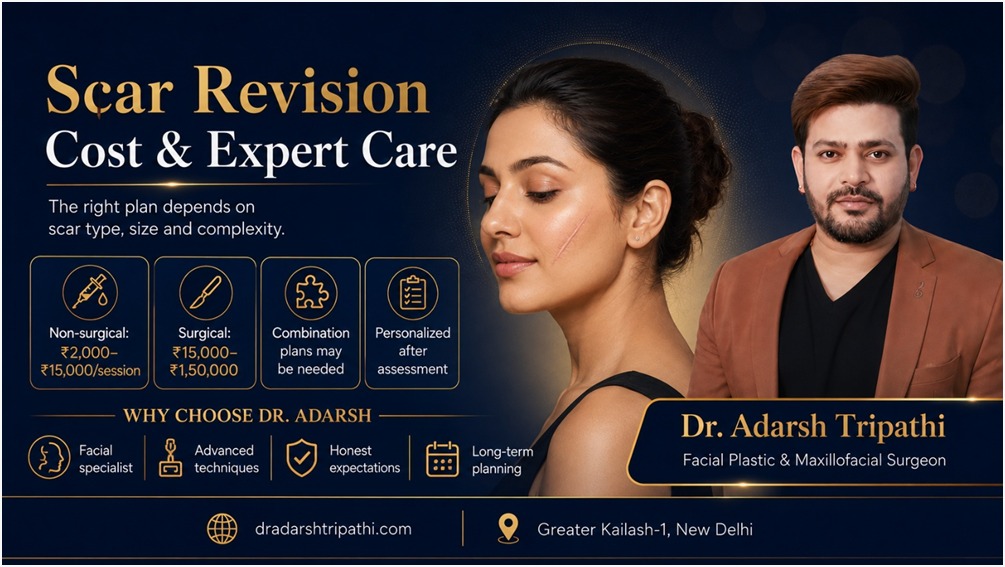
Scar Revision Cost in Delhi — Transparent Pricing
Cost varies widely based on scar type, size, technique, and whether the plan is surgical, non-surgical, or combination. Most scars need a course of treatment, so total course cost matters more than per-session price.
Approximate Cost at Sarayu Clinics, Delhi
Treatment | Approx. Cost | Typical Sessions | Best For |
Steroid Injection | Rs. 2,000–6,000/session | 3–6 monthly | Keloids, hypertrophic |
Silicone Gel/Sheets | Rs. 1,500–4,000/month | Months of use | All raised/healing scars |
Pressure Therapy | Customised | Months of use | Burns, certain keloids |
Chemical Peels | Rs. 2,500–8,000/session | 4–6 | Pigmented, superficial |
Microneedling / MNRF | Rs. 4,000–15,000/session | 4–6 | Atrophic, mixed scars |
Subcision | Rs. 5,000–15,000/session | 2–4 | Rolling, tethered scars |
Fractional Laser | Rs. 6,000–15,000/session | 3–5 | Atrophic, texture, mature |
TCA CROSS | Rs. 3,000–8,000/session | 3–6 | Ice-pick scars |
Dermal Fillers (scars) | Rs. 18,000–40,000 | As needed | Depressed scars (lift) |
Surgical Excision (small) | Rs. 15,000–35,000 | Usually 1 | Small linear scars |
Z-/W-Plasty (small) | Rs. 25,000–60,000 | Usually 1 | Selected linear/contracture |
Surgical Revision (large) | Rs. 50,000–1,50,000 | 1–staged | Large/complex scars |
Keloid Combination (per area) | Rs. 35,000–1,00,000 | Course | Multi-modal protocol |
Burn Reconstruction | Customised | Multi-stage | Functional + cosmetic |
Prices shown are for guidance only. Your final treatment cost will be confirmed during the initial consultation, based on your individual needs, concerns, and personalised treatment plan.
Why the right plan saves both money and skin ?
The most expensive scar revision is the wrong one repeated. A keloid ‘just excised’ that recurs bigger is more expensive (and worse for your skin) than the right combination protocol from the start. An atrophic scar lasered repeatedly when subcision was what it really needed wastes sessions. The skill is in the assessment — building the right combination plan for your specific scar means fewer wasted treatments, better final result, and lower total cost. The assessment itself is the value.
Results Timeline — When Will I See My Scar Improve?
Scar revision results unfold over months, not days. Patience is genuinely necessary — and rewarded.
Non-Surgical Treatment Course
- First session: minimal visible change immediately afterwards
- Sessions 2–3 (1–3 months): visible softening, flattening (for raised scars) or smoothing (for depressed scars)
- After course (3–6 months): main result visible — significantly improved scar
- Months 6–18: continued maturation; scar continues fading naturally
Surgical Revision
- Day 0: surgery; immediate wound visible
- Week 1–2: sutures removed; pink, raised early scar
- Month 1: early scar healing; can look quite obvious during this phase (don’t judge yet)
- Month 3: scar softening and flattening; pinkness fading
- Months 6–12: substantial improvement; scar becomes fine line
- Months 12–18: final mature appearance — what you’ll have long-term
Keloid Management
- Months 1–3: steroid injection course begins flattening
- Months 3–9: continued treatment; visible reduction in height and symptoms
- Months 9–18: scar continues to settle; long-term silicone and monitoring
- Ongoing: maintenance and recurrence-prevention vigilance
Why scars take so long to settle (the science) ?
Scar tissue actively remodels for up to 18 months — collagen continues reorganising, redness fades, and the scar gradually flattens and softens. Premature judgement during this period leads to unnecessary additional procedures. A scar at 3 months is NOT your final scar. A scar at 12 months is close to final. By 18 months, you’re looking at your long-term result. This biology is why a good surgeon will sometimes ask you to wait before adding more treatment.
How long do results last?
Surgical scar revision is permanent — the revised scar is your new scar. It will mature and fade further over the first 12–18 months. Non-surgical treatment results are also long-lasting; the improved scar tissue stays improved. Keloids require ongoing vigilance — they can recur years later if not maintained, particularly with new injury at the site.
Comparison — Which Approach Is Right for Your Scar?
If Your Scar Is… | Best First Approach | Why | Combined With |
Fresh (<3 months) | Silicone, pressure, sun protection | Prevention works better than later treatment | Steroid injection if raised |
Mild hypertrophic | Steroid injection + silicone | Flattens without surgery | Pressure, laser |
Keloid | COMBINATION protocol | Excision alone causes recurrence | Steroid + silicone + pressure + sometimes radiation |
Atrophic / depressed | MNRF, subcision, laser | Rebuilds dermal tissue | Fillers for instant lift |
Linear surgical | Surgical revision + Z-plasty | Repositions, refines | Silicone, laser post-op |
Contracture (restricting) | Surgical release | Functional restoration | Grafts/flaps, post-op resurfacing |
Pigmented | Peels + Q-switched laser | Targets pigment | Sun protection, brightening |
Acne scars (mixed) | Combination protocol | Each type needs different | Subcision, MNRF, TCA CROSS, peels |
Burn (extensive) | Multi-stage reconstruction | Release first, then refine | Pressure garments, laser |
Large old scar | Serial excision or revision | Staged for best result | Combination adjuncts |
Surgical vs Non-Surgical Revision — When to Choose Which
Non-surgical revision suits most milder scars, atrophic/depressed scars (where rebuilding from within is the goal), pigmented scars, and as adjuncts to surgical revision. Surgical revision suits poorly-positioned linear scars, wide or stretched scars, contractures restricting movement, and large traumatic or surgical scars where excision and refined closure offer the best path. Many scars benefit from a combination — surgical revision followed by laser refinement and silicone therapy, for example. A good surgeon walks you through which suits your specific situation.
Why a Facial Plastic Surgeon for Scar Revision?
Scar revision is fundamentally a surgical specialty — even non-surgical treatments work best when planned by someone with deep knowledge of how skin heals and scars. A facial plastic surgeon brings refined closure techniques (Z-plasty, W-plasty, GBLC) that pure-laser clinics can’t offer, deep knowledge of relaxed skin tension lines for natural-result placement, and the judgement to combine surgical with non-surgical treatments for optimal outcomes. For facial scars especially, where the result is the most visible, this combination of skills is precisely what matters.
Why Dr. Adarsh Tripathi Is a Trusted Scar Revision Surgeon in Delhi ?
Scar revision rewards a surgeon’s diagnostic eye and surgical refinement — the difference between a scar that disappears into the face and one that remains obvious. Here’s how to choose, and why patients choose Dr. Tripathi:
What to Look For in a Scar Revision Surgeon ?
- Surgical qualification — ideally a facial plastic, plastic, or maxillofacial surgeon
- The diagnostic skill to identify scar types correctly (and tell similar-looking scars apart)
- The full toolkit — surgical and non-surgical — so the right treatment can be chosen, not the only one available
- Refined surgical closure technique (Z-plasty, W-plasty, layered closure, relaxed skin tension line awareness)
- Knowledge of keloid combination protocols (and willingness to discuss recurrence prevention)
- Experience with Indian/darker skin (higher keloid and PIH risk)
- Honest expectations setting — improvement, not erasure
- Personal consultation by the doctor; clinical (not salon) facilities
Dr. Tripathi’s Credentials
- Maxillofacial and Facial Plastic Surgeon with 18+ years of experience
- Practice focused on the face — refined scar closure technique is everyday work
- Skilled across the full range: surgical excision, Z-plasty, W-plasty, GBLC, serial excision, contracture release
- Combined surgical-and-non-surgical approach — not limited to one device or technique
- Experienced with keloid combination protocols (essential for safe keloid management)
- PIH-conscious, Indian-skin-aware treatment planning
- Consultations personally conducted by Dr. Tripathi; known for natural, careful results
A Type-Matched, Timing-Aware Philosophy
Dr. Tripathi’s approach to scar revision is built on three principles: identify the scar type accurately, match the treatment (or combination) to what that specific scar needs, and respect timing — sometimes intervening early, sometimes patiently waiting for scar maturation. The result is the best achievable outcome rather than the most aggressive intervention. Particularly for keloids and complex scars, this measured combination approach is what protects you from the recurrence that quick-fix excision causes.
Frequently Asked Questions — Scar Revision in Delhi
Q: Who is the best scar revision surgeon in Delhi?
A: The best scar revision surgeon in Delhi for you is a facial plastic, plastic, or maxillofacial surgeon with refined surgical closure technique, knowledge of keloid combination protocols, and the full range of surgical and non-surgical options. Dr. Adarsh Tripathi is a Maxillofacial and Facial Plastic Surgeon with 18+ years of experience who performs surgical revision (excision, Z-plasty, W-plasty, GBLC) alongside non-surgical protocols at Sarayu Clinics, Greater Kailash.
Q: What is scar revision surgery?
A: Scar revision is a combination of surgical and non-surgical procedures that improve the appearance, texture, and function of scars from surgery, injury, burns, acne, or infection. Treatment matches the scar type: surgical excision and Z-plasty/W-plasty for linear and contracture scars; steroid injections combined with excision for keloids; laser, MNRF, and subcision for acne and depressed scars; dermal fillers for instant lift; silicone and pressure for fresh scars.
Q: How much does scar revision cost in Delhi?
A: Scar revision in Delhi costs approximately Rs. 2,000–15,000 per session for non-surgical treatments (steroid injections, laser, MNRF, subcision, peels) and Rs. 15,000–1,50,000 for surgical revision depending on size and complexity. Keloid combination protocols and large reconstructive cases are at the higher end. Because most scars need a combination over multiple sessions, total course cost matters more than per-session price. A personalised quote is given after consultation at Sarayu Clinics.
Q: Can scars be completely removed?
A: No scar can be completely removed — but they can be made dramatically less noticeable. Realistic improvement with the right combination of treatments is around 50–90% in appearance. The goal is a scar that looks like a small natural skin variation rather than the scar it was — often hard to see in normal light. Any clinic promising complete erasure is overpromising; honest improvement is the realistic and achievable goal.
Q: Should I have my keloid scar surgically removed?
A: Keloids should rarely be surgically removed on their own — simple excision usually causes the keloid to recur, often as a larger one, because keloids are a genetic tendency to overgrow scar tissue. The standard approach is a combination protocol: intralesional steroid injections, silicone gel/sheets, pressure therapy, and where excision is part of the plan, it MUST be combined with post-operative steroid injections and sometimes superficial radiation to prevent recurrence. Ask any clinic exactly what their recurrence-prevention protocol is.
Q: When is the best time to start scar revision?
A: Timing depends on your scar’s age and type. For fresh scars (0–3 months), focus on PREVENTION: silicone gel/sheets, pressure, strict sun protection. For maturing scars (3–12 months), early intervention works well: steroid injections for raised scars, laser for redness, continued silicone. For mature scars (over 12 months), surgical revision options become predictable. Many patients want immediate revision of recent scars — waiting and supporting natural healing often gives a better final result.
Q: Is scar revision painful?
A: Scar revision is not very painful because non-surgical treatments use numbing cream beforehand and surgical revision is performed under local or general anaesthesia. Steroid injections sting briefly; laser and MNRF feel like warm pinpricks after numbing; subcision is felt as pressure under the skin. Surgical revision is essentially painless during, with mild post-operative discomfort managed with prescribed medication for a few days.
Q: How many sessions are needed for scar revision?
A: Most non-surgical scar revision needs 3–6 sessions spaced 4–8 weeks apart, with results continuing to develop for months after the course. Keloid combination protocols typically need monthly steroid injections for 3–6 months alongside continuous silicone and pressure therapy. Surgical revision is usually a single procedure but is often followed by post-operative non-surgical refinement (silicone, laser) over the following months.
Q: What is Z-plasty surgery for scars?
A: Z-plasty is a refined surgical scar revision technique where small triangular flaps of skin are created on either side of a scar and transposed, breaking up a straight scar line into a zigzag pattern and redirecting it along natural skin creases. This makes the scar much less visible (the eye doesn’t easily follow zigzag lines) and is particularly useful for scars crossing joints (releasing contractures) or scars that cross natural skin lines awkwardly. A hallmark of refined facial plastic surgery.
Q: Can scar revision treat old scars?
A: Yes, even old scars can be significantly improved with the right treatment. Mature scars over 12 months old often respond well to surgical revision (excision, Z-/W-plasty), fractional laser for texture, and pigment treatments where colour is mismatched. While very old scars may need a multi-step approach, dramatic improvement is genuinely achievable. The realistic outcome depends on the scar type, size, location, and your skin’s healing characteristics.
Q: Will I get insurance coverage for scar revision in Delhi?
A: Purely cosmetic scar revision is generally not covered by health insurance. However, scar revision for functional or medical reasons — contracture release restoring movement, painful or symptomatic scars, certain reconstructive cases after trauma — may be partly covered. The documentation required varies by insurer. The clinic can provide appropriate documentation for insurance claims where the indication is functional. Check your individual policy.
Q: How do I choose a scar revision surgeon in Delhi?
A: Choose a facial plastic, plastic, or maxillofacial surgeon with deep scar revision experience, refined closure technique (Z-plasty, W-plasty, GBLC), knowledge of keloid combination protocols, the full range of surgical and non-surgical options, and experience with Indian skin. Ensure they identify the scar type accurately, are honest about realistic outcomes (improvement, not erasure), conduct the consultation personally, and operate in clinical (not salon) facilities. For keloid-prone patients especially, the combination-protocol approach is what protects you from recurrence.
How to Reach Us:
Phone:+91 9289111083 ,+91 9289111084
Dr Adarsh’s website: https://dradarshtripathi.com/
Facebook: https://www.facebook.com/DrAdarshTripathi3011
Instagram: https://www.instagram.com/dr_adarsh_tripathi/
Youtube: https://www.youtube.com/@dr_adarsh_tripathi
Linkedin: https://www.linkedin.com/in/dr-adarsh-tripathi-a43005b8/
Online Booking: https://dradarshtripathi.com/contact-us/ to schedule appointments conveniently.