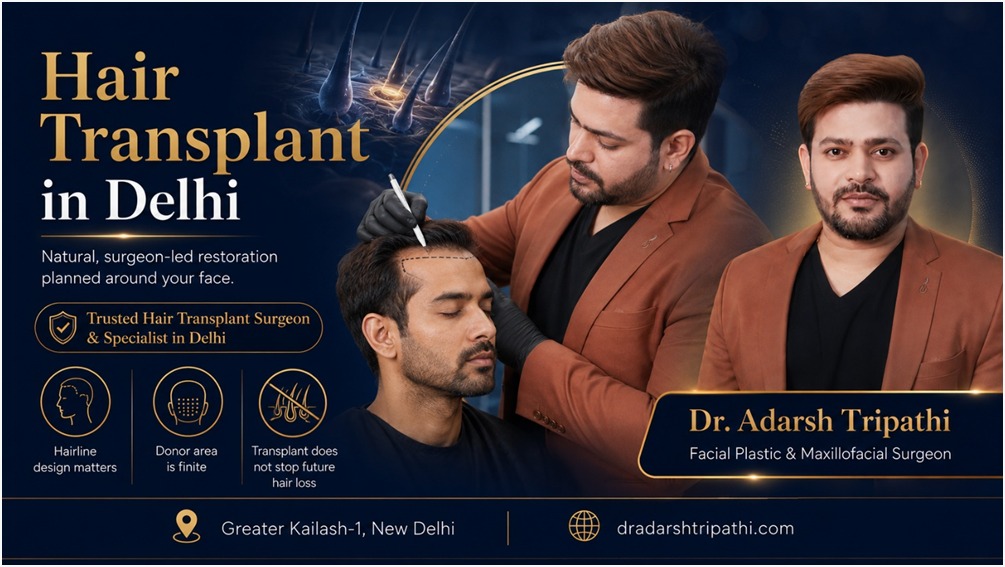
Hair Transplant in Delhi — Natural Hairline Design by a Facial Plastic Surgeon
Hair transplant surgery is one of the most satisfying procedures in aesthetic medicine when it’s done right — and one of the most regretted when it isn’t. The difference between a result you’d never guess was a transplant and one that announces itself across a room comes down to four things: hairline design, graft placement angle, density planning, and respect for how the rest of your face is proportioned. The technical part — moving follicles from the donor area to where they’re needed — is now standardised and reliably performed at most reputable clinics in Delhi. The artistry part, however, varies enormously, and it’s what determines whether your transplant gives you a decade of natural-looking hair or a recognisable ‘doll’s hair’ line that haunts every photograph.
Here’s the most important insight on this page, and it’s where this clinic differs from most hair-only clinics in Delhi: hair transplant is fundamentally a facial aesthetic decision. Where your hairline sits — its height above your eyebrows, its shape (rounded, slightly receded at the temples, naturally peaked or flat), its symmetry with your facial proportions — affects how your whole face looks for life. Hair-only specialty clinics focus on grafts and density. They may do excellent technical work but often miss the facial-aesthetic judgement that makes a hairline truly natural. As a Maxillofacial and Facial Plastic Surgeon, Dr. Adarsh Tripathi’s daily work is facial proportion — the same expertise that goes into rhinoplasty, blepharoplasty, and facial sculpting goes into designing your hairline. This is the genuine differentiator when you’re choosing the best hair transplant surgeon in Delhi: a surgeon who treats your hairline as part of your face, not just as a row of grafts.
There’s a second insight rarely discussed by clinic websites: hair transplant is not a cure for hair loss. It moves hair from areas where it’s resistant to balding (the donor area at the back and sides of the scalp) to areas that have lost it. The transplanted hair stays for life, but the non-transplanted native hair around it can continue to thin — meaning you may need either a second procedure later, medical therapy (finasteride, minoxidil) to preserve native hair, or both. Anyone offering a ‘one and done’ hair transplant without discussing future loss is overpromising. A good consultation includes mapping where you’re likely to lose hair NEXT, and planning your transplant accordingly so it ages well.
Dr. Adarsh Tripathi is a Maxillofacial and Facial Plastic Surgeon with over 18 years of experience at Sarayu Clinics, Greater Kailash-1, New Delhi. This page covers everything about hair transplant in Delhi — what it is, the types of procedure (FUE, FUT, DHI, Sapphire FUE, body hair transplant), areas treated (scalp, beard, eyebrow), the Norwood scale, who’s a candidate and who isn’t, the realistic 12–18 month timeline including the shedding phase that surprises most patients, cost, the comparison with medical treatment, and how to choose the right hair transplant surgeon in Delhi.
Quick Answer — What is hair transplant and what does it cost in Delhi?
Hair transplant is a surgical procedure in which hair follicles from the donor area (back and sides of the scalp) are moved to areas of hair loss — most commonly the receding hairline, crown, and thinning vertex. Modern techniques include FUE (Follicular Unit Extraction — no linear scar), FUT (Follicular Unit Transplantation — strip method), DHI (Direct Hair Implantation — precise placement), and Sapphire FUE. In Delhi, hair transplant cost ranges from Rs. 40,000 (small graft counts) to Rs. 3,00,000+ (large or multi-session cases). Typical FUE pricing is Rs. 30–90 per graft. Final results appear 12–18 months after surgery. Dr. Adarsh Tripathi at Sarayu Clinics, Greater Kailash, performs hair transplant with emphasis on natural hairline design — the facial-aesthetic dimension that distinguishes a truly natural result.
Benefits of Hair Transplant — Realistic and Lasting
Hair transplant, done well, is genuinely transformative. It also has clear limits worth understanding upfront. Here’s an honest picture of what it delivers:
- Permanent results from the transplanted hair — these follicles are genetically resistant to balding and stay for life
- Natural-looking hairline when designed with facial aesthetic principles — proper height, shape, irregularity, and density gradient
- Restoration of receded temples, frontal hairline, crown, or diffusely thinning areas
- Beard, moustache, eyebrow, and (in selected cases) eyelash restoration
- Use of your own hair — no foreign material, no rejection risk
- Outpatient procedure performed under local anaesthesia — no general anaesthesia in most cases
- Walk-out-the-same-day experience — most patients drive home or take a taxi after the procedure
- Real psychological impact — confidence in photographs, social settings, professional contexts
- Compatible with combined procedures — many patients combine with eyebrow transplant, beard transplant, or facial procedures
- Hair grows, behaves, washes, cuts, and styles like normal hair because it IS normal hair
An honest framing: hair transplant restores hair where it has been lost — it doesn’t cure ongoing hair loss. Your native hair (the hair that hasn’t been transplanted) can continue to thin over the years, which is why most surgeons recommend combining transplant with medical therapy (finasteride, minoxidil) and sometimes additional procedures over time. A good surgeon plans your hairline to age well — slightly conservative rather than ultra-low, allowing for future natural loss. The ‘celebrity hairline’ is rarely the right hairline for a 30-year-old who has 50 more years of life ahead.
Areas Treated by Hair Transplant
Hair transplant can restore hair to almost any area where it has been lost, with technique adjusted for each region’s specific needs.
Scalp — Receding Hairline and Temples
The most commonly treated area, especially in men. The frontal hairline, temple recessions, and the transition zone where balding starts. This is where hairline DESIGN matters most — height, shape, irregularity, and density gradient all affect whether the result looks natural. A facial plastic surgeon’s eye for proportion is particularly valuable here.
Scalp — Crown and Vertex
The whirl area at the top-back of the head. Often the second area to thin in male pattern baldness. Density planning matters — coverage is the goal, not full pre-balding density (which would consume donor hair unsustainably).
Scalp — Mid-Scalp Thinning
Diffuse thinning across the middle of the scalp. Requires planned density and careful graft distribution among existing native hair.
Female Hair Loss — Crown and Diffuse Thinning
Female pattern hair loss (Ludwig pattern) tends to be diffuse rather than focal — thinning across the crown with preserved hairline. Female hair transplant strategy differs from male: usually focused on adding density to thinning areas rather than restoring a new hairline. Careful candidate selection is essential — diffuse loss with insufficient donor density may not be transplantable.
Beard and Moustache
Patchy beards, absent areas in the moustache or chin, or post-injury beard scarring respond beautifully to FUE beard transplant. The hairs used are scalp donor hairs which adapt to the beard area and grow indefinitely. The texture is slightly different from native beard hair but is generally indistinguishable to others.
Eyebrows
Thin, sparse, or absent eyebrows from over-plucking, scarring, alopecia, or trauma. Eyebrow transplant requires the finest aesthetic judgement — angle, direction, and density of each individual hair is planned to create a natural brow. Demanding, refined work for an experienced surgeon.
Body Hair Transplant (BHT)
Where scalp donor supply is limited (advanced loss with depleted donor area), hair from the chest, beard, or other body areas can be used. Body hair has different characteristics — texture, growth rate, length — so it’s generally used to add density behind the front hairline rather than at the most visible front. A specialised technique for selected cases.
Scar Hair Transplant
FUE follicles can be transplanted into scars from previous strip surgeries, surgical scars on the scalp, or scars elsewhere on the face/body to camouflage them with hair. A useful adjunct to scar revision in certain cases.
Eyelash Transplant
Rarely performed but possible for absent eyelashes from scarring or alopecia. Specialised procedure with ongoing maintenance — transplanted lashes need trimming and curling like scalp hair.
Conditions Treated — and the Norwood Scale
Hair loss isn’t a single condition — different patterns of loss need different approaches. Understanding which pattern of loss you have is the first step in planning a transplant.
Male Pattern Baldness (Androgenetic Alopecia) — The Norwood Scale
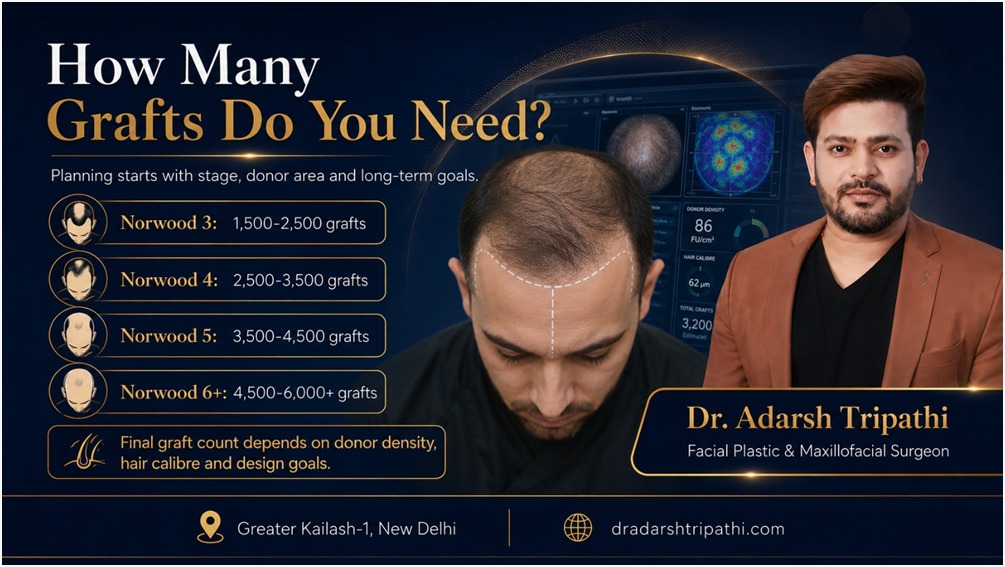
The dominant cause of male hair loss, affecting up to 50% of men by age 50. Progresses according to the Norwood-Hamilton scale, from Norwood 1 (no loss) to Norwood 7 (extensive loss leaving only a horseshoe of donor hair). Understanding YOUR Norwood stage — and predicting where you’re likely to be in 10 years — is critical for transplant planning.
Norwood Stages — What Each Means for Transplant
- Norwood 1: No transplant needed (assessment only if thinning is starting)
- Norwood 2: Slight frontal recession; transplant possible but often medical therapy first
- Norwood 3: Significant recession, first definite candidate stage — 1500–2500 grafts typically
- Norwood 3 Vertex: Adds crown loss to recession — 2000–3000 grafts
- Norwood 4: Larger frontal/temporal loss with crown — 2500–3500 grafts; may need staging
- Norwood 5: Bridge of hair narrows between front and crown — 3000–4500 grafts; staging common
- Norwood 6: Bridge gone, frontal/mid join with crown — 4000–6000 grafts; multi-session usually needed
- Norwood 7: Only horseshoe of donor hair remains — limited transplant possible; honest counselling needed
Female Pattern Hair Loss (Ludwig Scale)
Female pattern loss is typically diffuse thinning across the crown with preserved hairline, classified by the Ludwig scale (1 to 3). Female candidates need careful assessment — diffuse loss with thinning donor area may NOT be a good transplant candidate, because the donor area itself may be miniaturised. Medical therapy is often first-line for females.
Traction Alopecia
Hair loss from tight braiding, ponytails, hair extensions, or turbans over years. Often affects the frontal hairline and temples. If the hair loss is permanent (no follicles left), transplant restores hair. If it’s still recoverable (follicles miniaturised but present), changing the hair styling habit + minoxidil may be tried first.
Scarring Alopecia
Hair loss from inflammatory or scarring conditions (lichen planopilaris, frontal fibrosing alopecia, discoid lupus, folliculitis decalvans). Transplant can be considered ONLY when the underlying condition has been inactive for several years — transplanting into active disease causes loss of the grafts. Careful dermatological assessment first.
Trichotillomania (Hair-Pulling Disorder)
If the disorder has been resolved for a substantial period and there’s no risk of resumption, transplant can be considered. Otherwise inappropriate.
Post-Traumatic / Post-Surgical Hair Loss
Hair loss from burns, surgical scarring, or trauma. Often very rewarding to treat — restoring hair to scarred areas significantly improves appearance and conceals scars.
Eyebrow and Beard Loss
Over-plucking, alopecia areata (after stable disease), scarring, or genetic sparseness. Restored with FUE follicles from the scalp donor.
The most important honest insight — hair transplant doesn’t stop ongoing hair loss
Hair transplant moves bald-resistant follicles to bald areas. The transplanted hair stays for life — but your NATIVE hair (the hair that wasn’t transplanted) can continue thinning. Without addressing the underlying hair loss medically (finasteride, minoxidil, or both), you may end up with transplanted hair surrounded by progressively thinning native hair — eventually requiring a second transplant or a permanently thin look around the transplanted areas. The honest, lasting approach combines transplant for the visible areas WITH medical therapy to preserve native hair. Any clinic that doesn’t discuss this combined approach is missing half the conversation. Dr. Tripathi discusses medical therapy as part of every transplant consultation.
Types of Hair Transplant — FUE, FUT, DHI, Sapphire FUE, and Others
Hair transplant isn’t a single technique — it’s a family of techniques. The right choice depends on your needs, donor characteristics, and aesthetic goals.
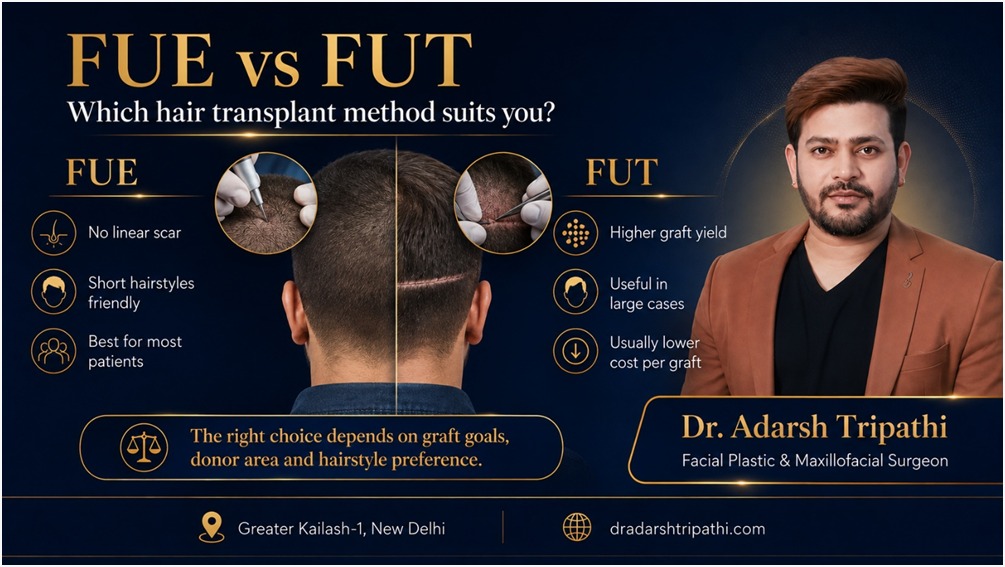
FUE (Follicular Unit Extraction)
The modern standard. Individual follicular units (each containing 1–4 hairs) are extracted one by one from the donor area using a small (0.7–1.0mm) circular punch. No linear scar — only tiny dot scars that become essentially invisible. The grafts are then implanted into the recipient sites. Recovery is faster than FUT, with no stitches to remove. The most popular technique today.
- Best for: most candidates; those wanting short hairstyles; those wanting fastest recovery
- Advantages: no linear scar, faster recovery, can use body hair too
- Limitations: extraction is time-intensive, may not yield as many grafts in a single session as FUT
FUT (Follicular Unit Transplantation / Strip Method)
The older but still useful technique. A thin strip of scalp is removed from the donor area; the wound is closed with sutures, leaving a linear scar (which can usually be hidden under hair length 4+). The strip is then dissected under microscope into individual follicular units for implantation. FUT can yield more grafts per session than FUE for very large cases.
- Best for: large cases (4000+ grafts) where maximum yield is needed; patients keeping longer hair
- Advantages: highest graft yield per session, often more cost-effective for large cases
- Limitations: linear scar (hidden by hair length but limits very short haircuts), longer recovery
DHI (Direct Hair Implantation)
A variation of FUE using a Choi implanter pen, which makes the recipient incision and implants the graft in one step. Allows very precise placement angle and depth, and may reduce graft handling time. Often marketed as a superior technique but is essentially a modified FUE — the surgeon’s skill matters more than the specific tool.
- Best for: precise placement requirements; selected cases
- Advantages: precise angle/depth control; reduced graft handling
- Limitations: slower than skilled FUE in experienced hands; the technique is operator-dependent
Sapphire FUE
Standard FUE but using a sapphire blade (rather than steel) to make the recipient incisions. The sapphire blade creates slightly finer, cleaner incisions, which some surgeons find improves graft survival and reduces post-operative redness. A refinement of FUE rather than a fundamentally different technique.
- Best for: refined hairline work; those wanting finer recipient sites
- Advantages: finer incisions; potentially less surface bleeding
- Limitations: marginally more expensive; benefit is incremental
Robotic FUE (ARTAS)
FUE performed with robotic assistance — the ARTAS robot identifies and harvests follicular units. Available at selected clinics worldwide. Consistency is the marketed advantage; speed of harvesting is similar to a skilled manual surgeon in most reported comparisons. Most Delhi clinics offer manual FUE rather than robotic.
- Best for: clinics with the equipment; selected cases
Body Hair Transplant (BHT)
Using hair from the chest, beard, or body when scalp donor supply is limited. The follicles are harvested via FUE technique. Body hair grows shorter than scalp hair and has different characteristics, so it’s used strategically — typically behind the front hairline to add density rather than at the most visible frontal positions.
- Best for: depleted scalp donor area; very advanced loss
- Limitations: body hair has different texture; growth pattern differs
Combined / Long-Hair FUE
Specialised techniques where follicles are extracted with surrounding hair intact — allowing the patient to see the result more quickly. Limited availability.
Are You a Good Candidate for Hair Transplant?
Not everyone is a good candidate — and a responsible surgeon will sometimes recommend against transplant when it isn’t right. Honest assessment is the first step.
You are likely a good candidate if:
- You have stable hair loss pattern (not actively progressing rapidly) — typically over 25 years old
- You have adequate donor area — sufficient density at the back and sides of the scalp
- Your hair loss is androgenetic (pattern baldness), traction-related, scarring (stable), or post-traumatic
- You’re in good general health, non-smoker or willing to stop, no bleeding disorders
- You have realistic expectations — restoration of natural hair, not necessarily teenage density
- You understand the timeline — 12–18 months for full result
- You’re committed to follow medical therapy (finasteride, minoxidil) if recommended to preserve native hair
- You’re prepared for the shedding phase at 2–4 weeks and the slow regrowth
You may NOT be a good candidate if:
- Your hair loss is very early and progressing rapidly — medical treatment first; assess in 12+ months
- You’re under 25 with active loss — risk of progression making the transplant look unnatural
- Your donor area is itself thin or miniaturised — common in advanced loss and diffuse female loss
- Norwood 7 with depleted donor — only limited transplant possible; honest counselling essential
- You have active scarring alopecia — must be inactive for years before transplant
- You have keloid tendency — case-by-case assessment, FUE generally safer than FUT
- Bleeding disorders, uncontrolled diabetes, severe medical conditions
- You’re a heavy smoker unwilling to stop — significantly impairs graft survival
- Unrealistic ‘celebrity hairline’ expectations or body dysmorphic features
- Trichotillomania actively present
- Recent isotretinoin use — wait 6 months after stopping
The Donor Area Reality — A Finite Supply
Your donor area (the safe zone of bald-resistant follicles at the back and sides of your scalp) is FINITE. Most people have 6,000–8,000 grafts that can safely be harvested over a lifetime. Heavy or repeated transplant can deplete this. A good surgeon plans for your future hair loss too — preserving donor grafts for later procedures if you’re young, rather than using everything up at age 28 when you may need more at age 45. This conservative approach is part of responsible long-term planning.
The Honest Conversation
At consultation, expect an honest conversation about: your Norwood stage and likely future progression, your donor area capacity, whether medical therapy should come first or alongside, what hairline shape and density suits your face, whether single or staged procedures are needed, and what realistic results look like. A surgeon who promises maximum density at the lowest hairline at one session, without addressing future hair loss, is selling a procedure rather than planning a result.
The Hair Transplant Procedure — Step by Step
Step 1: Consultation & Planning
Dr. Tripathi assesses your hair loss pattern (Norwood/Ludwig stage), donor area density, family history of hair loss, age, and goals. Photos are taken. The proposed hairline shape and height are discussed and (often) drawn on you for your review — this is where facial aesthetic judgement most directly shapes the outcome. Graft count needed is estimated. Single vs staged procedure is planned. Medical therapy options are discussed. Realistic timeline and budget are established.
Step 2: Pre-Operative Preparation
- Stop smoking at least 4 weeks before — significantly affects graft survival
- Stop blood-thinning medications/supplements 1 week before (with doctor’s clearance)
- Pre-operative blood tests if not done recently
- Start minoxidil 4–6 weeks before if recommended (improves recipient site preparation)
- Avoid alcohol for 48 hours before
- Wash hair the morning of the procedure
- Eat a normal breakfast — procedure is under local anaesthesia, not general
- Wear comfortable button-front clothing
- Arrange transport home (you can travel by taxi/Uber, but no driving the same day)
Step 3: Hairline Design
On the procedure day, BEFORE any cutting or extraction, the hairline is designed in detail and shown to you. Adjustments are made until you’re comfortable with the planned hairline shape, height, and temple position. This is your last chance to refine the design — once extraction starts, the plan is set.
Step 4: Anaesthesia
Local anaesthesia is administered to the donor and recipient areas. This involves multiple small injections to numb the scalp; mildly uncomfortable for a few minutes, then completely numb for the rest of the procedure. Most patients describe the rest of the day as comfortable. Sedation can be added for anxious patients.
Step 5: Graft Extraction
In FUE: individual follicular units are extracted one at a time from the donor area using a fine punch. In FUT: a thin strip is removed, sutured closed, and then microscopically dissected. Extraction is the most time-intensive phase — taking 2–4 hours for moderate cases, longer for large ones. You can read, watch shows, or rest during this period.
Step 6: Recipient Site Creation
Tiny incisions are made in the recipient area at the precise angle, direction, and density planned. This is one of the most aesthetically critical steps — the angle determines how the hair will grow, the density determines coverage, and the irregularity determines naturalness. Done by the surgeon personally rather than delegated.
Step 7: Graft Placement
Each follicular unit is placed individually into the prepared sites. Single-hair grafts are placed at the front for natural soft hairline; multi-hair grafts are placed behind for density. Direction and angle are matched to surrounding hair. This phase takes 2–4 hours for moderate cases.
Step 8: Post-Procedure Care
Done same day. You leave with a head bandage on the donor area (FUE: smaller; FUT: across the strip line). Detailed aftercare instructions are given. A driver/taxi takes you home. Most patients eat dinner normally and sleep at home that night.
Total procedure time: 6–10 hours for typical moderate cases, with breaks. Large cases may extend to a full day or be staged across two days.
Downtime & The Shedding Phase — What Really Happens
Here’s where most patients are unprepared: the timeline isn’t ‘transplant on Monday, full hair by next month.’ The journey is unique and includes a phase that surprises everyone. Let’s walk through it honestly.
Days 1–3
Mild swelling around the forehead is normal — peaks at day 3, then subsides. Tiny scabs form around each transplanted graft (looks like tiny dots; you keep these clean and don’t pick them). Donor area feels tender, especially for FUT (across the suture line) or numb for FUE. Sleep with head elevated. Take prescribed antibiotics and pain medication. No vigorous activity.
Days 4–10
Scabs gradually shed as you gently wash according to instructions. Swelling resolves. Sutures removed at day 10 for FUT (FUE has no stitches to remove). You can return to desk work around day 5–7 with a cap if you’re self-conscious about the early appearance.
Weeks 2–4 — The ‘Shedding Phase’ (THIS IS NORMAL!)
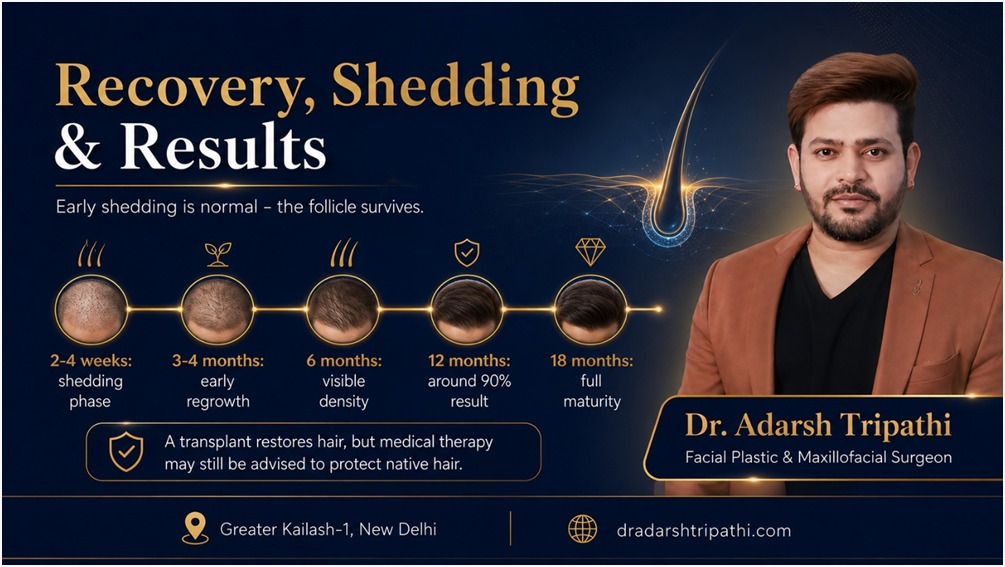
Around 2–4 weeks after surgery, the TRANSPLANTED HAIRS SHED. Yes — the hair you just had transplanted falls out. This is normal, expected, and happens to almost everyone. The HAIR shaft sheds, but the FOLLICLE (the root) remains alive in the scalp. The follicle then enters a resting phase before producing new hair. Patients who don’t know about this phase often panic — but it’s a sign the transplant is healing as expected, not a failure. Anyone telling you ‘the hair will keep growing from day one’ is misleading you.
Months 2–3 — The ‘Ugly Duckling’ Phase
This is the hardest period emotionally. The transplanted hair has shed, the native hair around it is unchanged, and there’s no visible new growth yet. You may look thinner than before surgery. This is normal and temporary. Resist the urge to judge the result during this phase. Cap, hat, or strategic styling can help. Keep going.
Months 3–6 — Regrowth Begins
New hair starts emerging from the transplanted follicles. Initially fine, wispy, slightly slow-growing — but gradually thickens. By month 6, around 50% of the eventual final result is visible. Real improvement, real momentum.
Months 6–12 — Steady Improvement
Hair continues thickening, gaining length, matching surrounding hair character. By 12 months, approximately 90% of the final result is visible.
Months 12–18 — Final Result
Density and texture mature fully. You can now judge the final result. From now on, the transplanted hair behaves exactly like your normal hair — washing, cutting, styling all normal.
Recovery Essentials
- Sleep with head elevated for 7 days (use 2 pillows or a recliner)
- First gentle washing typically day 3 with prescribed shampoo as instructed
- No picking at scabs — let them shed naturally
- No swimming, saunas, gym for 2–3 weeks
- No direct sun exposure to scalp for 2 weeks; SPF on scalp after
- No alcohol for 5 days
- Take prescribed medications including any antibiotics
- Sleep face up (not on transplanted area) for first 7–10 days
- Don’t expect ‘visible results’ before 4 months
- Trust the process — the shedding phase is normal
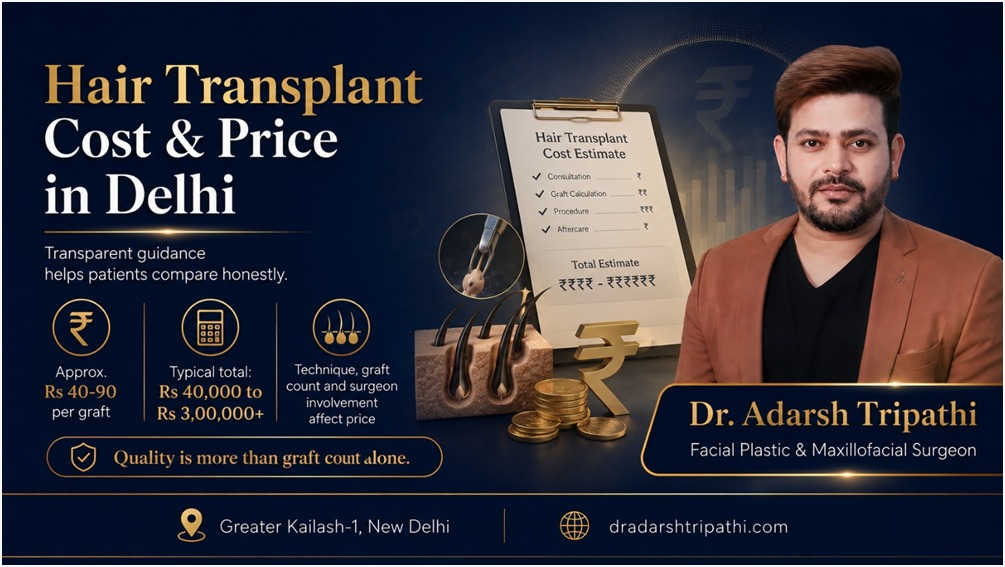
Hair Transplant Cost and Price in Delhi - Transparent Pricing
Hair transplant cost in Delhi depends primarily on the number of grafts needed and the technique used. Most clinics quote either per-graft pricing or package pricing. Total cost varies enormously across clinics — and so does the quality of work.
Approximate Cost at Sarayu Clinics, Delhi
Procedure | Per-Graft Cost | Typical Grafts | Total Cost Range |
FUE Hair Transplant | Rs. 40–90 | 1500–4000 | Rs. 60,000–3,00,000+ |
FUT Hair Transplant | Rs. 30–60 | 2000–4500 | Rs. 60,000–2,50,000+ |
DHI (Choi pen technique) | Rs. 60–100 | 1500–3500 | Rs. 90,000–3,00,000+ |
Sapphire FUE | Rs. 50–100 | 1500–4000 | Rs. 75,000–3,50,000+ |
Eyebrow Transplant | Per session | 200–600 | Rs. 40,000–1,20,000 |
Beard Transplant | Per session | 800–2500 | Rs. 50,000–2,00,000 |
Body Hair Transplant | Per graft (higher) | Selected cases | Customised |
PRP Therapy (adjunct) | Per session | — | Rs. 6,000–15,000 |
GFC Therapy (adjunct) | Per session | — | Rs. 8,000–20,000 |
Combined Hair + Medical (annual) | Customised | — | Rs. 15,000–40,000 ongoing |
Why graft count is only part of the cost story ?
Two clinics may both quote 2000 grafts at Rs. 80,000 — but one delivers the surgeon designing the hairline, making the recipient incisions, and overseeing every step, while the other delegates most of the work to technicians while the surgeon sees several patients per day. The graft count is the same; the result quality is dramatically different. The surgeon’s PERSONAL involvement in hairline design and recipient site creation is what determines whether the result looks natural — and it’s worth asking about specifically. Cheap mass-throughput transplants can leave lifelong unnatural results. Don’t choose hair transplant on lowest price.
Prices shown are for guidance only. Your final treatment cost will be confirmed during the initial consultation, based on your individual needs, concerns, and personalised treatment plan.
Results Timeline — Realistic Expectations Across 12-18 Months
Hair transplant rewards patience more than almost any aesthetic procedure. Here’s the full realistic timeline.
Same Day
You have your final hairline placed, but it’s covered in scabs and surrounded by shaved scalp (typically). This is NOT what your result will look like.
Week 1
Scabs shed gradually with gentle washing. Donor area heals. Most patients return to desk work.
Weeks 2-4 — Transplanted Hair Sheds (Normal)
The transplanted hairs shed — the shaft falls out, leaving the follicle quietly alive beneath. This is NORMAL and EXPECTED. Don’t panic. Don’t judge the result.
Months 2-3 — Ugly Duckling Phase
No visible growth yet; you may look thinner than before surgery. Frustrating but temporary. Keep going.
Month 4-6 — Regrowth Begins
New hairs emerge, initially fine and wispy. By month 6, around 50% of final result is visible.
Month 9 — Real Progress
Around 70-80% of final result. You can clearly see the transplant is working.
Month 12 — Near Final
Around 90% of final result. Most patients are very happy at this stage.
Month 18 — Final Mature Result
Density and texture fully mature. The transplanted hair is now part of your scalp for life.
Years 2+ — Ongoing
Transplanted hair grows, ages, and behaves normally for the rest of your life. Native hair around it may continue to thin — which is why medical therapy is often recommended alongside.
For independent guidance on what hair transplant surgery can realistically achieve, the American Academy of Dermatology publishes patient resources worth reading alongside any clinic’s own material.
Hair Transplant vs Medical Treatment — The Honest Comparison
Surgery isn’t always the right answer. For many patients (especially early-stage or younger), medical therapy alone can dramatically slow or partly reverse hair loss. Surgery is best added once the situation is stable or for cases where loss is already established.
Treatment | How It Works | Best For | Limitations |
FUE/FUT/DHI | Moves bald-resistant follicles | Established loss with stable pattern | Doesn’t stop ongoing loss |
Finasteride 1mg | Blocks DHT (hormone causing loss) | Slowing/halting male pattern loss | Male only (mostly); side effects possible |
Minoxidil (topical) | Vasodilator, prolongs growth phase | Both sexes; early loss | Need lifelong use; modest gains |
PRP / GFC | Growth factors | Adjunct to transplant; early thinning | Modest standalone effect |
Low-Level Laser | Light therapy | Mild support | Modest evidence |
Hair Mesotherapy | Nutrient micro-injection | Adjunctive | Modest standalone effect |
Dutasteride | Stronger DHT blocker | Cases where finasteride insufficient | Off-label in some regions; side effects |
Hair Transplant + Medical | Combined approach | BEST long-term result | Higher cost; lifetime commitment |
The Combined Approach — Why It’s Almost Always Right
The most successful hair restoration plans combine transplant (for already-bald or thinning areas) with medical therapy (to preserve native hair from continued loss). Transplant addresses the visible problem; medical therapy prevents tomorrow’s problem. This combined approach is what produces lasting, natural-looking results that age well over years. A surgeon who recommends ONLY transplant without addressing your future loss is leaving half the work undone.
FUE vs FUT — The Direct Comparison
Factor | FUE | FUT |
Donor scar | Tiny dots, essentially invisible | Linear strip scar, hidden by hair length |
Maximum yield per session | Moderate (good for most) | Higher (good for very large cases) |
Recovery | Faster | Slower (sutures, more discomfort) |
Cost per graft | Higher | Lower |
Can use body hair | Yes | No |
Patients keeping short hair | Yes | Avoid (scar visible) |
Patients keeping longer hair | Yes | Yes (scar hidden) |
Repeat procedure friendly | Yes | Yes, but limited by scar |
Why a Facial Plastic Surgeon for Hair Transplant?
Most hair transplant in Delhi is done by hair-specialty clinics or general dermatologists. So why a facial plastic surgeon? One core reason: HAIRLINE DESIGN is a facial aesthetic decision. The hairline frames the face. Its height above the eyebrows, the shape of the temples, the curvature of the front edge, the irregularity (a perfectly straight hairline looks fake; subtle irregularity looks natural), and the density gradient (denser at the back, slightly less dense at the very front) — all of these are facial proportion decisions. A facial plastic surgeon’s daily work is exactly this — facial proportion, balance, aesthetic harmony. For hair transplant, this expertise translates directly into hairlines that look like they belong on your face rather than like a transplant. Combined with technical competence in FUE/FUT/DHI, this aesthetic dimension is the genuine value of choosing a facial plastic surgeon.
Why Dr. Adarsh Tripathi Is a Trusted Hair Transplant Surgeon and Specialist in Delhi ?
Hair transplant outcomes depend on three things: honest assessment and planning (including future hair loss), the surgeon’s personal involvement in critical steps (hairline design, recipient site creation), and aesthetic judgement that treats your hairline as part of your face. Here’s how to choose, and why patients choose Dr. Tripathi:
What to Look For in a Hair Transplant Surgeon ?
- Medical qualification — facial plastic, plastic, or dermatology surgeon (NOT ‘hair technician’)
- Surgeon’s personal involvement in hairline design and recipient incision creation (not delegated)
- Honest assessment of Norwood stage and likely future progression
- Discussion of medical therapy (finasteride/minoxidil) alongside transplant
- Realistic graft count and conservative donor area management
- Natural hairline design — not too low, not too dense, with appropriate irregularity
- Honest about who is NOT a candidate (won’t sell a transplant to wrong candidates)
- Multiple techniques available (FUE, FUT, DHI) — not one-size-fits-all
- Pre-operative photos and design shown to you before extraction starts
- Clinical (not salon) facilities; transparent pricing
- The International Society of Hair Restoration Surgery publishes independent patient guidance on choosing a hair restoration surgeon, including which stages the surgeon should perform personally.”
Dr. Tripathi’s Credentials
- Maxillofacial and Facial Plastic Surgeon with 18+ years of experience
- Facial aesthetic expertise — daily work on facial proportion, balance, hairline-to-face relationships
- Personal involvement in hairline design and recipient site creation for every patient
- Honest assessment of Norwood stage, donor area, and medical therapy needs
- Multiple techniques offered: FUE, FUT, DHI, Sapphire FUE, eyebrow and beard transplant
- Combined approach with medical therapy for long-term native hair preservation
- Conservative donor management — preserving future surgical options
- Consultations personally conducted by Dr. Tripathi
The Hairline Design Philosophy
Dr. Tripathi’s approach to hair transplant is built on facial aesthetics first. The hairline shape, height, irregularity, and density gradient are designed to suit YOUR face — your forehead height, brow position, facial proportions, and how you’ll want your face to look at age 50 as well as 30. The technical execution (extracting and implanting follicles) follows the design. The result is hairlines that look like they belong on the face — not transplanted lines stitched on top. Combined with honest planning, conservative donor management, and medical therapy where appropriate, this produces results that age well over decades.
Frequently Asked Questions — Hair Transplant in Delhi
Q: Who is the best hair transplant surgeon in Delhi?
A: The best hair transplant surgeon in Delhi for you is a medically qualified specialist — ideally a facial plastic, plastic, or dermatological surgeon — who personally designs your hairline (rather than delegating to technicians), is honest about your future hair loss, recommends medical therapy alongside surgery where appropriate, and treats hairline design as a facial aesthetic decision. Dr. Adarsh Tripathi is a Maxillofacial and Facial Plastic Surgeon with 18+ years of experience who performs hair transplant with facial-aesthetic hairline design at Sarayu Clinics, Greater Kailash.
Q: What is hair transplant surgery?
A: Hair transplant surgery is a procedure in which hair follicles from the donor area (back and sides of the scalp, which are genetically resistant to balding) are extracted and moved to areas of hair loss — typically the receding hairline, crown, or thinning vertex. Modern techniques include FUE (Follicular Unit Extraction — no linear scar), FUT (Follicular Unit Transplantation — strip method), DHI (Direct Hair Implantation via Choi pen), and Sapphire FUE. The transplanted hair grows naturally for life.
Q: How much does hair transplant cost in Delhi?
A: Hair transplant in Delhi typically costs Rs. 40,000 to Rs. 3,00,000+ depending on the number of grafts needed and the technique used. FUE pricing is approximately Rs. 40–90 per graft; FUT is slightly less per graft but with linear scar. Small cases (1,500 grafts) start around Rs. 60,000; large multi-session cases reach Rs. 3,00,000 or more. Beard transplant ranges Rs. 50,000–2,00,000; eyebrow transplant Rs. 40,000–1,20,000. A personalised quote follows consultation at Sarayu Clinics.
Q: Is hair transplant permanent?
A: Yes — the TRANSPLANTED hair is permanent and grows for life because the follicles taken from the donor area are genetically resistant to balding. However, your NATIVE non-transplanted hair can continue thinning over the years, which is why most surgeons recommend combining hair transplant with medical therapy (finasteride and/or minoxidil) to preserve native hair. Anyone claiming a ‘one and done’ permanent hair solution without discussing future native hair loss is overpromising.
Q: What is the difference between FUE and FUT hair transplant?
A: FUE (Follicular Unit Extraction) removes individual follicles one by one using a fine punch, leaving only tiny dot scars that become essentially invisible. FUT (Follicular Unit Transplantation) removes a thin strip of donor scalp which is then microscopically dissected — leaving a linear scar that can be hidden under hair length of 4 or longer. FUE has faster recovery and no linear scar; FUT can yield more grafts per session for very large cases. FUE is the more popular modern technique for most patients.
Q: How long does it take to see hair transplant results?
A: Visible hair transplant results emerge gradually over 12–18 months. The transplanted hair sheds at 2–4 weeks (normal — the follicle remains alive). New growth begins around month 3–4, with about 50% of final result by month 6, 90% by month 12, and full mature density by month 18. The slow timeline is biology — the follicles need time to enter a new growth phase. Be prepared for the ‘ugly duckling’ phase at month 2–3 before regrowth starts.
Q: Why does transplanted hair fall out after surgery?
A: Transplanted hair falls out 2–4 weeks after surgery because the hair shaft is shed while the follicle (root) enters a temporary resting phase. This ‘shock loss’ is completely normal and happens to nearly every patient. The follicle then re-enters the growth cycle and produces a new hair starting around month 3–4. Don’t panic when the transplanted hair sheds — it’s expected, the follicles are alive, and new growth is coming.
Q: Is hair transplant painful?
A: Hair transplant is performed under local anaesthesia, which means the procedure itself is essentially painless after the initial numbing injections (which feel like brief pinpricks). Most patients describe the long procedure (6–10 hours) as boring rather than painful — you can read, watch shows, or rest. After the procedure, mild scalp tenderness, donor area soreness, and possible forehead swelling for 2–3 days are managed with prescribed medication.
Q: Can women have hair transplant?
A: Yes — women can have hair transplant, but careful candidate selection is essential. Female pattern hair loss tends to be diffuse rather than focal, and the donor area may also be miniaturised, making women a more complex candidate group than men. Suitable candidates include women with stable pattern hair loss and good donor density, traction alopecia, post-traumatic hair loss, and scarring alopecia (when inactive). Many women benefit from medical therapy first, with transplant added if needed.
Q: Will my native hair around the transplant continue to thin?
A: Yes — your native non-transplanted hair can continue to thin if you have ongoing androgenetic alopecia. This is why hair transplant alone isn’t a complete solution; medical therapy (finasteride for men, minoxidil for both sexes, sometimes other treatments) is recommended alongside surgery to preserve your native hair. The combined approach — transplant for bald areas plus medical therapy for native hair — is what produces the most natural-looking, lasting results.
Q: Are there any risks or side effects of hair transplant?
A: Hair transplant is very safe in skilled hands. Common, temporary effects include scalp tenderness, donor area soreness, forehead swelling, scabbing at graft sites, and the shedding phase. Rare risks include infection (minimised by sterile technique and antibiotic prophylaxis), poor graft survival (smoking, alcohol, poor aftercare are main causes), shock loss of native hair around grafts (usually temporary), and rare scarring. Choosing an experienced surgeon and following aftercare strictly minimises all risks.
Q: How do I choose the best hair transplant clinic in Delhi?
A: Choose a clinic where the SURGEON (not just technicians) personally designs the hairline and makes the recipient incisions, where the surgeon is medically qualified (facial plastic, plastic, or dermatology), where pre-operative photos and design are shown before extraction starts, where medical therapy is discussed alongside transplant, where honest assessment is given (including who is NOT a candidate), and where facilities are clinical not salon-style. Avoid clinics with extremely cheap quotes — they typically delegate critical steps to technicians while seeing multiple patients per day.
What makes someone a hair transplant specialist rather than a clinic that offers hair transplant?
In hair restoration the distinction is unusually concrete, because the procedure has several stages and they are not equally delegable. A specialist personally designs the hairline, personally creates the recipient sites at the planned angle and density, and personally oversees extraction – these three steps determine whether the result looks natural. A specialist also assesses your Norwood stage against your likely progression, manages your donor area as a finite lifetime resource rather than a single-procedure supply, and discusses medical therapy to protect the hair you have not lost yet. A clinic where the surgeon appears for the consultation and technicians perform everything else is offering hair transplant as a service. A specialist is performing surgery and planning a result you will still be pleased with in fifteen years.
How to Reach Us:
Phone:+91 9289111083 ,+91 9289111084
Dr Adarsh’s website: https://dradarshtripathi.com/
Facebook: https://www.facebook.com/DrAdarshTripathi3011
Instagram: https://www.instagram.com/dr_adarsh_tripathi/
Youtube: https://www.youtube.com/@dr_adarsh_tripathi
Linkedin: https://www.linkedin.com/in/dr-adarsh-tripathi-a43005b8/
Online Booking: https://dradarshtripathi.com/contact-us/ to schedule appointments conveniently.