Dimple Creation Surgery in Delhi
Some of the most recognisable smiles in the world share one small thing in common — dimples. Those tiny, natural-looking indentations on the cheeks (or chin) have been considered a sign of charm, warmth, and attractiveness across cultures for centuries. In India, they carry a particularly strong association with beauty and good fortune.
The good news? You no longer have to be born with them. Dimple creation surgery — clinically called dimpleplasty — is a quick, minimally invasive procedure that lets you add permanent dimples to your face with very little downtime and no visible scarring.
At Sarayu Clinics in Greater Kailash-I, New Delhi, Dr. Adarsh Tripathi performs dimpleplasty with a precision that comes from 18+ years of specialisation in facial plastic and maxillofacial surgery. Every procedure is planned around your individual facial structure, so the dimples look like they have always been there — not like something that was added later.
This page gives you everything you genuinely need to know before making a decision — from what the surgery involves and what recovery actually looks like, to honest cost details and the questions patients most often ask.
What Is Dimple Creation Surgery (Dimpleplasty)?
A dimple forms naturally when there is a small gap or split in the zygomaticus major — the muscle responsible for pulling the corners of your mouth upward when you smile. This gap tethers the overlying skin inward, creating a visible indentation on the cheek. In people born without this anatomical variation, the skin moves freely over the muscle when smiling, and no dimple appears.
Dimpleplasty surgically recreates this effect. A tiny incision is made on the inner wall of the cheek (inside the mouth, so nothing is visible on the outside). A small piece of the inner cheek tissue is removed, and a dissolvable suture is passed from one side of the cheek muscle to the undersurface of the skin. As the wound heals, the internal scar tissue forms a permanent tether — creating a natural-looking dimple that appears whenever you smile.
The entire procedure usually takes 20 to 30 minutes per dimple and is done under local anaesthesia in a clinical setting. There is no general anaesthesia, no hospital admission, and most people go back to work or daily activities the same day or the next morning.
Benefits of Dimple Creation Surgery
People choose dimpleplasty for different reasons — some for aesthetics, some because dimples run in the family and they always wished they had them too. Here is what the procedure genuinely offers:
- Natural, Permanent Results: Once healed, the dimples become a permanent part of your facial anatomy. Unlike fillers or make-up tricks, they do not fade or need to be topped up.
- No Visible Scars: All incisions are made inside the mouth. Your skin on the outside remains completely untouched.
- Quick Procedure: Most sessions are completed in under 30 minutes per dimple. You arrive, have the procedure, and leave — typically within 90 minutes including preparation.
- Done Under Local Anaesthesia: There is no need for general anaesthesia or sedation. You are awake, comfortable, and can go home immediately afterwards.
- Same-Day Discharge: Dimpleplasty is a true walk-in, walk-out procedure. No overnight hospital stay is required.
- Customisable: You choose where you want the dimples — on one cheek or both, on the cheeks or chin — and Dr. Tripathi works with your facial structure to ensure placement looks balanced and natural.
- Minimal Downtime: Most patients experience only mild swelling for 2–4 days and resume normal activities within 24 hours.
- Improved Confidence: For many patients, especially those who have always admired dimples, the change — while subtle — has a genuinely positive impact on how they feel about their smile.
Areas Where Dimples Can Be Created
Dimpleplasty is not a one-size-fits-all procedure. Dr. Adarsh Tripathi assesses your facial geometry during the consultation and recommends placement that suits your bone structure and overall facial proportions. The most common areas include:
Cheek Dimples (Most Popular)
These are the classic smile dimples — positioned on the middle of the cheek, roughly at the level of the corner of the mouth. When placed correctly, they appear only when you smile, which gives them a very natural quality. Both cheeks can be treated in the same session.
Chin Dimple (Cleft Chin)
A dimple or indentation at the centre of the chin is sometimes called a cleft chin. It adds a defined, sculpted quality to the lower face and works particularly well for patients with a strong jawline. Some patients combine this with chin implant surgery for a more complete result.
Single vs. Double Dimples
Many patients choose bilateral dimples (both cheeks) for a symmetrical result. However, a single dimple on one side is also an option — some patients have a natural dimple on one side and want the other side to match, or simply prefer the asymmetric look.
Who Is a Good Candidate for Dimple Creation Surgery?
Dimpleplasty is one of the more accessible cosmetic procedures in terms of candidacy — most healthy adults who want dimples can safely have the procedure. You are likely a good candidate if:
- You are at least 18 years of age
- You are in good general health with no uncontrolled medical conditions
- You do not smoke, or are willing to stop for a period before and after surgery
- You have realistic expectations about the outcome (dimples enhance your smile, they do not transform your face entirely)
- You understand that the results are permanent and have thought through the decision carefully
- You do not have active oral infections, mouth ulcers, or ongoing dental procedures
During your consultation, Dr. Tripathi will review your medical history, assess your cheek tissue thickness and facial anatomy, and advise whether any adjustments are needed before proceeding.
Who Should Wait or Reconsider:
- Patients with active skin infections near the cheek area
- Those currently undergoing orthodontic treatment involving the cheeks
- Individuals with bleeding disorders or on blood-thinning medications (to be reviewed)
- Anyone with unrealistic expectations — for example, expecting the dimples to be visible 24/7 from day one
The Dimple Creation Procedure — Step by Step
Here is exactly what happens on the day of your surgery, so there are no surprises:
- Pre-Procedure Consultation & Facial Mapping: Before the procedure begins, Dr. Tripathi marks the precise location of each dimple on your cheek. This is done with you sitting upright and smiling naturally. The goal is to identify the spot that will look most natural given your specific muscle movement and cheek volume. Placement is everything — too high, too low, or off-centre, and the result can look artificial.
- Anaesthesia: Local anaesthetic is applied to the inner cheek surface. This takes about 2–3 minutes to work fully. You will feel a mild pinch or pressure when the injection is given, and then the area becomes completely numb. You are awake throughout the procedure and can communicate normally.
- Incision: A small, precise incision is made on the inner lining of the cheek (the buccal mucosa). No cut is made on the outside of your face, so there is zero external scarring.
- Tissue Removal: A tiny amount of cheek muscle and submucosal fat — typically just 2–3 mm — is carefully removed from the marked area. This creates the internal ‘hollow’ that forms the dimple.
- Suturing: A fine absorbable suture is placed from one side of the cheek muscle to the undersurface of the skin, creating a tether. As healing progresses, internal scar tissue reinforces this connection, making the dimple permanent even after the suture dissolves.
- Closure: The inner cheek incision is closed with dissolvable stitches. There are no stitches to remove later.
- Recovery Monitoring: You rest briefly in the clinic while the anaesthetic wears off. Dr. Tripathi or a member of the care team reviews post-operative instructions with you before you leave. Most patients are ready to go home within 30–45 minutes of the procedure finishing.
Before & After Care Instructions
Before Your Surgery
- Avoid aspirin, ibuprofen, and other blood-thinning medications for 7–10 days before the procedure (consult your regular doctor before stopping any prescribed medication)
- Do not eat or drink anything for 2–3 hours before your appointment if you have been given any oral sedation; water is fine if only local anaesthesia is being used
- Inform Dr. Tripathi of any herbal supplements, vitamins, or over-the-counter medications you take regularly
- Brush your teeth and rinse thoroughly with a chlorhexidine mouthwash before arriving — good oral hygiene reduces the infection risk significantly
- Arrange for someone to accompany you home if you feel you may be anxious about the procedure
After Your Surgery
- Apply a cold pack (wrapped in a cloth) to the outside of your cheeks for 10–15 minutes every hour for the first 24–48 hours — this reduces swelling and discomfort
- Use the antibiotic mouthwash prescribed by Dr. Tripathi after every meal for the first 5–7 days
- Stick to soft foods — dal, khichdi, idli, yoghurt, mashed vegetables — for 3–5 days. Avoid anything that requires vigorous chewing or involves very hot liquids initially
- Do not press, poke, or massage the cheeks during recovery — the internal suture needs to settle undisturbed
- Avoid strenuous exercise for 5–7 days
- Take the prescribed antibiotics for the full course — do not stop early even if things seem fine
- Attend your follow-up appointments as scheduled — typically at 1 week and 4–6 weeks post-procedure
Downtime & Recovery — What to Realistically Expect
One of the reasons dimpleplasty has grown in popularity is that recovery is genuinely quite easy compared to most cosmetic procedures. Here is a realistic breakdown:
Timeline | What to Expect |
Day 0–1 | Mild swelling and numbness inside the cheek. Dimple may be visible at rest. Eat soft foods. You can go home same day. |
Days 2–4 | Swelling peaks then begins to reduce. Some patients notice mild bruising on the cheek surface. Cold packs help. Most people return to desk work or normal activities by Day 2. |
Week 1–2 | Swelling largely resolves. The dimple may still appear visible even without smiling — this is normal and temporary. Internal sutures dissolve during this period. |
Weeks 3–4 | The dimple begins to look more natural. It may be less visible on some days depending on healing. Do not worry — this fluctuation is a normal part of the process. |
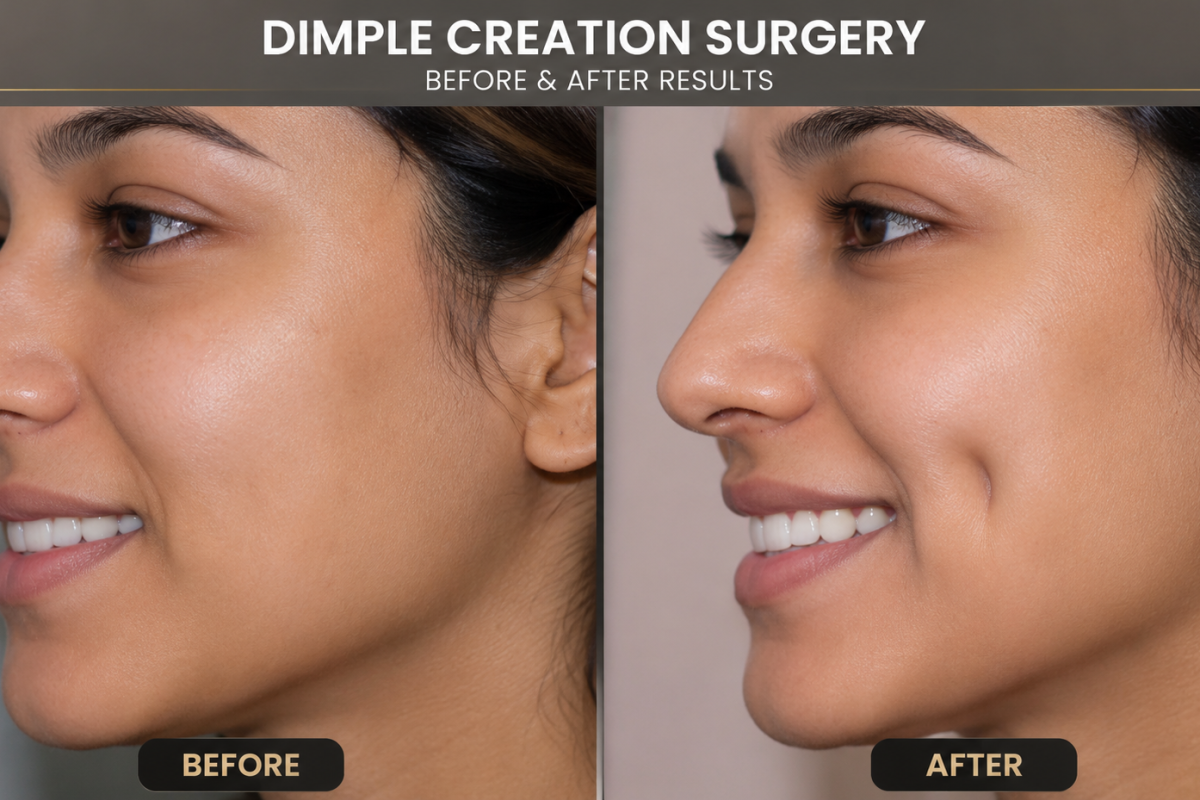
6–8 Weeks | Full, final results are visible. The dimple now appears predominantly when you smile, making it look completely natural. This is when most before-and-after photos are taken. |
Long Term | In the vast majority of patients, the dimples are permanent. Over many years, natural changes in facial volume and skin laxity may subtly alter the appearance, but the structural tether remains. |
Social downtime is minimal. You can return to most social situations within 3–5 days once the initial swelling settles. However, there is no standard ‘one-day recovery’ for everyone — healing timelines vary depending on individual skin type, age, and how well post-procedure instructions are followed.
Cost of Dimple Creation Surgery in Delhi
At Dr. Adarsh Tripathi’s clinic at Sarayu Clinics, Greater Kailash-I, the cost of dimple creation surgery generally falls in the following range:
Procedure | Approximate Cost Range | Notes |
Single Cheek Dimple | Rs. 30,000 – Rs. 35,000 | Local anaesthesia included |
Both Cheek Dimples (Bilateral) | Rs. 55,000 – Rs. 65,000 | Most common option; both done in same session |
Chin Dimple | Rs. 30,000 – Rs. 40,000 | May vary based on tissue depth |
Combination (Cheek + Chin) | On consultation | Customised pricing |
What Influences the Final Cost?
- Surgeon’s Expertise: A facial plastic surgeon with specific experience in facial anatomy will typically charge more than a general practitioner — and rightly so. The precision of placement directly determines how natural the result looks.
- Number of Dimples: Single vs. bilateral treatment, and whether chin dimple is included.
- Clinic Location & Facilities: Clinics in premium locations in Delhi with modern surgical setups carry slightly higher overheads, which is reflected in pricing.
- Individual Anatomy: Some patients have denser or thicker cheek tissue that requires more time and precision.
For context, dimple creation surgery in Delhi is among the more affordable cosmetic procedures available — especially compared to dermal fillers (which are temporary and require repeat visits) or more extensive facial surgeries. It is a permanent result from a single session.
Results Timeline — When Will You See the Final Outcome?
This is probably the most misunderstood aspect of dimpleplasty, and it is worth being upfront about it.
Immediately after surgery: The dimple will be visible even when your face is at rest. This happens because the suture is freshly placed and pulling the skin inward constantly. This is not the final result.
In the first 2 weeks: As the suture dissolves and initial healing occurs, the constant dimpling starts to ease. Some patients worry at this stage that the dimple is disappearing — this is normal and expected.
Between weeks 3 and 6: Internal scar tissue gradually forms and takes over the job of maintaining the tether. The dimple may appear inconsistent during this period — visible on some days, less so on others.
At 6–8 weeks: The final result becomes clear. The dimple now appears naturally when you smile and is not visible (or barely perceptible) at rest. This is the look you will carry forward.
It is worth understanding that dimpleplasty is permanent in approximately 90% of cases. In a small number of patients, if the suture breaks during the early healing phase or insufficient scar tissue forms, the dimple may fade over time. This is why choosing an experienced surgeon and following post-operative instructions carefully makes a significant difference to the long-term outcome.
Dimple Creation Surgery vs. Other Options
Before committing to any procedure, it helps to understand what your alternatives are and why surgery is (or is not) the right choice for you.
Factor | Dimpleplasty | Dermal Fillers | Makeup / Contouring | No Treatment |
Permanence | Permanent | 6-18 months | Temporary (washes off) | No change |
Looks Natural? | Yes, with correct placement | Variable — can look unnatural | Depends on skill | N/A |
Downtime | 2–4 days | 1–2 days | None | None |
Long-term Cost | One-time cost | Repeat sessions needed | Ongoing product cost | None |
Scarring Risk | None (incision inside mouth) | None | None | None |
Who It Suits | Anyone wanting a lasting result | Those wanting a trial before committing | Occasional use only | Happy without dimples |
One option not covered in the table above is piercing-based dimple jewellery — a popular trend that creates the illusion of dimples. While these can be a fun temporary option, they carry infection risks and do not replicate the natural movement of a surgically created dimple when smiling.
Risks, Safety & What to Watch For
Dimpleplasty is genuinely one of the safer cosmetic procedures available — it has been performed worldwide since the 1960s and carries a well-established safety profile. That said, like any surgical procedure, it is not entirely without risk, and patients deserve to know what those risks are.
Common and Temporary
- Mild swelling and tenderness for 2–5 days
- Temporary numbness inside the cheek
- The dimple appearing visible at rest during the first 2–4 weeks of healing (this resolves on its own)
Less Common Risks
- Infection: Internal incisions carry a small infection risk, particularly if post-operative oral hygiene is not maintained. This is why antibiotic cover is prescribed and why patients are asked to rinse with antiseptic mouthwash regularly. Infections are treated with antibiotics and are rarely serious when caught early.
- Asymmetry: If both cheeks are treated, there is a small chance the dimples may not appear identically placed or equally deep. Careful pre-surgical marking by an experienced surgeon reduces this risk significantly.
- Dimple Fading: In approximately 5–10% of cases, the dimple may become less defined over time if insufficient scar tissue forms. A touch-up revision may be possible if this occurs.
- Overly Deep Dimple: Occasionally, a dimple may appear deeper than intended, especially initially. This usually settles over time, but in rare cases a minor revision may be needed.
- Suture Issues: If the dissolvable suture breaks too early in the healing process, the dimple may not form properly. This is uncommon with modern suture materials.
- Nerve or Muscle Effects: Extremely rare. The procedure is well away from the main facial nerve branches when performed correctly. Dr. Tripathi’s specialisation in facial anatomy makes this risk particularly low.
Common Myths About Dimple Creation Surgery — Cleared Up
Myth | Fact |
Dimples are only for women. | Dimpleplasty is equally popular among men. Cheek dimples and cleft chins are both considered attractive features across genders. |
The procedure is very painful. | Local anaesthesia ensures you feel minimal discomfort during the procedure. Post-procedure soreness is mild and well-managed with standard pain relief. |
You will have a scar on your face. | All incisions are inside the mouth. There is no external scar. |
Dimples only look natural if you are born with them. | When placed by a skilled surgeon at the anatomically correct position, surgical dimples are indistinguishable from natural ones — even to other surgeons. |
The results can be easily reversed if you change your mind. | The results are intended to be permanent. While surgical revision is possible, it is not simple or guaranteed. This is a decision to think through carefully beforehand. |
Dimples are always visible, even when not smiling. | After the healing period (6–8 weeks), dimples typically appear only when you smile or make certain facial expressions — exactly as natural dimples do. |
Related Treatments at Sarayu Clinics
Dimpleplasty is often combined with — or considered alongside — other facial procedures for a more complete aesthetic result. Dr. Tripathi performs all of the following at Sarayu Clinics:
Treatment | What It Does | Often Combined With Dimpleplasty? |
Buccal Fat Removal | Slims the cheeks by removing excess fat pads | Sometimes — patients wanting a leaner face with subtle dimples |
Chin Implant Surgery | Adds definition and projection to the chin | Yes — chin dimple + implant is a popular combination |
Cheek Fillers | Adds volume to the mid-face | Occasionally, for patients who want added cheek definition |
Full Face Sculpting | Comprehensive facial reshaping procedure | Yes — dimpleplasty can be one component |
Rhinoplasty | Reshapes the nose | Not typically, but some patients address both in the same consultation |
Facelift Surgery | Lifts and tightens sagging facial skin | Rarely — facelift is typically for older patients with different concerns |
Frequently Asked Questions (FAQs)
Q1. What exactly is dimple creation surgery, and how is it different from natural dimples?
Natural dimples occur when the zygomaticus major muscle has a split or gap that tethers the overlying skin. Dimple creation surgery (dimpleplasty) recreates this anatomical effect through a small internal incision and suture, without any external scarring. The end result is functionally and visually the same as a natural dimple.
Q2. How long does the procedure take?
Each dimple typically takes 20–30 minutes to create. If you are having both cheeks done, plan for the total procedure to take around 45–60 minutes. Including preparation and a short post-procedure rest, most patients are in and out of the clinic in about 90 minutes.
Q3. Is it painful? What does it feel like?
The local anaesthetic injection is the only point of mild discomfort — a small pinch lasting a few seconds. Once numb, you should not feel any pain during the procedure. Afterwards, as the anaesthetic wears off, there is typically mild soreness and a tight feeling inside the cheek, similar to having a dental filling done. Standard over-the-counter pain relief is usually sufficient.
Q4. Will the dimples look natural?
Yes — if placed correctly. The single most important factor in achieving natural-looking dimples is precise pre-surgical marking by an experienced surgeon who understands facial anatomy and movement patterns. Dr. Tripathi performs this assessment carefully during consultation and marks the placement with you smiling naturally, not just at rest.
Q5. Can I only get dimples on my cheeks, or are there other options?
Cheek dimples are the most common choice, but a chin dimple (cleft chin effect) is also a popular option. Some patients choose to have a single dimple on one cheek to match an existing natural dimple on the other side. Placement is fully customisable.
Q6. What is the recovery like — can I go to work the next day?
Most patients with desk-based or work-from-home roles return to work the next day. If your job involves significant social interaction or public-facing appearances, you may prefer to take 3–5 days off until the initial swelling settles. Physical labour or exercise should be avoided for about a week.
Q7. Are the results permanent?
In approximately 90% of patients, yes — the dimples are permanent. The internal scar tissue that forms during healing maintains the tether even after the suture dissolves. In a small number of cases, the dimple may fade if insufficient scar tissue forms. This is more likely when post-operative instructions are not followed carefully.
Q8. Can dimples be removed if I change my mind?
This is an important question and the honest answer is: it is possible but not straightforward. A surgical revision can be performed to release the internal tether, but the scar tissue that has already formed makes complete reversal difficult to guarantee. This is why it is important to approach dimpleplasty as a permanent decision and take time to think it through before proceeding.
Q9. How much does dimple creation surgery cost in Delhi?
At Sarayu Clinics, a single cheek dimple typically costs Rs. 30,000–35,000, and bilateral cheek dimples (both sides) range from Rs. 55,000–65,000. Exact pricing is confirmed during consultation after assessing your specific anatomy. All costs are discussed transparently — there are no hidden charges.
Q10. Is dimple surgery safe? What are the risks?
Dimpleplasty has a well-established safety record and is one of the lower-risk cosmetic procedures. Risks include mild temporary swelling, a small chance of infection (manageable with antibiotics and good oral hygiene), possible asymmetry between the two dimples, and in rare cases the dimple fading over time. Serious complications such as nerve injury are extremely uncommon when the procedure is performed by a qualified specialist.
Q11. What is the minimum age for dimple creation surgery?
Most surgeons, including Dr. Tripathi, recommend waiting until the patient is at least 18 years old. This ensures both facial maturity and the patient’s capacity to make an informed, independent decision about a permanent cosmetic change.
Q12. Can dimple creation surgery be combined with other procedures?
Yes. It is commonly combined with buccal fat removal (for patients seeking a slimmer, more sculpted face), chin implant surgery (especially when a chin dimple is also desired), and cheek fillers. Combination procedures are discussed during consultation based on your individual goals.
Q13. Does insurance cover dimple creation surgery?
No. Dimpleplasty is an elective cosmetic procedure and is not covered by health insurance in India. All costs are paid out-of-pocket. If financing options are something you need, this can be discussed with the clinic directly.
Q14. How do I know if I am a good candidate?
The best way to find out is to book a consultation with Dr. Tripathi. In general, healthy adults with realistic expectations who want to add dimples to their smile are suitable candidates. Patients with active oral infections, bleeding disorders, or who are pregnant are typically advised to wait.
Why Choose Dr. Adarsh Tripathi for Dimple Creation Surgery in Delhi?
There are many clinics in Delhi offering dimpleplasty. Here is why the choice of surgeon matters — and why patients consistently choose Dr. Tripathi:
Why It Matters | Dr. Adarsh Tripathi’s Advantage |
Surgical Specialisation | Dr. Tripathi is a qualified Maxillofacial and Facial Plastic Surgeon — not a general dermatologist or GP. Facial anatomy is his primary specialisation, which directly impacts placement accuracy. |
Experience | 18+ years of practice, with thousands of facial procedures performed. Experience reduces the risk of asymmetry and ensures confident, precise execution. |
Precision Planning | Every dimpleplasty begins with a detailed facial assessment and marking session. Placement is not guesswork — it is planned around your natural smile mechanics and facial geometry. |
Transparent Consultation | Dr. Tripathi will tell you honestly if dimpleplasty is right for you, what results are realistic for your face, and what the risks are. There is no pressure to proceed. |
Dedicated Facility | Sarayu Clinics operates in a properly equipped clinical environment at Greater Kailash-I — one of South Delhi’s most accessible and established medical areas. |
Post-Operative Support | Follow-up consultations are included. If you have any concerns during recovery, the clinic is reachable and responsive. |
Schedule a consultation with Dr. Adarsh Tripathi at Sarayu Clinics.
- Phone: +91-9990333300,+91 8882870882
- Email: sarayuinquiries@gmail.com
- Sarayu Clinics website: https://sarayuclinics.com/
- Facebook: https://www.facebook.com/sarayuclinics/
- Instagram: https://www.instagram.com/sarayuclinics/
- Youtube: https://www.youtube.com/channel/UCnHOtwgrzMKAPQthvVShftg
- Adarsh Tripathi’s profile: https://sarayuclinics.com/luxury/about-us/
- Adarsh Tripathi’s Linkedin profile: https://in.linkedin.com/in/dr-adarsh-tripathi-a43005b8
- Online Booking: Visit our website at https://sarayuclinics.com/beauty/appointment/to schedule appointments conveniently.